- Mandatory CPCB approval for every Plastic Producer, Importer, Brand Owner (PIBO) and Plastic Waste Processor (PWP) in India.
- Filed only through CPCB's centralized EPR Portal for Plastic Packaging — no offline application route exists.
- Core documents (incorporation, PAN, GST, EPR Action Plan) plus category-wise packaging and recycled-content proof.
- PWM (Amendment) Rules, 2026 added recycled-content targets, End-of-Life categories, and IS 14534:2023 labelling requirements.
Introduction
EPR (Extended Producer Responsibility) Plastic Waste registration is a mandatory Central Pollution Control Board (CPCB) authorisation under the Plastic Waste Management Rules, 2016 — as amended in 2022, 2024, 2025 and 2026 — for every Producer, Importer, and Brand Owner (PIBO) that places plastic packaging in the Indian market, and for every registered Plastic Waste Processor (PWP).
Registration is filed entirely online through CPCB's centralized EPR Portal for Plastic Packaging. Core documents include incorporation proof, PAN, GST registration, category-wise packaging data, and a detailed EPR Action Plan; approval typically takes 15 to 60 working days depending on documentation quality. Once registered, PIBOs must meet annual recycling and recycled-content targets, procure EPR certificates, and file annual returns by 30 June every year to stay compliant.
What Is EPR Plastic Waste Registration?
Extended Producer Responsibility (EPR) for plastic packaging is the regulatory principle that makes Producers, Importers, and Brand Owners (PIBOs) financially and operationally responsible for the plastic packaging they introduce into the Indian market — across its entire lifecycle, from manufacture to end-of-life collection and recycling. It shifts the burden of plastic waste management away from municipalities and onto the businesses that generate the packaging in the first place.
The framework operates under the Plastic Waste Management Rules, 2016, notified by the Ministry of Environment, Forest and Climate Change (MoEFCC). Several amendments have reshaped the compliance landscape since then:
- PWM (Amendment) Rules, 2022 (16 February 2022) — inserted the Schedule II EPR guidelines and created the centralized CPCB EPR portal, making digital registration mandatory for the first time.
- PWM (Amendment) Rules, 2024 — expanded the definition of 'importer' to include importers of plastic raw material, widening the pool of obligated entities.
- PWM (Amendment) Rules, 2025 — introduced mandatory QR code, barcode, or unique-number labelling proof for packaging traceability, effective 1 July 2025.
- PWM (Amendment) Rules, 2026 (G.S.R. 237(E), notified 31 March 2026) — added mandatory recycled-content targets for plastic packaging, formalised a three-year carry-forward mechanism for unmet food-contact packaging targets starting FY 2026-27, introduced new End-of-Life (EOL) categories, and referenced IS 14534:2023 labelling standards.
On the trade side, CBIC Instruction No. 21/2025-Customs now requires proof of valid EPR registration at customs clearance for imports involving plastic packaging, linking EPR compliance directly to import operations, not just domestic sales.
Who Needs EPR Plastic Waste Registration?
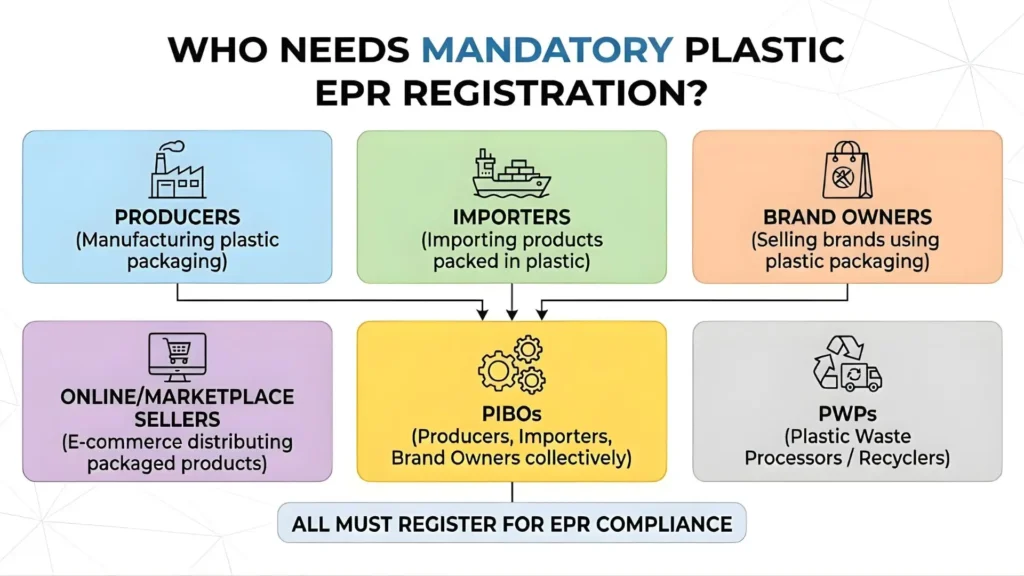
EPR Plastic Waste registration applies broadly, with no general turnover-based exemption. You almost certainly need to register if your business falls into any of the following categories:
- Producers — companies that manufacture plastic packaging materials such as bottles, containers, pouches, or wrappers.
- Importers — businesses that import plastic packaging directly, import goods wrapped in plastic packaging, or (since the 2024 amendment) import plastic raw material.
- Brand Owners — companies that sell products under their own brand using plastic packaging, even if a third party manufactures that packaging.
- E-commerce entities and cloud kitchens — platforms and food businesses operating under their own brand are covered; aggregator-based restaurants should clarify EPR ownership with the aggregator.
- Plastic Waste Processors (PWPs) — recyclers, co-processors, and waste-to-energy or waste-to-oil operators who must separately register to legally generate and sell EPR certificates.
Simplified provisions may exist for genuinely micro-scale operations, but businesses should verify their exact obligation status directly on the CPCB EPR portal rather than assuming an exemption applies.
Plastic Packaging Categories & Recycling Targets
The Plastic Waste Management Rules divide plastic packaging into four broad categories, each carrying its own recycling and reuse obligations. Category-wise targets are phased and increase year over year, so treat the figures below as directional and always confirm the current financial year's numbers on the CPCB portal.
| Category | Packaging Type | Recycling Target Trend (by FY 2026-27) |
|---|---|---|
| Category I | Rigid plastic packaging | Targets plateau around 80% |
| Category II | Flexible plastic packaging (single-layer) | Targets plateau around 80% |
| Category III | Multi-layered plastic packaging (MLP) | Caps around 60% — harder to recycle, so kept lower |
| Category IV | Compostable plastic packaging / carry bags | Targets plateau around 80% |
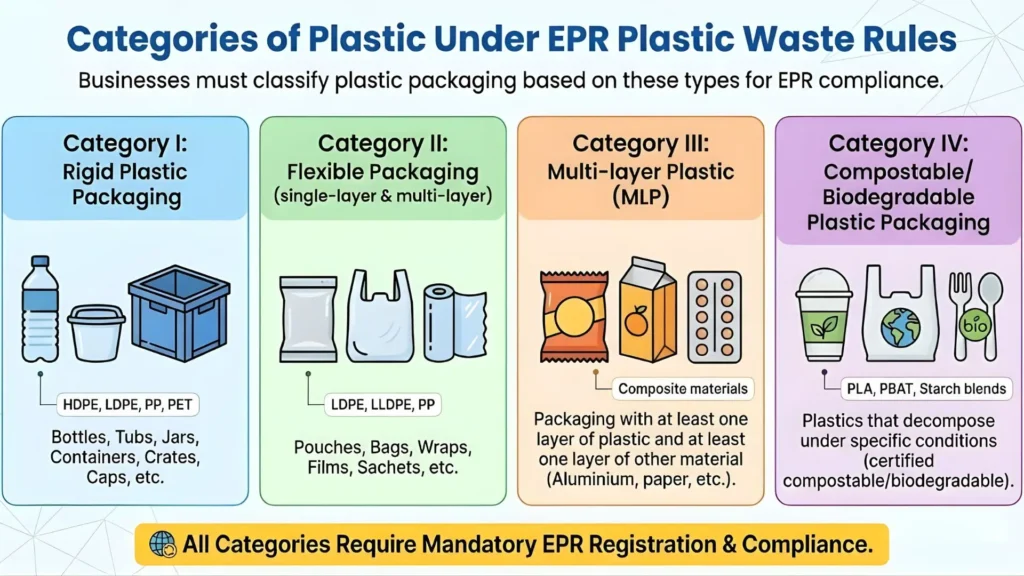
Category III (multi-layered packaging) carries lower targets than the other categories because finding authorised MLP recyclers remains a genuine supply-side constraint in several states.
Documents Required for EPR Plastic Waste Registration
CPCB and State Pollution Control Boards (SPCBs) review EPR applications almost entirely on paperwork — there is no in-person interview. Address mismatches between GST, incorporation, and consent documents are the single biggest cause of delays and queries, so accuracy matters more than volume.
Core Documents (Common to All Applicants)
- Certificate of Incorporation, Partnership Deed, or Shop & Establishment proof, depending on business structure
- PAN card of the company or entity
- GST registration certificate, with an address matching all other submitted documents
- Authorized signatory's identity proof (Aadhaar/PAN) plus a board resolution or authorization letter naming them
- Registered office and, where applicable, factory/manufacturing unit address proof
- Valid contact details — email ID and mobile number — for OTP-based portal verification
- Digital Signature Certificate (DSC) or Aadhaar e-sign, where digital signing is required
- Previous financial year's sales, production, or import data, used to calculate the annual target
- EPR Action Plan describing the collection/recycling mechanism, target numbers, and recycler or PRO tie-ups
- Signed and sealed self-declaration on company letterhead confirming the accuracy of submitted data
Plastic-Specific Documents (Filed Against Form I of the PWM Rules)
- Proof of selling in more than two states (GST returns or tax invoices), if applying centrally with CPCB rather than through an SPCB/PCC
- District Industries Centre (DIC) Certificate, if the applicant operates its own production facility
- Valid Consents under the Air and Water Acts, for businesses operating a manufacturing unit
- Category-wise details of the type and quantity of plastic packaging produced or marketed
- A representative image of the plastic packaging for each applicable EPR category
- Copy of the previous EPR Registration certificate, for renewal applications
- Agreements with registered Plastic Waste Processors (PWPs) or Producer Responsibility Organisations (PROs) supporting the Action Plan
- Since the 2026 Amendment Rules: recycled-content sourcing evidence and reuse-target documentation for applicable packaging, verifiable through a Registered Environmental Auditor where required
- QR code, barcode, or unique-number labelling proof, in line with the traceability requirement effective 1 July 2025
Additional Documents for Plastic Waste Processors (Recyclers)
- Consent to Establish (CTE) and Consent to Operate (CTO) from the relevant SPCB/PCC
- Processing/recycling capacity certification (tonnes per annum)
- Site layout or facility details supporting the registered processing capacity
- Environmental compliance reports or prior audit records, if requested during review
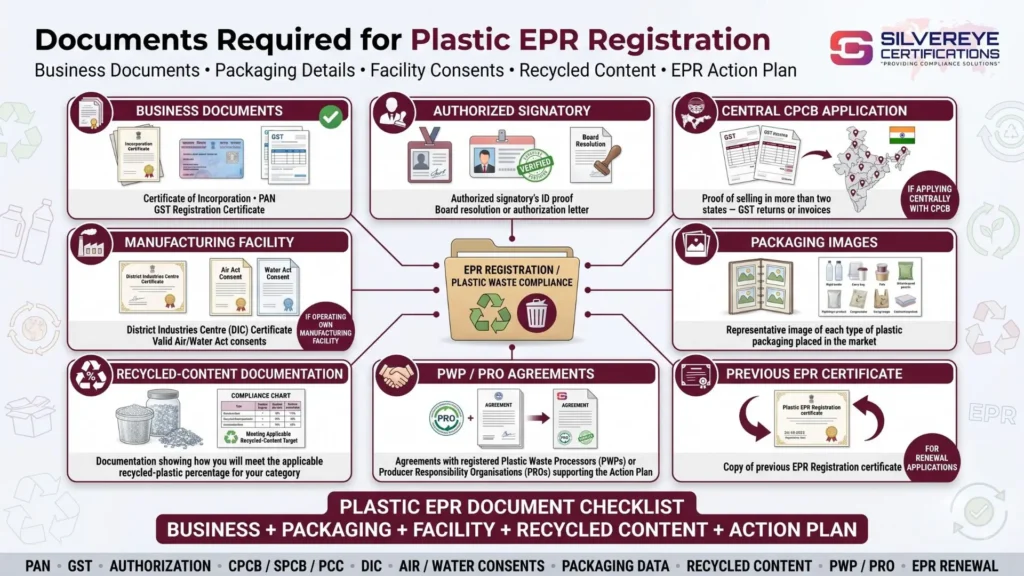
Documents in the core set — incorporation, PAN, GST, signatory proof — can generally be reused if a business also needs EPR registration under E-Waste, Battery, Tyre, or Used Oil rules. Category-specific documents must still be prepared separately for each portal.
Latest Notifications & Regulatory Updates (2022–2026)
| Notification | Date | What Changed |
|---|---|---|
| PWM (Amendment) Rules, 2022 | 16 Feb 2022 | Inserted Schedule II EPR guidelines; created the centralized CPCB EPR portal |
| PWM (Amendment) Rules, 2024 | 2024 | Expanded 'importer' definition to include importers of plastic raw material |
| CPCB EC Guidelines | 4 Apr 2024 | Set Environmental Compensation slabs for shortfall in recycling targets |
| PWM (Amendment) Rules, 2025 | Effective 1 Jul 2025 | Made QR code / barcode / unique-number labelling proof mandatory for traceability |
| CBIC Instruction No. 21/2025-Customs | 2025 | Mandates EPR proof at customs clearance for plastic-packaged imports |
| PWM (Amendment) Rules, 2026 (G.S.R. 237(E)) | 31 Mar 2026 | Added recycled-content targets, new EOL categories, IS 14534:2023 labelling, 3-year carry-forward mechanism |
The pace of amendments means a compliance understanding from even 2024 no longer covers a clean, penalty-free filing today. Businesses that registered before 2025 should specifically review whether their labelling, recycled-content, and Action Plan documentation reflect the current rules.
EPR Plastic Waste Registration Process, Step by Step
- Gather and verify core and category-specific documents, ensuring every address matches across GST, incorporation, and any consent documents.
- Create an account on CPCB's centralized EPR Portal for Plastic Packaging and complete the online application form (Form I).
- Draft and upload a state-wise EPR Action Plan describing how the business will collect back and recycle its plastic packaging.
- Submit signed agreements with CPCB-authorized Plastic Waste Processors (PWPs) or Producer Responsibility Organisations (PROs) backing the Action Plan.
- Pay the applicable registration fee, calculated based on packaging category, business size, and plastic volume.
- Respond to any CPCB or SPCB clarification requests promptly — most delays come from queries, not outright rejections.
- Receive the EPR Registration Number and certificate via the portal and registered email once approved.
- Begin ongoing compliance: procure EPR certificates against annual targets, maintain records, and file the annual return.
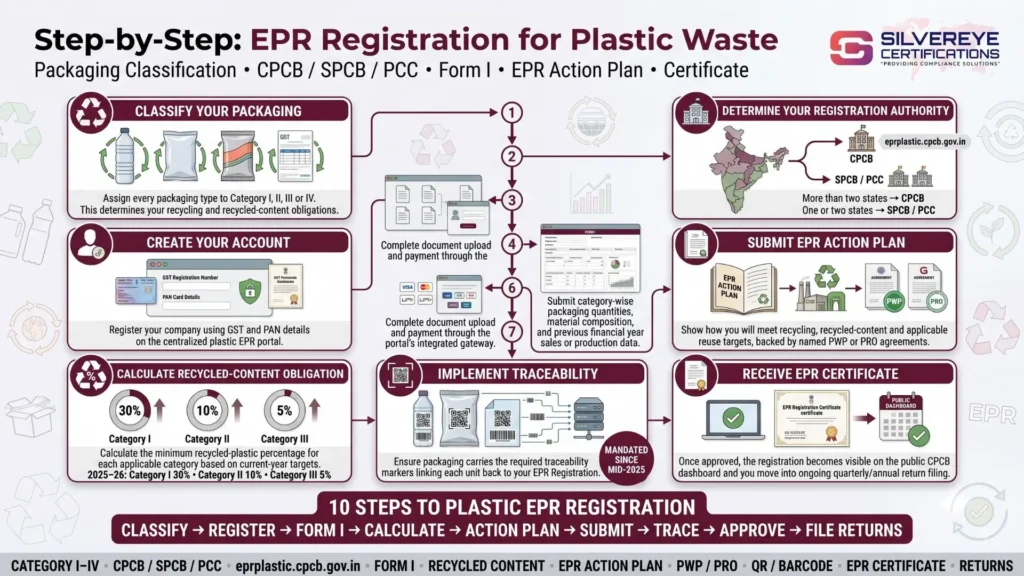
With complete, accurate documentation, approval typically takes 15–30 working days; if CPCB or the SPCB raises queries, this can extend to 45–60 days. Applying at least two months ahead of any deadline you're working toward is a sensible buffer.
EPR Plastic Waste Registration Fees
CPCB sets and periodically revises fees independently for each category. There is no uniform flat fee — the amount depends on the applicant's category (PIBO vs. PWP), business size, and the volume of plastic packaging declared. Treat the summary below as directional and verify current figures on the live CPCB portal before paying.
| Applicant Type | Fee Basis |
|---|---|
| Producers / Brand Owners (PIBOs) | Based on packaging category and annual sales/production volume |
| Importers | Based on import volume and packaging category, including raw material imports since 2024 |
| Plastic Waste Processors (PWPs) | Based on registered recycling/processing capacity |
| Small businesses / early-stage sellers | Concessional fee slabs may apply — confirm eligibility on the portal |
Beyond the one-time registration fee, the recurring cost of EPR compliance is dominated by procuring EPR certificates to meet annual targets — plastic EPR certificates currently trade in a market-driven range of roughly ₹4,000 to ₹20,000 per metric tonne, with no statutory floor or ceiling, unlike the banded fee structures used for e-waste and battery EPR.
Validity, Renewal & Annual Compliance
Plastic EPR registration is not a fixed-term certificate that simply expires — it is an ongoing authorisation tied directly to annual performance. Once registered, a PIBO or PWP must continue to demonstrate compliance every financial year to keep the registration active and in good standing.
- Annual returns are due by 30 June following the close of each financial year, reporting sales/import volumes, EPR certificates procured or generated, and progress against recycling and recycled-content targets.
- At renewal or annual filing, expect to submit updated sales/production data, a refreshed EPR Action Plan, and prior certificate copies — even where core company documents like PAN, GST, and incorporation remain unchanged.
- Unfulfilled targets in categories like plastic can generally be carried forward for up to three financial years, with partial Environmental Compensation refunds available if the shortfall is later made good.
- For food-contact packaging specifically, the 2026 Amendment Rules allow producers to carry forward unfulfilled recycled-content targets from FY 2025-26 for up to three years starting FY 2026-27, provided at least one-third of the shortfall is cleared each year.
Consistent, on-time annual return filing is generally a prerequisite for smooth continuation of the registration — missed or incomplete filings can delay approvals for related applications and increase audit scrutiny.
Penalties for Non-Compliance
EPR penalties operate on two separate tracks: criminal liability under the Environment (Protection) Act, 1986, and civil Environmental Compensation (EC) imposed directly by CPCB for shortfalls in meeting targets.
Environmental Compensation for Target Shortfall
- First year of shortfall: ₹5,000 per tonne of the unmet target
- Second consecutive year of shortfall: ₹10,000 per tonne
- Third consecutive year of shortfall: ₹20,000 per tonne
- Compensation does not cancel the underlying obligation — the shortfall still carries forward, and a portion of the compensation paid can be refunded once the target is later met
Statutory Penalties Under the Environment (Protection) Act, 1986
- First offence: imprisonment up to 5 years, or a fine up to ₹1,00,000, or both (Section 15)
- Continued violation: an additional fine of up to ₹5,000 per day after the date of first conviction
- Violation continuing beyond one year: imprisonment extendable up to 7 years (Section 15(2))
- Company officers — directors, managers, and officers in default — can be held personally liable under Section 16 unless they can prove the offence occurred without their knowledge.
Operating without a valid EPR registration when your business is covered by the rules is treated as an active compliance violation, not a paperwork gap — CPCB has been publishing names of non-compliant entities and issuing crore-level penalty notices.
Benefits of EPR Plastic Waste Registration
- Legal continuity — avoids Environmental Compensation, show-cause notices, and the risk of registration suspension or cancellation
- Import and customs clearance — CBIC now checks for valid EPR proof on plastic-packaged imports, so registration directly protects supply chains
- Marketplace and institutional trust — e-commerce platforms and large buyers increasingly ask for EPR proof before onboarding a brand or vendor
- Access to the EPR certificate market — registered PIBOs can transparently procure certificates, and PWPs can generate and sell them
- ESG and sustainability credibility — demonstrable compliance supports circular-economy claims made to investors, auditors, and consumers
How Silvereye Certifications Helps with EPR Plastic Waste Compliance
Silvereye Certifications is a regulatory compliance consultancy supporting Indian and international businesses across BIS, CDSCO, WPC-ETA, TEC/MTCTE, and EPR Authorization, including PAN-India EPR services for plastic, e-waste, battery, tyre, and used-oil waste categories.
For EPR Plastic Waste specifically, Silvereye Certifications supports businesses through:
- A category-wise document checklist tailored to your packaging mix before you begin the CPCB application
- Pre-submission review to catch address mismatches, formatting issues, and missing declarations before CPCB does
- Drafting a CPCB-aligned EPR Action Plan backed by verifiable recycler or PRO agreements
- Recycler tie-ups and plastic-credit sourcing support to help meet annual recycling and recycled-content targets
- End-to-end annual compliance — data preparation, return filing, certificate reconciliation, and renewal tracking, so deadlines like the 30 June annual return are never missed
Because Silvereye Certifications also manages BIS, CDSCO, WPC, and TEC/MTCTE documentation, businesses needing EPR alongside other product certifications can consolidate their paperwork and compliance relationship instead of coordinating multiple vendors.
Conclusion
EPR Plastic Waste documentation and registration is no longer a one-time formality — it is a recurring compliance obligation that touches sales data, recycler agreements, labelling, and annual filings every single year. The businesses that stay penalty-free are the ones that treat their EPR Action Plan as a genuine operating plan, keep every address consistent across GST, incorporation, and consent documents, and track amendment rules like the 2025 labelling requirement and the 2026 recycled-content mandate as they land.
If you'd rather have your EPR Plastic Waste documentation reviewed, prepared, and filed by specialists, Silvereye Certifications supports the complete lifecycle — from first CPCB application to annual returns and renewal — across plastic, e-waste, battery, tyre, and used-oil EPR categories.
Frequently Asked Questions
What documents are required for EPR Plastic Waste registration?
You need core documents (incorporation certificate, PAN, GST, authorized signatory proof, and an EPR Action Plan) plus plastic-specific documents such as category-wise packaging data, recycler/PRO agreements, and — since the 2026 Amendment Rules — recycled-content sourcing evidence and QR-code labelling proof.
Who is legally required to get EPR Plastic Waste registration?
Producers, Importers, and Brand Owners (PIBOs) who introduce plastic packaging into the Indian market, along with registered Plastic Waste Processors (PWPs). There is generally no turnover-based exemption; simplified provisions for very small businesses should be verified directly on the CPCB portal.
How long does EPR Plastic Waste registration take to get approved?
With complete documentation, approval typically takes 15 to 30 working days. If CPCB or the State Pollution Control Board raises a query for additional documents, the timeline can extend to 45 to 60 days.
Where do I apply for EPR Plastic Waste registration?
Applications are filed exclusively through CPCB's centralized EPR Portal for Plastic Packaging. There is no offline application route — registration, target tracking, certificate trading, and annual returns all run through this single portal.
What is an EPR Action Plan, and is it mandatory?
Yes, it is mandatory. The EPR Action Plan explains how your business will collect back and recycle its plastic packaging, and it must be backed by named, verifiable recycler or PRO agreements rather than general statements of intent.
What happens if I miss my annual recycling target?
CPCB imposes Environmental Compensation — ₹5,000 per tonne for a first-year shortfall, rising to ₹10,000 for a second consecutive year and ₹20,000 for a third. The underlying obligation still carries forward for up to three years, and part of the compensation can be refunded once the target is later fulfilled.
When is the EPR annual return for plastic waste due?
Annual returns are generally due by 30 June following the close of the relevant financial year, reporting packaging volumes, EPR certificates procured, and progress against recycling and recycled-content targets.
Does EPR plastic waste registration expire and need renewal?
It doesn't expire on a fixed date the way some other EPR categories do. Instead, it stays valid on an ongoing basis as long as you file annual returns and meet your targets, with updated sales data and a refreshed Action Plan required at each cycle.
What are the penalties for operating without EPR registration?
Under the Environment (Protection) Act, 1986, a first offence can draw imprisonment of up to 5 years, a fine of up to ₹1,00,000, or both, with additional daily fines for continued violations. Company directors and officers in default can also be held personally liable.
What changed in the Plastic Waste Management (Amendment) Rules, 2026?
The 2026 Amendment Rules (G.S.R. 237(E), notified 31 March 2026) introduced mandatory recycled-content targets for plastic packaging, new End-of-Life packaging categories, IS 14534:2023 labelling requirements, and a formal three-year carry-forward mechanism for unmet food-contact packaging targets starting FY 2026-27.
Can recyclers and PIBOs use the same set of documents?
Core documents — incorporation certificate, PAN, GST, and signatory proof — can generally be reused. But Plastic Waste Processors additionally need Consent to Establish (CTE), Consent to Operate (CTO), and processing-capacity certification, which PIBOs typically do not need to submit.
How much do EPR certificates for plastic waste cost?
Plastic EPR certificate pricing is market-driven, currently trading in a broad range of roughly ₹4,000 to ₹20,000 per metric tonne depending on packaging category and market conditions, with no statutory floor or ceiling set by CPCB.