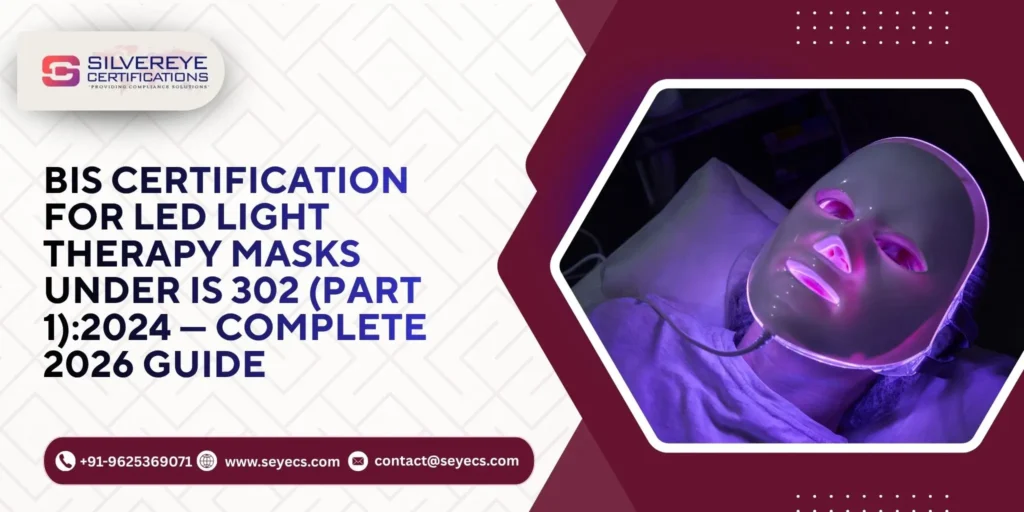
- LED light therapy masks now fall under mandatory BIS certification through IS 302 (Part 1):2024, enforced via the QCO notified by DPIIT on 6 April 2026 (S.O. 1739(E)).
- Certification is granted under Scheme-I (ISI Mark) of the BIS Conformity Assessment Regulations, 2018, and the product carries the ISI mark once licensed.
- General manufacturers must comply by 1 October 2026; small enterprises by 1 January 2027; and micro enterprises by 1 April 2027.
- Official BIS government fees start at ₹1,000 for the application, with testing, inspection, and marking charges billed separately based on lab and product scope.
Introduction
BIS certification for LED light therapy masks is mandatory in India under IS 302 (Part 1):2024, the Indian Standard covering beauty care appliances that use lasers and intense light sources (which includes LED-based skincare devices). It is enforced through the Safety of Household, Commercial and Similar Electrical Appliances (Quality Control) Order, 2026, notified by the DPIIT on 6 April 2026.
Manufacturers and brand owners must secure a BIS Scheme-I (ISI Mark) license before manufacturing or selling LED masks in India. General manufacturers must comply by 1 October 2026, small enterprises by 1 January 2027, and micro enterprises by 1 April 2027. Government fees start at ₹1,000, excluding lab testing, inspection, and marking charges.
What Is BIS Certification for LED Light Therapy Masks?
If you manufacture, import, or private-label LED face masks, red light therapy masks, or any wearable device that uses LEDs to treat skin, you have probably come across the term "BIS certification for LED light therapy masks" while researching how to sell legally in India. In simple terms, this is the government approval that confirms your device meets India's electrical and optical safety requirements before it reaches a customer's face.
BIS stands for the Bureau of Indian Standards, the national body that sets and enforces product standards in India. LED light therapy masks fall under the category "Beauty Care Appliances Incorporating Lasers and Intense Light Sources" because they use intense LED light — usually red, blue, or near-infrared wavelengths — directly on the skin. Once a product category is brought under a Quality Control Order (QCO), selling it without a valid BIS licence becomes a legal offence, not just a compliance gap.

This is not a niche requirement anymore. Beauty tech has grown fast in India, and LED masks are now sold on e-commerce marketplaces, in salons, and through D2C brands. The government's move to regulate them under IS 302 (Part 1):2024 is a direct response to that growth, aimed at stopping unsafe, untested electrical devices from being sold to consumers who wear them directly on their face.
Understanding IS 302 (Part 1):2024 — The Standard Behind the Certification
IS 302 (Part 1):2024 is titled "Household and Similar Electrical Appliances — Safety — Part 1: General Requirements." It is India's adopted version of the international standard IEC 60335-1:2020, which means the safety benchmarks are aligned with what regulators in Europe, the UK, and other major markets already expect from electrical appliances.
The standard applies to electrical appliances rated up to 250V for single-phase use and up to 415V for other appliances, covering household, commercial, and light-industrial use. For LED light therapy masks specifically, BIS certification is assessed alongside the relevant Part 2 sectional requirements for beauty care appliances using lasers and intense light sources, which sit on top of the Part 1 general safety base.
Together, these standards test the mask's insulation, temperature rise, protection against electric shock, mechanical strength, and — importantly for a device worn on the face — its optical radiation exposure limits.
In practical terms, this means your LED mask is tested for things like:
- Whether the LEDs and internal wiring can overheat during normal use or charging.
- Whether the light intensity and wavelength stay within safe exposure limits for skin and eyes.
- Whether the battery, adapter, and charging cable meet electrical insulation and short-circuit protection norms.
- Whether the silicone/plastic housing resists heat, moisture, and mechanical stress under normal wear.
This is why the certification is not just paperwork — it involves actual laboratory testing of your product against these parameters before BIS grants a licence.
When Does BIS Certification Become Mandatory for LED Light Therapy Masks?
Here is where a lot of confusion exists online, so it is worth getting the timeline right. The original Quality Control Order covering household and similar electrical appliances — including beauty care appliances using lasers and intense light sources — was first notified by the Department for Promotion of Industry and Internal Trade (DPIIT) in 2024. BIS subsequently issued implementation circulars in December 2024 and again in September 2025 to guide manufacturers on licensing under the revised IS 302 (Part 1):2024 / IEC 60335-1:2020 standard.
The order has since been updated. The current governing notification is the Safety of Household, Commercial and Similar Electrical Appliances (Quality Control) Order, 2026 — Gazette notification S.O. 1739(E), notified by DPIIT on 6 April 2026 under Section 16 of the BIS Act, 2016. This 2026 order supersedes the earlier 2025 order and revises the compliance deadlines, giving manufacturers, including LED mask brands, a clearer and slightly extended runway to get certified.
QCO 2026 — Implementation Timeline
| Enterprise Category | Compliance Deadline | Applicable Standard |
|---|---|---|
| General / Large & Medium Enterprises | 1 October 2026 | IS 302 (Part 1):2024 |
| Small Enterprises | 1 January 2027 | IS 302 (Part 1):2024 |
| Micro Enterprises | 1 April 2027 | IS 302 (Part 1):2024 |
Under this order, every covered appliance — including LED light therapy masks — must conform to IS 302 (Part 1):2024 and carry the BIS Standard Mark (ISI Mark) granted under Scheme-I of Schedule-II of the BIS (Conformity Assessment) Regulations, 2018.
Stock manufactured or imported before your applicable deadline can generally continue to be sold for a limited transition window (commonly cited as up to six months), but this is subject to conditions in the order, so it should not be treated as a loophole to delay certification.
A common question we hear is, "Do I need to wait until October 2026 to apply?" The honest answer is no — you shouldn't. Testing, documentation, and factory audits typically take four to eight weeks once your application is filed, and BIS-recognized labs get busier as the deadline approaches.
Brands that start early avoid the last-minute rush and the risk of a listing takedown on marketplaces like Amazon and Flipkart, which have already begun asking sellers of electrical beauty devices for BIS documentation.
Who Needs BIS Certification for LED Light Therapy Masks in India?
BIS certification under IS 302 (Part 1):2024 applies to anyone who manufactures, assembles, or imports LED light therapy masks for the Indian market. This includes:
- Indian manufacturers producing LED face masks, red/blue light therapy masks, or combination light-and-microcurrent devices domestically.
- Private-label and D2C beauty brands that get LED masks manufactured on contract and sell them under their own brand name.
- Foreign manufacturers exporting LED masks to India, who apply through the Foreign Manufacturers Certification Scheme (FMCS) route instead of the domestic Scheme-I route.
- Importers and distributors who bring in finished LED masks for resale in India, since customs clearance for these products is linked to a valid BIS licence.
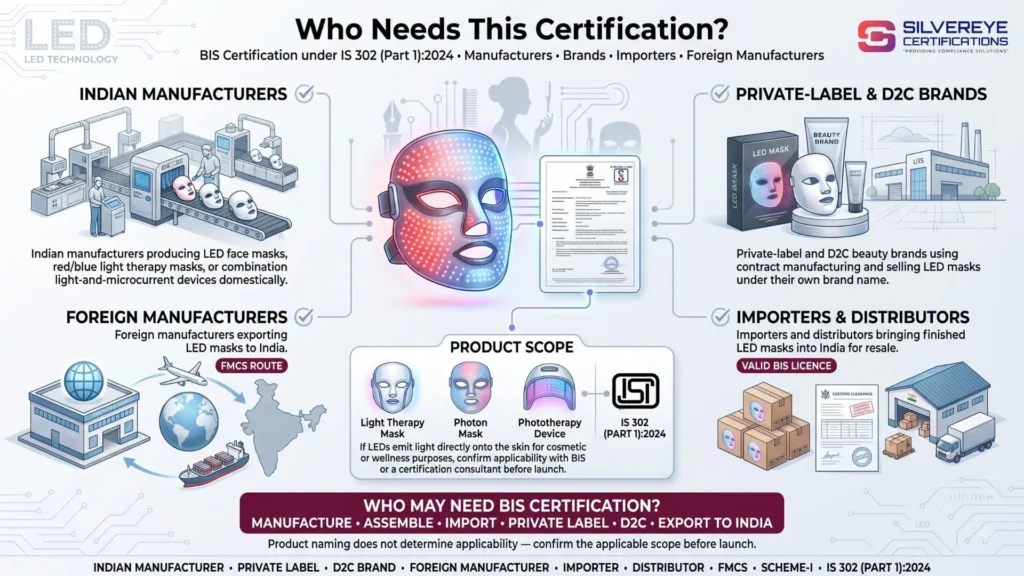
If your product uses LEDs to emit light directly onto the skin for cosmetic or wellness purposes — regardless of whether you call it a "light therapy mask," "photon mask," or "phototherapy device" — it is reasonable to assume it falls within the scope of beauty care appliances incorporating intense light sources under IS 302 (Part 1):2024, and you should confirm applicability with BIS or a certification consultant before launch.
What Are the Benefits of Getting BIS Certification for Your LED Mask?
Beyond legal compliance, there are real business reasons brands are getting ahead of this certification rather than waiting for the deadline to force their hand.
- Legal market access: Without a BIS license, manufacturing, importing, or selling the product after your compliance deadline is a punishable offence under the BIS Act, 2016.
- Marketplace and retail approval: E-commerce platforms and organized retail chains increasingly ask for BIS documentation before listing electrical beauty appliances.
- Consumer trust: The ISI mark is one of the most recognized quality symbols in India, and it signals that your device has been independently tested for electrical and optical safety.
- Smoother customs clearance: For imported LED masks, a valid BIS/FMCS licence prevents shipments from being held up or rejected at Indian ports.
- Reduced liability: Certified products carry documented proof of safety testing, which matters if a product safety complaint or recall situation ever arises.
What Documents Are Required for BIS Certification of LED Light Therapy Masks?
The exact document list can vary slightly by application type (Indian manufacturer vs. foreign manufacturer under FMCS), but the core set BIS asks for typically includes:
- Company registration proof (GST certificate, Certificate of Incorporation, or Udyam/MSME registration).
- Factory address proof and a layout plan of the manufacturing unit.
- Technical specifications and drawings of the LED mask, including wavelength, power rating, and circuit details.
- List of raw materials and components used, with supplier details for critical parts like LEDs, batteries, and PCBs.
- In-house testing facility details, or an agreement with a third-party BIS-recognised lab if in-house testing capability is limited.
- Test reports from a BIS-recognised laboratory confirming compliance with IS 302 (Part 1):2024.
- Trademark or brand authorisation letter, if the product is sold under a different brand than the manufacturer.
- Authorized signatory details and a Power of Attorney where an agent or consultant is filing on the applicant's behalf.
- For foreign manufacturers: Authorised Indian Representative (AIR) appointment letter, as required under the FMCS route.
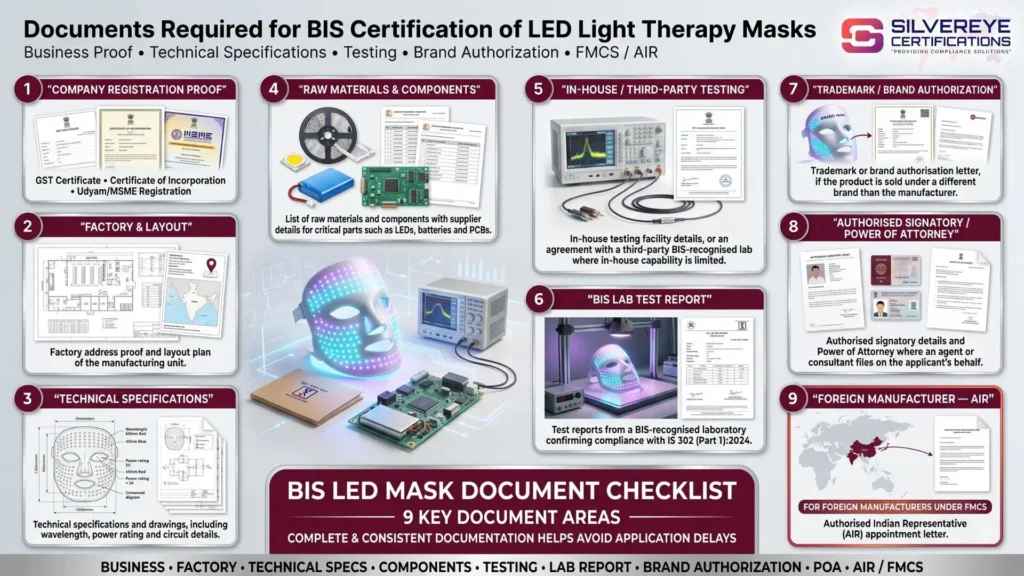
Missing or inconsistent documentation is one of the most common reasons applications get delayed, so it is worth having a consultant review your file before submission on the BIS Care portal.
How Does the BIS Certification Process Work for LED Light Therapy Masks?
BIS certification for LED light therapy masks is processed under Scheme-I (the standard ISI Mark scheme) of Schedule-II of the BIS (Conformity Assessment) Regulations, 2018. Here is how the process generally unfolds:
- Product scope and standard confirmation: Confirm that your LED mask falls under IS 302 (Part 1):2024 and identify the exact test parameters applicable to your model.
- Sample testing: Send product samples to a BIS-recognised laboratory for testing against the relevant clauses of IS 302 (Part 1):2024.
- Application filing: Submit the application, technical documents, and test reports through the BIS Care Manager portal.
- Document scrutiny: BIS reviews your application and documentation for completeness and technical accuracy.
- Factory audit: A BIS officer conducts an on-site inspection of the manufacturing facility to verify production capability and in-house quality control.
- Sample verification (if required): BIS may draw additional samples during or after the factory audit for independent verification testing.
- Grant of licence: Once the audit and testing are cleared, BIS grants the Scheme-I licence, allowing you to use the ISI mark on the LED mask and its packaging.
- Ongoing surveillance: BIS conducts periodic market and factory surveillance audits to ensure continued compliance after the licence is granted.
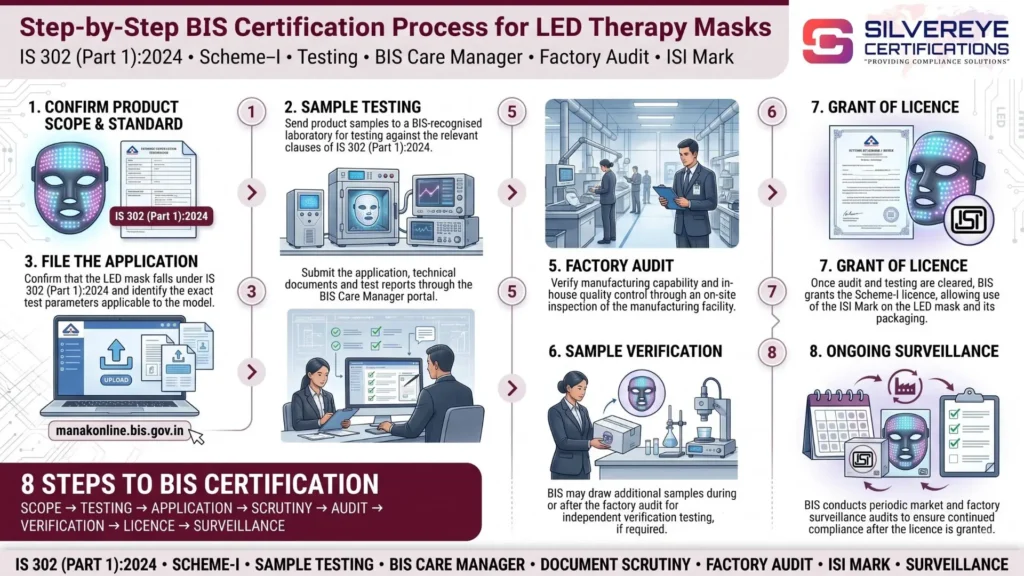
For most LED mask applicants with complete documentation, the process takes roughly four to eight weeks from application to license grant, though this can extend if test reports need to be redone or if the factory audit raises non-conformities that need correction.
How Much Does BIS Certification for LED Light Therapy Masks Cost?
One of the most searched questions on this topic is simply, "how much does it cost?" The honest answer is that BIS does not charge one flat fee — the total cost depends on government charges (fixed, published on the BIS official website), independent lab testing charges (which vary by product complexity and by lab), and any professional or consultancy fees if you choose to work with an agency.
What Are the Official BIS Government Fees Under Scheme-I?
| Fee Component | Amount | Notes |
|---|---|---|
| Application Fee | ₹1,000 (+18% GST) | One-time, non-refundable, paid at filing |
| Annual Licence Fee | ₹1,000 (+18% GST) per year | Paid yearly to keep the licence active |
| Factory Audit / Inspection Fee | ₹7,000 per man-day (+18% GST) | Charged for each day of on-site BIS audit |
| Testing Charges | As per actuals | Depends on the BIS-recognised lab and number of parameters tested |
| Marking Fee | As per applicable rate | Recurring fee linked to production/sales volume once licensed |
| Renewal Application Fee | ₹1,000 (non-refundable) | Payable when the licence comes up for renewal |
| Inclusion of New Model/Variety | ₹5,000 | Applicable if you add a new LED mask model to an existing licence |
These figures reflect the standard government fee structure published for BIS Scheme-I (ISI Mark) applicants and are subject to change by BIS from time to time. For the most current and authoritative fee schedule, always cross-check directly on the official BIS website and the BIS Care Manager portal before budgeting your certification costs.
On top of government fees, budget separately for independent lab testing (which can range from a few thousand rupees to well over ₹50,000 depending on how many parameters and models are tested) and, if you engage a consultant, their professional service fee for documentation, liaison, and audit support.
How Long Is BIS Certification Valid and How Does Renewal Work?
A BIS Scheme-I licence for LED light therapy masks is typically granted for one year and is renewable annually, subject to continued compliance and payment of the annual licence fee. BIS also conducts periodic surveillance during the licence period, which can include repeat factory audits and market sample testing.
- Initial license validity: 1 year from the date of grant, renewable thereafter.
- Renewal window: Applications should be filed at least a few weeks before expiry, along with updated test reports if your product specifications have changed.
- Late renewal: A late fee applies if the renewal application is filed after the licence has lapsed, and selling under an expired license is treated as non-compliance.
- Model additions: If you launch a new LED mask variant under an existing licence, it typically goes through an "inclusion of new variety" process rather than a fresh application.
What Are the Latest 2026 BIS Regulatory Updates for LED Light Therapy Masks?
- The governing order is now the Safety of Household, Commercial and Similar Electrical Appliances (Quality Control) Order, 2026 (S.O. 1739(E), notified 6 April 2026), which supersedes the earlier 2025 order and covers 90 categories of electrical appliances, including beauty care appliances using lasers and intense light sources.
- BIS's September 2025 implementation guidelines clarified that a manufacturer producing multiple types of electrical appliances under IS 302 (Part 1) can now be granted a single consolidated BIS license, rather than separate licenses per appliance type.
- Adding a genuinely new appliance category to an existing license now involves a desk audit, review of independent test reports, and on-site verification by BIS, rather than a full fresh application in every case.
- Marking fees are applied per the rates in BIS Circular CMD-2/G-18 dated 29 April 2025, so brands should confirm current marking fee rates directly with BIS or their certification consultant before finalising pricing.
Because QCO timelines and circulars have moved more than once since 2024, treat any date you read online (including in this article) as something to reconfirm on the official BIS website before making a business decision, especially if you are close to a compliance deadline.
What Common Mistakes Do LED Mask Brands Make During BIS Certification?
- Assuming a CE mark or FDA clearance from another country is sufficient for the Indian market — BIS certification is a separate, India-specific legal requirement.
- Waiting until close to the compliance deadline to start testing, which leaves no buffer if a test report needs to be redone.
- Submitting incomplete technical documentation, which is one of the most frequent causes of application delays.
- Not accounting for marking fees and annual renewal costs when budgeting, and only planning for the one-time application fee.
- Treating a sourcing agent's or trading partner's certification as their own — the licence is tied to the specific manufacturer and brand named on it.
Why Should You Choose Silvereye Certifications for BIS Certification?
Getting a BIS licence for a product category like LED light therapy masks involves more than form-filling — it means understanding exactly how IS 302 (Part 1):2024 applies to your specific device, coordinating with a BIS-recognised lab for the right tests, and preparing a factory that can pass its BIS audit the first time. Silvereye Certifications works as a BIS certification consultancy for manufacturers, importers, and D2C beauty brands navigating exactly this kind of compliance.
- Hands-on BIS, CRS, and FMCS experience: The team works across BIS product categories, including electrical and electronic appliances, and understands how Scheme-I applications are actually reviewed and audited.
- Documentation done right the first time: Since incomplete or inconsistent paperwork is one of the biggest causes of delay, Silvereye Certifications helps applicants prepare technical files, test coordination, and factory documentation before filing — reducing back-and-forth with BIS.
- Lab and audit coordination: The team helps line up sample testing with BIS-recognized laboratories and prepares manufacturers for the factory inspection stage.
- Transparent, fair pricing: Government fees, testing charges, and professional fees are laid out clearly upfront, so brands can budget accurately instead of being surprised by hidden costs later.
- End-to-end support: From initial scope confirmation to license grant and ongoing renewal, Silvereye Certifications supports the full lifecycle of the certification, not just the first application.
If your compliance deadline is approaching and you are still unsure whether your LED mask needs certification, which documents you are missing, or how much the process will realistically cost, it is worth getting a proper scope assessment before you assume anything — rather than finding out the hard way during a marketplace review or a customs hold.
What Should You Know Before Getting BIS Certification for an LED Light Therapy Mask?
LED light therapy masks have moved from a niche gadget to a mainstream beauty category in India, and regulation has caught up with that growth. BIS certification under IS 302 (Part 1):2024, enforced through the QCO 2026 notified on 6 April 2026, is now a legal requirement for anyone manufacturing, importing, or selling these devices — with deadlines running from 1 October 2026 for general manufacturers through to 1 April 2027 for micro enterprises.
The safest approach is not to wait for your deadline to arrive. Confirm whether your product falls within scope, get your documentation and lab testing in order early, and treat the BIS Scheme-I license as part of your product launch checklist rather than an afterthought. Brands that plan for this now will be the ones still selling confidently on Indian marketplaces and in retail once enforcement is in full swing — while those who delay risk listing takedowns, customs holds, and lost sales at exactly the wrong moment.
Frequently Asked Questions
Is BIS certification mandatory for LED light therapy masks in India?
Yes. Under the Safety of Household, Commercial and Similar Electrical Appliances (Quality Control) Order, 2026, LED light therapy masks fall under IS 302 (Part 1):2024 as beauty care appliances incorporating intense light sources, and BIS certification with the ISI mark is mandatory before manufacturing, importing, or selling them in India.
What is the deadline for BIS certification of LED masks?
General manufacturers must comply by 1 October 2026, small enterprises by 1 January 2027, and micro enterprises by 1 April 2027, as per the current QCO 2026 timeline.
Which BIS scheme applies to LED light therapy masks?
Domestic manufacturers apply under Scheme-I (ISI Mark Scheme) of Schedule-II of the BIS (Conformity Assessment) Regulations, 2018. Foreign manufacturers exporting to India typically apply under the Foreign Manufacturers Certification Scheme (FMCS).
How much does BIS certification cost for an LED mask?
Official government fees start at ₹1,000 for the application and ₹1,000 per year for the licence, plus ₹7,000 per man-day for factory audits. Lab testing and marking fees are additional and vary by product and testing scope. Always verify current fees on the official BIS website.
How long does the BIS certification process take?
For most applicants with complete documentation, the process — from sample testing to license grant — typically takes about four to eight weeks, though it can take longer if test reports need to be redone or the factory audit flags issues.
What documents are required to apply for BIS certification?
Common requirements include company registration proof, factory layout, technical drawings of the LED mask, component and supplier details, test reports from a BIS-recognized lab, and authorized signatory details. Foreign manufacturers also need an Authorized Indian Representative.
Can I sell my LED mask on Amazon or Flipkart without BIS certification?
Once your compliance deadline under the QCO passes, selling without a valid BIS licence is non-compliant, and marketplaces are increasingly requiring BIS documentation upfront for electrical beauty devices, regardless of the exact enforcement deadline.
Is the BIS license for LED masks valid permanently once granted?
No. The license is typically valid for one year and must be renewed annually, along with payment of the renewal fee and, where applicable, updated test reports.
Do imported LED masks also need BIS certification?
Yes. Imported LED light therapy masks need certification through the FMCS route for foreign manufacturers, and customs clearance is generally linked to having a valid BIS license for the product.
What happens if I add a new LED mask model after getting certified?
A new model under an existing license usually goes through an "inclusion of new variety" process rather than a completely fresh application, though it still requires a fee and, in many cases, additional test reports.
Does BIS certification cover both electrical safety and light exposure safety?
Yes. IS 302 (Part 1):2024 covers general electrical safety (shock protection, insulation, overheating), while the sectional requirements for beauty care appliances incorporating lasers and intense light sources address light and optical radiation exposure specific to devices used on the skin.