- Compulsory from 1 October 2026 for medium and large manufacturers under the QCO 2026 mandate; later dates apply to small and micro enterprises.
- Covers electric toothbrushes, water flossers and other electrically powered oral care appliances used in homes, clinics and commercial settings.
- Assessed against IS 302 (Part 1):2024, identical to IEC 60335-1:2020, and certified under Scheme-I of the BIS Conformity Assessment Regulations, 2018.
- Manufacturing, importing or selling these appliances without a valid ISI license can invite fines, seizure and prosecution under Section 29 of the BIS Act, 2016.
Introduction
BIS certification for oral hygiene appliances is the mandatory safety approval the Bureau of Indian Standards issues for electric toothbrushes, water flossers and similar electrically powered oral care devices sold in India. It is granted under Scheme-I of the BIS (Conformity Assessment) Regulations, 2018, against IS 302 (Part 1):2024, which is identical to IEC 60335-1:2020.
Manufacturers and importers must get the product lab-tested, pass a factory inspection, and then use the ISI Mark on every unit sold. Under the current QCO 2026 notification, general manufacturers must be certified by 1 October 2026, small enterprises by 1 January 2027, and micro enterprises by 1 April 2027.
Which Oral Hygiene Appliances Require BIS Certification in India?
The phrase sounds broad, but BIS uses it as a defined regulatory category, not a loose description. Under the Safety of Household, Commercial and Similar Electrical Appliances Quality Control Order, "oral hygiene appliances" is listed as its own product entry (alongside categories such as shavers, blenders and air purifiers), and it specifically captures electrically powered devices used for cleaning teeth, gums and the mouth.
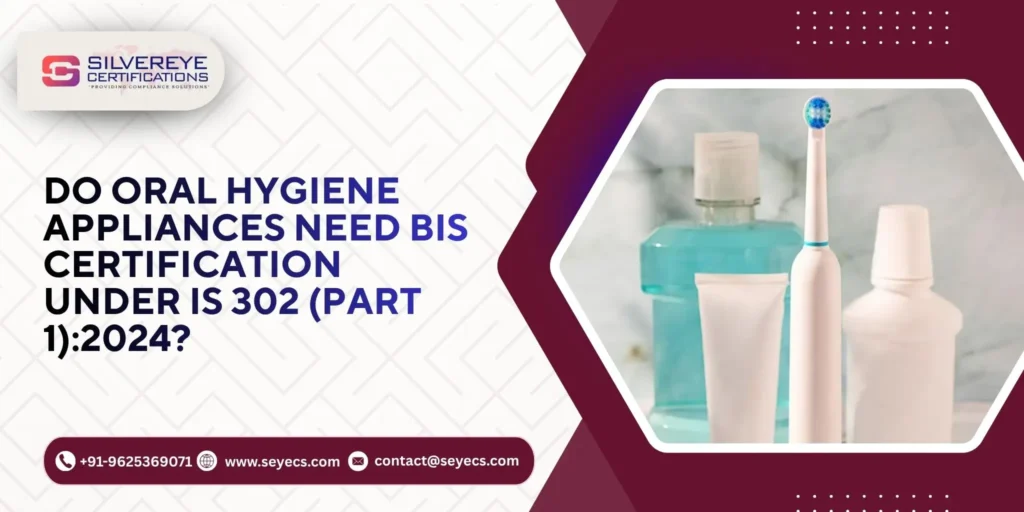
In practice, this means electric and battery-operated toothbrushes, and water flossers / oral irrigators that use a powered pump or motor to direct a water stream at the teeth and gum line. These are treated as electrical appliances first and dental-care products second — which is exactly why they fall under an electrical safety standard rather than a medical-device regulation.
Purely manual products — ordinary toothbrushes, manual floss, tongue scrapers with no motor or battery, and disposable interdental picks — sit outside this category simply because they carry no electrical risk to assess.
What Is IS 302 (Part 1):2024 and Why Does It Matter for Oral Hygiene Appliances?
IS 302 (Part 1):2024 is the seventh revision of India's general safety standard for household and similar electrical appliances, replacing the earlier IS 302 (Part 1):2008. It is dual-numbered with, and technically identical to, IEC 60335-1:2020, so a product cleared against this Indian standard is being tested to the same baseline used internationally.
The standard applies to electrical equipment used in homes, shops and light-industrial or commercial settings, rated up to 250 V for single-phase supply, and it explicitly extends to direct-current-supplied and battery-operated appliances — which is what brings cordless electric toothbrushes and rechargeable water flossers into scope. For oral hygiene appliances specifically, the assessment focuses on protection against electric shock, safe charging behaviour, temperature limits during use, resistance to moisture (since these products are used wet and rinsed regularly), mechanical strength of the handle and housing, and clarity of user markings and instructions.
One scope note worth knowing: the standard is not written for appliances specifically intended for use by children or by the elderly with reduced physical or sensory capability, and it excludes industrial appliances, portable electric hand tools, and devices already regulated as medical devices under separate law.
What Is the Latest BIS QCO Deadline for Oral Hygiene Appliances in 2026?
This is the section that changes fastest, so it is worth reading closely rather than assuming an older date still applies.
How Did We Get to Today's BIS Compliance Deadline?
- 17 September 2024 — DPIIT first notified the Quality Control Order built around IS 302 (Part 1):2008/2024, bringing a wide list of household and commercial electrical appliances, including oral hygiene appliances, under compulsory BIS certification.
- 19 May 2025 — that order was superseded by the Quality Control Order, 2025, which reset the compliance date to 19 March 2026 and confirmed IS 302 (Part 1):2024 as the governing standard.
- 6 April 2026 — DPIIT issued the Quality Control Order, 2026 (S.O. 1739(E)) under Section 16 of the BIS Act, 2016, superseding the 2025 order. The 90-category appliance list and the applicable standard stayed the same; only the compliance dates moved forward again.
The enforcement schedule now in force, by enterprise size, is set out below.
| Enterprise Category | Mandatory Compliance Date |
|---|---|
| General / medium and large manufacturers and importers | 1 October 2026 |
| Small enterprises | 1 January 2027 |
| Micro enterprises | 1 April 2027 |
Because this order has already been revised twice, treat this table as a snapshot and re-check the live notification on bis.gov.in or the DPIIT website before finalising a compliance plan. Products manufactured in India purely for export remain outside the QCO; anything sold within the Indian market, whether made locally or imported, needs certification once the relevant date arrives.
Why Are Oral Hygiene Appliances Subject to Mandatory BIS Certification?
The legal basis is Section 16 of the Bureau of Indian Standards Act, 2016, which lets the central government mandate BIS certification for products where consumer safety, public health or fair trade is at stake. Oral hygiene appliances qualify on a straightforward safety logic: they combine a battery, a motor and a charging circuit in a device that is used inside or right next to the mouth, repeatedly, often while wet.
Before this order, the category had no compulsory electrical safety check in India, which meant unbranded or poorly engineered imports could reach shelves without any independent verification of insulation, charging safety or heat build-up. Compulsory certification closes that gap by requiring every unit sold to be traceable to a tested, inspected, licensed manufacturing source.
Which Manufacturers and Importers Need BIS Certification for Oral Hygiene Appliances?
- Indian manufacturers of electric toothbrushes, water flossers or other qualifying oral care appliances — apply directly under Scheme-I for an ISI Mark license tied to their manufacturing unit.
- Brand owners and importers who source finished appliances from an overseas factory — the overseas manufacturing site itself needs a valid BIS license, usually secured through the Foreign Manufacturers Certification Scheme (FMCS) via an Authorized Indian Representative (AIR).
- Foreign manufacturers selling directly into India or through Indian distribution partners — apply through FMCS with an India-based AIR.
- Contract manufacturers producing oral hygiene appliances on behalf of a brand — the licence sits with the entity named as manufacturer on the product, so this needs to be clarified contractually before applying.
There is no enterprise-size exemption from certification itself — the QCO only staggers when each size category must comply. A micro-enterprise still needs a licence eventually; it simply has more time to get one.
Which Oral Hygiene Appliances Are Covered Under BIS Rules?
Typically covered
• Electric and battery-operated toothbrushes, including rechargeable and replaceable-battery models
• Water flossers and oral irrigators that use a powered pump to deliver a water or fluid stream
• Other electrically powered oral hygiene appliances operating within the standard's voltage and use limits
Typically outside scope
• Manual (non-electric) toothbrushes, floss, and non-powered tongue scrapers
• Appliances built and sold in India solely for export
• Devices classified and regulated as medical devices under separate legislation
• Industrial appliances and portable electric hand tools, governed by other standards
• Products already notified for mandatory certification under a more specific, separate Quality Control Order
What Are the Benefits of BIS Certification for Oral Hygiene Appliance Brands?
- Legal right to sell — once your enterprise category's QCO deadline passes, this is the only way to lawfully manufacture, import or sell these appliances in India.
- Recognized consumer trust — the ISI Mark is a widely understood safety signal, which matters for a product used inside the mouth.
- Platform and retail access — organised retail chains and major e-commerce marketplaces increasingly require BIS/ISI proof before listing regulated electrical products.
- Fewer import delays — certified consignments move through customs more predictably than uncertified ones, which risk sampling, holds or rejection.
- A pathway to export — because the underlying standard mirrors IEC 60335-1:2020, certified products are already aligned with a benchmark accepted well beyond India.
What Documents Do You Need for BIS Certification?
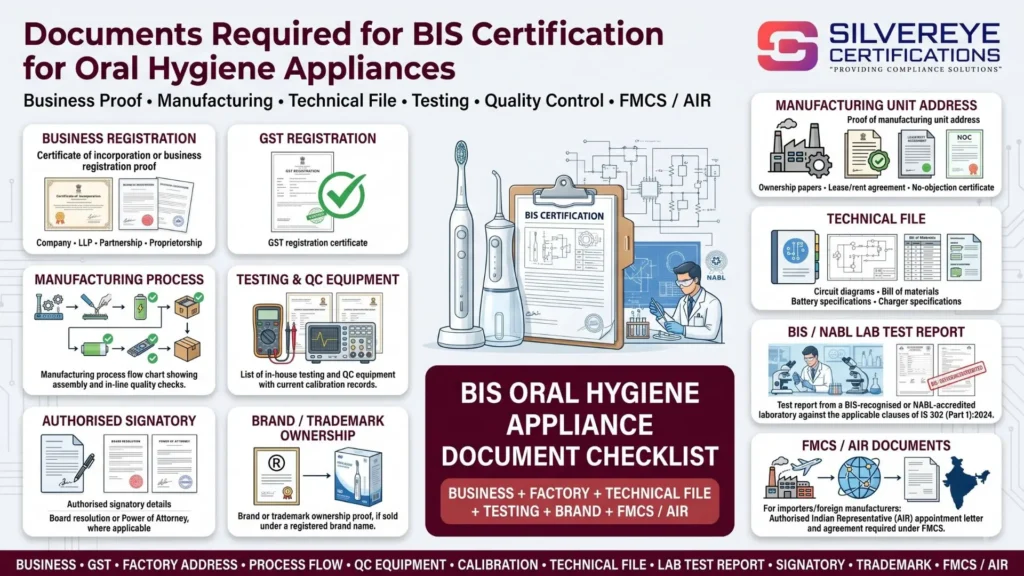
- Certificate of incorporation or business registration proof (company, LLP, partnership or proprietorship)
- GST registration certificate
- Proof of the manufacturing unit's address — ownership papers, lease/rent agreement, or a no-objection certificate
- A manufacturing process flow chart showing assembly and in-line quality checks
- Technical file — circuit diagrams, bill of materials, and battery/charger specifications for the appliance
- Test report from a BIS-recognised or NABL-accredited laboratory against the applicable clauses of IS 302 (Part 1):2024
- Authorised signatory details, with a board resolution or power of attorney where applicable
- Brand or trademark ownership proof, if sold under a registered brand name
- For importers/foreign manufacturers: the Authorized Indian Representative (AIR) appointment letter and agreement required under FMCS
How Does the BIS Certification Process Work Step by Step?
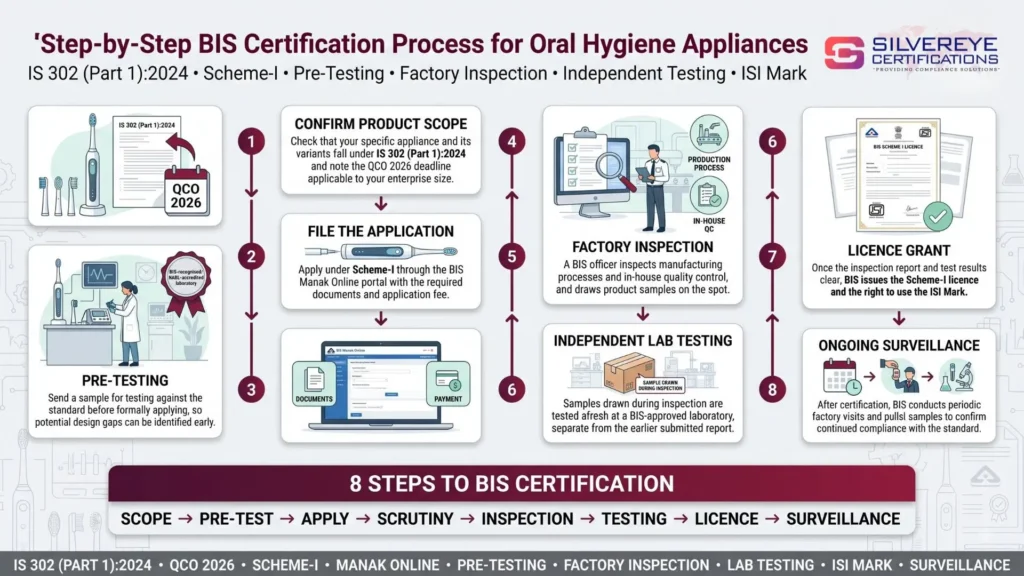
- Confirm scope — check that your specific appliance (and its variants) genuinely falls under IS 302 (Part 1):2024 and note the QCO 2026 deadline applicable to your enterprise size.
- Pre-testing — send a sample to a BIS-recognised or NABL-accredited laboratory for testing against the standard before you formally apply, so any design gaps surface early.
- File the application — apply under Scheme-I through the BIS Manak Online portal with your documents and application fee.
- Document scrutiny — BIS reviews the file for completeness and technical accuracy.
- Factory inspection — a BIS officer inspects the manufacturing unit's processes and in-house quality control, and draws product samples on the spot.
- Independent lab testing — the samples drawn during inspection are tested afresh at a BIS-approved laboratory, separate from your earlier submitted report.
- Licence grant — once the inspection report and test results clear, BIS issues the Scheme-I licence and the right to use the ISI Mark.
- Ongoing surveillance — after certification, BIS carries out periodic factory visits and pulls market samples to confirm the product still meets the standard.
How Much Does BIS Certification for Oral Hygiene Appliances Cost in 2026?
BIS maintains and periodically updates its official fee schedule at bis.gov.in, under Product Certification → Fee, including a downloadable marking-fee document covering all products under Scheme-I. The table below sets out the standard fee heads that apply to this category; the exact current figures, especially the product-specific marking fee, should always be confirmed on the official page before you budget, since BIS revises these numbers from time to time through gazette amendments.
| Fee Head | Typical Amount / Basis |
|---|---|
| Application fee | Approx. Rs 1,000 per application, non-refundable |
| Factory inspection fee | Approx. Rs 7,000 per man-day, plus the inspecting officer's actual travel and stay costs |
| Annual licence fee | Approx. Rs 1,000 per year for as long as the licence remains active |
| Marking fee | Charged per unit produced/marked under the licence; product- and turnover-linked, per the current BIS marking-fee notification |
| Laboratory testing charges | Payable directly to the testing lab, based on the number of parameters tested — not a fixed BIS fee |
| MSME / startup concession | Micro enterprises and DPIIT-recognised startups have historically been eligible for meaningful concessions on marking fees, subject to current BIS terms |
For the definitive, up-to-date numbers — including the latest marking-fee schedule and any active fee-concession notification — go directly to bis.gov.in/product-certification/product-certification-fee, where BIS publishes the downloadable marking-fee PDF and every amendment issued against it. Treat figures quoted anywhere else, including here, as a planning estimate rather than a final invoice.
How Long Is BIS Certification Valid and When Do You Need to Renew It?
- A Scheme-I license is typically granted for an initial term and can be renewed for periods of up to five years at a time, provided surveillance results stay satisfactory.
- The annual license fee and applicable marking fees must be paid every year — letting the license lapse removes your legal right to use the ISI Mark, even if the underlying product hasn't changed.
- BIS runs scheduled and occasionally unannounced surveillance inspections, along with market sample testing, to confirm certified units continue to match IS 302 (Part 1):2024.
- Start the renewal process at least 60–90 days before expiry — a gap in an active license can stop production or sale until it is restored.
How Long Does the BIS Certification Process Take?
- Domestic manufacturers under the simplified procedure (where eligible): testing, documentation and inspection often wrap up in roughly 30–65 days if the product clears lab testing on the first attempt.
- Domestic manufacturers under the normal procedure: plan for a longer window, since additional verification steps are involved.
- Foreign manufacturers via FMCS: generally the slowest route, often stretching to several months once you account for AIR appointment, an overseas factory audit, and shipping samples to India for testing.
The single biggest variable is testing outcomes — a first-attempt failure means a redesign or component change followed by a retest, which is why pre-testing before the formal application is worth the extra step.
What Happens If You Sell Oral Hygiene Appliances Without BIS Certification?
Once a product falls under a notified Quality Control Order and the compliance date for your enterprise category has passed, manufacturing, storing for sale, importing or selling it without a valid BIS license is an offence under Section 29 of the Bureau of Indian Standards Act, 2016.
In practice this can mean financial penalties (reported ranges run from roughly Rs 2 lakh up to ten times the value of the goods for repeat offences), imprisonment of up to two years in serious or repeat cases, seizure of non-compliant stock, customs detention for imports, removal from e-commerce listings, and cancellation of any other BIS licences the same entity holds.
Why Choose Silvereye Certifications
Oral hygiene appliances sit at an awkward intersection — they are electrical products, tested against an electrical standard, but they are also personal-care devices that consumers judge on trust. Getting the certification right means understanding both sides: the technical clauses of IS 302 (Part 1):2024/IEC 60335-1:2020, and the practical realities of manufacturing a small, battery-powered, water-exposed device at scale.
Silvereye Certifications works with electric toothbrush, water flosser and oral care appliance manufacturers and importers on exactly that combination — reviewing your product design and documentation against the standard early, coordinating pre-testing with a recognized laboratory, preparing a complete and inspection-ready file, and managing the Scheme-I or FMCS application from submission through to licence grant and renewal.
If your enterprise falls in the general/medium-large category, the 1 October 2026 date is close enough that the practical move is to start the gap assessment now rather than after a failed test forces a redesign. Silvereye Certifications can look at where your current product and paperwork stand today and map out a realistic, honest timeline to a license — with enough runway built in for at least one round of corrective testing if needed.
Conclusion
BIS certification for oral hygiene appliances under IS 302 (Part 1):2024 has moved from a discretionary quality mark to a firm legal requirement, with the QCO 2026 notification setting 1 October 2026 as the line for most manufacturers and importers, and 2027 dates following for small and micro enterprises.
The requirement exists for a sensible reason — these are electrically powered devices used inside the mouth, and independent safety testing is a reasonable ask before they reach a bathroom shelf. Brands that start early, pre-test honestly, keep documentation complete, and budget realistically for application, inspection, testing and yearly marking fees tend to get through the process without drama, and come out the other side with a product Indian consumers can trust on sight.
If your appliance isn't certified yet, the most useful next step is a straightforward one: map it against IS 302 (Part 1):2024 today, and start the testing conversation before your compliance date turns into a compliance problem.
Frequently Asked Questions
Are oral hygiene appliances a separate BIS category, or part of general electrical appliances?
They are listed as their own entry within the broader household and commercial electrical appliances Quality Control Order, but they are certified against the same general standard, IS 302 (Part 1):2024, that covers most other appliances in that order.
What products specifically need this certification?
Electric or battery-operated toothbrushes and water flossers/oral irrigators are the core products BIS has notified under this category. Purely manual, non-electric oral care products are not covered.
What is the compliance deadline right now, and could it change again?
Under QCO 2026, general manufacturers must comply by 1 October 2026, small enterprises by 1 January 2027, and micro enterprises by 1 April 2027. Given that this order has been revised twice already, it's worth checking the current notification on bis.gov.in before relying on any single date.
Which certification scheme applies — CRS, FMCS or Scheme-I?
Domestic manufacturers apply under Scheme-I (the ISI Mark scheme). Foreign manufacturers apply under FMCS, using an India-based Authorised Indian Representative. The Compulsory Registration Scheme (CRS) is a separate track mainly used for electronics and IT products, and does not apply to this category.
How much does certification cost overall?
Government charges typically include an application fee of around Rs 1,000, a factory inspection fee of around Rs 7,000 per man-day, an annual licence fee of around Rs 1,000, plus a product-linked marking fee and separate laboratory testing charges. The exact current schedule is published on bis.gov.in.
Can a small brand outsource manufacturing and still get certified?
Yes, but the BIS license is tied to the manufacturing unit named on the application, so the brand and the contract manufacturer need a clear written agreement on who applies, whose factory is inspected, and who is responsible for ongoing surveillance compliance.
Do imported water flossers need certification, or only locally made ones?
Both. Once the category is under compulsory certification, imported appliances need the overseas factory to hold a valid BIS license (typically via FMCS), regardless of where the product is manufactured.
How long is the license valid once granted?
It is usually granted for an initial term and can be renewed for up to five years at a time, as long as annual fees are paid and surveillance inspections continue to be satisfactory.
What is the biggest reason certification gets delayed?
Failing lab testing on the first attempt is the most common delay, since it forces a design or component change followed by a full retest. Getting an informal pre-test done before the formal application substantially reduces this risk.
Are export-only products exempt from this requirement?
Yes. Goods manufactured in India solely for export are explicitly excluded from the Quality Control Order. Anything intended for the Indian market, whether made locally or imported, needs certification.
Do micro and small manufacturers get a fee discount?
Historically, BIS has offered meaningful marking-fee concessions to eligible micro enterprises and DPIIT-recognized startups, in addition to a later compliance deadline. Current eligibility and percentages should be confirmed on the official BIS fee notification, since these terms are updated periodically.
What should a brand do first if it hasn't started the process yet?
Confirm which of your SKUs fall under IS 302 (Part 1):2024, get an informal lab pre-test done to identify gaps, and start assembling the documentation file in parallel — running testing and paperwork together, rather than one after the other, is what keeps most applicants inside their QCO deadline.