
- IEC Code Registration gives your business a unique 10-digit number, mandatory for almost all import or export activity from India.
- It costs a flat ₹500 government fee and is usually approved within 1–3 working days on the DGFT portal.
- Not every business needs one — personal-use imports, small cross-border trade with neighbouring countries, and most government departments are exempt.
- Once issued, the IEC code lasts a lifetime, but you must confirm your details on the DGFT portal every year between April and June.
Introduction
IEC Code Registration is the process of obtaining an Importer-Exporter Code, a unique 10-digit number issued by the Directorate General of Foreign Trade (DGFT) that authorizes a business or individual to import or export goods and, in certain cases, services from India.
Since IEC numbers now follow the applicant's PAN, most businesses already 'have' the number in principle — but it only becomes usable once you separately apply and register it with DGFT.
The registration costs a one-time government fee of ₹500, is completed entirely online, is typically approved within 1 to 3 working days, and remains valid for the lifetime of the business, subject to a free annual confirmation each year.
What Is an IEC Code Registration?
An IEC Code (Importer-Exporter Code) is a unique 10-digit identification number that functions like a passport for your business in international trade. Since a 2017 reform, this number is structurally identical to the applicant's PAN — one PAN can be linked to exactly one IEC.
Even so, DGFT treats registration as a separate legal step: simply having a PAN does not activate your IEC. Once registered, the code must be quoted on every shipping bill, bill of entry, and foreign trade invoice, and banks require it to process any inbound or outbound international payment.
Who Actually Needs IEC Code Registration?
IEC Code Registration applies broadly, but the exact requirement depends on what you're trading and how:
| Situation | Is IEC Required? |
| Importing goods for resale, manufacturing, or trade | Yes — mandatory for customs clearance |
| Exporting goods from India | Yes — mandatory for shipping bill filing |
| Receiving payment for exported goods | Yes — banks require it to process the remittance |
| Exporting services (e.g., IT, consulting) without claiming FTP benefits | Generally not required |
| Exporting services while claiming Foreign Trade Policy incentives | Yes — required to access the benefit |
| Importing goods strictly for personal use | No — exempted |
| Government ministries/departments importing or exporting | No — exempted |
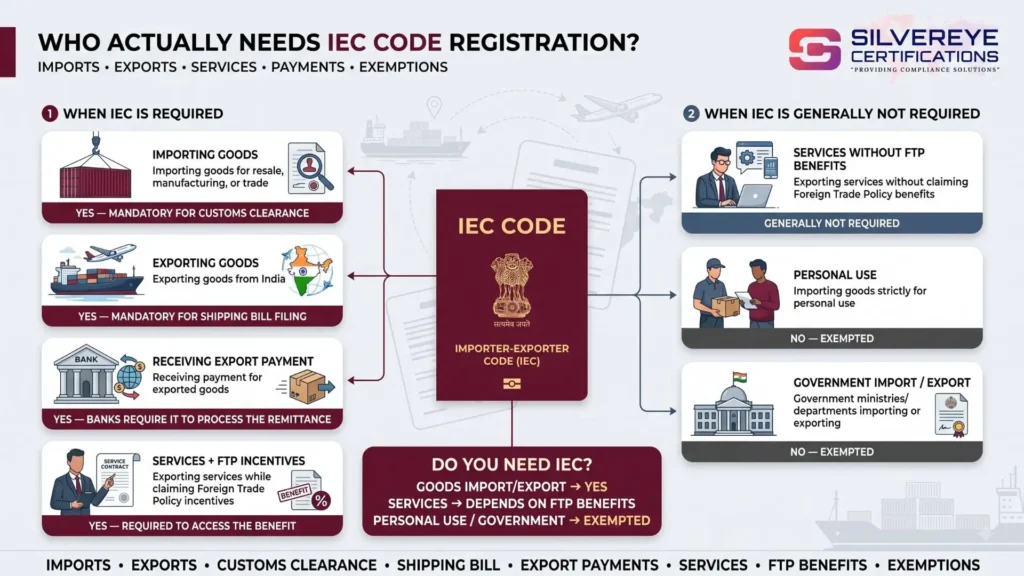
Small-value cross-border trade with Nepal, Myanmar, or China through specified border routes is also exempted, provided the consignment value stays under the government-notified threshold — except for restricted or sensitive goods listed under the Foreign Trade Policy.
Categories of Exporters Under IEC Code Registration
When applying, DGFT asks you to select a category that best describes your business — this classification affects how your trade activity is tracked and which schemes you may later qualify for:
- Manufacturer Exporter — a business that manufactures the goods it exports
- Merchant Exporter — a trader who buys finished goods and exports them without manufacturing
- Merchant-cum-Manufacturer Exporter — a business that does both
- Service Provider — a business exporting services and seeking Foreign Trade Policy benefits
Benefits of IEC Code Registration
| Benefit | What It Means for Your Business |
| Legal Trade Authorisation | Makes your import or export activity fully compliant under the Foreign Trade Policy. |
| Smooth Customs Clearance | Shipping bills and bills of entry require a valid IEC to be processed. |
| Faster International Payments | Banks use the IEC to route export proceeds and import remittances correctly. |
| Access to Government Schemes | Needed to claim benefits like RoDTEP, duty drawback, and Advance Authorization. |
| No Return Filing | Unlike GST or income tax, IEC does not require any periodic returns to be filed. |
| Lifetime Validity | A one-time registration that never needs renewal, only an annual confirmation. |
| Business Credibility Abroad | Overseas buyers and suppliers often ask for your IEC to verify legitimacy. |
Eligibility Criteria for IEC Code Registration
Practically any legally recognised business structure in India can apply, including:
- Sole proprietors and individual traders
- Partnership firms and Limited Liability Partnerships (LLPs)
- Private limited, public limited companies, and One Person Companies (OPCs)
- HUFs, Trusts, and Societies engaged in trade
- E-commerce sellers exporting through platforms like Amazon Global or their own websites
Documents Required for IEC Code Registration
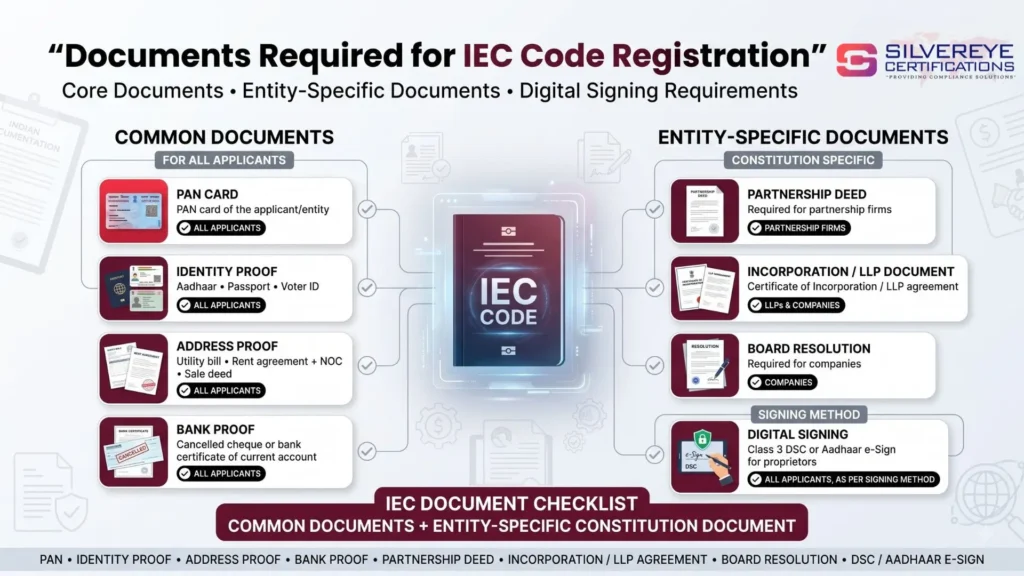
The document set stays largely the same across entity types, with one additional constitution document depending on your structure:
| Document | Applies To |
| PAN card of the applicant/entity | All applicants |
| Identity proof (Aadhaar, passport, voter ID) | All applicants |
| Address proof (utility bill, rent agreement + NOC, sale deed) | All applicants |
| Cancelled cheque or bank certificate of current account | All applicants |
| Partnership deed | Partnership firms |
| Certificate of Incorporation / LLP agreement | LLPs and Companies |
| Board resolution | Companies |
| Class 3 DSC (or Aadhaar e-Sign for proprietors) | All applicants, per signing method |
IEC Code Registration Process
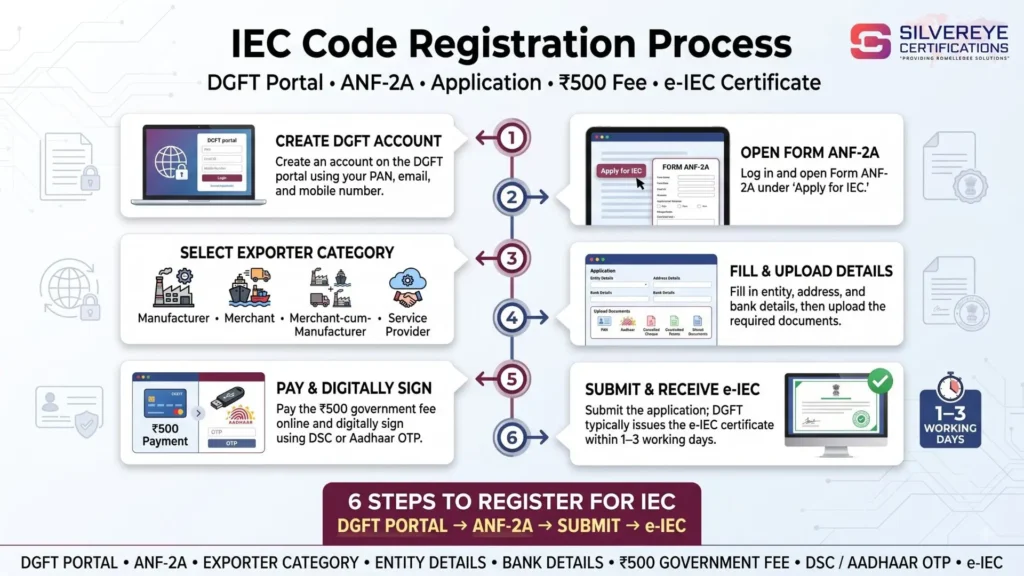
- Create an account on the DGFT portal using your PAN, email, and mobile number.
- Log in and open Form ANF-2A under 'Apply for IEC.'
- Select your exporter category (Manufacturer, Merchant, Merchant-cum-Manufacturer, or Service Provider).
- Fill in entity, address, and bank details, then upload the required documents.
- Pay the ₹500 government fee online and digitally sign using DSC or Aadhaar OTP.
- Submit the application; DGFT typically issues the e-IEC certificate within 1–3 working days.
IEC Code Registration Fees
| Particulars | Fee (Approx.) |
| New IEC application (government fee) | ₹500 (one-time, non-refundable) |
| Modification of IEC details | ₹200 |
| Duplicate IEC certificate | ₹200 |
| Annual profile confirmation (April–June) | Free |
| Professional/consultant assistance | ₹1,000 – ₹5,000 (varies by provider) |
IEC Code Validity and the Annual Update
Once issued, an IEC code is valid for the lifetime of the business — there's no expiry and no renewal fee. However, DGFT requires every IEC holder to log in between April 1 and June 30 each year and confirm their profile details are current, even without any changes.
Missing this window causes the IEC to be marked inactive, which halts customs clearance and international payments until it's reactivated. This is the only recurring compliance tied to IEC Code Registration.
When You Don't Need IEC Code Registration
A handful of specific categories are exempted from mandatory IEC Code Registration:
- Central or State Government ministries and departments
- Individuals importing or exporting goods purely for personal use, unrelated to trade or manufacturing
- Small-value trade with Nepal, Myanmar, or China through notified border routes, within the prescribed consignment value limit
- Service exporters not claiming any Foreign Trade Policy benefit or dealing in specified restricted services
Even exempted categories lose the exemption when dealing in restricted, sensitive, or dual-use goods listed under the Foreign Trade Policy — always verify current status on the DGFT portal before assuming an exemption applies.
How Silvereye Certifications Can Help
Figuring out which exporter category to select, whether your service export actually needs an IEC, or getting a document mismatch corrected before submission is where most first-time applicants lose time.
Silvereye Certifications handles IEC Code Registration end to end — reviewing your eligibility, preparing and verifying documents, filing Form ANF-2A correctly, and managing the annual compliance update — so your business gets its code right the first time, without delays or resubmissions.
Conclusion
IEC Code Registration is the foundation every Indian import-export business is built on — a one-time, ₹500 registration that unlocks customs clearance, international banking, and access to export incentive schemes. What trips people up isn't the cost or the process, which DGFT has made genuinely simple, but the smaller details: picking the right exporter category, knowing whether an exemption applies, and not forgetting the free annual update between April and June.
Get those right, and your IEC becomes a one-time task that supports your business for as long as it trades internationally. If you'd rather have the entire registration — and the compliance that follows it — handled correctly, Silvereye Certifications can manage it for you from start to finish.
Frequently Asked Questions
What is IEC Code Registration used for?
It's used to obtain the Importer-Exporter Code, the mandatory identification number required to legally import or export goods, and certain services, from India.
Is IEC Code Registration mandatory for every business?
No. It's mandatory for most import/export activity, but personal-use imports, certain government bodies, and small-value border trade are exempted.
How much does IEC Code Registration cost?
The government charges a flat, one-time fee of ₹500, paid online through the DGFT portal's integrated payment gateway.
How long does IEC Code Registration take to complete?
Most applications are approved and the e-IEC certificate issued within 1 to 3 working days, provided documents are accurate and complete.
Does IEC Code Registration need to be renewed?
No. The IEC has lifetime validity. You only need to confirm your profile details on the DGFT portal annually between April 1 and June 30.
Is IEC required for exporting services like IT or consulting?
Only if you're claiming benefits under the Foreign Trade Policy or dealing in DGFT-specified services. Regular service exports without such benefits generally don't need an IEC.
Can an individual apply for IEC Code Registration?
Yes. Individuals and sole proprietors can register using their personal PAN, just like partnership firms and companies use their entity PAN.
What exporter category should I select while applying?
Choose based on your business: Manufacturer Exporter if you produce the goods, Merchant Exporter if you trade finished goods, or Service Provider if you export services under FTP schemes.
Is IEC Code Registration the same as GST registration?
No. GST covers domestic tax compliance, while IEC specifically authorises cross-border trade. Both are separate, even though they share the PAN-based structure.
What happens if I skip the annual IEC update?
DGFT can mark your IEC inactive, which blocks customs clearance and trade payments until you reactivate it by completing the confirmation.
Can my IEC application get rejected?
Yes, commonly due to PAN mismatches, incorrect bank details, or unclear document scans. You can reapply, but the ₹500 fee is non-refundable and payable again.
Who can help me complete IEC Code Registration correctly?
You can self-file on dgft.gov.in, or use a professional service like Silvereye Certifications to check eligibility, prepare documents, and file on your behalf.