

- BEE star rating for televisions covers colour TVs and UHD TVs, and became mandatory in India from January 1, 2026 — it was previously voluntary.
- The star rating is calculated from a TV's annual energy consumption (AEC), which is based on power draw measured against screen area, not just screen size alone.
- Every TV brand selling in India now needs its models tested, registered on the BEE portal, and correctly labelled before manufacture, import or sale.
- The Appliance Labelling and Compliance Regulations, 2026 extend enforcement to e-commerce listings, so online marketplace product pages must also display accurate BEE ratings.
Introduction
BEE Star Rating for Televisions is India's official 1-to-5-star energy-efficiency label for colour TVs and UHD TVs, issued by the Bureau of Energy Efficiency under the Ministry of Power. Since January 1, 2026, it has become mandatory — before that, TV manufacturers could choose to register voluntarily.

The rating is worked out from the television's annual energy consumption (AEC), calculated from its measured power draw relative to screen area under BEE's Schedule 26 test method, at a NABL-accredited lab. To sell a TV in India now, manufacturers and importers must get each model tested, register it on the BEE portal, and display the correct star label — including on e-commerce listings, which now fall under active BEE market surveillance.
What Is the BEE Star Rating for Televisions?
BEE Star Rating for Televisions is the energy-efficiency label issued by India's Bureau of Energy Efficiency (BEE) for colour televisions and ultra-high-definition (UHD) TVs, under the Energy Conservation Act, 2001. It rates a TV model from 1 to 5 stars, with 5 stars representing the lowest electricity draw for a comparable screen size and viewing experience.
Televisions run for hours every day in most Indian households, and as screens have grown larger and brighter with UHD and large-format panels, their cumulative power draw has grown too. That's the practical reason BEE brought TVs under formal star rating — to give buyers a simple, visual way to compare running costs before they choose between two similarly priced sets.
The technical rules for TV star rating sit in BEE Schedule 26, which lays out how a set's annual energy consumption (AEC) is calculated and how that AEC maps to a star band.
Why BEE Star Rating for Televisions Matters Now
- It's now a legal requirement, not a marketing choice: since January 1, 2026, selling an unlabelled colour TV or UHD TV in India is a compliance violation, not just a missed opportunity.
- Running-cost transparency: a large UHD panel and a similarly sized older LED set can have very different annual power costs, and the star label makes that difference visible at the point of sale.
- Retail and e-commerce impact: online listings are now within BEE's market surveillance scope, so an unrated or incorrectly rated TV can be flagged and delisted from major platforms.
- Brand trust: a genuine, verifiable 4- or 5-star rating is increasingly a differentiator in a crowded Indian TV market where buyers actively compare energy labels before purchase.
How Is the TV Star Rating Calculated?
Unlike a simple wattage comparison, BEE's method for televisions ties power consumption to screen area, so a fair comparison can be made between sets of different sizes. In broad terms, the process works like this:
- The TV's on-mode power consumption is measured at an accredited lab, using standardized test video content and defined ambient conditions.
- This power figure is converted into Annual Energy Consumption (AEC), expressed in kilowatt-hours per year, using a formula that factors in the screen's calculated area in square centimetres.
- The AEC is compared against BEE's Star Rating Band for that year of manufacture (the bands are periodically revised as display technology improves) to arrive at a 1-to-5 star result.
- For TVs with an Automatic Brightness Control (ABC) function, both power at a defined light level and power under ABC operation are tested, and the two results must stay within a defined tolerance of each other.
This is why two TVs with the same screen size but different panel technology, backlighting or picture-processing chips can land in different star bands — the label reflects real measured energy behaviour, not just a spec-sheet wattage number.
From Voluntary to Mandatory: The Television Timeline
| Period | Status for Colour TV / UHD TV |
| Before January 1, 2026 | Voluntary — manufacturers could choose to register and display a BEE star label, but it wasn't legally required |
| From January 1, 2026 | Mandatory — every colour television and UHD TV sold in India must carry a valid, current BEE star label |
| Ongoing | Enforcement now extends to e-commerce listings under the Appliance Labelling and Compliance Regulations, 2026 |
If your brand was already voluntarily registered before 2026, the transition to mandatory status is generally straightforward. If you treated voluntary registration as optional and skipped it, your TV models are very likely non-compliant as of today and need to be registered without delay.
Who Needs BEE Registration for Televisions?
- Domestic TV manufacturers assembling or producing colour TVs or UHD TVs in India must register the brand and every individual model.
- Importers bringing TVs into India for commercial sale must hold a valid BEE registration in their own name, backed by an authorization letter from the overseas manufacturer.
- Traders and re-branders selling TVs under their own brand name must register as well, even if they source finished sets from another manufacturer.
Key Benefits of BEE Star Rating for Televisions
| Benefit | What It Means for You |
| Legal market access | Mandatory since January 2026 — the only way to legally manufacture, import or sell colour TVs and UHD TVs in India |
| E-commerce compliance | Correct star labelling keeps your listings compliant under active online market surveillance |
| Consumer trust | A visible, verifiable star rating helps buyers compare running costs across competing TV brands and models |
| Competitive positioning | Higher star ratings increasingly influence purchase decisions in a crowded, comparison-driven TV market |
| Audit readiness | A complete, accurate registration record protects your brand if BEE conducts check-testing or a compliance review |
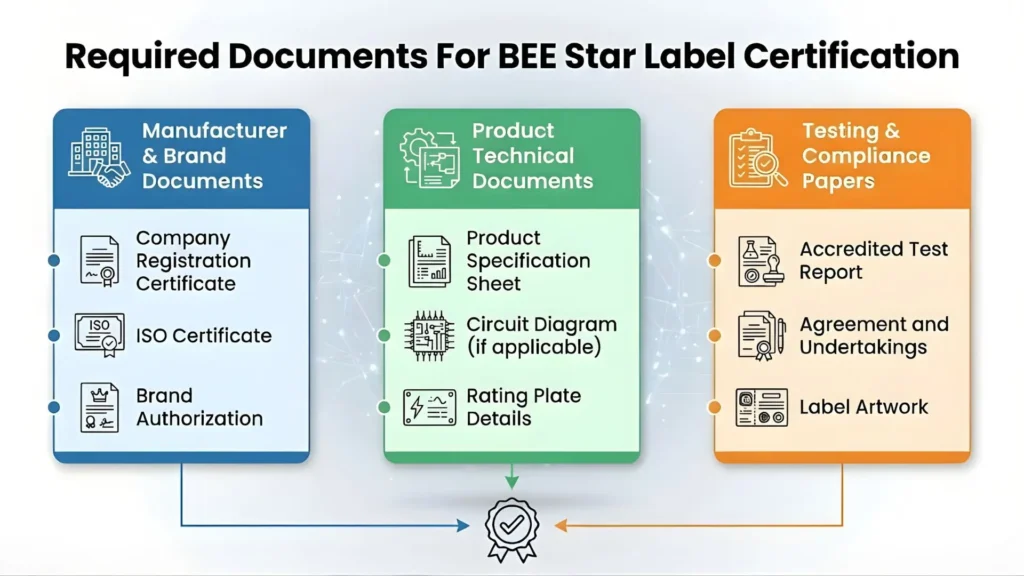
Documents Required for TV BEE Star Rating Registration
- Company incorporation and GST registration proof
- Trademark registration certificate for the TV brand name
- Authorization letter from the overseas manufacturer (for importers), naming the importer and IEC code
- NABL-accredited (or BEE-approved) lab test report per BEE Schedule 26, including measured power consumption and calculated screen area
- Product technical specification sheet (screen size, panel type, resolution, ABC function details if applicable)
- Product photographs, front and rear panel views
- Declaration of conformity
- Proposed BEE label artwork following the current television label template
- Registration fee payment receipt
Step-by-Step Process to Get BEE Star Rating for a Television
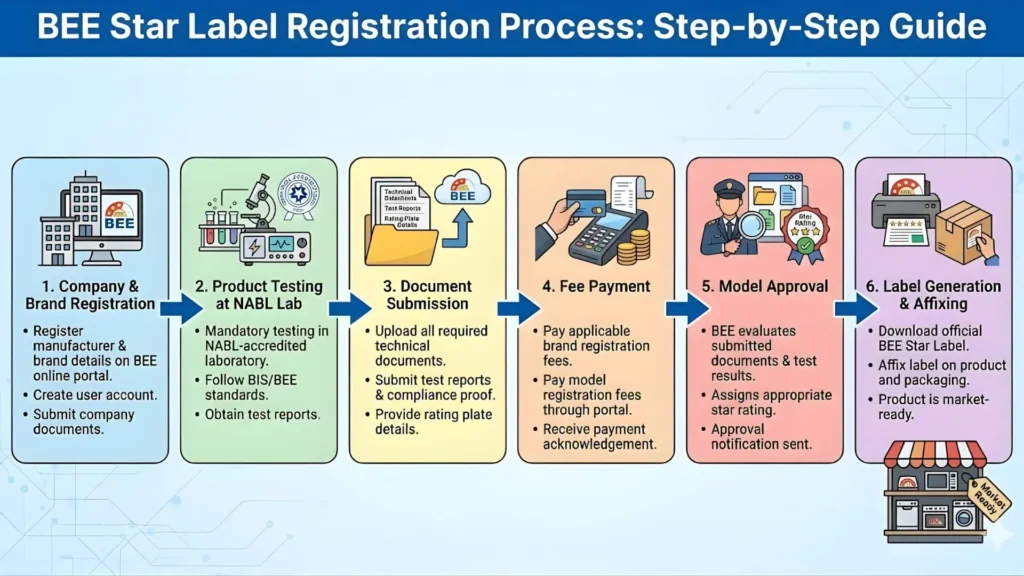
- Confirm your TV model falls under the mandatory colour TV / UHD TV category on beestarlabel.com and download the current Schedule 26 test requirements.
- Send a representative sample to a NABL-accredited lab (or one specifically listed as approved for television testing) for power consumption and screen-area measurement.
- Review the test report to confirm the calculated Annual Energy Consumption (AEC) and resulting star band before proceeding.
- Register your brand/company on the BEE portal with the required company documents, if not already registered.
- Submit the model registration application with the test report, specifications, photographs, declaration of conformity and proposed label artwork.
- Pay the applicable model registration fee and, where required, submit signed hard copies for final scrutiny.
- Respond to any deficiency notice from BEE's technical team promptly to avoid delays.
- On approval, print the BEE-compliant label — with your registration number and correct star rating — on every unit and update your e-commerce listings accordingly.
Fees for BEE Star Rating Registration (Television Category)
Fees for television registration follow the same general BEE fee structure used across product categories:
| Fee Component | Approximate Range |
| Security deposit (brand/company registration) | Commonly cited around ₹1,00,000; reduced for MSME/small-scale applicants |
| Model registration fee (per TV model) | Commonly cited example: around ₹2,000 per model, in line with other appliance categories |
| Laboratory testing charges | Paid directly to the lab; varies with screen size, panel technology and number of variants tested |
| Renewal fee | Generally lower than fresh registration, though re-testing costs apply if the star rating table has been revised |
Always confirm the current fee schedule directly on the BEE portal, since fee slabs and MSME concessions are revised periodically.
Validity and Renewal Timeline for TV BEE Registration
Like other appliance categories, TV registrations carry a validity period printed on the Registration Certificate — generally in the 1 to 3 year range. Because television star rating bands are periodically revised as display technology becomes more efficient, it's common for a model's underlying test data to need refreshing sooner than the certificate's nominal expiry date if BEE issues a new rating table for the category.
- Start the renewal process 60–90 days before your certificate's printed expiry date.
- Check whether BEE has issued a revised star rating table for televisions since your last registration — if so, re-testing is required.
- Confirm your testing lab's NABL accreditation is still current for TV/display testing.
- Update your model's technical documentation and declaration of conformity.
- Submit the renewal application and fee, and switch to the newly issued label before the old one lapses.
As with all BEE categories, selling TVs with an expired registration is treated as non-compliant, with no automatic late-fee grace period — a lapsed registration typically means starting over as a fresh applicant.
BEE Star Rating for Televisions: What's New in 2026
- Mandatory from January 1, 2026: Colour televisions and UHD TVs moved from a voluntary category to full mandatory star labelling under BEE's 2026 gazette notification — a major shift for TV brands that had previously skipped registration.
- E-commerce market surveillance: The Appliance Labelling and Compliance Regulations, 2026 extend compliance checks to online marketplace listings, meaning platforms and sellers can both face scrutiny for missing or inaccurate star ratings on product pages.
- First-time compliance burden for many brands: Because this is a newly mandatory category, a large number of TV models that were never tested or labelled before must now go through the full registration process for the first time, rather than a simple renewal.
- Continued periodic review of rating bands: BEE has indicated that the mandatory appliance list and associated rating tables are reviewed and updated periodically, so TV manufacturers should expect further band revisions as panel and backlighting efficiency continues to improve.
The practical takeaway for TV brands: if your models were sold without a BEE star label before 2026 on the assumption that it was optional, that assumption is no longer valid, and getting registered should be treated as an immediate priority rather than a routine to-do.
Common Mistakes TV Brands Make
- Assuming voluntary-era registration status still applies without checking the 2026 mandatory update.
- Testing against an outdated version of Schedule 26 or an earlier star rating band table.
- Under-reporting screen area or using inconsistent size measurements between the test report and marketing material.
- Forgetting to update e-commerce product listings with the correct, current star rating after registration.
- Missing the ABC (Automatic Brightness Control) tolerance requirement where the TV includes that feature, leading to test report rejection.
Get Expert Help: Silvereye Certifications
Television testing under BEE Schedule 26 involves more technical nuance than many other appliance categories — screen-area calculations, ABC tolerance checks, and star band interpretation all need to be handled precisely. Silvereye Certifications, a Noida-based regulatory compliance consultancy, helps TV manufacturers, importers and brands secure BEE Star Rating for Televisions correctly the first time, alongside related approvals such as BIS (ISI/CRS/FMCS), WPC-ETA, FSSAI, MSME and ISO certifications.
Their team coordinates with NABL-accredited labs experienced in television testing, prepares and files BEE portal documentation, and tracks renewal timelines so your TV models stay compliant across both retail and e-commerce channels. If your brand is still catching up on the 2026 mandatory shift for televisions, working with an experienced consultant like Silvereye Certifications can help you close that compliance gap quickly and correctly.
Conclusion
BEE Star Rating for Televisions has moved from a nice-to-have differentiator to a hard legal requirement in the span of a single regulatory notification. For any brand manufacturing, importing or selling colour TVs and UHD TVs in India, 2026 marks the point where energy-efficiency labelling stops being optional — testing under Schedule 26, portal registration, accurate labelling and now even e-commerce listing accuracy are all part of a single compliance chain. Approached methodically — confirm your category status, test correctly, register accurately, and track your validity date — TV brands can turn this requirement into what it was designed to be: a transparent, trustworthy signal that helps energy-conscious Indian buyers choose confidently between competing screens.
Frequently Asked Questions
Is BEE star rating mandatory for televisions now?
Yes. Colour televisions and UHD TVs became mandatory under BEE star labelling from January 1, 2026, having previously been a voluntary category.
How is the BEE star rating for a TV calculated?
It's based on the television's Annual Energy Consumption (AEC), derived from measured on-mode power consumption relative to the screen's calculated area, tested per BEE Schedule 26 at an accredited lab.
What is BEE Schedule 26?
It is the official BEE document setting out the scope, test methods, and star rating bands used specifically for colour television and UHD TV star labelling.
Do UHD TVs and standard LED TVs use the same rating method?
Both fall under the same broad Schedule 26 framework and are rated on annual energy consumption relative to screen area, though their actual power draw and resulting star bands typically differ due to panel and backlighting differences.
What documents are needed for TV BEE registration?
Company registration and trademark proof, a NABL-accredited Schedule 26 test report, technical specifications, product photographs, a declaration of conformity, proposed label artwork, and (for importers) an authorisation letter from the manufacturer.
How much does BEE registration cost for a television model?
Costs generally follow BEE's standard structure — a company-level security deposit plus a per-model registration fee, commonly cited around ₹2,000 per model, alongside separate lab testing charges.
Does BEE TV star labelling apply to e-commerce listings?
Yes. The Appliance Labelling and Compliance Regulations, 2026 extend compliance checks to online marketplace product pages, not just physical retail.
What happens if my TV brand hasn't registered under the new 2026 rule?
Selling an unregistered colour TV or UHD TV after January 1, 2026 is a compliance violation, which can lead to penalties, delisting from e-commerce platforms, and market withdrawal.
How long is a TV BEE registration valid?
Generally 1 to 3 years, as printed on the Registration Certificate, though re-testing may be needed sooner if BEE revises the television star rating bands.
Can imported televisions be sold in India without BEE registration?
No. Importers must hold a valid BEE registration in their own name, supported by an authorisation letter from the foreign manufacturer, before commercial sale.
What is Automatic Brightness Control (ABC) testing for TVs?
For TVs with an ABC sensor, BEE testing measures power consumption both at a defined brightness level and under active ABC operation, and the two readings must stay within a set tolerance of each other.
Is renewal required if my TV model's specifications haven't changed?
Yes — registration validity still expires on its printed date regardless of unchanged specifications, and renewal (with possible re-testing if the rating table has been revised) is still required.