
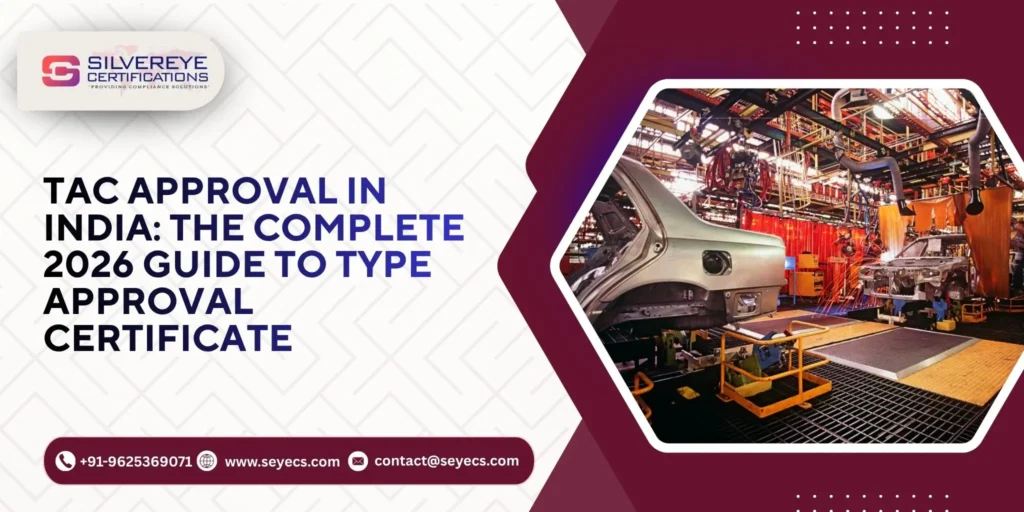
- TAC Approval is issued under the Central Motor Vehicles Rules (CMVR), 1989 by MoRTH-notified agencies like ARAI, ICAT, GARC and VRDE — it is not a BIS or WPC certificate.
- It applies to vehicles across the L, M, N and T categories, and to safety-critical parts such as brakes, tyres, lighting, seat belts, fuel tanks and EV batteries.
- Approval is tied to Conformity of Production (COP); most design or material changes require fresh testing or an amendment, not just a one-time certificate.
- 2026 brings real changes — a new ADAS mandate (AIS-162/184/186/187/188) for buses and trucks, and tightened EV battery-safety norms under AIS-038 and AIS-156.
Introduction
A Type Approval Certificate (TAC) is the mandatory approval issued in India under the Central Motor Vehicles Rules (CMVR), 1989, confirming that a vehicle, engine or automotive component meets the safety, performance and emission requirements set out in the applicable Automotive Industry Standards (AIS).
It is granted by MoRTH-notified testing agencies — mainly ARAI and ICAT, with GARC and VRDE handling specific categories. Without a valid TAC, a vehicle cannot be registered in India and a safety-critical component cannot legally be fitted or sold. Timelines vary by product and applicant type, typically running from a few weeks for documentation-only changes to over a month for full vehicle-level testing.
If you manufacture, import or assemble vehicles, engines or automotive components in India, you have almost certainly come across the term TAC — Type Approval Certificate. It is one of those approvals that sounds procedural on paper but, in practice, decides whether your product ever reaches an Indian road, showroom or export container.
This guide walks through what TAC actually covers, who needs it, how the approval works end to end, what it costs, how long it stays valid, and what has changed for 2026 — so you can plan the certification timeline for your product with a realistic picture rather than guesswork.
What Is a TAC Approval in India?
A Type Approval Certificate, commonly shortened to TAC, is the formal certificate of conformity granted to a vehicle, engine, or automotive component once it has been tested and found to meet the technical, safety and environmental standards prescribed for that product category in India. The certificate confirms that a representative sample — the "type" — has passed every applicable test, and that vehicles or parts produced to the same design going forward can be presumed to meet the same standard.
TAC is sometimes referred to informally as ARAI certification, ICAT approval, AIS certification, or homologation — these terms are often used interchangeably in the industry, but they all point back to the same underlying certificate issued under India's motor vehicle regulatory framework.
It is worth being precise about the terminology because TAC is frequently confused with two other approvals that Indian manufacturers also deal with: BIS certification (an electrical/electronic and product-safety mark) and WPC Equipment Type Approval or ETA (a wireless/radio-frequency approval for Bluetooth, Wi-Fi and similar devices). TAC is neither of these — it sits specifically within the automotive regulatory chain administered by the Ministry of Road Transport and Highways.
Legal Framework Governing TAC in India
TAC approval does not exist in isolation — it sits inside a layered legal and technical structure that has been built up since the late 1980s:
- Motor Vehicles Act, 1988 — The parent legislation that empowers the central government to frame rules for the construction, safety and registration of motor vehicles.
- Central Motor Vehicles Rules (CMVR), 1989 — the rulebook made under the Act. Rule 126 of the CMVR is the specific provision that governs type approval and lists the agencies authorized to grant it.
- Automotive Industry Standards (AIS) — The technical specifications (brake performance, crash safety, lighting, emissions, EV battery safety, and so on) developed by the Automotive Industry Standards Committee (AISC) and recommended for adoption under the CMVR.
- CMVR-Technical Standing Committee (CMVR-TSC) — Reviews AISC recommendations and forwards them to MoRTH for formal notification.
- Ministry of Road Transport and Highways (MoRTH) — The nodal ministry that notifies AIS standards into law and sets compliance deadlines.
A simple way to think about the relationship: AIS defines the technical "how" — the exact test methods and pass/fail limits — while CMVR is the legal "must," the rule that makes meeting those AIS standards mandatory before a vehicle or part can be sold or registered in India.
Who Needs TAC Approval in India?
TAC is not limited to finished cars. Indian regulation splits vehicles into categories, and separately requires certification for many of the components fitted inside them. Broadly, you will need TAC approval if you fall into any of the following groups:
Vehicle categories
- L-category — two-wheelers and three-wheelers (motorcycles, scooters, e-rickshaws, auto-rickshaws) above the exempted engine/motor threshold.
- M-category — passenger vehicles, from hatchbacks and sedans to buses (M2/M3).
- N-category — goods carriers, from light commercial vehicles to heavy trucks (N2/N3).
- T-category and construction equipment vehicles (CEVs) — agricultural tractors and off-road/construction machinery, which follow a related but distinct emission track (TREM stages).
Component and system categories
- Safety-critical parts: braking systems, tyres, seat belts, door locks, lighting and signalling equipment, mirrors, and glazing.
- Structural and fuel-system parts: fuel tanks, hoses, and chassis-related components.
- Electrical and electronic systems: automotive electronics, wiring harnesses, and — increasingly — EV batteries, battery management systems (BMS) and chargers.
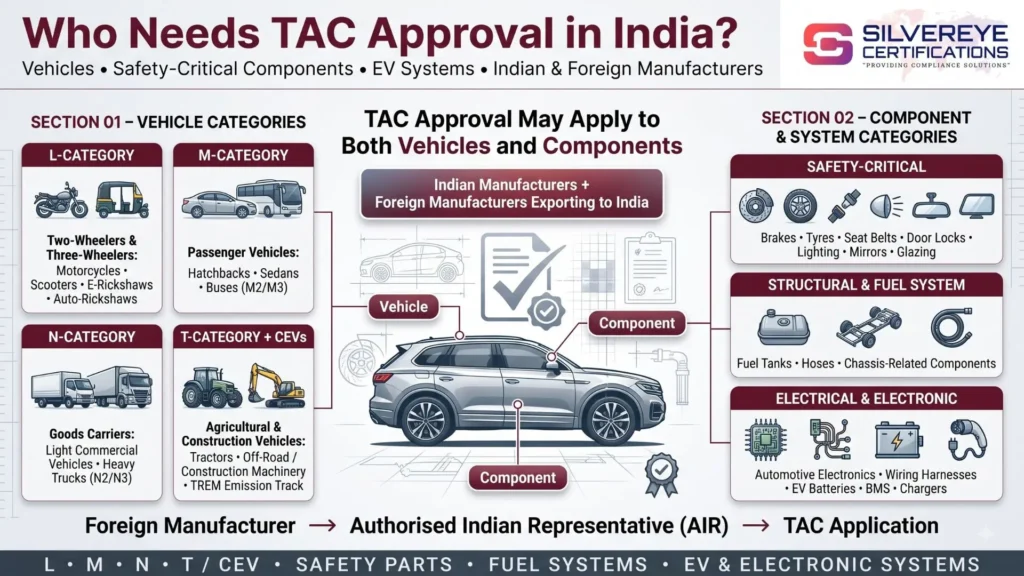
Both Indian manufacturers and foreign manufacturers exporting to India need TAC before their vehicle or component can be registered or legally fitted. A foreign manufacturer typically applies through an Authorised Indian Representative (AIR) rather than directly.
Products Covered Under the TAC Category
TAC is not a single certificate for a single product type — it spans complete vehicles, engines, and a long list of individual safety and performance components fitted inside them. The table below summarises the main product groups that fall under the TAC category in India.
| Category | Products / Components Covered |
| Two & three-wheelers (L-category) | Motorcycles, scooters, mopeds, auto-rickshaws, e-rickshaws, and other L-category vehicles above the exempted motor/engine threshold |
| Passenger vehicles (M-category) | Hatchbacks, sedans, SUVs, MPVs, and buses (M2/M3), including electric and hybrid passenger vehicles |
| Commercial / goods vehicles (N-category) | Light commercial vehicles, trucks, and heavy goods carriers (N2/N3) |
| Tractors & construction equipment (T/CEV) | Agricultural tractors and off-road construction equipment vehicles, tracked separately under TREM emission stages |
| Engines & powertrains | Internal combustion engines, electric motors, and powertrain assemblies fitted to the above vehicle categories |
| Braking systems | Brake assemblies, brake hoses, and Advanced Emergency Braking System (AEBS) components under AIS-162 |
| Tyres & wheels | Pneumatic tyres and wheel assemblies tested for load, speed and endurance ratings |
| Lighting & signalling equipment | Headlights, tail lights, indicators, and other lighting or signalling components |
| Safety restraint systems | Seat belts, airbags, and child-restraint anchorage systems |
| Structural & fuel-system parts | Fuel tanks, fuel hoses, and related structural components |
| Door & locking mechanisms | Door locks, hinges, and latch systems |
| Automotive electronics | Wiring harnesses, control units, and vehicle electronics not separately covered under BIS or WPC |
| EV-specific components | EV batteries, Battery Management Systems (BMS), and EV chargers, tested under AIS-038 and AIS-156 for thermal-runaway and water-ingress safety |
| ADAS & driver-assist systems | Advanced Emergency Braking (AIS-162), Driver Drowsiness Warning (AIS-184), Blind Spot Information (AIS-186), Moving Off Information (AIS-187), and Lane Departure Warning (AIS-188), mandatory for M2/M3/N2/N3 vehicles under the 2026 rollout |
| Vehicle tracking devices | Vehicle Location Tracking (VLT) and panic-button devices under AIS-140, fitted to public-service and commercial vehicles |
If your product does not clearly fall into one of these groups, the safest approach is to confirm applicability directly with ARAI or ICAT before finalising your design, since new component categories are added to the AIS framework fairly regularly.
Which Agencies Issue TAC Approval in India?
Rule 126 of the CMVR names specific agencies as "notified testing agencies" for type approval. The two most commonly used are ARAI and ICAT, with GARC and VRDE handling more specialised or defence-linked categories.
| Agency | Full Form / Nature | Typical Focus |
| ARAI | Automotive Research Association of India (Pune) — autonomous body under the Ministry of Heavy Industries | Primary type-approval agency for the widest range of vehicles, engines and components; recognised as a Scientific and Industrial Research Organisation (SIRO) |
| ICAT | International Centre for Automotive Technology (Manesar, Haryana) | Vehicle, engine and component type approval, with strong EMI/EMC and safety-testing infrastructure, often preferred by manufacturers based in northern India |
| GARC | Global Automotive Research Centre (Chennai/Oragadam) | Testing and type approval support, particularly for vehicles and components from the southern manufacturing cluster |
| VRDE | Vehicle Research & Development Establishment | Testing linked to defence and specialised heavy-vehicle applications |
You do not usually get to freely pick and choose between them for every product — the applicable agency depends on the vehicle or component category, and in some cases on where your testing facility or manufacturing base is located. It is common, and often more efficient, to work with a consultant who already has an established working relationship with the relevant agency.
Benefits of Getting TAC Approval
- Legal market access — Without TAC, a vehicle simply cannot be registered with the Regional Transport Office (RTO), and a safety-critical component cannot be legally fitted or sold for use on Indian roads.
- Consumer trust and safety credibility — TAC signals that an independent, government-notified laboratory has verified the product against India-specific safety and emission benchmarks, not just a foreign standard.
- Smoother exports — An India TAC is frequently referenced by buyers and regulators in other markets as evidence that a vehicle or part has already cleared a rigorous, internationally-recognized testing regime.
- Avoiding penalties and seizure — Vehicles or components sold without valid type approval risk registration refusal, customs hold-ups at the port, and enforcement action.
- A documented compliance trail — The Conformity of Production system that follows TAC gives manufacturers an ongoing quality record that is useful well beyond the certificate itself, including for tenders and OEM vendor approvals.
Eligibility for TAC Approval
A few eligibility points are worth flagging before you apply, because they change how the process unfolds:
- Component-level certification usually has to be completed first. Vehicle-level type approval assumes that the safety-critical parts fitted in the vehicle — brakes, tyres, seat belts, lighting and so on — already carry their own valid certification.
- Applicants can be manufacturers, assemblers, or importers. A foreign manufacturer without an Indian entity applies through an Authorized Indian Representative (AIR), who holds the certificate and technical responsibility on the applicant's behalf.
- The product must be tested as a representative "type" or prototype. You cannot get TAC on paper specifications alone; a physical unit, sub-assembly, or in some cases a Body-in-White (BIW), has to be submitted for testing at the notified agency.
- Prior WMI/WMC registration (World Manufacturer Identifier / World Manufacturer Code) and BIS licenses for any safety-critical components covered under a separate mandatory BIS scheme are typically required as supporting documentation, not substitutes for TAC itself.
Documents Required for TAC Approval
Documentation requirements differ slightly by product and by agency, but a typical CMVR type-approval application — closely following the formats ARAI publishes under AIS-007 — asks for:
- Technical specifications of the vehicle, engine or component, prepared in the format prescribed under AIS-007.
- Company profile and manufacturing/factory details, including quality-control procedures followed at the production facility.
- Copies of any existing Type Approval Certificates and Conformity of Production (COP) certificates for components already fitted (for example, tyres, brakes, or lighting units sourced from certified suppliers).
- BIS license copies for any safety-critical components that fall under a mandatory BIS certification scheme.
- WMI/WMC certificates as applicable to the vehicle standard being followed.
- Test reports from accredited/notified laboratories, where available, along with the tentative date for submission of the test/prototype vehicle, vehicular systems or components for physical testing.
- Drawings, material specifications and the Conformity of Production plan describing how consistency will be maintained across the production run.
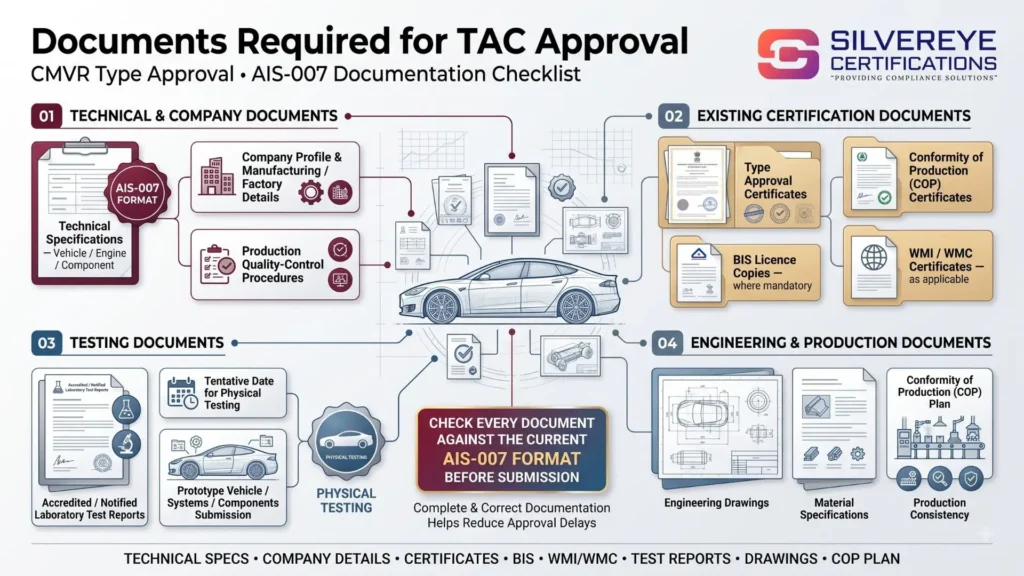
Because incomplete or incorrectly formatted documentation is one of the most common reasons for delay, it is worth having every document checked against the current AIS-007 format before submission rather than after the agency raises a query.
Step-by-Step TAC Approval Process
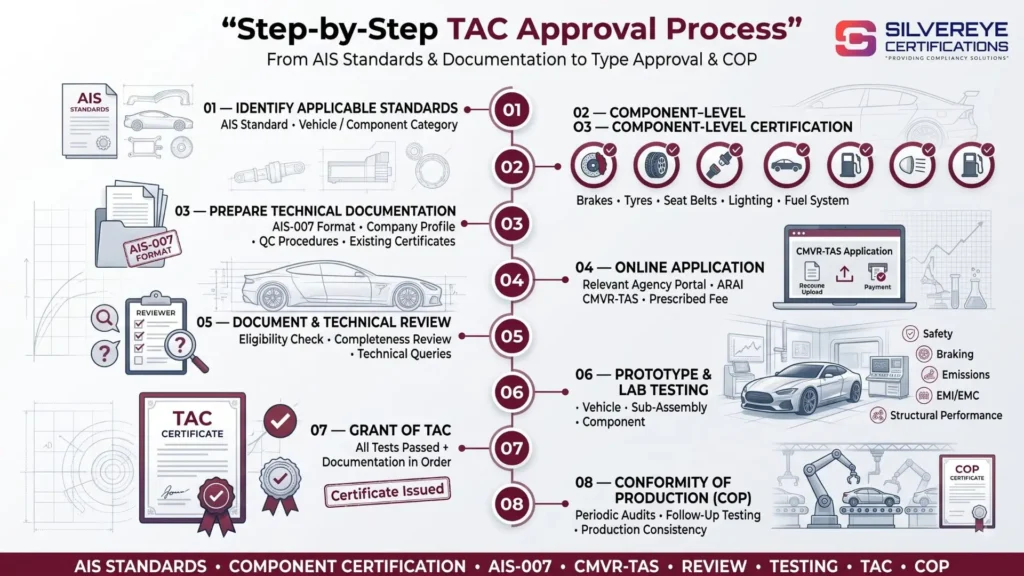
- Identify the applicable AIS standards and vehicle/component category. This determines the exact tests, agency, and documentation format that apply to your product.
- Complete component-level certification first, for any safety-critical parts (brakes, tyres, seat belts, lighting, fuel system) that will be fitted into the vehicle.
- Prepare the technical documentation package in the AIS-007 format, along with company profile, QC procedures, and any existing component certificates.
- Submit the application through the relevant agency's online portal — for ARAI, this is the CMVR-TAS (Type Approval System) portal — along with the prescribed fee.
- Undergo document and technical review, where the agency verifies eligibility, checks the completeness of the submission, and raises queries if anything is missing or inconsistent.
- Submit the prototype vehicle, sub-assembly, or component sample for laboratory testing as per the applicable AIS standard(s) — covering areas such as safety, braking, emissions, EMI/EMC, and structural performance depending on the product.
- Receive the grant of TAC once all tests are passed and documentation is in order. The certificate is issued in the applicant's (or Authorized Indian Representative's) name.
- Maintain Conformity of Production (COP) going forward — periodic audits and, where required, follow-up testing to confirm that ongoing production continues to match the approved type.
TAC Approval Grading and Processing Timeline
ARAI grades type-approval requests by the scale of change involved, which directly affects the processing timeline. As an indicative benchmark (subject to timely and correct document submission):
| Request Type | What It Covers | Indicative Timeline |
| Type-I (Documentation) | Application for documentation changes or certificate extension, without any fresh testing or vehicle verification | ~10 working days |
| Type-II (Partial) | Technical changes requiring partial tests and updated documentation | ~30 working days |
| Type-III (Full) | New vehicle with the complete set of tests applicable under CMVR | ~45 working days |
Outside vehicle-level approval, timelines quoted for component-level TAC vary noticeably across sources — anywhere from roughly three to five weeks for simpler components, to four to twelve weeks for more complex ones, and around one month for domestic manufacturers versus about two months for foreign manufacturers.
Treat any timeline as indicative: the actual duration depends on how complete your first submission is, how quickly you respond to agency queries, prototype/sample availability, and the specific tests your product needs. Always confirm current turnaround with the agency or your consultant at the time of filing.
TAC Approval Fees in India
There is no single published flat fee for TAC — costs depend on the vehicle or component category, the specific AIS standards that apply, the number and complexity of tests required, whether the applicant is domestic or foreign, and which agency (ARAI, ICAT, GARC or VRDE) is handling the certification. A basic component-level test can cost meaningfully less than a full vehicle-level Type-III approval that involves crash testing, emission testing, and multiple prototype cycles.
Because fee schedules are revised periodically by the agencies themselves, treat any figure you see quoted online as indicative rather than final, and confirm the current fee structure directly with ARAI, ICAT, GARC, VRDE, or through a consultant like Silvereye Certifications before budgeting for your project.
Validity, Renewal, and Conformity of Production (COP)
TAC is best understood not as a one-time, fixed-term certificate but as an approval that stays valid for as long as the product continues to be manufactured exactly as approved. In practice, this plays out in a few ways:
- Any change to the design, materials, structure, or a key safety-related component of the approved vehicle or part typically triggers a fresh application — anywhere from a documentation-only Type-I update to a full Type-III retest, depending on how significant the change is.
- Manufacturers are expected to maintain Conformity of Production (COP), meaning ongoing production must continue to match the tested and approved type. Agencies can conduct COP audits, and failure to maintain consistency can put the certificate at risk.
- Some industry sources describe TAC validity in calendar terms (for example, around a year, with recertification required for design changes), while others describe it as tied to the product's continued, unmodified production run. This is a genuine point of variance across sources, so confirm the exact validity and renewal condition applicable to your specific product category directly with the certifying agency rather than relying on a general rule of thumb.
TAC vs BIS vs WPC ETA: How Do They Differ?
Manufacturers who deal with multiple regulatory approvals in India sometimes conflate TAC with BIS certification or WPC's Equipment Type Approval (ETA), because all three use the word "approval" or "certification" for a conformity mark. They are administered by entirely different authorities and cover different risk areas.
| Parameter | TAC | BIS Certification | WPC ETA |
| Governing law | Central Motor Vehicles Rules (CMVR), 1989 | BIS Act, 2016 and product-specific Quality Control Orders | Indian Wireless Telegraphy Act / WPC framework |
| Administering body | MoRTH via ARAI / ICAT / GARC / VRDE | Bureau of Indian Standards | Wireless Planning & Coordination Wing, DoT |
| What it covers | Vehicles, engines, and automotive safety/performance components | Electrical, electronic and general product safety | Wireless/RF products (Bluetooth, Wi-Fi, RFID, etc.) |
| Typical trigger | Vehicle registration, sale of safety-critical auto parts | Sale of notified electronic/electrical products | Import or manufacture of radio-frequency devices |
It is common for a single connected product — for example, a telematics-enabled commercial vehicle — to require more than one of these approvals at once: TAC for the vehicle itself, BIS for certain electronic components, and WPC ETA for any embedded wireless module. Mapping out which approval applies to which part of your product early avoids duplicate testing and sequencing delays.
What's New in 2026: Key TAC and CMVR Updates
2026 has brought some of the most significant additions to the AIS framework in recent years, particularly around vehicle safety electronics and EV battery standards. Here is what manufacturers and importers should be tracking:
ADAS mandate for buses and trucks
MoRTH's draft notification G.S.R. 184(E) proposes mandatory Advanced Driver Assistance Systems for M2, M3, N2 and N3 category vehicles — that is, buses and trucks. The proposed suite covers five standards: AIS-162 (Advanced Emergency Braking System), AIS-184 (Driver Drowsiness and Attention Warning), AIS-186 (Blind Spot Information System), AIS-187 (Moving Off Information System), and AIS-188 (Lane Departure Warning System). The compliance dates being discussed are 1 April 2026 for new models and 1 October 2026 for existing models already in production.
AIS-140 (vehicle location tracking) enforcement tightens
AIS-140, the vehicle-tracking and panic-button standard, has moved further into enforcement in 2026, with state transport authorities linking fitness-certificate renewal to verified device registration on state VLTS portals, following a Supreme Court direction in May 2026. Two-wheelers, e-rickshaws and three-wheelers continue to be exempted in most state notifications, while maxi-cabs, motor cabs and buses face challans for non-compliance.
Tightened EV battery-safety standards
AIS-038 Rev.2 (with its most recent revision issued in mid-2024) and AIS-156 continue to be the core EV battery-safety references for CMVR type approval, mandating thermal-runaway propagation testing, IPX7 water-ingress protection, RFID-based battery traceability, and a microprocessor-based Battery Management System (BMS) with cell-level protection. Compliance with these standards is a prerequisite for CMVR type approval of electric vehicles and their battery packs.
New and draft categories
- A draft notification proposes a dedicated construction and safety standard, AIS-209 (Part 1):2026, for two-wheeled road ambulances (L2 category), with proposed compliance from 1 October 2027 and mandatory fitness-certificate renewal every two years.
- For agricultural tractors, a draft TREM-V emission stage is proposed for the sub-25 HP and above-75 HP segments, expected around 1 October 2026, alongside the already-implemented TREM Stage IV for tractors above roughly 37 kW (about 50 HP).
Because several of these are still in draft or phased-rollout stage, always check the latest gazette notification on the MoRTH website, or with your certifying agency, before finalising a compliance timeline for your product.
Common Mistakes to Avoid During TAC Approval
- Starting vehicle-level testing before component-level certification is complete — this almost always causes rework and resubmission.
- Submitting technical documentation that does not match the current AIS-007 format, which triggers avoidable review queries and delay.
- Underestimating Conformity of Production obligations, and treating TAC as a one-time formality rather than an ongoing compliance commitment.
- Not budgeting time or cost for a Type-II or Type-III retest when a design or material change is introduced mid-production.
- Assuming one certification (BIS, WPC, or TAC) automatically covers a connected product end to end, when in reality different sub-systems may need different approvals.
- Waiting until the vehicle or component is fully finalised before checking regulatory requirements, instead of mapping AIS applicability at the design stage.
Why Choose Silvereye Certifications for TAC Approval?
- End-to-End TAC Support: Assistance from requirement assessment to certificate issuance.
- AIS Standard Guidance: Help identify the applicable AIS standards and testing requirements.
- Documentation Support: Assistance with preparing AIS-007 technical documents and application files.
- ARAI & ICAT Coordination: Support in coordinating with the relevant notified testing agency.
- Testing & Compliance Support: Assistance with prototype testing, technical queries, and certification requirements.
- COP Support: Guidance on Conformity of Production requirements after TAC approval.
- Multi-Certification Expertise: Support for TAC along with applicable BIS, WPC, and other regulatory approvals.
Conclusion
TAC approval is essential for ensuring that vehicles and automotive components meet India's required safety, performance, and environmental standards. With changing AIS and CMVR requirements, proper planning and documentation are important to avoid delays and additional testing.
Silvereye Certifications helps manufacturers, importers, and brand owners navigate the TAC approval process with professional documentation, testing coordination, and compliance support—making the certification journey simpler, smoother, and more efficient.
Frequently Asked Questions
What is TAC (Type Approval Certificate) in India?
TAC Approval is the certificate of conformity issued under the Central Motor Vehicles Rules, 1989, confirming that a vehicle, engine, or automotive component meets the applicable Automotive Industry Standards (AIS) for safety, performance and emissions.
Who issues TAC in India — ARAI or ICAT?
Both ARAI and ICAT are notified testing agencies authorised under Rule 126 of the CMVR to grant TAC. GARC and VRDE also issue type approval for specific vehicle and component categories. Which agency applies to your product depends on category and, in some cases, location.
Is TAC the same as BIS certification or WPC ETA?
No. TAC is administered by MoRTH under CMVR and covers vehicles and automotive components. BIS certification covers general electrical/electronic product safety, and WPC ETA covers wireless/radio-frequency devices such as Bluetooth or Wi-Fi modules. A single connected vehicle may need more than one of these approvals for different parts.
Which vehicles require TAC approval?
Vehicles across the L (two/three-wheelers), M (passenger vehicles including buses), N (goods vehicles including trucks) and T/CEV (tractors and construction equipment) categories require TAC before they can be registered for use on Indian roads.
Do individual auto components need separate TAC?
Yes. Safety-critical components such as brakes, tyres, seat belts, lighting, fuel tanks and, increasingly, EV batteries and BMS units, need their own component-level type approval, which is typically completed before the vehicle-level approval is sought.
How long does TAC approval take?
It depends on the grading of the request. Documentation-only changes (Type-I) can take around 10 working days, partial technical changes (Type-II) around 30 working days, and full vehicle-level approval with complete testing (Type-III) around 45 working days at ARAI, subject to timely document and prototype submission. Component-level timelines are generally shorter but vary by product complexity.
Is TAC valid for a lifetime, or does it need renewal?
TAC generally remains valid as long as the product is manufactured to the same approved design and Conformity of Production is maintained. Any significant design, material or component change usually requires fresh certification. Exact validity terms can vary by category, so confirm with the certifying agency for your specific product.
Can foreign manufacturers get TAC approval in India?
Yes. Foreign manufacturers can obtain TAC through an Authorised Indian Representative (AIR), who manages the application, documentation and technical liaison with the certifying agency on the manufacturer's behalf.
What is Conformity of Production (COP)?
COP is the ongoing quality assurance requirement that follows TAC, confirming that vehicles or components coming off the production line continue to match the tested and approved type. It can involve periodic audits and, in some cases, follow-up testing.
What documents are needed for TAC approval?
Typical requirements include technical specifications in the AIS-007 format, company and manufacturing profile, quality-control procedures, existing component TAC/COP certificates, BIS licences for applicable safety-critical parts, WMI/WMC certificates, and test reports along with the prototype or sample for physical testing.
What are the new 2026 updates affecting TAC and CMVR?
Key 2026 developments include the proposed ADAS mandate (AIS-162/184/186/187/188) for buses and trucks, tightened AIS-140 vehicle-tracking enforcement linked to fitness-certificate renewal, continued rollout of EV battery-safety standards under AIS-038 Rev.2 and AIS-156, a draft standard for two-wheeled road ambulances (AIS-209), and a proposed TREM-V emission stage for certain tractor segments.
How much does TAC approval cost?
There is no single fixed fee — cost depends on the product category, applicable AIS standards, number of tests required, and whether the applicant is domestic or foreign. Confirm the current fee schedule directly with ARAI, ICAT, GARC or VRDE, or through a certification consultant, before budgeting for your project.