
- The TAC approval process runs through five core stages — category identification, documentation, application filing, testing, and grant — followed by ongoing Conformity of Production monitoring.
- Vehicle and engine applications are filed through ARAI's CMVR-TAS online portal (the software that replaced the older DELTA system), with ICAT, GARC and VRDE following comparable but agency-specific workflows.
- Processing time depends on the grading of your request — roughly 10 working days for documentation-only changes, 30 for partial technical changes, and 45 for a full new-vehicle Type-III approval.
- 2026 process updates include a revised AIS-048 battery standard, tighter ADAS-related test requirements for buses and trucks, and closer portal-level linkage between AIS-140 device registration and fitness-certificate renewal.
Introduction
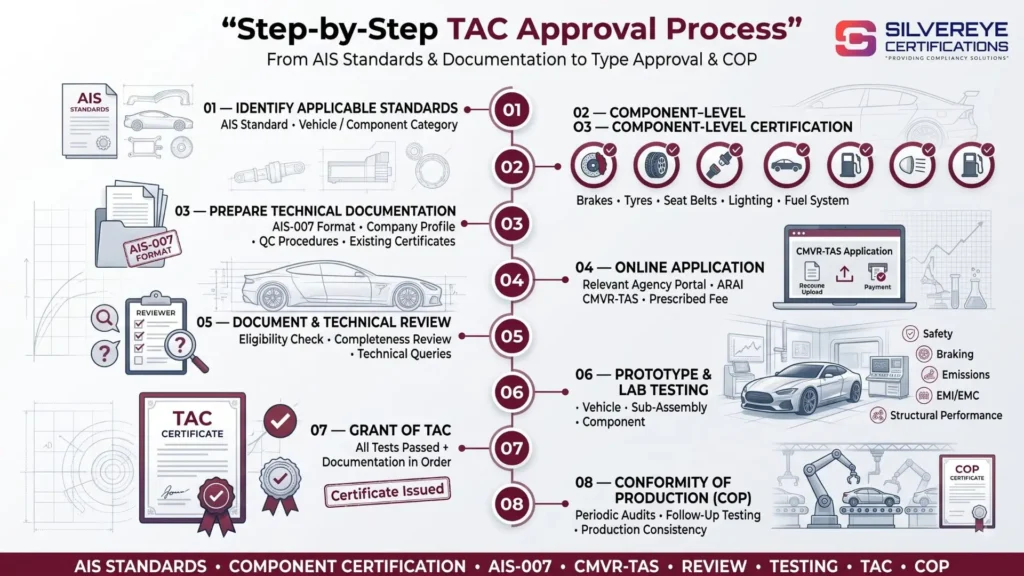
The TAC approval process in India runs through five main stages: first, identifying the correct vehicle or component category and applicable AIS standards; second, preparing technical documentation in the AIS-007 format; third, filing the application through the relevant agency's online portal — ARAI uses the CMVR-TAS system; fourth, undergoing document review and physical/laboratory testing of the prototype or sample; and fifth, receiving the grant of TAC once all requirements are met.
After that, manufacturers must maintain Conformity of Production (COP) through ongoing audits. Depending on the scale of the request, the full cycle can take anywhere from about 10 working days for a documentation-only change to 45 working days or more for a complete new-vehicle approval.
How the TAC Approval Process Works
Before diving into each stage individually, here is the process in a single sequence. Every TAC application in India — whether for a full vehicle, an engine, or an individual safety-critical component — moves through some version of these five phases:
- Category and standard identification — Determining exactly which AIS standards, CMVR rules, and vehicle/component category apply to your product.
- Documentation preparation — Compiling technical specifications, drawings, company and factory details in the prescribed AIS-007 format.
- Application filing — Submitting the application and fee through the relevant agency's online system, most commonly ARAI's CMVR-TAS portal.
- Technical review and testing — The agency scrutinises documents, then tests the prototype, sample, or sub-assembly against applicable standards.
- Grant and post-approval compliance — TAC is issued once testing is successfully completed, followed by ongoing Conformity of Production (COP) monitoring.
The sections below walk through each of these in detail, along with the documents, timelines and portals involved at every step.
Stage 1: Identifying the Correct Category and AIS Standards
This is the step that determines everything downstream — the testing agency, the specific AIS standards, the documentation format, and the eventual timeline all flow from correctly classifying your product first.
- Determine whether you are certifying a complete vehicle, an engine, or an individual component — each follows a related but distinct approval route.
- Confirm the vehicle category (L, M, N, or T/CEV) and, for electric vehicles, check threshold-based classification — for example, electric two-wheelers above 250W power and a maximum design speed over 25 km/h fall under two-wheeler type approval.
- For components, identify the specific CMVR rule and IS/AIS standard that applies. A horn fitted on a two-wheeler, for instance, is notified under Rule 119(1) of the CMVR and must meet IS 1884-1993 at the component level, in addition to AIS-014 installation requirements once fitted to a specific vehicle model.
- Map out whether any component-level certification needs to be completed before the vehicle-level application can be filed, since vehicle type approval assumes safety-critical parts are already certified.
Getting this classification wrong is one of the most common causes of delay later in the process, because it often means resubmitting documentation against a different standard partway through.
Stage 2: Preparing Technical Documentation (AIS-007 Format)
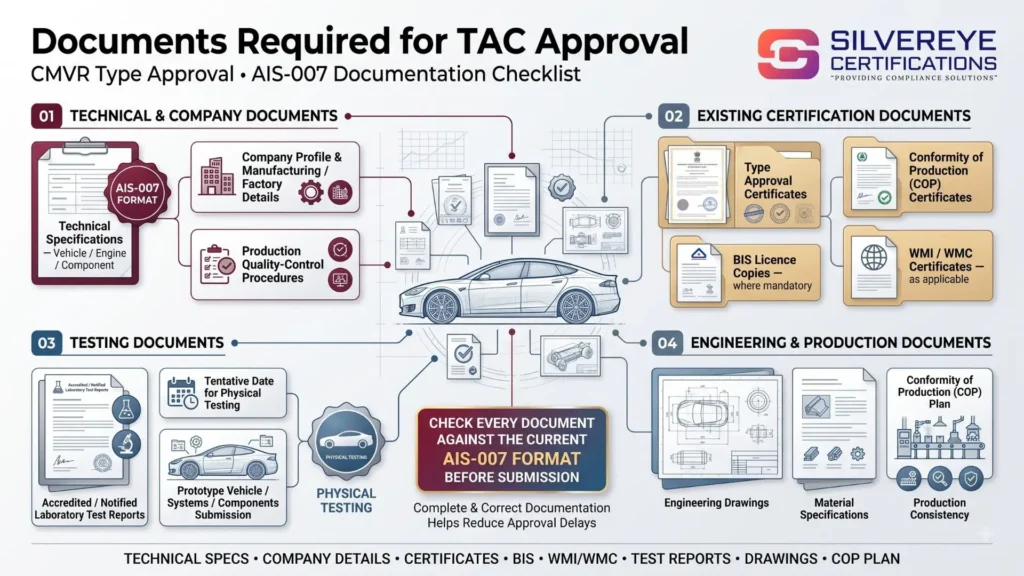
Once the category and standards are locked in, the next stage is compiling the technical documentation package. ARAI's AIS-007 format is the reference structure most vehicle and engine applications follow, and the required set typically includes:
- Technical specifications and drawings of the vehicle, engine, or component, prepared in the AIS-007 format.
- Company profile, manufacturing/factory details, and quality-control procedures followed at the production site.
- Copies of existing Type Approval Certificates and Conformity of Production certificates for any components already fitted.
- BIS license copies for safety-critical components covered under a mandatory BIS scheme, and WMI/WMC certificates as applicable.
- An authorization letter (for applications filed through an Authorized Indian Representative) and application/covering letters as prescribed by the agency.
- A tentative date for submission of the prototype vehicle, sub-assembly, or component sample for testing.
Agencies consistently flag document mismatches — between the application, technical drawings, and the physical prototype — as one of the biggest sources of avoidable clarification cycles. Cross-checking every document against the current format before submission is worth the extra day it takes.
Stage 3: Filing the Application (CMVR-TAS Portal and Agency Workflows)
Applications for vehicle and engine type approval at ARAI are filed through the CMVR Type Approval Software (CMVR-TAS) — the online portal that replaced ARAI's earlier DELTA software system, built to handle certification projects more efficiently and support an expanded set of features. ICAT, GARC and VRDE run their own comparable submission workflows for the categories they handle.
- Create an account and log in to the relevant agency's portal (CMVR-TAS for ARAI applications).
- Upload the technical documentation package and pay the prescribed application fee.
- Select the correct request grading — Type-I (documentation only), Type-II (partial technical change), or Type-III (full new-vehicle approval) — since this determines both the review depth and the timeline.
- Track application status and respond to any portal-raised queries within the stipulated window to avoid the process stalling.
For component-level applications, ARAI also provides downloadable application forms specifically for submitting technical specifications, used alongside or instead of the online portal depending on the component category.
Stage 4: Document Scrutiny and Testing
Once the application is filed, it enters a two-part review: document scrutiny followed by physical or laboratory testing.
Document and technical scrutiny
The agency verifies that the submitted documentation is complete, correctly formatted, and consistent with the product being certified. Any discrepancy — between drawings and the physical sample, for instance — is raised as a query at this stage, before testing begins.
Prototype or sample testing
The manufacturer submits the prototype vehicle, sub-assembly, Body-in-White (BIW), or component sample for testing at the agency's laboratory. Depending on the product, testing can cover:
- Braking performance and Advanced Emergency Braking System (AEBS) response under AIS-162.
- Emission testing, relevant Bharat Stage norms, and — for tractors — TREM stage requirements.
- Structural and crash safety, lighting and signalling performance, and noise levels.
- Electrical safety and EMI/EMC testing for automotive electronics and connected systems.
- For EVs specifically, thermal-runaway propagation, IPX7 water-ingress protection, and Battery Management System (BMS) performance under AIS-038 and AIS-156.
Handling non-conformities
If a test result does not meet the required standard, the agency flags it as a non-conformity. Depending on severity, this can mean an engineering correction, a part replacement, a documentation correction, submission of additional technical information, or — in more significant cases — a full retest. Building buffer time into your project plan for at least one round of corrective action is realistic rather than pessimistic.
Stage 5: Grant of TAC and Post-Approval Compliance
Once testing is successfully completed and documentation is in order, the agency grants the Type Approval Certificate in the applicant's name (or the Authorised Indian Representative's name, for foreign manufacturers). This is not, however, the end of the compliance journey:
- Conformity of Production (COP) monitoring begins immediately — the manufacturer must ensure ongoing production continues to match the exact approved type.
- Agencies can conduct periodic COP audits, and in some categories, follow-up testing, to confirm continued compliance.
- Any subsequent design, material, or key-component change requires a fresh application, graded as Type-I, Type-II, or Type-III depending on the scale of the change — treating TAC as a one-time formality is a common and costly mistake.
TAC Approval Process Timeline, Stage by Stage
| Stage | What Happens | Indicative Duration |
| Category & standard identification | Confirming applicable AIS standards, CMVR rules, and vehicle/component category | Typically self-managed before formal filing; a few days to a couple of weeks depending on product complexity |
| Documentation preparation | Compiling AIS-007 technical specs, drawings, and supporting certificates | Varies by product; 1–3 weeks is common for a well-organised applicant |
| Application filing (Type-I) | Documentation-only changes or certificate extension, no fresh testing | ~10 working days |
| Application filing (Type-II) | Partial technical changes requiring limited tests and updated documentation | ~30 working days |
| Application filing (Type-III) | Full new-vehicle approval with the complete applicable test set | ~45 working days |
| Component-level testing | Testing of individual safety-critical parts (brakes, tyres, lighting, etc.) | Roughly 3–12 weeks depending on component complexity and test scope |
| Post-grant COP monitoring | Ongoing audits confirming production continues to match the approved type | Continuous, for as long as the product remains in production |
These durations assume correct, complete documentation and timely submission of the prototype or sample. Delays most often come from incomplete paperwork, late prototype availability, or unresolved non-conformities raised during testing — all of which sit within the applicant's control to manage proactively.
Process Differences: Domestic Manufacturers vs Foreign Manufacturers
| Aspect | Domestic Manufacturer | Foreign Manufacturer |
| Applicant of record | Files and holds the TAC directly | Applies through an Authorised Indian Representative (AIR), who holds the certificate on the manufacturer's behalf |
| Documentation | Same AIS-007 format and supporting certificates | Same requirements, plus an authorisation letter appointing the AIR |
| Testing sample logistics | Prototype/sample sourced and delivered domestically | Prototype/sample typically shipped to India for in-country testing |
| Indicative timeline | Around a month is often cited as a rough domestic benchmark for simpler categories | Around two months is often cited as a rough benchmark, largely due to logistics and coordination |
Fees Involved in the TAC Approval Process
Fees are charged at more than one point in the process — an application/documentation fee at filing, and testing fees that vary based on the number and complexity of tests required. A simple component-level test naturally costs less than a full Type-III vehicle approval involving multiple prototype test cycles. Because fee schedules are revised periodically by ARAI, ICAT, GARC and VRDE, always confirm the current, category-specific fee structure directly with the agency — or through a certification consultant — before finalising your project budget.
Validity and Renewal Process
TAC is best understood as valid for as long as the product continues to be manufactured exactly as approved, rather than as a certificate with a fixed calendar expiry in every case. The renewal or amendment process itself typically follows this pattern:
- Identify the change — a design tweak, material substitution, or new variant — that triggers the need for a fresh filing.
- Determine the correct grading for the change: Type-I for documentation-only updates, Type-II for partial technical changes, or Type-III if the change is significant enough to require a full retest.
- Submit the updated documentation (and, where required, a revised prototype or sample) through the same portal used for the original application.
- Undergo review and, if applicable, testing, following the same document-scrutiny-then-testing sequence as the original TAC.
- Receive the amended or renewed certificate, and continue Conformity of Production monitoring under the updated approval.
Because validity terms and renewal triggers can vary by product category, and because sources in the public domain describe this differently — some framing it as a roughly annual validity requiring recertification, others as tied purely to unchanged production — always confirm the exact validity and renewal condition for your specific product with the certifying agency.
2026 Updates to the TAC Approval Process
CMVR-TAS portal and standard revisions
ARAI's certification workflow now runs on the CMVR Type Approval Software (CMVR-TAS), which replaced the older DELTA system to make certification projects easier to manage online. Alongside the portal update, the AIS-048 battery standard has been revised to distinguish between different battery technologies for motor vehicles and trucks, and AIS-156 and AIS-038 have been updated to require system-level battery testing for electric vehicles — a meaningful shift for EV manufacturers going through the process in 2026.
ADAS-linked process changes for buses and trucks
MoRTH's draft notification G.S.R. 184(E) proposes mandatory Advanced Driver Assistance Systems for M2, M3, N2 and N3 category vehicles — AIS-162 (Advanced Emergency Braking), AIS-184 (Driver Drowsiness Warning), AIS-186 (Blind Spot Information), AIS-187 (Moving Off Information), and AIS-188 (Lane Departure Warning) — with proposed compliance from 1 April 2026 for new models and 1 October 2026 for existing models. In process terms, this means additional test modules built into the Type-III (and in some cases Type-II) approval cycle for these vehicle categories.
Closer AIS-140 portal linkage
The AIS-140 vehicle-tracking process has moved further into enforcement in 2026, with state transport authorities increasingly linking fitness-certificate renewal to verified device registration on state VLTS portals, following a Supreme Court direction in May 2026 — making device-level type approval status a more visible checkpoint in a vehicle's ongoing compliance record, not just a one-time fitment step.
Common Process Mistakes That Cause Delays
Filing before component-level certification is complete, when the vehicle-level application assumes it already is.
- Choosing the wrong request grading (Type-I/II/III), which mismatches the review depth the agency expects against what is actually being changed.
- Inconsistent documentation — drawings, technical specifications and the physical prototype not matching each other exactly.
- Underestimating time needed to source or prepare the prototype, sub-assembly, or BIW for testing.
- Not planning for at least one round of corrective action following a non-conformity finding.
- Treating COP as a formality rather than an ongoing process, resulting in gaps discovered only at audit.
Why Choose Silvereye Certifications for TAC Approval?
- End-to-End Support: Assistance from AIS standard identification to TAC certificate issuance.
- Expert Documentation Support: Help prepare and review AIS-007 technical documents, drawings, and supporting records.
- Agency Coordination: Assistance with ARAI, ICAT, GARC, and VRDE application and testing requirements.
- Testing Support: Coordination for prototype, component, safety, emission, and other applicable testing.
- Query & Correction Support: Help address technical queries and non-conformities to reduce delays.
- COP Guidance: Continued support for Conformity of Production after TAC approval.
Conclusion
The TAC approval process involves multiple stages, from identifying applicable AIS standards and preparing documentation to application filing, testing, and final certification. Proper planning can help reduce delays and avoid unnecessary re-testing.
Silvereye Certifications helps manufacturers, importers, and brand owners manage the TAC approval process efficiently with documentation, testing coordination, agency liaison, and post-approval COP support—making the certification journey simpler, smoother, and more reliable.
Frequently Asked Questions
What are the main stages of the TAC approval process in India?
The process runs through category and standard identification, documentation preparation in the AIS-007 format, application filing through the agency's online portal, document scrutiny and testing, and finally the grant of TAC followed by ongoing Conformity of Production monitoring.
Which portal is used to apply for TAC approval?
For vehicle and engine type approval, ARAI uses the CMVR Type Approval Software (CMVR-TAS) portal, which replaced its earlier DELTA system. ICAT, GARC and VRDE run their own comparable application workflows for the categories they certify.
How long does the TAC approval process take?
It depends on the request grading: roughly 10 working days for Type-I (documentation-only) requests, 30 working days for Type-II (partial technical change) requests, and 45 working days for Type-III (full new-vehicle) requests at ARAI, assuming complete documentation and timely prototype submission.
What documents are needed to start the TAC approval process?
Typical requirements include technical specifications and drawings in the AIS-007 format, company and factory details, quality-control procedures, existing component TAC/COP certificates, BIS licenses where applicable, WMI/WMC certificates, and an authorization letter if filing through an Authorized Indian Representative.
What happens if my product fails testing during the process?
The agency flags it as a non-conformity. Depending on severity, this can require an engineering correction, part replacement, documentation correction, additional technical information, or a full retest before the process can move forward.
Can the TAC approval process be done fully online?
Application filing, document upload, fee payment and status tracking are handled through the relevant agency's online portal, but physical or laboratory testing of the prototype, sample, or component still has to happen in person at the agency's facility.
Is the process different for foreign manufacturers?
Yes. Foreign manufacturers apply through an Authorized Indian Representative (AIR), who manages the application and holds the certificate on the manufacturer's behalf. The core stages are the same, but logistics for shipping a prototype or sample to India typically add time.
What is Conformity of Production (COP) and when does it apply in the process?
COP is the ongoing compliance stage that begins right after TAC is granted, requiring the manufacturer to keep production consistent with the approved type. Agencies can conduct periodic COP audits and, in some cases, follow-up testing.
Do I need to repeat the entire process for a minor design change?
Not necessarily. Minor documentation-only changes are typically handled as a faster Type-I request, while more significant technical changes are graded Type-II or, for major changes, a full Type-III retest.
What process changes came into effect in 2026?
Key 2026 process changes include the CMVR-TAS portal replacing the older DELTA system, a revised AIS-048 battery standard and system-level EV battery testing under AIS-038/AIS-156, additional ADAS test modules for M2/M3/N2/N3 vehicles under draft notification G.S.R. 184(E), and closer linkage between AIS-140 device registration and fitness-certificate renewal on state portals.
How much does the TAC approval process cost?
Costs include an application/documentation fee and testing fees that scale with the number and complexity of tests required. There is no single flat figure — confirm the current, category-specific fee schedule with ARAI, ICAT, GARC or VRDE, or through a certification consultant, before budgeting.