- Every printing press that prints a registered periodical in India must file an online intimation to PRGI, not a separate “RNI registration” of its own.
- The core compliance document is Form-IV (Printer's Certificate), which in 2026 requires the press's GST number and Press Registration Certificate details.
- Printers must digitally co-sign the Form-I declaration alongside the publisher before a periodical can be registered.
- Failure to file printer intimation or keep printed imprint-line details accurate can attract penalties under the PRP Act, 2023.
Introduction: Why Printing Presses Need to Understand RNI/PRGI Rules
RNI registration for printing press refers to the legal obligation of every printer that prints a registered newspaper, magazine, or periodical to furnish an online intimation to the Press Registrar General of India (PRGI) through the Press Sewa Portal. Rather than a standalone certificate, this involves submitting Form-IV (Printer's Certificate), the press's GST registration number, address and identity proof, and a signed printing press agreement with the publisher.
Under the Press and Registration of Periodicals Act, 2023, this intimation must generally be filed within 30 days of the press commencing operations, and the printer must also digitally co-sign the publisher's Form-I declaration before the periodical itself can be registered.

If you run a printing press that prints newspapers, magazines, or other periodicals in India, you are not a bystander in the RNI registration process — you are a legally recognized party to it. Under the Press and Registration of Periodicals Act, 2023 (PRP Act), Chapter II specifically deals with “Printing Press and Periodical,” placing direct compliance duties on printers alongside publishers and owners.
What is RNI Registration For Printing Press?
Unlike a newspaper or magazine, a printing press does not receive its own “RNI certificate.” Instead, the PRP Act, 2023 requires every printer of a periodical to furnish an intimation on the online Press Sewa Portal to the Press Registrar General and the specified local authority, with prescribed particulars about the press. This is a separate but connected compliance step from the periodical's own registration — you cannot legally print a registered periodical without your press's details being on record with PRGI.
The Act also introduces two important terms that printing press owners should know. “Printer” means the printing press's owner or keeper. “Keeper” means the person who manages the day-to-day operations of a printing press where the owner is a non-individual entity (such as a company or partnership). Both roles carry compliance responsibility under the law.
Benefits of Completing Printer Intimation & RNI Compliance
- Legal right to print registered periodicals: Without valid printer intimation, a press cannot lawfully print a periodical registered with PRGI.
- Smoother publisher relationships: Publishers actively check whether a press has completed its PRGI intimation before signing a printing agreement.
- Faster periodical registration: A press with clean, complete intimation records helps publishers avoid delays during their own RNI/PRGI application.
- Protection from penalties: Proper compliance protects the press from monetary penalties and potential action under the PRP Act, 2023.
- Stronger business credibility: Being on PRGI's verified printer record signals legitimacy to publishers, advertisers, and government bodies.
Who Needs to Complete RNI/PRGI Printer Intimation?
- Any printing press that prints a periodical carrying public news or commentary on public news, whether a daily newspaper, weekly, monthly magazine, or journal.
- New printing presses commencing operations and intending to print a registered periodical for the first time.
- Existing presses that have changed ownership, keeper, address, or machinery capacity and need to update their PRGI records.
- Presses taking on a new publisher/periodical contract, since Form-IV must reflect the specific periodical being printed.
Presses that only print books, stationery, commercial materials, or purely academic/scientific/technical journals (which fall outside the PRP Act's definition of “periodical”) generally do not need to complete this intimation for that work.
Documents Required for RNI Registration For Printing Press
Here is the document checklist a printing press needs to complete its PRGI intimation and support a publisher's registration:
| Document | Purpose |
| Form-IV (Printer's Certificate) | Core certificate signed by the press owner/keeper confirming agreement to print the periodical |
| Press owner/keeper identity proof (Aadhaar/PAN/Passport) | Verifies the individual responsible for the press |
| Press address proof (utility bill, property papers, rent agreement) | Confirms the registered location of the printing press |
| GST Registration Number | Now required as part of Form-IV details for 2026 filings |
| Press Registration Certificate Number (if applicable) | State-level press registration/licensing reference, where mandated locally |
| Printing press agreement | Signed agreement between the printer and publisher confirming printing terms |
| Machinery/capacity details | Basic operational details of the press, as prescribed on the portal |
| Digital signature / e-Sign for Form-I co-signing | Required for the printer to digitally co-sign the publisher's Form-I declaration |
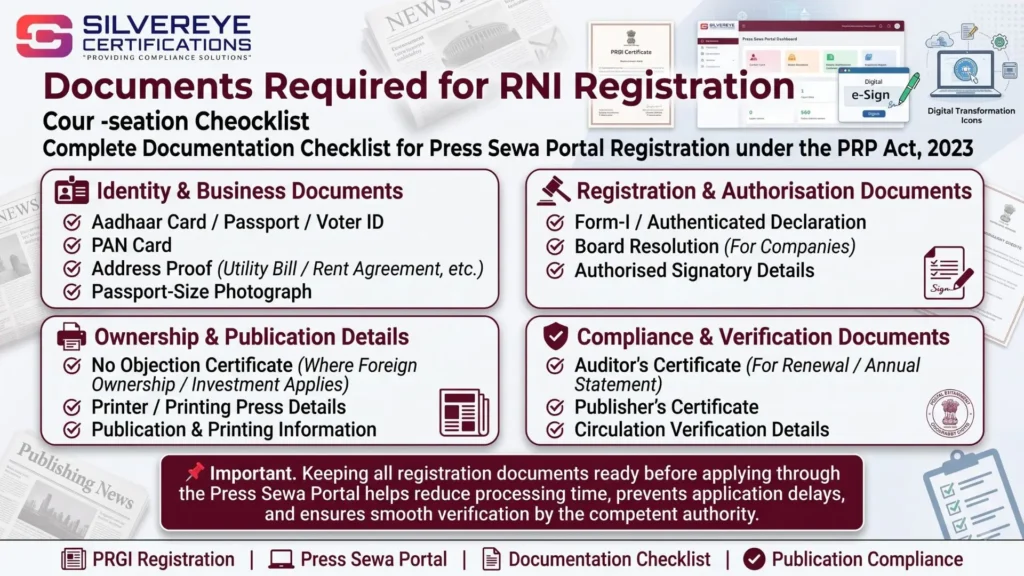
Keep both scanned soft copies (for portal upload) and physical originals on hand, since PRGI or the specified local authority can request verification at any stage. Document requirements are periodically refined, so always confirm the latest fields on the official Press Sewa Portal before filing.
Step-by-Step Process: How a Printing Press Completes RNI/PRGI Intimation
- Create a printer profile on the Press Sewa Portal using the press owner's or keeper's Aadhaar/PAN details.
- Enter the press's registered address, GST registration number, and basic operational/machinery details as prescribed.
- Upload Form-IV (Printer's Certificate) confirming the press's agreement to print the specific periodical.
- Upload the signed printing press agreement between the publisher and the printer.
- Digitally co-sign the publisher's Form-I declaration when the publisher initiates the periodical's registration or renewal.
- Submit the intimation to the Press Registrar General and the specified local authority within the prescribed time — generally within 30 days of the press commencing operations.
- Respond promptly to any Deficiency Communication from PRGI regarding missing or mismatched printer details.
- Once verified, the press's details are recorded against the periodical's registration, allowing lawful printing to begin or continue.
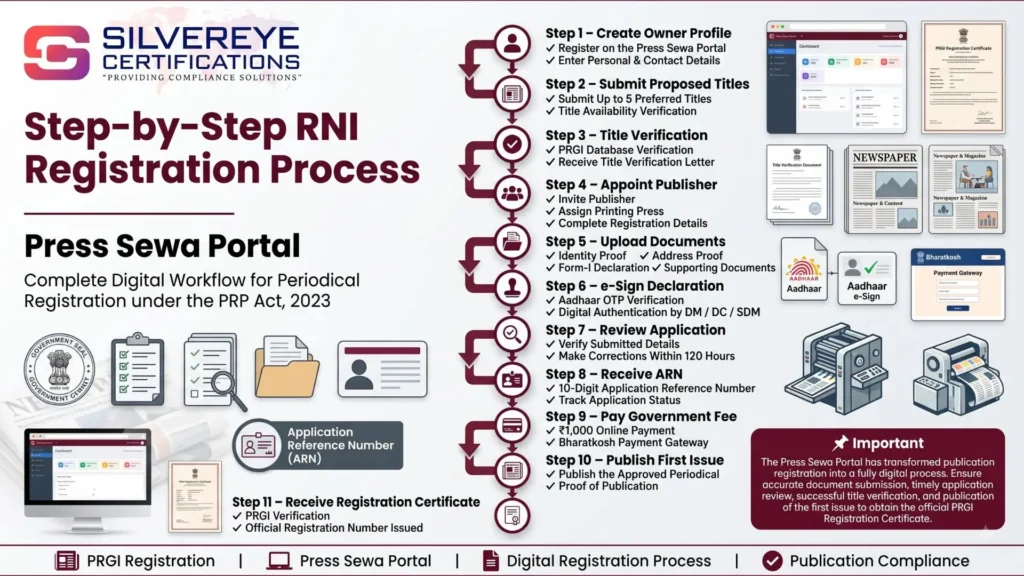
Note that this intimation runs alongside — not instead of — the periodical owner/publisher's own registration process. A periodical's Certificate of Registration cannot be finalized until the printer's details and Form-IV are verified on the Press Sewa Portal.
The Imprint Line: A Printing Press's Ongoing Legal Duty
Beyond one-time intimation, the PRP Act, 2023 places a continuing obligation on every periodical: it must legibly print the name of the printer, the place of printing, the editor, the publisher, and the place of publication on every issue.
This is commonly known as the imprint line or print line, and it is the printing press's responsibility to ensure this information is accurate and legible on every copy printed. Errors or omissions in the imprint line are a common reason applications and printed issues get flagged during verification.
Fees Related to Printing Press RNI/PRGI Compliance
| Component | Approximate Cost | Notes |
| Printer intimation filing | No separate government fee currently notified | Filed as part of the online Press Sewa Portal process |
| Periodical's own registration fee (paid by owner/publisher) | ₹1,000 | Paid via Bharatkosh; not a printer-specific cost |
| Notarisation of printing press agreement (where used) | Varies by notary/state | Depends on local documentation practice |
| Consultant/professional charges (optional) | Varies by service provider | For document preparation and portal filing support, e.g. Silvereye Certifications |
There is no separate large government fee specifically for printer intimation — the ₹1,000 registration fee is paid by the periodical's owner/publisher, not the press. Always verify current fee notifications on the official Press Sewa Portal, as PRGI updates these periodically.
Validity, Updates & Renewal for Printing Press Records
- Printer intimation is not a one-time-forever record — any change in press ownership, keeper, address, or machinery capacity must be updated on the Press Sewa Portal.
- If a press starts printing a new periodical, a fresh Form-IV specific to that periodical is required.
- When a publisher renews or files their Annual Statement, accurate, up-to-date printer details help avoid processing delays.
- Presses that stop printing a periodical should ensure this is reflected in the periodical's records to avoid future compliance confusion.
Latest 2026 Updates Affecting Printing Press Registration
- Form-IV now requires the printing press's GST Registration Number as a mandatory field, tightening verification of genuine, tax-compliant presses.
- Digital co-signing between publisher and printer on Form-I has become the standard practice under the Press Sewa Portal, replacing older physical declaration formats.
- Time-bound response requirements for Deficiency Communications during Circulation Verification through Desk Audit apply to printer-related discrepancies as well.
- Continued emphasis on single-window digital processing, with the specified local authority and PRGI reviewing printer and publisher submissions on the same online system.
Because PRGI advisories are updated from time to time, printing press owners should regularly check the official notice board on the Press Sewa Portal for the latest requirements.
Penalties & Compliance Risks for Printing Presses
The PRP Act, 2023 places clear obligations on printers, and non-compliance carries real consequences. Common risk areas for printing presses include:
- Printing a registered periodical without completing the required intimation to PRGI and the specified local authority.
- Inaccurate or missing imprint-line details (printer name, place of printing, editor, publisher, place of publication) on printed copies.
- Failing to update press records after a change in ownership, keeper, or address.
- Printing a periodical whose registration has been suspended or cancelled by PRGI.
Chapter V of the PRP Act, 2023 empowers the Press Registrar General to take penalty action for such lapses, though affected parties are entitled to a hearing before any final penalty or suspension is imposed.
Common Mistakes Printing Presses Make During RNI/PRGI Compliance
- Assuming intimation is optional or only the publisher's responsibility — it is a distinct legal duty on the printer as well.
- Submitting Form-IV without the GST Registration Number now required for 2026 filings.
- Printing a periodical before the printing press agreement and Form-IV are actually finalised and uploaded.
- Letting imprint-line details go stale after an address or ownership change, creating a mismatch with PRGI records.
- Delaying response to a Deficiency Communication, which can hold up the publisher's entire registration or renewal.
How Silvereye Certifications Helps Printing Presses With RNI/PRGI Compliance
Printing press owners often juggle multiple publisher relationships, each requiring its own Form-IV and printing agreement. Silvereye Certifications is a compliance and regulatory consulting firm that helps printing presses, publishers, and periodical owners navigate RNI/PRGI documentation and filing on the Press Sewa Portal.
- Guidance on preparing Form-IV correctly, including the GST Registration Number and other 2026 requirements.
- Support drafting and organising printing press agreements with publishers.
- Assistance with the online intimation process and responding to Deficiency Communications.
- Ongoing compliance reminders so press records stay current after any change in ownership, keeper, or address.
Silvereye Certifications is a private consulting firm and does not issue government certificates or approvals; all intimation records and registration certificates are managed solely by the Press Registrar General of India (PRGI). For professional support with your printing press's RNI/PRGI compliance, you can reach out to Silvereye Certifications for consultation-based assistance.
Conclusion
RNI registration for printing press isn't a separate certificate to chase — it's an ongoing compliance relationship with PRGI built around accurate intimation, a properly filed Form-IV, a clear printing press agreement with your publisher, and a legible, accurate imprint line on every issue you print. Get these fundamentals right, keep your GST and address details current, and respond quickly to any Deficiency Communication, and your press will stay fully compliant while helping every publisher you work with sail through their own RNI/PRGI registration without delay.
Frequently Asked Questions
Does a printing press need its own RNI registration certificate?
No. A printing press doesn't get a separate RNI certificate; instead, it must furnish an online intimation to PRGI and the specified local authority through the Press Sewa Portal.
What is Form-IV in RNI registration for a printing press?
Form-IV is the Printer's Certificate, signed by the press owner or keeper, confirming the press's agreement to print a specific registered periodical. For 2026 filings, it also requires the press's GST Registration Number.
How long does a printing press have to file intimation with PRGI?
Printing presses are generally expected to furnish intimation within 30 days of commencing operations, though exact timelines should always be confirmed on the current Press Sewa Portal guidelines.
What is the difference between a printer and a keeper under the PRP Act, 2023?
“Printer” refers to the printing press's owner or keeper. “Keeper” specifically means the person managing day-to-day operations of a press where the owner is a non-individual entity, such as a company.
Does a printing press need to be involved in the Form-I declaration?
Yes. Under current Press Sewa Portal practice, the printer must digitally co-sign the publisher's Form-I declaration before the periodical's registration can be finalised.
What is the imprint line and who is responsible for it?
The imprint line is the legally required text on every issue showing the printer's name, place of printing, editor, publisher, and place of publication. Keeping this accurate is a shared responsibility, with the printing press directly accountable for print accuracy.
Is there a government fee for printer intimation?
There's no separate large government fee specifically for printer intimation; the ₹1,000 registration fee applies to the periodical's own registration, paid by the owner/publisher, not the press.
What happens if a printing press doesn't complete its PRGI intimation?
Printing a registered periodical without completed intimation is a compliance lapse under the PRP Act, 2023, and can expose the press to penalty action, subject to a hearing before PRGI.
Do book printers or commercial presses need this RNI/PRGI intimation?
Generally no — this obligation applies specifically to presses printing periodicals carrying public news or commentary on public news, not books, stationery, or purely commercial print work.
Can a printing press work with multiple publishers at once?
Yes, but each periodical it prints needs its own Form-IV and printing press agreement reflecting that specific publisher relationship.
What documents does a printing press need to update if it changes address?
The press should update its address proof, GST details if applicable, and any active Form-IV records on the Press Sewa Portal to keep PRGI's records accurate.