
- Explains eligibility, documents, fees by district scope, and the full registration process for a PSARA license in Delhi.
- Covers the Home Department, Government of NCT of Delhi, as Controlling Authority and the Form-I to Form-VI verification chain.
- Details the May 2026 amendment that removed criminal liability under Sections 12 and 20(2) of the PSARA Act.
- Written for security agency founders, HR heads, and facility managers operating across New Delhi, South Delhi, Dwarka, and the wider NCT.
Introduction
A PSARA license in Delhi is the mandatory authorization issued under the Private Security Agencies (Regulation) Act, 2005, by the Controlling Authority functioning under the Home Department, Government of NCT of Delhi, in coordination with Delhi Police for verification. It allows a company, LLP, partnership, or proprietorship to legally run a private security agency in Delhi, and can be sought for a single district, up to five districts, or the entire NCT, with the government fee rising accordingly.
The applicant must sign an MoU with a recognized training institute and clear police verification of all directors and the Principal Officer before the license is granted in Form VI. It is valid for five years, and guidance varies on renewal timing — most sources recommend filing 45 to 90 days before expiry. A May 2026 MHA amendment also removed criminal liability for certain procedural lapses under Sections 12 and 20(2), though operating without a license remains a criminal offence.
What Is a PSARA License in Delhi?
A PSARA license is the legal permission a private security agency needs before deploying guards, supervisors, or armoured-car crews anywhere in the National Capital Territory of Delhi. It is issued under the Private Security Agencies (Regulation) Act, 2005, with the Home Department, Government of NCT of Delhi, serving as the Controlling Authority responsible for granting, renewing, suspending, or cancelling licenses, while Delhi Police carries out the antecedent verification of directors and key personnel.
Delhi issues the PSARA license under the same district-tiered model used across most states: an applicant can seek a license for a single district, up to five districts, or the entire NCT, and the government fee scales with the scope chosen. Agencies that also want to operate outside Delhi — say, alongside Gurugram or Noida — need a separate PSARA license from each additional state's Controlling Authority, since Delhi's license only covers operations within the NCT.
Who Needs a PSARA License in Delhi?
Any proprietorship, partnership, LLP, or company that supplies private security personnel for payment anywhere in Delhi needs a PSARA license before starting operations. This covers agencies providing:
- Security guards for corporate offices, malls, hospitals, embassies-adjacent commercial premises, and residential societies across Delhi
- Supervisors who oversee deployed guards on client sites
- Bouncers and event security personnel for Delhi's large corporate-event and wedding-venue industry
- Armoured car and cash-in-transit services for banks and ATMs
- Training services, where the agency itself also trains aspiring guards
As the national capital with a dense concentration of corporate headquarters, government buildings, diplomatic missions, and high-footfall commercial hubs, Delhi has some of the highest private security deployment in the country — and a valid PSARA license has become a standard, non-negotiable requirement in most corporate and institutional security tenders.
Benefits of a PSARA License Registration
- Legal authority to operate in your chosen district, five-district group, or across the whole NCT without risking criminal prosecution for unlicensed operation.
- Eligibility for corporate, institutional, and government tenders across Delhi that list a valid PSARA license as a mandatory bid condition.
- Stronger client trust, since the license signals police-verified directors and a formal training tie-up for guards.
- Smoother access to EPF, ESI, and banking relationships once the agency is a recognized licensed entity.
- A documented compliance record that helps during client audits and departmental inspections.
Eligibility Criteria for a PSARA License in Delhi
For the Agency
- Must be incorporated or registered in India — proprietorship, partnership, LLP, or company — with a registered office address in Delhi.
- The agency's name must include "Security Agency" or "Security Services" and must not imply government backing.
- Must sign an MoU with a training institute recognized for guard and supervisor training.
- Must commence operations within six months of registration, as required under the Act.
For Directors, Partners, and the Principal Officer
- Must be Indian citizens, at least 18 years of age.
- Must clear police antecedent verification, with no conviction involving moral turpitude.
- Must not have been dismissed from government service for misconduct.
- A background in the police, paramilitary, or armed forces, or a recognized security-training qualification, strengthens the Principal Officer's profile.
For Security Guards and Supervisors
- Indian resident, between 18 and 65 years of age, meeting the physical standards prescribed under the Act.
- Clean character certificate and no record of dismissal for misconduct.
- Must complete the training prescribed under Section 9 of the Act before deployment.
- Ex-servicemen and former police personnel receive preference in recruitment under the Act.
Documents Required for PSARA License Registration in Delhi
| Category | Typical Documents |
| Agency / Entity | Certificate of incorporation or partnership deed, PAN, GST registration, proof of registered office address in Delhi |
| Directors / Partners / Principal Officer | PAN and Aadhaar, passport-size photographs, address proof, income-tax returns of the last three years, character certificate, affidavit of no prior conviction |
| Police Verification | Form-I application for antecedent verification of every director/partner, filed separately for each person in the case of a company, LLP, or partnership |
| Training Tie-Up | Signed MoU with a recognised training institute, training affidavit as required under the Act |
| Statutory Registrations | EPF and ESI registration once guards are employed, GST registration, Shops & Establishment registration |
| Ongoing Guard Records | Guard-wise identity, training-certificate, and deployment registers maintained as prescribed by the Controlling Authority |
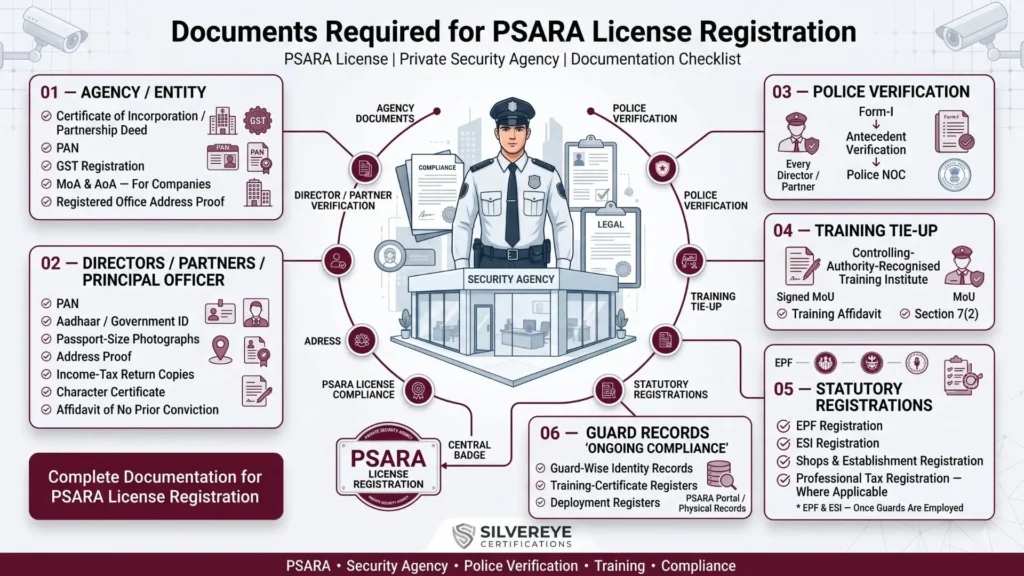
Delhi's application process runs through an online portal, so scanned copies of all the above documents should be clear, correctly named, and within the file-size limits set by the portal before upload.
Step-by-Step PSARA License Registration Process in Delhi
- Register or confirm the business structure (proprietorship, partnership, LLP, or company) with a registered office in Delhi.
- Decide the geographic scope — one district, five districts, or the entire NCT of Delhi — since the fee and application depend on this choice.
- Sign an MoU with a recognized training institute for guard and supervisor training.
- Compile the entity, director, and premises documents, along with the affidavits required under the Act.
- File Form-I with the Controlling Authority to initiate antecedent and police verification for every director and partner.
- Delhi Police conducts local background verification of all directors, partners, and key personnel named in the application.
- On receiving a satisfactory verification report, the Controlling Authority reviews the complete file and grants the PSARA license in Form VI, or communicates deficiencies for resolution.
- Once licensed, enrol guards and supervisors in the prescribed training, maintain statutory registers, and display the license at the registered office.
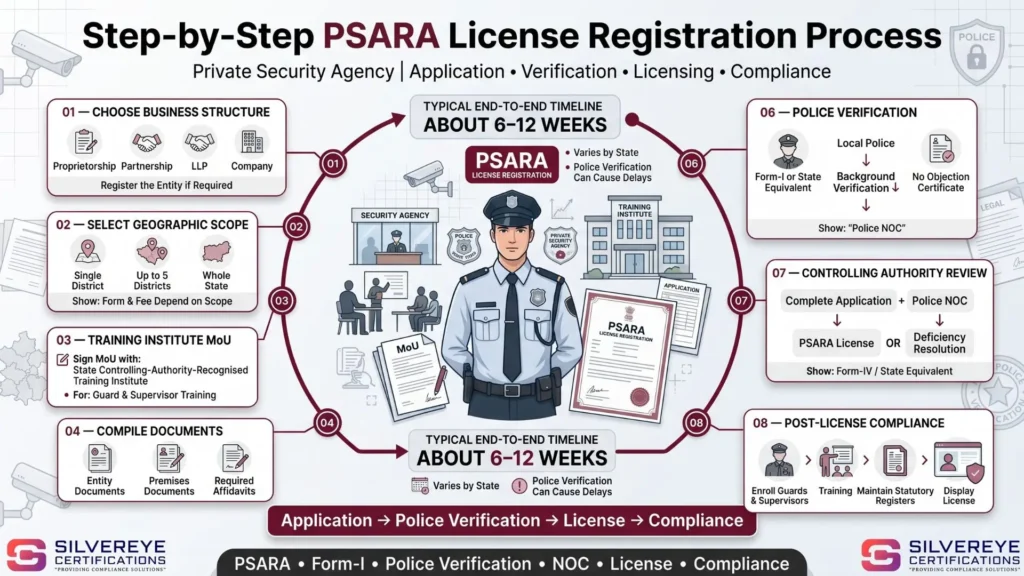
Most sources place Delhi's typical processing time at around 45 to 60 days for a complete application with smooth police verification, though a few consultants advertise faster turnarounds — treat those as best-case claims rather than a guarantee, since verification timelines depend on individual police stations.
PSARA License Fees in Delhi
Delhi follows the same district-tiered government fee structure used under the Act's model rules, with the amount depending on how many districts the license covers. These fees are exclusive of GST, and separate costs apply for the training-institute tie-up and any professional or consultant assistance. Since fee notifications can be revised, always confirm the current amount with the Controlling Authority before filing.
| License Scope | Government Fee (indicative)* |
| Single district in Delhi | ₹5,000 |
| Up to five districts in Delhi | ₹10,000 |
| Entire NCT of Delhi | ₹25,000 |
Figures reflect the fee structure commonly cited for Delhi's PSARA applications and exclude GST, training-institute charges, and any consultant fees. Confirm the current government fee with the Controlling Authority before submitting your application.
Validity and Renewal Timeline in Delhi
A PSARA license issued in Delhi is valid for five years from the date of issue, matching the standard cycle followed by most Indian states. Guidance on the renewal window varies by source — some cite a minimum of 45 days before expiry, while others recommend filing at least 90 days ahead to allow time for fresh police verification and any updated documents. Given this variation, it's sensible to treat 90 days as the safer target and confirm the current requirement with the Controlling Authority well in advance.
If a license is allowed to lapse without a timely renewal, the agency risks having to file as a fresh applicant rather than a straightforward renewal — restarting police verification and potentially disrupting ongoing client contracts. Building in a wide buffer before expiry is the more reliable approach.
The 2026 PSARA Update: Decriminalization of Sections 12 and 20(2)
The most important regulatory change for private security agencies nationwide in 2026 — and one that applies directly to Delhi-licensed agencies as well — came from the Ministry of Home Affairs. On 2 May 2026, the MHA issued a notification, effective 15 May 2026, omitting Section 12 and Section 20(2) of the Private Security Agencies (Regulation) Act, 2005.
In practical terms: before 15 May 2026, an agency that failed to display its license at its registered office (a Section 12 requirement), or that was found violating training norms under Section 9 or guard-eligibility norms under Section 10, could face criminal prosecution — a fine up to ₹25,000 and possible suspension or cancellation, treated as a criminal matter under Section 20(2). From 15 May 2026 onward, these specific procedural lapses are no longer criminal offences. Delhi's Controlling Authority still retains full power to suspend or cancel a license for genuine non-compliance — only the criminal-prosecution route for these technical lapses has been removed.
What still applies in full, including in Delhi:
- Operating without a valid PSARA license remains a criminal offence under Section 4 read with Section 20(1), carrying a fine and imprisonment of up to one year.
- Training standards for guards and supervisors under Section 9 must still be fully met.
- Guard eligibility norms under Section 10 — age, citizenship, character verification, physical fitness — remain mandatory.
- Unauthorized use of military or police uniforms by private security personnel continues to be a criminal offence.
This change followed sustained industry advocacy at the national level, including a March 2026 review meeting at the MHA that raised concerns about license-renewal pendency and inconsistent state-wise implementation — concerns that are especially relevant in Delhi, given the sheer density of licensed agencies operating across the NCT and the high volume of applications the Controlling Authority processes each year.
Compliance Obligations After Getting a Delhi PSARA License
- Display the license at the registered office as required by the Act.
- Deploy only guards who have completed the prescribed training and cleared antecedent verification.
- Maintain updated registers of employees, training records, and site deployment, available for inspection by the Controlling Authority.
- Appoint supervisors in the ratio prescribed under the Act (commonly one supervisor for every fifteen guards).
- Report any change in directors, Principal Officer, or registered office address to the Controlling Authority promptly.
- Complete EPF and ESI registrations once guards are on payroll and keep statutory dues current.
- File the renewal application well ahead of expiry — targeting a 90-day buffer rather than the bare 45-day minimum some sources cite.
Penalties for Non-Compliance
Operating a private security agency in Delhi without a valid PSARA license is a criminal offence under Section 4 read with Section 20(1) — a fine that can extend up to ₹25,000 and imprisonment of up to one year, or both, with continuing violations attracting further action.
Genuine non-compliance with training or guard-eligibility norms can still lead to suspension or cancellation of the license by the Controlling Authority, and any order refusing or cancelling a license must record the specific reasons, giving the applicant a fair opportunity to be heard. Even though the May 2026 amendment removed criminal prosecution for certain procedural lapses under Sections 12 and 20(2), a cancelled or blacklisted license can still prevent the owners from securing a fresh license later — so ongoing compliance, not a one-time filing, is what protects the business.
Common Mistakes to Avoid
- Assuming the Delhi license covers operations in Gurugram, Noida, or Ghaziabad — it does not; each state needs its own separate PSARA license.
- Filing Form-I with inconsistent director details across different applicants, which slows down police verification.
- Choosing too narrow a district scope at filing — expanding coverage later means a fresh application, not a simple upgrade.
- Delaying the training-institute MoU, which stalls the entire application file.
- Treating the 2026 decriminalization update as a reason to relax training, display, or guard-eligibility compliance.
How Silvereye Certifications Can Help
Getting a PSARA license in Delhi — choosing the right district scope, assembling director and premises documents, coordinating police verification, and tying up with a recognized training institute — takes real time away from actually running a security business. Silvereye Certifications works with security agencies and facility management companies operating across New Delhi, South Delhi, Dwarka, and the wider NCT to prepare PSARA applications, track verification status, and manage renewals well before expiry, so license continuity never becomes a business risk.
Frequently Asked Questions
What is a PSARA license in Delhi?
It is the mandatory authorization issued under the Private Security Agencies (Regulation) Act, 2005, by the Controlling Authority functioning under the Home Department, Government of NCT of Delhi, allowing a business to legally provide private security services in Delhi.
Can I get a PSARA license for just one district in Delhi?
Yes. Delhi allows applicants to choose a single district, up to five districts, or the entire NCT, with the government fee rising at each tier.
How long is a PSARA license valid in Delhi?
A PSARA license issued in Delhi is valid for five years from the date of issue, in line with most Indian states.
When should I apply for PSARA license renewal in Delhi?
Guidance varies — some sources cite a minimum of 45 days before expiry, while others recommend 90 days. It's safer to start the renewal process at least 90 days ahead.
How much does a PSARA license cost in Delhi?
The commonly cited government fee is ₹5,000 for a single district, ₹10,000 for up to five districts, and ₹25,000 for the entire NCT of Delhi, exclusive of GST and training-institute or consultant charges.
How long does it take to get a PSARA license in Delhi?
Most guidance places the typical timeline at around 45 to 60 days for a complete application, though the actual duration depends heavily on how quickly police verification is completed.
What documents are required for a PSARA license in Delhi?
Core documents include the entity's incorporation proof, PAN and GST registration, director identity and address proof, income-tax returns, character certificates, a signed MoU with a recognised training institute, and Form-I for police verification.
What happens if an agency operates in Delhi without a PSARA license?
It is a criminal offence under Section 4 read with Section 20(1) of the Act, attracting a fine of up to ₹25,000, imprisonment of up to one year, or both, along with immediate exposure to enforcement action against the business.
What changed in the PSARA Act in 2026, and does it apply in Delhi?
Yes — effective 15 May 2026, the MHA omitted Sections 12 and 20(2) of the Act nationwide, removing criminal liability for certain procedural lapses such as not displaying the license. Delhi's Controlling Authority can still suspend or cancel a license for genuine non-compliance, and operating without a license, plus training and guard-eligibility norms, remain fully enforceable.
Does a Delhi PSARA license allow operations in Gurugram or Noida?
No. PSARA licensing is state-wise, and Delhi's license covers only the NCT; an agency operating in Gurugram (Haryana) or Noida (Uttar Pradesh) needs a separate PSARA license from each state's Controlling Authority.
Is police verification mandatory for a PSARA license in Delhi?
Yes. Every director, partner, or proprietor must undergo police antecedent verification through Form-I, conducted by the local Delhi Police, before the Controlling Authority grants the license.
What form is used to grant a PSARA license in Delhi?
Once verification is complete and the Controlling Authority is satisfied, the PSARA license in Delhi is issued in Form VI.