

- BEE Star Rating for distribution transformers is mandatory in India, rating units by their energy losses under IS 1180 (Part 1) and the IS 2026 series.
- Unlike household appliances, transformers are rated on no-load (core) and load (copper) losses — lower total losses mean higher efficiency and more stars.
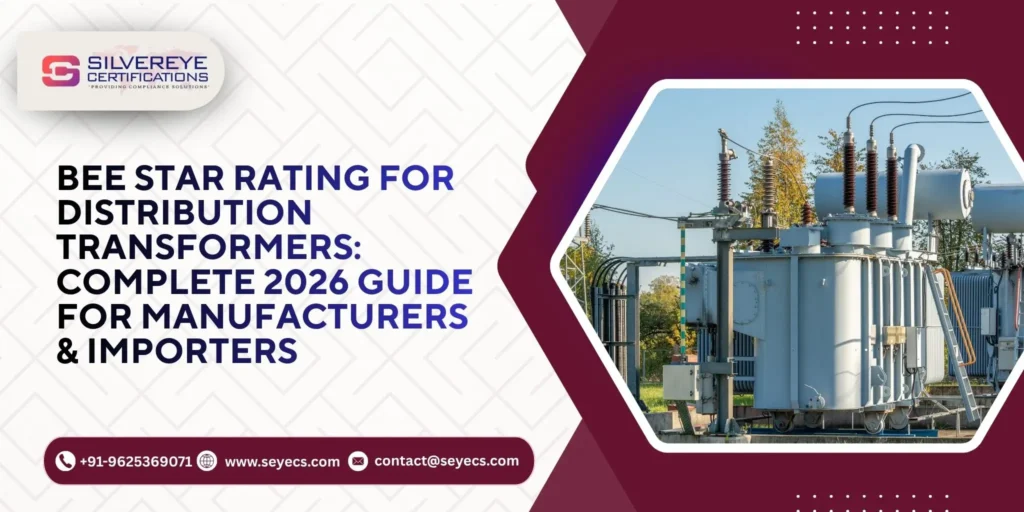
- The scheme covers outdoor oil-immersed distribution transformers up to 2500 kVA and 33 kV, with standard ratings including 10, 16, 25, 63, 100, 160 and 200 kVA.
- Since 2026, utilities, EPCs and industrial buyers increasingly specify star-labelled transformers in tenders, making certification a genuine procurement requirement, not just a compliance formality.
Introduction
BEE Star Rating for Distribution Transformers is India's energy-efficiency labelling scheme for outdoor oil-immersed distribution transformers, run by the Bureau of Energy Efficiency under the Ministry of Power. Star labelling for this category was made mandatory from January 1, 2026 as part of BEE's wider 2026 expansion.
Unlike appliances rated on power consumption, transformers are rated on their energy losses — specifically no-load (core) losses and load (copper) losses — measured against IS 1180 (Part 1), read with the IS 2026 series and IS 2500 (Part 1). Lower total losses earn a higher star rating, up to 5 stars.

Because distribution transformers run continuously and there are millions installed across India's grid, even small efficiency gains at this level translate into substantial national energy savings, which is why utilities and EPC contractors now specify star-rated transformers in procurement tenders.
What Is BEE Star Rating for Distribution Transformers?
BEE Star Rating for Distribution Transformers is the energy-efficiency label issued by India's Bureau of Energy Efficiency (BEE), under the Ministry of Power, for the transformers that step down medium-voltage power to the 415/240 V supply used in homes, offices and industrial premises. These are, quite literally, the workhorses of the Indian power grid — running continuously, in enormous numbers, largely unnoticed.
That scale is exactly why this category matters so much for national energy conservation. A single transformer's efficiency gain looks small on paper, but multiplied across the millions of distribution transformers installed nationwide, even a modest reduction in losses adds up to a genuinely significant cut in India's overall transmission and distribution losses.
The technical foundation for this scheme is IS 1180 (Part 1), which covers outdoor oil-immersed distribution transformers up to 2500 kVA and 33 kV, read together with the IS 2026 series and IS 2500 (Part 1) for construction, testing and performance requirements.
Why BEE Star Rating for Distribution Transformers Matters
- It's now a mandatory compliance requirement: selling or installing a non-compliant, unlabelled distribution transformer in India can result in penalties, legal action and market restrictions.
- The scale effect is real: with millions of transformers running 24/7 across the grid, efficiency improvements here have an outsized impact compared to almost any consumer appliance category.
- Procurement leverage: utilities, EPC contractors and large industrial buyers increasingly write star-rating requirements directly into tender specifications, making certification a market-access issue, not just a legal one.
- Lower operating costs downstream: certified, higher-star transformers reduce transmission losses and cut operational costs for the utilities and industries that install them.
How Is the Transformer Star Rating Calculated?
Distribution transformers aren't rated on how much power they draw — they're rated on how little energy they waste as heat while doing their job. This waste is measured as losses, and BEE's star rating is built entirely around two loss components:
- No-load losses (core losses): the energy lost continuously in the transformer's magnetic core, whether or not the transformer is actually supplying load at any given moment.
- Load losses (copper losses): the energy lost in the windings as current flows through them, which increases as the transformer's actual load increases.
The combined total of these losses, measured against the transformer's rated capacity under IS 1180 test conditions, determines the star band. Lower total losses at a given kVA rating mean a higher star rating — a 5-star transformer wastes meaningfully less energy as heat than a 1- or 2-star unit of the same capacity, even though both deliver the same output.
For context, industry references cite loss limits at defined load percentages and a standard reference temperature of 75°C for oil-filled units — for example, a maximum permitted loss figure at 50% load is specified for each star band and kVA rating, giving manufacturers a precise, testable engineering target rather than a vague efficiency goal.
Scope: Which Transformers Does This Cover?
| Parameter | Coverage |
| Transformer type | Outdoor, oil-immersed distribution transformers |
| Capacity range | Up to 2500 kVA |
| Voltage class | Up to 33 kV |
| Standard kVA ratings under the scheme | Commonly cited ratings include 10, 16, 25, 63, 100, 160 and 200 kVA, among others |
| Applicable standards | IS 1180 (Part 1), read with the IS 2026 series and IS 2500 (Part 1) |
If your transformer falls outside this scope — for instance, a much larger power transformer or a dry-type unit governed by a different IS 2026 part — confirm the applicable BEE and BIS requirements separately, since the star labelling framework described here is specific to this defined category.
Who Needs BEE Certification For Distribution Transformers?
- Domestic transformer manufacturers producing oil-immersed distribution transformers within scope must register the brand and every rated capacity/model variant.
- Importers bringing distribution transformers into India for commercial or utility supply must register in their own name, with the appropriate authorisation from the overseas manufacturer.
- EPC contractors and system integrators supplying transformers as part of larger projects should confirm their supplier's BEE registration status, since project specifications increasingly require it.
Key Benefits of BEE Star Rating for Distribution Transformers
| Benefit | What It Means for You |
| Legal market access | Mandatory since 2026 — required to legally manufacture, import or supply distribution transformers in India |
| Tender eligibility | Utilities, EPCs and industrial buyers increasingly require star-rated transformers as a qualifying condition in procurement |
| Lower system losses | Higher-star transformers directly reduce transmission and distribution losses for the buyer's network |
| Reduced operating cost | Lower no-load and load losses translate into measurable electricity cost savings over the transformer's operating life |
| Manufacturer credibility | A verified star rating differentiates genuinely efficient transformer designs in a competitive, price-sensitive market |
Documents Required for Distribution Transformer BEE Registration
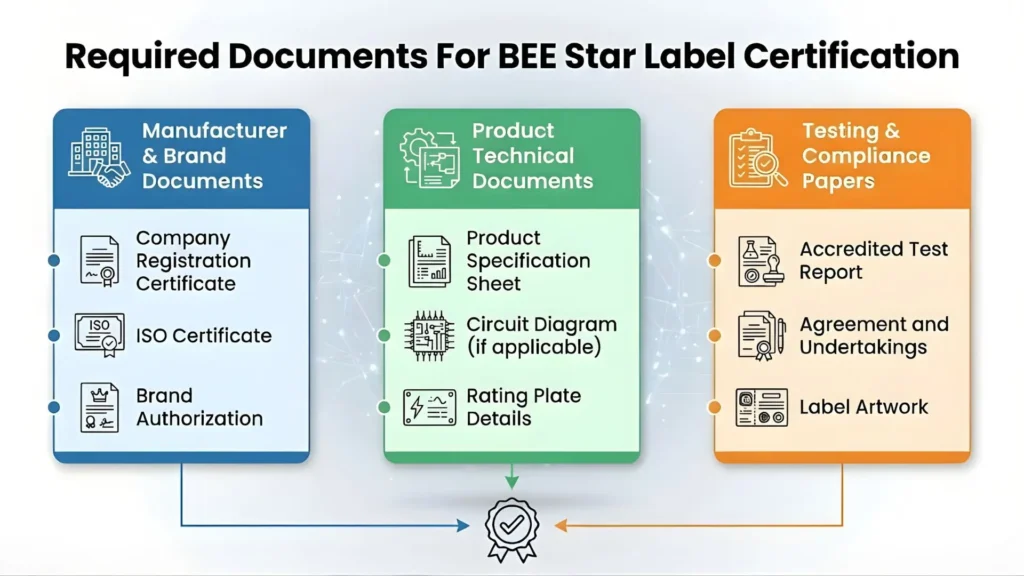
- Company incorporation and GST registration proof
- Trademark registration certificate for the transformer brand
- Authorisation letter from the overseas manufacturer (for importers)
- Test report confirming no-load and load losses per IS 1180 (Part 1), from a NABL-accredited or BEE-approved lab
- Product technical specification sheet, including kVA rating, voltage class and construction details
- Product photographs and nameplate details
- Declaration of conformity
- Proposed BEE label artwork following the current transformer label template
- Registration fee payment receipt
Step-by-Step Process to Get BEE Star Rating for a Distribution Transformer
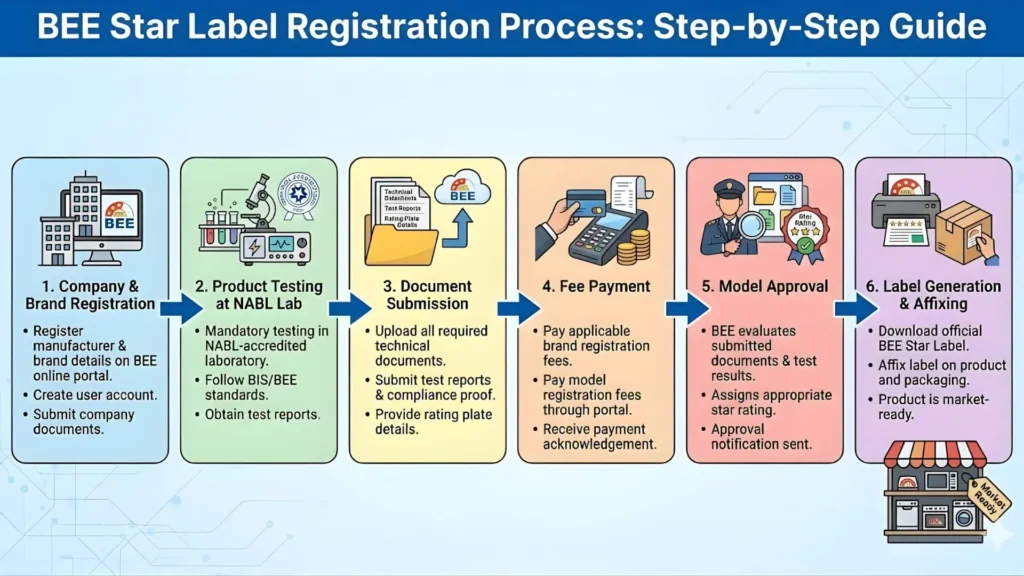
- Confirm your transformer falls within scope — outdoor, oil-immersed, up to 2500 kVA and 33 kV — under IS 1180 (Part 1).
- Download the current Star Rating Band table for your transformer's kVA rating from the BEE Standards & Labelling portal.
- Get the transformer tested at a NABL-accredited or BEE-approved lab for no-load and load losses, per IS 1180 test procedures.
- Compare the measured total losses against the applicable star band table for that kVA rating to confirm the resulting star level.
- Register your brand/company on the BEE portal with the required company documents.
- Submit the model registration application with the loss test report, specifications, photographs, declaration of conformity and proposed label artwork.
- Pay the applicable registration fee and respond promptly to any deficiency notice from BEE's technical team.
- On approval, affix the BEE-compliant label — showing registration number, kVA rating and verified star rating — on every unit before supply.
Fees for BEE Star Rating Registration (Distribution Transformer Category)
| Fee Component | Approximate Range |
| Security deposit (brand/company registration) | Commonly cited around ₹1,00,000; reduced for MSME/small-scale applicants |
| Model registration fee (per kVA rating/model) | Commonly cited example: around ₹2,000 per model, in line with other appliance categories |
| Laboratory loss testing charges | Paid directly to the accredited lab; varies with kVA rating and test scope |
| Renewal fee | Generally lower than fresh registration; re-testing costs apply if the loss limit tables are revised |
Because transformer loss testing is more specialised than typical appliance testing, factor in lab availability and turnaround time alongside the fee itself when planning your registration timeline.
Validity and Renewal Timeline For BEE Certification
Distribution transformer star rating notifications have historically been updated periodically by BEE — the underlying regulation traces back to a principal notification and has seen multiple amendments over the years as loss limit tables were tightened. Your Registration Certificate will state the specific validity period tied to your registered models, so track that printed date rather than assuming a fixed multi-year default across the category.
- Start renewal preparations 60–90 days before your certificate's printed expiry date.
- Check the BEE portal for any amendment to the loss limit tables for your kVA rating since your last registration.
- Re-test with fresh samples if the applicable star band table has been revised.
- Confirm your testing lab's accreditation still covers transformer loss testing under the current IS 1180 provisions.
- Submit the renewal application and fee, and update your label before the old registration lapses.
Continuing to supply transformers under an expired registration is treated as non-compliant, and given how heavily this category feeds into utility and EPC tenders, a lapsed certificate can mean losing project eligibility, not just a compliance notice.
BEE Star Rating Certification for Distribution Transformers: What's New in 2026
- Mandatory from January 1, 2026: Distribution transformers moved to mandatory BEE star labelling as part of the January 2026 expansion, alongside refrigerators, televisions, LPG stoves, chillers, cooling towers, deep freezers and grid-connected solar inverters.
- Procurement shift for utilities and EPCs: With the mandate now active, utilities, EPC contractors and industrial buyers are increasingly specifying star-labelled transformers directly in tender documents, changing how manufacturers position their products commercially.
- Long regulatory build-up: This mandate follows years of incremental amendments to the underlying transformer loss notification — including changes recorded through December 2023 — reflecting BEE's ongoing effort to tighten permissible loss limits as manufacturing technology has improved.
- Continued alignment with CEA technical standards: Electricity grid construction regulations have separately referenced BEE's transformer loss star levels as a baseline requirement, reinforcing that BEE star rating and grid-connection compliance are increasingly linked for this category.
For manufacturers who were previously registering only informally or supplying under older, superseded loss standards, 2026 marks the point where star labelling for distribution transformers is a hard gate to market and project participation, not a competitive extra.
Common Mistakes to Avoid For BEE Certification
- Testing against an outdated version of the loss limit tables instead of the current, in-force star band notification.
- Submitting no-load loss data without corresponding load loss data — both components are required to determine the overall rating.
- Assuming a transformer outside the 2500 kVA / 33 kV scope automatically qualifies under the same scheme without checking applicability separately.
- Overlooking those in the supply chain: EPCs and system integrators sometimes assume a supplier is registered without verifying it, risking project non-compliance.
- Missing renewal tracking, given that distribution transformer projects often have long supply cycles where a certificate can quietly lapse mid-project.
Get Expert Help: Silvereye Certifications
Loss testing for distribution transformers is more technically involved than most other BEE categories — accurate no-load and load loss measurement at the right test conditions is essential to landing the correct star band. Silvereye Certifications, a Noida-based regulatory compliance consultancy, helps transformer manufacturers, importers and EPC-facing suppliers secure BEE Star Rating for Distribution Transformers correctly, alongside related approvals such as BIS (ISI/CRS/FMCS), WPC-ETA, FSSAI, MSME and ISO certifications.
Their team coordinates with accredited labs experienced in IS 1180 loss testing, prepares complete BEE portal documentation, and manages renewal timelines so your transformers stay tender-eligible across long project cycles. If your business supplies transformers into utility or EPC procurement, working with an experienced consultant like Silvereye Certifications can help you avoid the loss-testing errors that most often delay these applications.
Conclusion
BEE Star Rating for Distribution Transformers sits at a genuinely different scale from most other appliance categories — it's not about a single household's electricity bill, but about the enormous, compounding losses that ripple across India's entire power distribution network.
With mandatory labelling now in force from January 2026, manufacturers and importers no longer have the option of treating this as voluntary quality signalling; it's a market-access requirement that increasingly determines tender eligibility with utilities and EPC contractors. The path to compliance is technical but well-defined: confirm your transformer falls within IS 1180's scope, get accurate no-load and load loss testing done, register correctly against the current star band tables, and keep your certificate's validity date on your compliance calendar. For a component that quietly runs 24 hours a day across millions of grid connections, getting this rating right is one of the highest-leverage efficiency decisions in India's energy landscape.
Frequently Asked Questions
Is BEE star rating mandatory for distribution transformers now?
Yes. Distribution transformers became mandatory under BEE star labelling from January 1, 2026, as part of the broader mandatory category expansion that year.
How is the BEE star rating for a distribution transformer calculated?
It's based on the transformer's no-load (core) losses and load (copper) losses, measured against IS 1180 (Part 1) test procedures — lower total losses result in a higher star rating.
What is the difference between no-load and load losses?
No-load losses occur continuously in the transformer's core regardless of whether it's supplying load; load losses occur in the windings and increase as the actual electrical load increases.
What transformers are covered under this BEE scheme?
The scheme covers outdoor, oil-immersed distribution transformers up to 2500 kVA and 33 kV, tested under IS 1180 (Part 1) read with the IS 2026 series and IS 2500 (Part 1).
What documents are needed for transformer BEE registration?
Company and GST registration, trademark certificate, a NABL-accredited loss test report per IS 1180, technical specifications, photographs, a declaration of conformity, and proposed label artwork.
How much does BEE registration cost for a distribution transformer?
Costs generally follow BEE's standard structure — a company-level security deposit plus a per-model registration fee, alongside separate, more specialised lab testing charges for loss measurement.
Do utilities require BEE-rated transformers in tenders?
Increasingly, yes. Many utilities, EPC contractors and industrial buyers now specify star-labelled transformers directly in procurement tender conditions.
What happens if a transformer manufacturer isn't BEE registered?
Selling non-compliant, unregistered distribution transformers in India can lead to penalties, legal action, and restrictions on further sales until compliance is achieved.
Can imported distribution transformers be supplied in India without BEE registration?
No. Importers must hold a valid BEE registration in their own name for transformers within the defined scope before commercial or project supply.
How does CEA's technical standard relate to BEE transformer star ratings?
Grid construction regulations have referenced BEE's star levels as a baseline — for instance, requiring transformer losses to be no worse than a specified BEE star level for grid connection eligibility.
What standard kVA ratings are covered under the BEE transformer scheme?
Commonly cited standard ratings include 10, 16, 25, 63, 100, 160 and 200 kVA, among others, within the up-to-2500 kVA scope.
Is renewal needed if my transformer's design hasn't changed?
Yes — registration validity still expires on its certificate's printed date, and if BEE has revised the loss limit tables since your last registration, re-testing is generally required at renewal.