
- PSARA license documents fall into four groups: entity proof, personnel/police verification papers, training tie-up documents, and statutory registrations like GST, EPF, and ESIC.
- The exact document list changes slightly with business structure — a proprietorship, partnership, LLP, and private limited company each submit a different entity-proof document.
- From 2026, the Ministry of Home Affairs has been pushing agencies to update guard and manpower data digitally on the PSARA portal, alongside stricter document consistency checks during renewal.
- Mismatched names, addresses, or PAN details across documents — not the police verification itself — remain the single biggest reason PSARA applications get sent back.
Introduction
The core PSARA license documents needed to apply are: proof of business registration (incorporation certificate, partnership deed, or proprietorship proof), PAN and GST of the entity, identity and address proof of directors or partners, a signed training-institute tie-up agreement, police verification papers of the applicant and key management, statutory registrations like EPF and ESIC where applicable, and the affidavits and declarations prescribed under the PSARA Act.
The exact list varies slightly depending on your business structure and state, but these documents form the base file every Controlling Authority in India asks for before processing a PSARA license application.
Most PSARA applications don't get delayed because of a complicated legal requirement — they get delayed because one document doesn't match another. A PAN card with a slightly different spelling of the company name, an address proof that doesn't match the GST certificate, an affidavit that wasn't notarised the way the Controlling Authority expects — these small mismatches are what actually stall applications for weeks.
This guide lays out every document a PSARA license genuinely requires, how the list changes by business structure, what's changed in how documents are verified in 2026, and the formatting details that quietly decide whether your file gets accepted on the first attempt.
Why the Document List Matters More Than People Expect
A PSARA license application is, at its core, a documentation exercise. The Controlling Authority isn't just checking whether you're eligible — it's cross-verifying every document against every other document in your file. Your entity's name on the GST certificate has to match the name on the PAN card, which has to match the name on the training-institute agreement, which has to match the name in the affidavit. Any inconsistency triggers a query, and each query round can add two to four weeks to an already time-bound process.
Getting the document set right the first time is, in practice, the single biggest lever an applicant has over how fast their PSARA license comes through.
The Four Categories of PSARA License Documents
| Category | What It Proves to the Controlling Authority |
| 1. Entity & Business Proof | Confirms the applicant is a legally registered business, not an informal operation |
| 2. Personnel & Verification Documents | Confirms the identity and character of the applicant, directors, or partners |
| 3. Training & Operational Documents | Confirms the agency has a real arrangement to train the guards it will deploy |
| 4. Statutory & Tax Registrations | Confirms the agency is set up to meet its labour-law and tax obligations toward guards and the government |
Complete PSARA License Documents Checklist
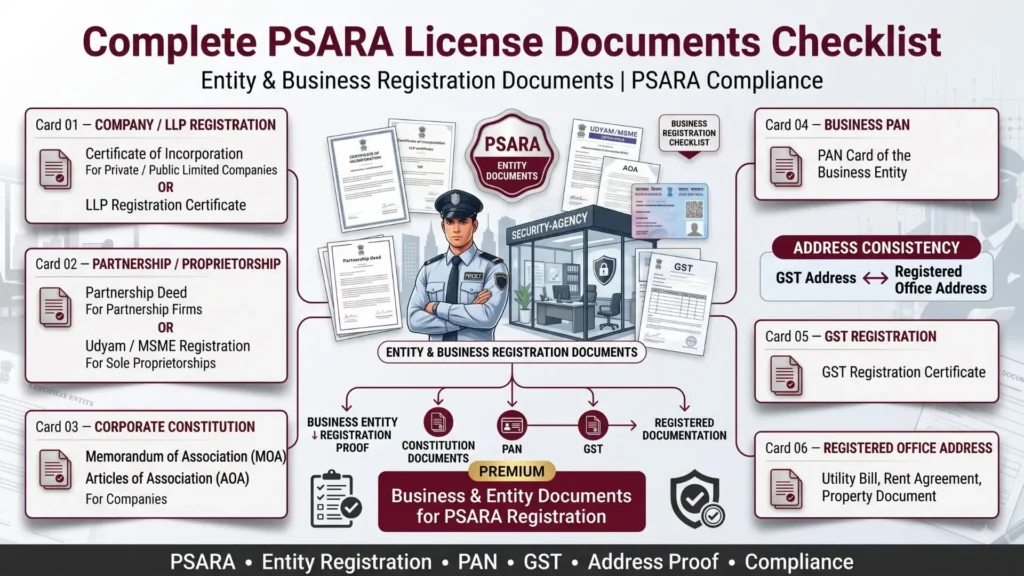
1. Entity and Business Registration Documents
- Certificate of Incorporation (for Private/Public Limited Companies) or LLP Registration Certificate
- Partnership Deed (for partnership firms) or Proprietorship proof such as a Udyam/MSME registration (for sole proprietorships)
- Memorandum of Association (MOA) and Articles of Association (AOA), for companies
- PAN card of the business entity
- GST registration certificate
- Registered office address proof — utility bill, rent agreement, or property document, consistent with the GST address
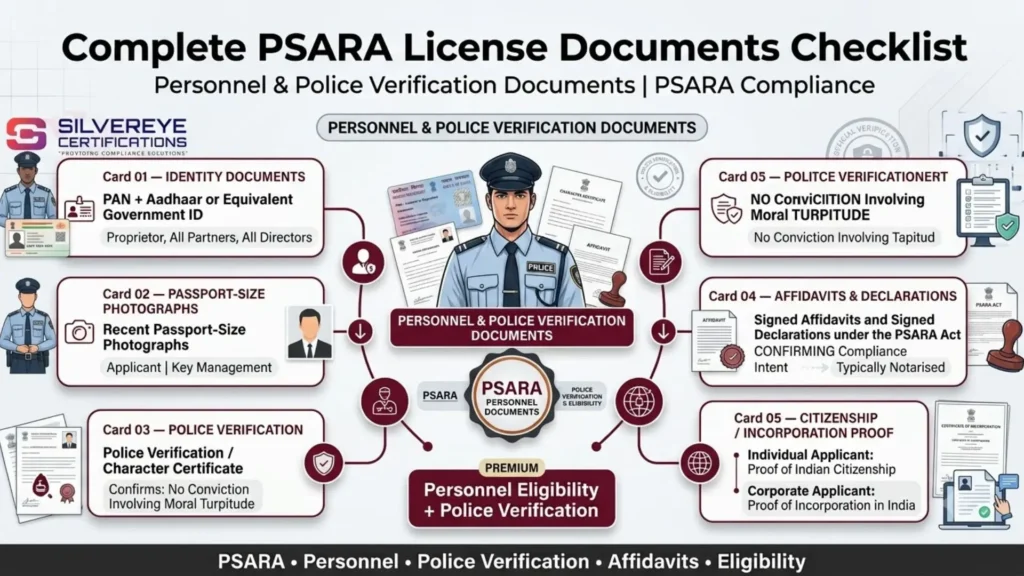
2. Personnel and Police Verification Documents
- PAN and Aadhaar (or equivalent government ID) of the proprietor, all partners, or all directors
- Recent passport-size photographs of the applicant and key management
- Police verification / character certificate confirming no conviction involving moral turpitude
- Signed affidavits and declarations under the PSARA Act, confirming eligibility and compliance intent — typically notarised
- Proof of Indian citizenship for individual applicants, or proof of incorporation in India for corporate applicants
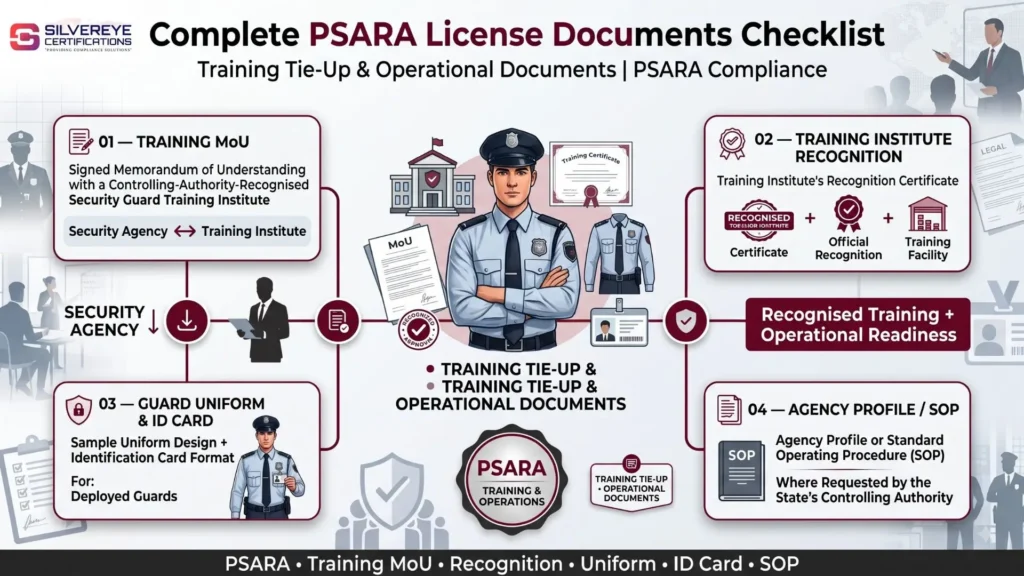
3. Training Tie-Up and Operational Documents
- Signed Memorandum of Understanding (MoU) with a Controlling-Authority-recognised security guard training institute
- Training institute's own recognition certificate, to confirm it's genuinely approved and not an informal vendor
- Sample uniform design and identification card format proposed for deployed guards
- Agency profile or standard operating procedure document, where the state's Controlling Authority requests it
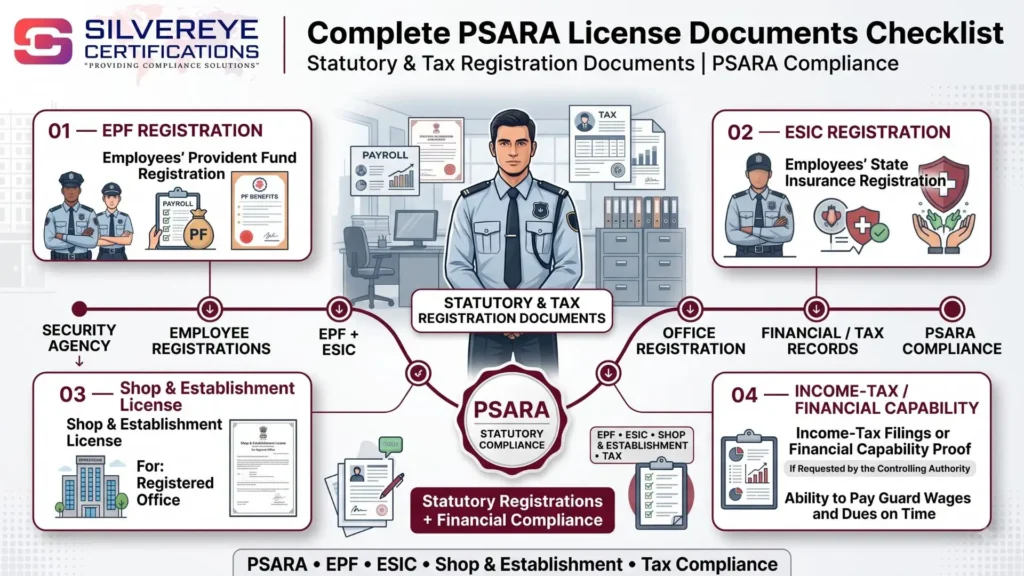
4. Statutory and Tax Registration Documents
- EPF (Employees' Provident Fund) registration, since guards are salaried employees entitled to PF benefits
- ESIC (Employees' State Insurance) registration, for employee health and insurance coverage
- Shop and Establishment license for the registered office
- Income-tax filings or financial capability proof, if requested by the Controlling Authority to assess the agency's ability to pay guard wages and dues on time
PSARA License Documents by Business Structure
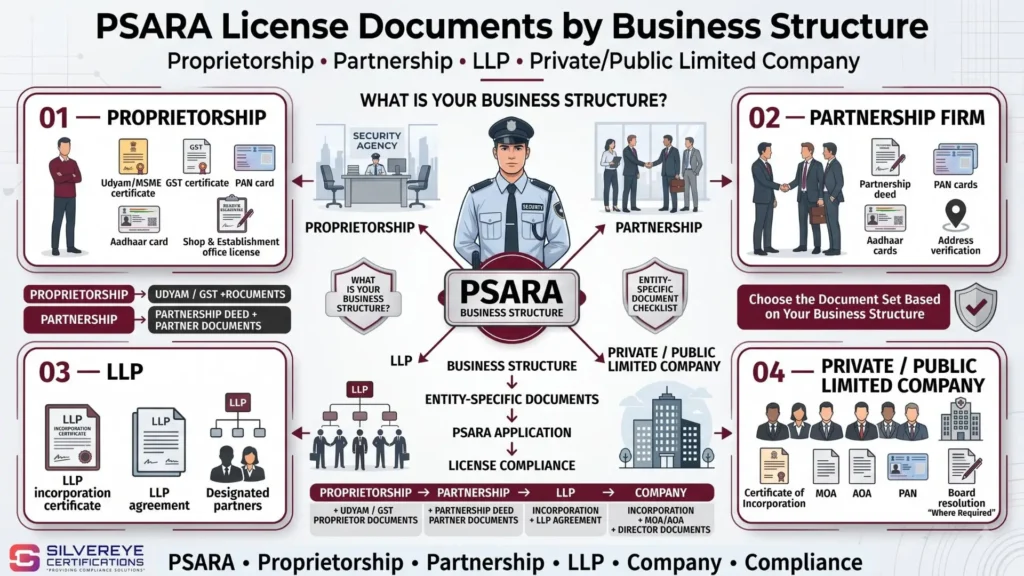
The core document set stays largely the same, but the entity-proof document itself changes depending on how the agency is structured:
| Business Structure | Entity-Specific Documents Needed |
| Proprietorship | Udyam/MSME registration or GST certificate in the proprietor's name; proprietor's PAN and Aadhaar; Shop & Establishment license |
| Partnership Firm | Registered Partnership Deed; PAN of the firm and all partners; Aadhaar and address proof of each partner |
| LLP | LLP Incorporation Certificate; LLP Agreement; PAN of the LLP and designated partners |
| Private/Public Limited Company | Certificate of Incorporation; MOA & AOA; PAN of the company and all directors; board resolution authorising the application, where required |
Documents Required for PSARA License Renewal
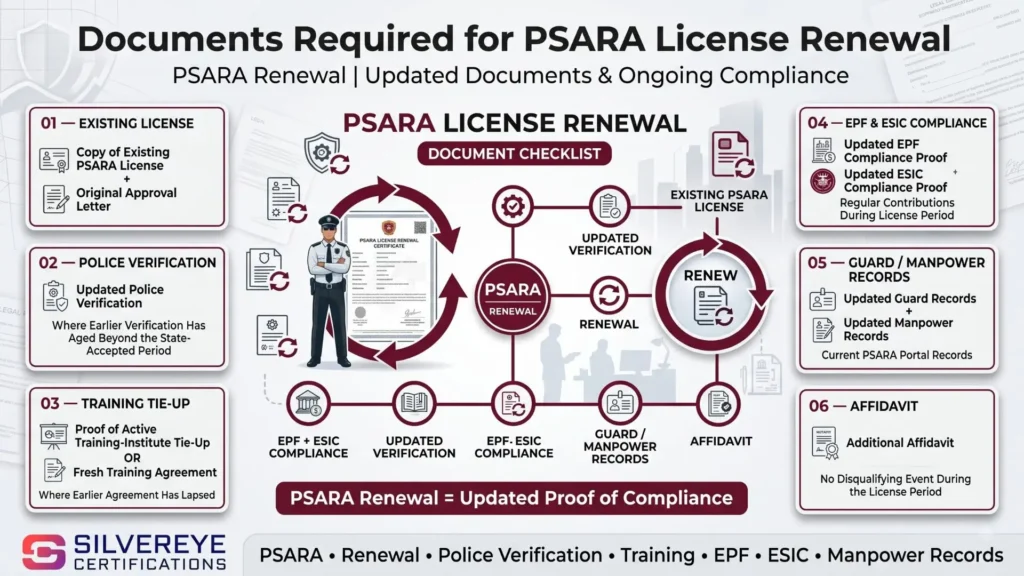
Renewal isn't just a fee payment — the Controlling Authority expects fresh proof that the agency is still operating within the rules. A typical renewal file includes:
- Copy of the existing PSARA license and the original approval letter
- Updated police verification, if the earlier verification has aged beyond what the state accepts
- Proof that the training-institute tie-up is still active, or a fresh agreement if the earlier one has lapsed
- Updated EPF and ESIC compliance proof, showing contributions have been paid regularly during the license period
- Updated guard/manpower records, since several states now expect these to be current on the PSARA portal at the time of renewal
- Any additional affidavit confirming no disqualifying event occurred during the license period
Document Formatting Rules That Quietly Decide Approval Speed
These aren't official legal requirements listed in the Act itself, but they reflect how Controlling Authorities actually process files, based on patterns reported across states:
- Every document should show the entity's name exactly as it appears on the PAN card — abbreviations, punctuation, or spacing differences ("Pvt. Ltd." vs "Private Limited") are a common trigger for a query.
- Affidavits generally need to be on the correct stamp-paper value for that state and notarized, not just self-attested, unless the state's own checklist explicitly says otherwise.
- Address proof and GST registration should reflect the same registered office address — a mismatch here is treated as seriously as a missing document.
- Scanned copies submitted online should be clear, complete (all pages, not just the first), and under the file-size limits specified by the state's PSARA portal.
- Keep the training-institute agreement dated before or on the date of filing — a tie-up signed after submission is a common reason for a returned application.
2026 Update: What's Changing Around PSARA License Documents
A few real, dated developments directly affect how PSARA documents are handled in 2026 — these are notified or officially announced items, not speculation.
1. Mandatory Digital Updating of Manpower Data on the PSARA Portal
At a Ministry of Home Affairs review meeting held on 13 March 2026, chaired by the Joint Secretary (Police Modernization) with FICCI, CAPSI, SAI, and other industry bodies present, the MHA announced a set of follow-up actions to fix long-standing implementation gaps in PSARA. One of the specific actions announced was increased digitization, including mandatory updating of manpower (guard) data on the PSARA portal — a direct response to the fact that several states were still relying on manual, paper-based submission of guard records.
For agencies, this means guard-level documentation (numbers deployed, training status, verification records) is moving toward being a living digital record rather than a one-time paper submission at the time of licensing or renewal.
2. Decriminalization of Minor Documentation and Display Lapses
Separately, a Ministry of Home Affairs notification issued on 2 May 2026, effective 15 May 2026, omitted Sections 12 and 20(2) of the PSARA Act. Section 12 relates to the requirement to display the license at the agency's office premises; procedural lapses here — along with certain delayed documentation issues — are no longer treated as criminal offences carrying fines up to ₹25,000 and possible license action.
The Controlling Authority can still suspend or cancel a license for genuine, substantive non-compliance, but a documentation delay on its own is no longer grounds for criminal prosecution the way it was before 15 May 2026. This does not extend to the core documents themselves — operating without a valid license, or without the mandatory training and eligibility documentation under Sections 9 and 10, remains fully enforceable and can still lead to serious penalties.
3. Push Toward a Single, State-Consistent Document Checklist
Industry bodies raised inconsistent documentation and training requirements across states as a recurring concern at both the March 2026 review meeting and the follow-up Joint Workshop on PSARA Compliance and Enforcement held in New Delhi on 25 June 2026. While a fully unified, pan-India document checklist has not been notified as of this writing, the direction of the ongoing "PSARA 2.0" discussion is toward more uniform documentation standards across the 28 states and 8 Union Territories where PSARA currently operates. Applicants should keep following their specific state's current checklist rather than assume a unified format is already in effect.
Common Document Mistakes That Delay a PSARA License
- Submitting an entity name on the affidavit that doesn't exactly match the PAN or GST certificate.
- Filing before the training-institute MoU is actually signed and dated, rather than just "in discussion."
- Using a self-attested affidavit where the state's checklist specifically requires notarization.
- Submitting an outdated address proof that no longer matches the current registered office on GST records.
- Leaving out one director's or partner's documents entirely, assuming only the lead applicant's paperwork is required.
Conclusion
Getting PSARA license documents right isn't about gathering more paperwork — it's about making sure every document tells the Controlling Authority the same, consistent story about who you are, where you're based, and how you plan to train and manage your guards.
The 2026 shift toward digital manpower records and the decriminalization of minor documentation lapses both point the same direction: agencies that keep clean, current, and consistent records — not just a one-time file at the point of application — are the ones that move through approvals and renewals with the least friction.
Frequently Asked Questions
What are the basic documents required for a PSARA license?
Business registration proof, PAN and GST of the entity, identity and police verification documents of directors or partners, a signed training-institute tie-up agreement, and statutory registrations like EPF and ESIC where applicable.
Do the required documents change based on business structure?
Yes. A proprietorship submits Udyam/MSME or GST proof in the proprietor's name, a partnership submits its Partnership Deed, an LLP submits its Incorporation Certificate and LLP Agreement, and a company submits its Certificate of Incorporation along with MOA and AOA.
Is a police verification certificate mandatory for a PSARA license?
Yes. Police verification of the applicant, proprietor, partners, or directors is a core part of the document and approval process, confirming there's no disqualifying criminal background.
Do I need a notarized affidavit for a PSARA license application?
Most states require the PSARA declarations and affidavits to be notarized on the prescribed stamp paper value, not just self-attested — always confirm the exact requirement on your state's current checklist.
What documents are needed for the training institute tie-up?
A signed Memorandum of Understanding (MoU) with a Controlling-Authority-recognised training institute, along with that institute's own recognition proof, confirming it is genuinely approved to train security guards.
What documents are required for PSARA license renewal?
A copy of the existing license, updated police verification if required, proof the training tie-up is still active, current EPF/ESIC compliance records, and updated guard/manpower data where the state portal requires it.
Why do PSARA applications get delayed over documents?
The most common cause is inconsistency — an entity name, address, or PAN detail that doesn't match exactly across different documents — rather than any single document being missing.
Are EPF and ESIC registration documents mandatory for a PSARA license?
In most states, yes, since guards deployed by the agency are salaried employees entitled to provident fund and health insurance benefits under labour law, and Controlling Authorities check for this compliance.
Has anything changed about PSARA documents in 2026?
Yes. Following an MHA review meeting on 13 March 2026, agencies are increasingly expected to update guard and manpower data digitally on the PSARA portal rather than through manual, paper-only submission, and a May 2026 notification decriminalised certain minor documentation and display lapses.
Can a PSARA application be resubmitted if documents are rejected?
Yes. Most rejections are correctable — once the mismatched, missing, or improperly formatted document is fixed, the application can be refiled with the Controlling Authority.
Do all directors need to submit documents, or just one authorised signatory?
All directors or partners typically need to submit their identity, address, and police verification documents — submitting only the lead applicant's paperwork is a common reason applications are sent back.