
- Covers eligibility, documents, fees, and the full registration process for a PSARA license in India.
- Explains the May 2026 amendment that removed criminal liability under Sections 12 and 20(2) of the Act.
- Breaks down validity, renewal timelines, and the penalties that still apply for unlicensed operation.
- Written for founders, HR heads, and facility managers evaluating or renewing a private security agency license.
Introduction
A PSARA license is a mandatory authorization issued by a state's Controlling Authority under the Private Security Agencies (Regulation) Act, 2005, allowing a company, LLP, partnership, or proprietorship to legally run a private security agency in India. It is granted per state (or a single district, up to five districts, or the whole state within that state) after police verification of directors, a tie-up with a recognized training institute, and submission of incorporation, address, and identity documents.
Most licenses are valid for five years and must be renewed 60–90 days before expiry. Operating without one is a criminal offence under Section 4 read with Section 20(1), inviting a fine and up to a year in prison — though a May 2026 MHA amendment removed criminal liability for certain procedural lapses under Sections 12 and 20(2).
What Is a PSARA License?
A PSARA license is the legal permission a private security agency needs before it can deploy guards, supervisors, bouncers, or armoured-car crews anywhere in India. It is issued under the Private Security Agencies (Regulation) Act, 2005 — commonly shortened to PSARA — a central law that every state has adopted through its own PSARA Rules. The license is not issued by the central government; it comes from the State Controlling Authority appointed for that state, usually a senior police or home department officer.
Because the law is central but the licensing is state-wise, an agency operating guards in Delhi, Uttar Pradesh, and Karnataka needs three separate PSARA licenses — one from each state's Controlling Authority. Within a single state, the applicant can further choose the geographic scope of the license: a single district, up to five districts, or the entire state, and the government fee scales with that choice.
Who Needs a PSARA License?
Any person or business entity — sole proprietorship, partnership firm, LLP, or private/public limited company — that offers private security services for payment needs a PSARA license before it starts operations. This includes agencies supplying:
- Security guards for offices, factories, malls, hospitals, and residential societies
- Supervisors and site managers who oversee deployed guards
- Bouncers and event security personnel
- Armoured car and cash-in-transit services
- Training services for aspiring security guards, where the trainer is also acting as an agency
Government departments and forces such as the police, army, or paramilitary are excluded from this requirement, since the Act specifically targets private, for-profit security provision.
Benefits of Holding a Valid PSARA License
- Legal right to operate — without it, running a security business is a punishable offence, not just a compliance gap.
- Eligibility for corporate, government, and PSU security contracts, most of which mandate a valid license as a bid qualifier.
- Stronger client trust, since the license signals that guards have passed police verification and formal training.
- Access to banking, insurance, and EPF/ESI registrations that are easier to secure once the agency is a recognised, licensed entity.
- Protection against sudden closure — regulators generally act against licensed agencies through warnings and corrective timelines rather than outright shutdowns for minor issues.
Eligibility Criteria for a PSARA License
For the Agency
- Must be an entity incorporated or registered in India (proprietorship, partnership, LLP, or company); foreign-owned agencies face additional security-clearance scrutiny.
- The agency's name must include "Security Agency" or "Security Services" and must not suggest government patronage or affiliation.
- Must have a registered office address in the state where the license is sought.
- Must sign a Memorandum of Understanding (MoU) with a training institute recognized by that state's Controlling Authority.
For Directors, Partners, and the Principal Officer
- Must be Indian citizens and at least 18 years of age.
- Must clear police verification and antecedent checks; no conviction for an offence involving moral turpitude or a term of two years or more.
- Must not have been dismissed or removed from government service on grounds of misconduct.
- Owners and the Principal Officer are generally expected to hold a special security-training qualification, or relevant experience such as a police, paramilitary, or armed-forces background.
For Security Guards and Supervisors
- Indian resident, between 18 and 65 years of age.
- Clean character certificate and successful completion of the prescribed training under Section 9 of the Act.
- Meets the physical standards set by the state's PSARA Rules.
- Ex-servicemen from the Army, Navy, Air Force, or Police are given preference in recruitment under the Act.
Documents Required for PSARA License Registration
| Category | Typical Documents |
| Agency / Entity | Certificate of incorporation or partnership deed, PAN, GST registration, MoA & AoA (for companies), proof of registered office address |
| Directors / Partners / Principal Officer | PAN and Aadhaar or other government ID, passport-size photographs, address proof, income-tax return copies, character certificate, affidavit of no prior conviction |
| Police Verification | Form-I application for antecedent verification of every director/partner, followed by a police NOC |
| Training Tie-Up | Signed MoU with a Controlling-Authority-recognised training institute, training affidavit under Section 7(2) of the Act |
| Statutory Registrations | EPF and ESI registration (once guards are employed), Shops & Establishment registration, professional tax registration where applicable |
| Guard Records (ongoing) | Guard-wise identity, training-certificate, and deployment registers maintained on the PSARA portal or in physical form as the state prescribes |
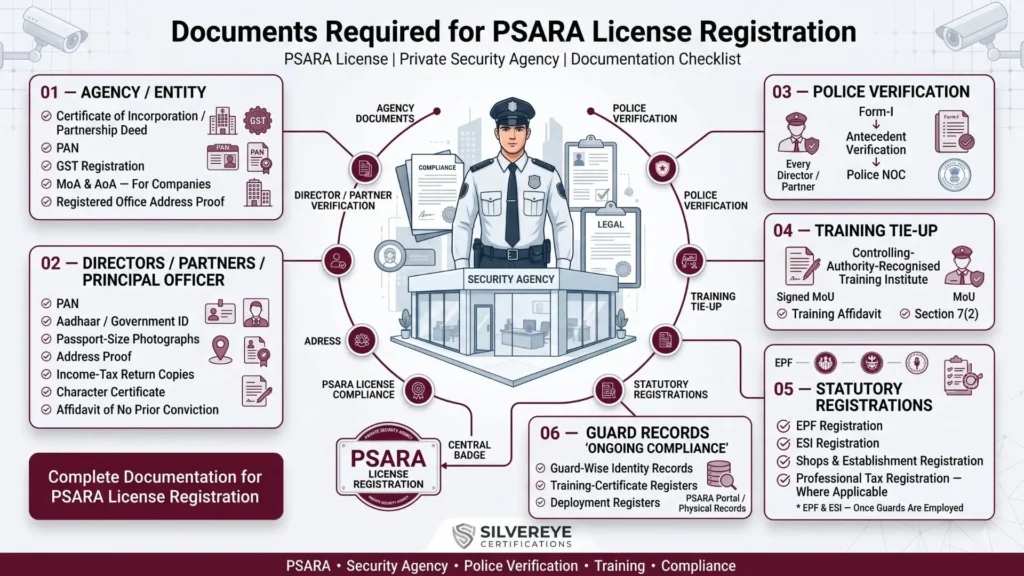
Document lists vary slightly by state, so it is worth checking the specific checklist published on your state's PSARA portal before filing.
Step-by-Step PSARA License Registration Process
Choose the business structure (proprietorship, partnership, LLP, or company) and register it if it doesn't already exist.
- Decide the geographic scope you want — a single district, up to five districts, or the whole state — since the application form and fee depend on this choice.
- Sign an MoU with a training institute recognized by the state's Controlling Authority for guard and supervisor training.
- Compile the entity, director, and premises documents listed above, and prepare the affidavits required under the Act.
- File Form-I (or the state's equivalent) with the Controlling Authority, along with the prescribed fee, to initiate antecedent and police verification of all directors/partners.
- The local police conduct background verification and issue a No Objection Certificate once satisfied there is no adverse history.
- On receiving the police NOC, the Controlling Authority examines the complete application and either grants the PSARA license (commonly in Form-IV or the state's corresponding form) or communicates deficiencies for resolution.
- Once licensed, enrol guards and supervisors for training, maintain the statutory registers, and display the license at the registered office as required.
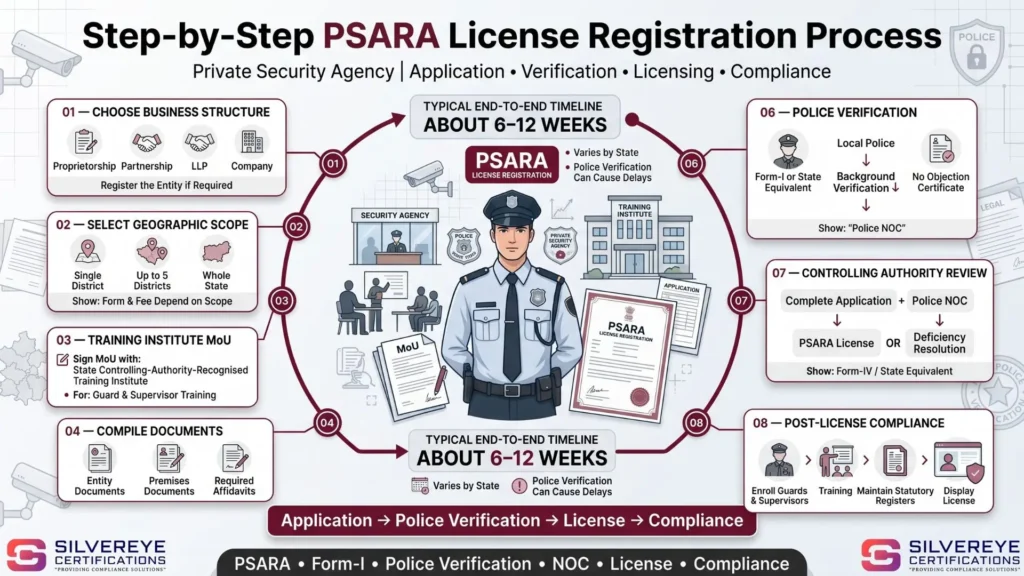
End-to-end timelines vary widely by state and by how quickly police verification is completed — agencies typically see anywhere from about six to twelve weeks, though longer pendency is common in some states and is a recognized industry pain point.
PSARA License Fees
The Act leaves the exact fee schedule to each state's PSARA Rules, and the amount always depends on the geographic scope chosen — a single-district license costs less than a five-district license, which in turn costs less than a whole-state license. Renewal fees are typically lower than the fee for a fresh license. Because these figures are revised by state notifications from time to time, treat any number you see online as indicative and confirm the current fee on your state's PSARA portal or with the Controlling Authority before filing.
| License Scope | Typical Fee Positioning* |
| Single district | Lowest tier |
| Up to five districts | Mid tier |
| Entire state | Highest tier |
| Renewal (any scope) | Generally lower than a fresh application of the same scope |
Indicative positioning only. Exact amounts differ by state and are subject to periodic revision — always verify with the state Controlling Authority.
Validity and Renewal of a PSARA License
In most states, a PSARA license is valid for five years from the date of issue. A handful of states run shorter cycles — for instance, some states have historically issued one-year licenses — so it's important to check the validity period printed on your own license rather than assuming the five-year default.
Renewal has to be filed before the current license lapses; most Controlling Authorities recommend submitting the renewal application 60 to 90 days ahead of expiry, since it involves fresh police verification, an updated training-institute MoU, and updated records for any change in directors, Principal Officer, or office address. If a license is allowed to lapse, several states treat the renewal as a brand-new application, which restarts police verification and can disrupt ongoing client contracts for months.
The 2026 PSARA Update: Decriminalization of Sections 12 and 20(2)
The most significant regulatory development for the private security industry in 2026 came from the Ministry of Home Affairs. On 2 May 2026, the MHA issued a notification, effective 15 May 2026, omitting Section 12 and Section 20(2) of the Private Security Agencies (Regulation) Act, 2005.
Here is what that means in practical terms. Before 15 May 2026, an agency that failed to display its license at its registered office (a Section 12 requirement), or that was found in violation of training norms under Section 9 or guard-eligibility norms under Section 10, could face criminal prosecution — a fine of up to ₹25,000 and possible suspension or cancellation of its license, treated as a criminal matter under Section 20(2).
From 15 May 2026, these kinds of procedural lapses are no longer treated as criminal offences. The State Controlling Authority still retains full power to take regulatory action — including suspension or cancellation of the license — for genuine non-compliance; only the criminal-prosecution route for these specific technical lapses has been removed.
It is important not to over-read this as deregulation. Several obligations remain fully in force and enforceable:
- Operating a security agency without a valid PSARA license is still a criminal offence under Section 4 read with Section 20(1), carrying a fine and imprisonment of up to one year.
- Training standards for guards and supervisors under Section 9 must still be met in full.
- Guard eligibility norms under Section 10 — age, citizenship, character verification, physical fitness — remain mandatory.
- Unauthorized use of military or police uniforms by private security staff continues to be a criminal offence.
The amendment followed sustained industry advocacy, including a review meeting at the MHA on 13 March 2026 chaired by the Joint Secretary (Police Modernization), where stakeholders raised concerns around license-renewal pendency, inconsistent state-wise implementation, and the administrative burden of procedural violations being treated as crimes. The government has also flagged further steps on its agenda, including greater digitization of guard-data submission on the PSARA portal and continuing consultations on GST and labour-related issues affecting the sector.
If your agency has been licensed for a while, this update is a good trigger to review your internal compliance checklist — not to relax it, but to understand exactly which obligations now carry regulatory consequences versus criminal ones.
Compliance Obligations After Getting a PSARA License
- Display the license at the registered office and at any branch offices, as required by your state's rules.
- Deploy only guards and supervisors who have completed the prescribed training and cleared antecedent verification.
- Maintain up-to-date registers of employees, training records, and deployment details, available for inspection by the Controlling Authority.
- Appoint supervisors in the ratio prescribed by the state (commonly one supervisor for every fifteen guards).
- Report any change in directors, Principal Officer, or registered office to the Controlling Authority without delay.
- Complete EPF, ESI, and other labour-law registrations once guards are on payroll, and stay current on statutory dues.
- File the renewal application well ahead of expiry rather than waiting for a final reminder.
Penalties for Non-Compliance
Operating a private security agency without a valid PSARA license remains a criminal offence: Section 4 read with Section 20(1) prescribes a fine ranging up to ₹25,000 and imprisonment that can extend to one year, and repeat or continuing violations attract both a fine and a jail term.
Genuine non-compliance with training or guard-eligibility norms can still lead to suspension or cancellation of the license by the Controlling Authority, even though the May 2026 amendment removed the criminal-prosecution angle for certain procedural lapses under Sections 12 and 20(2). A cancelled or blacklisted license can bar the owners from obtaining a fresh license later, so treating compliance as an ongoing discipline — not a one-time filing — is the safer approach.
Common Mistakes to Avoid For PSARA License
- Assuming a PSARA license from one state covers operations in another — it does not; each state needs its own license.
- Delaying the training-institute MoU until after filing, which slows down the entire application.
- Waiting until the last month before expiry to start the renewal, leaving no buffer for fresh police verification.
- Deploying guards before their training certificates and antecedent checks are complete.
- Treating the 2026 decriminalization update as a reason to relax display, training, or eligibility compliance.
How Silvereye Certifications Can Help
Navigating a PSARA license — choosing the right geographic scope, assembling director and premises documents, coordinating police verification, and tying up with an approved training institute — takes time away from actually running a security business. Silvereye Certifications works with security agencies, facility management companies, and corporate security teams across India to prepare PSARA applications, track police-verification status, and manage renewals well before expiry, so that license continuity never becomes a business risk.
Frequently Asked Questions
What is a PSARA license?
A PSARA license is the mandatory state-issued authorisation under the Private Security Agencies (Regulation) Act, 2005, that allows a business to legally provide private security services such as guards, supervisors, and armoured-car crews.
Who is required to get a PSARA license?
Any proprietorship, partnership, LLP, or company that supplies security guards, supervisors, bouncers, or armoured-car services for payment needs a PSARA license in every state where it deploys personnel.
How long is a PSARA license valid?
Most states issue a PSARA license for five years, though a few states have historically used a one-year cycle, so it's best to check the validity date on your own license certificate.
How much does a PSARA license cost?
The government fee depends on the geographic scope chosen — single district, up to five districts, or the whole state — and is fixed by each state's own PSARA Rules, so it should be confirmed on the relevant state portal rather than assumed from a generic figure.
How long does it take to get a PSARA license?
Timelines vary by state and depend heavily on how quickly police verification of directors is completed; agencies commonly see the process take anywhere from about six to twelve weeks, with longer pendency reported in some states.
Can a single PSARA license cover operations across multiple states?
No. PSARA licensing is state-wise — an agency operating in more than one state needs a separate license from each state's Controlling Authority.
What documents are needed to renew a PSARA license?
Renewal generally requires the existing license, updated director and premises documents, an updated training-institute MoU, and details of any change in the Principal Officer or office address since the last grant.
What happens if an agency operates without a PSARA license?
It is a criminal offence under Section 4 read with Section 20(1) of the Act, attracting a fine and imprisonment of up to one year, in addition to immediate exposure to closure of the business.
What changed in the PSARA Act in 2026?
Effective 15 May 2026, the MHA omitted Sections 12 and 20(2) of the Act, removing criminal liability for certain procedural lapses such as not displaying the license at the office. Regulatory action like suspension or cancellation still applies, and operating without a license, plus training and guard-eligibility norms, remain fully enforceable.
Is police verification mandatory for a PSARA license?
Yes. Every director, partner, or proprietor must undergo police antecedent verification, and the Controlling Authority issues the license only after receiving a police No Objection Certificate.
Does an agency need its own training institute to get a PSARA license?
No. The agency doesn't have to own a training institute — it just needs a signed MoU with a training institute recognized by the state's Controlling Authority to train its guards and supervisors.
Can ex-servicemen get any relaxation in the PSARA process?
Ex-servicemen from the Army, Navy, Air Force, or Police with relevant experience are given preference in recruitment under the Act, and some states offer relaxations in the training requirement for them.