
- Checks LED chips, drivers, solder, and wiring for lead, cadmium, mercury, and other restricted substances above set limits.
- Backed by accredited lab test reports and a signed Declaration of Conformity — not a government-issued certificate.
- India's E-Waste Management Rules mirror EU RoHS limits for six hazardous substances in electrical and electronic components.
- Testing usually takes 4–8 weeks and cost depends on how many components and confirmatory tests are involved.
Introduction
RoHS testing for LED lighting components checks whether LED chips, drivers, solder joints, wiring, and plastic housings stay within permitted limits for lead, mercury, cadmium, hexavalent chromium, and related substances. In India, this sits under the E-Waste (Management) Rules, which track the EU RoHS Directive's limits closely.
An accredited lab runs XRF screening followed by confirmatory chemical analysis, and the outcome is a test report plus a Declaration of Conformity signed by the manufacturer — there is no single government-issued "RoHS certificate." LED manufacturers, importers, and exporters typically need this documentation before shipping to the EU, onboarding with large OEM buyers, or clearing customs in markets that recognize RoHS.
What Is RoHS Testing and Why It Applies to LED Lighting
RoHS stands for Restriction of Hazardous Substances. It began as EU Directive 2002/95/EC, effective from July 2006, and was replaced by the broader Directive 2011/65/EU (commonly called RoHS 2) in January 2013. RoHS 2 widened the net to cover almost all electrical and electronic equipment, along with cables and spare parts, instead of just a narrow list of gadgets.
LED lighting products are built from dozens of small parts — LED chips or dies, phosphor coatings, driver circuits, solder joints, connectors, wiring, plastic housings, and heat sinks. Each of these can independently carry a restricted substance: lead in solder, cadmium in certain phosphors, brominated flame retardants in plastic casings. That is why RoHS testing for LED lighting components is done part by part, not just on the finished bulb or fixture as a single unit.
The Legal Framework: EU RoHS and India's E-Waste Rules
On the EU side, RoHS compliance works on a self-declaration model. There is no central EU body that issues a RoHS certificate — the manufacturer or importer takes responsibility for the claim, backed by test evidence and supplier declarations that must be complete and ready for audit.
In India, the equivalent obligation sits inside the E-Waste (Management) Rules, 2016, carried forward through the 2022 Rules and the 2023 amendment. Rule 16(1) requires that new electrical and electronic equipment, along with their components, consumables, parts, and spares listed in Schedule I, must not contain restricted substances beyond specified concentration values. The Central Pollution Control Board (CPCB) administers this provision. Unlike the EU version, India's RoHS provision currently restricts six substances and does not yet cover the four phthalates that EU RoHS 3 added.
RoHS-style restrictions are no longer an EU-only concern. More than twenty jurisdictions — including China, South Korea, Saudi Arabia, and several US states — now run equivalent hazardous-substance restriction schemes, which makes RoHS testing for LED lighting components a practical requirement for almost any manufacturer with export ambitions, not just those selling into Europe.
Restricted Substances and Permissible Limits
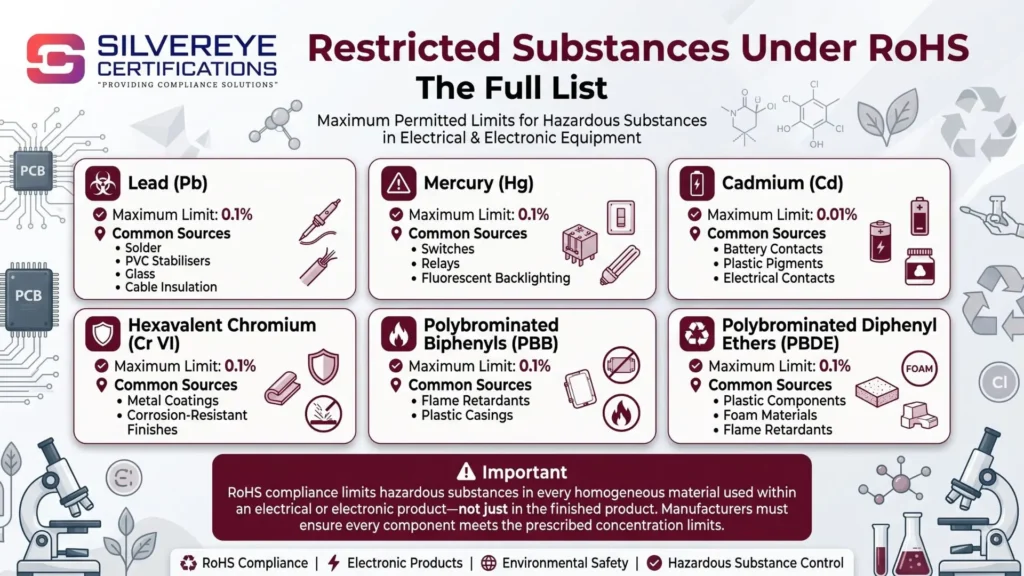
The core of any RoHS test report is a comparison against fixed concentration limits, measured by weight in each homogeneous material — meaning a material that cannot be mechanically separated into different materials, such as a single wire coating or a solder joint.
| Substance | Symbol | Max Limit (by weight) | Applies in India |
| Lead | Pb | 0.1% (1,000 ppm) | Yes |
| Mercury | Hg | 0.1% (1,000 ppm) | Yes |
| Cadmium | Cd | 0.01% (100 ppm) | Yes |
| Hexavalent Chromium | Cr(VI) | 0.1% (1,000 ppm) | Yes |
| Polybrominated Biphenyls | PBB | 0.1% (1,000 ppm) | Yes |
| Polybrominated Diphenyl Ethers | PBDE | 0.1% (1,000 ppm) | Yes |
| Phthalates (DEHP, BBP, DBP, DIBP) | — | 0.1% each | EU only, not yet in India |
One change worth tracking for 2026: the cadmium exemption that many LED chip and phosphor-converted LED manufacturers relied on (entry 39(a) in the EU exemption list) expired in November 2025 and has been replaced by a narrower entry 39(b) with tighter conditions. LED chip suppliers still citing the old exemption in their material declarations need to update that paperwork, or the finished fixture's RoHS claim becomes unsupportable.
Which LED Components Actually Need Testing
Because the limits apply per homogeneous material, testing a finished LED bulb as one lump is not enough. A thorough RoHS test plan for LED lighting typically breaks the Bill of Materials down into:
- LED chips or dies, and their phosphor coating
- Driver ICs and the driver circuit board (PCB)
- Solder joints and internal interconnects
- Wiring, cables, and connectors
- Plastic housing, lens, and diffuser
- Heat sinks and metal casing
- Capacitors, resistors, and other passive components
Skipping any of these because they seem minor is one of the most common gaps auditors and large buyers flag during vendor reviews.
Who Needs RoHS Testing for LED Lighting Components
- LED bulb, luminaire, driver, and module manufacturers
- Importers bringing LED components or finished fixtures into India
- Exporters selling to the EU or to any RoHS-recognising market
- OEM, ODM, and private-label brands sourcing from third-party factories
- Component suppliers — chip, driver, and PCB makers — supplying fixture assemblers who require a declaration further down the chain
Company size doesn't change the substance limits themselves, though India's broader e-waste compliance framework does offer some procedural relaxations for smaller enterprises in filing and EPR-related obligations.
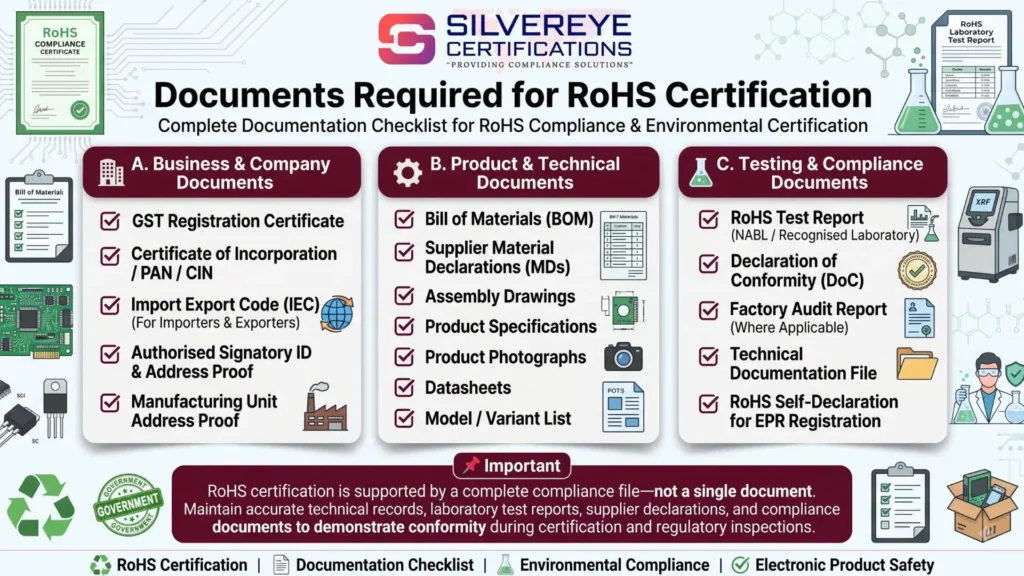
Documents Required for RoHS Testing
- Bill of Materials (BOM) listing every component and material used
- Product technical specifications and datasheets
- Supplier material declarations (SMDs) for each sourced component
- Accredited laboratory test report (XRF screening plus confirmatory results where needed)
- Declaration of Conformity (DoC), signed by the manufacturer or authorized representative
- Company registration and business identity documents
- Invoice and shipment documentation referencing the compliance claim, for import consignments
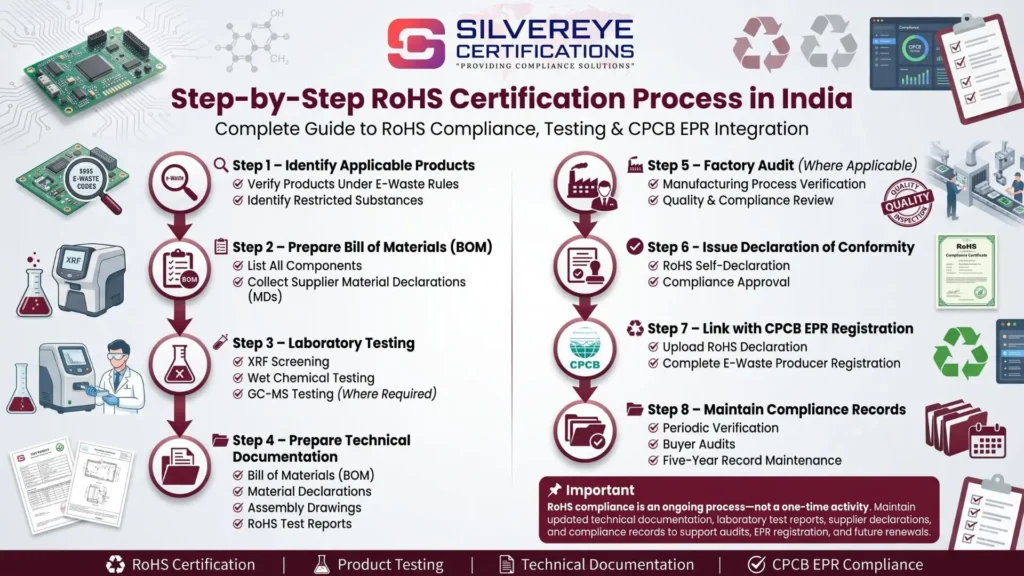
RoHS Testing Process for LED Components
1. BOM Review and Homogeneous-Material Breakdown
The lab or compliance team first maps the finished product down to individual homogeneous materials, since that is the level at which limits are checked.
2. Sample Selection
Representative samples are drawn for each component category, covering different suppliers and production batches where relevant.
3. Screening Test (XRF)
X-ray fluorescence screening gives a fast, non-destructive first reading on lead, mercury, cadmium, chromium, and bromine content.
4. Confirmatory Testing
Any component that reads close to or above the threshold goes through confirmatory wet-chemistry analysis — ICP-OES or AAS for metals, GC-MS for phthalates and flame retardants where the destination market requires it.
5. Test Report Compilation
The accredited lab issues a formal report listing each tested material and its measured concentration against the applicable limit.
6. Cross-Checking Supplier Declarations
Lab results are checked against the material declarations already collected from component suppliers, and any mismatch is flagged before sign-off.
7. Declaration of Conformity
The manufacturer drafts and signs the DoC, referencing the applicable directive or rule, the product identification, and the supporting test report.
8. Technical File Retention
All records — BOM, declarations, test reports, and the DoC — are compiled into a technical file kept ready for regulatory or customer audit.
Testing Methods Used in the Lab
| Method | Purpose | Typical Use |
| XRF (X-ray fluorescence) | Fast, non-destructive screening for heavy metals | First-pass check per IEC 62321-3-1 |
| ICP-OES / AAS | Precise wet-chemistry metal quantification | Confirmatory test for borderline XRF results |
| GC-MS | Detects phthalates and brominated flame retardants | Mainly for EU-bound shipments |
| UV-Vis Spectrophotometry | Confirms hexavalent chromium presence | Used where chromium-based coatings are involved |
Testing is usually carried out through internationally recognised names such as SGS, TÜV, Intertek, Eurofins, and UL, alongside NABL-accredited Indian laboratories that many exporters find more convenient for turnaround time and cost.
Fees for RoHS Testing
Costs for RoHS testing of LED components in India typically fall between ₹50,000 and ₹2,00,000 per product line, depending on how many BOM line items are tested, whether confirmatory testing is triggered, and which laboratory is used. A simple non-integrated LED lamp with fewer internal components generally costs less to test than a complex driver-integrated luminaire with more solder joints, connectors, and PCB layers. These figures are indicative — always confirm current pricing directly with the testing laboratory before budgeting a product launch.
Validity, Retesting Triggers, and Renewal Timeline
RoHS test reports are not licenses with a fixed multi-year validity, unlike a BIS registration. Compliance is only as current as the last-tested Bill of Materials. In practice, retesting is triggered whenever:
- A component supplier changes, even for a seemingly minor part such as a connector or wire
- A material formulation changes on an existing component
- An exemption the product relied on expires or is narrowed, as happened with the LED chip cadmium exemption
- A buyer, customs authority, or regulator specifically requests fresh evidence
As general good practice, many manufacturers choose to revalidate their RoHS test data every 12 to 24 months even without a known BOM change, since exemption entries and limit values are periodically revised by regulators.
RoHS vs CE Marking vs BIS: How They Differ
| Aspect | RoHS | CE Marking | BIS (India) |
| Purpose | Restricts hazardous substances | Overall EU market conformity (safety + EMC + RoHS) | Indian product safety and quality mark |
| Basis | Self-declaration + lab test report | Self-declaration or notified body review | Licensed certification scheme |
| Governing law | EU 2011/65/EU; India's E-Waste Rules | LVD, EMC, and RoHS directives together | BIS Act; CRS / ISI schemes |
| Output document | Test report + Declaration of Conformity | CE Declaration of Conformity + technical file | BIS license or CRS registration certificate |
| Validity | Tied to the current BOM; no fixed term | Valid until product design changes | Fixed-term license (CRS now runs 5 years) |
A frequent misunderstanding is assuming that a BIS registration or CE mark automatically covers RoHS. It doesn't — RoHS is a separate substance-restriction requirement that sits alongside safety and EMC compliance, not underneath it.
Benefits of RoHS Testing for LED Manufacturers and Exporters
- Opens market access to the EU and other RoHS-recognising markets
- Meets vendor-onboarding requirements set by large OEM and retail buyers
- Reduces the risk of shipment rejection or recall at customs
- Builds documented credibility with buyers and regulators alike
- Supports a lower-toxicity, more sustainable component supply chain
- Helps avoid penalties under India's E-Waste Management Rules for non-compliant electrical and electronic equipment
Common Mistakes That Cause RoHS Compliance Gaps
- Testing only the finished fixture and skipping internal parts like solder or wire insulation
- Relying on an old supplier declaration without checking whether its exemption reference has since expired
- Assuming BIS or CE certification already covers RoHS obligations
- Not retesting after switching PCB, driver, or connector suppliers
- Treating RoHS as a one-time task rather than an ongoing BOM-monitoring process
How Silvereye Certifications Helps
Silvereye Certifications supports LED manufacturers, importers, and exporters through the practical side of RoHS compliance — reviewing the Bill of Materials to identify which parts genuinely need testing, coordinating sampling and lab testing with accredited partners, compiling the Declaration of Conformity and supporting technical file, and tracking exemption expiry dates so a supply chain change doesn't quietly break an existing compliance claim.
Frequently Asked Questions
What is RoHS testing for LED lighting components?
It is laboratory testing of individual LED parts — chips, drivers, solder, wiring, and housings — to confirm each stays within the permitted limits for restricted hazardous substances such as lead, mercury, and cadmium.
Is RoHS certification mandatory in India?
There is no separate government-issued RoHS certificate in India, but compliance with the restricted-substance limits under the E-Waste (Management) Rules is mandatory for covered electrical and electronic equipment, including LED lighting components.
Which substances are restricted under RoHS for LED products?
Lead, mercury, cadmium, hexavalent chromium, polybrominated biphenyls (PBB), and polybrominated diphenyl ethers (PBDE) are restricted under India's provisions. The EU additionally restricts four phthalates.
Do LED drivers need separate RoHS testing from the LED chip?
Yes. Drivers, chips, solder, wiring, and housings are each treated as separate homogeneous materials and are usually tested individually as part of a full BOM breakdown.
How long does RoHS testing take for LED components?
Most testing and documentation cycles are completed within 4 to 8 weeks, depending on how many components require confirmatory testing beyond the initial XRF screening.
What is the typical cost of RoHS testing in India?
Costs generally range from about ₹50,000 to ₹2,00,000 per product line, depending on component count and testing depth. Always confirm current rates with the testing lab, as this figure is indicative.
Is there a fixed validity period for a RoHS test report?
No. There is no fixed multi-year validity like a license. Retesting is triggered by BOM changes, supplier changes, or exemption updates, and many manufacturers refresh their data every 12 to 24 months as good practice.
What is the difference between RoHS and CE marking for LED products?
RoHS restricts hazardous substances specifically. CE marking is broader — it covers overall EU market conformity, including electrical safety and electromagnetic compatibility, with RoHS as one of the directives bundled into it.
Do small LED manufacturers or MSMEs need RoHS testing?
The substance limits apply regardless of company size. India's e-waste framework offers some procedural relaxations for smaller enterprises in filing and EPR obligations, but not an exemption from the RoHS substance limits themselves.
What documents prove RoHS compliance for an LED product?
A Bill of Materials, supplier material declarations, an accredited lab test report, and a signed Declaration of Conformity together form the standard compliance file.
Does a BIS certification cover RoHS compliance for LED products?
No. BIS certification addresses product safety and performance standards; RoHS is a separate hazardous-substance restriction requirement and needs its own supporting test evidence.
What happens if an LED product fails RoHS testing?
The flagged component or material needs to be reformulated or resourced from a compliant supplier, followed by retesting before the Declaration of Conformity can be issued for that product.