

- RNI registration needs three separate document sets — for the Owner, the Publisher, and the Printer — since each of them creates a distinct profile on the Press Sewa Portal.
- The core paperwork includes ID and address proof, a PAN card, a passport-size photo, a notarized title affidavit, and the Form-I declaration — most of which most applicants already have on hand.
- Documents must be uploaded as clear, unaltered scans (photos are capped around 20 KB), and details must match your Aadhaar exactly to avoid e-Sign failures.
- Companies, trusts, and partnerships need extra paperwork — PAN, incorporation proof, board authorization, and GST details — on top of the individual owner's documents.
Introduction
The documents required for RNI registration cover three separate profiles on the Press Sewa Portal: Owner, Publisher, and Printer. At a minimum, you'll need a photo ID (Aadhaar/PAN/Passport/Voter ID), proof of date of birth, a passport-size photograph, a notarized affidavit declaring your title is unique, and the Form-I declaration confirming your intent to publish. Companies and trusts additionally need PAN, incorporation documents, and a board authorization letter. All files must be uploaded as clear, unaltered scans, with details matching your Aadhaar exactly for e-Sign to succeed.
Why This Document Checklist Matters
Ask anyone who has been through RNI/PRGI registration, and they'll tell you the same thing: it's rarely the process that trips people up — it's missing or mismatched paperwork. Because the Press Sewa Portal now runs entirely online under the Press and Registration of Periodicals Act, 2023, every document has to be uploaded as a clean digital file, and even small inconsistencies (a name spelled differently on Aadhaar versus PAN, for instance) can stall an otherwise straightforward application.

This checklist brings together everything you need — for the Owner, Publisher, and Printer roles — so you can gather it all before you even open the portal, instead of scrambling mid-application.
Benefits of Having Your Documents Ready in Advance
- Fewer rejections: A complete, correctly formatted document set is the single biggest factor in avoiding title or application rejection.
- Faster processing: Applications with all documents uploaded correctly the first time move through PRGI review noticeably faster.
- Smoother e-Sign: Matching your Aadhaar details across every document prevents OTP/e-Sign failures, one of the most common last-minute snags.
- Less back-and-forth: You avoid PRGI queries and resubmission requests that can add weeks to your timeline.
- Protects your title: A properly notarized affidavit strengthens your claim over the proposed title in case of a future dispute.
Who Needs to Submit Documents?
Document requirements depend on which role you're filling on the Press Sewa Portal. Most small publications have the same person acting as both Owner and Publisher, but the portal still treats these as separate profiles with separate uploads.
| Role | Who This Is | Documents Needed? |
| Owner | The person/entity proposing the title and initiating the application | Yes — identity, DOB, photo, affidavit |
| Publisher | The person responsible for actually publishing the periodical | Yes — identity proof, Form-I, appointment confirmation |
| Printer / Keeper | The printing press or its manager, responsible for printing | Yes — press registration proof, identity proof |
| Specified Authority | DM/DC/SDM who authenticates the declaration | No applicant documents — verifies and e-signs digitally |
Complete Documents Required for RNI Registration
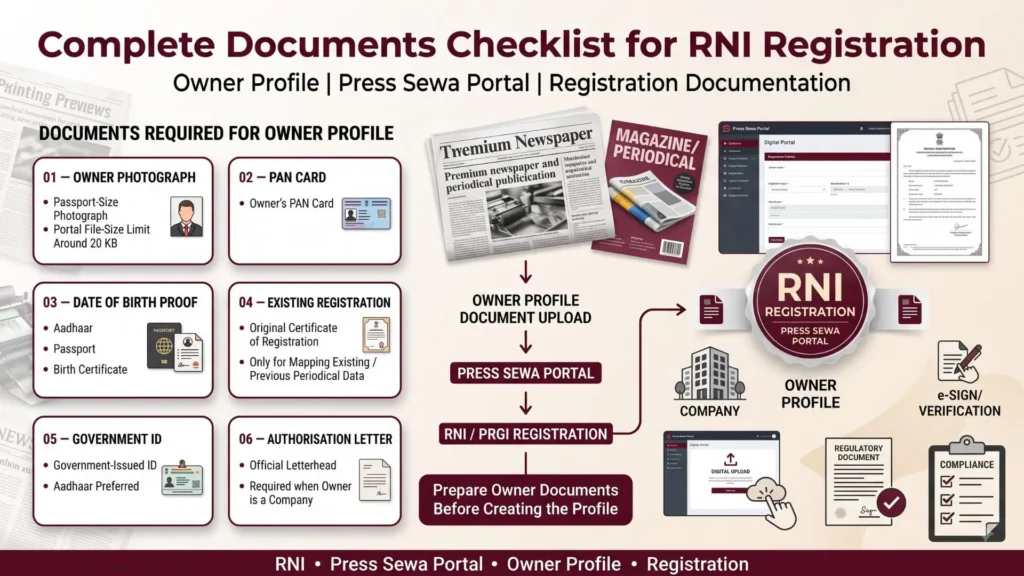
1. Documents Required for the Owner Profile
These are uploaded when the Owner first creates a profile on the Press Sewa Portal:
- Photograph of the Owner (passport-size, kept under the portal's file-size limit — around 20 KB).
- PAN Card of the Owner.
- Document supporting the Owner's Date of Birth (Aadhaar, Passport, or birth certificate).
- Original Certificate of Registration, only if you're mapping an existing/previous periodical's data.
- Any other government-issued ID — Aadhaar Card is preferred, since portal details are validated against it.
- Authorization Letter, on official letterhead, if the Owner is a company rather than an individual.
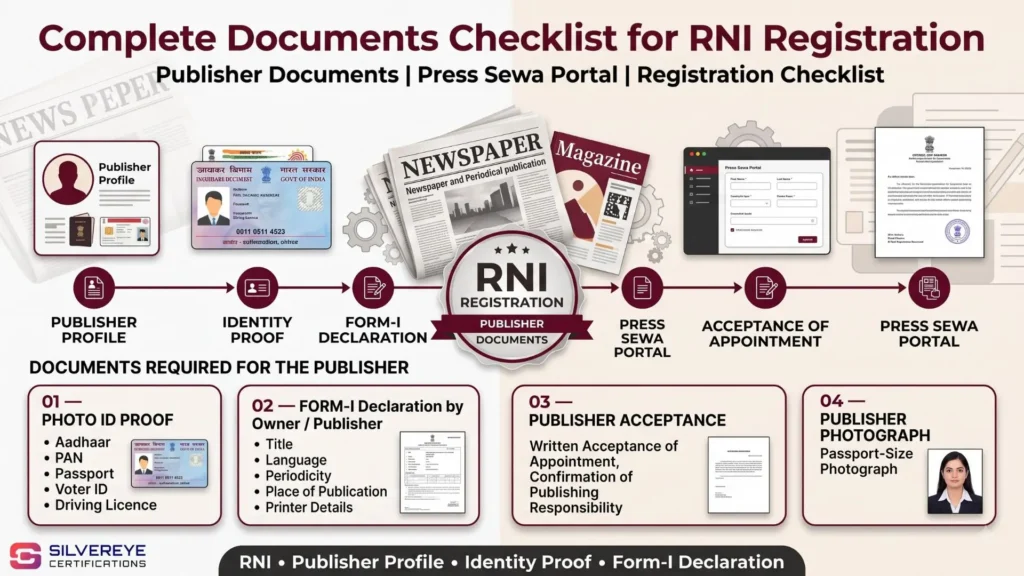
2. Documents Required for the Publisher
- Valid photo ID proof (Aadhaar, PAN, Passport, Voter ID, or Driving Licence).
- Form-I — the Declaration by the Owner/Publisher, stating the title, language, periodicity, place of publication, and printer details.
- Publisher's written acceptance of appointment (confirming they agree to take on the publishing responsibility).
- Passport-size photograph of the Publisher.
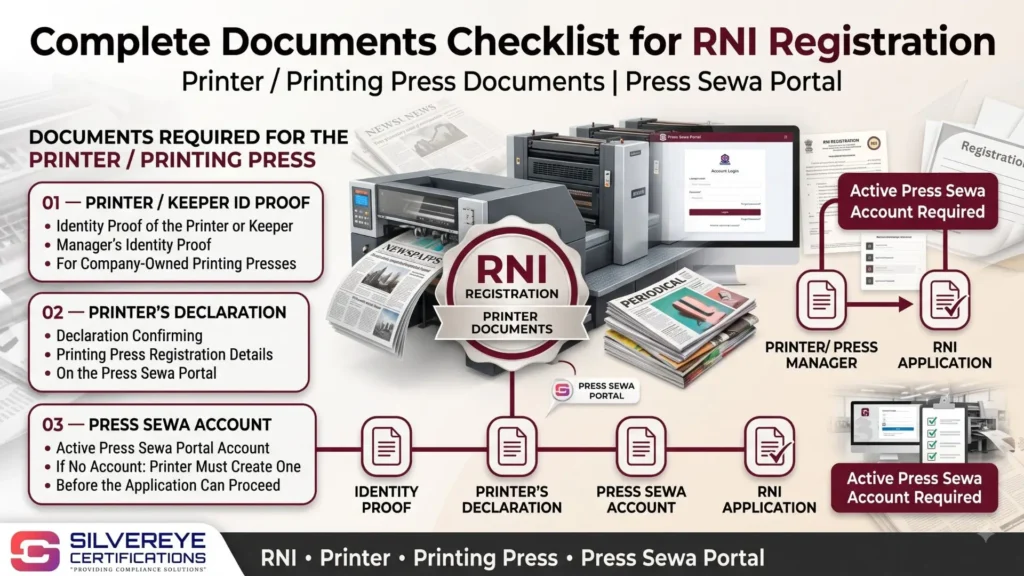
3. Documents Required for the Printer / Printing Press
- Identity proof of the Printer or Keeper (manager, for presses owned by a company).
- Printer's declaration confirming the press's registration details on the portal.
- Proof that the printing press already has an active Press Sewa Portal account — if not, the printer must create one before the application can move forward.
4. Title Affidavit
- A notarised affidavit, typically on non-judicial stamp paper (value generally ₹100–₹500 depending on the state).
- Content: a declaration by the Owner that the proposed title isn't already in use, isn't offensive, and doesn't resemble any existing registered title.
- Must be signed in front of a Notary Public before being scanned and uploaded.
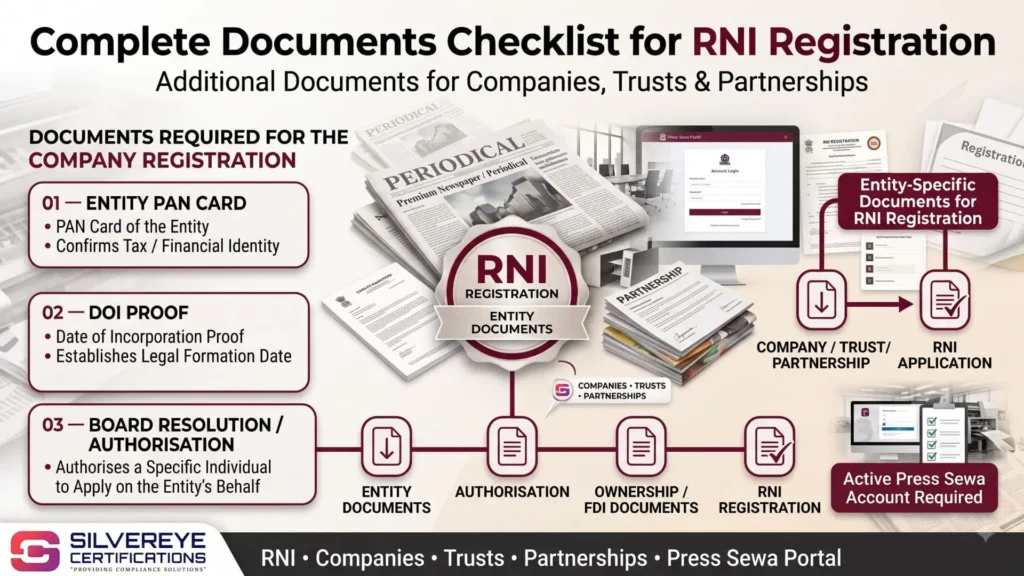
5. Additional Documents for Companies, Trusts & Partnerships
| Document | Why It's Needed |
| PAN Card of the entity | Confirms tax/financial identity of the organisation |
| Date of Incorporation (DOI) proof | Establishes when the company/firm was legally formed |
| Board Resolution / Authorization Letter | Authorises a specific individual to apply on the entity's behalf |
| GST Certificate (if available) | Supports the organisation's registered business status |
| Shareholding pattern document | Required for ownership-transfer or revision applications |
| Document supporting Foreign Direct Investment (if any) | Confirms compliance with FDI norms for foreign-linked ownership |
6. Documents Needed After Title Approval (Before Final Certificate)
- Scanned PDF copy of the first published issue's front page — proof that the periodical has actually gone to print.
- Any No Objection Certificate (NOC), if there's foreign ownership or investment involved.
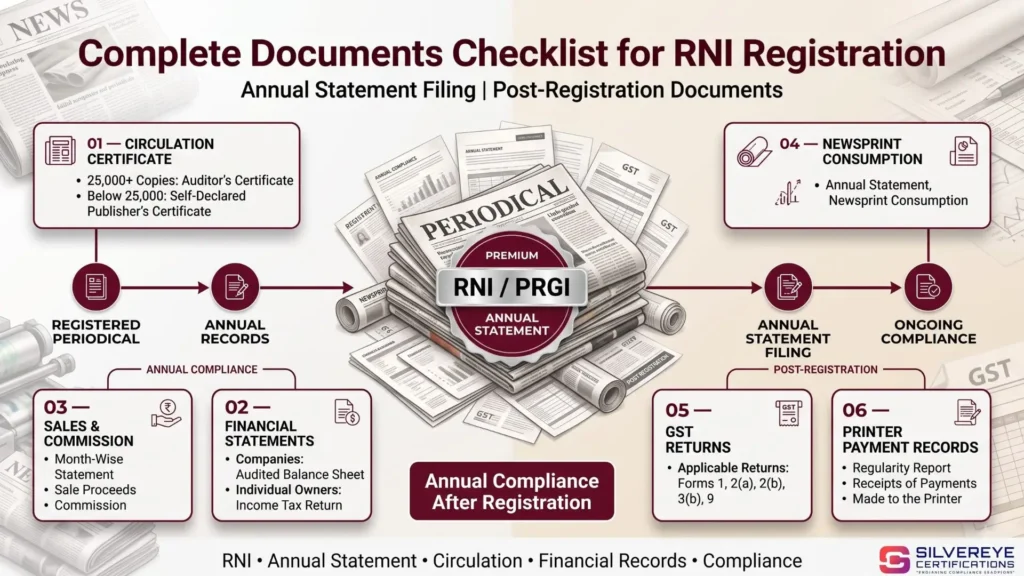
7. Documents for Annual Statement Filing (Post-Registration)
These aren't needed at the registration stage but become mandatory every year once you're registered:
- Auditor's Certificate (for circulation of 25,000+ copies) or a self-declared Publisher's Certificate (below that threshold).
- Audited Balance Sheet (for companies) or Income Tax Return (for individual owners).
- Month-wise statement of sale proceeds and commission.
- Statement of newsprint consumption for the year.
- Applicable GST returns (Forms 1, 2(a), 2(b), 3(b), and 9, as relevant).
- Regularity report and receipts of payments made to the printer.
Document Format & Upload Rules You Shouldn't Ignore
- Upload all files as clear, legible, and unaltered scans — blurry or edited documents are a common reason for rejection.
- Keep photographs within the portal's size limit (roughly 20 KB) to avoid upload errors.
- Fill in your profile details exactly as they appear on your Aadhaar Card — mismatches are the most frequent cause of e-Sign/OTP failure.
- Submit documents in PDF format wherever the portal specifies it, particularly for affidavits and declarations.
- Keep both digital scans and physical originals on hand — originals may be requested later during desk audits or circulation verification.
RNI Registration Documents: Fees Linked to Paperwork
| Item | Approximate Cost |
| Notarised title affidavit (stamp paper + notary charges) | ₹100–₹500+, depending on state |
| Registration processing fee (paid after documents are uploaded) | ₹1,000 via Bharatkosh |
| Document re-submission after rejection | No extra government fee, but delays your ARN/timeline |
Timeline: How Documentation Affects Approval Speed
Document readiness is one of the biggest levers you have over how fast your RNI registration moves. A complete, error-free document set can help you stay closer to the lower end of the typical 3–4 month approval window; missing or mismatched paperwork is what usually pushes applications toward the slower end, or into repeated rounds of resubmission.
Validity: Do Documents Need to Be Re-submitted Later?
- Your original registration documents don't need to be re-uploaded once approved, but any change in ownership, title, address, or printer requires a fresh revision application with updated documents.
- Every year, a fresh set of Annual Statement documents (circulation certificate, financial statements, etc.) must be filed to keep your registration active.
- If ownership passes to a legal heir, additional documents — a Legal Heir/Survivorship Certificate, or a Succession Certificate in disputed cases — are required for the transfer.
Common Documentation Mistakes to Avoid
- Uploading a scanned photo or ID that's blurry, cropped, or exceeds the portal's file-size limit.
- Listing a name, date of birth, or address that doesn't exactly match the Aadhaar record.
- Forgetting to get the title affidavit notarised before uploading it.
- Submitting Publisher or Printer documents before their profiles are even created on the portal.
- Leaving out the company PAN or board resolution when applying as a corporate entity.
- Not keeping a copy of the first published issue ready for the post-approval upload step.
Conclusion
Most delays in RNI registration don't come from the process itself — they come from paperwork that's incomplete, mismatched, or uploaded in the wrong format. Once you have your Owner, Publisher, and Printer documents sorted, your notarised title affidavit ready, and every detail matching your Aadhaar record exactly, the rest of the Press Sewa Portal journey tends to move quickly. Treat this checklist as your pre-application prep list, and you'll likely avoid the single biggest reason applications get stuck.
Frequently Asked Questions
What is the most important document for RNI registration?
The Form-I declaration and a valid government photo ID (preferably Aadhaar) are the two most essential documents, since nearly every other step depends on them being accurate.
Do I need separate documents for the Owner and Publisher?
Yes. Even if the same person holds both roles, the Press Sewa Portal requires separate profile creation, and in some cases separate document uploads, for Owner and Publisher.
Is a notarised affidavit compulsory for RNI registration?
Yes, a notarised affidavit declaring that your proposed title is unique and non-offensive is a standard requirement, typically on non-judicial stamp paper.
What documents does a printing press need to submit?
The Printer or Keeper needs identity proof and must confirm the press's registration details on the Press Sewa Portal, along with formally accepting the Publisher's nomination.
What documents are required for a company applying for RNI registration?
Companies need PAN, proof of incorporation, a board resolution or authorisation letter, and where applicable, GST certificate and FDI-related documents, in addition to individual owner documents.
Why did my Aadhaar e-Sign fail during document submission?
This usually happens when your name or details on the portal don't exactly match your Aadhaar record — double-check spelling, date of birth, and address before e-Signing.
What size should photographs be for the Press Sewa Portal?
Photographs are generally required to be small in file size (around 20 KB), so use a compressed, clear passport-size photo when uploading.
Do I need to submit documents again every year?
Your core registration documents aren't resubmitted annually, but you must file fresh Annual Statement documents — circulation and financial proof — every year to keep your registration active.
What document is needed after my title is approved but before the final certificate?
You typically need to upload a scanned PDF of the front page of your first published issue as proof of actual publication.
Can I use a Voter ID instead of Aadhaar for RNI registration?
Yes, Voter ID, PAN, Passport, or Driving Licence are generally accepted as identity proof, though Aadhaar is preferred since portal validation is closely tied to it.
What documents are required if ownership passes to a legal heir?
A Legal Heir/Survivorship Certificate (or a Succession Certificate in disputed cases) along with the legal heir's photo ID is required for an ownership-transfer application.
What happens if I upload an unclear or edited document?
The Press Sewa Portal requires clear, legible, and unaltered documents — unclear or edited files are a common reason for delay or rejection during verification.