
- Changes are classified as major (prior approval needed) or minor (notification only) under the Sixth Schedule
- Major changes must be approved before implementation and completed within 60 days of approval
- Minor changes must be notified to CDSCO within 30 days of being made
- Misclassifying a major change as minor risks license suspension or cancellation
Introduction
CDSCO post approval changes are modifications made to a medical device after it already holds a valid manufacturing license (Form MD-5/MD-9) or import license (Form MD-15). Under the Sixth Schedule of the Medical Devices Rules, 2017, these changes are classified as major or minor.
Major changes — such as design changes affecting specifications, performance, or primary packaging material — need prior CDSCO approval and must be implemented within 60 days of that approval. Minor changes, like manufacturing process tweaks that don't affect quality, only need to be notified to CDSCO within 30 days. Getting this classification wrong is one of the most common causes of license action in India.
What Are CDSCO Post-Approval Changes?
CDSCO post-approval changes (often shortened to PACs) are any modifications made to a medical device, its manufacturing process, packaging, labelling, or licensing details after the device has already received its manufacturing license (Form MD-5 for Class A/B, Form MD-9 for Class C/D) or import license (Form MD-15).
Once CDSCO approves a device, it doesn't stay static forever — companies routinely update designs, switch suppliers, tweak manufacturing processes, or change packaging. The Medical Devices Rules, 2017, requires that these changes be reported and, in many cases, approved before they're implemented, so that the device in the market still matches what CDSCO originally reviewed for safety and performance.
This is different from an endorsement, which is about adding an entirely new device or site to an existing license. Post-approval change management is about keeping an already-approved device's registration accurate as it evolves over time.
Major vs Minor Changes: How CDSCO Classifies Them
The Sixth Schedule of the Medical Devices Rules, 2017, splits post-approval changes into two categories based on their potential impact on safety, performance, and quality.
| Change Type | Examples | What's Required |
| Major change | Design changes affecting specifications, indication for use, performance, or stability; change in primary packaging material | Prior approval from CDSCO required before implementation; must be completed within 60 days of approval |
| Minor change | Changes in manufacturing process, equipment, or testing that don't affect device quality; packaging changes excluding primary packaging material | Notification to CDSCO within 30 days of the change; no prior approval needed |
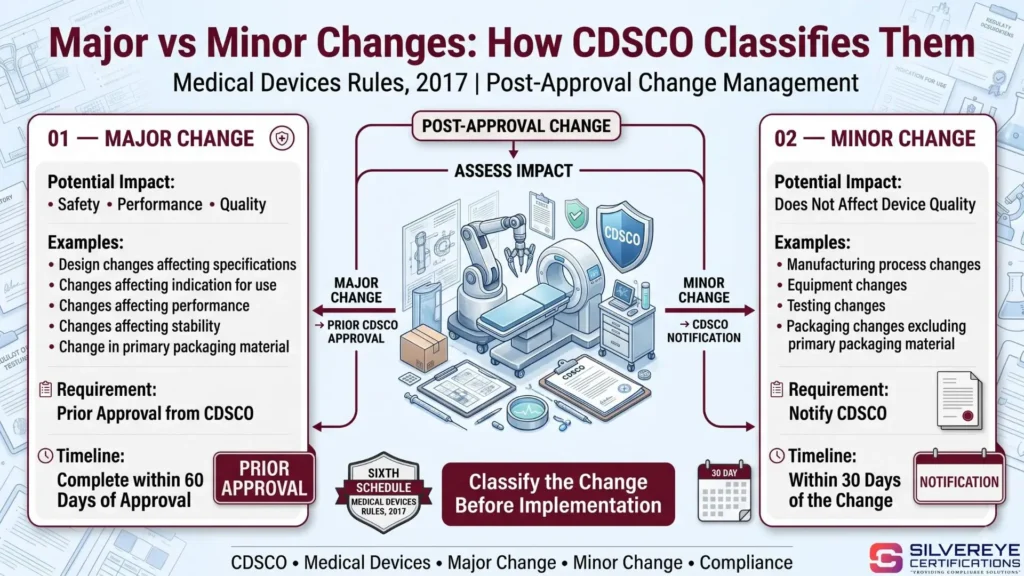
A simple way to think about it: if the change could plausibly affect how safe or effective the device is, or if CDSCO would have asked for new supporting data had this been proposed during the original application, it's almost certainly major. If it doesn't touch the device's risk profile, safety, or performance, it's more likely minor.
Benefits of Managing Post-Approval Changes Correctly
- Keeps your manufacturing or import license valid and avoids CDSCO enforcement action
- Lets you continue improving your product — new suppliers, process upgrades, design refinements — without market disruption
- Builds a clean compliance track record that helps with faster reviews on future applications
- Protects your ability to keep selling the device in India while the change is under review, when handled through the correct notification/approval route
Who Needs to File CDSCO Post-Approval Changes?
This process applies if you fall into any of these categories:
- Manufacturers holding a valid Form MD-5 (Class A/B) or Form MD-9 (Class C/D) license who are changing device design, materials, or manufacturing process
- Importers holding a valid Form MD-15 import license who are updating device specifications, packaging, or labelling
- Companies switching a component supplier, testing method, or manufacturing site for an already-approved device
- Businesses updating product labelling, indications for use, or packaging that differs from what was originally approved
Eligibility & Applicable Licenses
- The applicant must hold a valid, unexpired base license — Form MD-5/MD-6 for Class A/B, Form MD-9/MD-10 for Class C/D, or Form MD-15 for imports
- The Device Master File or Plant Master File must be kept current and consistent with what's being changed
- The proposed change must be correctly classified as major or minor before filing, since the documentation and timeline differ significantly
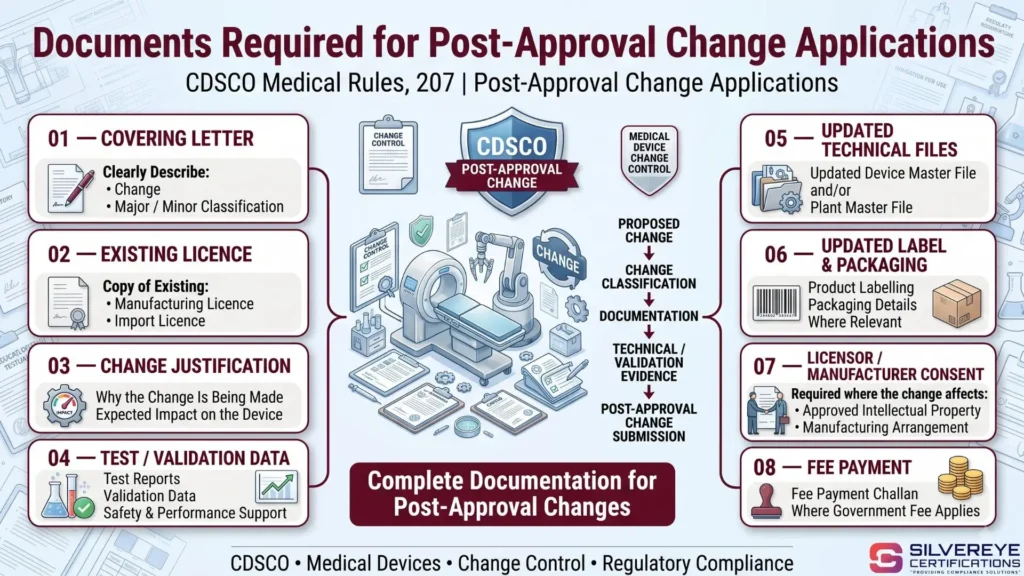
Documents Required for Post-Approval Change Applications
A typical post-approval change submission includes:
- Covering letter clearly describing the change and its classification (major or minor)
- Copy of the existing manufacturing or import license
- Change justification — why the change is being made and its expected impact on the device
- Test reports or validation data supporting that the change doesn't compromise safety or performance
- Updated Device Master File and/or Plant Master File reflecting the change
- Updated product labelling and packaging details, where relevant
- Licensor or manufacturer consent, if the change affects a third party's approved intellectual property or manufacturing arrangement
- Fee payment challan, where a government fee applies to the specific change
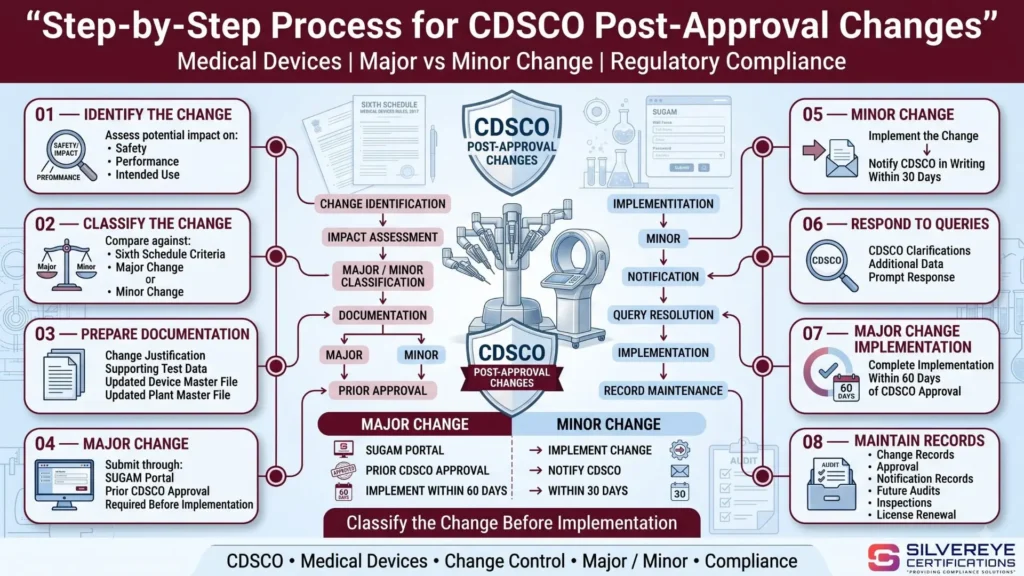
Step-by-Step Process for CDSCO Post-Approval Changes
- Identify the change and assess its potential impact on device safety, performance, and intended use
- Classify the change as major or minor by comparing it against the Sixth Schedule criteria
- Compile the change justification, supporting test data, and updated Device Master File/Plant Master File
- For major changes: submit the application through the SUGAM portal and wait for CDSCO's prior approval before implementing the change
- For minor changes: implement the change and notify CDSCO in writing within 30 days
- Respond promptly to any CDSCO queries seeking clarification or additional data
- For major changes, complete implementation within 60 days of receiving CDSCO's approval
- Maintain records of the change and its approval/notification for future audits, inspections, or license renewal
Fees for CDSCO Post-Approval Changes
| Change Type | Indicative Fee Position |
| Minor change notification | Typically no separate government fee; primarily a documentation and notification exercise |
| Major change requiring prior approval | Fee applicable depending on device class and nature of change; verify current rate on SUGAM |
| Retention fee (unrelated to PAC, but often due around the same review cycle) | Payable once every 5 years, ranging by device class as per the Second Schedule |
Government fees for post-approval changes vary depending on the device's risk classification and the specific nature of the change. Always confirm the current applicable fee on the CDSCO/SUGAM portal before submitting a major change application.
Timeline: How Long Does a CDSCO Post-Approval Change Take?
| Change Type | Typical Review Timeline |
| Minor change | Generally 2 to 4 weeks for CDSCO review after notification |
| Major change — Class A/B | Varies; may involve a notified body audit to verify continued QMS compliance |
| Major change — Class C/D | Roughly 90 to 180 days depending on the complexity of the change and any additional technical or clinical data required |
These are general ranges — actual timelines depend on documentation quality, whether CDSCO raises queries (which pauses the review clock), and the specific device class involved.
Validity: How Post-Approval Changes Relate to Your Base License
A post-approval change doesn't create a new, independent license or a new expiry date. Once approved or acknowledged, it becomes part of your existing manufacturing or import license record and follows that license's validity and retention cycle. This mirrors how endorsements work — any addition or change made to your base license remains valid only as long as the base license itself remains valid, so keeping your underlying license current through timely retention fee payments protects everything you've added to it over time.
Common Reasons Post-Approval Change Applications Get Delayed or Rejected
- The change is misclassified as minor when it actually meets the criteria for a major change
- Implementing a major change before receiving CDSCO's prior approval
- Insufficient test data or validation evidence to support that the change doesn't affect safety or performance
- Device Master File or Plant Master File not updated to reflect the change
- Missing licensor consent where the change affects a third party's approved manufacturing arrangement
- Slow response to CDSCO queries, which extends the overall review timeline
A Practical Framework for Classifying Your Change
Before filing, ask these questions to judge whether your change is major or minor:
- Does the change affect the device's intended use, safety, or performance?
- Would this change alter any section of the technical dossier CDSCO originally reviewed?
- Would CDSCO likely ask for new supporting data if they discovered this change independently?
- Could the change influence the device's risk classification or its labelling claims?
If the answer to any of these is yes, treat the change as major and seek prior approval — misclassifying a genuinely major change as minor is one of the most costly mistakes manufacturers make, since intent doesn't override impact in CDSCO's assessment.
Post-Approval Changes vs Endorsement: What's the Difference?
| Mechanism | What It Covers | Applicable Forms |
| Post-approval change | Modifying an already-approved device — design, process, packaging, labelling | Filed against existing MD-5, MD-9, or MD-15 license |
| MD-3 endorsement | Adding a new device, model, or manufacturing site to an existing Class A/B license | Form MD-3 referencing existing Form MD-5 |
| MD-14 endorsement | Adding a new device, model, or site to an existing import license | Form MD-14 referencing existing Form MD-15 |
Why Choose Silvereye Certifications
Silvereye Certifications helps manufacturers and importers correctly classify and file CDSCO post-approval changes — from assessing whether a proposed change is major or minor, to compiling change justifications, test data, and updated Device Master Files, and tracking the application through CDSCO review. Getting the classification right the first time avoids the costly delays and compliance risk that come with misclassified changes. Our team stays current with CDSCO and Ministry of Health & Family Welfare updates so your filing reflects the latest requirements.
Frequently Asked Questions
What are CDSCO post-approval changes?
They are modifications made to an already-approved medical device — such as design, manufacturing process, packaging, or labelling changes — after the device holds a valid manufacturing or import license.
How does CDSCO classify major and minor changes?
Under the Sixth Schedule of the Medical Devices Rules, 2017, major changes need prior CDSCO approval before implementation, while minor changes only need to be notified within 30 days.
What happens if I implement a major change without approval?
CDSCO can take enforcement action, including suspending or cancelling the license, and the device may not be allowed to remain in the market until the change is properly approved.
How long do I have to notify CDSCO about a minor change?
Minor changes must be notified to CDSCO within 30 days of the change being made.
How long does CDSCO take to approve a major change?
Timelines vary by device class and change complexity — minor changes are typically reviewed within 2 to 4 weeks, while major changes for Class C/D devices can take roughly 90 to 180 days.
Is a change in the manufacturing site always a major change?
Not necessarily, but changes that could affect device quality, safety, or performance — including many site changes — are generally treated as major and require prior approval. Each case should be assessed against the Sixth Schedule criteria.
Do post-approval changes need a separate license?
No. Approved or notified changes become part of your existing manufacturing or import license record rather than creating an independent new license.
What documents are needed for a post-approval change application?
Typical documents include a covering letter, existing license copy, change justification, supporting test data, and an updated Device Master File or Plant Master File.
How is a post-approval change different from an endorsement?
A post-approval change modifies an already-approved device's existing details. An endorsement (Form MD-3 or MD-14) adds an entirely new device, model, or site to an existing license.
What if I'm unsure whether my change is major or minor?
As it against whether it affects intended use, safety, performance, or risk classification. When in doubt, treat it as major and seek prior approval, or consult a regulatory professional before implementing the change.
Does a post-approval change affect my license's validity or retention fee?
Approved changes don't create a separate expiry date — they follow the validity and retention cycle of your base manufacturing or import license.