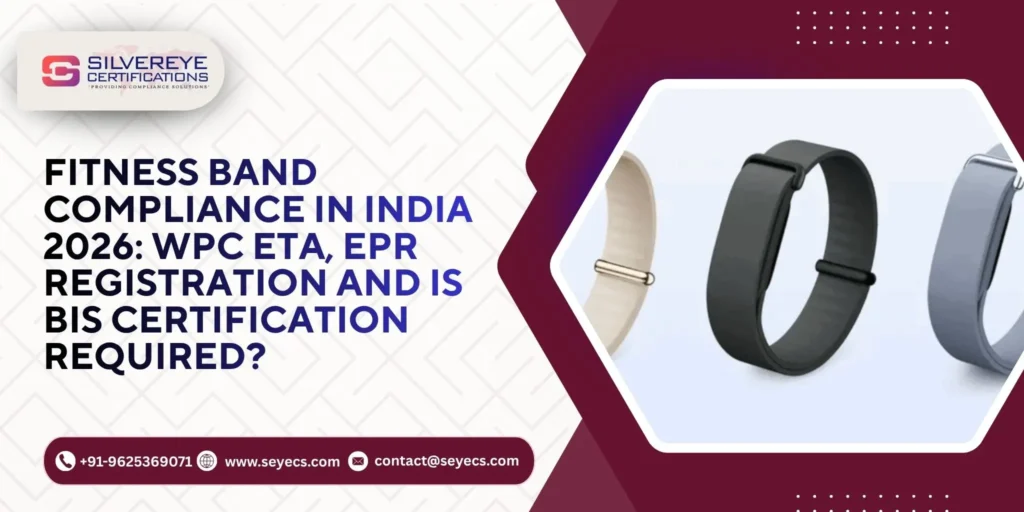
- Screenless fitness band Compliance (like Fitbit Air-style trackers) are approved under WPC ETA Approval, not under BIS CRS, since CRS display-based standards don't apply to them.
- EPR Registration under E-Waste Rules 2022 and Battery Waste Rules 2022 is mandatory for every fitness band sold in India, screen or no screen.
- An RF Test Report from a NABL/ISO 17025 lab is the backbone document for WPC ETA — without it, your application doesn't move.
- Legal Metrology (LMPC) declarations on pre-packaged fitness bands Certification are a separate, often-missed requirement for importers and e-commerce sellers.
Introduction
Fitness Band need WPC-ETA approval before they can be sold, imported, or manufactured in India, because their Bluetooth module transmits on a de-licensed radio frequency regulated by the WPC Wing.
Take Google's Fitbit Air as an example — a screenless health tracker that launched globally in May 2026 and connects to the Google Health app over Bluetooth. As of this writing, it hasn't officially launched in India yet, though several reports note it has already appeared on India's BIS certification database ahead of that launch, which is a useful real-world signal of how this compliance process actually plays out.
BIS registration is more nuanced: smartwatches are clearly on BIS's notified CRS list, but screenless trackers without a display occupy a genuine grey area that's worth verifying directly. EPR registration — covering Plastic, Battery, and E-Waste — applies regardless of the BIS answer.
WPC ETA Approval for Fitness Bands: The Non-Negotiable Requirement
Regardless of whether your fitness band has a screen, a battery, or a heart-rate sensor, one thing is constant: if it transmits data wirelessly, it needs WPC ETA Approval. This is the single most important certification for any wearable or smart band sold in India, and there is no screenless exemption here.
Why WPC ETA Applies to Every Fitness Band
WPC ETA (Equipment Type Approval) is issued by the Wireless Planning & Coordination Wing under the Department of Telecommunications (DoT). It confirms that a device's Bluetooth or Wi-Fi radio operates within India's permitted de-licensed frequency bands (typically 2.4 GHz) without causing harmful interference to other communication systems. Smart watches and fitness bands using Bluetooth or Wi-Fi are explicitly listed among the product categories that require ETA before import or sale.
Selling a wearable without WPC ETA isn't a minor paperwork gap — customs authorities can stop shipments at the port, and e-commerce marketplaces increasingly ask for ETA documentation before listing wireless products.
What an RF Test Report Covers
At the center of the WPC ETA application is the RF Test Report — a document from a NABL-accredited (or equivalent ISO/IEC 17025) laboratory that verifies your device's radio module against Indian frequency and power limits. A thorough RF test report covers:
- Operating frequency band and confirmation it falls within de-licensed limits
- Transmit power output, checked against permissible EIRP limits
- Spurious emissions and out-of-band interference levels
- Modulation scheme and channel bandwidth (Bluetooth Low Energy, Wi-Fi, etc.)
- Antenna specifications and device labeling details
Without a clean RF test report matching your declared technical specifications, your ETA application will be delayed or rejected — this is the step where most first-time applicants lose the most time.
WPC ETA Process, Documents, and Timeline
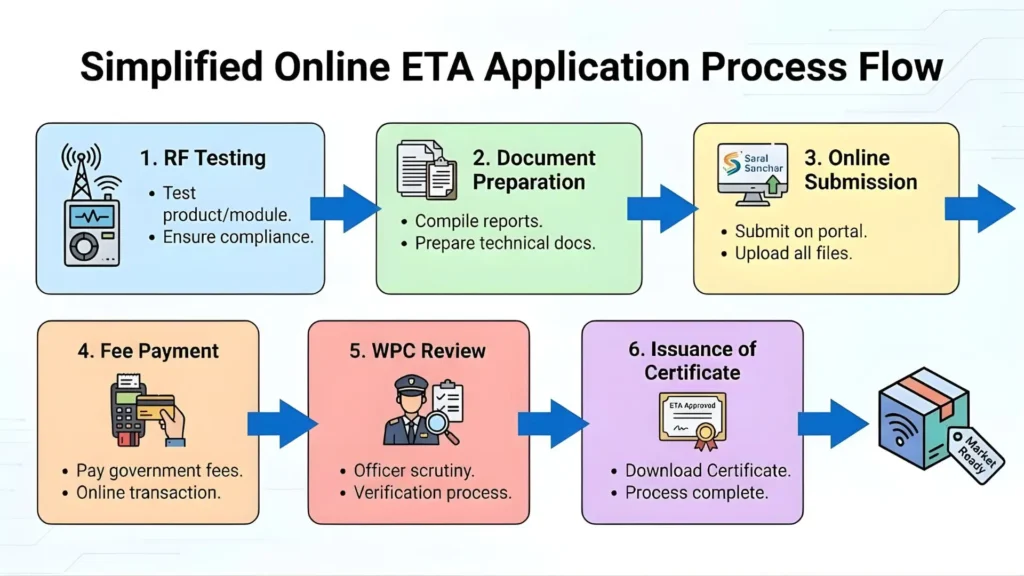
| Step | What Happens |
| 1. RF Lab Testing | Sample device is tested at a recognized lab; RF Test Report is generated. |
| 2. Document Compilation | Technical specs, company/brand details, and (for foreign manufacturers) an Authorized Indian Representative (AIR) authorization are compiled. |
| 3. Portal Submission | Application filed on the Saral Sanchar portal — either the standard ETA route or the Self-Declaration route for eligible low-power, license-exempt devices. |
| 4. WPC Review | WPC Wing verifies RF compliance and documentation. |
| 5. Approval Issued | ETA certificate issued per model; typical processing runs roughly 10–15 working days once documents are complete, though this can vary case to case. |
| Verify Before You File WPC ETA processing timelines and the applicability of the Self-Declaration route depend on the exact frequency band, transmit power, and DoT's current notifications. Confirm your device's eligibility on the Saral Sanchar portal or with a compliance consultant before setting client-facing timelines. |
Once granted, WPC ETA does not have a fixed expiry — it remains valid as long as the wireless hardware and RF module are unchanged. If you revise the antenna, radio chipset, or transmit power in a later hardware version, a fresh or amended ETA is typically needed for that model.
Why Fitness Band Compliance Like Fitbit Air Need WPC-ETA Approval
A screenless tracker's entire job is to collect data quietly and hand it off to your phone — heart rate, SpO2, HRV, sleep stages, cardio load. That handoff happens over Bluetooth, and that's exactly the transmission WPC regulates. A few things make this unavoidable for the category:
- The Bluetooth module is classified as a Short-Range Device (SRD) under WPC's frequency allocation rules, the same category wireless earbuds and smartwatches fall into.
- Having no screen doesn't change anything from WPC's perspective — it regulates based on radio transmission, not on what the device displays.
- Customs checks for a valid ETA number on wireless-enabled electronics at the port, so an imported tracker without one risks getting held up before reaching a warehouse.
- Marketplaces increasingly ask sellers to confirm WPC ETA compliance before approving wireless wearable listings, which affects launch timing as much as legal risk.
Role of RF Testing in Fitness Band WPC ETA Compliance
RF testing is what actually backs up a WPC ETA application — it's lab evidence that a tracker's Bluetooth module behaves the way it should, not just a paperwork step. The test is carried out by a NABL-accredited or WPC-recognised laboratory, and the resulting report is what WPC evaluates before granting approval.
For a small, screenless device like Fitbit Air, this matters more than it might for a bulkier gadget. Google describes it as one of Fitbit's smallest trackers yet, worn snugly against the skin in a compact housing — and a tighter enclosure, closer to the body, can genuinely change how a Bluetooth chipset performs compared to how it behaves on the chipset manufacturer's own reference board.
- Operating frequency band — Confirming the module stays within India's permitted de-licensed bands (Bluetooth typically sits in the 2.4 GHz ISM band).
- Transmission power (EIRP) — Checking radiated power doesn't exceed the limit set for that frequency band.
- Spurious emissions — Making sure the module isn't bleeding signal into bands it has no business transmitting on.
- Receiver performance — Confirming the module receives signal within expected technical parameters.
Is a Screenless Fitness Band Different From a Smartwatch Under BIS Rules?
This is the trickiest question in the category, and Fitbit Air is a genuinely useful example of why. Smartwatches are clearly notified under BIS's Compulsory Registration Scheme (CRS), governed by a specific Indian Standard written for that category. Fitbit Air, by contrast, deliberately has no display, no calls, no notifications, and no payments — Google built it specifically to not be a smartwatch. That's a meaningful distinction, since the notified BIS standard was written with display-equipped smartwatches in mind.
Interestingly, this is also where the Fitbit Air case gets genuinely instructive: some reports indicate it's already appeared on India's BIS certification database ahead of an official India launch, even though it's a screenless tracker. If accurate, that suggests Google may be treating BIS registration as applicable to this device — but we can't independently confirm the details of that filing, and one product's approach doesn't automatically set the rule for the entire category. Rather than assume an answer either way, the honest guidance is to check your specific product's status directly against the current CRS notified list, or have a compliance consultant confirm it, rather than copying the answer from a smartwatch guide or a screenless smart ring guide.
EPR Compliance for Fitness Band: Plastic, Battery & E-Waste
Extended Producer Responsibility (EPR) makes the brand — not the factory — responsible for what happens to a product after its useful life. For a fitness tracker, three separate registrations typically apply, all handled through the Central Pollution Control Board (CPCB) portal.
1. EPR – Plastic Waste Management
Fitness trackers ship in retail boxes, protective film, and courier packaging. Google specifically markets Fitbit Air's packaging as plastic-free, which is a good example of brands getting ahead of this requirement rather than treating it as an afterthought. Under the Plastic Waste Management Rules, 2016 (as amended), the brand owner or importer using any plastic packaging must register on CPCB's EPR portal and meet annual collection and recycling targets.
2. EPR – Battery Waste Management
A tracker like Fitbit Air runs on a small built-in battery rated for roughly a week of use per charge. Under the Battery Waste Management Rules, 2022, the entity placing that battery-containing product in the Indian market has to register as a producer and fulfil collection and recycling obligations — regardless of whether the battery is sold as a standalone accessory or built permanently into the device.
3. EPR – E-Waste Management
As an electrical and electronic device, a fitness tracker falls under the E-Waste (Management) Rules, 2022. Manufacturers and importers register as producers on the CPCB portal and report volumes placed in the market against prescribed collection targets.
Legal Metrology Declarations for Fitness Tracker Packaging
This requirement isn't specific to wireless devices, which is exactly why it's easy to overlook. Under the Legal Metrology (Packaged Commodities) Rules, 2011, a boxed fitness tracker sold in India needs certain declarations on its packaging before it can legally be sold: manufacturer or importer name and address, net quantity, month and year of packing, Maximum Retail Price (MRP) inclusive of taxes, and customer care contact details.
For a brand selling through Amazon or Flipkart, this typically gets checked at the listing-approval stage, alongside WPC ETA and BIS documentation where applicable. It's worth reviewing packaging artwork against this checklist early, rather than after a marketplace rejects a listing over a missing MRP declaration.
Benefits of Getting Fitness Band Certification Right the First Time
- Faster customs clearance — pre-approved ETA and EPR numbers mean shipments move through ports without holds.
- Marketplace approval — Amazon, Flipkart, and other platforms increasingly gate wireless wearable listings behind valid WPC and EPR documentation.
- Legal protection — avoids penalties under the WPC Wireless Act, E-Waste Rules, and Legal Metrology Act, all of which carry real financial consequences.
- Consumer trust — visible compliance markings signal a legitimate, safety-tested product in a market increasingly wary of unregulated grey-market wearables.
- Long-term market access — as MeitY and CPCB tighten wearable-category enforcement through 2026, early and correct registration keeps your brand ahead of stricter future audits.
Who Needs to Apply For Fitness Band?
- Indian manufacturers producing fitness bands, activity trackers, or other wearables domestically
- Foreign brands importing these devices into India, acting through an Authorized Indian Representative (AIR) for WPC ETA
- E-commerce sellers and brand owners placing such wearables in the Indian market under their own label
- Startups and D2C wearable brands sourcing white-label or OEM trackers for India-specific launch
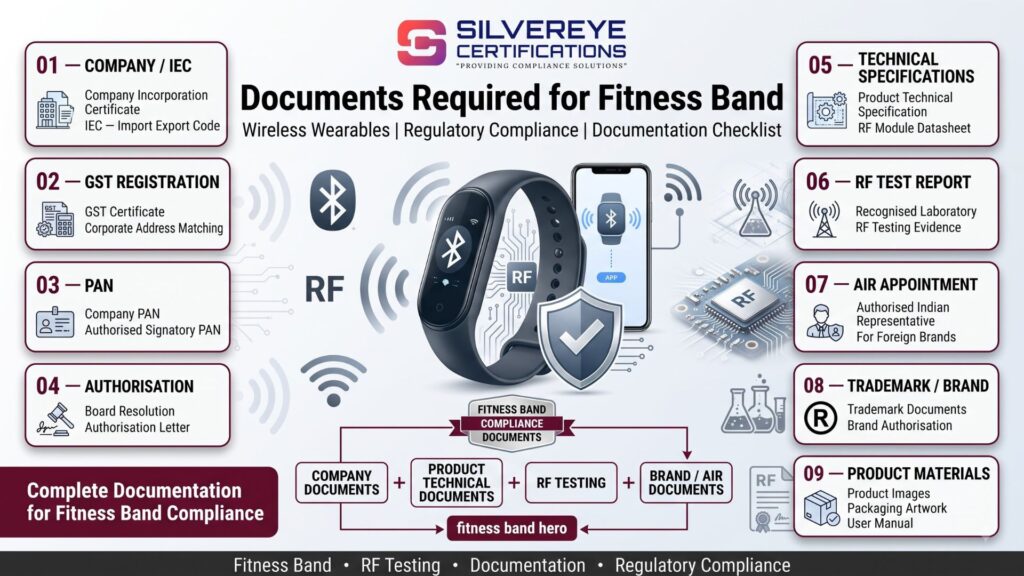
Documents You'll Need Across These Approvals
- Company incorporation certificate / IEC (Import Export Code)
- GST registration certificate matching the corporate address
- PAN of the company and authorised signatory
- Board resolution / authorisation letter for the signatory
- Product technical specification sheet and RF module datasheet
- RF test report from a recognised lab
- Authorised Indian Representative (AIR) appointment letter, for foreign brands
- Trademark/brand authorisation documents, where applicable
- Product images, packaging artwork, and user manual
Step-by-Step Process to Get a Fitness Band Certification-Ready
- Get a formal applicability check done — confirm in writing whether your exact model needs BIS CRS, not just WPC ETA and EPR.
- Commission RF and safety testing at a recognised lab for the RF test report (and IS 13252 testing, if applicable).
- File the WPC ETA application via the Saral Sanchar portal with full technical documentation.
- Register as a producer on the CPCB EPR e-waste portal and tie up with an authorised recycler or PRO.
- Register with the Legal Metrology Department for LMPC and finalise compliant packaging copy.
- If your model does fall under the smart-watch BIS CRO, file the CRS application with IS 13252 (Part 1) test results.
- Print the WPC ETA number, EPR registration number, WEEE symbol, and LMPC declarations on the final packaging.
- Launch — and calendar your EPR annual returns and any renewal dates so compliance doesn't lapse post-launch.
Common Mistakes Fitness Tracker Brands Make
- Assuming a screenless tracker is automatically exempt from BIS just because it isn't a 'smartwatch' — this needs direct verification, not an assumption.
- Treating EPR as optional for a small, lightweight product — battery and e-waste obligations apply regardless of the device's size.
- Overlooking Legal Metrology packaging declarations because the focus stays entirely on wireless compliance.
- Using diagnostic-sounding marketing language for health notifications without checking whether that positioning changes the product's regulatory category.
Why Work With Silvereye Certifications For Fitness Band
Fitness trackers sit at the intersection of several compliance tracks — wireless, product safety, waste management, and packaging law — and getting the BIS question wrong in either direction costs real time and money. Silvereye Certifications works specifically on WPC-ETA, BIS/CRS, and EPR (Plastic, Battery, E-Waste) approvals for electronics and wearable brands entering the Indian market. For a fitness tracker launch, that typically means:
- Confirming your specific product's BIS/CRS status rather than relying on a generic smartwatch-vs-wearable assumption.
- Coordinating RF testing with accredited labs and preparing documentation WPC expects for the finished product.
- Registering and managing Plastic, Battery, and E-Waste EPR obligations on the CPCB portal, including annual reporting.
- Reviewing packaging artwork against Legal Metrology requirements before it goes to print.
- Acting as your point of contact for queries raised by WPC, BIS, or CPCB during processing.
If you're planning a fitness tracker launch in India, it's worth having a compliance partner check your specific product against current rules, rather than assuming an answer based on a different device in the same broad category.
Conclusion
Google's Fitbit Air makes the compliance picture concrete, precisely because it's happening in real time: WPC-ETA approval is mandatory for the Bluetooth module regardless of whether the device has a screen, BIS applicability genuinely depends on your specific product and is worth verifying directly — as the Fitbit Air's reported BIS database appearance suggests brands are already doing — and EPR registration across Plastic, Battery, and E-Waste rules applies without exception. Add Legal Metrology packaging declarations to the list, and that's the full compliance picture for this category, grounded in how an actual current launch is unfolding rather than guesswork.
If you'd rather have someone confirm exactly where your product lands on the BIS question — and handle the rest end-to-end — Silvereye Certifications works specifically on WPC-ETA, BIS/CRS, and EPR compliance for electronics and wearable brands, and can walk you through what your fitness tracker needs before you commit to a launch date.
Frequently Asked Questions
Do Fitness Band need WPC-ETA approval in India?
Yes. Any Fitness band using Bluetooth to sync with a companion app is transmitting on a de-licensed radio frequency, which makes WPC-ETA approval mandatory before sale, import, or manufacture in India.
Is Google Fitbit Air an example of a device that needs WPC-ETA approval?
Fitbit Air is used here purely as an illustrative example of the product category — a Bluetooth-based, screenless tracker. Any brand building or importing a similar device needs to treat WPC-ETA as mandatory for its wireless module; we're not asserting confirmed claims about Google's own regulatory filings, which we don't have direct visibility into.
Has Google Fitbit Air launched in India yet?
As of this writing, no official India launch has been confirmed by Google, though the device has appeared on Indian retail listings and, according to some reports, on BIS's certification database. This status can change quickly, so it's worth checking current sources for the latest update.
Does a fitness Band need BIS registration
It depends on the specific product. Smartwatches are clearly notified under BIS's CRS list, but screenless trackers occupy a genuine grey area that isn't consistently documented, so it's worth verifying your exact product's status directly rather than assuming either answer.
Why does a screenless tracker get treated differently from a smartwatch?
BIS's notified smartwatch standard was written with display-equipped devices in mind. A screenless tracker is a different product definition, which is why its BIS status needs separate verification rather than automatically following the smartwatch rule.
Does EPR apply even if BIS doesn't?
Yes. EPR registration for Plastic, Battery, and E-Waste applies to fitness trackers regardless of whether BIS/CRS applies, since EPR is triggered by packaging, battery content, and electronic waste — not by BIS notification status.
What is Legal Metrology compliance, and does it apply to fitness trackers?
It's a packaging labelling requirement under the Legal Metrology (Packaged Commodities) Rules, 2011, requiring declarations like MRP, net quantity, and manufacturer details on pre-packaged goods — including fitness trackers — sold in India.
Is BIS certification compulsory for a screenless fitness band?
Generally, no — screenless fitness bands typically fall outside the current BIS CRS notified list, since CRS standards target display-based ICT/AV equipment like smartwatches. Always confirm your specific model's classification before assuming exemption.
What is an RF Test Report and why is it required?
It's a lab report from a NABL or ISO 17025 accredited facility confirming your device's radio frequency, power output, and emissions meet Indian standards. It's the core technical document behind your WPC ETA application.
How long does WPC ETA approval typically take?
Processing commonly runs around 10–15 working days once RF testing and documentation are complete, though this can vary based on application route and current WPC workload — verify current timelines before committing to a launch date.
Is Legal Metrology registration needed for imported fitness bands?
Yes. Imported fitness bands sold as pre-packaged commodities need an LMPC Registration Certificate and correct packaging declarations covering MRP, net quantity, and importer details.
Can a foreign fitness band brand apply for WPC ETA directly?
Foreign manufacturers typically need to appoint an Authorized Indian Representative (AIR) to file the WPC ETA application on their behalf.