

- BIS CRS registration has been mandatory for passport readers since 1 March 2016 under IS 13252 (Part 1):2010, and the category is now transitioning to IS/IEC 62368-1:2023.
- BIS licenses under Scheme-II now carry a 5-year initial validity and 5-year renewal cycle, following the Bureau's amendment dated 25 February 2026, with fees still payable annually in advance.
- MeitY's notification dated 29 October 2025 permits concurrent use of the old and new safety standards for passport readers until 1 November 2028, after which only IS/IEC 62368-1:2023 will apply.
- Typical first-time registration takes about 20–25 working days for the lead model once BIS-recognized lab testing is complete, and requires manufacturer-only eligibility (importers/traders cannot apply directly).
Introduction
BIS Registration for passport readers is a compulsory certification issued by the Bureau of Indian Standards under Scheme-II of the BIS (Conformity Assessment) Regulations, 2018. It has been mandatory since 1 March 2016 under IS 13252 (Part 1):2010, and manufacturers are now migrating to the newer IS/IEC 62368-1:2023 standard, with both standards allowed to run together until 1 November 2028 as per MeitY's notification dated 29 October 2025.

As of the amendment dated 25 February 2026, BIS licenses under Scheme-II are granted for 5 years initially and renewed for another 5 years, with fees paid annually. Only manufacturers (Indian or via an Authorized Indian Representative for foreign manufacturers) are eligible to apply, and the certificate carries a unique BIS R-number that must appear on the product before sale.
What Is BIS Registration for Passport Readers?
A passport reader (also called a passport scanner) is an electronic device that reads and verifies passport data — typically from the Machine-Readable Zone (MRZ) printed on the passport, and in advanced models, from the RFID chip embedded in e-passports. These devices are widely used at airports, immigration counters, border control desks, and passport-issuing offices to speed up identity verification and reduce manual errors. Because they connect to mains power or batteries and process sensitive identity data, they fall under the Compulsory Registration Scheme (CRS) administered by the Bureau of Indian Standards (BIS) on behalf of the Ministry of Electronics and Information Technology (MeitY).

Under the Electronics and Information Technology Goods (Requirement for Compulsory Registration) Order, 2021, no person can manufacture, store, sell, import, or distribute a passport reader in India unless it has been tested against the applicable Indian Standard and carries the BIS Standard Mark with a unique registration number. This requirement has applied to passport readers since 1 March 2016.
BIS registration works on a self-declaration of conformity model: the manufacturer gets the product tested at a BIS-recognized laboratory, submits the report and supporting documents, and BIS grants a license once everything is verified. This is different from the older ISI mark scheme (Scheme-I), which involves periodic factory audits; CRS/Scheme-II relies primarily on test reports and documentation.
For passport readers specifically, this certification exists to verify that the device's electrical, thermal, and mechanical safety — insulation, creepage distances, power supply components, and connectors — meets a baseline that protects users and the systems they connect to, from shock, overheating, or component failure.
Latest 2026 Update: Migration to IS/IEC 62368-1:2023 for Passport Readers
This is the most important recent change for anyone holding or applying for a BIS license on a passport reader. In its notification S.O. 4997(E) dated 29 October 2025, MeitY amended the Compulsory Registration Order to notify IS/IEC 62368-1:2023 — “Audio/Video, Information and Communication Technology Equipment – Part 1: Safety Requirements” — as the standard that supersedes IS 13252 (Part 1):2010 and IS 616:2017 across 38 notified product categories, including Passport Readers (Sl. No. 22 of the notified list).
BIS followed this up with implementation guidelines dated 9 March 2026 (Ref: Reg/IS/IEC 62368-1:2023/Guidelines/01), which lay out exactly how existing licenses and new applicants must handle the switch.
Key Dates You Need to Know
| Milestone | Date / Deadline |
| MeitY notification amending the CRO to include IS/IEC 62368-1:2023 | 29 October 2025 |
| BIS implementation guidelines for migration issued | 9 March 2026 |
| Last date of concurrent running of IS 13252 (Part 1):2010 with IS/IEC 62368-1:2023 | 1 November 2028 |
| IS 13252 (Part 1):2010 stands withdrawn for passport readers (and other listed categories) | After 1 November 2028 |
What This Means If You Already Hold a Passport Reader License
- You may continue operating under IS 13252 (Part 1):2010 until 1 November 2028, but you must plan the switch well before that date.
- To migrate, submit a fresh test report for your lead model(s) under IS/IEC 62368-1:2023 through the Standard Revision / Amendment / Essential Requirement option on your BIS login.
- For every other model already in your scope of license, you can submit a signed undertaking confirming IS/IEC 62368-1:2023 compliance instead of testing each one individually.
- If you miss the deadline, BIS may initiate cancellation of the license or deletion of the affected model(s) from your scope.
- Once compliance is confirmed, BIS issues a formal letter listing the model(s) for which IS/IEC 62368-1:2023 compliance has been established.
What This Means If You Are a New Applicant
- If your sample is already with the lab or your test report is already issued under IS 13252 (Part 1):2010, your application can still be processed under the old standard.
- New applications from now on can be filed under either the old standard or IS/IEC 62368-1:2023 — but if you choose the old standard, you must give a written declaration that you will migrate to IS/IEC 62368-1:2023 before the concurrent-running deadline.
- After 1 November 2028, BIS will not grant any new license for passport readers under IS 13252 (Part 1):2010.
Big Change: BIS License Validity Extended to 5 Years
Separately from the standard migration, BIS has also revised how long a Scheme-II license stays valid. Pursuant to an amendment dated 25 February 2026 to the BIS (Conformity Assessment) Regulations, 2018, the validity and renewal structure for licenses under Scheme-II — which includes the CRS license for passport readers — has changed as follows:
| Provision | Revised Rule (effective from 25 Feb 2026 amendment) |
| Initial grant of licence | 5 years (previously 2 years) |
| Renewal period | A further 5 years on each renewal |
| Fee payment | Annual, paid in advance by the prescribed due date, even though the licence itself now runs for 5 years |
| Non-payment of annual fee / production details | Triggers suspension, deferment, cancellation, or expiry provisions under the BIS (Conformity Assessment) Regulations, 2018 |
In short: your BIS CRS certificate for a passport reader is now a 5-year license, not a 2-year one — but you still need to pay the annual fee and submit production details every year on time, or the license can be suspended or cancelled regardless of the 5-year term. This is a genuine relief on renewal paperwork frequency, but it does not remove the annual compliance obligation.
Applicable Indian Standards for Passport Readers — Product Compliance Table
The table below summarises exactly where passport readers sit in the current BIS CRS framework, including the standard being phased out and the one replacing it.
| Field | Details |
| Product Category | Passport Readers |
| Sl. No. in MeitY Notification (62368-1:2023 migration list) | 22 |
| Mandatory Under CRS Since | 1 March 2016 |
| Current Standard | IS 13252 (Part 1):2010 |
| Standard Superseding It | IS/IEC 62368-1:2023 |
| Governing Regulation | BIS (Conformity Assessment) Regulations, 2018 – Scheme II, Schedule II |
| Certifying Authority | Bureau of Indian Standards (BIS), Registration Department |
| Nodal Ministry | Ministry of Electronics and Information Technology (MeitY) |
| Concurrent-Running Deadline | 1 November 2028 |
| Eligible Applicant | Manufacturer (Indian manufacturer or Authorised Indian Representative for a foreign manufacturer) |
| Licence Validity (from 25 Feb 2026) | 5 years, renewable for a further 5 years |
| Fee Payment Cycle | Annual, in advance |
| Certificate Output | BIS Standard Mark with unique 10-digit R-number |
Who Is Eligible to Apply for BIS CRS Registration (Passport Readers)?
- The applicant must be the manufacturer of the passport reader — traders, dealers, and pure importers cannot apply directly.
- A foreign manufacturer must appoint an Authorized Indian Representative (AIR) based in India to apply and correspond with BIS on their behalf.
- Each manufacturing location needs its own separate BIS license; a single license does not cover multiple factories.
- The product (passport reader model) must fall within the notified CRS product list and be tested against the applicable Indian Standard.
- The manufacturing address on the application must match the address on the business/manufacturing license submitted as proof.
Documents Required for BIS CRS Registration of Passport Readers
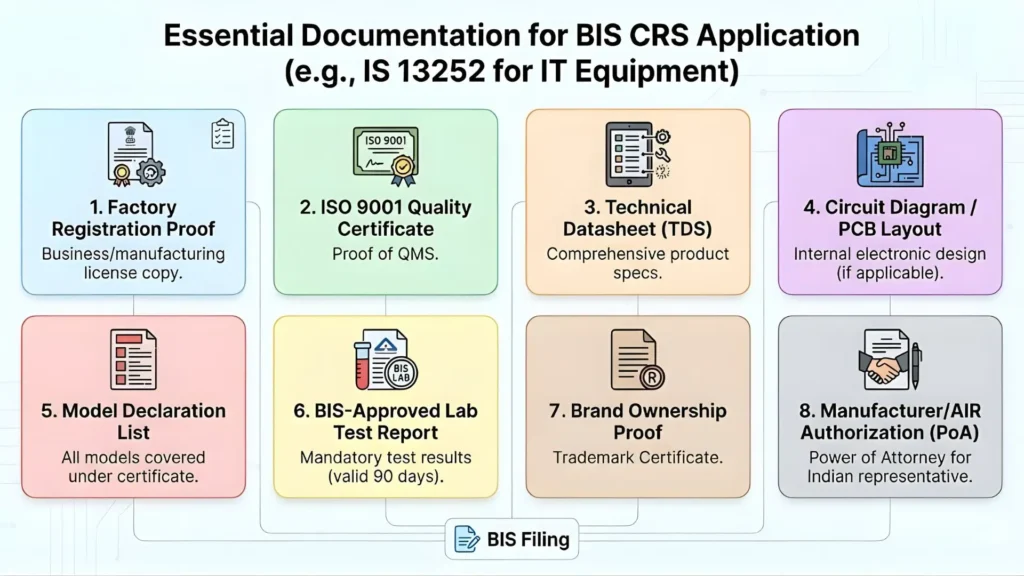
- Documentation requirements can vary slightly by case, but the following are consistently asked for:
- Duly filled BIS application form (Form-I for a new license) submitted through the BIS CRS online portal
- Business/manufacturing licence copy showing the factory address (in English, plus local language where applicable)
- Test report from a BIS-recognised laboratory for the lead model, tested against IS 13252 (Part 1):2010 or IS/IEC 62368-1:2023
- PCB layout, schematic diagram, and Critical Component List (CCL) of the passport reader
- User manual / instruction manual for the product
- Trademark registration copy or authorization letter, if the brand is not owned by the manufacturer
- Nomination letter and affidavit for the Authorized Indian Representative (AIR), for foreign manufacturers
- KYC documents of the manufacturer and, where applicable, the AIR
- Undertaking / declaration regarding implementation of IS/IEC 62368-1:2023 (for existing licensees migrating, or new applicants choosing to file under the old standard)
Step-by-Step BIS CRS Registration Process for Passport Readers
- Create a BIS portal account — Register on the BIS CRS online portal to receive login credentials.
- Select a BIS-recognized test laboratory and raise a test request for your passport reader model.
- Submit samples to the lab for testing against IS 13252 (Part 1):2010 or IS/IEC 62368-1:2023, as applicable.
- Receive the test report and report number once testing is complete and the product passes.
- Submit the full application with supporting documents on the CRS portal, generally within 90 days of the online application being filed.
- BIS review — officials examine the test report, application, and documents for conformity with the applicable Indian Standard.
- Query resolution, if any — BIS will flag missing or inconsistent documentation for correction.
- Grant of licence — BIS issues the CRS registration certificate with a unique R-number once the evaluation is successful.
- Marking — the R-number and BIS Standard Mark must be printed on the product/packaging before sale.
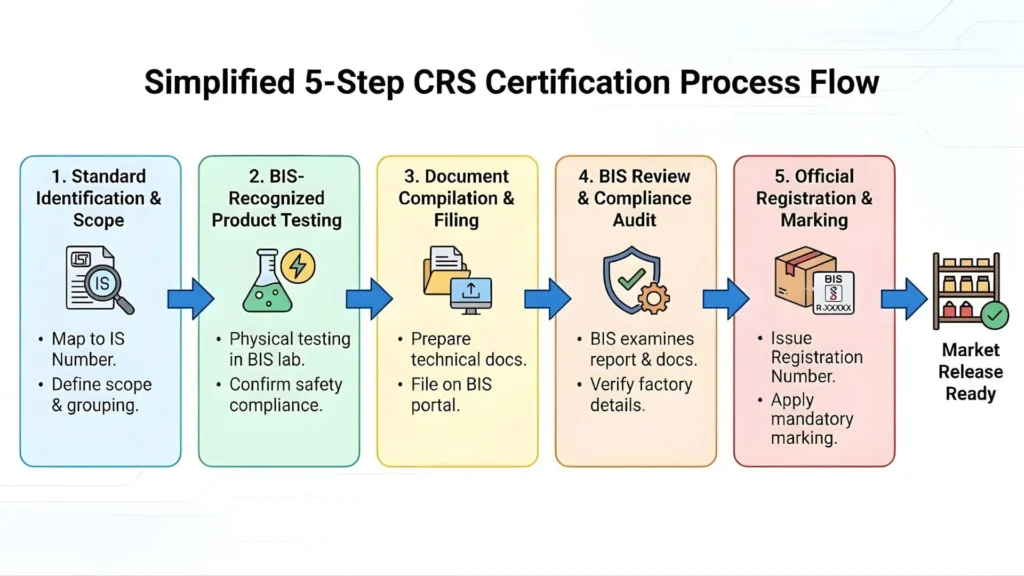
For a first application, the lead model typically takes around 20–25 working days once testing and documentation are in order; adding further models (inclusions) to an existing licence is usually faster, around 15–20 working days.
BIS CRS Fees for Passport Readers
BIS CRS fees are made up of a government application/grant fee, an annual license fee, and testing charges paid to the laboratory, plus consultant charges if you engage a certification partner. Government fee components for CRS applications commonly range from roughly ₹1,000 to ₹53,000 plus applicable GST, depending on the product category and number of models — actual figures should always be confirmed against the current BIS fee schedule, since fees are revised from time to time.
| Fee Component | When Payable | Notes |
| Application/Grant Fee | At the time of filing the application | As per BIS's current fee schedule for Scheme-II |
| Annual Licence Fee | Every year, in advance, by the due date | Applies throughout the 5-year validity period |
| Lab Testing Charges | Before/during sample testing | Payable to the BIS-recognised laboratory, varies by model and test scope |
| Renewal Fee | At the end of each 5-year cycle | Renewal is now granted for a further 5 years |
| Late Fee (if applicable) | If annual fee/renewal is delayed | May attract suspension/deferment as per BIS regulations |
Validity, Renewal & Compliance Timeline
| Stage | Timeline / Frequency |
| Initial licence validity | 5 years from date of grant |
| Annual fee & production data submission | Every year, in advance, by the prescribed due date |
| Renewal application | To be filed before expiry of the 5-year term, for a further 5-year period |
| Standard migration (passport readers) | Complete before 1 November 2028 |
| Non-payment consequence | Suspension/deferment, followed by cancellation/expiry if unresolved |
Benefits of BIS CRS Registration for Passport Reader Manufacturers
- Legal market access — without it, selling, importing, or distributing passport readers in India is not permitted.
- Consumer trust — the BIS mark signals independently verified electrical and safety compliance.
- Avoids seizure, penalties, and legal action at customs or during market surveillance.
- Improves acceptance on e-commerce marketplaces, which increasingly ask for the R-number before listing electronics.
- Longer 5-year validity (from the 2026 amendment) reduces the administrative burden of frequent renewals.
- A valid CRS licence supports smoother due diligence during tenders, B2B sales, and retail partnerships.
What Happens If You Sell Passport Readers Without BIS Registration?
Selling, storing, importing, manufacturing, or distributing a notified product like a passport reader without valid BIS CRS registration is a violation of the Electronics and Information Technology Goods (Requirement for Compulsory Registration) Order, 2021. Consequences can include seizure of non-compliant stock, monetary penalties, and legal proceedings, along with rejection or delisting on e-commerce platforms and at customs for imported units.
Need Expert Help? Silvereye Certifications — Trusted BIS CRS Consultants
Navigating BIS CRS registration for passport readers — especially with the ongoing migration to IS/IEC 62368-1:2023 and the new 5-year validity rules — involves careful documentation, lab coordination, and timeline management. This is exactly where Silvereye Certifications adds value.
Silvereye Certifications is a specialist BIS registration consultancy that helps manufacturers and Authorized Indian Representatives handle the entire CRS journey for passport readers and other electronic/IT products — from identifying the correct Indian Standard and preparing PCB layouts, schematics, and CCL documentation, to coordinating with BIS-recognised labs, filing the application, resolving BIS queries, and managing renewals and standard-migration submissions before the 2028 deadline.
- End-to-end documentation review to avoid rejections and delays
- Guidance on migrating existing licenses from IS 13252 (Part 1):2010 to IS/IEC 62368-1:2023
- Support with annual fee compliance so your 5-year license never lapses due to a missed due date
- Dedicated assistance for both Indian manufacturers and foreign manufacturers needing an AIR
If you manufacture or import passport readers and want a compliant, timely BIS CRS registration — or need to plan your migration to IS/IEC 62368-1:2023 before 1 November 2028 — Silvereye Certifications can guide the process from application to certificate.
Frequently Asked Questions
Is BIS CRS registration mandatory for passport readers in India?
Yes. Passport readers are a notified product category under MeitY's Compulsory Registration Order, and no one can manufacture, sell, store, import, or distribute them in India without a valid BIS CRS license and R-number.
Which standard applies to passport readers right now — IS 13252 or IS/IEC 62368-1:2023?
Both can currently be used. IS 13252 (Part 1):2010 remains valid for passport readers until 1 November 2028, after which only IS/IEC 62368-1:2023 will apply, as per MeitY's notification dated 29 October 2025 and BIS's implementation guidelines dated 9 March 2026.
How long is a BIS CRS license valid now?
Following the amendment dated 25 February 2026 to the BIS (Conformity Assessment) Regulations, 2018, a Scheme-II license — including for passport readers — is now granted for 5 years initially and renewed for a further 5 years, with fees still paid annually in advance.
Do I still need to pay fees every year even though the licence is now valid for 5 years?
Yes. The extended 5-year term changes how often you renew, not how often you pay. Annual fees and production details must still be submitted by the due date, or suspension, deferment, or cancellation provisions can apply.
Can a trader or importer apply for BIS CRS registration for passport readers?
No. Only the manufacturer can apply. A foreign manufacturer must appoint an Authorized Indian Representative (AIR) in India to file and manage the application.
What happens to my existing passport reader licence if I don't migrate to IS/IEC 62368-1:2023 in time?
If you fail to complete the migration by the last date of concurrent running (1 November 2028), BIS may initiate cancellation of the license or removal of the affected model(s) from your scope of license.
How long does BIS CRS registration take for a passport reader?
For a first (lead) model, the process generally takes around 20–25 working days after testing and documentation are complete. Adding further models to an existing license is usually quicker, around 15–20 working days.
What documents are essential for a passport reader BIS application?
Key documents include the BIS application form, manufacturing licence/address proof, the BIS-recognised lab's test report, PCB layout and schematic diagram, Critical Component List, user manual, and (for foreign manufacturers) AIR nomination and affidavit.
Can a new applicant still apply under the old standard, IS 13252 (Part 1):2010?
Yes, for now. New applications can be filed under either standard, but if you choose IS 13252 (Part 1):2010, you must submit a declaration confirming you will migrate to IS/IEC 62368-1:2023 before the concurrent-running deadline of 1 November 2028.
What is the BIS R-number, and where does it need to appear?
The R-number is the unique registration number BIS assigns once a licence is granted. It must be displayed on the product and/or its packaging, along with the BIS Standard Mark, before the passport reader is offered for sale
Who can help with BIS CRS registration and the standard migration for passport readers?
Specialist consultancies such as Silvereye Certifications assist manufacturers with document preparation, lab coordination, application filing, query resolution, and migration to IS/IEC 62368-1:2023 within the prescribed deadline.