- The RoHS certification process runs through five phases: material assessment, lab testing, technical documentation, Declaration of Conformity, and ongoing verification.
- Testing follows internationally recognised IEC 62321 standards — XRF screening first, then confirmatory wet-chemical or GC-MS testing for borderline results.
- Your technical file (BOM, supplier declarations, test reports) must be ready for inspection at any time, not just filed away after certification.
- In India, the process ties directly into the E-Waste (Management) Rules, 2022 and your EPR registration with the CPCB.
Introduction
The RoHS Certification process has five practical steps: first, identify the homogeneous materials in your product and the substances that apply; second, test those materials using XRF screening (per IEC 62321-3-1) followed by confirmatory wet-chemical or GC-MS testing for borderline results; third, build a technical documentation file with your Bill of Materials, supplier declarations, and test reports; fourth, issue a signed Declaration of Conformity (DoC) referencing those records; and fifth, keep the file current for CPCB verification, buyer audits, and renewal. Most manufacturers complete the full cycle in 2 to 6 weeks.
What Is the RoHS Certification Process?
RoHS certification isn't a single certificate you apply for and forget about — it's an ongoing process built around proving, with test data and paperwork, that your electrical or electronic product stays within the permitted limits for hazardous substances like lead, cadmium, mercury, and hexavalent chromium.
The process has three core pillars, which is exactly what most manufacturers ask about first: testing (checking whether the materials actually meet the limits), documentation (recording exactly how you know that), and declaration (formally stating compliance in a document your buyers, customs officials, and regulators can rely on).
In India, this process sits under the E-Waste (Management) Rules, 2022, enforced by the Central Pollution Control Board (CPCB) under the Ministry of Environment, Forest and Climate Change. Globally, the testing methods reference the IEC 62321 series of standards, and the documentation structure commonly follows EN 50581 and IEC 63000 — the same references Indian labs and exporters use when preparing files for EU-bound shipments.
Why Getting the Process Right Matters
- Prevents shipment holds: A weak or incomplete compliance file is one of the most common reasons goods get stopped at customs in RoHS-regulated markets.
- Protects you from false declarations: Signing a Declaration of Conformity without real test data behind it is a compliance and legal risk, not a shortcut.
- Builds long-term buyer trust: OEMs and EU distributors increasingly audit the process itself — not just the final certificate — before locking in a supplier.
- Keeps you aligned with Indian law: Rule 16 of the E-Waste (Management) Rules, 2022 requires producers to maintain technical documentation that can be produced for CPCB or SPCB verification at any time.
- Makes renewal painless: A well-maintained process means you're not starting from scratch every five years or after every supplier change.
- Reduces cost over time: Catching a non-compliant component early through screening is far cheaper than a rejected shipment or a market recall later.
Who Needs to Follow the RoHS Certification Process?
This isn't limited to large factories — the process applies to anyone whose product could end up carrying restricted substances above the threshold:
- Manufacturers of electrical and electronic equipment (EEE) sold in India
- Importers bringing electronics or components into the country
- Brand owners and OEMs selling under their own label, even with outsourced manufacturing
- Exporters shipping to the EU, UK, or any other RoHS-aligned market
- Component suppliers, since buyers usually push RoHS documentation requirements down the supply chain contractually
- MSMEs — some get phased timelines under the E-Waste Rules, but the substance-restriction requirement itself still applies
The RoHS Certification Process: Step-by-Step
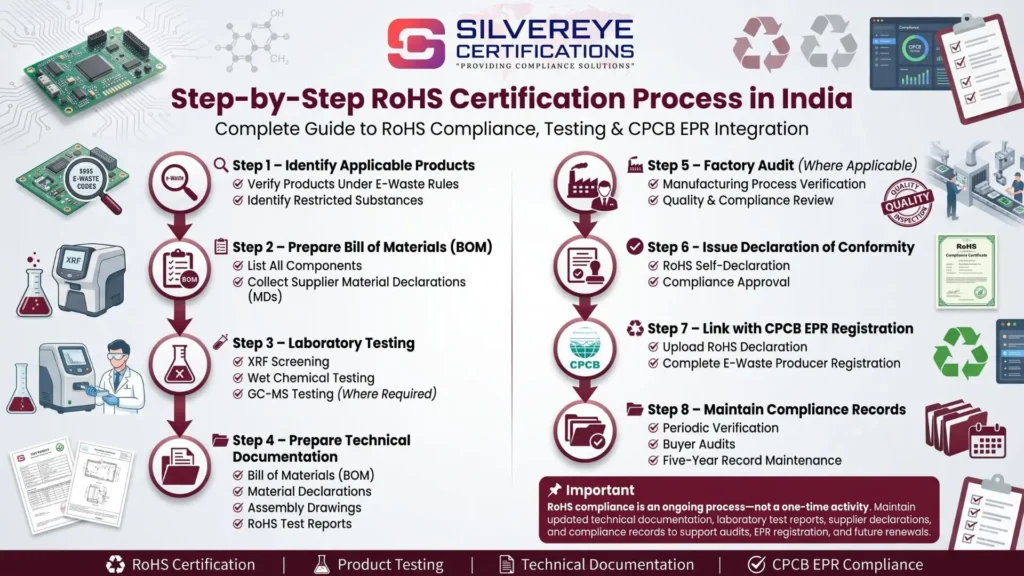
Here's the process broken into the five phases every manufacturer actually goes through, in the order labs and certification bodies follow it.
Phase 1: Material and Product Assessment
Before any testing happens, you need to map out what you're actually testing. This means listing every homogeneous material in the product — solder joints, plastic housings, cable insulation, metal plating, PCB coatings — because RoHS limits apply at the material level, not just the finished product as a whole.
- Identify every homogeneous material and component in the product
- Determine which of the six (or ten, for EU exports) restricted substances are realistically present in each material
- Flag high-risk components first — solder, plastic casings, metal finishes, and flame-retardant plastics are the usual suspects
- Decide whether testing will cover the full Bill of Materials or a risk-based sample, based on product complexity
Phase 2: Testing
Testing is where compliance actually gets proven, not assumed. Labs typically run this in two stages:
- Screening: X-ray Fluorescence (XRF) testing, following IEC 62321-3-1, gives a fast, non-destructive read on lead, mercury, cadmium, and total chromium and bromine content within minutes.
- Confirmatory testing: For results near the threshold, or for substances XRF can't isolate precisely — like hexavalent chromium or specific phthalates — labs move to wet-chemical methods: ICP-OES or ICP-MS for metals, and GC-MS for PBB, PBDE, and phthalates.
- FTIR (Fourier-Transform Infrared Spectroscopy) is sometimes used as an additional screening step for plastics and polymers where XRF alone isn't conclusive.
For export-bound products, choosing a NABL-accredited lab — or one recognised in your buyer's country — matters, because a test report from an unrecognised lab may need to be repeated at the destination, costing you time and money twice over.
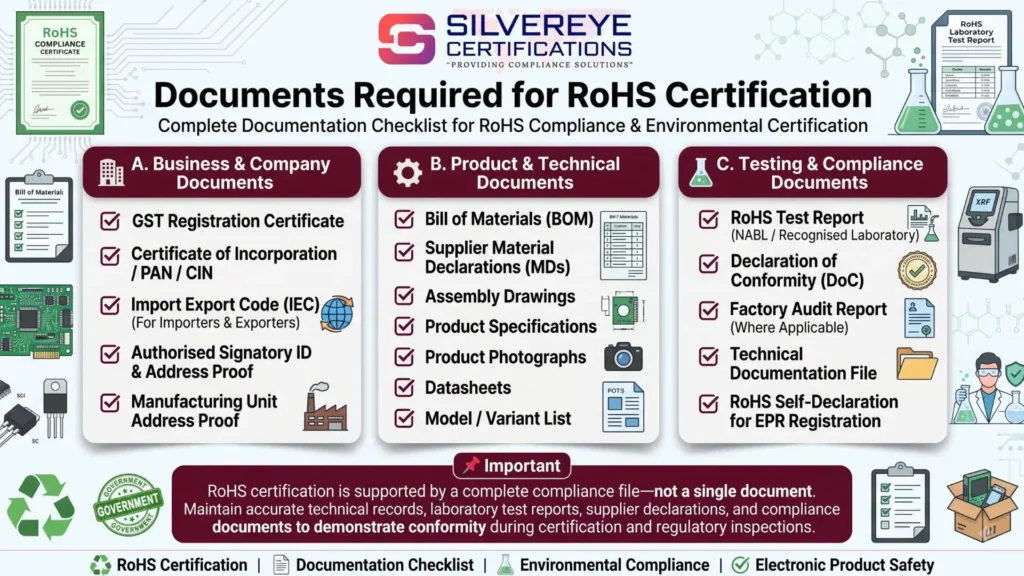
Phase 3: Documentation
This is the step most manufacturers underestimate. A RoHS technical file isn't one document — it's a structured record that ties your test results back to the actual product, so anyone reviewing it later (CPCB, a buyer, an auditor) can trace compliance from raw material to finished good.
- Bill of Materials (BOM) listing every part, component, and raw material
- Supplier Material Declarations (MDs) confirming restricted substances are within limits for each supplied part
- Test reports from screening and confirmatory testing, referenced against the exact BOM line items they cover
- Assembly drawings and product specifications showing how components come together
- A risk assessment note explaining why certain materials were tested and others were assessed as low-risk, if you used a sampling approach rather than testing every single component
Internationally, this file structure is commonly built around IEC 63000, which sets out how to compile RoHS technical documentation for complex products with many homogeneous materials. Indian exporters preparing files for EU buyers often follow the same structure, since it's what European customers expect to see during a supplier audit.
Phase 4: Declaration of Conformity (DoC)
Once testing and documentation are in place, the next step is drafting and signing the Declaration of Conformity — the formal statement that your product meets RoHS thresholds. This isn't a generic template; it needs to reference the specific product, its test reports, and the substances checked.
- Product identification: name, model number, and variant details
- A clear statement of which RoHS thresholds the product has been assessed against
- Reference to the supporting test reports and technical file
- Name, designation, and signature of the responsible person at the manufacturing or importing company
- Date of issue and, where relevant, the certifying or testing body's details
Internationally, this declaration structure aligns with EN 50581, the harmonized standard referenced for RoHS technical documentation and conformity statements. In India, this self-declaration is what gets attached to your EPR registration application on the CPCB's e-waste portal when you register as a producer, importer, or brand owner.
Phase 5: Certification, Filing, and Ongoing Verification
Compliance doesn't end once the DoC is signed. The final phase is about keeping the process alive:
- File the technical documentation where it can be retrieved quickly if CPCB, an SPCB, or a buyer asks for it
- Link the RoHS declaration to your EPR registration, if you're a producer, importer, or brand owner under the E-Waste Rules
- Set a review trigger for any change in supplier, raw material, or product design — this is the single most common reason a previously compliant product falls out of compliance
- Plan for renewal well before the five-year validity window closes
Documents You'll Need at Each Stage of the Process
| Process Stage | Documents Required |
| Material Assessment | Product specifications, component list, engineering drawings |
| Testing | Sample submission form, lab test reports (XRF, ICP-OES/MS, GC-MS as applicable) |
| Documentation | Bill of Materials, Supplier Material Declarations, assembly drawings, risk assessment notes |
| Declaration | Signed Declaration of Conformity, authorised signatory details, company registration (GST/PAN/CIN/IEC) |
| Ongoing Filing | Technical documentation file, EPR registration reference, renewal schedule/records |
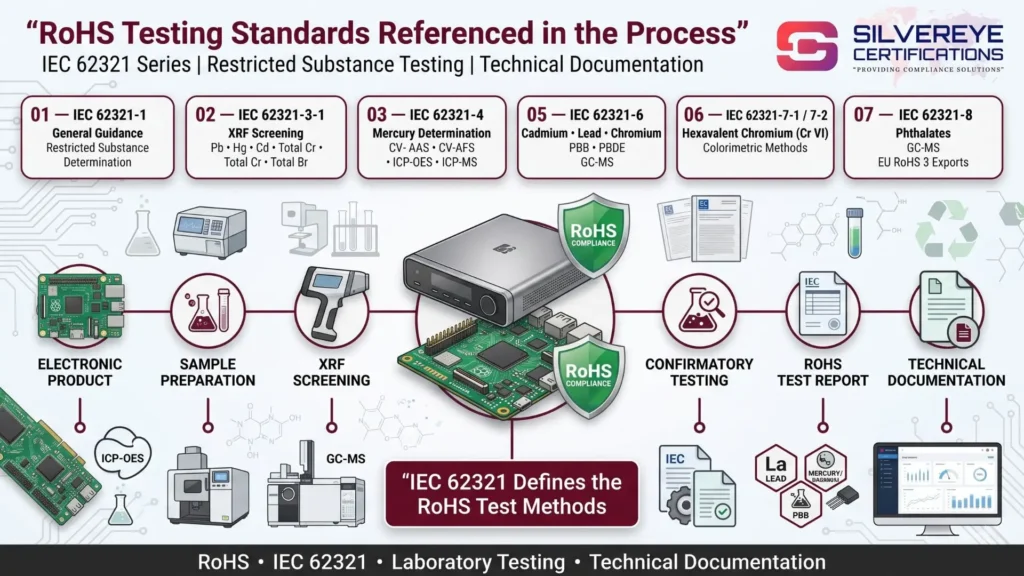
RoHS Testing Standards Referenced in the Process
Labs don't test RoHS compliance arbitrarily — the IEC 62321 series defines the exact method for each substance. Knowing these helps you read a test report correctly and ask your lab the right questions.
| Standard | What It Covers |
| IEC 62321-1 | General guidance for determining restricted substances in EEE |
| IEC 62321-3-1 | XRF screening method for lead, mercury, cadmium, total chromium, and total bromine |
| IEC 62321-4 | Mercury determination using CV-AAS, CV-AFS, ICP-OES, or ICP-MS |
| IEC 62321-5 | Cadmium, lead, and chromium determination using AAS, AFS, ICP-OES, or ICP-MS |
| IEC 62321-6 | PBB and PBDE determination by GC-MS |
| IEC 62321-7-1 / 7-2 | Hexavalent chromium (Cr VI) determination by colorimetric methods |
| IEC 62321-8 | Phthalates determination by GC-MS (relevant for EU RoHS 3 exports) |
| EN 50581 / IEC 63000 | Structure and content of the RoHS technical documentation file |
RoHS Compliance Process: Typical Costs
Costs vary by how many components you test and how deep the confirmatory testing needs to go. As a working guide for India:
| Cost Component | Typical Range (INR) | Depends On |
| XRF screening (per BOM/product) | ₹3,400 – ₹9,999+ | Number of components, sample volume |
| Confirmatory wet-chemical/GC-MS testing | Additional, quoted per substance/sample | Number of borderline results, substances tested |
| Documentation & Declaration of Conformity drafting | ₹3,500 – ₹5,000 | Product complexity, number of variants |
| Full process, testing to declaration | ₹3,500 – ₹20,000+ | Certifying body, product range, urgency |
Validity and Renewal Timeline
A RoHS Declaration of Conformity is generally valid for 5 years from the date of issue in India. But validity in practice is tied to your product staying exactly as tested — the moment you change a supplier, swap a raw material, or redesign a component, the existing DoC no longer reliably covers the product, even if the five years haven't passed.
For renewal, the process repeats in a lighter form: an updated BOM, fresh supplier declarations, and a new round of testing focused on whatever changed. Manufacturers who keep their technical file updated year-round typically renew in a fraction of the time it took to get certified the first time. Most full compliance cycles — from initial screening to a signed declaration — take 2 to 6 weeks, depending on product complexity and how quickly documents come together.
Common Mistakes That Break the RoHS Certification Process
- Testing only a sample BOM and assuming the rest of the product is automatically covered
- Accepting supplier declarations at face value without any lab verification
- Signing a Declaration of Conformity that isn't clearly linked to specific test reports
- Not updating the technical file after a supplier, material, or design change
- Treating the five-year validity as a fixed deadline instead of an ongoing process that needs monitoring
- Using a lab or test method that isn't recognized in the destination market, forcing a retest at customs or during a buyer audit
Conclusion
The RoHS certification process is less about chasing a single certificate and more about building a habit — testing your materials honestly, documenting what you find, and declaring only what your test reports actually support. Skip a step, and it usually shows up later as a rejected shipment, a failed buyer audit, or a scramble at renewal time.
Done properly, the five phases — assessment, testing, documentation, declaration, and ongoing filing — aren't complicated, even for smaller manufacturers. What matters is treating the technical file as a living record, not a one-time exercise, and re-checking it every time your supply chain shifts. That's what turns RoHS compliance from a recurring headache into a process that quietly protects your shipments, your buyer relationships, and your standing with regulators — in India and every export market beyond it.
Frequently Asked Questions
What are the main steps in the RoHS certification process?
The process runs through five steps: material and product assessment, lab testing (screening plus confirmatory testing), technical documentation, Declaration of Conformity, and ongoing filing and renewal.
What testing methods are used in the RoHS certification process?
XRF screening (IEC 62321-3-1) is used first for a fast read on metals like lead, mercury, and cadmium. Borderline or unclear results move to confirmatory wet-chemical testing (ICP-OES/ICP-MS) or GC-MS for PBB, PBDE, and phthalates.
What documents are required to prove RoHS compliance?
A complete file includes the Bill of Materials, supplier material declarations, lab test reports, assembly drawings, and a signed Declaration of Conformity, along with company registration documents like GST, PAN, and IEC.
How is a Declaration of Conformity different from a test report?
A test report shows the raw testing results for specific materials or components. The Declaration of Conformity is the formal, signed statement — referencing those test reports — that the finished product meets RoHS thresholds.
How long does the RoHS compliance process take?
Most manufacturers complete the full cycle, from initial testing to a signed declaration, in 2 to 6 weeks, depending on product complexity and how quickly documentation is prepared.
Can I self-certify RoHS compliance without third-party testing?
Self-declaration is accepted, but it should be backed by genuine lab test data. A declaration without supporting test reports and a technical file is difficult to defend during a buyer audit or regulatory check.
What standards govern RoHS testing methods?
The IEC 62321 series governs testing methods for each restricted substance, while EN 50581 and IEC 63000 guide how the technical documentation file should be structured.
Do I need to retest my product every time something changes?
Yes, if the change affects a homogeneous material — a new supplier, a different plastic grade, or a redesigned component can all alter substance content, even if the product looks the same from outside.
Is the RoHS certification process the same for domestic sale and export?
The core process is similar, but export-bound products, especially to the EU, should be tested against all ten RoHS 3 substances, including phthalates, even though India's current rules cover six.
How does the RoHS certification process connect to EPR registration in India?
When registering as a producer, importer, or brand owner for Extended Producer Responsibility (EPR) on the CPCB e-waste portal, you're required to attach your RoHS self-declaration as part of the application
What happens if a product fails RoHS testing?
The specific material or component causing the failure needs to be identified, reformulated or replaced, and retested before a Declaration of Conformity can be issued for that product.
How often should the RoHS technical file be reviewed?
Ideally, review it whenever there's a supplier, material, or design change, and at minimum once a year, so renewal after the five-year validity period doesn't mean starting the process from zero.