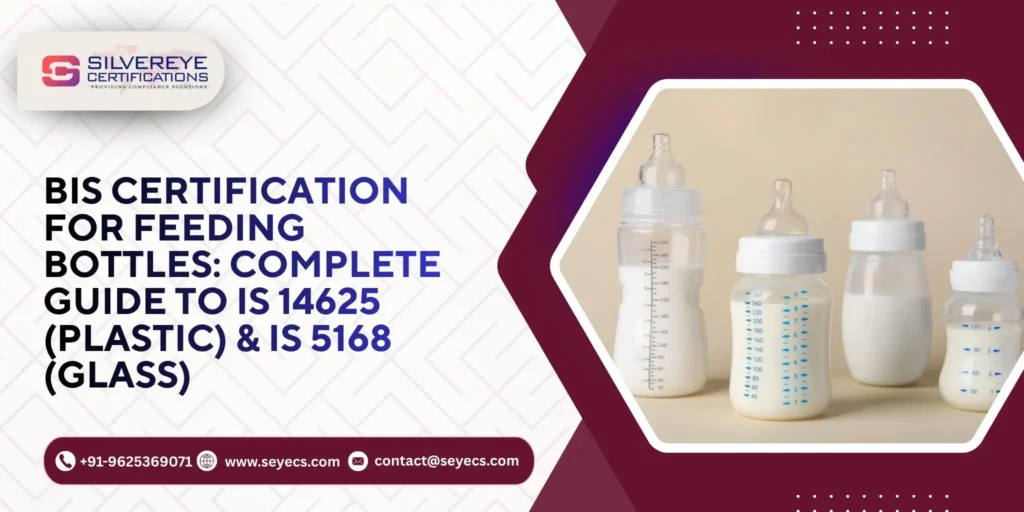
- Plastic feeding bottles need BIS certification under IS 14625:2015 — covering food-grade material, leak-proofing, and heat resistance.
- Glass feeding bottles need BIS certification under IS 5168:2018 — covering thermal shock resistance, breakage strength, and lead-free glass.
- Both fall under BIS's mandatory ISI Mark Scheme-I; selling uncertified feeding bottles in India is not legally allowed.
- Domestic certification typically takes around 30 working days; foreign manufacturers under FMCS should plan for up to 180 working days.
Introduction
BIS certification for feeding bottles is mandatory in India for both plastic and glass baby bottles sold, manufactured, or imported in the country. Plastic feeding bottles are certified under IS 14625:2015, which checks for food-grade, BPA-free material, leak-proof design, and heat resistance.
Glass feeding bottles are certified under IS 5168:2018, which checks thermal shock resistance, breakage strength, and lead-free glass. Manufacturers must get samples tested at a BIS-recognized lab, apply through BIS's ISI Mark Scheme-I, and pass a factory inspection. Domestic applications generally take about 30 working days; foreign manufacturer (FMCS) applications can take up to 180 working days.
What Is BIS Certification for Feeding Bottles?
BIS certification for feeding bottles is the safety and quality approval issued by the Bureau of Indian Standards confirming that a baby feeding bottle — whether made of plastic or glass — is safe for infant use. Because feeding bottles come into direct, repeated contact with an infant's mouth and food, and are routinely sterilized at high temperatures, India treats them as a mandatory-certification product category rather than a voluntary quality mark. Once BIS is satisfied that a bottle meets the applicable Indian Standard, it grants an ISI Mark license, and the manufacturer is allowed to print the ISI mark along with the license number on the product and its packaging.

Two Indian Standards govern feeding bottles depending on the material used: IS 14625:2015 for plastic feeding bottles, and IS 5168:2018 for glass feeding bottles. Both fall under BIS's Product Certification Scheme (Scheme-I, commonly called the ISI Mark scheme), and both require lab testing plus a factory audit before a license is granted.
Why Is BIS Certification Mandatory for Feeding Bottles in India?
Feeding bottles are a food-contact product used with the most vulnerable consumers — infants — which is why BIS certification for feeding bottles is enforced strictly under the BIS Act, 2016 and the applicable Quality Control Orders. A bottle made from low-grade plastic or glass can leach harmful chemicals, crack under boiling-water sterilization, or leak inaccurate volume markings that affect feeding schedules. BIS testing is designed to catch exactly these risks before a bottle reaches a parent's home.
Key reasons certification is compulsory
- Chemical safety: IS 14625 requires food-grade, BPA-free plastic; IS 5168 requires lead-free, non-toxic glass.
- Sterilization resistance: both standards test how the bottle withstands repeated boiling, steam sterilizing, and temperature cycling.
- Structural safety: glass bottles are tested for thermal shock and impact/breakage resistance; plastic bottles for leak-proof sealing and durability.
- Accurate volume marking: capacity graduations must be clear and accurate so parents can measure feeds correctly.
- Market and e-commerce access: most marketplaces and retail chains now ask for a valid BIS/ISI license number before listing baby feeding bottles.
IS 14625 (Plastic Feeding Bottles) vs IS 5168 (Glass Feeding Bottles): Key Differences
Both standards protect the same end-user — an infant — but they test very different materials and failure risks. Here's how BIS certification for feeding bottles differs across the two standards:
| Parameter | IS 14625 (Plastic Feeding Bottles) | IS 5168 (Glass Feeding Bottles) |
| Material covered | Food-grade plastics such as polypropylene (PP), polyethersulfone (PES) | Food-grade, lead-free, thermal-shock-resistant glass |
| Key safety concern | Chemical leaching (BPA and other toxins), leak-proofing, durability | Breakage resistance, thermal shock during sterilisation, lead content |
| Core tests | Toxicity/material safety, leakage, ageing, heat resistance, capacity accuracy | Impact strength, thermal shock resistance, volume accuracy, chemical safety |
| Labelling requirement | Clear capacity markings, usage instructions, batch/licence details | Clear capacity markings, usage instructions, batch/licence details |
| Scheme | BIS Scheme-I (ISI Mark), mandatory | BIS Scheme-I (ISI Mark), mandatory |
| Typical timeline (domestic) | Around 30 working days | Around 30 working days |
Note: Standard versions and QCO notifications are updated periodically by BIS. Always confirm the current edition (IS 14625 / IS 5168) and applicability on the official BIS portal before starting the process.
Who Needs BIS Certification for Feeding Bottles?
BIS certification for feeding bottles applies to anyone placing plastic or glass baby bottles in the Indian market:
- Domestic manufacturers of plastic feeding bottles (IS 14625) or glass feeding bottles (IS 5168).
- Foreign manufacturers exporting feeding bottles to India, certified through the Foreign Manufacturers Certification Scheme (FMCS) with an Authorized Indian Representative.
- Private-label and D2C baby-care brands that outsource manufacturing but sell under their own brand name.
- Importers and distributors bringing feeding bottles into India for retail or e-commerce sale.
- E-commerce sellers listing feeding bottles on marketplaces that require a valid ISI license number at listing stage.
Eligibility Criteria for BIS Certification of Feeding Bottles
- A registered legal business entity (proprietorship, partnership, LLP, or company) with valid GST/company registration.
- A functioning manufacturing unit — in India for the standard ISI Mark route, or overseas with an appointed Authorized Indian Representative for FMCS.
- Product formulation/design that meets the material and safety requirements of IS 14625 (plastic) or IS 5168 (glass), as applicable.
- Access to, or arrangement with, a BIS-recognized testing laboratory for the required sample tests.
- An in-house quality control setup (including in-house testing capability where required) that BIS can inspect during the factory audit.
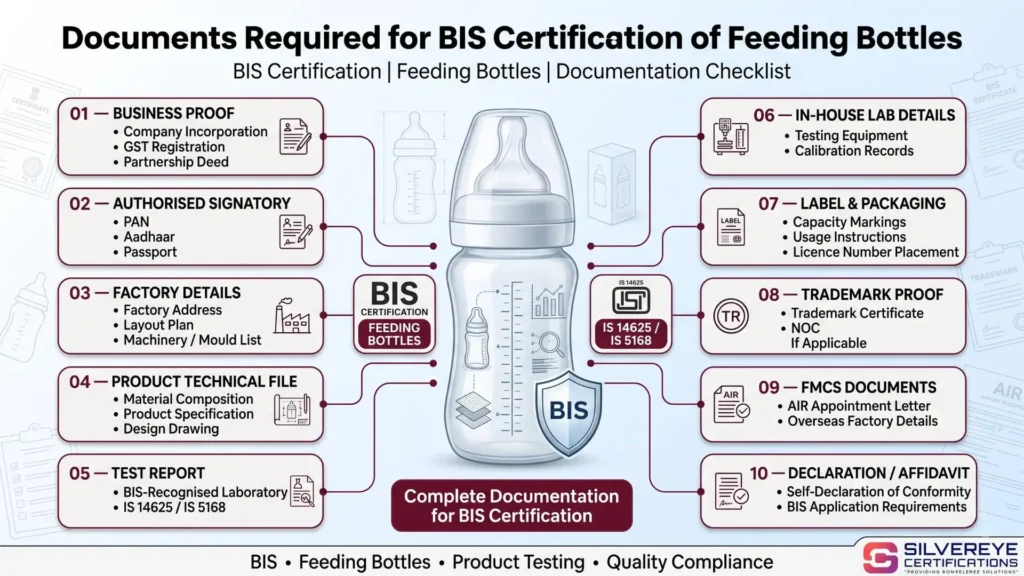
Documents Required for BIS Certification of Feeding Bottles
Keeping the following documents ready in advance is the fastest way to avoid delays in BIS certification for feeding bottles:
| Document Category | Details |
| Business proof | Company incorporation certificate / GST registration / partnership deed |
| Authorised signatory proof | PAN card, Aadhaar card, or passport of the authorized signatory |
| Factory details | Manufacturing unit address proof, layout plan, and machinery/mould list |
| Product technical file | Material composition sheet, product specification, and design drawing |
| Test report | Type-test report from a BIS-recognized lab as per IS 14625 or IS 5168 |
| In-house lab details | Equipment list and calibration records of the in-house testing facility |
| Label & packaging artwork | Capacity markings, usage instructions, and license-number placement |
| Trademark proof | Trademark registration certificate or NOC, if applicable |
| FMCS documents (foreign units only) | Authorized Indian Representative (AIR) appointment letter and overseas factory details |
| Declaration/affidavit | Self-declaration of conformity as prescribed in the BIS application form |
Step-by-Step BIS Certification Process for Feeding Bottles
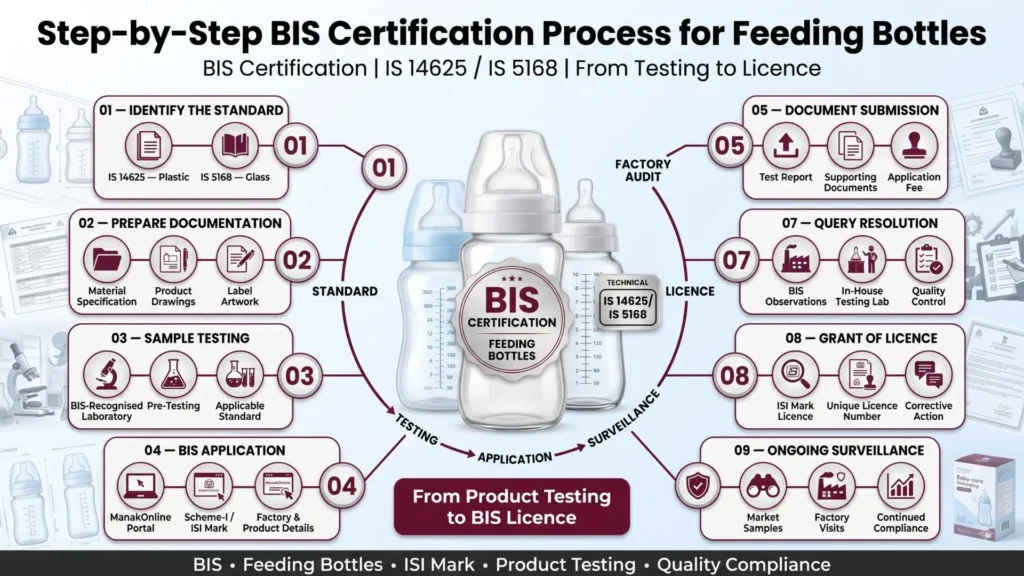
Here's how BIS certification for feeding bottles works from application to license in hand:
- Identify the correct standard: confirm whether your product needs IS 14625 (plastic) or IS 5168 (glass).
- Prepare technical documentation: material specification sheet, product drawings, and label artwork.
- Send samples for testing: submit feeding bottle samples to a BIS-recognized laboratory for pre-testing against the applicable standard.
- Register on the BIS Manak Online portal and complete the Scheme-I (ISI Mark) application with factory and product details.
- Upload the test report and supporting documents, and pay the prescribed application fee online.
- Factory audit: a BIS officer inspects the manufacturing unit, in-house testing lab, and quality control processes.
- Query resolution: respond to any observations or non-conformities raised during document review or the factory audit.
- Grant of license: once satisfied, BIS issues the ISI Mark license with a unique license number for the certified feeding bottle.
- Ongoing surveillance: BIS may draw market samples and conduct periodic factory visits to confirm continued compliance.
BIS Certification Fees for Feeding Bottles
The overall cost of BIS certification for feeding bottles depends on whether the product is plastic or glass, the number of variants/sizes, and the testing lab chosen. Broadly, applicants should budget for these cost heads:
| Cost Head | Approximate Range |
| BIS application fee | A modest fixed government fee per application, as prescribed by BIS |
| Lab testing charges | Varies by lab and number of parameters tested for the applicable standard |
| Factory audit fee | Charged per man-day of the BIS officer's visit (higher for overseas FMCS audits) |
| Annual minimum licence & marking fee | Recurring fee payable to retain the right to use the ISI mark |
| Consultant/professional fee (optional) | Charged by consultants like Silvereye Certifications for documentation, lab coordination, and audit handling |
Fee figures vary by product type, number of models, and testing lab, and are revised periodically by BIS. Always verify the current official fee schedule on the BIS ManakOnline portal or with a certification consultant before budgeting.
Timeline: How Long Does BIS Certification for Feeding Bottles Take?
For domestic manufacturers with documents and test reports in order, BIS certification for feeding bottles typically takes around 30 working days from application to license grant. Foreign manufacturers applying under the Foreign Manufacturers Certification Scheme (FMCS) should plan for a longer timeline — up to 180 working days — since it includes appointing an Authorised Indian Representative and an overseas factory audit by BIS officials. The most common causes of delay are incomplete documentation, failed lab tests requiring re-submission, and non-conformities found during the factory audit.
Validity and Renewal of BIS Certification for Feeding Bottles
A BIS ISI Mark license for feeding bottles is typically granted for an initial period, after which it must be renewed to remain valid, along with ongoing BIS surveillance in the interim. Renewal generally requires payment of the annual minimum license fee and marking fee, along with confirmation that the product and factory still conform to IS 14625 or IS 5168, as applicable.
- Start the renewal process 2–3 months before the license expiry date to avoid any gap in certification.
- Renewal typically needs updated test reports (where required), production records, and confirmation of continued factory compliance.
- Selling feeding bottles on an expired BIS license is a violation of the BIS Act, 2016 — the right to use the ISI mark stops the moment the license lapses.
- BIS may pull market samples and run compliance checks even while the license is active, so quality control has to be maintained continuously, not just at renewal time.
Benefits of BIS-Certified Feeding Bottles
- Infant safety assurance: certified bottles are tested for chemical safety, sterilization resistance, and structural durability.
- Legal market access: certified products can be manufactured, imported, and sold in India without regulatory risk.
- E-commerce and retail eligibility: most marketplaces and retail chains require a valid ISI license number before listing baby feeding bottles.
- Consumer trust: the ISI mark reassures parents that the product has passed independent, government-recognized testing.
- Brand credibility: certification signals a manufacturer's long-term commitment to product safety in a highly trust-sensitive category.
Consequences of Selling Non-Certified Feeding Bottles
Manufacturing, importing, or selling plastic or glass feeding bottles in India without valid BIS certification is non-compliant with the BIS Act, 2016. This can lead to seizure of non-compliant stock, penalties, removal of listings from e-commerce platforms, and — in a category as trust-sensitive as infant feeding products — lasting reputational damage that is difficult for a brand to recover from. Certification is not just a compliance checkbox; in the baby-care segment, it is often the deciding factor in whether a parent trusts a brand at all.
Silvereye Certifications: Your BIS Certification Partner for Feeding Bottles
Feeding bottles sit at the intersection of two demanding compliance areas — food-contact material safety and infant product regulation — which is why getting BIS certification right the first time matters more here than in most product categories. Silvereye Certifications works with plastic and glass feeding bottle manufacturers and importers as an end-to-end consulting partner, guiding you through both IS 14625 and IS 5168 without the trial-and-error that often comes with a first-time BIS application.
- Standard identification: confirming whether your product needs IS 14625, IS 5168, or both, before you invest in testing.
- Documentation support: preparing material specification sheets, label artwork, and quality manuals exactly as BIS expects.
- Lab coordination: connecting you with BIS-recognized testing laboratories and tracking test timelines for plastic and glass bottles.
- Factory audit readiness: preparing your unit, in-house lab, and quality records so the BIS inspection goes through without non-conformities.
- Renewal and surveillance support: tracking your license expiry, managing renewal filings, and handling ongoing BIS compliance queries.
If you manufacture or import plastic or glass feeding bottles and want a certification partner that understands both IS 14625 and IS 5168 in depth, Silvereye Certifications is positioned as a dependable, experienced consultant for BIS certification of feeding bottles — helping you move from application to license with fewer surprises and less back-and-forth with BIS.
Conclusion
BIS certification for feeding bottles is not just a regulatory formality — it's the safety net that stands between an infant and a product that could leach harmful chemicals, crack under sterilization, or fail in everyday use. Whether you manufacture plastic feeding bottles under IS 14625 or glass feeding bottles under IS 5168, the path to certification follows the same broad arc: identify the right standard, get tested at a BIS-recognized lab, apply through the Manak Online portal, clear the factory audit, and stay on top of renewals once the license is granted.
Getting this right early — with complete documentation and a lab-ready product — is what separates a smooth, first-time approval from months of avoidable back-and-forth with BIS. For manufacturers and importers who would rather focus on building their product than decoding compliance paperwork, working with an experienced partner like Silvereye Certifications can make the difference between a stalled application and a certified, market-ready feeding bottle.
Frequently Asked Questions
Is BIS certification mandatory for feeding bottles in India?
Yes. Both plastic feeding bottles (IS 14625:2015) and glass feeding bottles (IS 5168:2018) require mandatory BIS certification under the ISI Mark Scheme-I before they can be manufactured, imported, or sold in India.
What is the difference between IS 14625 and IS 5168?
IS 14625 covers plastic feeding bottles and focuses on food-grade, BPA-free material, leak-proofing, and heat resistance. IS 5168 covers glass feeding bottles and focuses on thermal shock resistance, breakage strength, and lead-free glass.
How long does BIS certification for feeding bottles take?
Domestic manufacturers typically get certified in around 30 working days. Foreign manufacturers applying under FMCS should plan for up to 180 working days, since it includes an overseas factory audit.
What documents are required for BIS certification of feeding bottles?
Business registration proof, authorised signatory ID, factory and in-house lab details, product material/technical specifications, a valid test report from a BIS-recognised lab, label artwork, and a quality control manual.
Is a factory audit compulsory for feeding bottle BIS certification?
Yes. Under the ISI Mark / Product Certification Scheme, BIS conducts a factory audit to check manufacturing capability, material handling, and in-house quality control before granting the licence.
Can one manufacturer get certification for both plastic and glass feeding bottles?
Yes, but they are separate certifications — a manufacturer producing both types needs a licence under IS 14625 for plastic bottles and a separate licence under IS 5168 for glass bottles.
Can a foreign manufacturer get BIS certification for feeding bottles?
Yes, through the Foreign Manufacturers Certification Scheme (FMCS), which requires an overseas factory audit and an Authorised Indian Representative (AIR) based in India.
What happens if I sell feeding bottles without BIS certification?
It is non-compliant with the BIS Act, 2016, and can lead to seizure of stock, penalties, delisting from e-commerce marketplaces, and reputational damage in a trust-sensitive category like infant products.
Do e-commerce marketplaces require BIS certification for feeding bottles?
Most major marketplaces now ask sellers to enter a valid BIS/ISI licence number before a feeding bottle listing goes live, since it is a mandatory-certification product in India.
How much does BIS certification for feeding bottles cost?
Costs include the application fee, lab testing charges, factory audit fee, and annual minimum licence/marking fee. The exact amount depends on the product type (plastic or glass), number of variants, and testing lab — confirm current figures with BIS or a certification consultant.