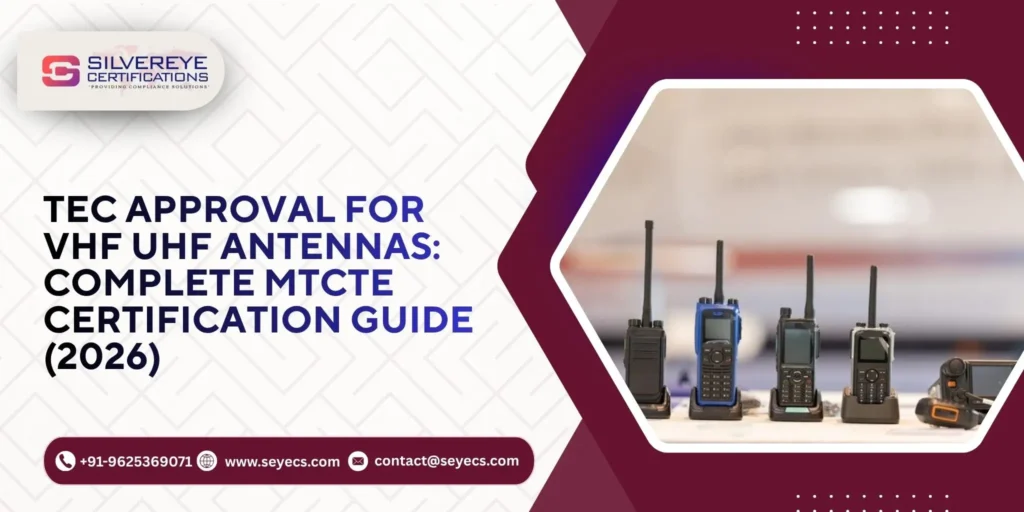
- VHF/UHF radio system equipment — including antennas supplied as part of the system — falls under TEC's General Certification Scheme (GCS), a notified MTCTE category.
- Certification requires lab testing at a TEC-designated CAB against published Essential Requirements (ERs) covering RF, safety, and EMI/EMC parameters.
- A valid TEC/MTCTE certificate is mandatory before the equipment is manufactured, imported, or sold in the Indian market.
- Certificates are valid for 5 years and can be renewed for another 5-year term under the same certificate number.
Introduction
TEC Approval for VHF UHF antennas refers to certification under India's Mandatory Testing and Certification of Telecom Equipment (MTCTE) scheme, run by the Telecommunication Engineering Centre (TEC) under the Department of Telecommunications. VHF/UHF Radio Equipment System — which covers transceivers, repeaters, and antennas supplied as part of the radio system — is a notified product category tested under the General Certification Scheme (GCS).
Getting TEC approval means testing the equipment at a TEC-designated lab against published Essential Requirements, submitting test reports on the MTCTE portal, and receiving a certificate valid for 5 years before the product can be legally manufactured, imported, or sold in India.
What Is TEC Approval For VHF UHF Antennas?
If you manufacture, import, or sell VHF or UHF radio equipment in India — including the antennas that go with it — you have probably run into the term "TEC approval" while trying to clear customs or list your product with a network operator, PSU, or government buyer. This guide walks through what TEC approval for VHF UHF antennas actually covers, who needs it, how the certification process works under India's MTCTE framework, what it costs, and how long it stays valid. The goal is to give you a single, complete, accurate reference — grounded in the actual TEC/MTCTE regulatory framework — so you know exactly what to prepare before you start.
VHF (Very High Frequency) and UHF (Ultra High Frequency) radio systems are the backbone of two-way communication for police, defence, aviation, marine, railways, mining, event management, and industrial safety teams across India. Because this equipment connects to or operates alongside India's telecom and spectrum infrastructure, the Department of Telecommunications (DoT) requires it to be tested and certified before it reaches the market.
What Is TEC Approval? Understanding MTCTE
TEC stands for the Telecommunication Engineering Centre, the technical wing of the Department of Telecommunications (DoT), Ministry of Communications, Government of India. TEC administers the Mandatory Testing and Certification of Telecom Equipment (MTCTE) scheme, introduced under the Indian Telegraph (Amendment) Rules, 2017.

Under MTCTE, telecom and ICT equipment that is connected to, or capable of being connected to, the Indian telecom network must be tested against TEC-published Essential Requirements (ERs) and certified before it can be manufactured, imported, or sold in India. TEC has rolled out this requirement in phases; VHF/UHF Radio Equipment System is one of the notified categories introduced under a later phase of MTCTE and has been mandatory for some time, with TEC periodically issuing clarifications, exemptions, and testing-parameter updates for this category.
Does "Antenna" Mean a Standalone Passive Antenna, or Is It Part of the Radio System?
This is the single most common point of confusion, so it deserves a straight answer instead of a vague one. TEC's notified category is called "VHF UHF Radio Equipment System," not "antenna" as a standalone line item. In practice, this category covers the full radio system — transceivers (handheld, mobile, and base station), repeaters, and the antennas and other components that are part of that system.
A genuinely passive antenna sold on its own, with no active electronics, generally sits closer to passive telecom infrastructure, which is treated differently from active, signal-generating equipment under MTCTE. But once an antenna is bundled, sold, or represented as part of a VHF/UHF radio system — for example, a base-station antenna assembly supplied alongside a repeater or transceiver — its RF performance parameters (gain, VSWR, radiation pattern, frequency band) are tested and certified as part of that system's Essential Requirements. Because scope questions like this directly affect whether testing is required, we recommend getting your exact product configuration reviewed against the current TEC notification before you assume either way.
Who Needs TEC Approval for VHF UHF Radio Equipment and Antennas?
- Domestic manufacturers producing VHF UHF transceivers, repeaters, base stations, or antenna assemblies for sale in India.
- Importers and distributors bringing in foreign-manufactured VHF/UHF radio equipment for the Indian market.
- Foreign OEMs selling through an Authorized Indian Representative (AIR).
- System integrators supplying communication systems to police, defence support functions, disaster management, aviation ground support, marine, railways, mining, or event/security companies.
- Brand owners re-labelling or re-badging VHF/UHF radio equipment for the Indian market.
Benefits of Getting TEC Approval For VHF UHF Antennas
- Legal market access: certified products can be manufactured, imported, and sold without risk of customs seizure or DoT enforcement action.
- Tender and procurement eligibility: government departments, PSUs, telecom operators, and defence-adjacent buyers routinely ask for a valid TEC/MTCTE certificate before shortlisting a vendor.
- Network and safety assurance: certification confirms the equipment won't cause harmful interference and that RF emissions stay within prescribed limits.
- Buyer trust: a TEC label and certificate number signal that the product has been independently tested rather than self-certified with no verification.
- Smoother customs clearance: import consignments with valid certification move through ports and customs without repeated compliance queries.
Certification Scheme: GCS for VHF UHF Radio Equipment
MTCTE offers two certification routes:
| Scheme | How It Works | Applies To |
| General Certification Scheme (GCS) | Applicant submits full test reports plus a test-wise compliance summary from a TEC-designated CAB (or an accredited MRA-partner lab); TEC evaluates the reports before issuing the certificate. | VHF/UHF Radio Equipment System (Group C) and other higher-scrutiny product categories |
| Simplified Certification Scheme (SCS) | Applicant tests the product against the ERs and submits a compliance checklist with a Self-Declaration of Conformity (SDoC); detailed test reports aren't submitted upfront but TEC can call for them. | Lower-risk, self-declared product categories notified separately by TEC |
VHF/UHF Radio Equipment System is certified under the General Certification Scheme (GCS), which means test reports are mandatory and evaluated by TEC before a certificate is granted — there's no self-declaration shortcut for this category.
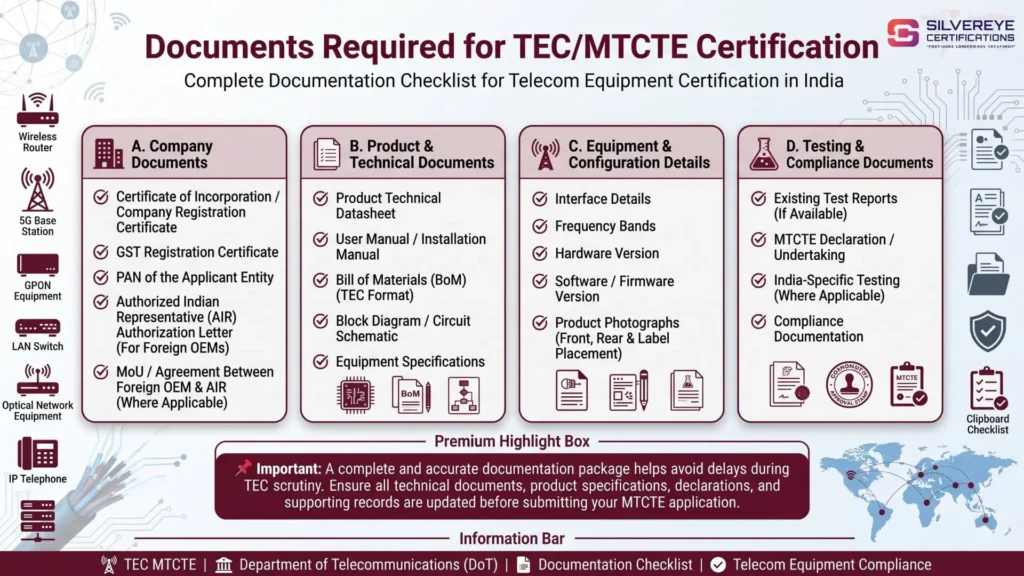
Documents Required for TEC Approval
| Document | Purpose |
| Company/manufacturer registration certificate | Establishes the legal entity applying for certification |
| Authorised Indian Representative (AIR) letter | Required for foreign OEMs without an Indian manufacturing presence |
| MoU/agreement between foreign OEM and AIR | Confirms the AIR is authorised to apply and be responsible in India |
| Technical datasheet of the product | Details frequency bands, power output, modulation, and other RF specs |
| Circuit diagram / block diagram | Used by the test lab and TEC to verify the design against the ERs |
| Bill of Materials (BoM) | Lists components used, relevant for family/associated model classification |
| Test setup details | Describes how the sample was configured and tested |
| Test reports from a TEC-designated CAB or MRA-recognised lab | Core evidence of ER compliance under GCS |
Step-by-Step TEC Approval Process for VHF UHF Antennas
- Create an account on the MTCTE portal and complete the applicant/manufacturer profile, including AIR details for foreign OEMs.
- Identify the correct product category and applicable Essential Requirement (ER) for your specific VHF/UHF equipment or antenna configuration.
- Select a TEC-designated Conformity Assessment Body (CAB), or a recognized lab from an MRA partner country, and send in samples for testing.
- Complete testing against the ER parameters — safety, EMI/EMC, and RF/technical requirements — and obtain the test report and test-wise compliance summary.
- Submit the application on the MTCTE portal with all supporting documents and the test report, then pay the applicable fee through the Non-Tax Receipt Portal (NTRP).
- TEC evaluates the submission and test reports for compliance against the relevant ER.
- On approval, TEC issues the certificate; associated/family models (up to 10 per certificate, subject to TEC's classification rules) can often be added without full retesting.
- Apply the TEC label — including the certificate number and the required machine-readable (QR) code — to the equipment before it is sold, distributed, or imported.
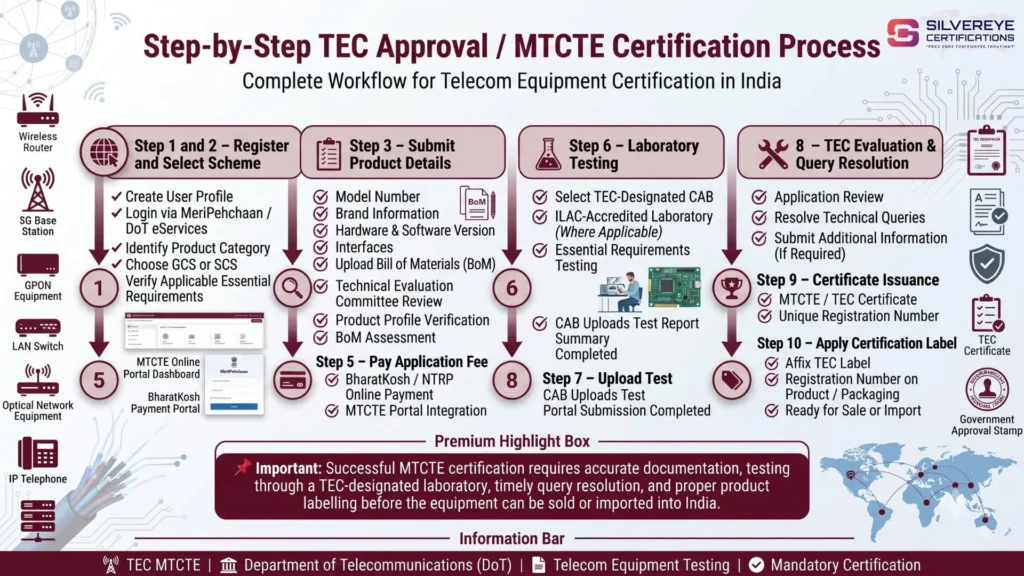
Based on the current published timelines for GCS-route products, the certification process typically takes around 40–45 working days from a complete application, though this depends on lab scheduling, sample availability, and whether TEC raises any clarification during evaluation.
Essential Requirements: What Gets Tested
- RF/technical parameters — operating frequency band, transmit power, spurious emissions, frequency stability, and (where applicable) antenna gain, VSWR, and radiation pattern.
- EMI/EMC — electromagnetic interference and compatibility, to confirm the equipment won't disrupt other network or radio equipment.
- Safety — electrical and product safety parameters relevant to the equipment class.
- Security requirements — as applicable, coordinated with the National Centre for Communication Security (NCCS) for relevant equipment types.
TEC periodically issues time-bound exemptions for specific technical parameters within an ER — VHF/UHF Radio Equipment System has been covered by such exemption notifications in the past. Always check the latest notification on the MTCTE portal before finalising your test plan, since a parameter that was exempt last year may be back in scope now.
TEC Approval Fees
TEC charges application and certification fees as per its official Schedule of Fees (Annexure to the MTCTE procedure document), payable online through the Non-Tax Receipt Portal (NTRP) linked from the MTCTE portal. Fees vary by product category, certification scheme (GCS/SCS), and whether the application is for a new model or an associated/family model, and all fees are non-refundable once paid. Because the fee schedule is revised from time to time, treat any number you see quoted elsewhere as indicative — always confirm the current applicable fee on the official MTCTE portal, or check with a certification consultant, before budgeting for your application.
Validity, Renewal & Timeline
| Milestone | Detail |
| Certificate validity | 5 years from the date of issue |
| Renewal | Can be renewed for a further 5-year term under the same certificate number, subject to TEC's then-current renewal requirements |
| When to apply for renewal | Well before expiry — industry guidance points to at least a month ahead, though building in more lead time avoids any gap in valid certification |
| Typical processing time (GCS) | Around 40–45 working days for a complete, first-time application |
| ILAC lab report validity | Test reports from ILAC-accredited labs in non-border-sharing countries are generally accepted if not older than 2 years from the date of submission |
Labelling Requirements
Once certified, the equipment must carry the TEC label along with the certificate number, presented as required in machine-readable form (such as a QR code), in line with TEC's labelling guidelines. For equipment from foreign OEMs, the Authorised Indian Representative is responsible for ensuring the labelling requirement is met before the product reaches the Indian market.
TEC Approval vs WPC Equipment Type Approval — Don't Confuse the Two
A lot of applicants assume TEC approval alone covers everything a VHF UHF radio needs. It doesn't. TEC/MTCTE certifies the equipment against network-safety, EMI/EMC, and technical Essential Requirements. Separately, the Wireless Planning & Coordination (WPC) Wing of DoT governs spectrum use and equipment type approval (ETA) for wireless-transmitting devices, along with the wireless operating licence needed to actually use the allotted frequency. Depending on your product and how it will be sold or deployed, you may need both TEC/MTCTE certification and WPC clearances — they are separate approvals from separate wings of DoT, and one does not substitute for the other.
| TEC / MTCTE Approval | WPC Equipment Type Approval (ETA) | |
| Governs | Network safety, EMI/EMC, technical & security Essential Requirements | Spectrum use and RF emission limits for wireless-transmitting equipment |
| Issued by | Telecommunication Engineering Centre (TEC), DoT | Wireless Planning & Coordination (WPC) Wing, DoT |
| Typical need | Mandatory for notified categories like VHF/UHF Radio Equipment System | Needed for equipment that transmits on licensed/allotted spectrum |
What Happens If You Skip TEC Approval
- Consignments can be held or seized at customs for lacking a valid TEC certificate.
- The product cannot legally be manufactured, imported, or sold in India once it falls under a notified MTCTE category.
- Government, PSU, telecom-operator, and large enterprise tenders will typically disqualify uncertified equipment at the technical-bid stage.
- Non-compliance can invite enforcement action under the Indian Telegraph (Amendment) Rules, 2017, including directions against the OEM or dealer.
2026 Update: What's Changed
TEC continues to fine-tune the MTCTE framework for radio-system categories, including VHF UHF Radio Equipment System — through time-bound exemption notifications on specific technical parameters, updated ILAC test-report acceptance windows, and periodic re-categorization of products between GCS and SCS.
If you're planning an application in 2026, don't rely on older blog posts or outdated fee sheets; pull the current notification and fee schedule directly from the MTCTE portal, or work with a consultancy that tracks these updates as they're issued.
How Silvereye Certifications Can Help
Silvereye Certifications works with manufacturers, importers, and brand owners taking VHF UHF radio equipment and antennas through TEC/MTCTE certification — from confirming whether your specific product configuration falls under GCS, to coordinating CAB testing, preparing the application and technical documentation, and tracking the certificate through to issuance and renewal. If you're unsure whether your antenna needs certification on its own or as part of a system, that scoping call is the right place to start.
Conclusion
TEC approval for VHF UHF antennas isn't a single form you fill out — it's a testing and certification process built around your product's exact configuration, whether that's a standalone antenna, a base-station antenna bundled with a repeater, or a full transceiver system. Getting the scoping right at the start — GCS category, correct ER, right CAB — saves weeks of rework later. If your product touches India's VHF/UHF spectrum in any commercial capacity, treat TEC/MTCTE certification as a prerequisite to your go-to-market timeline, not an afterthought.
Frequently Asked Questions
Is TEC approval mandatory for VHF UHF antennas in India?
It's mandatory for equipment falling under the notified "VHF UHF Radio Equipment System" category — which includes antennas supplied as part of a radio system. A genuinely standalone passive antenna with no active electronics is generally treated differently, so the specific product configuration should be checked against the current TEC notification.
What is MTCTE?
MTCTE stands for Mandatory Testing and Certification of Telecom Equipment — the certification scheme run by TEC under the Department of Telecommunications, established under the Indian Telegraph (Amendment) Rules, 2017.
Which certification scheme applies to VHF UHF radio equipment — GCS or SCS?
VHF UHF Radio Equipment System is certified under the General Certification Scheme (GCS), which requires full test reports evaluated by TEC — not the self-declaration route used under SCS.
How long does TEC approval take?
For a complete GCS application, the process typically takes around 40–45 working days, though this can vary with lab scheduling and whether TEC raises clarifications during evaluation.
How long is a TEC/MTCTE certificate valid?
Five years from the date of issue, and it can be renewed for a further five-year term under the same certificate number.
When should I apply for renewal?
Well before the certificate expires — apply with enough lead time to avoid any gap in valid certification, since a lapsed certificate means the equipment can't legally stay on the market.
What documents are needed for TEC approval?
Typically a company registration certificate, AIR authorization and MoU (for foreign OEMs), technical datasheet, circuit/block diagram, Bill of Materials, test setup details, and the test report from a TEC-designated CAB or MRA-recognized lab.
Who can apply — only Indian manufacturers?
No. Indian manufacturers, importers, and foreign OEMs (through an Authorised Indian Representative) can all apply for TEC/MTCTE certification.
How much does TEC approval cost?
Fees follow TEC's official Schedule of Fees and vary by product category and certification scheme; since the schedule is revised periodically, always confirm the current fee on the MTCTE portal rather than relying on a fixed figure.
Is TEC approval the same as WPC type approval?
No. TEC/MTCTE covers network-safety and technical Essential Requirements; WPC Equipment Type Approval covers spectrum use and RF emission limits for wireless-transmitting equipment. Many VHF/UHF products need both, issued by two separate wings of DoT.
What happens if I sell VHF/UHF equipment without TEC approval?
The product can be held at customs, refused market entry, and disqualified from tenders, and the OEM or dealer can face enforcement action under the Indian Telegraph (Amendment) Rules, 2017.
Can one certificate cover multiple antenna or radio models?
Yes, associated or family models — up to 10 per certificate, subject to TEC's classification rules — can generally be added without requiring full separate testing for each model.