- Smart meters need TEC/MTCTE certification for their telecom communication module, alongside separate BIS certification (IS 16444) for metering accuracy and safety.
- BIS certification is mandatory under the Smart Meters (Quality Control) Order, 2023 — no smart meter can be sold in India without it.
- AMISPs (Advanced Metering Infrastructure Service Providers) must furnish valid BIS type-test certificates before supplying meters to DISCOMs.
- A regular MTCTE certificate is valid for 10 years; BIS registration follows its own separate renewal cycle.
Introduction
TEC approval for smart meters refers to the mandatory MTCTE (Mandatory Testing and Certification of Telecom Equipment) certification that smart electricity meters need for their telecom communication module — the part that transmits consumption data over 4G, NB-IoT, or RF mesh networks to the utility's head-end system. This is separate from, and in addition to,
BIS certification under IS 16444 (Part 1), which is mandatory for every smart meter under the Smart Meters (Quality Control) Order, 2023, covering metering accuracy, safety, tamper resistance, and communication protocol compliance. In practice, a smart meter manufacturer or AMISP supplying meters in India needs both certifications — TEC/MTCTE for the telecom module and BIS for the meter itself — before the product can be deployed on a utility network.

India's smart metering rollout — under the Revamped Distribution Sector Scheme (RDSS) and state DISCOM AMI programs — has made smart meters one of the fastest-growing connected-device categories in the country. But because a smart meter is really two things bundled into one unit — a precision measurement instrument and a telecom-connected IoT device — it sits under two different regulators at once.
Why Smart Meters Need Two Separate Approvals
A smart meter isn't just an electricity meter with a chip added — it's a metering instrument and a telecom endpoint in the same enclosure. That dual nature is exactly why it falls under two different regulatory frameworks in India, each evaluating a different part of the device.
| Aspect | TEC / MTCTE Certification | BIS Certification (IS 16444) |
| Governing body | Telecommunication Engineering Centre (TEC), Department of Telecommunications | Bureau of Indian Standards (BIS), under the Smart Meters (Quality Control) Order, 2023 |
| What it evaluates | The meter's telecom communication module — network conformance, EMI/EMC, and (where applicable) security parameters | Metering accuracy (Class 1/2), electrical safety, tamper resistance, durability, and communication protocol compliance |
| Portal | mtcte.tec.gov.in | BIS online certification portal (Scheme-I/ISI registration) |
| Mandatory since | Smart meters are notified under MTCTE alongside other IoT/M2M-enabled telecom devices | Smart Meters (Quality Control) Order, 2023, made BIS certification (ISI mark) mandatory for AC static smart meters |
In practice, most AMI (Advanced Metering Infrastructure) tenders and DISCOM contracts explicitly require both — a BIS/type-test certificate under IS 16444 for the meter, and TEC/MTCTE certification for the embedded communication module, before an AMISP or manufacturer can supply meters at scale.
TEC/MTCTE Certification for the Smart Meter's Communication Module
Smart meters transmit consumption, tamper, and load-profile data to the utility's head-end system using a communication module — commonly 4G/LTE, NB-IoT (Narrowband IoT), or RF mesh technology. Because this module connects to and communicates over India's telecom network, it falls under MTCTE, the same framework that covers routers, IoT gateways, and other network-connected devices.
- EMI/EMC testing: Confirms the communication module doesn't interfere with, or get disrupted by, other network equipment.
- Network/interface conformance: Confirms the module correctly interfaces with the telecom network technology it uses (4G/LTE, NB-IoT, or RF mesh, as applicable).
- Safety: Electrical safety of the communication module and its power interface with the meter.
- Security requirements: As with other connected telecom devices, security parameters may apply per current DoT/TEC notifications, particularly for cellular-connected modules.
Where a smart meter uses a plug-and-play communication module (a common AMI design pattern that lets utilities swap 4G, NB-IoT, or RF modules without redesigning the meter), each module variant used needs to independently meet the applicable MTCTE requirement — check with TEC or your CAB on how module swaps are treated under your specific certificate.
BIS Certification for Smart Meters: IS 16444
The Smart Meters (Quality Control) Order, 2023 — issued by the Department for Promotion of Industry and Internal Trade (DPIIT), Ministry of Commerce and Industry — made BIS certification (ISI mark) mandatory for A.C. Static Direct Connected Watt Hour Smart Meters, Class 1 and Class 2, under IS 16444 (Part 1). No manufacturer can legally sell smart meters in India without this certification.
| What IS 16444 (Part 1) Covers | Details |
| Accuracy class | Class 1 or Class 2 watt-hour measurement accuracy for billing-grade metering |
| Communication protocol | Compatibility with DLMS/COSEM protocol and the associated data communication standard IS 15959 (Part 2) |
| Tamper resistance | Physical and magnetic tamper detection, event logging |
| Surge protection & durability | Electrical safety, insulation resistance, climatic endurance testing |
| Power consumption limits | Energy efficiency thresholds for the meter's own operation |
Utility and AMISP tenders typically also reference CBIP Report 325 (Central Board of Irrigation and Power specifications for smart meters) alongside IS 16444 and IS 15959, so check your specific state DISCOM's technical specification document for any additional testing clauses beyond the base BIS standard.
CEA Cybersecurity Guidelines: The Third Compliance Layer
Beyond TEC/MTCTE and BIS, the Central Electricity Authority (CEA) issued Cyber Security Guidelines for Power Systems in December 2021, which DISCOMs and AMISPs are expected to follow for AMI deployments. This layer focuses on periodic security auditing, conformance testing of smart meters and associated infrastructure, and cyber-security lifecycle testing — relevant because smart meters sit on critical power-distribution infrastructure, not just a private home network.
- This is a guideline-and-audit framework rather than a per-product certificate like TEC/MTCTE or BIS, but DISCOM tenders increasingly require documented compliance with it as part of AMISP empanelment.
- If you're bidding on a state AMI/RDSS smart metering tender, confirm the specific cybersecurity documentation your DISCOM expects — requirements vary by state and by tender.
Who Needs TEC Approval and BIS Certifications for Smart Meters?
- Smart meter manufacturers (Indian OEMs) producing metering hardware with embedded telecom communication modules.
- Foreign smart meter or communication-module manufacturers, represented by an Authorized Indian Representative (AIR) for MTCTE purposes.
- AMISPs (Advanced Metering Infrastructure Service Providers) bidding on state DISCOM/RDSS smart metering contracts — responsible for confirming both BIS and TEC compliance of the meters they supply.
- Communication module suppliers providing 4G/NB-IoT/RF modules to meter OEMs on a plug-and-play basis.
Documents Required for Smart Meter Certification
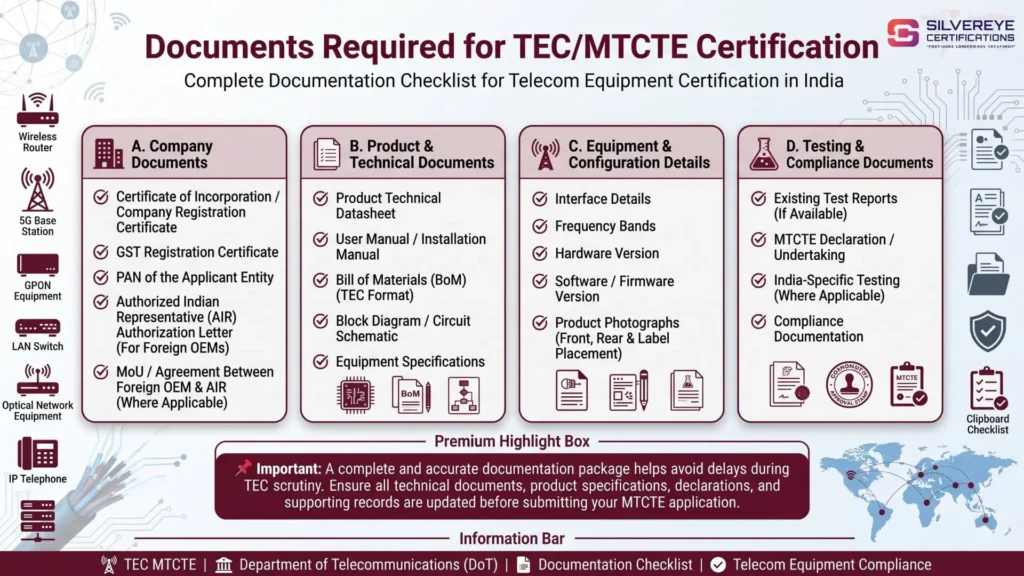
For TEC/MTCTE (Communication Module)
- Company registration and authorization documents (Certificate of Incorporation/Partnership Deed, Authorization Letter, PAN/GST).
- For foreign module manufacturers: AIR authorization letter and MoU/Affidavit.
- Bill of Materials (BoM) covering the communication module's hardware and firmware.
- Technical datasheet detailing the module's network technology (4G/LTE, NB-IoT, RF mesh), interfaces, and version.
- Test reports from a TEC-designated CAB against the applicable Essential Requirement.
For BIS (IS 16444)
- Type-test certificate from a NABL-accredited laboratory confirming compliance with IS 16444 and IS 15959.
- Manufacturing facility details and quality control process documentation.
- Product technical specifications, including accuracy class, communication protocol support, and tamper-detection features.
- BIS/OEM authorization form, where a third party is manufacturing on behalf of a brand owner.
Step-by-Step Process: Certifying a Smart Meter for the Indian Market
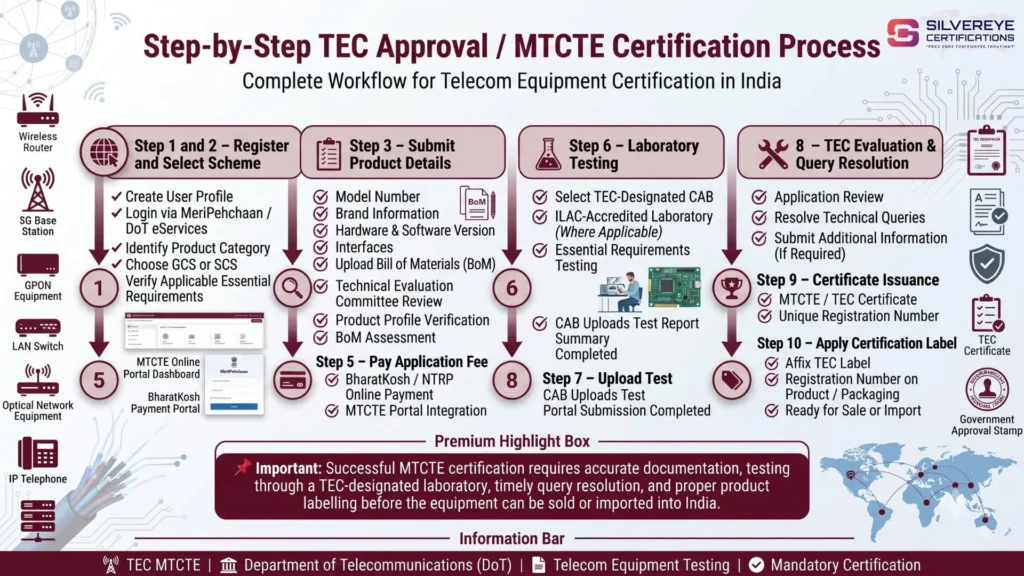
- Identify the communication technology your smart meter uses (4G/LTE, NB-IoT, or RF mesh) and confirm the applicable MTCTE Essential Requirement for that module type.
- Register on the MTCTE portal (mtcte.tec.gov.in), get your company profile approved, and file a Fresh Application for the communication module.
- Complete ER testing for the communication module at a TEC-designated CAB, covering EMI/EMC, network conformance, and safety parameters.
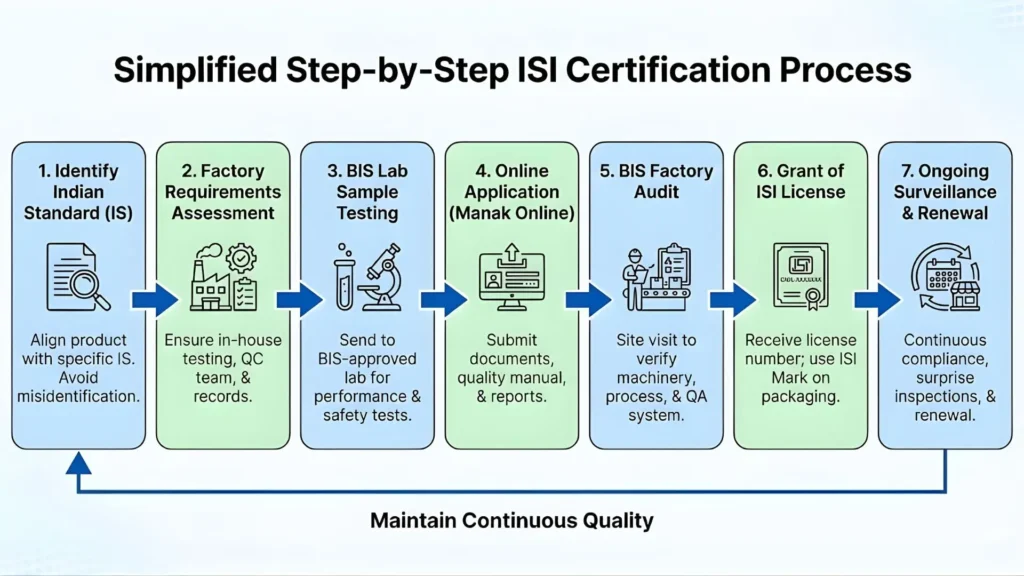
- Separately, submit the complete smart meter (not just the module) for type testing at a NABL-accredited lab against IS 16444 and IS 15959 for BIS certification.
- Apply for BIS registration/ISI mark under the Smart Meters (Quality Control) Order, 2023, submitting the type-test certificate and supporting documentation.
- Once both certifications are in hand, compile the combined compliance file — BIS type-test certificate plus MTCTE certificate — required by most AMISP/DISCOM tender documentation.
- For DISCOM/AMI project supply, submit both certificates for utility/purchaser approval before the Factory Acceptance Test, as most AMI contracts require certification to be in place at that stage.
- Affix the MTCTE label to the communication module (or its packaging) and maintain BIS ISI marking on the meter as required.
Fees for Smart Meter Certification
TEC/MTCTE fees for the communication module follow the standard MTCTE fee structure — based on product group classification, certification scheme, and application type, paid via BharatKosh/NTRP. BIS certification fees for IS 16444 follow BIS's own separate fee schedule under the ISI marking scheme. Since AMI projects are typically high-volume DISCOM tenders, many AMISPs also budget for NABL lab testing costs separately from the certification/registration fees themselves. Always confirm current fee schedules directly with TEC (for the communication module) and BIS (for the meter) before budgeting, since both are revised periodically.
- MTCTE application/processing fee: Based on product group classification for the communication module.
- CAB testing charges: Paid to the TEC-designated lab for the communication module's ER testing.
- BIS registration fee: Charged under the ISI marking scheme for IS 16444 compliance.
- NABL lab testing charges: For the full smart meter's type test against IS 16444 and IS 15959.
Typical Certification Timeline for Smart Meters
| Stage | Typical Duration |
| MTCTE profile approval + fresh application (communication module) | 1–2 weeks |
| MTCTE ER testing (communication module) | 3–5 weeks, depending on CAB scheduling |
| BIS type testing (full smart meter, IS 16444/IS 15959) | Several weeks at a NABL-accredited lab, depending on backlog |
| BIS registration/ISI mark issuance | Following successful review of type-test results and documentation |
| Combined readiness for AMISP/DISCOM tender submission | Plan for both certifications to be complete well ahead of Factory Acceptance Test milestones on any AMI contract |
Certificate Validity and Renewal
- MTCTE certificate (communication module): Valid for 10 years from the date of issue, the same validity period as other MTCTE-certified product categories.
- BIS registration (IS 16444): Follows BIS's own renewal cycle under the ISI marking scheme — confirm the current validity period and renewal process directly with BIS, since Quality Control Order-based registrations are periodically reviewed.
Common Mistakes When Certifying Smart Meters
- Assuming BIS certification alone is sufficient — DISCOM and AMISP tenders generally expect both BIS and MTCTE compliance for the communication module.
- Treating the communication module and the base meter as a single certification exercise, when they're evaluated by different bodies against different standards.
- Not re-verifying MTCTE compliance when switching communication module suppliers or technology (RF to NB-IoT, for instance) on an existing meter design.
- Missing CBIP Report 325 or state-specific DISCOM technical specification clauses that go beyond the base IS 16444 requirement.
- Underestimating combined timeline — BIS type testing and MTCTE ER testing don't always run on the same schedule, and both need to be complete before Factory Acceptance Test milestones on AMI contracts.
Why Getting Smart Meter Certification Right Matters
- Tender eligibility: AMISPs cannot supply meters to DISCOMs without valid BIS type-test certification and, where applicable, MTCTE certification for the communication module.
- Legal market access: BIS certification (ISI mark) is legally mandatory for AC static smart meters under the Smart Meters (Quality Control) Order, 2023.
- Network reliability at scale: MTCTE certification for the communication module reduces the risk of network-level issues across the large device fleets typical of AMI rollouts.
- Long-term compliance stability: A 10-year MTCTE validity period reduces the recurring compliance burden across a smart meter's typical utility deployment lifecycle.
What's New for Smart Meter Certification in 2026
- India's smart metering rollout continues to scale under the Revamped Distribution Sector Scheme (RDSS), keeping AMISP and manufacturer demand for both BIS and MTCTE compliance high.
- MTCTE Procedure v3.0 (TEC 93009:2024) continues to govern certification for smart meter communication modules, with periodic clause-level amendments.
- The Smart Meters (Quality Control) Order, 2023 remains the governing BIS framework, with IS 16444 and IS 15959 periodically updated to reflect evolving AMI communication standards.
- CEA's cybersecurity guidelines for power systems continue to shape DISCOM/AMISP tender requirements, particularly for data security across large-scale AMI deployments.
Conclusion
TEC approval for smart meters isn't a single certificate — it's one half of a two-part compliance requirement. The communication module needs MTCTE certification from TEC, while the meter itself needs BIS certification under IS 16444, mandatory since the Smart Meters (Quality Control) Order, 2023.
Manufacturers and AMISPs who plan for both from the start — rather than assuming BIS alone covers everything — avoid the late-stage compliance gaps that can hold up Factory Acceptance Tests and DISCOM tender approvals. Add CEA's cybersecurity expectations into your documentation, and you'll have the complete compliance picture most state AMI/RDSS projects actually require.
Frequently Asked Questions
Does TEC certify smart meters in India?
TEC/MTCTE certifies the smart meter's telecom communication module — the part that transmits data over 4G, NB-IoT, or RF mesh networks — not the meter's core measurement function, which falls under BIS certification (IS 16444) instead.
Is BIS certification mandatory for smart meters?
Yes. Under the Smart Meters (Quality Control) Order, 2023, BIS certification (ISI mark) against IS 16444 (Part 1) is mandatory for AC static direct-connected smart meters before they can be sold in India.
Can I sell a smart meter in India with only BIS certification and no TEC certification?
If the meter includes a telecom-connected communication module (4G, NB-IoT, RF mesh, etc.), that module is generally expected to also meet MTCTE requirements — most AMISP/DISCOM tenders require both certifications, not one in isolation.
What is IS 16444 for smart meters?
IS 16444 (Part 1) is the Bureau of Indian Standards specification for A.C. Static Direct Connected Watt Hour Smart Meters (Class 1 and 2), covering accuracy, communication protocol compliance, tamper resistance, and safety.
How long does smart meter certification take?
Combined BIS type testing and MTCTE communication-module certification commonly takes several weeks to a few months, depending on lab scheduling — plan for both processes to run in parallel rather than sequentially where possible.
What communication protocol do Indian smart meters use?
Most Indian smart meters use the DLMS/COSEM protocol, in line with IS 15959 (Part 2), the data communication standard that complements IS 16444 for smart meter interoperability with utility head-end systems.
Do I need new MTCTE certification if I change my meter's communication module?
In most cases, yes — since plug-and-play communication modules (4G, NB-IoT, RF) are evaluated individually under MTCTE, switching module technology or supplier typically requires confirming or renewing that module's own certification.
How long is a TEC/MTCTE certificate valid for a smart meter's communication module?
A regular MTCTE certificate is valid for 10 years from the date of issue, the same validity period applicable across other MTCTE-certified telecom product categories.
Who tests a smart meter's communication module for TEC certification?
Testing is carried out at a TEC-designated Conformity Assessment Body (CAB), evaluating the module against the applicable MTCTE Essential Requirement for EMI/EMC, network conformance, and safety.
What role does the Central Electricity Authority (CEA) play in smart meter compliance?
CEA's Cyber Security Guidelines for Power Systems (issued December 2021) set expectations for DISCOMs and AMISPs around periodic security auditing and conformance testing of smart meters and AMI infrastructure — this sits alongside, not instead of, TEC/MTCTE and BIS certification.