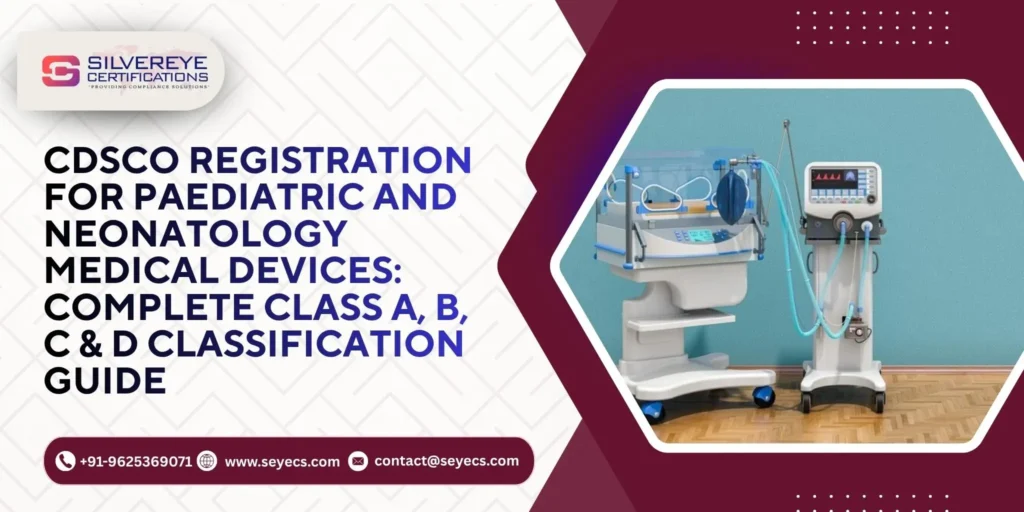
- 137 notified devices across 4 risk classes: CDSCO's paediatric and neonatology device list spans Class A (28 devices), Class B (63 devices), Class C (44 devices), and Class D (2 devices) — each with its own licensing route.
- Manufacturing license depends on class: Class A/B manufacturers use Form MD-3 (granted as MD-5) via the State Licensing Authority; Class C/D manufacturers use Form MD-7 (granted as MD-9) via CDSCO's Central Licensing Authority.
- Importers always use MD-14/MD-15: Regardless of class, an authorized Indian agent files Form MD-14 and receives the import license on Form MD-15 from CDSCO.
- Wholesalers always use MD-41/MD-42: Any business stocking, supplying, or distributing these devices needs the registration certificate granted on Form MD-42, applied for via Form MD-41.
Introduction
CDSCO registration for paediatric and neonatology medical devices is mandatory under the Medical Devices Rules, 2017, and the applicable license depends entirely on the device's risk class. Class A devices (e.g., infant scales, phototherapy eye protectors) and Class B devices (e.g., infant incubators' control accessories, neonatal ECG electrodes) follow the MD-3 application / MD-5 license route through the State Licensing Authority.
Class C devices (e.g., neonatal ventilators, infant apnoea monitors) and Class D devices (e.g., bioabsorbable craniofacial bone screws) follow the MD-7 application / MD-9 license route through CDSCO's Central Licensing Authority. Importers use Form MD-14 (license granted as MD-15), and wholesalers/distributors use Form MD-41 (registration granted as MD-42), regardless of class.
What Is CDSCO Registration for Paediatric and Neonatology Devices?
CDSCO registration for paediatric and neonatology devices is the regulatory approval issued by the Central Drugs Standard Control Organization (CDSCO), under India's Ministry of Health and Family Welfare, that authorizes a business to manufacture, import, or distribute medical devices intended for infant, neonatal, or paediatric patients. These devices are notified under the Medical Devices Rules, 2017 (MDR 2017), notified under the Drugs and Cosmetics Act, 1940, and are classified by risk into four categories — Class A, B, C, and D — as specified in the First Schedule, Part 1 of MDR 2017.
It covers everything from a simple infant scale or a nappy-changing table (Class A) to a neonatal intensive-care ventilator or an implantable craniofacial bone screw (Class C/D). Because the risk profile varies enormously across this range — from a non-invasive comfort item to a life-supporting device inserted into a critically ill newborn — CDSCO applies a different licensing pathway, review depth, and documentation standard depending on where a specific device falls.
How CDSCO Classifies Paediatric and Neonatology Devices
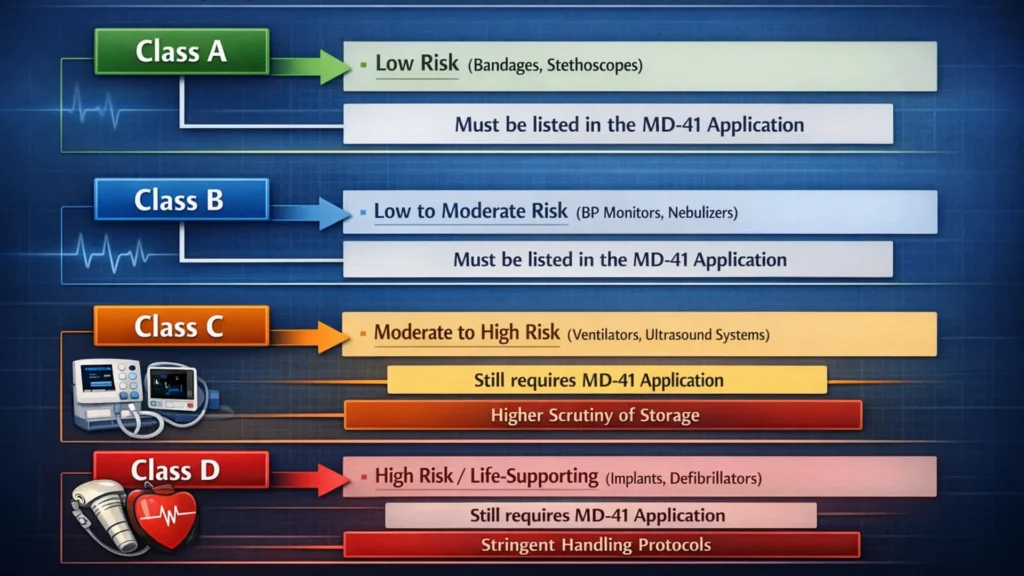
CDSCO's risk-based classification system, aligned with Global Harmonization Task Force (GHTF) principles, sorts every notified device into Class A (low risk), Class B (low-to-moderate risk), Class C (moderate-to-high risk), or Class D (high risk). For paediatric and neonatology devices, the classifying factors typically include whether the device is invasive, whether it sustains or supports a life function, whether it is implanted, and how much clinical judgement is needed if it fails.
| Risk Class | Risk Level | Licensing Authority | Manufacturing Forms |
| Class A | Low risk | State Licensing Authority | Form MD-3 (Application) → Form MD-5 (Licence) |
| Class B | Low-to-moderate risk | State Licensing Authority | Form MD-3 (Application) → Form MD-5 (Licence) |
| Class C | Moderate-to-high risk | CDSCO – Central Licensing Authority | Form MD-7 (Application) → Form MD-9 (Licence) |
| Class D | High risk | CDSCO – Central Licensing Authority | Form MD-7 (Application) → Form MD-9 (Licence) |
| Why this list matters for 2026 compliance Many paediatric and neonatal devices look deceptively simple (an infant bed, a warming pad, a urine collection bag) but are classified higher than a business might assume, purely because of their intended use on a vulnerable newborn or infant patient. Cross-check your exact product against the tables below before assuming a lower-risk pathway applies — misclassification is one of the most common causes of CDSCO application delay or rejection in this device category. |
Class A Paediatric and Neonatology Devices — Complete List
Class A devices carry the lowest risk and are generally non-invasive, non-life-supporting products used for comfort, positioning, basic measurement, or general nursery care. The following 28 devices are notified as Class A under CDSCO's First Schedule, Part 1:
| S.No. | Device Name |
| 1 | Assistive ergonomic chair mobility base |
| 2 | Exhaled-gas oesophageal intubation detector, paediatric |
| 3 | Infant care table |
| 4 | Infant incubator warming hood |
| 5 | Infant inguinal hernia truss |
| 6 | Infant limb immobilizer, reusable |
| 7 | Infant limb immobilizer, single-use |
| 8 | Infant scale, electronic |
| 9 | Infant sleep positioner |
| 10 | Infant whole-body immobilizer, reusable |
| 11 | Infant whole-body immobilizer, single-use |
| 12 | Infant-hammock bed mattress |
| 13 | Infant-hammock bed mattress overlay |
| 14 | Microlaryngeal probe |
| 15 | Neonatal kangaroo care garment |
| 16 | Oxygen administration hood, paediatric |
| 17 | Paediatric dorsiflexion slant board |
| 18 | Paediatric urine collection/analysis kit |
| 19 | Phototherapy eye protector, reusable |
| 20 | Phototherapy eye protector, single-use |
| 21 | Birthing bath |
| 22 | Newborn-infant bed |
| 23 | Bedrail pad |
| 24 | Nappy changing table, portable |
| 25 | Nasal aspirator, electric |
| 26 | Oral medicine dropper |
| 27 | Oxygen terminal unit |
| 28 | Teething device, non-fluid-filled |
Manufacturers of these devices apply for a manufacturing license on Form MD-3 and receive it on Form MD-5 from their State Licensing Authority — the lightest regulatory pathway in this category.
Class B Paediatric and Neonatology Devices — Complete List
Class B devices carry a low-to-moderate risk. This is the largest single group in the paediatric and neonatology category, covering incubator accessories, monitoring electrodes, phototherapy equipment, warming systems, and various beds and dental chairs. The following 63 devices are notified as Class B:
| S.No. | Device Name |
| 1 | Aerosol tent, paediatric |
| 2 | Airway Pressure / Oxygen Monitor |
| 3 | Anaesthesia Facemask, single use (paediatric) |
| 4 | Anaesthesia Facemask, reusable (paediatric) |
| 5 | Circulating-air whole-body heating/cooling system pad, reusable |
| 6 | Circulating-air whole-body heating/cooling system pad, single-use, sterile |
| 7 | Circulating-fluid whole-body heating/cooling system pad, reusable |
| 8 | Circulating-fluid whole-body heating/cooling system pad, single-use |
| 9 | Closed-ended adhesive infant/paediatric urine collection bag |
| 10 | Electric pad whole-body heating system |
| 11 | Electric pad whole-body heating system pad |
| 12 | External counterpulsation system, paediatric |
| 13 | External defibrillator electrode, paediatric, reusable |
| 14 | External defibrillator electrode, paediatric, single-use |
| 15 | Hepatic ultrasound elastography system applicator |
| 16 | Infant bed crib top |
| 17 | Infant bed restraint |
| 18 | Infant heat shield |
| 19 | Infant resuscitation cabinet |
| 20 | Infant resuscitation table |
| 21 | Liquid crystal vein locator |
| 22 | Neonatal chest percussor |
| 23 | Neonatal electrocardiographic electrode |
| 24 | Neonatal hypothermia cot |
| 25 | Neonatal hypothermia cot heat-conduction mattress |
| 26 | Neonatal hypothermia cot heat-retention pad |
| 27 | Neonatal pulmonary surfactant catheter |
| 28 | Non-rechargeable public semi-automated external defibrillator electrode, paediatric |
| 29 | Open-ended adhesive infant/paediatric urine collection bag |
| 30 | Ophthalmic tonometer, battery-operated |
| 31 | Orthopaedic medialization instrument |
| 32 | Oxygen administration tent, neonatal/paediatric |
| 33 | Paediatric bed |
| 34 | Paediatric blood donor set |
| 35 | Paediatric dental chair, electric |
| 36 | Paediatric dental chair, mechanical |
| 37 | Paediatric strabismus screening scanner |
| 38 | Paediatric-temperature nasogastric/orogastric tube |
| 39 | Blanket/pad infant phototherapy unit |
| 40 | Flotation therapy bed, neonatal |
| 41 | Otoacoustic emission system, battery-powered |
| 42 | Otoacoustic emission system, line-powered |
| 43 | Overhead infant phototherapy unit |
| 44 | Thoracic electrical impedance segmentography system |
| 45 | Thoracic electrical impedance segmentography system electrode array |
| 46 | Wearable neonatal heart rate meter |
| 47 | Antimicrobial infant garment |
| 48 | Boiling water sterilizer |
| 49 | Resuscitator face mask, reusable |
| 50 | Resuscitator face mask, single-use |
| 51 | Warming infant bed, adjustable |
| 52 | Warming infant bed, non-adjustable |
| 53 | Blanket/pad infant phototherapy unit tester |
| 54 | Blood transfusion set, exchange |
| 55 | Blue light radiometer |
| 56 | Cranial orthosis |
| 57 | Multi-purpose saline solution |
| 58 | Open infant incubator |
| 59 | Pulmonary function analysis system, paediatric |
| 60 | Reactive-gel heating pad |
| 61 | Rocking infant bed, electric |
| 62 | Teething device, fluid-filled |
| 63 | Visual-reinforcement-audiometry reward system |
Like Class A, Class B manufacturers apply on Form MD-3 and receive the licence on Form MD-5 from the State Licensing Authority, though CDSCO's technical review is generally more detailed than for Class A products.
Class C Paediatric and Neonatology Devices — Complete List
Class C devices carry a moderate-to-high risk, typically because they support a critical physiological function, are used in intensive or critical care, or are implanted for an extended period. The following 44 devices are notified as Class C:
| S.No. | Device Name |
| 1 | Antimicrobial endotracheal tube, paediatric |
| 2 | Breathing circuit gas-flow sensor, reusable |
| 3 | Breathing circuit gas-flow sensor, single-use |
| 4 | Cerebral oximeter |
| 5 | Craniofacial bone screw, non-bioabsorbable, sterile |
| 6 | Cuff-suction endotracheal tube |
| 7 | Enteral feeding kit, adult/paediatric, sterile |
| 8 | Flexible bone nail, non-sterile |
| 9 | Flexible bone nail, sterile |
| 10 | Funnel chest remodelling bar |
| 11 | Growth-correction orthopaedic fixation plate kit |
| 12 | Infant apnoea monitor |
| 13 | Infant incubator control unit |
| 14 | Infant warmer |
| 15 | Infant/regional-body warmer |
| 16 | Internal defibrillator electrode, paediatric |
| 17 | Lacrimal intubation set |
| 18 | Multifunction cardiac electrode, paediatric |
| 19 | Neonatal CPAP unit |
| 20 | Neonatal intensive-care ventilator |
| 21 | Neonatal physiologic monitoring system |
| 22 | Neonatal/paediatric heart rate monitoring application software |
| 23 | Neonatal/paediatric heart rate monitoring hardware |
| 24 | Nitric oxide delivery unit, system-based |
| 25 | Open-surgery manual linear cutting stapler, reprocessed |
| 26 | Open-surgery manual linear cutting stapler, reusable |
| 27 | Open-surgery manual linear cutting stapler, single-use |
| 28 | Open-surgery manual linear stapler, reusable |
| 29 | Open-surgery manual linear stapler, single-use |
| 30 | Paediatric cardiopulmonary bypass cannula |
| 31 | Mobile steam washer/disinfector |
| 32 | Respiratory gas heating wire, infant |
| 33 | Stationary pneumatic high-frequency ventilator respiration monitor |
| 34 | Syringe pump |
| 35 | Transcutaneous intracranial pressure sensor |
| 36 | Cardiac septostomy catheter, balloon |
| 37 | Cardiac septostomy catheter, blade |
| 38 | Conventional infant incubator |
| 39 | Home BPAP unit |
| 40 | Oxygen breath analyser |
| 41 | Respiratory apnoea monitoring system |
| 42 | Skin transilluminator, battery-powered |
| 43 | Skin transilluminator, line-powered |
| 44 | Transport infant incubator |
Class C manufacturers must apply on Form MD-7 and receive the manufacturing license on Form MD-9 directly from CDSCO's Central Licensing Authority — a materially more rigorous process than the state-level Class A/B route.
Class D Paediatric and Neonatology Devices — Complete List
Class D is CDSCO's highest-risk category, reserved for implantable devices where failure carries serious consequences. Only 2 paediatric/neonatology devices are notified as Class D:
| S.No. | Device Name |
| 1 | Craniofacial bone screw, bioabsorbable |
| 2 | Polyglyconate suture |
Like Class C, Class D manufacturing licences are granted on Form MD-9 following an MD-7 application to CDSCO's Central Licensing Authority, and typically require the most extensive clinical and technical documentation of any category covered in this guide.
Who Needs CDSCO Registration for These Devices?
CDSCO registration applies separately to each role in the supply chain, and the exact form depends on the device's class:
| Entity | Class A/B Route | Class C/D Route | Issuing Authority |
| Manufacturer | Form MD-3 → MD-5 | Form MD-7 → MD-9 | State Licensing Authority (A/B); CDSCO Central Licensing Authority (C/D) |
| Importer | Form MD-14 → MD-15 | Form MD-14 → MD-15 | CDSCO – Central Licensing Authority (all classes) |
| Wholesaler / Distributor | Form MD-41 → MD-42 | Form MD-41 → MD-42 | State Licensing Authority (all classes) |
Note that import and wholesale licensing routes stay the same regardless of class — MD-14/MD-15 for import and MD-41/MD-42 for wholesale — but the manufacturing route changes completely between Class A/B and Class C/D.
CDSCO Manufacturing License: MD-3/MD-5 (Class A/B) vs. MD-7/MD-9 (Class C/D)
Class A/B Manufacturing — Form MD-3 & MD-5
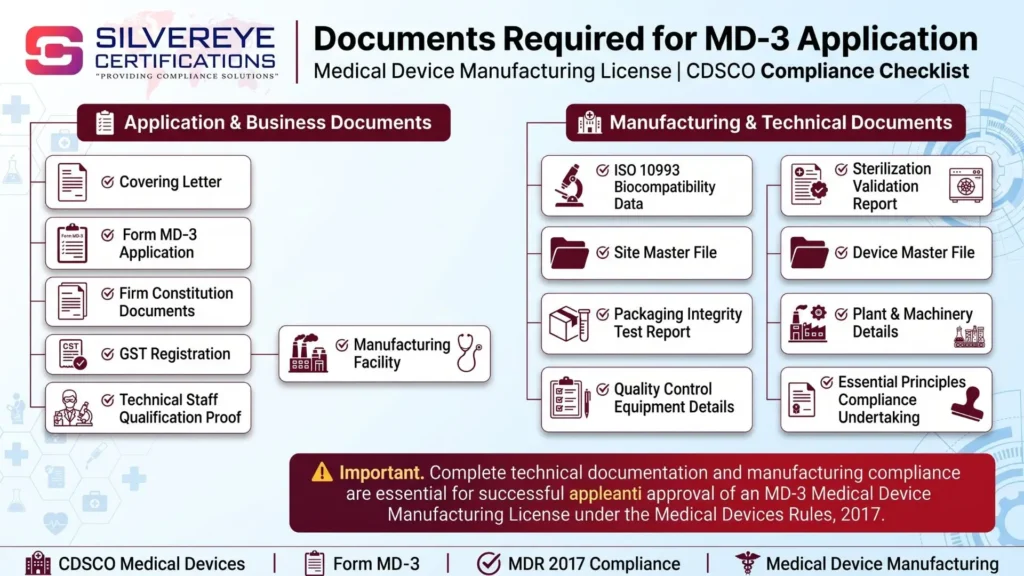
- Applicant must be a registered business entity with a defined manufacturing premise in India.
- Quality Management System aligned with ISO 13485:2016, proportionate to the specific device's risk.
- Application filed on Form MD-3 via the CDSCO SUGAM portal, with a Site Master File and Device Master File.
- Reviewed and granted by the State Licensing Authority (SLA) on Form MD-5.
- Typical processing time: approximately 3–6 months, including any facility inspection.
Class C/D Manufacturing — Form MD-7 & MD-9
- Applicant must meet the same business-entity and premise requirements, with a more rigorous Quality Management System given the higher device risk.
- Application filed on Form MD-7 via the SUGAM portal, with a comprehensive Device Master File, clinical/performance evaluation data, and (for implants) biocompatibility and material data.
- Reviewed and granted directly by CDSCO's Central Licensing Authority on Form MD-9.
- A facility inspection by CDSCO's Medical Device Officers is typically scheduled within 60 days of a complete application.
- Typical processing time: approximately 6–9 months, reflecting the deeper technical and clinical review required for Class C/D devices.
CDSCO Import License for Paediatric and Neonatology Devices (MD-14 & MD-15)
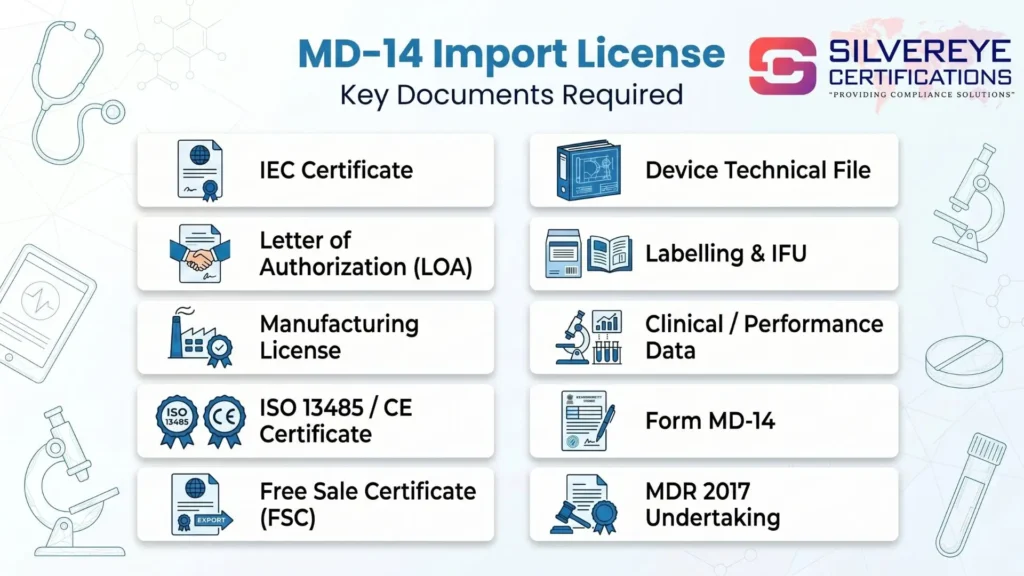
Foreign manufacturers cannot sell paediatric or neonatology devices directly in India, regardless of class. They must appoint an Authorized Indian Agent who holds a valid wholesale license (Form MD-42) or manufacturing license, and who files the import application on Form MD-14. CDSCO's Central Licensing Authority reviews the application — with depth proportionate to the device's class — and grants the import license on Form MD-15.
Documents Required for MD-14 Application
- Covering letter and duly filled Form MD-14.
- Government fee payment challan.
- Notarized and apostilled Power of Attorney from the foreign manufacturer authorizing the Indian agent.
- Copy of the agent's Wholesale License (MD-42) or Manufacturing License.
- Free Sale Certificate or Marketing Authorization from the regulatory authority of the country of origin.
- Device Master File and Plant Master File of the foreign manufacturing site, with clinical/performance data appropriate to the device's class.
- ISO 13485 certificate and any applicable CE marking or equivalent international approval.
| Import review scales with device class A Class A infant scale and a Class C neonatal ventilator both use Form MD-14/MD-15, but CDSCO's depth of review differs enormously — expect substantially more queries around clinical performance, software validation, and biocompatibility for higher-class devices like ventilators, incubators, and implantable bone-fixation products. |
CDSCO Wholesale / Distributor License for Paediatric and Neonatology Devices (MD-41 & MD-42)
Any business that stocks, exhibits, sells, or distributes these devices in bulk — including distributors, stockists, C&F agents, and e-commerce sellers of regulated medical devices — needs a wholesale registration, regardless of the device's class. The application is made on Form MD-41, and the State Licensing Authority grants the registration certificate on Form MD-42.
Eligibility and Documents for MD-41/MD-42
- A dedicated storage premise of adequate size with proper shelving, cleanliness, and record-keeping arrangements.
- A technically competent person overseeing storage and distribution.
- Duly filled Form MD-41, business constitution proof, premises address proof and layout plan, technical competence proof, and the fee payment receipt.
- A Drug Inspector conducts a physical inspection of the storage premises before the State Licensing Authority issues the registration certificate on Form MD-42.
CDSCO Fees for Paediatric and Neonatology Device Registration
Government fees differ by license type and risk class, as prescribed under the First Schedule of MDR 2017. Class C/D fees are meaningfully higher than Class A/B, reflecting the deeper technical review involved. Fees are revised from time to time, so always verify the current amount on the SUGAM portal before submitting payment.
| Licence Type | Applicable Fee | Notes |
| Class A/B Manufacturing (MD-3/MD-5) | As per MDR 2017 Schedule I | Lower than Class C/D; confirm current amount on SUGAM |
| Class C/D Manufacturing (MD-7/MD-9) | As per MDR 2017 Schedule I | Higher fee reflecting Central Licensing Authority review |
| Import Licence (MD-14/MD-15) | As per MDR 2017 Schedule I | Applies per manufacturing site and per product/product group |
| Wholesale Licence (MD-41/MD-42) | ₹3,000 per premise (government fee) | Non-refundable; same across all device classes |
Processing Timeline & Validity of CDSCO Licenses by Class
| Licence Type | Typical Processing Time | Validity | Renewal |
| MD-5 (Class A/B Manufacturing) | Approx. 3–6 months | 5 years from date of issue | Apply before expiry with retention/renewal fee |
| MD-9 (Class C/D Manufacturing) | Approx. 6–9 months, including facility inspection | 5 years from date of issue | Apply before expiry with retention/renewal fee |
| MD-15 (Import, any class) | Approx. 3–9 months depending on class and document completeness | Generally continues indefinitely subject to a 5-year retention fee cycle | Pay retention fee every 5 years |
| MD-42 (Wholesale, any class) | Approx. 30–60 days | 5 years from date of issue | Renew before expiry to avoid disruption |
As a best practice, begin renewal filing at least 90 days before expiry for Class C/D licenses, and 60 days for Class A/B, since Central Licensing Authority review depth for higher-class devices can extend the timeline if any performance or clinical data needs updating.
Benefits of CDSCO Registration for Paediatric and Neonatology Devices
- Legal market access: A valid CDSCO authorization, matched to the correct class, is what allows any of these 137 devices to be manufactured, imported, or sold in India.
- NICU and paediatric-ward procurement eligibility: Government hospitals, NICUs, and paediatric procurement tenders require CDSCO documentation before empanelling a supplier.
- Protection from penalties: Registered businesses avoid the seizure, fines, and legal action that come with selling unregistered medical devices.
- Export credibility: A CDSCO license strengthens your regulatory profile when paediatric or neonatal devices are later exported to markets that recognize Indian approvals.
Penalties for Non-Compliance
Manufacturing, importing, or distributing a paediatric or neonatology device without the applicable CDSCO authorization is a violation of the Medical Devices Rules, 2017 and the Drugs and Cosmetics Act, 1940. Consequences can include seizure of stock, suspension or cancellation of any related licenses, financial penalties, and prosecution under the Act, which in serious or repeat cases can extend to imprisonment. Because this category includes devices used on critically ill newborns and infants, non-compliance carries a direct patient-safety dimension that CDSCO and hospital procurement bodies both treat seriously.
Common Mistakes to Avoid
- Assuming every device used on infants automatically qualifies for the lightest Class A pathway — many everyday-looking products (incubators, monitors, warming beds) are Class B or C.
- Applying under the wrong form — filing MD-3 for a Class C/D device (which needs MD-7), or MD-7 for a Class A/B device (which only needs MD-3).
- Submitting an incomplete Device Master File without class-appropriate performance, biocompatibility, or clinical evaluation data.
- Assuming a single license covers manufacturing, import, and wholesale activity — each role needs its own authorization.
- Not cross-checking the specific device name and variant (e.g., reusable vs. single-use, battery-powered vs. line-powered) against the CDSCO list, since these variants can carry different classes.
- Delaying renewal filing until close to expiry, especially for Class C/D licenses where review depth can extend the timeline.
Conclusion
The paediatric and neonatology device category is one of the most classification-diverse groups CDSCO regulates — spanning everything from a simple infant scale to a neonatal ventilator to an implantable bone screw. Getting the classification right for your specific product is the single most important step: it determines whether you need the lighter MD-3/MD-5 state-level route or the more rigorous MD-7/MD-9 Central Licensing Authority route, and it shapes the documentation, timeline, and fees you should plan for.
The team at Silvereye Certifications specializes in end-to-end CDSCO medical device registration support — from device classification and technical dossier preparation to SUGAM portal submissions and post-approval compliance management for paediatric and neonatology device manufacturers, importers, and distributors across India.
Frequently Asked Questions
Is CDSCO registration mandatory for all paediatric and neonatal medical devices?
Yes. Every notified paediatric and neonatology device under MDR 2017 — whether Class A, B, C, or D — requires the applicable CDSCO license or registration before manufacture, import, or distribution in India.
How many paediatric and neonatology devices does CDSCO classify, and across which classes?
Based on CDSCO's First Schedule, Part 1 classification list, 137 paediatric and neonatology devices are notified: 28 in Class A, 63 in Class B, 44 in Class C, and 2 in Class D.
What is the difference between the MD-3/MD-5 and MD-7/MD-9 manufacturing routes?
MD-3/MD-5 is the manufacturing license route for Class A and Class B devices, reviewed and granted by the State Licensing Authority. MD-7/MD-9 is the manufacturing license route for Class C and Class D devices, reviewed and granted directly by CDSCO's Central Licensing Authority.
Do importers use different forms depending on the device's class?
No. Importers use Form MD-14 (application) and receive Form MD-15 (licence) from CDSCO's Central Licensing Authority regardless of whether the device is Class A, B, C, or D — though the depth of technical review does scale with class.
Do wholesalers and distributors need a different license for higher-class devices?
No. Wholesalers and distributors use Form MD-41 (application) and receive Form MD-42 (registration certificate) from the State Licensing Authority regardless of the device's class.
How can I check which class my specific paediatric or neonatal device falls under?
Cross-reference your device's exact name and variant (e.g., reusable vs. single-use) against CDSCO's official First Schedule, Part 1 classification list on the SUGAM portal, since even closely related variants of the same device can carry different risk classes.
How long does CDSCO registration take for these devices?
Class A/B manufacturing licences (MD-5) typically take 3–6 months. Class C/D manufacturing licences (MD-9) typically take 6–9 months, including a facility inspection. Import licences (MD-15) range from about 3–9 months depending on class, and wholesale registrations (MD-42) typically take 30–60 days.
What is the validity of these CDSCO licenses?
MD-5, MD-9, and MD-42 are generally valid for 5 years from the date of issue. MD-15 import licences generally continue indefinitely, subject to a 5-year retention fee cycle.
What documents are required across these license types?
Core documents include the relevant application form (MD-3, MD-7, MD-14, or MD-41), business constitution proof, site/premises details, a Device Master File with class-appropriate technical and clinical data, technical staff qualifications, and the applicable fee payment receipt. Importers additionally need a Power of Attorney and a Free Sale Certificate from the country of origin.
How do I renew a CDSCO license for a paediatric or neonatal device?
Renewal applications should be filed at least 60 days before expiry for Class A/B licenses, and at least 90 days before expiry for Class C/D licenses, using the previous license details, updated technical/clinical documentation, and the prescribed renewal or retention fee, submitted through the SUGAM portal to the relevant State or Central Licensing Authority.