
- Filing goes straight to DGFT HQ: Since 2021, Export Authorisation applications for restricted (non-SCOMET) items are submitted directly to DGFT Headquarters, not the Regional Authority.
- SCOMET exports follow a stricter path: Dual-use and strategic items go through an additional review by the Inter-Ministerial Working Group (IMWG), which includes representatives from Defence, External Affairs, and Space.
- Validity differs by category: A SCOMET export authorization is typically valid for 24 months, while restricted-item authorizations can be revalidated in six-month blocks up to a maximum of 12 months.
- The list keeps evolving: DGFT revises the SCOMET list and restricted export categories through periodic notifications, so re-verify your ITC (HS) code before every shipment.
Introduction
DGFT Export Authorization is the government permission required to legally export goods classified as “Restricted” or listed under SCOMET (dual-use items) from India. An exporter with a valid Import Export Code (IEC) files Form ANF 2N on the DGFT portal, along with ANF 1, a proforma invoice or export order, product details, and end-use documentation. Applications for restricted (non-SCOMET) items go directly to DGFT Headquarters in New Delhi, while SCOMET applications are additionally reviewed by the Inter-Ministerial Working Group. The fee is based on CIF value (minimum ₹500), and approval typically takes 15 to 60 working days, longer for SCOMET cases needing multi-agency clearance.
What Is DGFT Export Authorization?
DGFT Export Authorization is the formal approval an exporter must secure before shipping goods that fall under the “Restricted” category of India’s ITC (HS) Code, or under the SCOMET list of dual-use and strategically sensitive items. It is issued under the Foreign Trade Policy by the Directorate General of Foreign Trade, Ministry of Commerce and Industry, and customs will not permit export clearance of such goods without it. The authorization is tied to a specific product, quantity, buyer, and end use, so a new or amended application is generally required for each distinct export transaction or shipment pattern.
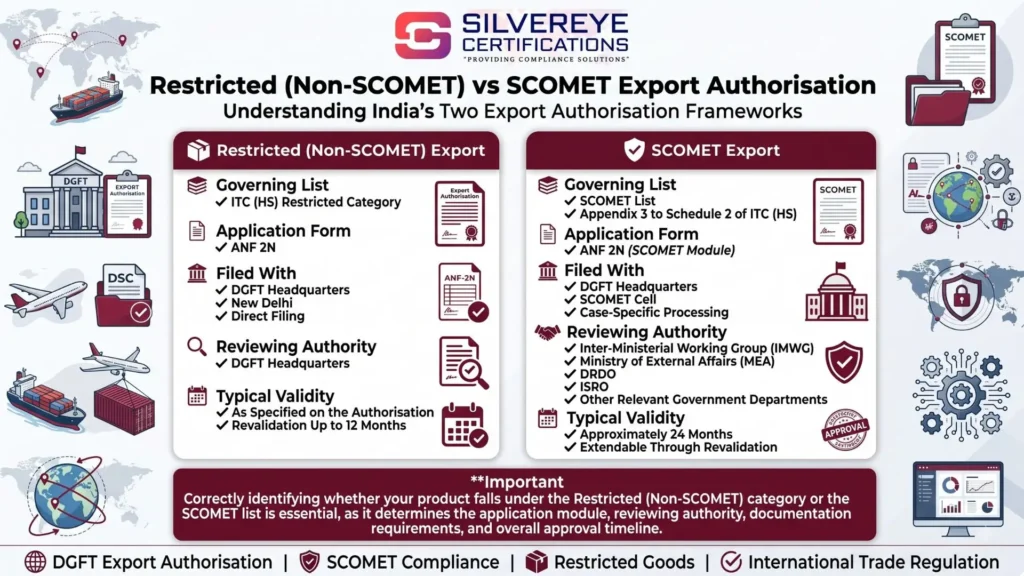
Restricted (Non-SCOMET) vs SCOMET Export Authorization
Not all export authorisations follow the same review path. Understanding which category your product falls into determines who reviews your application and how long it takes:
| Aspect | Restricted (Non-SCOMET) Export | SCOMET Export |
| Governing list | ITC (HS) Restricted category | SCOMET List, Appendix 3 to Schedule 2 of ITC (HS) |
| Application form | ANF 2N | ANF 2N (SCOMET module) |
| Filed with | DGFT Headquarters, New Delhi (direct filing since 17 May 2021) | DGFT Headquarters — SCOMET Cell, with case-specific review |
| Reviewing body | DGFT Headquarters | Inter-Ministerial Working Group (IMWG) — MEA, DRDO, ISRO, and other departments as relevant |
| Typical validity | As specified on the authorisation; revalidation up to 12 months | Around 24 months, extendable via revalidation |
Who Needs to Apply for DGFT Export Authorization?
You need to go through this process if:
- Your product’s ITC (HS) code is currently marked “Restricted” for export, or it appears in Categories 0 to 8 of the SCOMET list.
- You hold a valid Import Export Code (IEC), since the DGFT portal application is filed and tracked under your IEC profile.
- Neither you nor any director, partner, proprietor, or trustee of your firm is on DGFT’s Denied Entity List (DEL).
- Your firm has no pending default or disqualification under the Foreign Trade Policy.
- For SCOMET Category 6 items specifically, clearance additionally involves the Department of Defence Production, Ministry of Defence.
Documents Required for DGFT Export Authorization
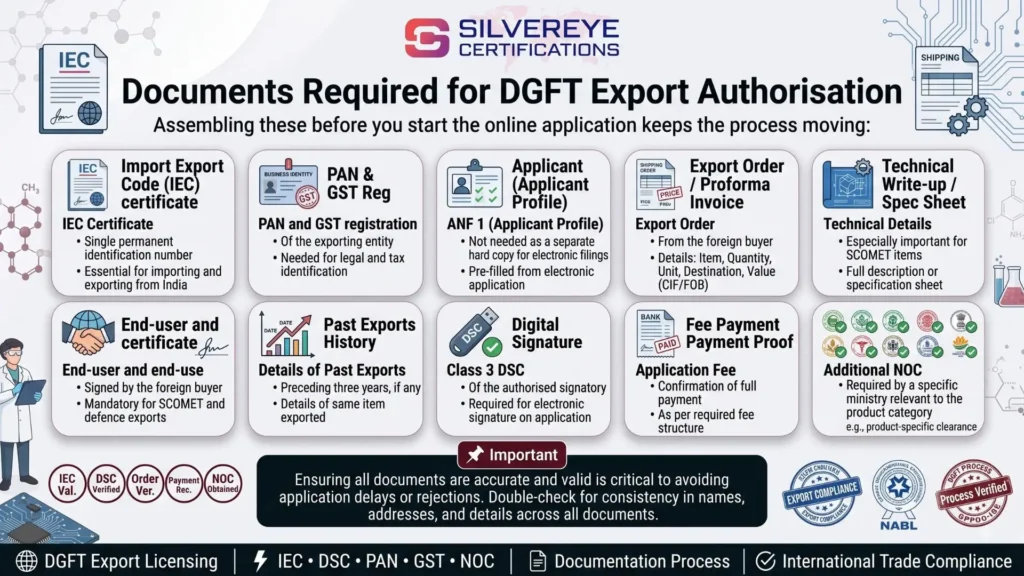
Assembling these before you start the online application keeps the process moving:
- Import Export Code (IEC) certificate
- PAN and GST registration of the exporting entity
- ANF 1 — applicant profile (not needed as a separate hard copy for electronic filings)
- Export Order or Proforma Invoice from the foreign buyer, showing item description, quantity, unit of measurement, destination country, and CIF/FOB value
- Technical write-up or product specification sheet, especially important for SCOMET items
- End-user and end-use certificate from the foreign buyer, particularly for SCOMET and defence-linked exports
- Details of past exports of the same item in the preceding three years, if any
- Class 3 Digital Signature Certificate (DSC) of the authorised signatory
- Application fee payment proof
- Any additional NOC required by a specific ministry or department relevant to the product category
Step-by-Step DGFT Export Authorization Application Process
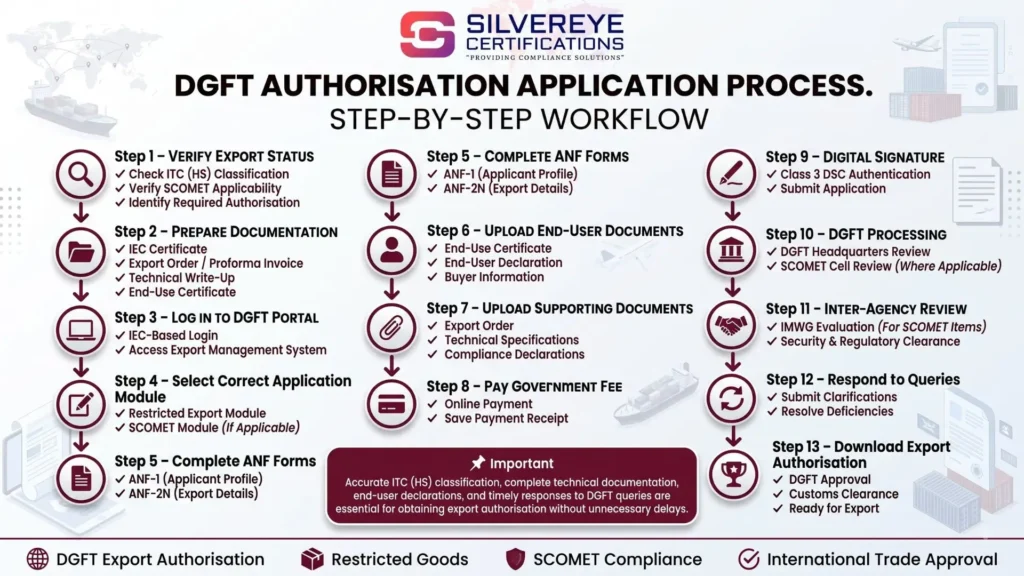
- Verify your product's export status: Check the current ITC (HS) classification and, separately, the SCOMET list on the DGFT website to confirm whether your item needs a restricted-goods authorisation, a SCOMET authorisation, or both.
- Compile your documentation: Gather the IEC copy, export order or proforma invoice, technical write-up, and end-use certificate before starting the online form.
- Log in to the DGFT portal: Access dgft.gov.in with your IEC-based credentials; complete registration first if you haven't already.
- Navigate to the correct module: For restricted (non-SCOMET) items, go to Services > Export Management System > Restricted Export. For dual-use items, go to Services > Export Management System > SCOMET.
- Fill ANF 1 and ANF 2N together: ANF 1 captures your firm's profile and compliance history; ANF 2N captures the item description, quantity, destination, value, and buyer details.
- Attach end-use and end-user documentation: This is scrutinised closely, especially for SCOMET items, since it establishes who will use the goods and for what purpose.
- Upload supporting documents and declarations: Include the export order, technical specifications, past export history, and confirm your firm is not on the Denied Entity List.
- Pay the application fee electronically: Complete payment through the DGFT portal and retain the receipt for upload with the application.
- Sign digitally and submit: Authenticate the application using your Class 3 DSC before final submission.
- Application routing: Restricted (non-SCOMET) applications go directly to DGFT Headquarters, Udyog Bhawan, New Delhi for processing. SCOMET applications are additionally routed to the SCOMET Cell at DGFT HQ.
- Inter-agency review, where applicable: SCOMET applications are examined by the Inter-Ministerial Working Group, which meets roughly once a month; a case may be deferred if a member department's comments are still awaited.
- Respond to DGFT queries promptly: Address any clarification requests within the stipulated window to avoid the application being treated as withdrawn.
- Download the Export Authorization: Once approved, download it from your DGFT dashboard and present it to Customs at the time of export, along with the shipping bill and commercial invoice.
A Closer Look at SCOMET Export Authorization
SCOMET (Special Chemicals, Organisms, Materials, Equipment and Technologies) covers dual-use items that can serve both civilian and military purposes, spread across eight categories in Appendix 3 to Schedule 2 of the ITC (HS). A few features set this process apart from a standard restricted-item export:
- Applications are reviewed by the Inter-Ministerial Working Group (IMWG), typically chaired at the Additional DGFT level, with member departments including the Ministry of External Affairs, DRDO, and ISRO.
- Export of SCOMET items purely for display or exhibition (outside Categories 0, 1, and 2) does not require an end-use or end-user certificate, but re-import is generally expected within six months if the item is not sold.
- SCOMET items can move from a Domestic Tariff Area (DTA) unit to a Special Economic Zone (SEZ) without a fresh authorization.
- The Global Authorization for Intra-Company Transfers (GAICT) policy allows certain re-exports of imported SCOMET Category 8 items to overseas group companies without a fresh pre-export authorization, and is typically valid for three years from issuance.
- Export of related “technology” — including software or technical data sent by email or cloud transfer — can also require a SCOMET license, not just physical hardware shipments.
DGFT Export Authorization Fees
| Application Type | Fee |
| New Export Authorisation (restricted or SCOMET) | ₹1 per ₹1,000 of CIF value; minimum ₹500, maximum ₹1,00,000 |
| Revalidation | Nominal fee as prescribed on the DGFT portal; often waived for the specific delay period, subject to a six-month cap |
| Amendment | Nominal fee as prescribed on the DGFT portal |
Fees are paid electronically and revised periodically by DGFT notification — confirm the current rate on the portal before you pay.
Processing Timeline For DGFT Export Authorization
| Stage | Typical Duration |
| Initial screening after submission | A few working days |
| Document and end-use verification | 1 to 2 weeks |
| Decision on straightforward restricted-item exports | 15 to 30 working days |
| SCOMET cases needing IMWG review | 40 to 60 days, longer if deferred pending a member department's comments |
Validity, Amendment, and Revalidation
Export Authorisations are not open-ended. Keep these points in mind once yours is approved:
- A SCOMET export authorization is generally valid for around 24 months from issuance.
- Restricted-item and SCOMET export authorizations can typically be revalidated for six months at a time, up to a maximum of 12 months, at the discretion of DGFT Headquarters.
- Revalidation for the period lost to delay is often permitted without an extra fee, subject to a six-month cap or the actual delay period, whichever is less.
- Amendment applications — for a change in item description, quantity, value, or buyer — must be filed online, and original approval copies may need to be presented physically to DGFT Headquarters for endorsement.
- For authorizations issued before 17 May 2021, revalidation or amendment requests still go to the concerned Regional Authority rather than DGFT Headquarters.
Post-Approval Compliance For DGFT Export Authorization
- End-use verification: DGFT and, for SCOMET items, the concerned ministries can call for proof that the goods reached the declared end user for the declared purpose.
- Exhibition re-import condition: SCOMET items exported for display abroad generally need to be re-imported within six months unless a separate sale licence is obtained.
- Record retention: Keep the authorisation, export order, shipping bill, and end-use certificate on file well beyond the shipment date.
- Renewal tracking: Note your authorisation's expiry date early so a revalidation application can be filed before it lapses, especially for recurring export contracts.
Common Reasons Export Authorization Applications Get Delayed
- Treating a SCOMET item as a simple restricted-goods export, or vice versa, and filing under the wrong module
- Weak or missing end-use/end-user documentation, which is scrutinised heavily for dual-use goods
- CIF or FOB value mismatches between the export order and the ANF 2N entry
- Incomplete ANF 1 compliance declarations
- SCOMET applications stuck pending comments from a member department of the IMWG
- Filing a revalidation or amendment with the Regional Authority when the original authorisation was issued after 17 May 2021 and should go to DGFT Headquarters instead
2026 Update: What's Changed Recently
DGFT revised the SCOMET list under Notification No. 31/2025-26 dated 23 September 2025, effective 30 days after issuance, so exporters of dual-use items should re-check their product's current category. Separately, in early 2026 DGFT extended the Export Obligation Period for Advance Authorization and EPCG Authorization holders to 31 August, citing prevailing geopolitical developments affecting global shipping routes and supply chains — a reminder that export-linked compliance timelines can shift with limited notice during periods of global trade disruption. While that particular extension applies to a different scheme, it reflects the kind of policy responsiveness that also shapes restricted and SCOMET export processing during volatile trade periods.
How Silvereye Certifications Can Help
Export Authorization applications carry higher stakes than most compliance filings — a SCOMET misclassification or a weak end-use certificate can stall a shipment for months, not days. Silvereye Certifications helps exporters correctly classify products against the ITC (HS) and SCOMET lists, prepare ANF 1 and ANF 2N filings with consistent documentation, build defensible end-use certification, and track applications through DGFT Headquarters or IMWG review, while also managing revalidation and amendment deadlines so approved authorizations stay usable.
Conclusion
DGFT Export Authorization is straightforward for exporters who do the classification homework upfront — confirming whether an item is simply “Restricted” or falls under the more tightly reviewed SCOMET list, and filing ANF 1 and ANF 2N with consistent, well-documented end-use information. The biggest timeline risks sit with SCOMET shipments, where Inter-Ministerial Working Group review adds both rigor and time, so building in a realistic buffer before your planned export date matters more than for a routine restricted-item shipment. Track your authorisation's validity and revalidation window carefully, since a lapsed authorisation can stall a recurring export contract just as easily as a missing document can stall a first-time application.
If you'd rather have specialists manage the classification, documentation, and DGFT Headquarters or IMWG follow-up on your behalf, Silvereye Certifications can handle your Export Authorisation application end to end, keeping your restricted and SCOMET exports compliant and on schedule.
Frequently Asked Questions
What is DGFT Export Authorization?
It is the government approval required from the Directorate General of Foreign Trade before exporting goods classified as “Restricted” or listed under SCOMET, without which customs will not clear the export shipment.
Which form is used to apply for DGFT Export Authorization?
Form ANF 2N is used for both restricted (non-SCOMET) export authorizations and SCOMET export authorizations, typically filed along with ANF 1.
Where are restricted export authorization applications submitted?
Since 17 May 2021, applications for restricted (non-SCOMET) export authorizations are submitted directly to DGFT Headquarters in New Delhi, not the Regional Authority.
What is SCOMET and how is it different from a regular restricted export?
SCOMET refers to Special Chemicals, Organisms, Materials, Equipment and Technologies — dual-use items with civilian and military applications. SCOMET exports go through an additional review by the Inter-Ministerial Working Group, unlike standard restricted-item exports.
How much does DGFT Export Authorization cost?
The standard fee is ₹1 per ₹1,000 of CIF value, subject to a minimum of ₹500 and a maximum of ₹1,00,000, paid electronically through the DGFT portal.
How long does it take to get a DGFT Export Authorization?
Straightforward restricted-item cases are often decided within 15 to 30 working days. SCOMET cases needing Inter-Ministerial Working Group review can take 40 to 60 days or more.
How long is a SCOMET export authorization valid?
It is typically valid for around 24 months from issuance, and can be extended through revalidation in increments of up to six months, capped at a further 12 months.
Can an Export Authorization be revalidated if I miss the original validity period?
Yes. DGFT Headquarters can revalidate restricted and SCOMET export authorizations on merit, generally in six-month blocks up to a maximum of 12 months.
Do I need an end-use certificate for every export authorization?
It is mandatory for most SCOMET applications and commonly required for restricted-item exports involving sensitive end use; exhibition-only SCOMET exports outside Categories 0, 1, and 2 are a limited exception.
What happens if I export restricted or SCOMET goods without authorization?
Customs can detain or seize the shipment, DGFT can impose penalties under the FTDR Act, and your IEC can be suspended or cancelled, halting future export activity.