
- A genuine platform upgrade, not a rebrand: SIMS 2.0 launched July 25, 2024 on an completely replacing SIMS 1.0, which was discontinued immediately on the DGFT website.
- Built for speed and accuracy: New features include API integration with other government portals, a streamlined data entry system, and a registration form cut down to roughly 20 fields from the original 56.
- The foundation for newer tools: SARAL SIMS, the simplified annual-registration option for small and export-linked importers launched in November 2025, runs on top of the SIMS 2.0 ecosystem.
- Still the same core rules: SIMS 2.0 didn't change the fundamentals — the ₹500 minimum fee, 75-day ARN validity, and mandatory registration requirement for Chapters 72, 73, and 86 all carried over from SIMS 1.0.
Introduction
SIMS 2.0 is the upgraded version of India's Steel Import Monitoring System, launched by the Ministry of Steel and DGFT on July 25, 2024, at 2:00 PM. It replaced SIMS 1.0 (which ran on the DGFT website since November 2019) with a dedicated portal at sims.steel.gov.in, featuring API integration with other government systems, a simplified data entry process, and enhanced monitoring capabilities. SIMS 2.0 is where every steel importer must now register shipments — coils, sheets, plates, stainless steel, bars, and more — under Chapters 72, 73, and 86 of the ITC(HS) before customs clearance. It is not a license; it's a mandatory pre-import registration system.
What Is SIMS 2.0?
SIMS 2.0 is the second-generation version of India's Steel Import Monitoring System — an online platform run by the Ministry of Steel, in coordination with the Directorate General of Foreign Trade (DGFT), that requires importers to register steel shipment details in advance before the goods arrive in India. It's the current, active version of SIMS that every steel importer uses today, having fully replaced the original SIMS 1.0 system.
Functionally, SIMS 2.0 does the same core job SIMS has always done: it collects advance information — product, quantity, value, origin, and expected arrival — on steel imports so the government can maintain a real-time trade database. What's changed is how that job gets done: a dedicated, purpose-built portal with better integration, fewer manual steps, and faster processing than the original system.
It's worth being clear on what SIMS 2.0 is not. It is not an import license, and it doesn't require government approval of your shipment. The applicable import policy for SIMS-covered steel remains "free, but subject to compulsory registration under SIMS" — meaning you don't need permission to import, but you do need to register in advance.
The History: From SIMS 1.0 to SIMS 2.0
| Milestone | Date |
| SIMS 1.0 launched | November 1, 2019, via DGFT Notification No. 17/2015-2020, hosted on the DGFT website |
| Decision to upgrade the system | February 2024, by the Ministry of Steel |
| SIMS 2.0 officially launched | July 25, 2024, at 2:00 PM, via DGFT Trade Notice No. 10/2024-25 |
| SIMS 1.0 discontinued | Immediately upon SIMS 2.0's launch on July 25, 2024 (old applications remained viewable/downloadable, but no new filings were accepted) |
| SARAL SIMS added | November 20, 2025, as a simplified annual-registration path within the SIMS 2.0 ecosystem |
SIMS 2.0 was formally launched by the Union Minister for Steel and Heavy Industries, in the presence of the Minister of State for Steel and Heavy Industries and the Secretary of Steel, marking what the Ministry described as a milestone in improving transparency, efficiency, and accountability in India's steel import sector.
Why Did the Ministry of Steel Build SIMS 2.0?
SIMS 1.0 had been operating since 2019 and, like many first-generation government digital systems, had accumulated friction points — a lengthy 56-field application form, limited integration with other government databases, and a workflow that required more manual verification than necessary. As steel import volumes grew and the need for faster, cleaner trade data became more pressing, the Ministry of Steel initiated the SIMS 2.0 project in February 2024 to address these gaps directly.
SIMS 2.0 vs. SIMS 1.0: What Actually Changed
| Aspect | SIMS 1.0 | SIMS 2.0 |
| Portal | Hosted on dgft.gov.in | Dedicated portal at sims.steel.gov.in |
| Application fields | 56 fields | Approximately 20 fields |
| System integration | Limited integration with other government databases | API integration with multiple government portals |
| Non-QCO grade clarification | Required a separate Ministry of Steel NOC/clarification | NOC requirement revoked — direct registration for Non-QCO grades |
| Small importer option | Not available | SARAL SIMS added (November 2025) for eligible small/export-linked importers |
| Core validity and fee rules | 75-day ARN validity; ₹500 minimum, ₹1,00,000 maximum fee | Same 75-day validity and fee structure carried forward unchanged |
Key Features of SIMS 2.0
- Dedicated government portal: SIMS 2.0 operates on its own domain, sims.steel.gov.in, separate from the general DGFT website, giving it a purpose-built interface for steel import registration specifically.
- Simplified data entry: The registration form was reduced from 56 fields to roughly 20, cutting down the time and complexity of filing a standard application.
- API integration with government systems: SIMS 2.0 connects with other government portals, reducing manual re-entry of information already available elsewhere in the system, such as IEC details.
- Digital authentication: Applications are signed using a Digital Signature Certificate (DSC) or Aadhaar-based OTP, tightening the verification process compared to the earlier system.
- Enhanced quality control measures: The upgraded system supports more robust monitoring of import trends, helping the Ministry of Steel and DGFT track patterns like sudden volume spikes from specific countries more effectively.
- SARAL SIMS integration: Built as an extension within the SIMS 2.0 framework, SARAL SIMS gives small and export-linked importers a single annual registration option instead of per-shipment filing.
Benefits of SIMS 2.0 for Importers
- Faster application process: Fewer fields and a more streamlined interface mean less time spent per registration compared to the old SIMS 1.0 form.
- Reduced compliance friction for Non-QCO products: The removal of the separate NOC/clarification requirement for Non-QCO steel grades means fewer steps between application and registration number.
- Better data accuracy: API integration with other government systems reduces manual entry errors that were more common under SIMS 1.0.
- More flexibility for small importers: SARAL SIMS, built on the SIMS 2.0 platform, means MSMEs and export-linked importers no longer need to file a fresh registration for every small shipment.
- Continued transparency for the steel industry: The core purpose — publishing aggregated import data to inform policy and industry decisions — continues, now with a more real-time and reliable data pipeline.
Who Needs to Use SIMS 2.0?
- All steel importers: Anyone bringing in steel products under Chapters 72, 73, or 86 of the ITC(HS) — coils, sheets, plates, bars, wire, stainless and alloy steel — must register through SIMS 2.0.
- Customs brokers and agents: Anyone filing a Bill of Entry for a steel shipment on an importer's behalf needs to confirm a valid SIMS 2.0 registration exists first.
- SEZ/EOU units: Clearance of steel from an SEZ or EOU into the domestic tariff area (OTA) also requires SIMS 2.0 registration, following the same rules as standard imports.
A valid IEC remains the non-negotiable prerequisite — you cannot log in to or register on SIMS 2.0 without one.
Documents Needed for SIMS 2.0 Registration
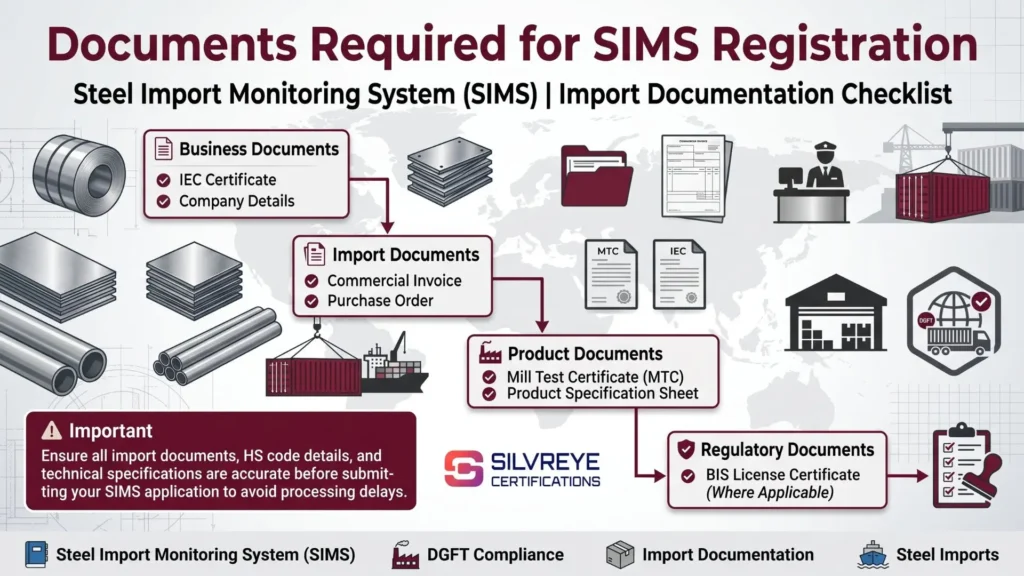
The document requirements carried over from SIMS 1.0 largely unchanged: your IEC certificate, commercial invoice, Mill Test Certificate, product specification sheet, and BIS certificate (where your product falls under an active Quality Control Order). SIMS 2.0 also requires a Digital Signature Certificate or Aadhaar-based OTP for signing the application.
How to Register on SIMS 2.0
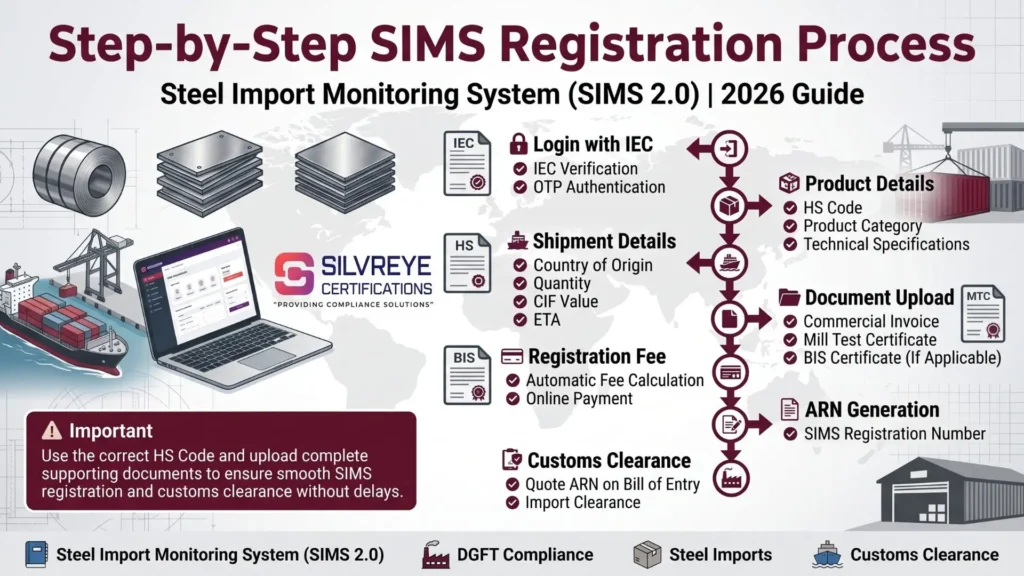
- Log in to the DGFT portal: Use your IEC credentials to access the integrated Import Management System.
- Navigate to Steel Import Monitoring System (SIMS): Found under Services → Import Management System on the DGFT portal.
- Fill in the simplified application: Complete the roughly 20-field form covering your business, product, and shipment details.
- Upload supporting documents: Attach your invoice, Mill Test Certificate, and BIS certificate if applicable.
- Digitally sign and pay: Authenticate with your DSC or Aadhaar OTP, then complete the fee payment.
- Receive your ARN instantly: The Automatic Registration Number is generated immediately and sent to your registered email.
SIMS 2.0 Registration Fees
| Fee Component | Detail |
| Rate | Re. 1 per ₹1,000 of the covered steel portion's CIF value |
| Minimum Fee | ₹500 per registration |
| Maximum Fee | ₹1,00,000 per registration |
| Refund Policy | Non-refundable, even if the shipment is delayed or cancelled |
SIMS 2.0 Validity and Renewal Timeline
- Validity: The Automatic Registration Number (ARN) generated through SIMS 2.0 is valid for 75 days from the date of registration — unchanged from SIMS 1.0.
- No renewal process: If the ARN lapses before your shipment arrives, you need to file a completely fresh registration; there's no extension option.
- Advance registration window (2026 update): As per the Ministry of Steel notice effective February 20, 2026, register 60 days before to 2–3 days before your shipment's expected arrival.
SARAL SIMS: The Newest Addition to the SIMS 2.0 Ecosystem
Launched on November 20, 2025, SARAL SIMS is a simplified registration path built within the broader SIMS 2.0 framework, specifically for MSMEs and export-linked importers. Instead of registering separately for every consignment, eligible importers can file a single annual registration covering multiple shipments — up to 10 MT per consignment and an annual cap of 1,000 MT (temporarily 500 MT through April 2026), with no quantity limit for export-linked imports through Advance Authorization, SEZ, or EOU routes.
SARAL SIMS is best understood as an evolution within SIMS 2.0 rather than a separate system — it uses the same underlying IEC-based login and DGFT infrastructure, just with a different registration frequency and scope.
Common Misunderstandings About SIMS 2.0
- SIMS 2.0 is an import license: It isn't. SIMS 2.0 is a mandatory pre-import registration system, not an approval or licensing mechanism — the import policy remains "free, but subject to compulsory registration."
- SIMS 1.0 still works: It doesn't. SIMS 1.0 was discontinued immediately when SIMS 2.0 launched on July 25, 2024; only old, previously submitted applications remain viewable on the DGFT website.
- SIMS 2.0 replaced BIS certification: It didn't. SIMS 2.0 and BIS certification are separate requirements — SIMS registration doesn't remove the need for BIS certification on products covered by an active Quality Control Order.
- The fee structure changed with SIMS 2.0: It hasn't. The Re. 1 per ₹1,000 fee formula, ₹500 minimum, and ₹1,00,000 maximum all carried over unchanged from SIMS 1.0.
What Happens If You Don't Register on SIMS 2.0
- Your Bill of Entry will not be accepted by customs without a valid SIMS 2.0 ARN.
- Shipment holds, demurrage, and storage charges accumulate during the resulting delay.
- Possible re-export or rejection of non-compliant consignments, along with financial penalties for non-compliance.
Conclusion
SIMS 2.0 is best understood as a genuine modernization of India's steel import registration system, not just a version-number update. The move from a 56-field form on the general DGFT website to a streamlined, roughly 20-field application on a dedicated portal has made day-to-day compliance noticeably easier, and the platform has continued evolving since launch — most notably with the addition of SARAL SIMS in late 2025. What hasn't changed is the fundamental purpose: every steel importer bringing in products under Chapters 72, 73, or 86 of the ITC(HS) still needs a valid, current SIMS registration before customs will clear their shipment. If you're new to steel importing or returning after a few years away, SIMS 2.0 at sims.steel.gov.in is where that registration now happens, start to finish.
Frequently Asked Questions
What is SIMS 2.0?
SIMS 2.0 is the upgraded version of India's Steel Import Monitoring System, launched by the Ministry of Steel and DGFT on July 25, 2024, replacing SIMS 1.0 with a dedicated portal, simplified application process, and better integration with other government systems.
When was SIMS 2.0 launched?
SIMS 2.0 was officially launched on July 25, 2024, at 2:00 PM, through DGFT Trade Notice No. 10/2024-25.
Is SIMS 1.0 still usable?
No. SIMS 1.0 was discontinued immediately when SIMS 2.0 launched. Previously submitted SIMS 1.0 applications remain viewable and downloadable on the DGFT website, but no new registrations can be filed on the old system.
What is the official website for SIMS 2.0?
SIMS 2.0 is accessed at https://sims.steel.gov.in, a dedicated portal separate from the general DGFT website that hosted SIMS 1.0.
What's different about SIMS 2.0 compared to SIMS 1.0?
SIMS 2.0 reduced the application from 56 fields to about 20, added API integration with other government portals, removed the separate NOC requirement for Non-QCO steel grades, and later became the platform for SARAL SIMS — while the core fee structure and 75-day ARN validity stayed the same.
Is SIMS 2.0 an import license?
No. SIMS 2.0 is a mandatory pre-import registration requirement, not a license or approval system. The import policy for covered steel remains "free, but subject to compulsory registration under SIMS."
Does SIMS 2.0 replace the need for BIS certification?
No. SIMS 2.0 registration and BIS certification are separate requirements. If your steel product falls under an active BIS Quality Control Order, you still need valid BIS certification in addition to your SIMS 2.0 registration.
How long is a SIMS 2.0 registration valid?
The Automatic Registration Number (ARN) generated through SIMS 2.0 is valid for 75 days from the date of registration, the same validity period used under SIMS 1.0.
What is SARAL SIMS and how does it relate to SIMS 2.0?
SARAL SIMS, launched November 20, 2025, is a simplified annual-registration option built within the SIMS 2.0 platform for eligible small and export-linked importers, letting them register once a year instead of per consignment.
Do I need a Digital Signature Certificate to use SIMS 2.0?
In most cases, yes. SIMS 2.0 requires digital authentication to sign and submit applications, using either a Digital Signature Certificate (DSC) or Aadhaar-based OTP linked to your IEC.
Did the SIMS registration fee change with the move to SIMS 2.0?
No. The fee structure — Re. 1 per ₹1,000 of CIF value, subject to a minimum of ₹500 and a maximum of ₹1,00,000 — carried over unchanged from SIMS 1.0 to SIMS 2.0.