
- Shampoos, conditioners, hair oils, hair dyes, hair serums, and styling products all need CDSCO registration before import or manufacture in India.
- Importers file Form COS-1 on the SUGAM portal to get the COS-2 Registration Certificate; the correct hair-care category must be picked from CDSCO's Fourth Schedule.
- Domestic hair-care manufacturers file Form COS-5 with their State Licensing Authority to obtain the COS-8 Manufacturing License after a GMP site inspection.
- Hair dyes and colourants face extra label scrutiny — patch-test warnings and full ingredient declaration are non-negotiable for approval.
Introduction
CDSCO cosmetic hair care product registration is the mandatory government approval required to import or manufacture shampoos, conditioners, hair oils, hair dyes, hair serums, and styling products for sale in India under the Drugs and Cosmetics Act, 1940 and the Cosmetics Rules, 2020. Importers submit Form COS-1 on CDSCO's SUGAM portal and receive the COS-2 Registration Certificate.
Domestic manufacturers file Form COS-5 with their State Licensing Authority and receive the COS-8 Manufacturing License after document review and a facility inspection. Hair-care products are mapped to specific categories under CDSCO's Fourth Schedule, and hair dyes carry additional labelling obligations such as a mandatory patch-test warning. Fees, documents, and validity differ between the import and manufacturing routes, so correct categorization and a compliance calendar are essential from day one.
What Is CDSCO Cosmetic Hair Care Product Registration?
CDSCO cosmetic hair care product registration is the regulatory clearance that lets a business legally import or manufacture hair-care products in India. For imported products, the Central Drugs Standard Control Organization grants a Registration Certificate (Form COS-2). For products made inside India, the relevant State Licensing Authority grants a Manufacturing License (Form COS-8). Both confirm that the shampoo, conditioner, hair oil, hair dye, or styling product meets the ingredient, safety, and labelling standards set out in the Cosmetics Rules, 2020.
Hair care is one of the highest-volume cosmetic segments imported into and manufactured within India, spanning everyday products (shampoo, conditioner, hair oil) as well as more tightly reviewed categories such as hair colourants, bleaches, and anti-hair-loss serums. Getting the category and claims right at the filing stage is the single biggest factor in how smoothly a hair-care registration moves through CDSCO or a State Licensing Authority.
Legal Framework Governing Hair Care Product Registration
- Drugs and Cosmetics Act, 1940 – Defines "cosmetic" under Section 3(aaa) and empowers CDSCO and State authorities to regulate manufacture, import, sale, and distribution.
- Cosmetics Rules, 2020 – Lays down the registration procedure, the Fourth Schedule product-category list (around 80 categories, including several hair-care sub-categories), the Seventh Schedule GMP requirements, and the Ninth Schedule quality/safety standards.
- SUGAM Portal – CDSCO's online filing system for both import registration and manufacturing-license applications; standard paper filings are no longer accepted.
- Bharatkosh Gateway – The government payment portal used for the prescribed registration and licensing fees.
Fee amounts, category numbers, and timelines are set by government notification and revised periodically. Always verify the current figures on the CDSCO SUGAM portal or with a registered regulatory consultant before filing.
Who Needs CDSCO Registration for Hair Care Products?
- Foreign hair-care brands (shampoo, conditioner, hair oil, hair color, styling ranges) entering India through an importer, Indian subsidiary, or authorized agent.
- Indian importers and distributors sourcing finished hair-care products from an overseas manufacturer.
- Indian manufacturers and contract manufacturers producing hair-care products domestically for local sale or export.
- Private-label and D2C hair-care brands using a third-party GMP facility under a loan-license arrangement.
- Salon-professional and keratin-treatment brands supplying to salons and professional channels in India.
A foreign manufacturer cannot file directly with CDSCO. The application must go through an authorized Indian agent, an Indian subsidiary of the manufacturer, or an Indian importer holding valid authorization.
Hair Care Product Category Table (CDSCO Classification)
Under the Fourth Schedule of the Cosmetics Rules, 2020, every cosmetic must be mapped to one of CDSCO's defined categories. Hair-care products span several distinct sub-categories, each with its own fee line, ingredient standard, and labelling checklist.
| Product Type | Typical Formats Covered | CDSCO Category Cluster | Applicable Form |
| Shampoos & conditioners | Rinse-off shampoos, conditioners, co-washes, scalp cleansers | Hair Care – Cleansing Products | COS-1 / COS-5 |
| Hair oils & serums | Coconut/herbal hair oils, leave-in hair serums, scalp oils | Hair Care – Hair Oils and Leave-on Products | COS-1 / COS-5 |
| Hair colourants & dyes | Permanent, semi-permanent, and temporary hair dyes; highlighting kits | Hair Care – Hair Colourants / Dyes | COS-1 / COS-5 |
| Hair bleaches & lighteners | Powder bleach, cream bleach, lightening kits | Hair Care – Bleaching Products | COS-1 / COS-5 |
| Styling products | Gels, waxes, mousses, hair sprays, creams, straightening balms | Hair Care – Styling Products | COS-1 / COS-5 |
| Anti-dandruff products | Anti-dandruff shampoos and scalp treatments (cosmetic claims only) | Hair Care – Anti-Dandruff | COS-1 / COS-5 |
| Anti-hair-loss / hair-growth products | Hair tonics, growth serums, scalp serums (cosmetic claims only) | Hair Care – Anti-Hair-Loss | COS-1 / COS-5 |
| Hair masks & deep-conditioning treatments | Hair masks, keratin/protein treatments, leave-in masks | Hair Care – Treatment Products | COS-1 / COS-5 |
| Hair-removal creams | Depilatory creams for scalp-adjacent or body hair removal | Hair Removal Products | COS-1 / COS-5 |
Products that only make cosmetic claims — cleansing, conditioning, colouring, styling, or improving appearance — stay within the cosmetics pathway. The moment a hair-care product claims to "treat," "cure," or "reverse" a medical condition such as alopecia or a scalp disease, it risks reclassification as a drug, which triggers an entirely different, more stringent licensing route outside the scope of cosmetic registration.
Two Registration Pathways: Import vs Manufacturing
There are two separate routes to legally sell a hair-care product in India:
- Import route (COS-1 → COS-2): for hair-care products manufactured outside India and imported for sale. Regulated centrally by CDSCO.
- Manufacturing route (COS-5 → COS-8): for hair-care products formulated, filled, or packed inside India. Regulated by the State Licensing Authority of the state where the facility is located.
COS-1 and COS-2 are not competing options — COS-1 is the application, COS-2 is the certificate it leads to. The same logic applies to COS-5 (application) and COS-8 (the manufacturing license itself).
Form COS-1: Cosmetic Import License Registration Application
What COS-1 Covers
Form COS-1 is the structured online application filed on the CDSCO SUGAM portal to register a hair-care product — and every variant, such as different shades in a hair-colour range or different fragrance/size variants of a shampoo — for import into India. It is filed by the manufacturer, an authorised Indian agent, an Indian subsidiary, or the Indian importer, addressed to the Central Licensing Authority i.e. the Drugs Controller General (India).
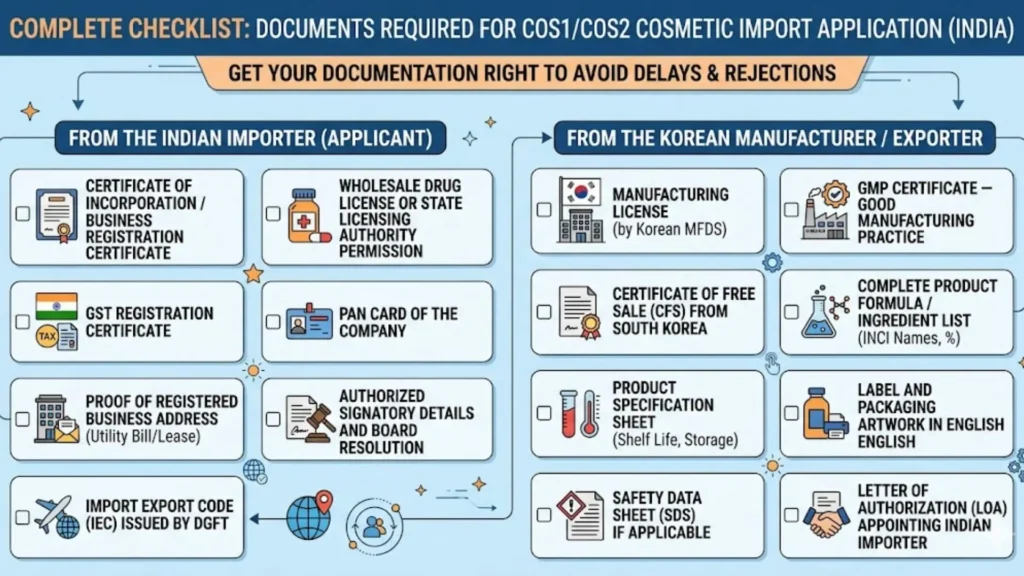
Documents Required for COS-1
- Covering letter stating the purpose (fresh application, endorsement, or re-registration)
- Duly filled, signed, and stamped Form COS-1
- Authorization from the manufacturer to the Indian agent, apostilled or authenticated by the Indian Embassy or a First Class Magistrate
- Free Sale Certificate confirming the product is freely sold in the country of origin
- Complete list of ingredients / composition with percentages, signed by the manufacturer (critical for hair dyes and bleaches)
- Product labels compliant with the Cosmetics Rules, 2020 labelling schedule, including patch-test warnings for hair dyes
- Correlation chart mapping each hair-care SKU in COS-1 to the Free Sale Certificate and Authorization letter
- Undertaking confirming compliance with the Cosmetics Rules, 2020
- Proof of fee payment through the Bharatkosh gateway
Step-by-Step COS-1 Filing Process
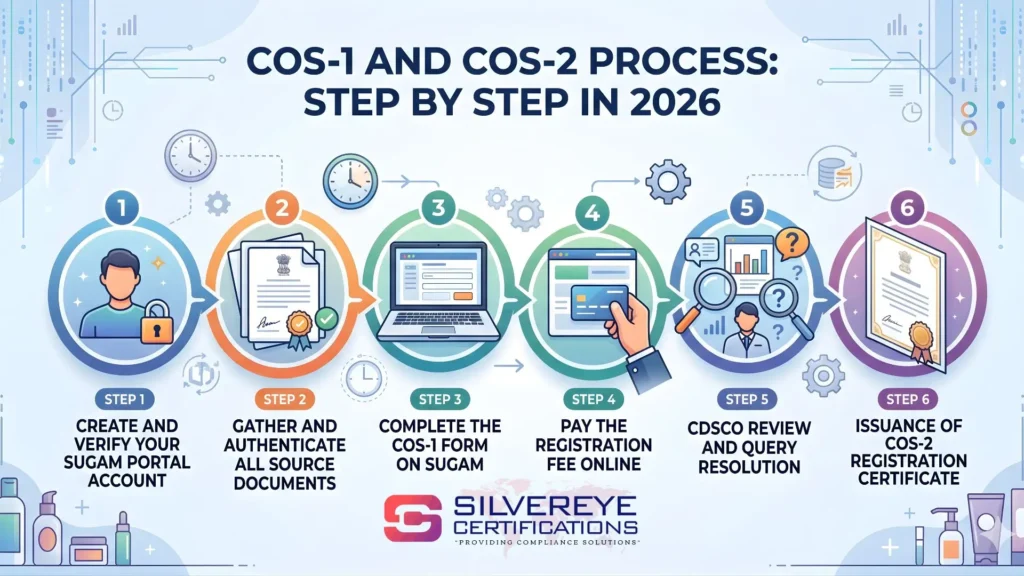
- Register on the CDSCO SUGAM portal and create login credentials with a valid email and mobile number.
- Map every hair-care SKU to the correct Fourth Schedule category — shampoo, hair oil, dye, styling, or treatment categories each have distinct requirements.
- Compile the Free Sale Certificate, ingredient list, labels, and manufacturer authorization for each product line.
- Fill and submit Form COS-1 on SUGAM with all supporting documents and pay the prescribed fee via Bharatkosh.
- Track the SUGAM dashboard and respond to any CDSCO queries or discrepancy notices within the stipulated time.
- Receive the COS-2 Registration Certificate once CDSCO is satisfied with the application.
- Print the RC (Registration Certificate) number on every hair-care product label before the first shipment clears Indian customs.
Form COS-2: Grant of Cosmetic Import Registration Certificate
COS-2 is the actual Registration Certificate — the government-issued document authorizing the import and sale of a specific hair-care product (and its listed variants) in India. It is granted by the Central Licensing Authority once the COS-1 application, documents, and fee are found satisfactory.
A COS-2 certificate typically lists the registration number, the registered manufacturer and Indian agent/importer details, the manufacturing site, and the approved products and shade/variant list. Under Rule 13 of the Cosmetics Rules, 2020, a COS-2 Registration Certificate remains valid in perpetuity, subject to timely payment of the prescribed registration retention fee before completion of the validity period stated on the certificate — commonly tracked on a 5-year cycle in line with CDSCO's broader retention-fee framework. Because certificate terms can vary, always confirm the exact validity and renewal date printed on your own COS-2 certificate.
Once a hair-care brand holds a COS-2 certificate, other importers can bring in the same registered product line by filing a simpler application (Form COS-4) for an Import Registration Number (Form COS-4A), backed by an undertaking from the original registration holder — useful for multi-distributor hair-care brands sold through several importers.
Form COS-5: Cosmetic Manufacture License Registration Application
Form COS-5 is the application a domestic manufacturer files with the State Licensing Authority to obtain permission to manufacture hair-care products at an Indian facility, for domestic sale or export. In short: COS-5 is the application, and COS-8 is the license it leads to.
Eligibility and Technical Staff Requirements
Every applicant must have qualified technical staff overseeing manufacturing and quality operations for hair-care production. Recognised qualifications include:
- Diploma in Pharmacy approved by the Pharmacy Council of India under the Pharmacy Act, 1948
- Registration under the Pharmacy Act, 1948
- Pass in the Intermediate Examination with Chemistry as a subject, or an equivalent examination recognized by the Licensing Authority
- Bachelor's degree in Cosmetic Technology from a recognized university
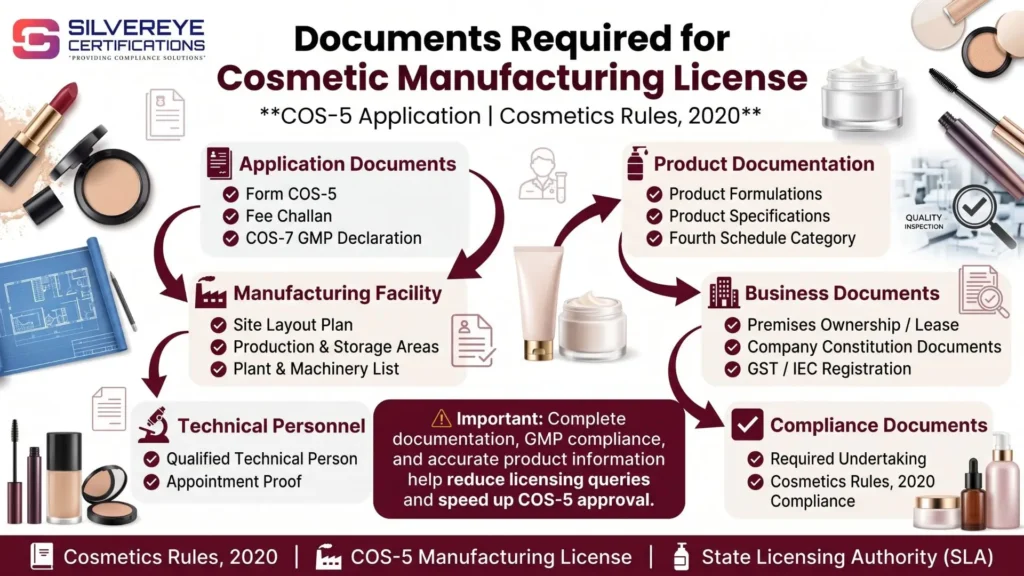
Documents Required for COS-5
- Cover letter stating the nature of the application
- Manufacturing site details and Site Master File
- Plant layout and list of equipment/machinery used for hair-care mixing, filling, and packing lines
- List of cosmetic products (hair-care SKUs and variants) proposed to be manufactured
- Proof of qualified technical staff with educational and experience certificates
- Self-declaration of GMP compliance in Form COS-7, referencing the Seventh Schedule
- Undertaking of product compliance with the Cosmetics Rules, 2020
- Constitution documents of the firm (incorporation certificate, partnership deed, UDYAM registration, etc.)
- Pollution Control Board approval/NOC, particularly relevant for hair-dye and bleach manufacturing units
- Fee payment receipt
Step-by-Step COS-5 Filing Process
- Register on the CDSCO SUGAM portal and select the cosmetic manufacturing license application.
- Prepare the Site Master File, plant layout, equipment list, and technical staff qualification proof.
- Complete the Form COS-7 self-declaration confirming GMP compliance under the Seventh Schedule.
- Submit Form COS-5 with all supporting documents and the prescribed fee to the State Licensing Authority.
- Respond to any document queries raised by the State Licensing Authority.
- Receive the COS-8 Manufacturing License once the application is verified and approved.

Form COS-8: Grant of Cosmetic Manufacturing License
COS-8 is the manufacturing license itself — the legal permit authorising a facility to manufacture hair-care products for sale or distribution in India (COS-9 is the equivalent license for a loan-license arrangement, where the applicant uses another company's approved premises).
- The State Licensing Authority must grant COS-8 within 45 days of completing document scrutiny and verification.
- Within 30 days of granting the license, the State Licensing Authority inspects the manufacturing premises to verify the information If the self-declaration is found false, the license can be cancelled; if correctable gaps are found, manufacturing is paused until they are resolved.
- If the State Licensing Authority does not inspect within 30 days, the license remains valid for all purposes in the meantime.
- Every licensed facility is subject to inspection at least once every three years going forward.
- The licensee must upload a copy of the COS-8 license to the CDSCO website for public record before production begins.
A COS-8 manufacturing license remains valid indefinitely unless suspended or cancelled by the State Licensing Authority, provided the manufacturer pays the prescribed license or loan-licese retention fee before completing five years from the date of issue. If the retention fee is missed, it can still be paid within a 180-day grace window, with a late fee of about 2% per month applied on the outstanding amount.
CDSCO Hair Care Registration Fees (Import & Manufacturing)
| License Stage | Fee Head | Approximate Fee | Paid Via |
| Import registration (COS-1 → COS-2) | Registration fee per cosmetic category per brand | ≈ USD 2,000 (or INR equivalent) per category, plus smaller charges per additional shade/variant | Bharatkosh gateway |
| Import registration – multiple manufacturing sites | Additional fee per extra manufacturing site for the same product | ≈ USD 500 per additional site | Bharatkosh gateway |
| Manufacturing license (COS-5 → COS-8) | Grant or retention fee per category of cosmetics (up to 10 products) | ≈ INR 10,000 per category | SUGAM / Bharatkosh, payable to State Licensing Authority |
| Manufacturing – additional product | Fee for each additional cosmetic item beyond 10 in a category | ≈ INR 500 per additional item | SUGAM / Bharatkosh |
| Manufacturing license retention | Payable before completion of every 5-year cycle to keep COS-8 active | As per prescribed schedule; late fee ≈ 2% per month within the 180-day grace window | SUGAM / Bharatkosh |
These figures reflect commonly cited 2026 fee levels for cosmetic registration and manufacturing licensing. Government fee heads are revised by notification, so confirm the exact current amount on the CDSCO SUGAM portal or Bharatkosh before submitting payment.
Validity and Renewal of Hair Care Product Registration & License
| Certificate/License | Validity | Renewal / Retention Requirement | Issuing Authority |
| COS-2 (Import Registration Certificate) | Valid in perpetuity, subject to the validity terms and retention fee stated on the certificate | Pay the prescribed retention fee before the certificate's stated validity period lapses; confirm the exact renewal date on your certificate | CDSCO (Central Licensing Authority) |
| COS-4A (Import Registration Number for an already-registered cosmetic) | 3 years from date of issue | Fresh application before expiry, unless suspended or cancelled earlier | CDSCO |
| COS-8 (Manufacturing License) | Valid indefinitely unless suspended or cancelled | Retention fee due before completing every 5-year cycle; 180-day grace period with ~2% monthly late fee | State Licensing Authority |
| COS-9 (Loan License) | Valid indefinitely unless suspended or cancelled | Same 5-year retention-fee cycle as COS-8 | State Licensing Authority |
Processing Timeline For Cosmetic Hair Care Products
| Stage | Typical Timeline | Notes |
| COS-1 filing to COS-2 grant (import) | Roughly 60–90 days from a complete filing; can extend to several months for hair-dye and bleach ranges if ingredient queries arise | Hair-colourant SKUs draw closer ingredient scrutiny than shampoos or oils |
| Site inspection window (manufacturing) | Within 30 days of COS-8 grant | Verifies the Form COS-7 self-declaration on-site, including effluent/wastewater handling for dye and bleach lines |
| COS-5 filing to COS-8 grant (manufacturing) | Up to 45 days after document verification is complete | Additional time needed if the Site Master File, Pollution Control Board NOC, or technical-staff proof needs correction |
Labelling Requirements for Hair Care Products
Every hair-care product sold in India — imported or domestically manufactured — must carry a compliant label:
- Product name and brand name
- Full name and address of the manufacturer, and of the importer/marketer for imported products
- Registration Certificate number (COS-2 RC No.) for imports, or the Manufacturing License number for domestic products
- Batch or lot number, manufacturing date, and best-before/use-by date where applicable
- Net quantity of contents
- Complete list of ingredients in descending order of weight (for packs above the small-pack exemption threshold)
- Directions for use and relevant precautions — mandatory for hair dyes, bleaches, and relaxers
- Patch-test warning and "external use only" caution specifically for hair dyes and colourants
- No drug-like or therapeutic claims (avoid claiming to "cure" hair loss, dandruff as a disease, or scalp disorders)
Very small packs (typically under 30 g or 60 ml, such as sachet shampoos and trial-size hair oils) are allowed reduced label details under the Cosmetics Rules, 2020 — confirm the exact exemption applicable to your pack size before finalising artwork.
Benefits of CDSCO Registration for Hair Care Brands
- Legal market access — Registered hair-care products clear Indian customs and can be sold through retail, modern trade, salons, and e-commerce without seizure risk.
- Consumer and retailer trust — A valid RC number or manufacturing license number on the label signals regulatory legitimacy to marketplaces, salons, and buyers.
- Marketplace eligibility — Most e-commerce platforms and organized retail chains require proof of CDSCO registration before listing a hair-care brand.
- Business continuity — Avoids the disruption, stock seizure, and reputational damage that follow enforcement action against unregistered cosmetics.
- Category headroom — Once a base registration or manufacturing license is in place, adding new shampoo, oil, or shade variants is generally a faster endorsement process.
Common Mistakes That Delay Hair Care Registration
- Mis-categorising a hair-care product under the wrong Fourth Schedule cluster (for example, filing a leave-in hair serum under a generic skin-care category).
- Submitting a Free Sale Certificate or manufacturer authorisation that is not properly apostilled or embassy-authenticated.
- Ingredient lists or labels that don't match the underlying formulation percentages submitted with COS-1 — a frequent issue with multi-shade hair-colour ranges.
- Missing the mandatory patch-test warning or ingredient disclosure required for hair dyes and bleaches.
- Marketing anti-hair-loss or anti-dandruff products with therapeutic or disease-related claims, which risks reclassification as a drug.
- Listing an over-ambitious first product catalogue instead of starting lean and adding variants after the initial COS-2 or COS-8 approval.
- Weak GMP documentation ahead of a State Licensing Authority site inspection, especially wastewater handling for dye/bleach manufacturing.
- Missing the retention-fee payment window for an existing COS-2 or COS-8, risking suspension of an otherwise valid registration.
Penalties for Non-Compliance for Hair Care Products
Importing, manufacturing, selling, or distributing hair-care products without valid CDSCO registration or a State manufacturing license is a violation of the Drugs and Cosmetics Act, 1940. Consequences can include seizure of stock at customs or at the point of sale, suspension or cancellation of any related licenses, mandatory product recall, and prosecution under the Act's penal provisions. CDSCO also retains the authority to suspend or cancel an existing COS-2 or COS-8 if a licensee is found violating the conditions of registration.
Conclusion
CDSCO cosmetic hair care product registration is a one-time regulatory investment that keeps your import shipments moving through customs, keeps your manufacturing line legally compliant, and keeps your shampoos, oils, dyes, and styling products eligible for retail, salon, and e-commerce listings across India. Whether your route is COS-1 to COS-2 for imported hair-care products or COS-5 to COS-8 for domestic manufacturing, the fastest path to approval is accurate category mapping, complete and consistent documentation, careful claim wording — especially for hair dyes and anti-hair-loss products — and a compliance calendar that tracks every retention-fee and renewal date well before it falls due.
Frequently Asked Questions
What CDSCO category do hair care products fall under?
Hair-care products are grouped under several Fourth Schedule clusters depending on function — cleansing (shampoos/conditioners), hair oils and leave-on products, hair colourants and bleaches, styling products, anti-dandruff, anti-hair-loss, and treatment/mask products.
Do I need CDSCO registration to import shampoo or hair oil into India?
Yes. No cosmetic, including shampoos, conditioners, and hair oils, can be legally imported into India without a valid Registration Certificate (COS-2) issued by CDSCO under Rule 12(1) of the Cosmetics Rules, 2020.
What is the difference between COS-1 and COS-2?
COS-1 is the online application filed on the SUGAM portal to seek import registration. COS-2 is the Registration Certificate CDSCO issues once that COS-1 application is reviewed and approved. They are two stages of one process, not two separate license types.
What is the difference between COS-5 and COS-8?
COS-5 is the application a manufacturer files with the State Licensing Authority to get a manufacturing license. COS-8 is the manufacturing license itself, granted after document review and a facility inspection.
Are hair dyes regulated differently from shampoos or conditioners?
All fall under the cosmetics framework, but hair dyes and bleaches face closer scrutiny of ingredient declarations and must carry a mandatory patch-test warning and clear directions for use, since certain colourant ingredients carry sensitisation risk.
How long does COS-1 to COS-2 approval take for a hair-care brand?
A complete, correctly categorised filing typically takes around 60 to 90 days. Hair-colourant and bleach SKUs can take longer if CDSCO raises ingredient or label queries.
How long does COS-5 to COS-8 approval take?
The State Licensing Authority is required to grant the manufacturing license within 45 days of completing document verification, followed by a site inspection within 30 days of the license being issued.
What is the validity of a COS-2 Registration Certificate?
Under Rule 13 of the Cosmetics Rules, 2020, a COS-2 certificate is valid in perpetuity, subject to payment of the prescribed retention fee before the validity period stated on the certificate lapses. Always check the specific date printed on your certificate.
What is the validity of a COS-8 Manufacturing License?
COS-8 remains valid indefinitely unless suspended or cancelled by the State Licensing Authority, provided the manufacturer pays the retention fee before completing every 5-year cycle, with a 180-day grace period available at a late fee.
Can a foreign hair-care brand apply directly to CDSCO for registration?
No. A foreign manufacturer must appoint an authorised Indian agent, route the application through its Indian subsidiary, or work through an Indian importer holding valid authorisation to file Form COS-1.
Can I market an anti-hair-loss serum with a claim that it "cures baldness"?
No. Therapeutic or disease-related claims (curing, treating, or reversing a medical condition) push a product out of the cosmetics pathway into the drug pathway, which requires an entirely separate and more stringent licence.
What happens if I sell hair-care products in India without CDSCO registration?
Unregistered hair-care products can be seized at customs or at the point of sale, and the business can face licence cancellation, mandatory recall, and prosecution under the Drugs and Cosmetics Act, 1940.