
- All urological medical devices sold or manufactured in India require CDSCO registration under MDR 2017.
- Devices are classified as Class A, B, C, or D based on risk — from basic incontinence aids to implantable prostheses.
- Importers apply via MD-14 (application) and receive MD-15 (import license); manufacturers use MD-3/MD-5 (Class A/B) or MD-7/MD-9 (Class C/D).
- Wholesale dealers need MD-41 (application) and MD-42 (wholesale license) — valid for 5 years, renewable 30 days before expiry.
Introduction
CDSCO registration for urological medical devices in India is mandatory under the Medical Devices Rules (MDR), 2017. Urological devices are classified into Class A (low risk), Class B (moderate risk), Class C (moderate-high risk), and Class D (high risk). Importers require an import license via MD-14/MD-15 application. Manufacturers of Class A/B devices apply via MD-3 and receive MD-5 license.
Class C/D manufacturers apply via MD-7 and receive MD-9 license. Wholesale dealers apply through MD-41 for MD-42 license. This guide covers the entire CDSCO registration process, documents, fees, timelines, and device classification for 2026
What Is CDSCO and Why Does It Regulate Urological Medical Devices?
The Central Drugs Standard Control Organisation (CDSCO) is India's national regulatory authority for medical devices, drugs, and cosmetics. It operates under the Directorate General of Health Services (DGHS), Ministry of Health and Family Welfare. CDSCO enforces the Drugs and Cosmetics Act, 1940 and the Medical Devices Rules (MDR), 2017 to ensure that every medical device available in India is safe, effective, and of acceptable quality.
Urological medical devices — from simple incontinence pads to implantable penile prostheses and laser lithotripsy systems — directly interact with patients' urinary tract, kidneys, and reproductive organs. Given the direct patient contact and risk of infection, obstruction, or organ damage, CDSCO mandates that all urological devices be registered before they can be legally imported, manufactured, or sold in India.
Starting January 1, 2026, all notified medical devices must have a valid CDSCO license. Non-compliant manufacturers or importers face product seizure, penalties, and legal action under the Drugs and Cosmetics Act.
CDSCO Classification of Urological Medical Devices (Class A, B, C & D)
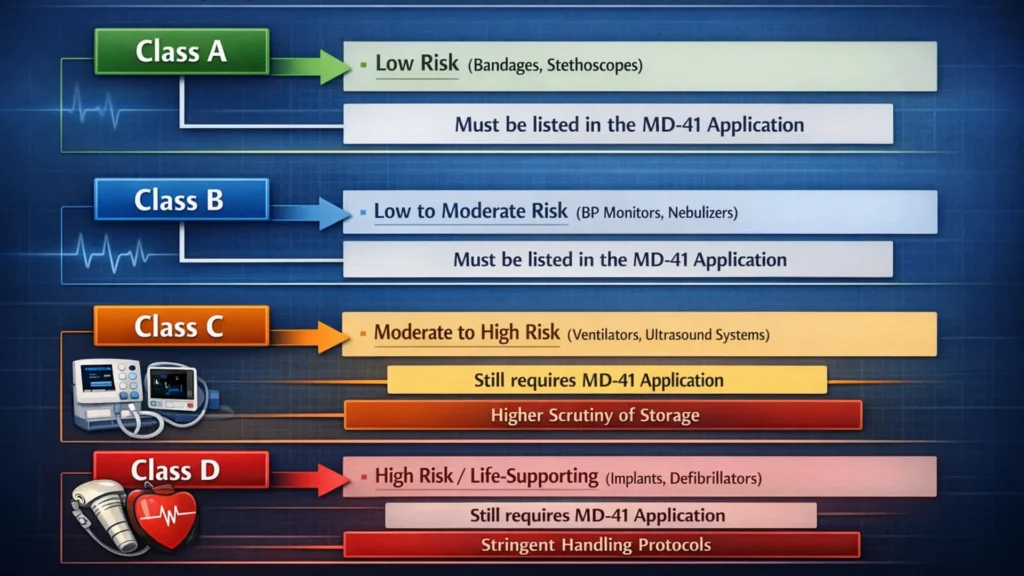
Under MDR 2017, medical devices are classified into four risk-based categories. Understanding the correct class for your urological device is the first step in the CDSCO registration process, as it determines the application form, fee, and regulatory scrutiny involved.
| Class | Risk Level | Examples (Urological) | License Type |
| A | Low Risk | Incontinence pads, urine collection bags, hand-held urinals | MD-5 (Mfr) / MD-15 (Import) |
| B | Moderate Risk | Cystoscopes, urethral catheters, lithotripsy probes, urodynamic systems | MD-5 (Mfr) / MD-15 (Import) |
| C | Moderate-High Risk | Urethral stents, extracorporeal lithotripsy systems, inflatable penile prostheses | MD-9 (Mfr) / MD-15 (Import) |
| D | High Risk | No urological devices listed in current classification (Class D typically includes life-sustaining implants) | MD-9 (Mfr) / MD-15 (Import) |
Class A Urological Medical Devices
Class A urological devices are low-risk, typically non-invasive products used externally or for basic collection purposes. They do not directly interact with internal organs and carry minimal clinical risk.
| S.No. | Device Name | Intended Use / Description |
| 1 | Bladder Neck Spreader | Moveable blades to separate and spread the bladder neck (reusable) |
| 2 | Closed-Ended Wearable Urine Collection Bag (Non-Sterile) | Flexible plastic pouch connected to urinary catheter; strapped to leg; no drainage opening |
| 3 | Closed-Ended Wearable Urine Collection Bag (Sterile) | Same as above, supplied sterile |
| 4 | Diaphragm Wearable Urinal | Male incontinence drainage device with scrotal support and diaphragm; connects to leg bag |
| 5 | Draping Incontinence Liner | Padded sheet to cover furniture/devices for incontinent persons |
| 6 | Drip Wearable Urinal | Male incontinence device with tubular sheath over penis to collect dribbling urine |
| 7 | Female Wearable Urinal, Reusable | Flexible collector fitting female genitals, channels urine via tube into collection bag |
| 8 | Hand-Held Urinal, Female | Portable container for direct urination by bed-bound female patients |
| 9 | Hand-Held Urinal, Male (Reusable) | Portable container for direct urination by bed-bound male patients |
| 10 | Home Faecal Specimen Collection Kit | Non-sterile devices for layperson faecal sample collection and mailing to lab |
| 11 | Incontinence Device Suspender | Secures body-worn incontinence device in stable position for persons with disability |
| 12 | Incontinence Pants Liner | Disposable absorbent pad worn inside incontinence pants (single-use) |
| 13 | Incontinence Pants, Reusable | Underwear designed to retain urine leakage in incontinent adults and older children |
| 14 | Incontinence Penis Clamp, Reusable | Gently compresses penis to occlude urethra and prevent involuntary urination in men |
| 15 | Penis/Scrotum Wearable Urinal | Cone-shaped front piece containing penis and scrotum; leak-proof seal for retracted penis |
| 16 | Urethral/Suprapubic Catheter Valve-Connector | Small valve connected to catheter for intermittent bladder drainage/filling |
| 17 | Urinary-Incontinence Vaginal Insert, Reusable | Inserted into vagina to relieve mixed/stress urinary incontinence via urethral support |
Class B Urological Medical Devices
Class B urological devices carry moderate risk. This category includes endoscopes, catheters, lithotripsy systems, and diagnostic urodynamic equipment that interact with internal body systems but are generally not permanently implanted.
| S.No. | Device Name | Intended Use / Description |
| 1 | Biliary/Urinary Stone Retrieval Basket (Reusable) | Flexible instrument to remove biliary/urinary stones during endoscopic procedure |
| 2 | Bladder-Emptying Vibratory Stimulator | Hand-held battery-powered device applying vibrations to abdomen to initiate urination |
| 3 | Cystometer | Measures bladder pressure and volume for neuromuscular diagnostic evaluation |
| 4 | Cystometer Probe, Ultrasonic | Ultrasound-emitting probe to study bladder capacity, sensation, pressure, residual urine |
| 5 | Cystoscopic Electrode | Sterile conductor placed in bladder to stimulate and/or record electrical activity |
| 6 | Electrohydraulic Lithotripsy System | Uses plasma-induced shock waves for intracorporeal fragmentation of kidney/ureter/bladder stones |
| 7 | Electrohydraulic/Pneumatic Lithotripsy System Probe, Urinary (Single-Use) | Sterile rod transmitting shock waves from electrohydraulic or pneumatic source to calculi |
| 8 | Electromechanical Lithotripsy System, Intracorporeal | Creates shock waves by electromechanical action for intracorporeal calculi fragmentation |
| 9 | Fibreoptic Ureteral Catheter, Reusable | Fibreoptic bundle tube inserted into ureter for illumination and irrigation |
| 10 | Filiform Urethral Bougie | Wire-like instrument for traversing urethral strictures and/or dilating the urethra |
| 11 | Flexible Endoscopic Stone-Retrieval Forceps, Reusable | Flexible device through endoscope working channel to grasp/remove stones or foreign bodies |
| 12 | Flexible Fibreoptic Cystonephroscope | Flexible endoscope for visual examination/treatment of bladder, urethra, and kidneys |
| 13 | Flexible Fibreoptic Cystoscope | Flexible endoscope for visual examination and treatment of bladder and urinary tract |
| 14 | Flexible Fibreoptic Cystourethroscope | Flexible endoscope for bladder and urethra including prostate region examination/treatment |
| 15 | Flexible Fibreoptic Nephroscope | Flexible endoscope percutaneously inserted for examination/treatment of the kidney |
| 16 | Flexible Fibreoptic Ureterorenoscope | Flexible endoscope for examination/treatment of ureter and renal pelvis |
| 17 | Flexible Fibreoptic Ureteroscope | Flexible endoscope for examination/treatment of the ureter (upper urinary tract) |
| 18 | Flexible Fibreoptic Urethroscope | Flexible endoscope for examination/treatment of the urethra |
| 19 | Flexible Ureteral Sheath/Fibreoptic Telescope | Sterile flexible endoscope assembly for ureter-accessed body cavity examination/treatment |
| 20 | Flexible Video Cystonephroscope | Flexible video endoscope for bladder, urethra (prostate), and kidneys |
| 21 | Flexible Video Cystoscope, Reusable | Flexible video endoscope introduced via urethra for bladder/urinary tract examination/treatment |
| 22 | Flexible Video Cystourethroscope | Flexible video endoscope for bladder and urethra including prostate region |
| 23 | Flexible Video Nephroscope | Flexible video endoscope for examination/treatment of the kidney |
| 24 | Flexible Video Ureterorenoscope, Reusable | Flexible video endoscope for ureter and renal pelvis examination/treatment |
| 25 | Flexible Video Ureteroscope, Reusable | Flexible video endoscope for ureter examination/treatment |
| 26 | Flexible Video Urethroscope | Flexible video endoscope for urethra examination/treatment |
| 27 | General-Purpose Ureteral Catheter | Flexible tube introduced into ureters through cystoscope or nephroscope |
| 28 | Hand Pneumatic Lithotripsy System, Urinary | Operator-held pneumatic device creating ballistic shock waves for intracorporeal stone fragmentation |
| 29 | Hepatic Function Analysis System | AC-powered device for quantitative liver function assessment via ICG clearance measurement |
| 30 | Hydraulic Male Urinary Incontinence Treatment System – Port | Implantable component providing access to system's inflatable pad for fluid introduction/removal |
| 31 | Incontinence Sensor/Alarm | Electronic device providing audible/visible/tactile signal when urine/faeces incontinently released |
| 32 | Intermittent Urethral Catheterization Kit (Non-Sterile) | Collection of non-sterile devices including urological catheter for self-urinary catheterization |
| 33 | Intermittent Urethral Catheterization Kit (Sterile) | Collection of sterile devices including urological catheter for self-urinary catheterization |
| 34 | Intermittent Urethral Drainage Catheter, Antimicrobial | Sterile tube repeatedly inserted through urethra for episodic urine drainage (self-applied) |
| 35 | Intermittent Urethral Drainage Catheter (Non-Sterile) | Non-sterile tube repeatedly inserted through urethra for episodic urine drainage (self-applied) |
| 36 | Intermittent Urethral Drainage Catheter (Sterile) | Sterile flexible or rigid tube for episodic urine drainage via self-catheterization |
| 37 | Intracorporeal Lithotripsy Suction System | Assembly for evacuating by suction irrigation fluid with calculi fragments during lithotripsy |
| 38 | Intraurethral Valve/Pump | Sterile non-powered device inserted in female urethra to facilitate voiding in IDC patients |
| 39 | Lithotrite | Hand-held manual surgical instrument for mechanical crushing of renal stones |
| 40 | Male Urinary Outflow Analysis System | AC-powered assembly measuring urine flow rate and estimating isovolumetric bladder pressure |
| 41 | Male Urinary Outflow Analysis System Cuff | Non-sterile inflatable cuff component of male urinary outflow analysis system |
| 42 | Manometric Catheter Sheath | Synthetic polymer sleeve to cover/protect manometric catheter from contamination |
| 43 | Penile Extracorporeal Shock Wave Therapy System | Mobile assembly delivering low-intensity shock waves to treat erectile dysfunction |
| 44 | Penile Extracorporeal Shock Wave Therapy System Applicator | Hand-held device transmitting shock waves to penile shaft/crura for ED treatment |
| 45 | Penis Wearable Urinal | Externally worn device over penis channelling urine via tube into collection bag |
| 46 | Pyeloscope | Rigid endoscope for visual examination/treatment of renal pelvis and calyces |
| 47 | Rigid Cystoscope | Rigid endoscope for visual examination and treatment of bladder and urinary tract |
| 48 | Rigid Cystourethroscope | Rigid endoscope for bladder and urethra including prostate region examination/treatment |
| 49 | Rigid Nephroscope | Rigid endoscope for visual examination and treatment of the kidney |
| 50 | Rigid Ureterorenoscope | Rigid/semi-rigid endoscope (may have flexible tip) for ureter and renal pelvis |
| 51 | Rigid Ureteroscope | Rigid endoscope for examination/treatment of the ureter |
| 52 | Rigid Urethroscope | Rigid endoscope for examination/treatment of the urethra |
| 53 | Rigid Video Ureterorenoscope | Sterile rigid/semi-rigid video endoscope for ureter and renal pelvis examination/treatment |
| 54 | Spark-Gap Lithotripsy System | Non-invasive device disintegrating stones via focused shock waves from spark-gap generator |
| 55 | Suprapubic Needle, Surgical (Reusable) | Hand-held instrument percutaneously puncturing lower abdominal wall for suprapubic surgical access |
| 56 | Temperature-Monitoring Indwelling Urethral Drainage Catheter | Sterile long-term Foley-type catheter with integral temperature sensor for core body temp monitoring |
| 57 | Transobturator Needle, Reusable | Hand-held instrument for transobturator puncture in surgical sling positioning for SUI treatment |
| 58 | Transvaginal Needle, Surgical | Hand-held instrument creating vaginal wall puncture for surgical sling positioning (SUI treatment) |
| 59 | Ultrasonic Lithotripsy System | Uses ultrasonic shock waves for intracorporeal fragmentation of kidney/ureter/bladder stones |
| 60 | Ureteral Patency Kit | Device collection for treating blocked ureter and maintaining ureteral patency |
| 61 | Urethral Drainage Catheter Punch | Hand-held instrument cutting small hole in Foley catheter to form Council-tip catheter |
| 62 | Urodynamic Measurement System | Advanced diagnostic assembly for bladder study: voiding cause, incontinence, neurogenic bladder |
Class C Urological Medical Devices
Class C urological devices are moderate-to-high risk. They include implantable devices, extracorporeal shock wave lithotripsy systems, microwave ablation catheters, and laser lithotripsy systems. These require more rigorous clinical and technical documentation.
| S.No. | Device Name | Intended Use / Description |
| 1 | Bare-Metal Urethral Stent, Short-Term | Non-bioabsorbable tubular stent placed short-term (≤30 days) in urethra to relieve LUTS/BPH |
| 2 | Electromechanical Lithotripsy System, Extracorporeal | Non-invasive device disintegrating stones via focused shock waves produced by electromechanical generator outside body |
| 3 | Hydraulic Male Urinary Incontinence Treatment System | Implantable assembly applying pressure to occlude bladder neck/urethra to treat male urinary incontinence |
| 4 | Hydraulic Male Urinary Incontinence Treatment System Port | Implantable port for accessing the system's inflatable pad for fluid introduction/removal |
| 5 | Hydraulic Male Urinary Incontinence Treatment System Tubing | Implantable silicone-and-metal tube connecting inflatable pad to system port |
| 6 | Hydraulic Male Urinary Incontinence Treatment System Tubing Plug | Implantable metal plug sealing system tubing to prevent leakage when fluid exchange not needed |
| 7 | Inflatable Penile Prosthesis | Surgically implanted interconnected device for selective penile tumescence/rigidity in erectile dysfunction |
| 8 | Laser Lithotripsy Fibre/Suction Guide | Sterile device inserted through rigid nephroscope during laser lithotripsy as laser fibre channel and debris removal channel |
| 9 | Laser Lithotripsy System | Assembly of specialized ureteroscope, laser-resistant catheter, and laser for intracorporeal ureteral stone disintegration |
| 10 | Microwave Hyperthermia System Catheter, Prostatic-Ablation (Reusable) | Thin rod used with hyperthermia system treating prostate disorders (cancer, BPH, prostatitis) via microwave heat |
| 11 | Perineal Orifice Incontinence-Control Electrical Stimulation System, Remote Control | Battery-powered remote-controlled intravaginal device treating urinary incontinence/pelvic problems via pelvic floor electrical stimulation |
| 12 | Piezoelectric Lithotripsy System | Non-invasive device disintegrating stones via focused shock waves produced by piezoelectric generator outside body |
Class D Urological Medical Devices
As per the current CDSCO classification list for urological medical devices (MD-53 to MD-62 schedule), no urological devices from the provided product list fall under Class D. Class D is reserved for the highest-risk devices such as active implantable devices for life-sustaining support. If you believe your device may fall in this category, consult CDSCO directly for classification guidance before applying.
Who Needs CDSCO Registration for Urological Medical Devices?
The following entities must obtain a CDSCO license before dealing in urological medical devices in India:
- Manufacturers (Indian): Any company or individual manufacturing urological medical devices in India for domestic sale or export must register with CDSCO and obtain the relevant state or central manufacturing license.
- Importers: Any company or individual importing urological medical devices into India from a foreign manufacturer must obtain a central CDSCO import license (MD-15) before clearing goods at the port.
- Wholesale Dealers: Entities selling urological medical devices to hospitals, clinics, distributors, or retailers must obtain a wholesale license (MD-42) from the State Licensing Authority.
- Contract Manufacturers / Loan Licensees: Those manufacturing under another brand's license also need to comply with CDSCO requirements and be listed under the principal license.
MD-14 Application and MD-15 Import License for Urological Medical Devices
If you are looking to import urological medical devices into India — whether cystoscopes, urethral catheters, lithotripsy systems, or incontinence management devices — you need to apply for an import license through the Central Drugs Standard Control Organisation (CDSCO) headquarters in New Delhi.
What Is MD-14?
MD-14 is the application form used by importers to apply for a license to import medical devices into India. It is submitted to the Central Licensing Authority (CLA), which is CDSCO at the central level. MD-14 is used for both new import license applications and for adding new devices to an existing import license.
What Is MD-15?
MD-15 is the grant of license for import of medical devices. Once CDSCO reviews and approves the MD-14 application along with all required documents, the import license in MD-15 format is issued to the applicant. This license must be renewed every 5 years.
Eligibility for Import License (MD-14/MD-15)
- The applicant must be an Indian company, LLP, proprietorship, or authorized agent of a foreign manufacturer.
- The foreign manufacturer must be registered and licensed in their country of origin.
- The device must be notified under the Medical Devices Rules, 2017.
- The device must meet the applicable Indian Standards or international standards (ISO, IEC, or equivalent).
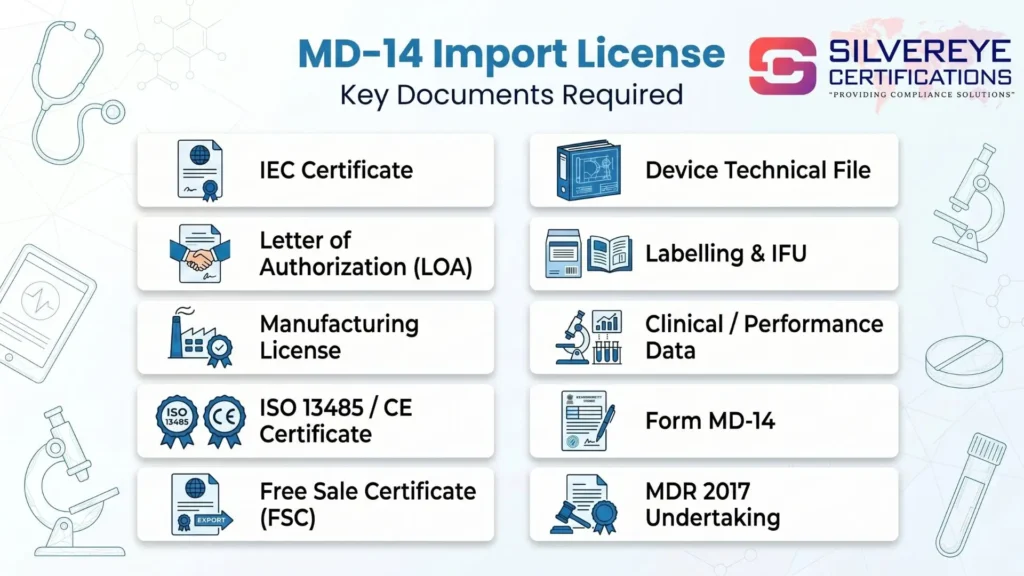
Documents Required for MD-14 (Import License Application)
| S.No. | Document | Details |
| 1 | MD-14 Application Form | Duly filled and signed application form |
| 2 | Authorization Letter | From foreign manufacturer authorizing Indian applicant as agent/importer |
| 3 | Free Sale Certificate | Issued by the competent authority of the country of origin of the foreign manufacturer |
| 4 | CE Certificate / 510(k) / Equivalent | Proof of regulatory approval in country of origin (CE Mark, US FDA 510k, etc.) |
| 5 | ISO 13485 Certificate | Quality Management System certification of the foreign manufacturer |
| 6 | Technical Documentation | Device description, intended use, specifications, labelling (including Indian labelling requirements) |
| 7 | Performance Testing Reports | Test reports from accredited labs as per applicable standards |
| 8 | Clinical Evaluation Report | For Class C/D devices; clinical data supporting safety and performance |
| 9 | Undertaking / Declaration | That the device is not banned or restricted in its country of origin |
| 10 | Proof of Payment | Challan of application fee payment via government portal (Sugam) |
MD-14 Application Fee (Import License)
| Device Class | Fee per Device (Approx.) | Portal |
| Class A & B | Rs. 1,000 – Rs. 2,500 per device | CDSCO Sugam Portal |
| Class C & D | Rs. 3,500 – Rs. 5,000 per device | CDSCO Sugam Portal |
Note: Fees are subject to revision by CDSCO. Always verify current fees on the official Sugam portal (sugam.gov.in) before filing.
MD-14/MD-15 Import License Process
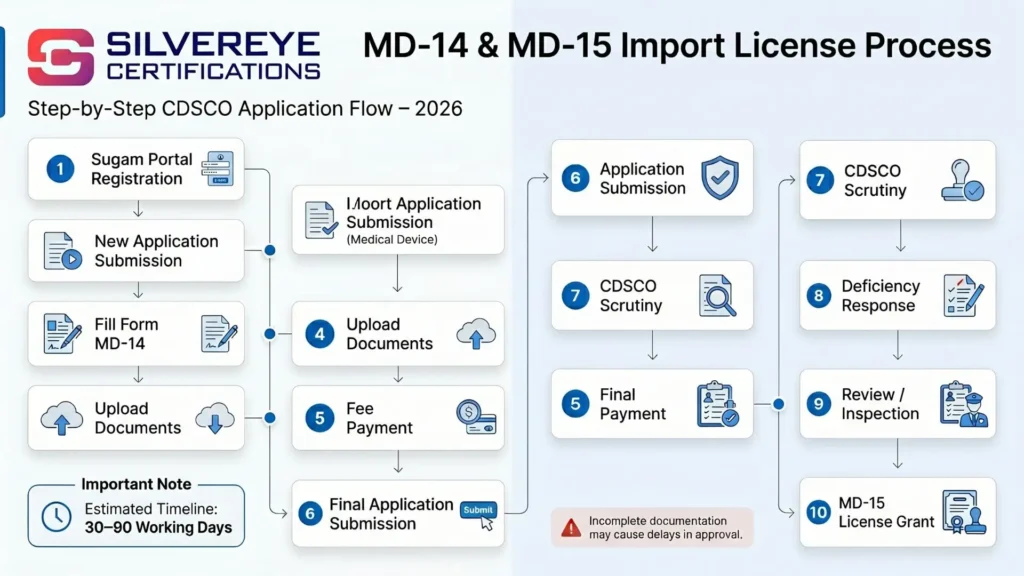
- Create an account on the CDSCO Sugam portal (sugam.gov.in).
- Fill out the MD-14 application form online and upload all required documents.
- Pay the applicable application fee via online payment gateway.
- CDSCO's technical committee reviews the application — may raise queries for clarification.
- For Class C/D devices, the application may be referred to the Subject Expert Committee (SEC) or New Drugs Advisory Committee.
- Upon approval, CDSCO issues the import license in MD-15 format electronically.
- The MD-15 import license is valid for 5 years and must be renewed before expiry.
Validity and Renewal of MD-15 Import License
- Import license (MD-15) is valid for 5 years from the date of issue.
- Renewal application should be filed at least 30 days before expiry.
- A grace period of 6 months may be granted, but importing during this period carries risk.
- Adding new devices to an existing license requires a separate MD-14 application per new device.
MD-41 Application and MD-42 Wholesale License for Urological Medical Devices
Any business entity distributing urological medical devices from a manufacturer or importer to hospitals, clinics, or retail outlets in India must hold a valid wholesale license. The wholesale license for medical devices is issued by the State Licensing Authority (SLA) — typically the State Drug Controller — of the respective state where the business operates.
What Is MD-41?
MD-41 is the application form used by wholesale dealers to apply for a license to sell, stock, exhibit, or distribute medical devices by wholesale. It is submitted to the State Licensing Authority (SLA) and covers all notified medical devices including urological devices.
What Is MD-42?
MD-42 is the grant of wholesale license for medical devices. Once the SLA approves the MD-41 application, the wholesale dealer receives the license in MD-42 format. This is a premises-specific license tied to the dealer's registered business address.
Eligibility for Wholesale License (MD-41/MD-42)
- The applicant must be a legally registered business entity (company, LLP, proprietorship, partnership firm).
- The business premises must meet minimum storage standards including adequate space, temperature-controlled storage where applicable, and security.
- A qualified person (Registered Pharmacist, or equivalent, as per state rules) may be required to be in charge.
- The applicant must deal only in devices for which the manufacturer/importer holds a valid CDSCO registration.
Documents Required for MD-41 (Wholesale License Application)
| S.No. | Document | Details |
| 1 | MD-41 Application Form | Duly filled and signed by applicant/authorized signatory |
| 2 | Proof of Business Registration | GST certificate, Shop Act license, Certificate of Incorporation, etc. |
| 3 | Premises Proof | Ownership deed or rental agreement for business premises |
| 4 | Site Plan/Layout | Floor plan of storage area with dimensions |
| 5 | Qualified Person Details | Educational qualification and appointment letter of the responsible person |
| 6 | Declaration/Undertaking | That the premises and storage facilities meet MDR 2017 requirements |
| 7 | Fee Payment Proof | Challan of application fee paid to the SLA |
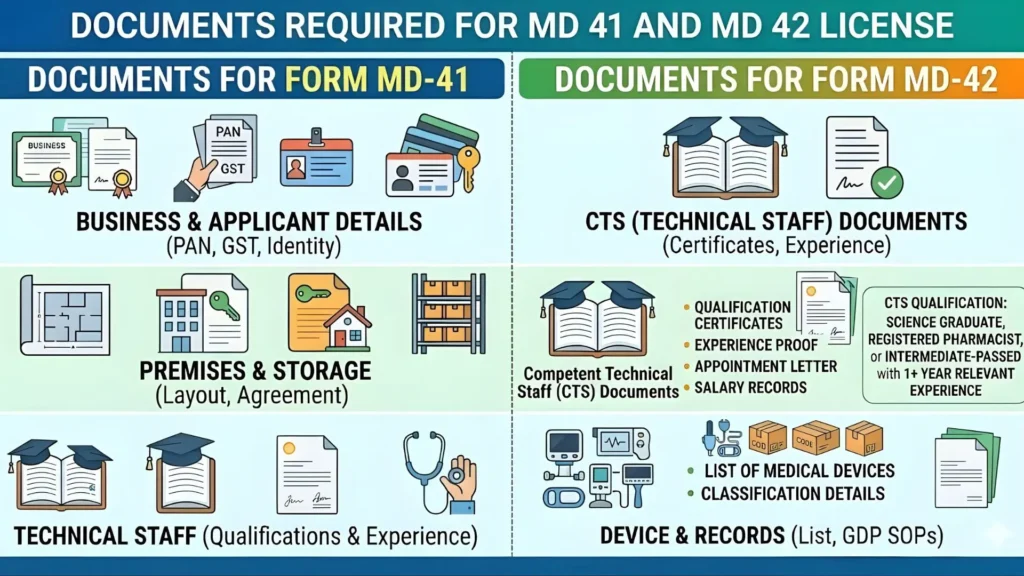
MD-41/MD-42 Wholesale License Process
- Submit the MD-41 application form along with all required documents to the State Licensing Authority (SLA).
- Pay the prescribed application fee as per the state's schedule of fees.
- The SLA inspects the premises to verify that storage conditions meet MDR 2017 Schedule requirements.
- If the premises and documents are satisfactory, the SLA issues the wholesale license in MD-42 format.
- MD-42 wholesale license is valid for 5 years from the date of issue.
- Renewal must be applied at least 30 days before expiry to avoid disruption to business operations.
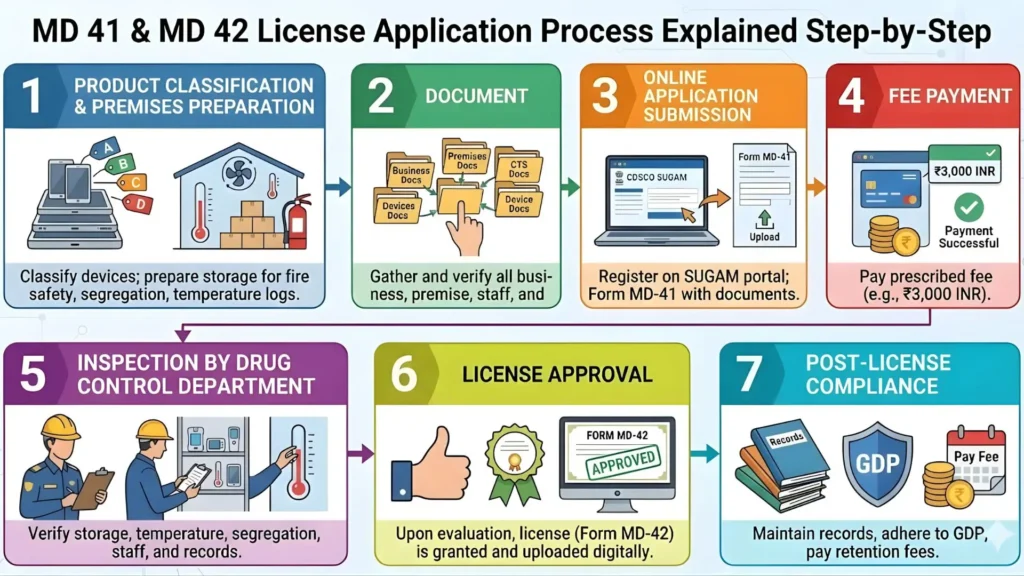
Validity and Renewal of MD-42 Wholesale License
- MD-42 wholesale license is valid for 5 years.
- Renewal application (MD-41) must be submitted to the SLA at least 30 days before expiry.
- Non-renewal results in license lapse; selling post-expiry is a punishable offence under the Drugs and Cosmetics Act.
MD-3 Application and MD-5 License for Manufacturing Urological Medical Devices (Class A & B)
Indian manufacturers of Class A and Class B urological medical devices must obtain a manufacturing license from CDSCO or the State Licensing Authority, depending on the device class. For Class A and B notified devices, the application is in Form MD-3 and the license is granted in Form MD-5.
What Is MD-3?
MD-3 is the application form used by manufacturers to apply for a license to manufacture Class A or Class B medical devices in India. The application is submitted to the State Licensing Authority (SLA) for Class A devices, and to the Central Licensing Authority (CLA) or SLA for Class B devices, depending on the state's delegation of powers.
What Is MD-5?
MD-5 is the manufacturing license granted to Class A and Class B medical device manufacturers after successful review of the MD-3 application and inspection of the manufacturing facility.
Eligibility for MD-3/MD-5 Manufacturing License (Class A & B)
- The applicant must be an Indian entity registered under the Companies Act, MSME, or equivalent.
- The manufacturing site must meet Good Manufacturing Practices (GMP) as per MDR 2017 Schedule III.
- A technically qualified person (diploma or degree in relevant engineering or science field) must be appointed as the person in charge of manufacturing.
- The premises must have adequate equipment, clean-room facilities (where applicable), testing equipment, and quality control infrastructure.
Documents Required for MD-3 Application (Class A & B Manufacturing License)
| S.No. | Document | Details |
| 1 | MD-3 Application Form | Duly filled and signed |
| 2 | Site Master File / GMP Documentation | Manufacturing process, SOPs, quality control procedures |
| 3 | Technical File / Device Dossier | Device description, specifications, intended use, labelling |
| 4 | ISO 13485 Certificate (or application) | Quality management system certification |
| 5 | Performance Testing Reports | Test reports from NABL-accredited or recognized labs |
| 6 | Qualified Person Details | Educational qualification, appointment letter, ID proof |
| 7 | Premises Documents | Ownership/lease deed, site plan, clean-room certifications where required |
| 8 | List of Manufacturing Equipment | With calibration certificates |
| 9 | Declaration of Conformity | That the device meets applicable Indian Standards (BIS) or international standards |
| 10 | Fee Payment Proof | Challan of applicable application fee |
MD-3 to MD-5 Manufacturing License Process (Class A & B)
- Submit MD-3 application form and documents to the State Licensing Authority (SLA) or via the Sugam portal.
- Pay the prescribed fee. The SLA scrutinizes documents for completeness.
- GMP inspection of the manufacturing facility is conducted by the SLA's drug inspector/technical officer.
- If premises are compliant and documents satisfactory, the MD-5 manufacturing license is issued.
- MD-5 is valid for 3 years (for Class B) or 5 years (for Class A) and must be renewed before expiry.
Validity and Renewal of MD-5 Manufacturing License
- Class A: MD-5 valid for 5 years; renewal via fresh MD-3 application.
- Class B: MD-5 valid for 3 years; renewal via fresh MD-3 application.
- Any change in manufacturing site, device, or qualified person requires prior intimation or amendment of license.
MD-7 Application and MD-9 License for Manufacturing Urological Medical Devices (Class C & D)
Manufacturers of higher-risk Class C and Class D urological medical devices — such as implantable urinary incontinence systems, laser lithotripsy systems, microwave prostatic ablation catheters, and inflatable penile prostheses — must apply to the Central Licensing Authority (CLA), which is CDSCO at the central level.
What Is MD-7?
MD-7 is the application form used by manufacturers to apply for a license to manufacture Class C or Class D medical devices in India. Unlike Class A/B (which may be handled at the state level), Class C/D applications are reviewed by CDSCO centrally, often with reference to Subject Expert Committees (SEC) or the New Drugs Advisory Committee (NDAC).
What Is MD-9?
MD-9 is the manufacturing license granted to Class C and Class D medical device manufacturers after CDSCO review, SEC/NDAC evaluation (if required), and GMP inspection of the manufacturing facility.
Eligibility for MD-7/MD-9 Manufacturing License (Class C & D)
- The applicant must be an Indian company or LLP registered under applicable law.
- The manufacturing site must meet higher-level GMP requirements, including environmental controls, biocompatibility testing, and sterilization validation for implantable devices.
- A qualified person with a degree in biomedical engineering, medical device technology, or a related discipline must be appointed.
- Clinical evaluation data supporting safety and performance of the device is mandatory for Class C/D.
- Biocompatibility testing as per ISO 10993 series is required for devices that come into contact with the body.
Documents Required for MD-7 Application (Class C & D Manufacturing License)
| S.No. | Document | Details |
| 1 | MD-7 Application Form | Duly filled and signed application to CDSCO central authority |
| 2 | Clinical Evaluation Report (CER) | Comprehensive clinical data supporting safety and performance for Class C/D devices |
| 3 | Risk Management File | As per ISO 14971 — risk analysis, evaluation, and controls |
| 4 | Biocompatibility Test Reports | ISO 10993 series testing for all body-contacting components |
| 5 | Sterilization Validation Reports | For sterile devices: EO, gamma, or steam sterilization validation data |
| 6 | Design Dossier / Technical File | Complete device design history, specifications, validation records |
| 7 | ISO 13485 Certificate | Mandatory quality management system certification |
| 8 | Performance Testing Reports | From NABL-accredited labs; must reference applicable Indian/international standards |
| 9 | Post-Market Surveillance Plan | Procedure for ongoing safety monitoring after device launch |
| 10 | Vigilance Reporting Procedure | Adverse event reporting procedure per MDR 2017 |
| 11 | GMP Documentation | SOPs, validation records, clean-room certification, equipment calibration |
| 12 | Fee Payment Proof | Challan of CDSCO prescribed application fee |
MD-7 to MD-9 Manufacturing License Process (Class C & D)
- Submit MD-7 application and complete dossier to CDSCO via the Sugam portal.
- Pay the applicable application fee. CDSCO assigns a review team or Subject Expert Committee (SEC).
- SEC/NDAC evaluates clinical data, technical documents, and biocompatibility evidence.
- GMP inspection of manufacturing facility is conducted by CDSCO technical officers.
- Queries (if any) are raised and must be addressed within the stipulated time.
- Upon satisfactory review, CDSCO issues the manufacturing license in MD-9 format.
Validity and Renewal of MD-9 Manufacturing License
- MD-9 is valid for 3 years from the date of issue.
- Renewal application must be filed before expiry. Late renewal may require re-inspection.
- Any modification to the device design, manufacturing process, or premises requires a prior amendment application to CDSCO.
Key Benefits of Getting CDSCO Registration for Urological Medical Devices
- Legal Market Access: Without CDSCO registration, urological medical devices cannot be legally sold, imported, or distributed in India. Registration eliminates the risk of product seizure or business shutdown.
- Quality Assurance: The registration process ensures that every urological device on the Indian market meets minimum safety and performance standards, reducing adverse patient outcomes.
- Hospital & Tender Eligibility: Government hospitals, large private hospital chains, and AIIMS-affiliated institutions typically require CDSCO registration proof before procuring medical devices. Registered products are eligible for government tenders.
- Investor & Partnership Confidence: A valid CDSCO registration strengthens business credibility for funding, international licensing deals, and hospital procurement contracts.
- Export Facilitation: CDSCO registration and GMP compliance is often recognized internationally, facilitating export documentation and regulatory submissions in other markets.
- Post-Market Surveillance Framework: Registration mandates a vigilance system, helping manufacturers proactively detect and address device-related adverse events, reducing liability.
Typical Timeline for CDSCO Registration of Urological Medical Devices
| License Type | Approximate Timeline | Key Factors Affecting Timeline |
| MD-15 (Import, Class A/B) | 3 – 6 months | Document completeness, query resolution time |
| MD-15 (Import, Class C/D) | 6 – 12 months | SEC/NDAC review, clinical data adequacy, query rounds |
| MD-42 (Wholesale) | 1 – 3 months | SLA inspection scheduling, premises compliance |
| MD-5 (Manufacture, Class A/B) | 3 – 6 months | GMP inspection, document completeness |
| MD-9 (Manufacture, Class C/D) | 9 – 18 months | SEC review, clinical dossier quality, GMP inspection |
These are approximate timelines. Actual processing times vary based on application quality, CDSCO workload, and the number of clarifications required. Engaging a regulatory consultant who is familiar with CDSCO processes can significantly reduce timelines by ensuring first-time document accuracy.
Renewal of CDSCO Licenses for Urological Medical Devices
All CDSCO licenses for urological medical devices have a defined validity period and must be renewed to continue legal operations. Failure to renew on time results in license lapse, which means the device cannot be legally imported, manufactured, or sold until the license is reinstated.
- Import License (MD-15): Renew via fresh MD-14 application at least 30 days before expiry.
- Wholesale License (MD-42): Renew via fresh MD-41 application at least 30 days before expiry with updated premises and staff details.
- Manufacturing License – Class A/B (MD-5): Renew via MD-3 application; re-inspection may or may not be required at SLA discretion.
- Manufacturing License – Class C/D (MD-9): Renew via MD-7 application; CDSCO re-inspection is generally required; updated post-market surveillance data must be submitted.
- Renewal fees: Same or similar to initial application fees — confirm on the Sugam portal at time of application.
Common Mistakes to Avoid in CDSCO Registration for Urological Devices
- Incorrect Device Classification: Misclassifying a device (e.g., treating a Class C implantable stent as Class B) leads to rejection, penalty, or recall. Always verify classification before applying.
- Incomplete Technical Dossier: Missing test reports, outdated ISO certificates, or absent clinical evaluation data are the top reasons for application rejection or prolonged query cycles.
- No Authorized Indian Representative: Foreign manufacturers must have a valid authorization letter and an authorized Indian representative (AIR) or importer — applications without this are rejected outright.
- Wrong Labelling: Indian labelling requirements under MDR 2017 differ from CE or US FDA labelling. Non-compliant labels cause rejection even when technical documentation is complete.
- Late Renewal: Waiting until after expiry to file renewal leads to a gap in legal status. Plan renewals at least 3 months before the license expiry date.
- Not Registering on Sugam Portal: All applications must be filed digitally on the CDSCO Sugam portal. Physical applications alone are not accepted for most device categories.
Conclusion
CDSCO registration for urological medical devices is a non-negotiable legal requirement for anyone operating in India's fast-growing medical device market. Whether you are importing flexible video cystoscopes, manufacturing urethral catheters, distributing incontinence management products, or supplying Class C implantable urinary incontinence systems, the right license — MD-15 (import), MD-42 (wholesale), MD-5 (Class A/B manufacture), or MD-9 (Class C/D manufacture) — must be in place before any commercial activity.
The classification of urological devices into Class A through C (with Class D not currently applicable for urological devices as per the current notified list) determines the level of documentation, clinical data, and regulatory scrutiny required. Starting early, maintaining complete documentation, and engaging regulatory experts familiar with CDSCO processes are the three most effective strategies to ensure timely registration and sustained compliance in 2026 and beyond.
Frequently Asked Questions
Is CDSCO registration mandatory for all urological medical devices in India?
Yes. All notified urological medical devices under MDR 2017 must have valid CDSCO registration before they can be legally imported, manufactured, or sold in India. Devices without registration are subject to seizure and the responsible entity faces penalties under the Drugs and Cosmetics Act, 1940.
What is the difference between MD-14 and MD-15 in CDSCO registration?
MD-14 is the application form that importers submit to CDSCO to request an import license for urological or other medical devices. MD-15 is the actual import license document issued by CDSCO after approving the MD-14 application.
How long does it take to get an import license (MD-15) for a Class B urological device?
For Class B urological devices, the MD-15 import license typically takes 3 to 6 months from the date of submission of a complete application. Incomplete applications or deficient documents significantly extend this timeline due to query rounds.
What forms are used for manufacturing licenses for Class C urological devices?
For Class C urological devices (such as urethral stents, inflatable penile prostheses, extracorporeal lithotripsy systems, and microwave prostatic ablation catheters), the manufacturer applies using MD-7 and, upon approval from CDSCO central authority, receives the manufacturing license in MD-9 format.
Do I need a separate CDSCO license for each urological device I manufacture?
Not necessarily separate licenses, but each device must be listed and approved individually. A manufacturing or import license typically covers specific devices listed on the license. Adding a new device requires an amendment application or a fresh application for that device.
What is the wholesale license form for urological medical devices?
MD-41 is the application form for obtaining a wholesale license for medical devices. The State Licensing Authority issues the wholesale license in MD-42 format after premises inspection and document verification.
Are urological incontinence pads (like incontinence pants liners) regulated by CDSCO?
Yes. Incontinence pants liners, reusable incontinence pants, incontinence penis clamps, and similar non-invasive urological management devices are classified as Class A devices under CDSCO's MDR 2017 classification. They require CDSCO registration, though the process for Class A is less burdensome than higher classes.
What clinical data is required for registering an inflatable penile prosthesis (Class C)?
Being an implantable Class C device, an inflatable penile prosthesis requires a comprehensive Clinical Evaluation Report (CER) covering literature reviews, pre-clinical testing data, post-market clinical data from other markets (CE/FDA studies acceptable), biocompatibility testing per ISO 10993, and a risk management file per ISO 14971.
Can a foreign manufacturer directly apply for CDSCO registration?
No. Foreign manufacturers cannot directly apply for CDSCO import registration. They must appoint an authorized Indian importer or authorized Indian representative who applies for the MD-14/MD-15 import license on their behalf. The authorization must be in writing, notarized, and apostilled where applicable.
What happens if I sell urological medical devices without a valid CDSCO license in India?
Selling, distributing, or manufacturing urological medical devices without a valid CDSCO registration is a punishable offence under the Drugs and Cosmetics Act, 1940. Penalties include product seizure, facility closure, cancellation of all existing licenses, fines, and in serious cases, criminal prosecution. It also creates significant product liability exposure.