
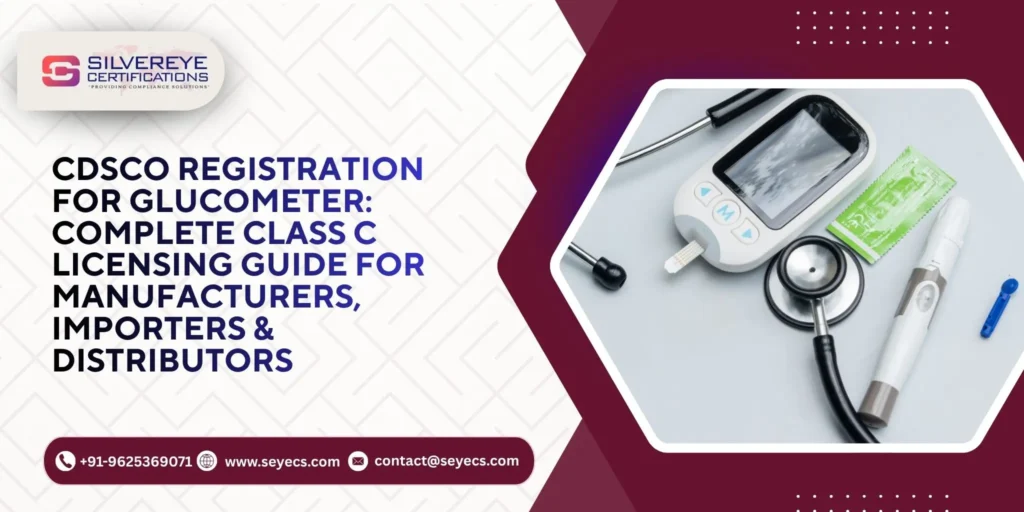
- Glucometer = Class C IVD: Since it directly influences insulin dosing decisions, CDSCO classifies glucometers as moderate-to-high-risk Class C in-vitro diagnostic devices, not Class A or B.
- Three separate license tracks: manufacturers (MD-7/MD-9), importers (MD-14/MD-15), and wholesalers/distributors (MD-41/MD-42) each need a different CDSCO application — you may need more than one depending on your business model.
- Licenses don't expire yearly: Under MDR 2017, CDSCO licenses remain valid indefinitely, subject to a retention fee paid once every 5 years.
- Everything runs through SUGAM: All applications, fee payments, and query responses for glucometer CDSCO registration are filed online via the CDSCO SUGAM portal.
What is CDSCO Registration For Glucometer?
CDSCO registration for glucometer is mandatory because a glucometer is classified as a Class C in-vitro diagnostic (IVD) device under India's Medical Devices Rules, 2017. Manufacturers apply through Form MD-7 and receive a manufacturing license in Form MD-9. Importers apply through Form MD-14 and receive an import license in Form MD-15.
Wholesalers and distributors apply through Form MD-41 and receive a registration certificate in Form MD-42. All applications are filed on CDSCO's SUGAM portal, and Class C devices go through Central Licensing Authority review, document scrutiny, and (for manufacturing/import) a facility inspection before approval.
Why Does a Glucometer Need CDSCO Registration?
A glucometer (blood glucose monitor) is used by diabetic patients and healthcare providers to measure blood sugar levels and make real-time decisions about insulin dosing, diet, and treatment. Because an inaccurate reading can directly cause a health-threatening event — hypoglycemia or hyperglycemia — CDSCO places glucometers in a stricter regulatory bracket than simple, low-risk instruments.
Glucometers fall under the In-Vitro Diagnostic (IVD) category since they test a biological sample (blood) outside the human body. CDSCO made glucometer registration compulsory for anyone wanting to manufacture, import, sell, or distribute the device in India, and mandated that all stakeholders hold a valid license from the Central Licensing Authority.
Glucometer Classification Under CDSCO: Why It's Class C
Under Rule 4 of the Medical Devices Rules, 2017, all medical devices and IVDs are placed into one of four risk classes. Here's how glucometers compare to devices in the other classes:
| Class | Risk Level | Example Devices | Regulatory Rigour |
| Class A | Low risk | Cotton wool, digital thermometers (basic) | Lightest oversight, registration-based |
| Class B | Low-moderate risk | BP monitors, pregnancy test kits | Registration/licence, moderate scrutiny |
| Class C | Moderate-high risk — Glucometer | Glucometers, ventilators, bone cement | Central Licensing Authority review + inspection |
| Class D | High risk | Coronary stents, HIV diagnostic kits | Strictest scrutiny, clinical evidence required |
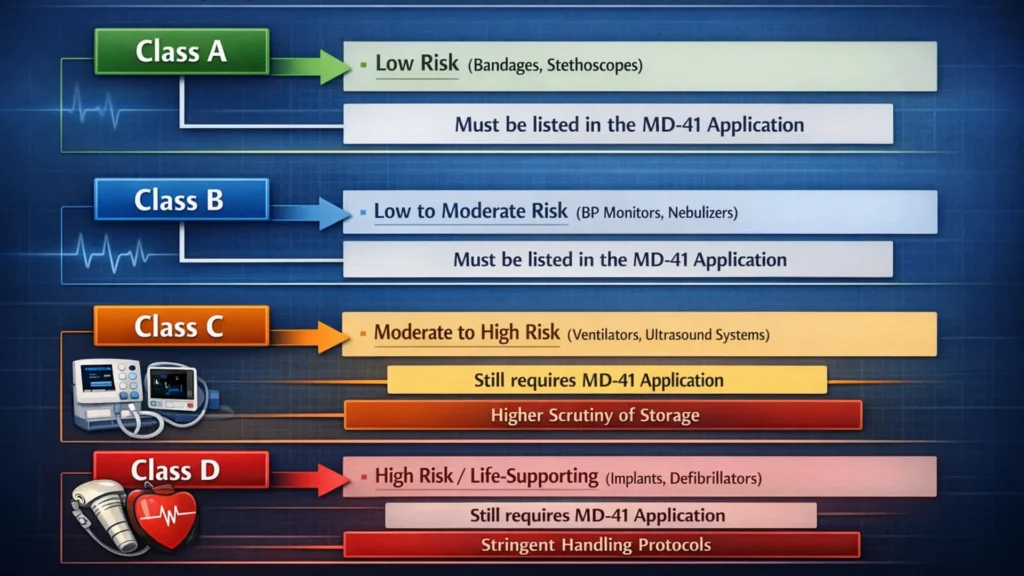
Because a glucometer sits in Class C, every pathway connected to it — manufacturing, import, and wholesale distribution — is regulated by the Central Licensing Authority (CLA) at CDSCO, not by a state authority alone, and typically involves a compliance inspection before the license is granted.
The Three CDSCO Licensing Pathways for Glucometer
Depending on your role in the supply chain, CDSCO registration for glucometer takes one of three forms. Many businesses — especially importers — end up needing more than one license at the same time.
| Stakeholder | Application Form | Licence Granted As | Issuing Authority |
| Manufacturer (Class C) | MD-7 | MD-9 | Central Licensing Authority (CDSCO) |
| Importer | MD-14 | MD-15 | Central Licensing Authority (CDSCO) |
| Wholesaler / Distributor | MD-41 | MD-42 | State Licensing Authority (SLA) |
CDSCO Registration for Glucometer Manufacturers — Form MD-7 & MD-9
If you manufacture glucometers in India, you must obtain a Class C manufacturing license. The application is filed in Form MD-7, and once CDSCO is satisfied with your documentation and facility inspection, the license is granted in Form MD-9.
Who Needs This License
- Domestic companies that manufacture, assemble, package, or label glucometers for sale in India.
- Businesses setting up a dedicated glucometer production facility with an in-house quality management system.
- Manufacturers using a loan license arrangement (a related pathway using Form MD-8, granted as MD-10, for those manufacturing at another party's licensed premises).
Eligibility Requirements
- A dedicated manufacturing facility compliant with Good Manufacturing Practices (GMP) and Schedule V of MDR 2017.
- A documented Quality Management System (QMS), ideally aligned with ISO 13485.
- Qualified technical and quality-control staff overseeing production.
- A complete Device Master File (DMF) and Plant Master File (PMF) for the glucometer product line.
Documents Required for MD-7 Application
- Covering letter stating the intent of the application
- Duly filled Form MD-7
- Fee payment challan
- Constitution details of the firm (partnership deed / MOA-AOA / GST / CIN)
- Proof of ownership or tenancy of the manufacturing site
- Plant Master File (PMF) — facility layout, equipment list, personnel details
- Quality Management System (QMS) documentation
- Device Master File (DMF) — design specifications, labelling, risk analysis, performance data
- Undertaking of compliance with the Quality Management System requirements under MDR 2017
Step-by-Step Process
- Create an account and log in to the CDSCO SUGAM portal.
- Confirm the glucometer's classification as Class C IVD before filing.
- Fill Form MD-7 online with product, facility, and technical staff details.
- Upload the PMF, DMF, QMS documents, and fee challan.
- CDSCO reviews the application; a Medical Device Officer conducts a facility inspection, typically within 60 days of application (provided submitted data is in order).
- Respond promptly to any queries or non-conformities (NCs) raised during review or inspection.
- On satisfactory review, CDSCO grants the manufacturing license in Form MD-9.
Government Fees, Timeline & Validity — Manufacturing (Class C)
| Item | Details |
| Application fee | ₹50,000 per manufacturing site + ₹1,000 per product (device model) |
| Inspection timeline | Within 60 days of application, if submitted data is complete |
| Overall approval timeline | Approximately 2-4 months for a well-documented application |
| Licence validity | Perpetual — does not expire on a fixed date |
| Retention fee | ₹1,000 per product, payable every 5 years to keep the licence active |
Note: government fee figures are prescribed under the Second Schedule of MDR 2017 and are subject to periodic revision — always confirm the current rate on the SUGAM portal before payment.
CDSCO Registration for Glucometer Importers — Form MD-14 & MD-15
Foreign or domestic companies wanting to bring glucometers into India for sale must obtain an import licence. The application is filed in Form MD-14 by an Authorised Indian Agent, and the licence is granted in Form MD-15.
Who Needs This License
- Foreign glucometer manufacturers exporting to India (must act through an Indian agent — they cannot apply directly).
- Indian companies importing glucometers or glucometer test strips for commercial sale.
- Businesses importing components or semi-finished glucometers for further assembly in India (a manufacturing license may also be required in this case).
Eligibility Requirements
- Authorised Indian Agent (AIA): A foreign manufacturer must appoint an Indian entity holding a valid wholesale licence (MD-42) or manufacturing license, backed by a notarized and apostilled Power of Attorney.
- The overseas manufacturing site should ideally hold ISO 13485 certification and ideally have approval from a reference regulator (USA, EU, UK, Japan, Canada, or Australia) — this can support, though not replace, India-specific review.
- A complete Device Master File matching the product exactly as sold in India (model numbers, labelling, intended use).
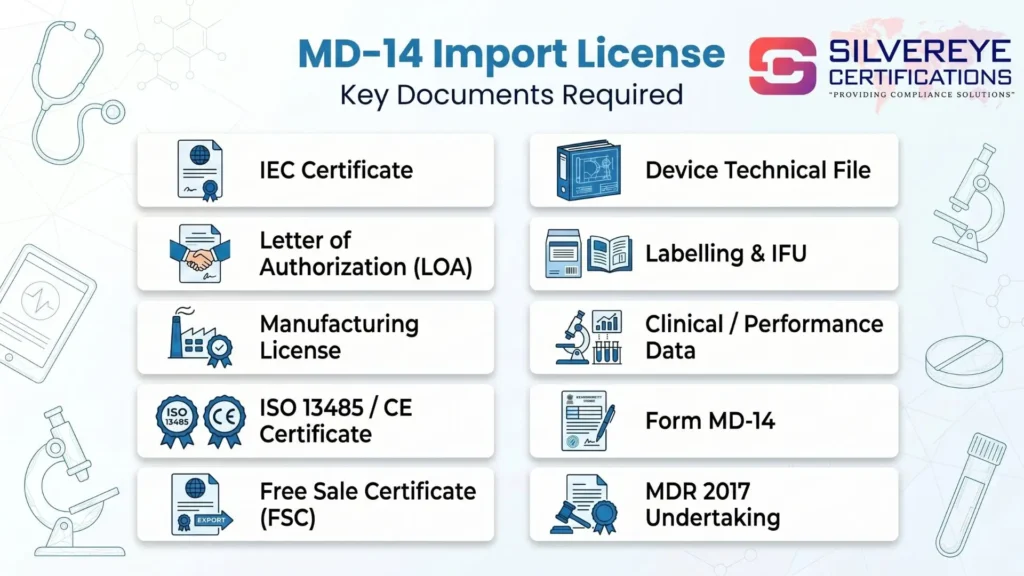
Documents Required for MD-14 Application
- Covering letter and duly filled Form MD-14
- Power of Attorney from the manufacturer to the Authorized Indian Agent (notarized and apostilled)
- Copy of the agent's Wholesale License / Manufacturing License / Registration Certificate (Form MD-42)
- Constitution details of the Authorized Indian Agent
- Free Sale Certificate (FSC) / Marketing Authorization from the country of origin, notarized
- ISO 13485 Certificate of the manufacturer, notarized
- Device Master File (DMF) and Plant Master File (PMF)
- Latest inspection/audit report from a Notified Body or National Regulatory Authority (within the last 3 years), if available
- Labelling and Instructions for Use (IFU) compliant with Indian requirements
Step-by-Step Process
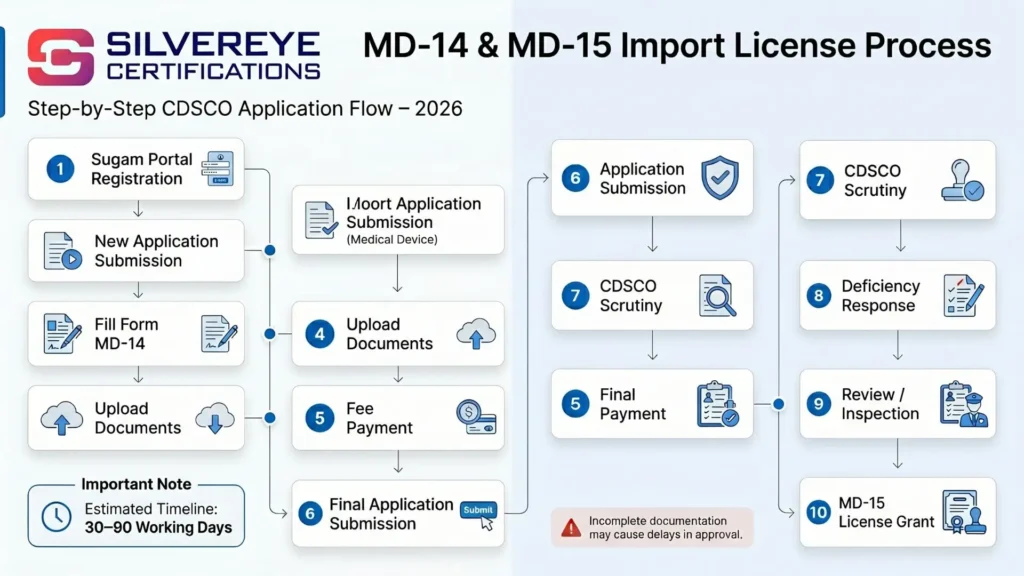
- Appoint an Authorized Indian Agent holding a valid MD-42 wholesale license (or manufacturing license).
- Compile the DMF, PMF, FSC, ISO 13485 certificate, and Power of Attorney.
- The agent files Form MD-14 on the SUGAM portal and pays the applicable government fee.
- CDSCO reviews the dossier and may schedule a site inspection of the overseas manufacturing facility for Class C devices.
- Respond to deficiency queries within the timeline CDSCO specifies (commonly 7-14 days per query cycle).
- On approval, CDSCO issues the import license in Form MD-15.
Government Fees, Timeline & Validity — Import (Class C)
| Item | Details |
| Application fee | Charged in USD per manufacturing site plus per device/product, under the Second Schedule of MDR 2017 (Class C attracts a higher site fee than Class A/B — confirm the exact current figure on SUGAM, as quoted rates vary by source and are periodically revised) |
| Inspection timeline | Within 60 days of application for Class C/D devices, where documentation is complete |
| Overall approval timeline | Commonly cited as 6-9 months for notified Class C devices |
| Licence validity | Perpetual, as long as retention fees are paid on schedule |
| Retention fee | Payable once every 5 years from the date of licence issue |
CDSCO Registration for Glucometer Wholesalers & Distributors — Form MD-41 & MD-42
Anyone stocking, selling, exhibiting, or distributing glucometers in bulk — traders, stockists, distributors, C&F agents, and e-commerce sellers of medical devices — must hold a wholesale Registration Certificate. This became mandatory from 30 September 2022 under the Medical Devices (5th Amendment) Rules, 2022. The application is filed in Form MD-41, and the certificate is issued in Form MD-42 by the State Licensing Authority (SLA).
Who Needs This License
- Distributors buying glucometers from manufacturers or importers to sell to sub-distributors or retailers
- C&F agents managing distribution operations for glucometer brands
- Traders or stockists operating a depot or warehouse
- E-commerce sellers listing glucometers on marketplaces (most platforms now require MD-42 proof before onboarding)
- Note: retail pharmacies selling directly to consumers need a separate retail license rather than MD-42, and manufacturers already covered by their own manufacturing license do not need a separate wholesale license for their own products.
Eligibility Requirements
- Adequate storage premises (commonly expected: at least 10-15 sq. m of dedicated storage plus a records area) with proper lighting and temperature control.
- Technical/competent staff: for Class C devices like glucometers, most State Licensing Authorities expect a person with a relevant technical/scientific degree, and some states require a pharmacist or biomedical professional, present at the premises during business hours.
- A declaration to source devices only from CDSCO-licensed manufacturers or importers.
- Self-certification of compliance with Good Distribution Practices (GDP).
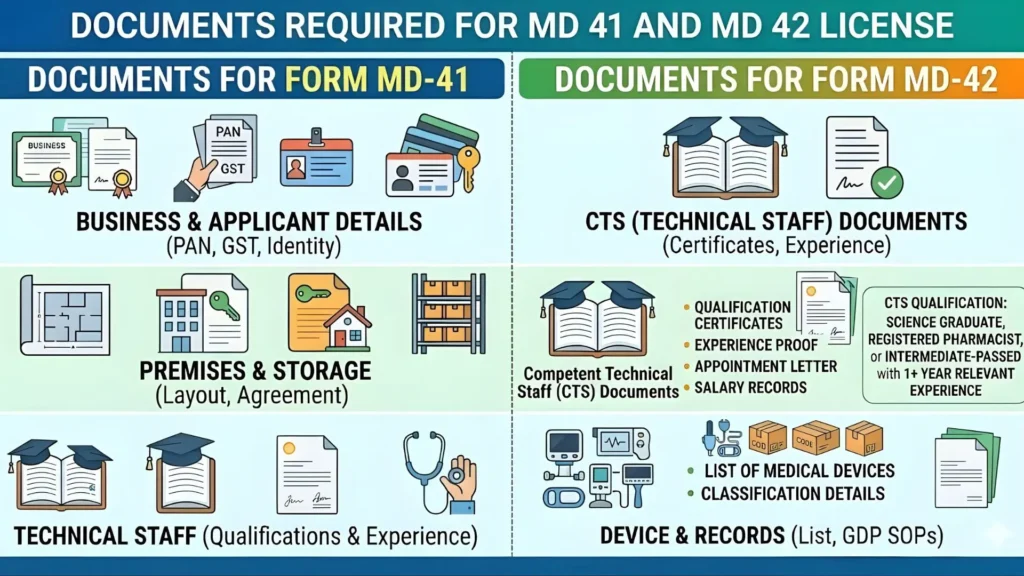
Documents Required for MD-41 Application
- Duly filled Form MD-41
- Identity proof of the applicant (Aadhaar/PAN) and business registration documents (GST/COI/MOA)
- Proof of ownership or rental agreement for the premises, with layout plan
- Details and qualification proof of the competent technical staff
- Self-certification of Good Distribution Practice compliance
- Cold-chain infrastructure details, if applicable to related temperature-sensitive IVD products
- Proof of government fee payment
Step-by-Step Process
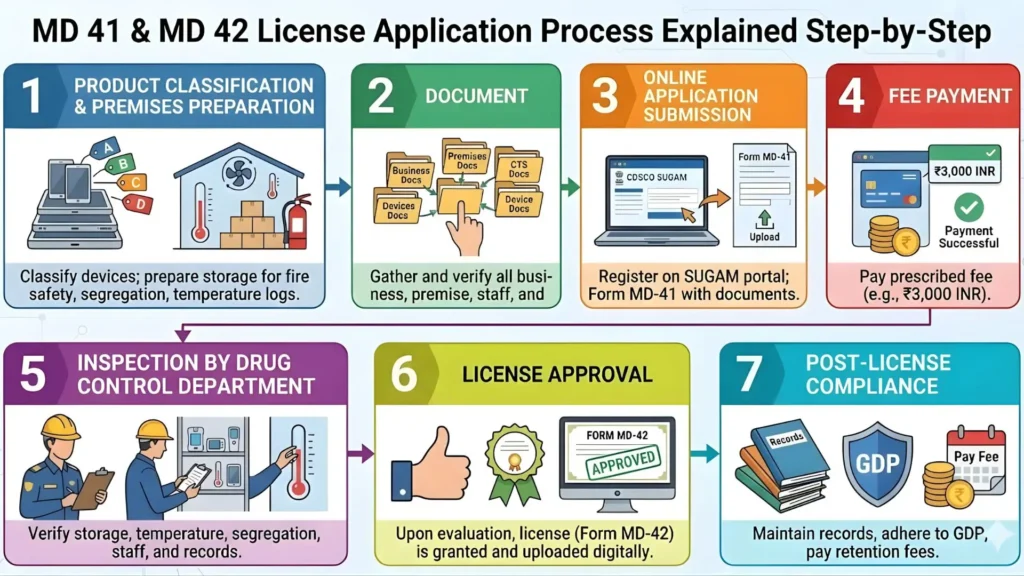
- Register on the SUGAM portal (or your state's dedicated portal, where applicable).
- Fill Form MD-41 with complete business and premises details.
- Upload all supporting documents in the required format.
- Pay the prescribed government fee.
- A Drug Inspector from the SLA inspects the premises to verify storage conditions, staffing, and compliance.
- On satisfactory inspection, the SLA grants the Registration Certificate in Form MD-42.
Government Fees, Timeline & Validity — Wholesale
| Item | Details |
| Application fee | ₹3,000 per premise (non-refundable) |
| Approval timeline | Typically 30-60 days, depending on inspection scheduling and application completeness |
| Licence validity | Valid indefinitely, subject to a retention fee paid every 5 years |
| Multi-state operations | A separate MD-42 is required in each state where you operate a warehouse or depot |
Benefits of Completing CDSCO Registration for Glucometer
- Legal market access: You can manufacture, import, or distribute glucometers in India without risking seizure, fines, or shutdown.
- Buyer and marketplace trust: Hospitals, distributors, and e-commerce platforms increasingly ask for MD-9/MD-15/MD-42 proof before onboarding a supplier.
- Tender and procurement eligibility: Government and institutional tenders typically require a valid CDSCO license and, where relevant, a Free Sale Certificate or Market Standing Certificate.
- Product credibility: Passing CDSCO's quality management and documentation review signals that your glucometer meets India's essential safety and performance principles.
- Long-term compliance cost efficiency: Since MDR 2017 licenses don't need annual renewal, the administrative burden after initial approval is comparatively lighter — retention fees only fall due every 5 years.
Penalties for Selling Glucometers Without CDSCO Registration
Manufacturing, importing, or distributing an unregistered Class C device like a glucometer is a violation of the Drugs & Cosmetics Act, 1940 and the Medical Devices Rules, 2017. Consequences commonly cited by regulatory practitioners include product seizure at customs or at the point of sale, monetary penalties, cancellation of any related trade licences, and — for serious or repeated violations — imprisonment.
Operating without an MD-42 wholesale registration specifically has been flagged as attracting escalating fines. Businesses should treat CDSCO registration for glucometer as a pre-launch requirement, not an afterthought.
Common Mistakes to Avoid During Glucometer CDSCO Registration
- Misclassifying the device — some applicants mistakenly file a glucometer as Class A/B; incorrect classification leads to rejection or major delays.
- Submitting a Power of Attorney that isn't properly notarized and apostilled — one of the most common causes of MD-14 rejection for foreign manufacturers.
- Mismatched details across documents (e.g., manufacturer name differing between the ISO 13485 certificate and the application form).
- Appointing an Authorized Indian Agent without a valid, current MD-42/MD-9 license of their own.
- Missing the 5-year retention fee deadline, which can lead to late fees or, eventually, suspension of an otherwise valid license.
- Assuming one state's MD-42 wholesale registration covers warehouses in other states — it does not.
Conclusion
CDSCO registration for glucometer is a mandatory, multi-track compliance requirement built around the device's Class C risk status. Whether you manufacture, import, or distribute glucometers in India, matching your business role to the correct form — MD-7/MD-9, MD-14/MD-15, or MD-41/MD-42 — and preparing accurate documentation upfront is the single biggest factor in avoiding delays. Because government fees, inspection triggers, and documentation checklists are periodically updated by CDSCO, always cross-check the latest requirements on the official SUGAM portal or with a qualified regulatory affairs professional before filing.
Frequently Asked Questions
Is a glucometer Class A, B, or C under CDSCO?
A glucometer is classified as a Class C in-vitro diagnostic (IVD) device under the Medical Devices Rules, 2017, because an inaccurate reading can pose a moderate-to-high risk to patient safety, such as incorrect insulin dosing.
What form does a glucometer manufacturer need to file with CDSCO?
A glucometer manufacturer files Form MD-7 with the Central Licensing Authority and, on approval, receives the manufacturing license in Form MD-9.
What form does a glucometer importer need to file with CDSCO?
An importer's Authorized Indian Agent files Form MD-14 on the SUGAM portal, and CDSCO grants the import license in Form MD-15 upon approval.
What license does a glucometer wholesaler or distributor need?
Wholesalers and distributors apply through Form MD-41 to the State Licensing Authority and receive a Registration Certificate in Form MD-42, mandatory since 30 September 2022.
How long does CDSCO registration for glucometer take?
Manufacturing licenses (MD-9) commonly take about 2-4 months, import licenses (MD-15) commonly take 6-9 months, and wholesale registration certificates (MD-42) typically take 30-60 days — all assuming complete, query-free documentation.
What is the validity of a CDSCO glucometer license?
Manufacturing, import, and wholesale licences issued under MDR 2017 are valid indefinitely. They do not expire on a fixed date but require a retention fee to be paid once every 5 years to remain active.
How much does CDSCO registration for glucometer cost?
Manufacturing (MD-7/MD-9) costs ₹50,000 per site plus ₹1,000 per product. Wholesale (MD-41/MD-42) costs ₹3,000 per premise. Import (MD-14/MD-15) fees are charged in USD per site and per device under the Second Schedule of MDR 2017 — confirm the current rate on the SUGAM portal, as it varies by device class.
Can a foreign glucometer manufacturer apply to CDSCO directly?
No. A foreign manufacturer must appoint an Authorized Indian Agent who holds a valid MD-42 wholesale license or manufacturing license, backed by a notarized and apostilled Power of Attorney, to file the MD-14 application on their behalf.
What happens if I sell glucometers in India without CDSCO registration?
Selling an unregistered Class C device violates the Drugs & Cosmetics Act, 1940. It can lead to product seizure, financial penalties, cancellation of related licenses, and legal proceedings, since glucometers are notified devices requiring mandatory licensing.
Do I need a separate MD-42 wholesale license for every state I operate in?
Yes. A wholesale Registration Certificate (MD-42) issued by one State Licensing Authority does not authorize operations in another state — a separate MD-42 is required for each state where you run a warehouse or depot.
Can one company hold both an import license and a wholesale license for glucometers?
Yes, and in practice most Authorized Indian Agents need both — the MD-42 wholesale license is often a prerequisite for a foreign manufacturer's agent to be eligible to file the MD-14 import application in the first place.
Is a Free Sale Certificate mandatory for glucometer import into India?
A notarized Free Sale Certificate or Marketing Authorization from the country of origin's regulatory authority is typically required as supporting evidence in the MD-14 application, even though it is listed as "if any" in the checklist for markets where such certificates exist.