- Wheelchairs are notified medical devices under India's Medical Devices Rules, 2017, requiring CDSCO registration before import, manufacture, or wholesale distribution.
- Importers must file Form MD-14 with CDSCO; domestic manufacturers apply via MD-3 (Class A/B) or MD-7 (Class C/D) to obtain a valid manufacturing license.
- Wholesale distributors of wheelchairs and mobility aids must obtain a license through Form MD-41 from the State Licensing Authority (SLA).
- All CDSCO wheelchair licenses carry a 5-year validity and must be renewed through the SUGAM online portal before expiry to maintain legal business operations.
Introduction
CDSCO medical device registration for wheelchairs in India is mandatory under the Medical Devices Rules, 2017. Wheelchairs are classified as Class A, B, C, or D based on risk. Importers apply via Form MD-14 and receive a grant through Form MD-15.
Domestic manufacturers use MD-3 (Class A/B, licensed by SLA) or MD-7 (Class C/D, licensed by CDSCO). Wholesale distributors apply through MD-41 and receive MD-42. All applications are filed on the CDSCO SUGAM portal. Licenses are valid for 5 years and subject to renewal. Non-compliance attracts penalties under Indian law.
What Is CDSCO Medical Device Registration for Wheelchairs in India?
The Central Drugs Standard Control Organization (CDSCO) is India's national regulatory authority for medical devices under the Drugs and Cosmetics Act, 1940, and the Medical Devices Rules, 2017. Wheelchairs — including manual, powered, sports, paediatric, and standing wheelchairs — are classified as notified medical devices in India. This means every entity involved in importing, manufacturing, or wholesale distribution of wheelchairs must hold a valid CDSCO license before conducting any commercial activity.

The growing focus on disability inclusion, rehabilitation care, and assisted mobility in India — supported by government programs like the Assistance to Disabled Persons (ADIP) scheme, Accessible India Campaign, and Ayushman Bharat — has significantly increased demand for quality-certified wheelchairs. CDSCO registration is the regulatory gateway to this market. Without it, businesses face product seizure, legal penalties, and exclusion from government tenders.
Why Is Wheelchairs Registration Under CDSCO Important in 2026?
- India has over 26 million persons with locomotor disability who are potential wheelchair users, creating one of the world's largest assistive device markets.
- Government procurement schemes like ADIP and state disability welfare programs mandate CDSCO-registered products for supply eligibility.
- CDSCO registration ensures wheelchairs meet minimum safety, load-bearing, and performance standards before reaching end users.
- From 2026, CDSCO enforcement of unregistered medical device imports has significantly increased, with stricter customs-level scrutiny.
- International buyers and NGOs supplying wheelchairs in India increasingly require CDSCO compliance as a sourcing prerequisite.
Wheelchairs Medical Device Classification Under CDSCO – Class A, B, C & D
Under the Medical Devices Rules, 2017, all notified medical devices including wheelchairs are classified into four risk-based categories. The classification determines which application form to use, which licensing authority processes it, what documentation is required, and what fee applies.
Class A – Low Risk Wheelchairs Devices
| S.No. | Device Name | Description / Use |
| 1 | Standard Manual Wheelchair (Non-Adjustable) | Basic manual wheelchair with fixed seat, backrest, and footrests. Self-propelled or attendant-pushed; no electrical or mechanical adjustment. Lowest risk category. |
| 2 | Folding Manual Wheelchair | Lightweight cross-brace folding wheelchair for ease of transport and storage. Non-powered, passive mobility device for general use. |
| 3 | Rigid Frame Manual Wheelchair | Non-folding, rigid-frame manual wheelchair preferred by active users for performance and durability. No electrical components. |
| 4 | Wheelchair Cushion (Standard Foam) | Non-powered foam cushion for pressure comfort on wheelchair seat. No therapeutic pressure-redistribution function; passive comfort accessory. |
| 5 | Wheelchair Footrest / Footplate (Accessory) | Detachable or swing-away footrest accessory for manual wheelchairs. Non-powered, passive component. |
| 6 | Wheelchair Armrest (Standard) | Fixed or detachable armrest for manual wheelchair. Non-powered, structural support accessory. |
| 7 | Wheelchair Anti-Tipping Device | Safety device fitted to the rear of a manual wheelchair to prevent backward tipping. Passive, non-powered safety accessory. |
| 8 | Wheelchair Bag / Pouch Accessory | Storage pouch or bag attached to wheelchair frame for carrying personal items. Non-medical, passive accessory. |
| 9 | Transport Wheelchair (Lightweight Attendant-Propelled) | Narrow, lightweight wheelchair designed for short-distance transport by an attendant; not intended for self-propulsion. |
| 10 | Wheelchair Gloves (Propulsion Gloves) | Gloves used by wheelchair users for hand protection during manual propulsion. Passive protective accessory. |
Class B – Low-Moderate Risk Wheelchairs Devices
| S.No. | Device Name | Description / Use |
| 1 | Tilt-in-Space Manual Wheelchair | Manual wheelchair with tilt-in-space mechanism allowing the entire seat to tilt backward while maintaining hip angle. Used for pressure relief and postural management. |
| 2 | Reclining Backrest Manual Wheelchair | Manual wheelchair with adjustable reclining backrest for users requiring varying degrees of recline for comfort or clinical management. |
| 3 | Paediatric Manual Wheelchair | Manual wheelchair designed and sized for children with physical disabilities. Adjustable to accommodate growth; low-moderate risk. |
| 4 | Hemi / Low-Seat Wheelchair | Manual wheelchair with lower seat height allowing one-foot propulsion for hemiplegic patients. Designed for specific functional need. |
| 5 | Sports / Active User Wheelchair | High-performance manual wheelchair for sport or active daily use; ultra-lightweight, cambered wheels, no electrical components. |
| 6 | Bariatric Manual Wheelchair (Heavy Duty) | Reinforced manual wheelchair with higher weight capacity (180–350 kg) for bariatric users. Wider seat and reinforced frame. |
| 7 | Beach / All-Terrain Manual Wheelchair | Manual wheelchair with wide balloon tyres for outdoor, beach, or rough-terrain use. Non-powered but designed for specific environmental conditions. |
| 8 | Commode Wheelchair (Toilet Wheelchair) | Wheelchair with integrated commode seat opening for toileting; used in home care and rehabilitation settings. |
| 9 | Shower / Bath Wheelchair | Corrosion-resistant wheelchair designed for use in wet environments; used for bathing assistance in hospitals and home care. |
| 10 | One-Arm Drive Wheelchair | Manual wheelchair with dual-rim one-arm drive mechanism for users with single functional upper limb. |
| 11 | Attendant-Controlled Powered Add-On (Manual Wheelchair + Power Attachment) | Power-assist add-on device attached to manual wheelchair that provides motorized assistance controlled by an attendant. Low-moderate risk. |
Class C – Moderate-High Risk Wheelchairs Devices
| S.No. | Device Name | Description / Use |
| 1 | Power Wheelchair (Standard Electric Wheelchair) | Battery-powered wheelchair with joystick or switch control for independent mobility of users with limited upper limb function. Moderate-high risk due to powered propulsion and battery system. |
| 2 | Power Tilt-in-Space Wheelchair (Electric) | Motorized wheelchair with powered tilt-in-space and recline functions; used in complex rehabilitation and long-term disability management by clinicians. |
| 3 | Standing Wheelchair (Electric Power Standing) | Motorized wheelchair capable of transitioning user to a standing position; used for physiological benefits in spinal injury rehabilitation. Moderate-high risk. |
| 4 | Pediatric Power Wheelchair | Battery-powered electric wheelchair specifically designed and sized for children with complex physical disabilities requiring powered mobility. |
| 5 | Power-Assisted Manual Wheelchair (Motorized Rear Wheels) | Manual wheelchair with battery-powered motorized rear wheels that supplement user propulsion via force-sensing technology; moderate-high risk due to electronic integration. |
| 6 | Outdoor / Heavy-Duty Power Wheelchair | High-capacity battery-powered wheelchair designed for outdoor terrain with robust suspension; used by adults with significant physical disability. |
| 7 | Reclining Power Wheelchair with Elevating Leg Rests | Electric wheelchair with multiple powered positioning functions including recline, tilt, and leg elevation; used for users with complex seating and medical needs. |
| 8 | Scooter / Mobility Scooter (3-Wheel / 4-Wheel) | Battery-powered mobility scooter used by elderly or persons with limited walking ability; tiller-steered, not hand-controller; moderate-high risk due to outdoor speed and traffic exposure. |
| 9 | Bariatric Power Wheelchair | Heavy-duty electric wheelchair designed for bariatric users (200 kg+) with reinforced frame, dual motors, and high-capacity battery system. |
Class D – High Risk Wheelchairs Devices
| S.No. | Device Name | Description / Use |
| 1 | Brain-Computer Interface (BCI) Controlled Wheelchair | Wheelchair controlled by neural signals or EEG-based brain-computer interface for users with no limb function (e.g., ALS, high cervical SCI). Highest risk — direct neural interface. |
| 2 | Robotic Exoskeleton Wheelchair / Hybrid Mobility System | Integrated robotic mobility system combining powered exoskeleton with wheelchair functionality; used in advanced neurological rehabilitation under clinical supervision. |
| 3 | Eye-Gaze / Sip-and-Puff Controlled Power Wheelchair (High-Complexity) | Power wheelchair controlled entirely by eye-gaze tracking or sip-and-puff input for users with no motor function; high risk due to complexity of control system and user dependency. |
| 4 | Autonomous / Semi-Autonomous Self-Driving Wheelchair (AI-Guided) | Power wheelchair with embedded AI navigation, obstacle avoidance sensors, and autonomous movement capability; high risk due to autonomous decision-making in dynamic environments. |
| 5 | Implant-Integrated Assistive Wheelchair System | Wheelchair system integrated with implanted neural stimulators or FES (Functional Electrical Stimulation) devices for hybrid mobility in severe paralysis cases. |
CDSCO Wheelchairs License Forms
| Role | Application Form | Grant of License | Licensing Authority | Applicable Class |
| Importer | MD-14 | MD-15 | CDSCO (Central) | Class A, B, C, D |
| Manufacturer (Low Risk) | MD-3 | MD-5 | State Licensing Authority (SLA) | Class A & B |
| Manufacturer (High Risk) | MD-7 | MD-9 | CDSCO (Central) | Class C & D |
| Wholesale Distributor | MD-41 | MD-42 | State Licensing Authority (SLA) | All Classes |
MD-14 Application and MD-15 Grant of License for Wheelchairs Importer
What Is Form MD-14 for Wheelchair Import?
Form MD-14 is the official application for an Import License under the Medical Devices Rules, 2017. Any business wishing to import wheelchairs — whether manual, power, paediatric, bariatric, sports, or advanced assistive wheelchairs — into India must file Form MD-14 with CDSCO (the Central Licensing Authority) before importing any commercial shipment.
The import license is device-specific and manufacturer-specific. This means a single application covers one wheelchair model from one manufacturer. Different models or different manufacturers each require separate MD-14 applications.
Who Needs to Apply for MD-14 for Wheelchairs?
- Foreign wheelchair manufacturers or their appointed Indian authorized agents / representatives
- Indian companies importing manual, power, or specialty wheelchairs from overseas manufacturers
- Importers sourcing mobility scooters, standing wheelchairs, tilt-in-space systems, and BCI wheelchairs
- NGOs and rehabilitation organizations importing wheelchairs for distribution in India
- Companies importing wheelchair components, powered add-on systems, and seating accessories
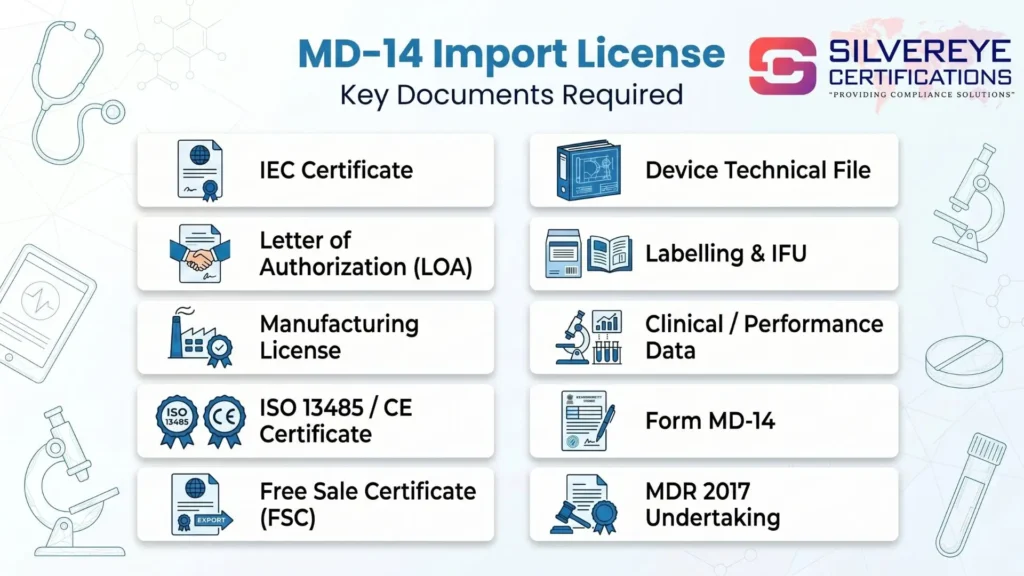
Documents Required for MD-14 – Wheelchairs Import License
| S.No. | Document Required | Purpose |
| 1 | Duly filled Form MD-14 (online via SUGAM portal) | Core application form |
| 2 | Certificate of Free Sale (CFS) or CE Mark / US FDA 510(k) clearance | Market approval in country of origin |
| 3 | ISO 13485:2016 certificate of foreign manufacturer | QMS compliance proof |
| 4 | Technical dossier / Device Master File | Complete device technical documentation |
| 5 | Declaration of Conformity (DoC) | Manufacturer's self-declaration of standards compliance |
| 6 | Risk management file (ISO 14971) | Risk analysis and hazard documentation |
| 7 | Electrical safety test report (IEC 60601-1) for power wheelchairs | Electrical safety for powered mobility devices |
| 8 | EMC test report (IEC 60601-1-2) for electric wheelchairs | Electromagnetic compatibility compliance |
| 9 | Battery safety certification (UN 38.3 or equivalent) for Li-ion batteries | Battery transport and safety compliance |
| 10 | Performance / durability testing (ISO 7176 series for wheelchairs) | Wheelchair-specific performance standard compliance |
| 11 | Biocompatibility data (ISO 10993) for skin-contact components | Material safety for upholstery and cushions |
| 12 | Labelling specimens in English meeting Rule 24 | Product labelling compliance |
| 13 | Authorisation letter from foreign manufacturer | Appointing Indian agent / importer |
| 14 | Proof of Indian business establishment (GST, incorporation certificate) | Applicant legal entity proof |
| 15 | Undertaking / affidavit by applicant | Compliance self-declaration |
| 16 | Clinical / performance evaluation data (Class C/D only) | Safety and effectiveness evidence for high-risk chairs |
ISO 7176 Wheelchair Standards Relevant to CDSCO Registration
CDSCO expects wheelchair technical dossiers to reference compliance with ISO 7176, the internationally recognized series of standards for wheelchairs. Key parts include:
| ISO Standard | Scope |
| ISO 7176-1 | Determination of maximum speed, acceleration, and deceleration of electric wheelchairs |
| ISO 7176-2 | Determination of dynamic stability of electric wheelchairs |
| ISO 7176-3 | Determination of effectiveness of brakes |
| ISO 7176-5 | Overall dimensions, mass, and turning space |
| ISO 7176-7 | Measurement of seating and wheel dimensions |
| ISO 7176-11 | Test dummies |
| ISO 7176-14 | Power and control systems – requirements and test methods |
| ISO 7176-15 | Accessibility requirements for information |
| ISO 7176-25 | Batteries and chargers for power wheelchairs |
MD-14 Application Fee for Wheelchairs Import License
| Device Class | Application Fee (INR) | Example Wheelchair Products |
| Class A | ₹5,000 per device | Standard manual, folding, transport wheelchair, accessories |
| Class B | ₹25,000 per device | Tilt-in-space, paediatric, sports, bariatric, commode wheelchair |
| Class C | ₹50,000 per device | Power wheelchair, mobility scooter, power tilt-in-space, standing wheelchair |
| Class D | ₹1,00,000 per device | BCI wheelchair, robotic exoskeleton, AI autonomous wheelchair |
Note: Fees are periodically revised by CDSCO. Always verify the current schedule on the SUGAM portal at sugam.gov.in before payment.
What Is Form MD-15?
Form MD-15 is the Grant of Import License issued by CDSCO upon successful review and approval of an MD-14 application. Once the MD-15 license is issued, the importer can legally import the registered wheelchair model into India and distribute it commercially.
- Validity: 5 years from the date of grant
- Renewal: Apply via Form MD-14 before expiry; renewal requires updated certificates if any have expired
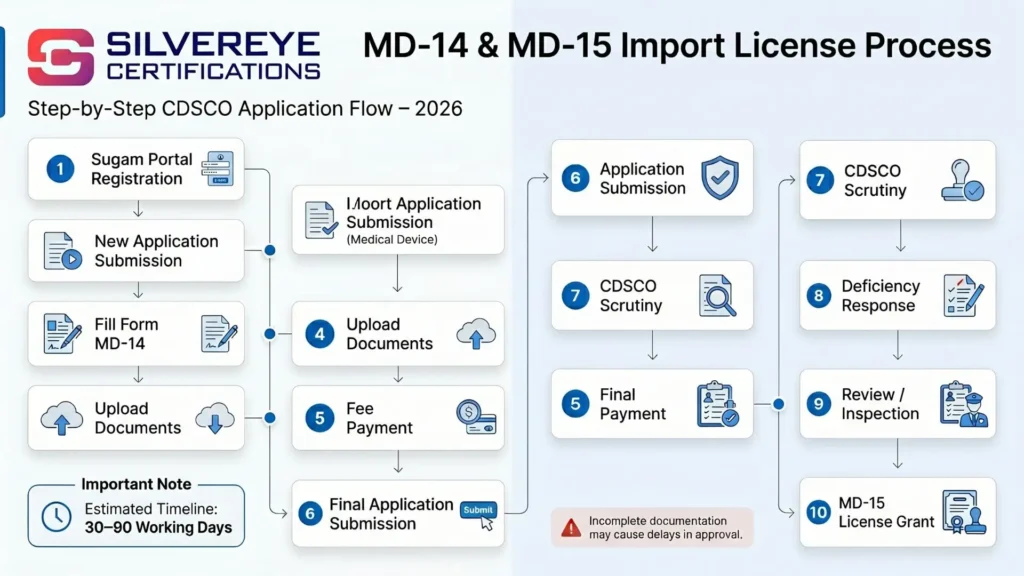
MD-14 Step-by-Step Process for Wheelchairs Import License
- Register on CDSCO SUGAM portal as an importer
- Select 'Import License for Medical Device' from the application dashboard
- Fill Form MD-14 online with complete wheelchair device and manufacturer details
- Upload all mandatory documents in PDF/JPG format within the portal's size limits
- Pay the prescribed fee online via the SUGAM payment gateway
- Submit the application and save the acknowledgement reference number
- Application is assigned to a CDSCO Technical Officer for scrutiny
- Respond to any technical queries or deficiency notices within the prescribed window
- CDSCO may request ISO 7176 test reports or clinical data for Class C/D wheelchairs
- Upon successful review, Form MD-15 (Import License) is issued digitally on SUGAM
- Download MD-15 license and maintain it for all future import transactions and customs clearance
MD-41 Application and MD-42 Grant of Wholesale License for Wheelchairs
What Is Form MD-41 for Wheelchair Distribution?
Form MD-41 is the application for a Wholesale Medical Device License under Rule 41 of the Medical Devices Rules, 2017. Any company or individual operating as a wholesale distributor, stockist, or C&F agent for wheelchairs and mobility aids must obtain this license from the State Licensing Authority (SLA) of their operating state before commencing distribution activities.
Who Needs an MD-41 Wholesale License for Wheelchairs?
- State-level or national distributors supplying wheelchairs to hospitals, rehabilitation centres, pharmacies, and DME retailers
- C&F agents and regional stockists warehousing wheelchair inventory for onward distribution
- Wholesale suppliers of power wheelchairs, mobility scooters, and seating systems to institutional buyers
- Distributors engaged in government tender supply of wheelchairs under ADIP, ALIMCO, or state schemes
- Companies managing bulk supply of wheelchair accessories — cushions, footrests, headrests, and seating systems
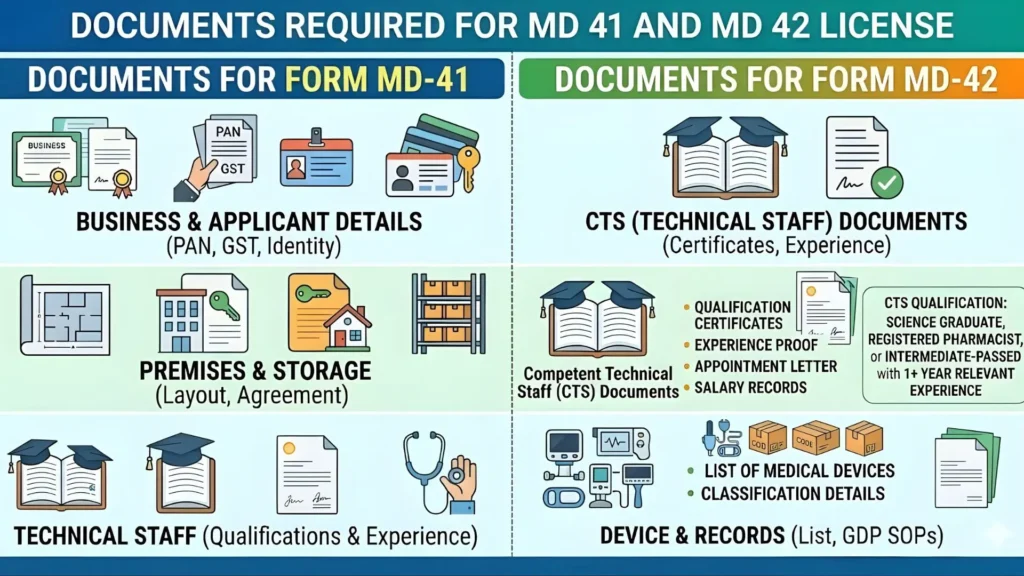
Documents Required for MD-41 – Wheelchairs Wholesale License
| S.No. | Document Required |
| 1 | Duly filled Form MD-41 |
| 2 | Proof of ownership or lease of storage / warehouse premises |
| 3 | Site plan / floor layout of storage facility |
| 4 | List of wheelchair and mobility aid devices to be wholesaled |
| 5 | Details of Qualified Person (QP) – name, qualifications, appointment letter |
| 6 | Affidavit / declaration by proprietor, partner, or director |
| 7 | GST registration certificate |
| 8 | Business incorporation certificate (for companies and LLPs) |
| 9 | Proof of adequate storage conditions (dry, clean, secure premises) |
| 10 | Undertaking for proper record-keeping, traceability, and complaint handling |
| 11 | NOC from local authority (if mandated by the respective state SLA) |
MD-41 Wholesale License Fee for Wheelchairs
| License Type | Fee (INR) | Remarks |
| New Wholesale License (MD-41) | ₹3,000 – ₹5,000 | Varies by state; confirm with respective SLA |
| Renewal of Wholesale License | ₹2,000 – ₹3,000 | Renewed every 5 years |
| Amendment (premises / device list) | As prescribed by SLA | Applicable when premises or product list changes |
What Is Form MD-42?
Form MD-42 is the Grant of Wholesale License issued by the State Licensing Authority on approval of the MD-41 application. This license authorizes the holder to wholesale supply and distribute the specified wheelchair and mobility device products from the approved premises within the licensed jurisdiction.
- Validity: 5 years from date of issue
- Renewal: Submit renewal via MD-41 to the SLA before expiry, with updated documents and fee
MD-3 Application and MD-5 Grant of Manufacturing License for Wheelchairs – Class A & B
What Is Form MD-3 for Wheelchairs Manufacturing?
Form MD-3 is the application form for a Manufacturing License for Class A and Class B medical devices in India, processed by the State Licensing Authority (SLA). Indian manufacturers producing standard manual wheelchairs, folding wheelchairs, paediatric wheelchairs, tilt-in-space models, sports wheelchairs, and shower chairs (Class A or B) must apply via MD-3 with their respective state SLA.
Who Needs to Apply for MD-3 for Wheelchairs Manufacturing?
- Domestic manufacturers producing standard folding or rigid manual wheelchairs (Class A)
- Companies manufacturing tilt-in-space, reclining, paediatric, and sports wheelchairs (Class B)
- Producers of commode wheelchairs, shower chairs, and bariatric manual wheelchairs (Class B)
- MSMEs and startups setting up wheelchair manufacturing units under Make in India initiatives
- Manufacturers of wheelchair accessories — cushions, footrests, armrests (Class A)
Documents Required for MD-3 – Manufacturing License (Class A & B Wheelchairs)
| S.No. | Document Required | Purpose |
| 1 | Duly filled Form MD-3 (online on SUGAM) | Core manufacturing license application |
| 2 | Proof of ownership or lease of manufacturing premises | Factory / facility documentation |
| 3 | Factory layout / site plan with area details | Facility structure verification |
| 4 | List of wheelchair devices to be manufactured with specifications | Scope of manufacturing license |
| 5 | Quality Management System documentation | ISO 13485 or equivalent QMS |
| 6 | Technical dossier for each wheelchair model | Design history file, specifications, testing |
| 7 | Details of Qualified Person (QP) with educational qualifications | Regulatory staffing requirement |
| 8 | List of manufacturing equipment and quality control instruments | Production capability proof |
| 9 | Raw material specifications and approved supplier list | Input material quality control |
| 10 | In-process and finished product testing protocols | QC procedures for wheelchair assembly |
| 11 | Structural / load testing data (basic, per applicable standards) | Safety compliance for Class A/B |
| 12 | Labelling specimens meeting Rule 24 requirements | Product label compliance |
| 13 | GST registration and business incorporation documents | Legal entity documents |
| 14 | Undertaking / declaration of compliance by manufacturer | Self-declaration |
MD-3 Manufacturing License Fee (Class A & B Wheelchairs)
| Device Class | Application Fee (INR) | Licensing Authority | License Duration |
| Class A | ₹3,000 per device type | State Licensing Authority (SLA) | 5 Years |
| Class B | ₹5,000 per device type | State Licensing Authority (SLA) | 5 Years |
What Is Form MD-5?
Form MD-5 is the Grant of Manufacturing License for Class A and Class B wheelchairs issued by the State Licensing Authority. Once issued, the holder can legally manufacture and sell the listed wheelchair models in India from the approved facility.
- Validity: 5 years from date of issue
- Renewal: Apply via Form MD-3 to the SLA before expiry with updated documents and applicable fee
MD-3 Manufacturing License Process – Step by Step
- Register as a medical device manufacturer on the SUGAM portal
- Select 'Manufacturing License – Class A/B Medical Device' and fill Form MD-3
- Upload factory layout, QMS documentation, and device technical files
- Pay the state-prescribed fee online through SUGAM
- SLA reviews application; may schedule factory inspection for verification
- Resolve any deficiency notices raised by SLA within the given timeline
- Upon approval after inspection and review, Form MD-5 is issued by SLA
- Download the license from SUGAM and commence commercial manufacturing
MD-7 Application and MD-9 Grant of Manufacturing License for Wheelchairs – Class C & D
What Is Form MD-7 for Wheelchairs Manufacturing?
Form MD-7 is the application for a Manufacturing License for Class C and Class D medical devices, processed by CDSCO at the central level. Indian manufacturers producing power wheelchairs, motorized tilt-in-space systems, standing wheelchairs, mobility scooters (Class C), or advanced BCI-controlled / autonomous wheelchairs (Class D) must apply via Form MD-7 with CDSCO, New Delhi.
Class C and D wheelchair manufacturing requires significantly more rigorous documentation including clinical evaluation data, ISO 7176 compliance testing, electrical safety certifications, and battery safety reports. CDSCO typically conducts a factory audit before granting the MD-9 license for these categories.
Who Needs to Apply for MD-7 for Wheelchair Manufacturing?
- Indian manufacturers of battery-powered / electric wheelchairs (Class C)
- Companies producing motorized standing wheelchairs and power tilt-in-space systems (Class C)
- Manufacturers of 3-wheel and 4-wheel mobility scooters (Class C)
- Producers of BCI-controlled, eye-gaze, and sip-and-puff wheelchairs (Class D)
- Companies developing AI-guided autonomous wheelchairs with obstacle avoidance (Class D)
- Manufacturers of robotic exoskeleton-integrated wheelchair systems (Class D)
Documents Required for MD-7 – Manufacturing License (Class C & D Wheelchairs)
| S.No. | Document Required | Purpose |
| 1 | Duly filled Form MD-7 (online on SUGAM) | Core manufacturing license application |
| 2 | Detailed Site Master File (SMF) | Comprehensive manufacturing facility documentation |
| 3 | ISO 13485:2016 certification (mandatory) | Quality management system compliance |
| 4 | Complete technical dossier for each wheelchair model | Design, risk, testing, software documentation |
| 5 | Risk management file (ISO 14971) | Systematic hazard analysis and risk control |
| 6 | Clinical evaluation / performance data | Safety and effectiveness evidence |
| 7 | ISO 7176 series test reports (relevant parts) | Wheelchair performance and safety standard compliance |
| 8 | Electrical safety test report (IEC 60601-1) for powered wheelchairs | Electrical safety compliance |
| 9 | EMC test report (IEC 60601-1-2) | Electromagnetic compatibility compliance |
| 10 | Battery and charger safety (UN 38.3, IEC 62133 for Li-ion) | Battery system safety certification |
| 11 | Software validation file (IEC 62304) for embedded control software | Medical device software compliance |
| 12 | Biocompatibility data (ISO 10993) for skin-contact parts | Material safety for seating and upholstery |
| 13 | Post-market surveillance and vigilance plan | Ongoing safety monitoring |
| 14 | In-process and final QC testing protocols | Quality control documentation |
| 15 | Qualified Person and technical staff details | Regulatory staffing compliance |
| 16 | Undertaking and Declaration of Conformity | Manufacturer's self-declaration |
MD-7 Manufacturing License Fee (Class C & D Wheelchairs)
| Device Class | Application Fee (INR) | Licensing Authority | License Duration |
| Class C | ₹50,000 per device type | CDSCO (Central Licensing Authority) | 5 Years |
| Class D | ₹1,00,000 per device type | CDSCO (Central Licensing Authority) | 5 Years |
What Is Form MD-9?
Form MD-9 is the Grant of Manufacturing License for Class C and D wheelchairs issued by CDSCO. This centrally granted license is mandatory before any powered or high-risk wheelchair can be commercially manufactured and sold in India. A factory audit by CDSCO is typically conducted as part of the MD-9 licensing process.
- Validity: 5 years from the date of issue
- Renewal: Apply through Form MD-7 before expiry; a fresh CDSCO factory audit may be conducted at renewal
Eligibility Requirements for CDSCO Wheelchair Registration
For Importers (MD-14)
- Legally incorporated entity in India — company, LLP, partnership, or proprietorship
- Registered business address in India with valid address proof
- Foreign manufacturer must appoint an authorized Indian agent with a formal letter
- Manufacturer's device must hold valid CE (EU MDR), US FDA, or equivalent regulatory approval
- Manufacturer must hold a valid ISO 13485 certificate covering the wheelchair products
- Device must be tested against ISO 7176 performance standards where applicable
For Manufacturers – Class A/B (MD-3)
- Own or leased manufacturing premises in India compliant with Schedule M-III GMP requirements
- Qualified Person employed full-time with prescribed educational qualifications
- Documented quality management system in place (ISO 13485 strongly recommended)
- Testing capability for structural strength, load bearing, and dimensional compliance of wheelchairs
For Manufacturers – Class C/D (MD-7)
- All Class A/B eligibility criteria, plus mandatory ISO 13485:2016 certification
- ISO 7176 performance testing by accredited laboratory for the specific wheelchair models
- Electrical safety (IEC 60601-1) and EMC (IEC 60601-1-2) test reports for powered wheelchairs
- Battery safety certification (UN 38.3 / IEC 62133) for lithium-ion battery powered systems
- Clinical evaluation or systematic performance evidence for the wheelchair model
- Factory must be ready for CDSCO audit before MD-9 license is granted
For Wholesale Distributors (MD-41)
- Adequate storage premises meeting basic cleanliness, safety, and security requirements
- Qualified Person available during business hours at the licensed premises
- Systems for purchase records, sale records, and product recall / traceability
Key Benefits of CDSCO Wheelchairs Medical Device Registration in India 2026
- Legal Market Access: Only CDSCO-registered wheelchairs can be legally imported, manufactured, or distributed in India. Registration is the primary legal requirement for market entry.
- Government Tender Eligibility: CDSCO-licensed wheelchair products are eligible for procurement under ALIMCO, ADIP scheme, state welfare boards, and PM-ABHIM procurement programs.
- Consumer Safety Assurance: CDSCO registration confirms that wheelchairs meet minimum safety and performance benchmarks, protecting end users — persons with disabilities, the elderly, and rehabilitation patients.
- Brand Credibility & Institutional Trust: Registered products are preferred by hospitals, rehabilitation centres, and NGOs over unregistered alternatives.
- Export Documentation Support: CDSCO registration assists in export compliance and is recognized by several foreign regulatory bodies for bilateral equivalence agreements.
- Participation in Disability Welfare Schemes: CDSCO compliance enables access to large-scale government mobility aid distribution programs across India.
- Investor & Partnership Readiness: Regulatory compliance is increasingly a prerequisite for institutional investors, private equity, and international distribution partnerships.
Validity and Renewal of CDSCO Wheelchair Licenses
| License Type | Application Form | Grant Form | Validity | Renewal Timeline |
| Import License | MD-14 | MD-15 | 5 Years | Apply minimum 90 days before expiry |
| Manufacturing (Class A/B) | MD-3 | MD-5 | 5 Years | Apply minimum 60 days before expiry |
| Manufacturing (Class C/D) | MD-7 | MD-9 | 5 Years | Apply minimum 90 days; factory re-audit possible |
| Wholesale License | MD-41 | MD-42 | 5 Years | Apply minimum 60 days before expiry via SLA |
Important: An expired license means zero legal imports or sales until renewal is granted. Build a compliance calendar with reminders at 6 months and 3 months before each license expiry date.
CDSCO Wheelchair Registration Processing Timeline 2026
| Application Type | Typical Processing Time | Key Factors |
| Import License (MD-14, Class A) | 25–40 working days | Document completeness; query response speed |
| Import License (MD-14, Class B) | 40–60 working days | ISO 13485 validity; CE / FDA proof |
| Import License (MD-14, Class C) | 60–90 working days | ISO 7176 test data; electrical safety reports |
| Import License (MD-14, Class D) | 90–150 working days | Clinical evaluation review; AI/BCI complexity |
| Manufacturing License (MD-3, Class A/B) | 30–60 working days | SLA workload; factory inspection schedule |
| Manufacturing License (MD-7, Class C/D) | 90–180 working days | CDSCO factory audit; ISO 7176 test verification |
| Wholesale License (MD-41) | 15–30 working days | State SLA workload; premises inspection |
How to Apply on CDSCO SUGAM Portal for Wheelchairs Registration 2026
All CDSCO medical device applications — import license, manufacturing license, and wholesale license — must be filed online through the SUGAM portal. Paper or offline applications are no longer accepted for standard registration processes.
- Visit sugam portal and register as a new applicant (importer / manufacturer / distributor)
- Complete your applicant profile with business details and contact information
- Select the applicable module: Import License / Manufacturing License / Wholesale License
- Choose the correct form: MD-14, MD-3, MD-7, or MD-41 based on your role and device class
- Fill the online application form with accurate wheelchair device and manufacturer details
- Upload all required documents in PDF/JPG format within the specified file size limits
- Review and verify all application details before final submission
- Pay the prescribed application fee online via SUGAM payment gateway
- Submit the application and download the acknowledgement receipt with reference number
- Track status on SUGAM dashboard; respond to any technical queries or deficiency notices promptly
- Receive digitally issued grant of license (MD-15, MD-5, MD-9, or MD-42) on the SUGAM portal
- Download and preserve the license; use it for all commercial, customs, and compliance purposes
Compliance Points for Wheelchairs Medical Device Registration in India
Labelling Requirements Under Rule 24 – Medical Devices Rules, 2017
- Wheelchair name and model number
- Manufacturer's name, address, and CDSCO license number
- Batch / serial number for traceability
- Manufacturing date and shelf life (where applicable)
- Maximum user weight capacity (clearly stated in kg)
- Electrical rating for powered wheelchairs (voltage, wattage, battery type)
- Intended use, warnings, precautions, and contraindications
- 'Rx Only' or equivalent caution for prescription-level complex rehabilitation devices
GMP Requirements Under Schedule M-III for Wheelchair Manufacturers
- Organized and adequately sized manufacturing area for wheelchair frame fabrication, assembly, and finishing
- Raw materials (steel, aluminium, upholstery, motors, batteries) from approved and documented suppliers
- In-process quality checks at frame welding, assembly, painting, and final inspection stages
- Finished product testing for load capacity, structural integrity, and stability before dispatch
- Batch records maintained for at least 5 years with full production and quality control history
Common Reasons for Rejection of Wheelchair CDSCO Applications
- Incomplete or inconsistent technical dossier — missing design history file or test data
- Expired ISO 13485 certificate or CE/FDA certificate with wrong product scope
- Missing ISO 7176 wheelchair performance test reports for Class C/D power wheelchairs
- Missing battery safety certification (UN 38.3) for lithium-ion powered wheelchairs
- Device name mismatch between CE certificate and application form
- Non-response to CDSCO technical queries within 30-day stipulated window
- Incorrect fee payment — wrong class or device type selected during fee payment
- Factory / premises not meeting Schedule M-III GMP requirements during SLA/CDSCO inspection
Conclusion
India's wheelchair and mobility aid market is at an inflection point. With 26 million persons with locomotor disabilities, a rapidly growing elderly population, and significant government investment in disability inclusion infrastructure, the demand for quality-certified wheelchairs has never been higher. CDSCO medical device registration is the legal and commercial foundation for every player in this market.
Whether you are importing manual folding wheelchairs from a European manufacturer, setting up a domestic electric wheelchair production unit, or building a distribution network for mobility scooters across India — the licensing path is clear: MD-14 for imports, MD-3/MD-5 for Class A/B manufacturing, MD-7/MD-9 for Class C/D manufacturing, and MD-41/MD-42 for wholesale. Each pathway has specific documentation requirements, fees, and timelines that must be respected.
Engage a qualified regulatory affairs professional for Class C/D applications or when navigating complex technical dossier requirements for power wheelchairs. Always verify the latest fee schedules, form versions, and document requirements on the official CDSCO SUGAM portal to ensure your application is current and complete.
Frequently Asked Questions
Is wheelchair registration mandatory under CDSCO in India?
Yes. Wheelchairs are listed as notified medical devices under Schedule I of the Medical Devices Rules, 2017. Any import, manufacture, or wholesale distribution of wheelchairs without a valid CDSCO license is a legal violation punishable under the Drugs and Cosmetics Act, 1940.
What class is a standard manual wheelchair under CDSCO?
A standard non-adjustable manual wheelchair is Class A (low risk). A tilt-in-space, paediatric, or sports wheelchair is Class B (low-moderate risk). Power wheelchairs and mobility scooters are Class C (moderate-high risk). BCI-controlled, robotic, and AI-autonomous wheelchairs are Class D (high risk).
Can a foreign wheelchair manufacturer sell directly in India without registering?
No. A foreign manufacturer must obtain an Import License (MD-15) via Form MD-14 through an authorized Indian agent before any commercial import. Attempting to import without a valid license risks customs seizure, legal penalties, and debarment from Indian markets.
Does a power wheelchair need ISO 7176 compliance for CDSCO registration?
Yes. CDSCO technical reviewers expect the technical dossier for power wheelchairs (Class C/D) to include performance test data per the ISO 7176 series. Parts covering dynamic stability (7176-2), brakes (7176-3), power systems (7176-14), and batteries (7176-25) are most commonly reviewed.
What is the difference between MD-3 and MD-7 for wheelchair manufacturers?
Form MD-3 is used by manufacturers of Class A and B manual wheelchairs, processed by the State Licensing Authority. Form MD-7 is used by manufacturers of Class C and D powered wheelchairs, processed by CDSCO at the central level. Documentation, fees, and inspection requirements are significantly more rigorous for MD-7.
How long does CDSCO take to process a wheelchair import license application?
For Class A manual wheelchairs, processing typically takes 25 to 40 working days. For Class B, it is 40 to 60 working days. For Class C power wheelchairs, expect 60 to 90 working days. Class D advanced wheelchairs may take 90 to 150 working days due to complex clinical and technical review.
Is ISO 13485 mandatory for wheelchair import registration under CDSCO?
Yes. A valid ISO 13485:2016 certificate of the foreign manufacturer is a mandatory document for the MD-14 import license application for all wheelchair classes. An expired or incorrectly scoped ISO 13485 certificate is a common reason for application rejection.
Do wholesale wheelchair distributors need a separate CDSCO license?
Yes. Any entity operating as a wholesale distributor, C&F agent, or stockist for wheelchairs must obtain a Wholesale Medical Device License via Form MD-41 from the State Licensing Authority. The license is granted as Form MD-42 and is valid for 5 years.
Does CDSCO conduct a factory inspection for wheelchair manufacturing licenses?
For Class A/B manufacturing licenses (MD-3/MD-5), the State Licensing Authority may or may not conduct a factory inspection depending on state policy. For Class C/D manufacturing licenses (MD-7/MD-9), a CDSCO factory audit is typically mandatory before the license is granted.
Where do I file CDSCO wheelchair registration applications in 2026?
All applications — MD-14 (import), MD-3 (Class A/B manufacturing), MD-7 (Class C/D manufacturing), and MD-41 (wholesale) — must be filed online on the CDSCO SUGAM portal. Physical/paper applications are not accepted for standard registration processes.