- Ultrasound machines are regulated as medical devices under MDR 2017 — classified across Class A, B, C, and D based on intended use and patient risk.
- Importers need Form MD-14 application and MD-15 import license from CDSCO before clearing any ultrasound equipment at Indian customs.
- Manufacturers require Form MD-3/MD-5 (Class A/B) or MD-7/MD-9 (Class C/D) — with Class C/D manufacturing licenses approved centrally by CDSCO.
- Wholesale distributors of ultrasound machines must obtain a separate MD-41 wholesale license (Form MD-42 grant) before supplying in the Indian market.
Introduction
CDSCO registration for ultrasound machines is mandatory under the Medical Devices Rules (MDR), 2017. Ultrasound machines fall under Class C or Class D depending on intended use. Importers file Form MD-14 and receive an MD-15 import license. Manufacturers of Class A/B file MD-3 for an MD-5 license; Class C/D manufacturers file MD-7 for an MD-9 license. Wholesale distributors require an MD-41 application and MD-42 license. All licenses are issued through the CDSCO Sugam portal.
What Is CDSCO and Why Does It Regulate Ultrasound Machines?
The Central Drugs Standard Control Organization (CDSCO) is India's national regulatory authority for medical devices, operating under the Ministry of Health and Family Welfare. Under the Medical Devices Rules, 2017 (MDR 2017) — notified under the Drugs and Cosmetics Act, 1940 — all medical devices sold or imported in India must be registered and licensed with CDSCO.
Ultrasound machines, also called ultrasonography equipment or sonography machines, use high-frequency sound waves to produce real-time images of internal body structures. They are used across diagnostic radiology, obstetrics, cardiology, emergency medicine, and point-of-care settings. Because they are used directly in clinical decision-making affecting patient outcomes, CDSCO brings them under mandatory regulatory oversight.
CDSCO registration for ultrasound machines ensures that every device entering the Indian market — whether imported or manufactured domestically — meets safety, performance, and quality standards before it is used on patients.
Medical Device Classification: Understanding Class A, B, C, and D
Under MDR 2017, all medical devices are classified into four risk-based classes. The classification determines which regulatory pathway applies — who approves the licence, what documents are needed, and how long the process takes.
| Class | Risk Level | Regulatory Authority | Examples (General) |
| Class A | Low risk | State Licensing Authority (SLA) | Tongue depressors, bandages, basic diagnostic tools |
| Class B | Low-moderate risk | State Licensing Authority (SLA) | Hypodermic needles, suction equipment, simple diagnostic devices |
| Class C | Moderate-high risk | CDSCO (Central) | Haemodialysis machines, ventilators, diagnostic imaging devices |
| Class D | High risk | CDSCO (Central) | Implantable devices, cardiac stents, high-risk life-support equipment |
| Note: Ultrasound machines are predominantly classified as Class C or Class D under MDR 2017 depending on their intended clinical application. This means their import and manufacturing licenses are approved centrally by CDSCO — not by the State Licensing Authority. |
Ultrasound Machine Classification Under CDSCO MDR 2017
CDSCO classifies ultrasound machines under the Medical Devices Rules, 2017, referring to the Third Schedule which lists notified medical devices subject to regulation. The classification of ultrasound equipment is based on intended use, patient contact type, and clinical risk profile.
Class A Ultrasound Devices — Low Risk
Class A devices have the lowest risk profile. Most ultrasound machines used in direct diagnostic or therapeutic applications do not fall in this class. However, some peripheral or ancillary ultrasound-related accessories with no direct patient risk may be categorised here.
| CLASS A — Low Risk Ultrasound-Related Devices | |||
| Device Type | Typical Use | Patient Contact | Regulatory Body |
| Ultrasound gel / coupling medium | Coupling agent for probe-skin contact | Indirect / surface | State Licensing Authority |
| Ultrasound probe covers / sheaths (non-sterile) | Probe hygiene barrier | Indirect | State Licensing Authority |
| Ultrasound equipment accessories (cables, mounts) | Ancillary support hardware | None | State Licensing Authority |
Class B Ultrasound Devices — Low to Moderate Risk
Class B ultrasound-related devices present a slightly elevated risk profile but are still managed at the state level. Standalone diagnostic ultrasound machines that are non-invasive and used for general-purpose imaging may in some configurations fall here, but most imaging systems are Class C.
| CLASS B — Low to Moderate Risk Ultrasound Devices | |||
| Device Type | Typical Use | Patient Contact | Regulatory Body |
| Basic handheld ultrasound devices (non-diagnostic output) | Limited-use bedside screening | Non-invasive surface | State Licensing Authority |
| Ultrasound therapy units (physiotherapy, low-intensity) | Musculoskeletal physiotherapy | External contact | State Licensing Authority |
| Fetal Doppler (handheld, non-imaging) | Monitoring fetal heartbeat externally | External contact | State Licensing Authority |
Class C Ultrasound Devices — Moderate to High Risk
The majority of diagnostic ultrasound machines used in Indian hospitals, clinics, and diagnostic centres fall under Class C. These include general-purpose B-mode scanners, colour Doppler systems, and portable diagnostic ultrasound units. Class C devices require central CDSCO approval for both import and manufacturing licences.
| CLASS C — Moderate to High Risk Ultrasound Machines (CDSCO Regulated) | |||
| Ultrasound Machine Type | Clinical Application | Key Feature | Regulatory Body |
| 2D B-Mode Ultrasound Scanner | Abdominal, obstetric, pelvic imaging | Real-time 2D grayscale imaging | CDSCO (Central) |
| Colour Doppler Ultrasound System | Vascular, cardiac, obstetric blood flow | Colour-coded blood flow mapping | CDSCO (Central) |
| Power Doppler Ultrasound System | Low-velocity vascular flow imaging | Enhanced sensitivity to slow flow | CDSCO (Central) |
| 3D Ultrasound Scanner | Obstetric fetal anatomy, organ volume | Three-dimensional reconstruction | CDSCO (Central) |
| 4D / Real-Time 3D Ultrasound Scanner | Live fetal imaging, cardiology | Real-time volumetric imaging | CDSCO (Central) |
| Portable / Handheld Diagnostic Ultrasound | Emergency, point-of-care, rural health | Battery-powered mobile unit | CDSCO (Central) |
| Wireless / Pocket Ultrasound Device | Point-of-care scanning, telemedicine | Smartphone-connected transducer | CDSCO (Central) |
| Cart-Based Diagnostic Ultrasound Workstation | Radiology departments, OPD imaging | Full-featured trolley-mounted system | CDSCO (Central) |
| Musculoskeletal (MSK) Ultrasound System | Joint, tendon, nerve imaging | High-frequency linear transducer | CDSCO (Central) |
| Breast Ultrasound Scanner | Breast lesion characterisation | High-resolution linear imaging | CDSCO (Central) |
| Thyroid / Superficial Organ Ultrasound System | Thyroid, lymph node, salivary gland | High-frequency probe | CDSCO (Central) |
| Transcranial Doppler (TCD) System | Cerebrovascular blood flow | Low-frequency pulsed Doppler | CDSCO (Central) |
| Ophthalmic Ultrasound (A-scan / B-scan) | Ocular biometry, retinal imaging | High-frequency eye probe | CDSCO (Central) |
| Veterinary Diagnostic Ultrasound | Animal diagnostic imaging | Adapted for animal anatomy | CDSCO (Central) |
Class D Ultrasound Devices — High Risk
Class D ultrasound systems are the highest-risk category — typically those used in invasive procedures, cardiac interventions, or where device failure poses direct life-threatening risk. These require the most rigorous CDSCO review and the strictest quality and clinical data standards.
| CLASS D — High Risk Ultrasound Machines (CDSCO Regulated) | |||
| Ultrasound Machine Type | Clinical Application | Key Feature | Regulatory Body |
| Echocardiography System (Echo Machine) | Cardiac structure and function assessment | Cardiac-specific probes and protocols | CDSCO (Central) |
| Transesophageal Echocardiography (TEE) System | Intraoperative and ICU cardiac monitoring | Invasive — probe inserted via oesophagus | CDSCO (Central) |
| Intravascular Ultrasound (IVUS) System | Coronary artery imaging during catheterisation | Invasive intravascular catheter probe | CDSCO (Central) |
| High Intensity Focused Ultrasound (HIFU) System | Non-invasive tumour ablation, uterine fibroids | Therapeutic — tissue destruction | CDSCO (Central) |
| Ultrasound-Guided Biopsy / Intervention System | Image-guided tissue sampling and procedures | Real-time needle guidance | CDSCO (Central) |
| Intraoperative Ultrasound System | Surgical guidance during open and laparoscopic surgery | Sterile, OR-integrated imaging | CDSCO (Central) |
| Endoscopic Ultrasound (EUS) System | GI tract and surrounding organ imaging | Invasive endoscope-mounted transducer | CDSCO (Central) |
| Laparoscopic Ultrasound Probe System | Intra-abdominal imaging during laparoscopy | Laparoscope-compatible probe | CDSCO (Central) |
CDSCO License Forms for Ultrasound Machines: Complete Overview
India's MDR 2017 framework uses specific application and licence forms depending on whether you are an importer, manufacturer, or wholesale distributor. Here is how the form structure works for ultrasound machines:
| Activity | Application Form | Licence / Grant Form | Issued By | Applicable Class |
| Import of ultrasound machines | MD-14 | MD-15 | CDSCO | All classes (A–D) |
| Wholesale distribution | MD-41 | MD-42 | State Licensing Authority | All classes (A–D) |
| Manufacturing (Class A / B) | MD-3 | MD-5 | State Licensing Authority | Class A & B |
| Manufacturing (Class C / D) | MD-7 | MD-9 | CDSCO (Central) | Class C & D |
| Note: Since most ultrasound machines are Class C or Class D, their manufacturing licenses (MD-7 → MD-9) are approved by CDSCO centrally. Class A/B ultrasound accessories manufactured domestically use the MD-3 → MD-5 pathway through the State Licensing Authority. |
MD-14 Application: Import License for Ultrasound Machines
Any company or entity that wants to import ultrasound machines into India for commercial sale, demonstration, or distribution must first obtain a valid import license in Form MD-15 by filing a Form MD-14 application with CDSCO.
Who Must File Form MD-14?
- Foreign ultrasound machine manufacturers exporting to India through an Indian authorised agent
- Indian importers and distributors bringing ultrasound systems from overseas OEMs
- Authorized Indian representatives (AIR) of foreign medical device companies
- Companies importing for re-export, clinical evaluation, or exhibition (separate pathways may apply)
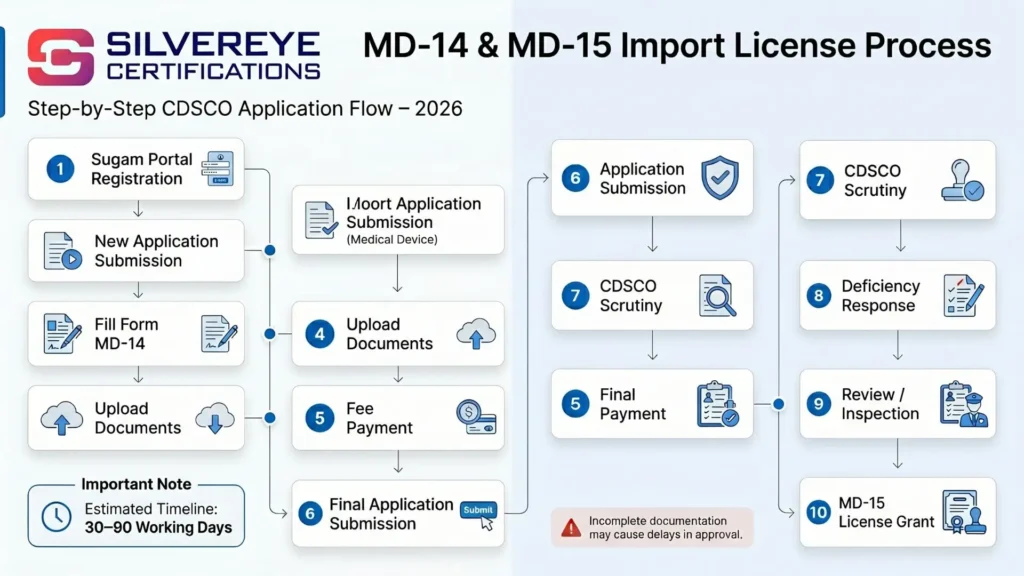
MD-14 Application Process — Step by Step
- Register on the CDSCO Sugam portal (sugam.gov.in) as an importer entity
- Appoint an Authorized Indian Representative (AIR) if the manufacturer is a foreign entity
- Classify the ultrasound machine correctly under MDR 2017 Third Schedule
- Prepare the complete Technical File / Device Master Record (DMR)
- Ensure the device holds a valid CE Mark, US FDA clearance, or approval from a recognized international regulatory authority (MDSAP member country)
- File Form MD-14 online on the Sugam portal with all required documents and fee payment
- CDSCO scrutinizes the application — may raise technical or clinical queries
- Respond to any Additional Information (AI) requests within stipulated timelines
- CDSCO grants the import license in Form MD-15 upon satisfactory review
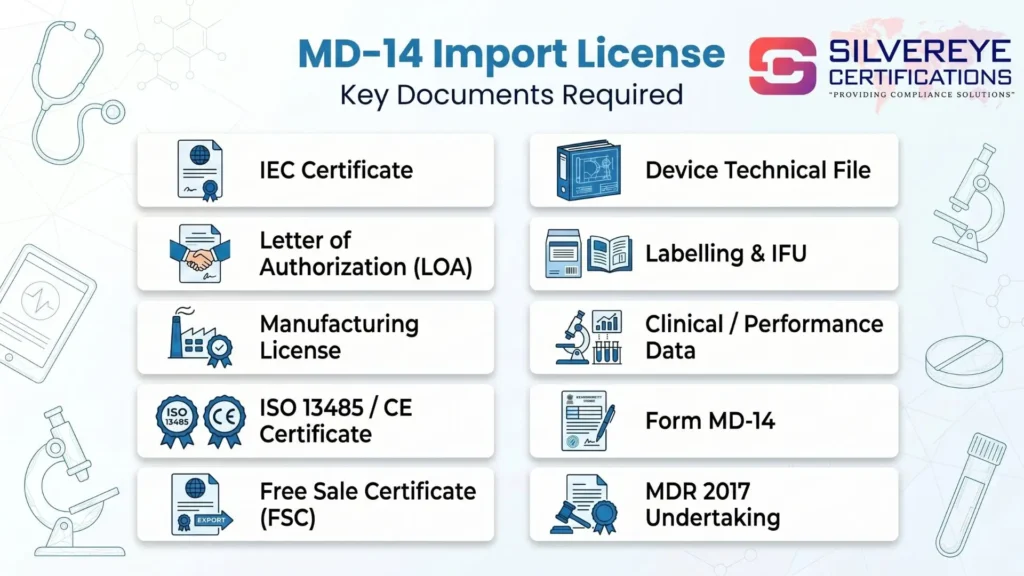
Documents Required for MD-14 (Import License — Ultrasound Machine)
| Document | Details / Requirement |
| Form MD-14 (duly filled) | Online submission via CDSCO Sugam portal |
| Certificate of incorporation / business registration | Of the Indian importer entity |
| Authorisation letter from foreign manufacturer | Appointing the Indian entity as AIR / importer |
| Foreign regulatory approval (CE / US FDA / TGA etc.) | Valid approval from recognised authority |
| ISO 13485 certificate of manufacturer | Quality management system certification |
| Device description and intended use | Clear clinical indication and mode of action |
| Risk classification justification | Per MDR 2017 classification rules |
| Essential Principles Checklist (EPC) | Compliance with Schedule III of MDR 2017 |
| Summary Technical Documentation (STED) / Technical File | Performance, safety, biocompatibility data |
| IEC 60601-1 compliance data | Electrical safety of medical electrical equipment |
| IEC 60601-2-37 compliance data | Specific to diagnostic ultrasound equipment |
| Clinical evaluation report / clinical data | Evidence of safety and performance |
| Labelling (draft) and Instructions for Use (IFU) | In English; Hindi optional but recommended |
| Post-market surveillance plan | How adverse events will be monitored |
| Unique Device Identification (UDI) details | As applicable under CDSCO UDI framework |
| Import Export Code (IEC) of importer | Issued by DGFT, India |
| Declaration of conformity | By manufacturer |
Government Fee for MD-14 (Import License)
| Fee Category | Approximate Fee (INR) |
| Application fee — Class A device | As per MDR 2017 Second Schedule |
| Application fee — Class B device | As per MDR 2017 Second Schedule |
| Application fee — Class C device | As per MDR 2017 Second Schedule |
| Application fee — Class D device | As per MDR 2017 Second Schedule |
| Import licence renewal fee | Per Second Schedule of MDR 2017 |
| Note: CDSCO revises fee schedules periodically. Always verify the current fee applicable to your device class on the official CDSCO Sugam portal before filing. Fee amounts differ by class and are prescribed under the Second Schedule of MDR 2017. |
MD-15: Grant of Import License for Ultrasound Machines
Once CDSCO completes its review of the MD-14 application and is satisfied with all submitted documents and compliance data, it grants the import license in Form MD-15. This is the legal document that authorizes you to import specific ultrasound machine models into India.
Key Features of the MD-15 Import License
- Device-specific — the license specifies the exact model(s) of ultrasound machine covered
- Importer-specific — issued in the name of the Indian entity (importer or AIR)
- Covers the manufacturer's name, manufacturing site, and country of origin
- Validity of 3 years for Class C and D devices; renewable before expiry
- Any model change, manufacturer site change, or labelling update requires license amendment
- A copy of the MD-15 license is required by Indian customs for clearance of each shipment
| MD-15 Licence Parameter | Details |
| Form | MD-15 |
| Issued by | CDSCO (Central) |
| Covers | Specified ultrasound machine model(s) from a specified manufacturer |
| Validity | 3 years (Class C / D); as notified for Class A / B |
| Renewal | Apply before expiry via Sugam portal |
| Amendment | Required for any change in device, site, or labelling |
MD-41 Application: Wholesale License for Ultrasound Machines
Any company that supplies, distributes, or sells ultrasound machines to hospitals, clinics, diagnostic centres, or other end-users in India must hold a valid wholesale license. The application for this license is filed in Form MD-41 with the State Licensing Authority of the state where the wholesale business operates.
Who Needs an MD-41 Wholesale License?
- Medical device distributors supplying ultrasound machines to hospitals or diagnostic centres
- Importers who also act as distributors for their own imported portfolio
- Regional wholesalers and stockists of ultrasound equipment
- Branches or depots of national distribution companies operating in specific states
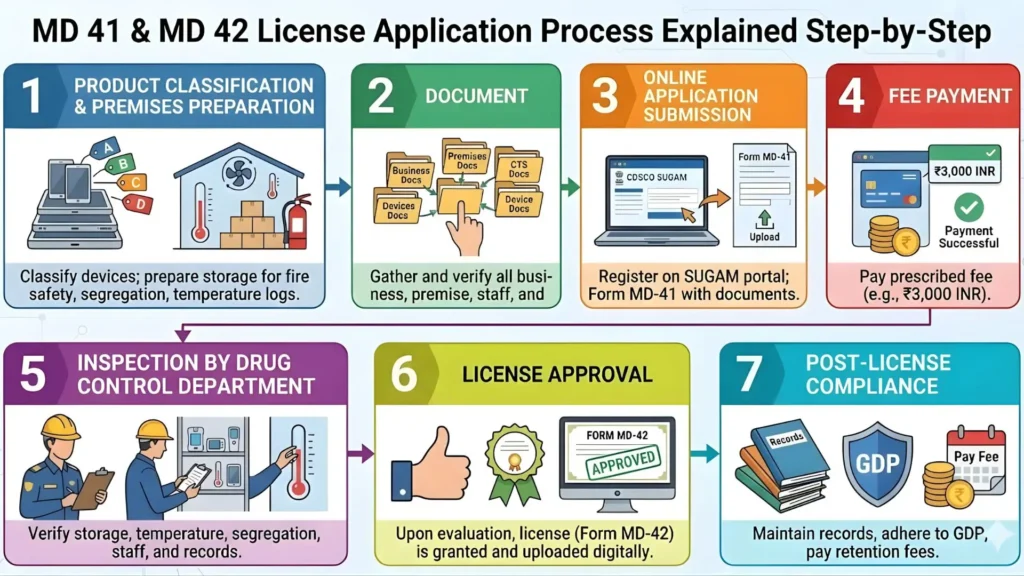
MD-41 Application Process
- Register with the State Licensing Authority (SLA) of the relevant state
- Prepare premises details — dedicated storage area for medical devices is required
- Appoint a technically qualified person (as required by the SLA)
- File Form MD-41 with required documents — online via the state portal or physical submission depending on state
- SLA may conduct a premises inspection
- Pay prescribed state fee
- SLA grants the wholesale license in Form MD-42 upon satisfactory review
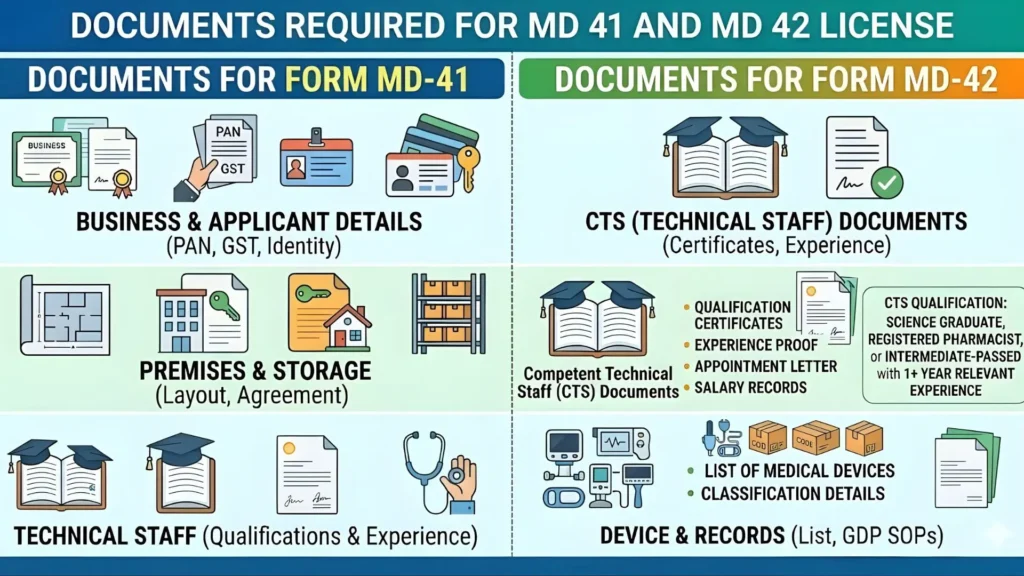
Documents Required for MD-41 (Wholesale License)
| Document | Details |
| Form MD-41 (duly filled) | Submitted to State Licensing Authority |
| Proof of business premises | Ownership or rental agreement |
| Layout plan of storage / office premises | Storage area must meet SLA standards |
| Business registration certificate | GST registration, company incorporation etc. |
| Copy of MD-15 import licence (for importer-distributors) | Showing valid import licence for products being distributed |
| Details of technically qualified person | As required under MDR 2017 and state notifications |
| Declaration of compliance | Signed by the applicant / proprietor |
MD-42: Grant of Wholesale License for Ultrasound Machines
The State Licensing Authority issues the wholesale license in Form MD-42 after reviewing the MD-41 application and, where applicable, inspecting the premises. This license must be displayed at the place of business and renewed on time.
| MD-42 Licence Parameter | Details |
| Form | MD-42 |
| Issued by | State Licensing Authority (SLA) |
| Covers | Wholesale distribution of specified medical device categories in the state |
| Validity | As specified by SLA — typically 5 years |
| Renewal | Apply before expiry with updated documents |
| Display requirement | Licence must be displayed at the place of business |
MD-3 Application and MD-5 License: Manufacturing License for Class A and B Ultrasound Devices
Domestic manufacturers of Class A or Class B ultrasound-related devices — such as physiotherapy ultrasound units, coupling gels, or basic diagnostic accessories — apply for a manufacturing license through Form MD-3 with the State Licensing Authority.
MD-3 Application Process (Class A / B Manufacturing)
- Identify the correct State Licensing Authority for the manufacturing state
- Ensure manufacturing premises comply with Schedule I of MDR 2017 (GMP requirements)
- Prepare quality management system documentation aligned to ISO 13485
- Appoint qualified technical staff as required under MDR 2017
- File Form MD-3 with the SLA along with all required documents and fee
- SLA conducts a GMP inspection of the manufacturing facility
- Address any inspection observations within specified timelines
- SLA grants the manufacturing license in Form MD-5 upon satisfactory compliance
Documents Required for MD-3 (Class A / B Manufacturing License)
| Document | Details |
| Form MD-3 (duly filled) | Submitted to State Licensing Authority |
| Proof of manufacturing premises | Ownership / lease agreement |
| Site master file / plant layout | Manufacturing, QC, storage areas |
| List of medical devices to be manufactured | With device description and intended use |
| ISO 13485 quality management system documentation | Or equivalent QMS aligned to MDR 2017 Schedule I |
| Equipment list and qualification records | All manufacturing and testing equipment |
| Qualification and experience of technical staff | As per MDR 2017 Schedule II |
| Process validation and test protocols | For each device class being manufactured |
| Risk management file (ISO 14971) | Device risk analysis documentation |
| Draft labels and Instructions for Use (IFU) | For each device intended for manufacture |
MD-5: Grant of Manufacturing License (Class A / B)
| MD-5 Licence Parameter | Details |
| Form | MD-5 |
| Issued by | State Licensing Authority (SLA) |
| Applicable to | Class A and Class B medical device manufacturers |
| Validity | As specified under MDR 2017 — typically 5 years |
| Renewal | Before expiry; re-inspection may be required |
| Scope | Facility and device category specific |
MD-7 Application and MD-9 License: Manufacturing License for Class C and D Ultrasound Machines
This is the most critical licensing pathway for domestic manufacturers of diagnostic ultrasound machines in India. Since most ultrasound imaging systems are Class C or Class D, their manufacturing licenses are applied for via Form MD-7 and approved centrally by CDSCO — not the State Licensing Authority.
MD-7 Application Process (Class C / D Manufacturing)
- Register on the CDSCO Sugam portal as a medical device manufacturer
- Ensure manufacturing facility is established and GMP-compliant per Schedule I of MDR 2017
- Obtain ISO 13485 certification from an accredited certification body
- Prepare the complete Technical File / Device Master Record for each ultrasound model
- Generate clinical evaluation / performance data — literature review or clinical trial as applicable
- Prepare Essential Principles Checklist (EPC) per Schedule III of MDR 2017
- File Form MD-7 on the Sugam portal with all required documents and prescribed fee
- CDSCO scrutinizes the application — may raise technical, clinical, or quality queries
- CDSCO conducts or arranges an audit of the manufacturing facility (GMP audit)
- Respond to all CDSCO queries within stipulated timelines
- CDSCO grants the manufacturing license in Form MD-9 upon satisfactory review and inspection
Documents Required for MD-7 (Class C / D Manufacturing License — Ultrasound Machine)
| Document | Details / Notes |
| Form MD-7 (duly filled) | Online submission via CDSCO Sugam portal |
| Certificate of incorporation | Company registration documents |
| ISO 13485 certificate | From NABCB-accredited or internationally recognised CB |
| Manufacturing site details and layout | Full GMP-compliant facility documentation |
| Device description and intended use statement | For each ultrasound model |
| Risk classification justification | Per MDR 2017 Third Schedule rules |
| Essential Principles Checklist (EPC) | Schedule III MDR 2017 compliance mapping |
| Risk management file (ISO 14971) | Risk analysis, evaluation, and control |
| Design history file / technical documentation | Engineering drawings, design verification, validation |
| IEC 60601-1 test report | General electrical safety — accredited lab |
| IEC 60601-2-37 test report | Safety of diagnostic ultrasound equipment — accredited lab |
| IEC 62304 software lifecycle documentation | For ultrasound devices with embedded software |
| IEC 62133 / battery safety (if applicable) | For portable/wireless ultrasound devices |
| Biocompatibility data (ISO 10993) | For patient-contact components |
| Clinical evaluation report | Per MEDDEV 2.7/1 or equivalent Indian guidelines |
| Post-market surveillance plan | Complaint handling, vigilance, PMCF plan |
| Sterilisation documentation (if applicable) | For sterile accessories |
| Draft labelling and IFU | In English; as per MDR 2017 labelling requirements |
| Unique Device Identification (UDI) details | Per CDSCO UDI requirements |
| Declaration of conformity | Signed by authorised signatory |
MD-9: Grant of Manufacturing License (Class C / D)
| MD-9 Licence Parameter | Details |
| Form | MD-9 |
| Issued by | CDSCO (Central Drugs Standard Control Organisation) |
| Applicable to | Class C and Class D medical device manufacturers |
| Validity | 3 years (as per MDR 2017) |
| Renewal | Apply before expiry; GMP re-audit may be required |
| Scope | Facility, device category, and specific model(s) |
| Post-grant obligation | Mandatory adverse event reporting, PMCF, CDSCO vigilance |
MD-14 vs MD-3 vs MD-7: Which License Do You Need?
| Criteria | MD-14 / MD-15 (Import) | MD-3 / MD-5 (Mfg A/B) | MD-7 / MD-9 (Mfg C/D) | MD-41 / MD-42 (Wholesale) |
| Who it is for | Importers of ultrasound machines | Manufacturers — Class A/B devices | Manufacturers — Class C/D devices | Wholesale distributors |
| Filed with | CDSCO (Central) | State Licensing Authority | CDSCO (Central) | State Licensing Authority |
| Ultrasound class relevance | All classes (A–D) | Class A/B accessories only | Class C/D ultrasound machines | All classes (A–D) |
| GMP inspection | Document review only | SLA site inspection | CDSCO GMP audit | Premises inspection |
| ISO 13485 required | Overseas manufacturer's | Yes (or equivalent) | Yes (mandatory) | Not typically |
| Clinical data required | Yes (for Class C/D) | Limited (Class A/B) | Yes (mandatory for C/D) | No |
| Typical timeline | 6–18 months (Class C/D) | 3–9 months | 9–24 months | 4–12 weeks |
Key Standards and Compliance Requirements for Ultrasound Machines in India
CDSCO expects ultrasound machine manufacturers and importers to demonstrate compliance with internationally recognized technical standards. Here are the primary standards applicable to ultrasound equipment:
| Standard | Scope | Applicable To |
| IEC 60601-1:2005+A1:2012 | General electrical safety for medical electrical equipment | All powered ultrasound machines |
| IEC 60601-2-37:2007+A1:2015 | Safety of diagnostic ultrasound equipment | All diagnostic ultrasound systems |
| IEC 62304:2006+A1:2015 | Software lifecycle processes for medical device software | Ultrasound systems with embedded software / AI |
| ISO 10993 (series) | Biocompatibility of medical devices | Patient-contact probes and accessories |
| ISO 14971:2019 | Risk management for medical devices | All ultrasound devices |
| ISO 13485:2016 | Quality management system for medical devices | All manufacturers |
| IEC 62133 / IEC 62368-1 | Battery / audio-video safety standards | Portable / wireless ultrasound devices |
| AIUM / IEC 61157 | Acoustic output measurement | Diagnostic ultrasound output labelling |
CDSCO Ultrasound Machine Registration: Timeline Overview
| Licence Type | Typical Processing Time | Main Factors Affecting Timeline |
| MD-15 Import Licence (Class C/D ultrasound) | 6 to 18 months | Document completeness, CDSCO query rounds, clinical data quality |
| MD-15 Import Licence (Class A/B accessories) | 2 to 6 months | Simpler documents, SLA processing |
| MD-9 Manufacturing Licence (Class C/D) | 9 to 24 months | GMP audit scheduling, technical file review, query responses |
| MD-5 Manufacturing Licence (Class A/B) | 3 to 9 months | SLA workload, GMP inspection scheduling |
| MD-42 Wholesale Licence | 4 to 12 weeks | State SLA workload, premises inspection |
| Note: These timelines are indicative. A complete and well-prepared application with all documents correct from the first submission significantly reduces the total processing time. |
Post-Market Obligations After Getting CDSCO License for Ultrasound Machine
Obtaining the licence is only the beginning. Once your ultrasound machine is on the Indian market, both importers and manufacturers have ongoing regulatory obligations under MDR 2017.
- Adverse Event Reporting: Any serious incident or malfunction must be reported to CDSCO within specified timelines
- Field Safety Corrective Actions (FSCA): Initiate and report any product recalls or safety corrections
- Post-Market Clinical Follow-Up (PMCF): Ongoing clinical data collection to support continued safety evidence
- Periodic Safety Update Reports (PSUR): Submit as required by CDSCO
- Vigilance reporting: Annual summary reporting of complaints and adverse events
- Labelling updates: Any change requires CDSCO approval before implementation
- License renewal: File before expiry — operating with an expired license is a violation
CDSCO 2026 Regulatory Updates for Medical Devices Including Ultrasound Machines
India's medical device regulatory framework is evolving rapidly. Here is what importers and manufacturers need to be aware of in 2026:
Mandatory CDSCO Registration Now Covers More Device Categories
CDSCO has progressively brought more medical device categories under mandatory MDR 2017 registration through notification waves. Ultrasound machines were among the earlier categories notified, and enforcement has strengthened significantly since 2022. As of 2026, CDSCO actively scrutinises import shipments at ports and seizes non-licensed ultrasound devices.
Digital Submission via Sugam Portal
The CDSCO Sugam portal has become the primary gateway for all MD-14 and MD-7 applications. Paper-based submissions are no longer accepted for import and Class C/D manufacturing licences. Applicants must ensure their digital certificates, signatures, and uploaded documents meet portal requirements.
UDI (Unique Device Identification) Framework
CDSCO is implementing a UDI system for medical devices in India, aligned with global frameworks like FDA UDI and EU MDR UDI. Ultrasound machine importers and manufacturers should begin UDI implementation planning as mandatory compliance timelines approach.
AI-Enabled and Software-Driven Ultrasound Systems
Ultrasound machines with integrated AI diagnostic algorithms, deep-learning analysis, or cloud-connected features are subject to additional regulatory scrutiny. CDSCO is developing specific guidance on AI/ML-based medical devices. If your ultrasound machine has AI-assisted diagnosis features, factor in additional documentation requirements for your IEC 62304 software lifecycle and clinical evaluation.
Why Work with a CDSCO Medical Device Consultant for Ultrasound Machine Registration?
CDSCO registration for ultrasound machines — particularly Class C and D systems — is technically complex. The documentation requirements, standard compliance expectations, and regulatory timelines make it one of the more demanding registration exercises under MDR 2017. Here is where expert support makes a tangible difference:
| Challenge | How a Consultant Helps |
| Correct device classification | Ensures the right class is assigned, avoiding misclassification rejections |
| Technical file preparation | Builds a complete, CDSCO-compliant STED / DMR from existing OEM documents |
| Standard compliance mapping | Maps IEC 60601-1, IEC 60601-2-37, ISO 14971, etc. to CDSCO EPC |
| Application filing on Sugam | Handles all portal submissions, fee payments, and documentation uploads |
| Query response management | Drafts precise, technically sound responses to CDSCO queries |
| GMP audit preparation | For manufacturers: prepares facility for CDSCO GMP inspection |
| Wholesale licence coordination | Manages MD-41 filings across multiple states for distribution networks |
| Post-market compliance | Sets up adverse event reporting, PMCF, and vigilance processes |
| Renewal tracking | Proactively tracks MD-15 and MD-9 expiry to prevent licence lapse |
Silvereye Certifications works with ultrasound machine importers and manufacturers on end-to-end CDSCO registration — from initial device classification and technical file preparation through to MD-15 or MD-9 license grant and ongoing post-market compliance support. Their team is familiar with both the Sugam portal workflows and the technical documentation standards CDSCO expects for Class C and D diagnostic imaging devices.
Conclusion
CDSCO registration for ultrasound machines in India is a structured, multi-step process governed by the Medical Devices Rules, 2017. The pathway you follow depends entirely on whether you are importing or manufacturing, and which device class your ultrasound machine falls under.
For most importers of diagnostic ultrasound systems, the journey is Form MD-14 to Form MD-15, with CDSCO reviewing a comprehensive technical file that includes CE/FDA approval, ISO 13485, IEC 60601-2-37 test data, and clinical evaluation evidence. For domestic manufacturers of Class C or D ultrasound machines, the route is Form MD-7 to Form MD-9 — including a GMP audit of the manufacturing facility.
Wholesale distributors must separately hold an MD-42 license from the State Licensing Authority before distributing in the Indian market. And Class A/B device manufacturers use the simpler MD-3/MD-5 state-level pathway.
The regulatory investment is significant — but so is the Indian medical imaging market. Getting the registration right the first time, with complete documentation and a clear compliance strategy, is the fastest path to market entry. Silvereye Certifications supports both importers and manufacturers through the complete CDSCO ultrasound machine registration process, from classification to license grant.
Frequently Asked Questions
Is CDSCO registration mandatory for all ultrasound machines sold in India?
Yes. All ultrasound machines that are notified as medical devices under MDR 2017 require mandatory CDSCO registration before they can be imported, manufactured, or sold in India. As of 2026, diagnostic ultrasound systems are among the notified categories subject to mandatory regulation.
What class are ultrasound machines under CDSCO MDR 2017 ?
Most diagnostic ultrasound machines — including B-mode scanners, colour Doppler systems, 3D/4D systems, and portable units — are classified as Class C under MDR 2017. High-risk invasive ultrasound systems like IVUS, transesophageal echo (TEE), and HIFU systems are classified as Class D. Basic ultrasound accessories may be Class A or B
What is the difference between MD-14 and MD-7 for ultrasound machines?
MD-14 is the application form for an import license — used by importers or Indian representatives of foreign manufacturers bringing ultrasound machines into India. MD-7 is the application form for a manufacturing license for Class C/D devices — used by companies that manufacture ultrasound machines domestically in India.
How long does it take to get an MD-15 import license for a Class C ultrasound machine?
A Class C ultrasound machine import license (MD-15) typically takes 6 to 18 months from the date of complete application submission. The timeline depends on document completeness, the number of query rounds raised by CDSCO, and the complexity of the device's clinical use and technical documentation.
Do ultrasound machine importers also need a wholesale licence (MD-42)?
If the importer also distributes or sells the machines directly to hospitals, clinics, or diagnostic centres, a separate wholesale license in Form MD-42 is required. The import license (MD-15) covers the right to import; the wholesale license (MD-42) covers distribution and sale within India.
What international approvals does CDSCO accept for ultrasound machine import license applications?
CDSCO accepts regulatory approvals from recognized international authorities including the US FDA (510k clearance or PMA), CE Mark under EU MDR/MDD, TGA approval (Australia), Health Canada approval, and approvals from MDSAP-participating countries. CE-marked ultrasound machines from European markets are commonly used as the base regulatory approval for Indian applications
Is ISO 13485 mandatory for getting a CDSCO ultrasound machine license?
For importers (MD-14/MD-15), the overseas manufacturer must hold a valid ISO 13485 certificate. For domestic manufacturers applying for MD-7/MD-9 (Class C/D), ISO 13485 certification of the manufacturing facility is mandatory as part of the CDSCO application.
What is the validity of the MD-15 import license for ultrasound machines?
Under MDR 2017, the MD-15 import licence for Class C and Class D devices is valid for 3 years. It must be renewed before expiry through the CDSCO Sugam portal. Operating without a valid license — even for a day after expiry — is a regulatory violation.
Can a single MD-15 license cover multiple models of ultrasound machines?
Generally, each distinct device model requires its own registration. However, certain families of devices with the same intended use, same basic design, and manufactured at the same site may be grouped under one application depending on how CDSCO reviews the submission. Consult a regulatory expert before deciding on an individual vs. family device strategy.
What happens if an ultrasound machine is imported without a valid CDSCO license?
Importing a notified medical device without a valid CDSCO import license is an offence under the Drugs and Cosmetics Act. The shipment can be detained or seized at the port of entry. The importer faces financial penalties and potential legal action. Repeat violations carry heavier consequences including criminal liability.