- CDSCO registration for ENT medical devices is mandatory under the Medical Devices Rules (MDR) 2017 for all 78+ notified ENT devices sold or imported in India.
- ENT devices are classified into Class A (low risk) through Class D (highest risk) — each class carries distinct documentation, fee, and approval timelines.
- The SUGAM online portal is the single gateway for submitting CDSCO registration applications for domestic manufacturers and importers.
- Non-compliance with CDSCO regulations attracts imprisonment up to 3 years and fines up to Rs. 5 lakh under MDR 2017.
Introduction
CDSCO License for ENT medical devices in India is governed by the Medical Devices Rules (MDR) 2017 under the Drugs & Cosmetics Act. All ear, nose, and throat (ENT) medical devices — from basic surgical instruments to cochlear implants and hearing aids — must be registered via the SUGAM portal before manufacture, import, or sale.
Devices are classified into Class A, B, C, and D based on risk. Class A devices require basic self-certification, while Class C and D devices require clinical data and detailed technical dossiers. Registration validity is typically 5 years and must be renewed before expiry.
What is CDSCO Registration and Why Does It Regulate ENT Medical Devices?
The Central Drugs Standard Control Organization (CDSCO) is India's national regulatory authority for pharmaceuticals and medical devices. It operates under the Ministry of Health and Family Welfare and enforces the Drugs and Cosmetics Act, 1940, along with the Medical Devices Rules (MDR) 2017.
ENT (ear, nose, and throat) medical devices include a broad spectrum of products — from simple ear excavators and tongue depressors to sophisticated cochlear implants, ossicular prostheses, and active bone-conduction hearing systems. Given that many of these devices are implanted inside the human body or interact with critical anatomical structures, the government mandates CDSCO registration to ensure safety, efficacy, and quality before these devices reach patients.
Since the MDR 2017 notification and its subsequent amendments, all notified ENT devices must be registered with CDSCO before they are manufactured for sale, imported, or distributed in India. This regulation applies to domestic manufacturers, authorised Indian representatives, and importers alike.
Legal Framework Governing ENT Medical Device Registration in India
Understanding the legal basis helps manufacturers, importers, and distributors avoid compliance gaps. Here is the key regulatory framework applicable to ENT medical devices:
- Drugs and Cosmetics Act, 1940 (as amended): The primary legislation governing the manufacture, sale, and import of drugs and medical devices.
- Medical Devices Rules (MDR) 2017: Specific rules for classification, registration, licensing, clinical investigation, and post-market surveillance of medical devices in India.
- Medical Devices (Amendment) Rules 2020 & 2021: Extended the scope of notified devices and brought additional ENT devices under mandatory regulation.
- CDSCO Guidance Documents & Circulars: Technical guidance on dossier requirements, clinical evaluation, labelling, and post-market obligations.
- BIS Standards & ISO 13485: Quality Management System (QMS) certification required for Class B, C, and D device manufacturers.
The MDR 2017 classifies all notified medical devices into four risk-based classes. ENT devices span all four classes, making it critical for manufacturers to correctly identify the classification of their product before applying for registration.
Risk-Based Classification of ENT Medical Devices Under MDR 2017
India follows a risk-based classification system aligned with international frameworks such as IMDRF, EU MDR, and WHO guidelines. The four classes — A, B, C, and D — determine the level of scrutiny a device must undergo before it is approved for market.
| Risk Class | Risk Level | Regulatory Requirement | Examples (ENT) |
| Class A | Low Risk | Self-certification / Basic compliance | Ear excavator, Tongue depressor, Tonsil knife |
| Class B | Low-Moderate Risk | CDSCO registration + QMS | Audiometer, Otoscope, Hearing aid, Nasal snare |
| Class C | Moderate-High Risk | CDSCO licence + Clinical data | Cochlear implant, Ossicular prosthesis, Larynx prosthesis |
| Class D | High Risk | Stringent CDSCO review + Clinical evidence | Tympanic membrane contact hearing aid |
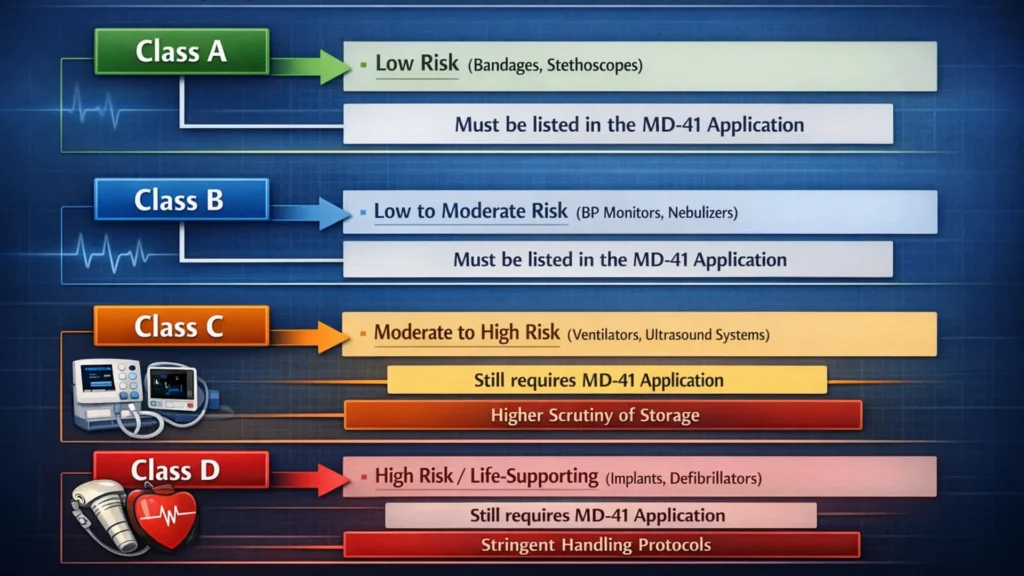
The classification of an ENT device depends on its intended use, duration of contact with the body, whether it is implantable, whether it uses energy (electrical/laser/radiation), and the potential consequences of device failure. Manufacturers must self-declare or seek CDSCO guidance for borderline cases.
CDSCO Class A ENT Medical Devices (Low Risk)
Class A ENT devices are low-risk, non-invasive instruments used primarily for surgical manipulation, examination support, or procedural assistance. These devices have minimal direct patient risk and typically do not enter the body or interact with critical tissues in a sustained manner.
Class A ENT Devices — Complete List
| S.No | Device Name | Intended Use |
| 1 | Adenotome | Surgical instrument for dissecting adenoids |
| 2 | Audiometer testing system | Electronic reference device to calibrate audiometers |
| 3 | Ear bowl | Fits curvature of head; enables ear treatments |
| 4 | Ear canal impression tray | Holds impression material for ear canal recording |
| 5 | Ear canal light | Illuminates the ear canal |
| 6 | Ear excavator | Cuts/scrapes tissue during ear surgical procedures |
| 7 | Endaural curette | Scrapes within ear canal; used in middle ear surgery |
| 8 | ENT transilluminator | Illuminates sinus tissue for translucent examination |
| 9 | Nasal septum straightening forceps | Straightens nasal septum during reconstructive procedures |
| 10 | Tonsil knife | Removes tonsils during surgical intervention |
| 11 | Tracheal bistoury | Opens abscesses/slits sinuses and fistulas in trachea |
| 12 | Bone particle collector | Filters/collects bone particles during otologic surgery |
| 13 | External nasal splint | External rigid device for nasal immobilisation |
| 14 | ENT cupped forceps | Removes tissue from ENT area |
| 15 | Tongue depressor | Moves tongue for examination of surrounding structures |
| 16 | Tracheal dilator | Dilates tracheal structure and tracheal passageway |
| 17 | Tonsillectome | Manually operated device to dissect tonsils |
Class A Registration Requirements
- Basic technical documentation and self-certification of compliance with essential principles of safety and performance.
- No mandatory CDSCO pre-market approval required; however, state licensing authority (SLA) license may be needed for manufacture.
- Labelling must comply with MDR 2017 Schedule V requirements.
- Post-market vigilance and adverse event reporting obligations still apply.
CDSCO Class B ENT Medical Devices (Low-Moderate Risk)
Class B ENT devices carry a low to moderate risk profile. This category includes diagnostic instruments, non-implantable hearing aids, therapeutic devices, and endoscopic tools that interface with mucosal tissues. These devices require formal CDSCO registration, quality management system (QMS) certification, and verified test reports.
Class B ENT Devices — Complete List
| S.No | Device Name | Intended Use |
| 1 | Adenotome blade | Mounts on adenotome for adenoid dissection |
| 2 | Audiometer | Evaluates hearing by generating tones across audible range |
| 3 | Otoscope | Visual examination of outer ear canal and tympanic membrane |
| 4 | Auditory evoked-potential graphic recorder | Records electrical potentials from auditory brain pathway |
| 5 | Behind-the-ear air-conduction hearing aid | Amplifies sound waves to compensate for hearing impairment |
| 6 | Behind-the-ear air-conduction tinnitus masker | Provides masking noise for tinnitus |
| 7 | Ear wick | Minimises bleeding during ear surgery |
| 8 | Electroglottograph | Records electrical potential changes from vocal cord movement |
| 9 | ENT chair, electric | Electrically controlled patient chair for ENT procedures |
| 10 | ENT chair, mechanical | Mechanically controlled patient chair for ENT procedures |
| 11 | ENT shaver system | Resects/debrides soft and osseous tissue in nasal/ear region |
| 12 | ENT surgical microscope | Magnifies minute structures during ENT surgery |
| 13 | Evoked-potential audiometer | Evaluates auditory pathway via ABR in patients |
| 14 | Flexible fibreoptic nasopharyngolaryngoscope | Examination/treatment of nasal passages, larynx, vocal cords |
| 15 | Flexible fibreoptic nasopharyngoscope | Examination/treatment of nasopharynx |
| 16 | Flexible fibreoptic rhinoscope | Examination/treatment of nasal cavity |
| 17 | Flexible fibreoptic sinoscope | Examination/treatment of paranasal sinuses |
| 18 | Flexible video antroscope | Examination/treatment of maxillary sinus pathology |
| 19 | Impedance audiometer | Evaluates middle ear functional condition via tympanic mobility |
| 20 | ENT nasal snare | Removes polyps/tissue from nasal cavity during surgery |
| 21 | Otoscope, endoscopic | Observation, diagnosis, treatment of outer/middle ear |
| 22 | Esophagoscope (flexible or rigid) | Examines/treats esophageal malfunction and disease |
| 23 | Mediastinoscope and accessories | Examines tissue separating lungs for diagnosis |
| 24 | Laryngostroboscope | Observes glottic action during phonation |
| 25 | Powered nasal irrigator | AC-powered pulsating stream to wash nasal cavity |
| 26 | Antistammering device | Minimises involuntary hesitative/repetitive speech |
| 27 | Wireless air-conduction hearing aid | Compensates impaired hearing with wireless technology |
| 28 | Hearing aid calibrator and analysis system | Calibrates/assesses electroacoustic characteristics of hearing aids |
| 29 | Master hearing aid | Simulates hearing aid during audiometric testing |
| 30 | Battery-powered artificial larynx | Produces sound in absence of larynx |
| 31 | Nasal dilator | Provides temporary relief from nasal breathing difficulties |
| 32 | Soft-tissue surgical forceps, alligator | Grasps/manipulates soft tissues during ENT surgery |
| 33 | Epistaxis balloon | Controls internal nasal bleeding near sphenopalatine artery |
| 34 | Eustachian tube balloon dilation system | Dilates cartilaginous Eustachian tube for dysfunction treatment |
| 35 | Otoscope, direct | Examination of outer ear canal and tympanic membrane |
Class B Registration Requirements
- Form MD-14 application submitted through SUGAM portal by the manufacturer or Indian authorized representative.
- ISO 13485-certified QMS or equivalent GMP certification from the manufacturing facility.
- Device Master File including design specifications, material composition, manufacturing process, and sterilization validation (if applicable).
- Performance test reports from NABL-accredited or ILAC-recognized laboratory.
- Free Sale Certificate (FSC) from country of origin for imported devices.
- Compliance declaration with Essential Principles of Safety and Performance (Schedule III, MDR 2017).
CDSCO Class C ENT Medical Devices (Moderate-High Risk)
Class C ENT devices are moderate to high-risk products, predominantly implantable devices, active implantable systems, and high-energy surgical tools. These devices are permanently or semi-permanently placed in contact with internal tissues, bones, or the auditory system. They require clinical performance data and a comprehensive technical dossier reviewed by CDSCO.
Class C ENT Devices — Complete List
| S.No | Device Name | Intended Use |
| 1 | Anchored bone-conduction hearing implant system | Treats hearing impairment from middle/outer ear obstructive pathologies |
| 2 | Auditory stimulator | Applies sound stimuli to patient's acoustic system |
| 3 | Behind-the-ear bone-conduction tinnitus masker | Provides ultrasonic broadband noise to mask tinnitus |
| 4 | Cochlear implant assessment system | Integrity test for implantable portion of cochlear implant in-situ |
| 5 | Ear prosthesis | Reconstructs external ear by replacing damaged/missing tissue |
| 6 | Ossicular prosthesis, partial | Implanted device for functional reconstruction of ossicular chain segments |
| 7 | Middle ear mold | Implanted preformed device to reconstruct middle ear cavity |
| 8 | Fully-implantable middle ear implant system | Compensates impaired hearing by transmitting vibrations to middle ear |
| 9 | Larynx prosthesis | Replacement/restoration of laryngeal function or patency maintenance |
| 10 | Ossicular prosthesis, total | Total functional reconstruction of the ossicular chain (malleus, incus, stapes) |
| 11 | Ear, nose, and throat electric or pneumatic surgical drill | Rotating drilling device for controlled bone incision/removal in ENT area |
| 12 | Argon laser for otology, rhinology, and laryngology | Coagulates/vaporises soft, fibrous, and osseous tissue during ENT surgery |
| 13 | Ear, nose, and throat microsurgical carbon dioxide laser | Surgical excision of tissue during microsurgical ENT procedures |
| 14 | Suction antichoke device | Emergency device using suction to remove airway-obstructing foreign objects |
| 15 | Tongs antichoke device | Emergency device to grasp/remove foreign objects from obstructed airway |
| 16 | External upper esophageal sphincter compression device | Applies pressure on cricoid cartilage for laryngopharyngeal reflux disease |
| 17 | Active implantable bone conduction hearing system | Compensates conductive/mixed hearing losses via mechanical vibrations on skull |
| 18 | Partial ossicular replacement prosthesis | Functional reconstruction of segments of the ossicular chain |
| 19 | Total ossicular replacement prosthesis | Total functional reconstruction of the complete ossicular chain |
| 20 | Mandibular implant facial prosthesis | Implanted device for functional reconstruction of mandibular deficits |
| 21 | Sacculotomy tack (Cody tack) | Implanted pointed stainless steel tack to relieve vertigo symptoms |
| 22 | Tympanostomy tube with semipermeable membrane | Implanted for middle ear ventilation/drainage while preventing fluid entry |
| 23 | Transcutaneous air conduction hearing aid system | Wearable sound-amplifying device; does not occlude ear canal |
| 24 | Gustometer | Battery-powered device providing galvanic stimulus for taste sensation |
Class C Registration Requirements
- Comprehensive technical dossier including device description, intended use, risk analysis (ISO 14971), and clinical evaluation report.
- Clinical data from clinical investigations or literature-based clinical evaluation as per Schedule VIII of MDR 2017.
- ISO 13485 QMS certification from an accredited certification body.
- Biocompatibility test reports as per ISO 10993 series (for implantable and body-contact devices).
- Sterilization validation (EN ISO 11135, EN ISO 11137, etc.) for sterile devices.
- Post-market clinical follow-up (PMCF) plan and post-market surveillance (PMS) plan.
- Free Sale Certificate and approval/registration from a recognized reference country for imported devices.
CDSCO Class D ENT Medical Devices (Highest Risk)
Class D is the highest risk category under MDR 2017. Currently, only one ENT device falls under this classification in the notified list.
Class D ENT Devices — Complete List
| S.No | Device Name | Intended Use |
| 1 | Tympanic membrane contact hearing aid | Prescription device compensating impaired hearing; transducer in direct contact with tympanic membrane |
Class D Registration Requirements
- All Class C requirements apply, plus additional stringent review by CDSCO expert committees.
- Mandatory clinical investigation data from Indian clinical trials or highly robust international clinical evidence with applicable population equivalence.
- Highest level of QMS evidence, including CAPA history, internal audit reports, and management review records.
- Third-party conformity assessment by a CDSCO-recognized notified body may be required.
- Regular re-evaluation and enhanced post-market surveillance obligations.
Who Needs CDSCO Registration for ENT Medical Devices?
The following entities are legally required to obtain CDSCO registration or license before engaging in commercial activities involving notified ENT medical devices in India:
- Domestic Manufacturers: Any Indian company or individual manufacturing notified ENT devices for sale in India must obtain a manufacturing license from the State Licensing Authority (SLA) along with CDSCO registration for Class B, C, and D devices.
- Importers / Authorized Indian Representatives: Companies importing ENT medical devices from foreign manufacturers must register the device with CDSCO in their own name as the Indian Authorized Representative (IAR). The IAR is responsible for post-market compliance.
- Own-Label Distributors: If a company rebrands or white-labels an ENT device, they assume the role of the manufacturer and must comply with full MDR 2017 obligations.
- Contract Manufacturers: If manufacturing is outsourced, the brand owner/legal manufacturer still bears regulatory responsibility and must hold the license.
Individual healthcare professionals, hospitals, and clinics purchasing registered ENT devices for patient use are not required to hold CDSCO registration but must ensure they procure only from registered sources.
Documents Required for CDSCO ENT Medical Device Registration
Submitting the correct documentation in the right format is the most critical step in CDSCO registration. Missing or incomplete documents are the primary reason for application rejections and delays. Below is the master document checklist:
| S.No | Document | Applicable Classes |
| 1 | Form MD-14 (Application form) | All classes |
| 2 | Form MD-15 (Undertaking) | All classes |
| 3 | Certificate of Incorporation / Partnership Deed | All classes |
| 4 | ISO 13485 Certificate (Quality Management System) | Class B, C & D |
| 5 | Device Master File (DMF) / Technical File | All classes |
| 6 | Essential Principles of Safety & Performance checklist | All classes |
| 7 | Instructions for Use (IFU) / Labelling | All classes |
| 8 | Performance / Test Reports from NABL/ILAC accredited lab | Class B, C & D |
| 9 | Clinical Performance / Safety Data | Class C & D |
| 10 | Free Sale Certificate (FSC) from country of origin | Imported devices – Class B, C & D |
| 11 | Proof of registration in country of origin | Imported devices |
| 12 | Authorization letter from foreign manufacturer | Imported devices |
| 13 | SUGAM portal user credentials & digital signature | All classes |
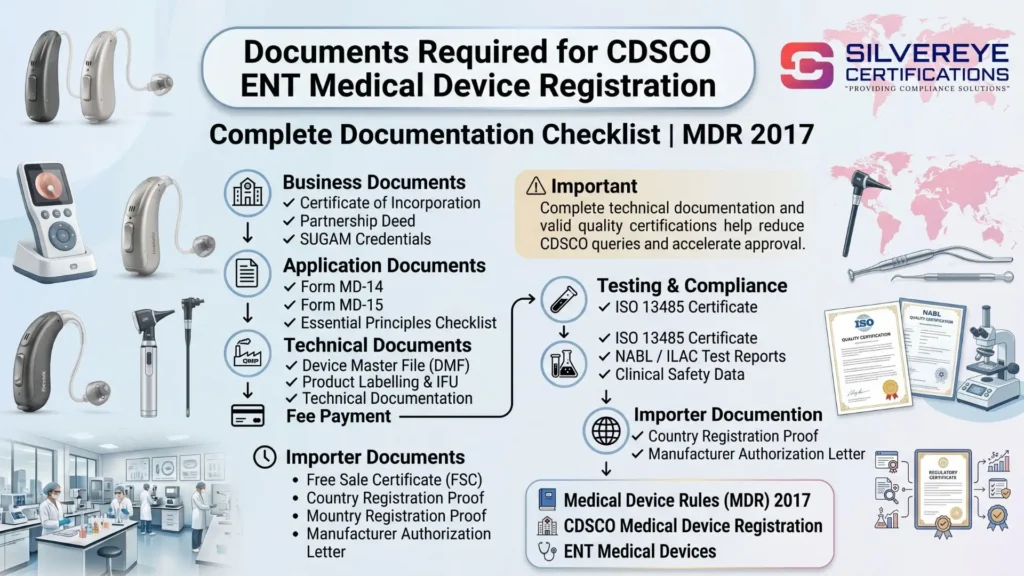
All documents must be uploaded in PDF format on the SUGAM portal. Foreign-language documents must be accompanied by a certified English translation. Technical files must be prepared as per the Common Submission Dossier Template (CSDT) specified by CDSCO.
Step-by-Step Process for CDSCO ENT Medical Device Registration
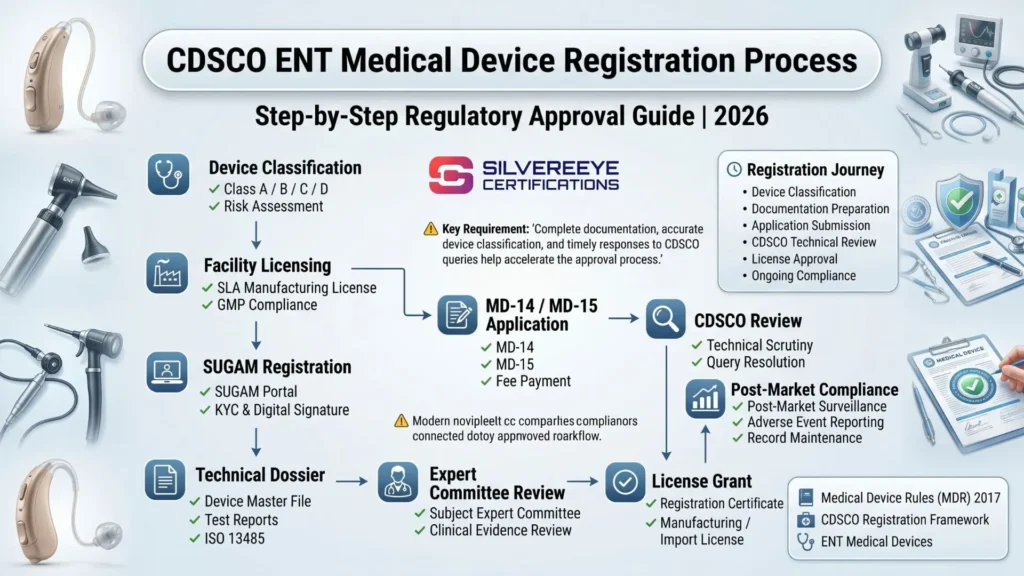
The CDSCO registration process follows a defined workflow via the SUGAM portal. Here is a clear, step-by-step breakdown:
- Step 1 — Device Classification: Confirm the risk class (A, B, C, or D) of your ENT device based on its intended use and the notified device list under MDR 2017. Misclassification can result in rejection.
- Step 2 — Facility Licensing: Domestic manufacturers must first obtain a manufacturing license from the State Licensing Authority (SLA) of the state where the facility is located.
- Step 3 — SUGAM Portal Registration: Create an account on the SUGAM portal (sugam.gov.in) as a manufacturer or importer. Complete KYC and digital signature setup.
- Step 4 — Prepare Technical Dossier: Compile all required documents including device master file, test reports, QMS certificates, clinical data (for Class C/D), and labelling materials.
- Step 5 — Online Application Submission: Submit Form MD-14 (application) and Form MD-15 (undertaking) through SUGAM along with the technical dossier and requisite fees.
- Step 6 — CDSCO Scrutiny: CDSCO officers review the application. They may raise queries (deficiency letters) requiring clarification or additional data within stipulated timeframes.
- Step 7 — Expert Committee Review (Class C/D): High-risk devices are evaluated by a Subject Expert Committee (SEC) which may request additional clinical evidence or a facility inspection.
- Step 8 — Grant of Registration / License: Upon satisfactory review, CDSCO grants the registration certificate (Class B) or manufacturing/import license (Class C/D). The certificate is issued digitally through SUGAM.
- Step 9 — Post-Market Obligations: After registration, maintain post-market surveillance, report adverse events within mandated timelines, and keep records for at least 5 years or the device's useful life, whichever is longer.
CDSCO Registration Fees for ENT Medical Devices
Registration fees vary based on the risk class of the device and whether it is a domestically manufactured or imported product. The fees mentioned below are indicative based on Schedule VII of MDR 2017 and are subject to revision by CDSCO.
| Device Class | Device Origin | Approximate Fee (2025-26) |
| Class A | Domestic | Self-declaration; nominal state-level fee if applicable |
| Class B | Domestic | Rs. 1,000 – Rs. 5,000 (approx.) per device/product |
| Class C | Domestic | Rs. 5,000 – Rs. 25,000 (approx.) per device/product |
| Class D | Domestic | Rs. 25,000+ (approx.) per device/product |
| Class B | Imported | USD 1,000 – USD 3,000 (approx.) per device |
| Class C | Imported | USD 3,000 – USD 10,000 (approx.) per device |
| Class D | Imported | USD 10,000+ (approx.) per device |
Note: Fees are payable online through the SUGAM portal via approved payment gateways. Additional charges may apply for name changes, address amendments, additional manufacturing sites, or accelerated review tracks. Always verify the current fee schedule on the CDSCO website before application.
CDSCO Processing Time & Validity of ENT Device Registration
| Device Class | Typical Processing Time | Remarks |
| Class A | 15 – 30 working days | Primarily self-certification; state licensing authority |
| Class B | 30 – 90 working days | CDSCO scrutiny; standard review track |
| Class C | 90 – 180 working days | CDSCO + clinical data review |
| Class D | 180 – 270 working days (or more) | Stringent CDSCO review; expert committee evaluation |
Registration Validity
- Class A: No formal CDSCO registration certificate; manufacturing license from SLA is typically valid for 5 years.
- Class B: CDSCO registration certificate is valid for 5 years from date of issue.
- Class C & D: License/registration valid for 5 years; subject to post-market surveillance obligations and periodic renewal.
Renewal of CDSCO Registration for ENT Medical Devices
CDSCO registration for ENT medical devices must be renewed before expiry to avoid legal consequences, including mandatory stoppage of manufacture/import. Here is what you need to know about the renewal process:
- Renewal Timeline: Applications for renewal must be submitted at least 90 days before the expiry date of the existing registration or license.
- Renewal Application: Submitted via SUGAM portal using the applicable renewal form (Form MD-16 or relevant form as notified).
- Updated Documents: Any changes in device design, manufacturing process, QMS status, or labelling since the original registration must be disclosed and updated documentation submitted.
- Fees: Renewal fees are typically equivalent to fresh registration fees; refer to the current CDSCO fee schedule.
- Continuous Compliance: Post-market surveillance reports, adverse event reporting records, and QMS audit reports must be current at the time of renewal.
- Lapsed Registrations: If a registration lapses, fresh application may be required along with an explanation for the delay, and the device cannot be legally sold during the lapsed period.
Post-Market Obligations for Registered ENT Medical Devices
CDSCO registration does not end with the issuance of the certificate. Manufacturers and importers of ENT medical devices have ongoing compliance obligations:
- Adverse Event Reporting (Vigilance): Serious adverse events must be reported to CDSCO within 30 days (or 10 days for life-threatening events) via the MvPI (Materiovigilance Programme of India).
- Post-Market Surveillance (PMS): Systematic collection and analysis of real-world performance data to detect any quality or safety issues.
- Field Safety Corrective Actions (FSCA): Recalls, safety notices, and corrective actions must be coordinated with CDSCO and communicated to all affected customers.
- Labelling Compliance: Ensure all labelling (including IFU) remains accurate, up to date, and compliant with Schedule V of MDR 2017 throughout the device's market life.
- QMS Maintenance: Annual internal audits and periodic external surveillance audits by the ISO 13485 certification body must be maintained.
- Record Keeping: All records related to design, manufacturing, testing, distribution, and complaints must be maintained for a minimum of 5 years or the device's lifetime, whichever is greater.
Penalties for Non-Compliance — CDSCO ENT Medical Device Regulations
The MDR 2017 and Drugs & Cosmetics Act carry strict penalties for manufacturers, importers, and distributors who violate CDSCO regulations. Non-compliance not only attracts legal consequences but can also result in permanent license cancellation and reputational damage.
| Violation | Penalty under MDR 2017 |
| Manufacturing without licence | Imprisonment up to 3 years + fine up to Rs. 5 lakh |
| Sale of non-registered notified device | Imprisonment up to 2 years + fine |
| Misbranded or substandard device | Recall + fine + possible suspension of licence |
| Import without valid NOC/licence | Seizure + penalty + ban on future imports |
CDSCO also has the authority to conduct surprise inspections of manufacturing facilities, warehouses, and import premises. Any violation of GMP norms, labelling requirements, or post-market obligations can trigger show-cause notices and enforcement action.
Conclusion
CDSCO registration for ENT medical devices is not just a regulatory checkbox — it is a fundamental requirement for ensuring patient safety and building trust in the Indian healthcare market. Whether you are a domestic manufacturer of surgical ENT instruments or an importer of state-of-the-art cochlear implants and hearing systems, understanding the correct device classification, documentation requirements, registration process, fees, and post-market obligations is essential to staying compliant in 2026 and beyond.
With the Indian medical device market growing rapidly and CDSCO tightening enforcement, early investment in regulatory compliance for your ENT device portfolio will protect your business, avoid costly disruptions, and most importantly, ensure safe and effective devices reach patients who need them.
Frequently Asked Questions
Is CDSCO registration mandatory for all ENT medical devices in India?
Not all ENT devices are currently notified. However, as of 2026, over 78 ENT devices are notified under MDR 2017 and Schedule I, making CDSCO registration mandatory for their manufacture, import, or sale. Non-notified devices may still require state-level licenses but not CDSCO central registration.
What is the difference between CDSCO registration and a manufacturing license?
CDSCO registration (or import license) is granted by the Central Licensing Authority (CLA) — CDSCO — for notified medical devices. A manufacturing license is issued by the State Licensing Authority (SLA) for the manufacturing facility. Both may be required depending on device class and type.
How long does it take to get CDSCO registration for a cochlear implant (Class C)?
Cochlear implants are Class C devices. The typical processing time is 90 to 180 working days, provided the dossier is complete and clinical data requirements are met. Queries from CDSCO can extend this timeline.
Can a foreign manufacturer directly apply for CDSCO registration in India?
No. Foreign manufacturers must appoint an Indian Authorized Representative (IAR) who submits the application on their behalf and is responsible for post-market compliance in India.
What is the SUGAM portal and how is it used for ENT device registration?
SUGAM is CDSCO's online portal for submitting applications for medical device registration, import licenses, manufacturing licenses, and related regulatory activities. All documentation and fees are submitted through SUGAM.
Do hearing aids require CDSCO registration in India?
Yes. Hearing aids — including behind-the-ear air-conduction hearing aids, wireless hearing aids, bone-conduction hearing systems, and tympanic membrane contact hearing aids — are notified medical devices and must be registered with CDSCO. Class and requirements vary by type.
Is clinical data always required for ENT device registration?
Clinical data (clinical investigation or clinical evaluation) is mandatory for Class C and D devices. For Class B devices, performance test data and literature-based clinical evaluation may suffice. Class A devices generally do not require clinical data.
What is the penalty for selling an unregistered ENT medical device in India?
Selling a notified medical device without CDSCO registration can result in imprisonment of up to 2-3 years and fines up to Rs. 5 lakh under the Drugs and Cosmetics Act and MDR 2017. Devices can also be seized and destroyed.
How do I renew an expired CDSCO registration for an ENT device?
Apply for renewal through the SUGAM portal at least 90 days before expiry. If the registration has already lapsed, you may need to apply afresh. During the lapsed period, the device cannot legally be sold in India.
Are ENT surgical instruments like tongue depressors or tonsil knives regulated by CDSCO?
Yes, devices such as tongue depressors, tonsil knives, ear excavators, and tracheal dilators are classified as Class A ENT medical devices. While CDSCO central registration requirements are lighter for Class A, they are still notified devices and must comply with MDR 2017 requirements including proper labelling and post-market vigilance.