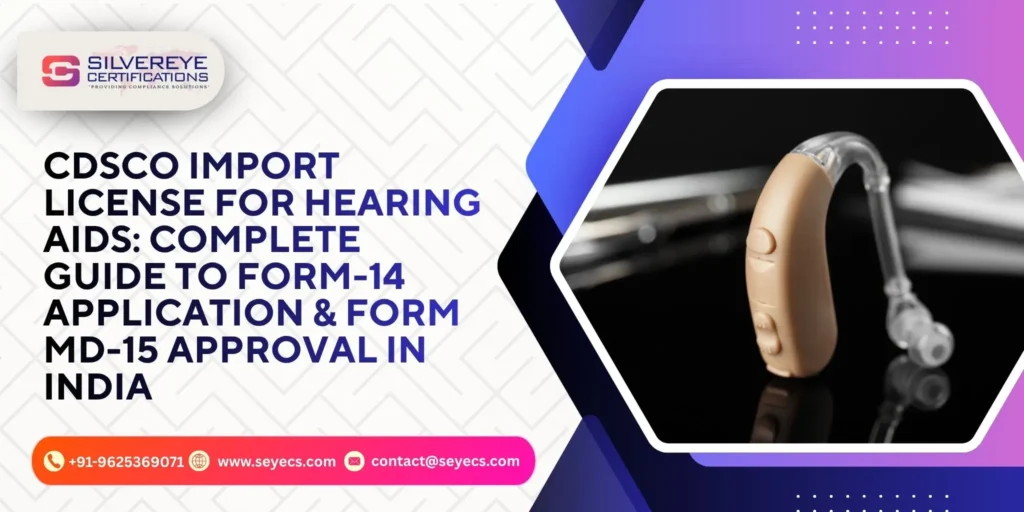
- CDSCO Import License For Hearing aids are regulated as Class B Medical Devices in India — a valid CDSCO import license under Form MD-15 is mandatory before importing or selling any hearing aid brand or model in India.
- The application is filed via Form-14 on the SUGAM online portal of CDSCO, along with prescribed documents, government fees, and a nominated Authorized Indian Agent (AIA).
- The license is issued under the Medical Device Rules (MDR), 2017 and is valid for 5 years from the date of grant — it must be renewed before expiry to avoid regulatory penalties.
- Non-compliance, including importing without a valid CDSCO import license, can lead to seizure of goods, cancellation of license, and prosecution under the Drugs and Cosmetics Act, 1940.
Introduction
If you are planning to import hearing aids into India, getting a CDSCO Import License for Hearing Aids is not just a regulatory formality — it is a legal requirement. Whether you are a foreign manufacturer, a trading company, or an Indian importer, you cannot legally import, stock, distribute, or sell hearing aids in India without this license.
India is one of the fastest-growing markets for hearing healthcare, and the Central Drugs Standard Control Organization (CDSCO) is the apex national regulatory authority that governs the import of medical devices under the Medical Device Rules (MDR), 2017. Hearing aids, classified as Class B medical devices, fall directly under CDSCO's regulatory framework.
This guide walks you through everything — from what the license is, who needs it, what documents are required, how to apply step by step, what the fees are, how long it takes, and how to renew it. This is the most up-to-date and detailed resource available on CDSCO Import License for Hearing Aids for 2026.
What Is a CDSCO Import License for Hearing Aids?
A CDSCO Import License for Hearing Aids is an official regulatory approval issued by the Central Drugs Standard Control Organization (CDSCO), Government of India, allowing the legal import and commercial distribution of hearing aids in the Indian market.
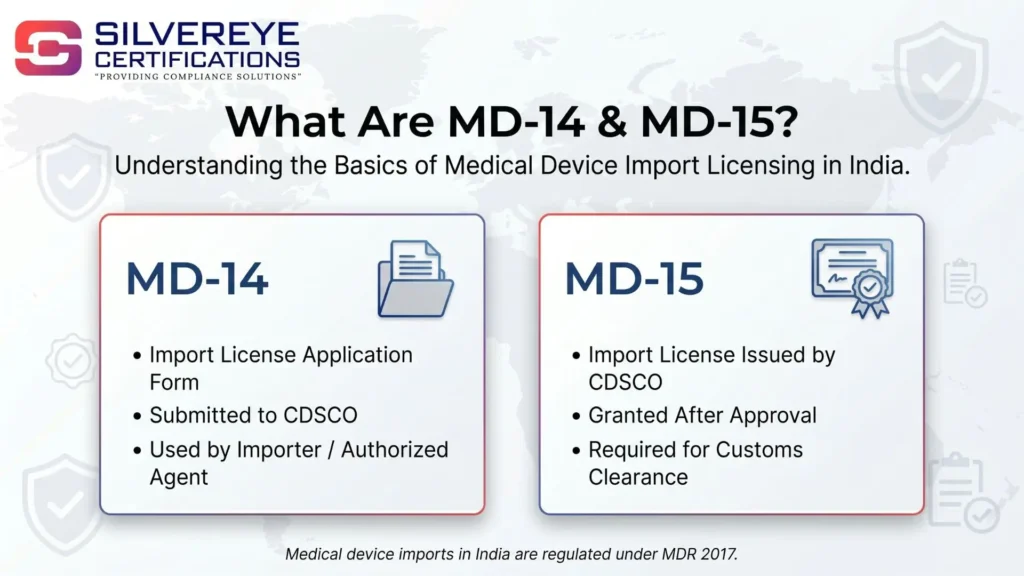
This license is formally known as Form MD-15 — the Grant of Import License for Medical Devices. The application for this license is filed through Form-14 under Rule 27 of the Medical Device Rules, 2017.
Under India's regulatory system, hearing aids are notified as Class B medical devices, which means they carry a moderate level of risk. Class B devices require mandatory CDSCO licensing before they can be imported, sold, or distributed in India — even if the product has international certifications like CE (Europe), FDA (USA), or TGA (Australia).
Why Is This License Mandatory for Hearing Aid Imports?
India brought medical devices under a formal regulatory framework through the Medical Device Rules, 2017, which came into full effect as a standalone regulation on April 1, 2020. Before this, only certain devices were regulated. Now, all medical devices including hearing aids must be licensed.
Here is why the CDSCO Import License for Hearing Aids is non-negotiable:
- Consumer Safety: Hearing aids are electronic medical devices that, if substandard, can damage residual hearing. CDSCO licensing ensures that only quality-tested, performance-compliant devices reach Indian patients.
- Legal Obligation: Importing hearing aids without a CDSCO import license is a punishable offence under Section 13 and Section 18 of the Drugs and Cosmetics Act, 1940. The penalty can include imprisonment and heavy fines.
- Market Access: Distributors, hospitals, audiologists, and retailers in India will not accept hearing aids from any importer who does not hold a valid CDSCO license. It is also required for e-commerce listings on platforms like Amazon India and Flipkart.
- Customs Clearance: Indian customs authorities check for valid CDSCO Import License details at the port of entry. Without it, the consignment will not be released and will be liable for confiscation.
- Bank and FEMA Compliance: For outward remittances related to medical device imports, banks and RBI-regulated FEMA compliance require valid import licensing documentation.
How Are Hearing Aids Classified as Class B Medical Devices?
Under the Medical Device Rules, 2017, medical devices are classified into four risk categories — Class A (low risk), Class B (low-moderate risk), Class C (moderate-high risk), and Class D (high risk).
Hearing aids are classified as Class B Medical Devices because:
- They are implantable or partially implantable only in rare sub-types (standard hearing aids are non-invasive but in-the-canal types can be semi-invasive)
- They deliver acoustic energy to the ear canal and surrounding tissues
- Malfunction or poor quality can result in further hearing loss in patients with existing auditory impairment
- They require fitting, calibration, and audiological assessment — suggesting a moderate degree of supervised clinical use
| Classification | Risk Level | Regulating Authority | License Required |
| Class A | Low Risk | State Licensing Authority (SLA) | Form MD-3 / MD-5 |
| Class B (Hearing Aids) | Low-Moderate Risk | CDSCO (Central) | Form MD-15 via Form-14 |
| Class C | Moderate-High Risk | CDSCO (Central) | Form MD-15 via Form-14 |
| Class D | High Risk | CDSCO (Central) | Form MD-15 via Form-14 |
Who Needs a CDSCO Import License for Hearing Aids?
The following entities must obtain a CDSCO Import License (Form MD-15) for hearing aids before beginning import activities:
- Foreign Manufacturers: Any overseas company that manufactures hearing aids and wishes to sell directly or through a distributor in India must have their product licensed under CDSCO. The manufacturer appoints an Authorized Indian Agent (AIA) who holds the license on their behalf.
- Indian Importers and Trading Companies: A registered Indian company that imports hearing aids from overseas manufacturers also needs this license. They act as the importer of record.
- Brand Representatives / Exclusive Distributors: If you hold the exclusive rights to distribute a foreign hearing aid brand in India, you must obtain a CDSCO Import License before importing the product.
- E-commerce and Online Sellers: Companies that import hearing aids and sell them online through their own website or third-party marketplaces in India must hold valid CDSCO import licenses for each model.
What Are the Eligibility Criteria for CDSCO Hearing Aid Import License?
Before applying for a CDSCO Import License for Hearing Aids, the applicant and the product must meet the following eligibility criteria:
For the Applicant (Indian Entity / AIA)
- The applicant must be a legally registered entity in India — a Private Limited Company, LLP, Partnership Firm, or Proprietorship registered under applicable Indian laws.
- The Authorized Indian Agent (AIA) must be a person or entity resident in India with a valid business address who can accept legal responsibilities for the imported devices.
- The applicant must have a valid business premises with appropriate storage conditions as per CDSCO standards for medical devices.
- The applicant or AIA should have a designated Regulatory Affairs Manager or a technically qualified person to manage CDSCO correspondence.
For the Product (Hearing Aid)
- The hearing aid model(s) must be manufactured in a facility that meets Good Manufacturing Practice (GMP) or ISO 13485 standards.
- The device must conform to the applicable performance standard — for hearing aids, this includes IEC 60118-0, IEC 60118-7, or equivalent standards recognized by CDSCO.
- A valid Free Sale Certificate (FSC) or Certificate of Marketability (CMC) from the country of origin must be available, confirming the product is approved and freely sold in the manufacturer's home country.
- The device must not be expired, recalled, or under any regulatory action by the regulatory authority of the country of manufacture.
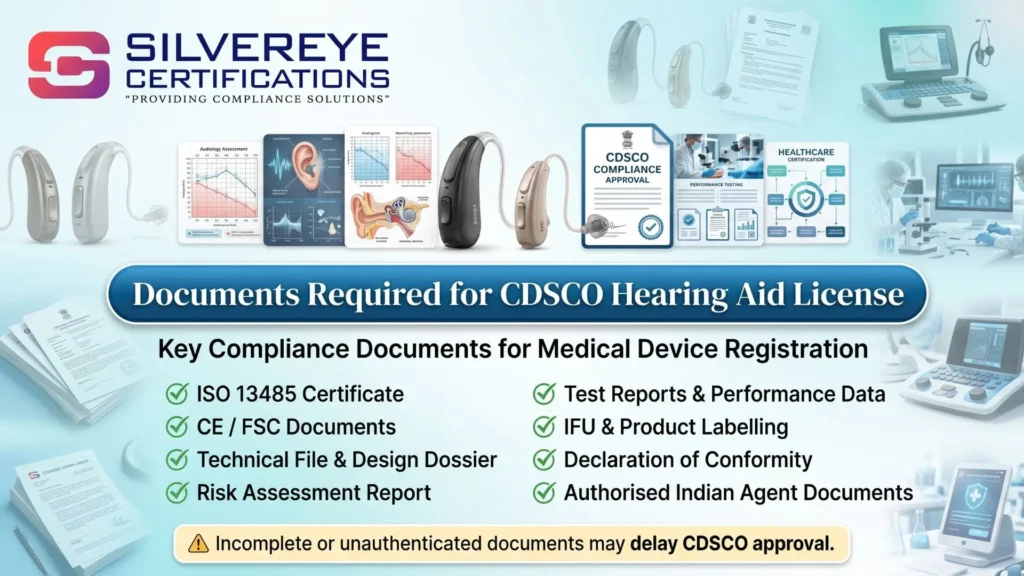
Documents Required for CDSCO Import License for Hearing Aids (Form-14)
The following documents must be submitted along with the Form-14 application on the SUGAM portal. All documents must be in English or accompanied by a certified English translation. Foreign documents must be notarized and apostilled (where required).
| S.No. | Document | Requirement |
| 1 | Form-14 Application (duly filled and signed by AIA) | Mandatory |
| 2 | Proof of Registration of Indian Entity (Certificate of Incorporation / GST / Trade License) | Mandatory |
| 3 | Appointment Letter of Authorized Indian Agent (AIA) from Foreign Manufacturer | Mandatory |
| 4 | Power of Attorney from Foreign Manufacturer in favour of AIA | Mandatory |
| 5 | Free Sale Certificate (FSC) / Certificate of Marketability from Country of Origin | Mandatory |
| 6 | Manufacturing Site License / GMP Certificate of Manufacturer (ISO 13485 preferred) | Mandatory |
| 7 | Undertaking from Foreign Manufacturer on Letter Head (as per CDSCO format) | Mandatory |
| 8 | Test Report / Performance Data as per IEC 60118-0 / IEC 60118-7 or equivalent | Mandatory |
| 9 | Device Description, Technical Dossier, User Manual / IFU | Mandatory |
| 10 | Risk Analysis Report (ISO 14971 based) | Mandatory |
| 11 | Declaration of Conformity (CE / FDA / TGA / equivalent) | Supporting |
| 12 | Clinical Evaluation Report (if applicable) | Conditional |
| 13 | Labelling and Packaging Details (as per MDR 2017 Schedule V) | Mandatory |
| 14 | List of Countries where device is marketed | Mandatory |
| 15 | Proof of Payment of Prescribed Government Fee (Challan) | Mandatory |
| 16 | Premises Details and Storage Conditions Declaration | Mandatory |
Step-by-Step Process to Apply for CDSCO Import License for Hearing Aids
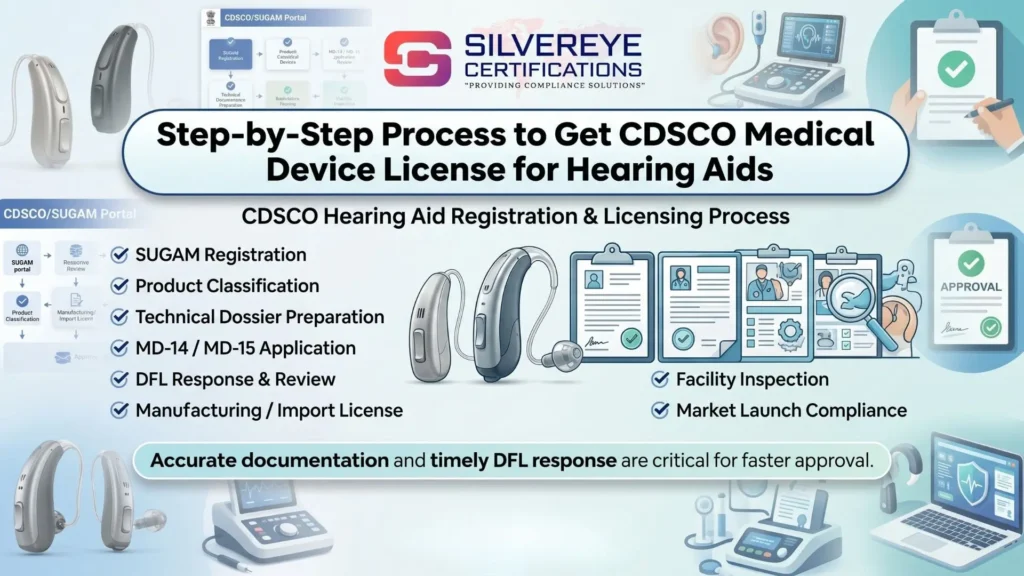
Here is the complete step-by-step process to obtain a CDSCO Import License for Hearing Aids (Form MD-15) in India:
Step 1: Register on CDSCO SUGAM Portal
The first step is to register your organization on the CDSCO SUGAM (Software for Unified Grant Management) online portal at sugam.cdsco.gov.in. Create an account as an Authorized Indian Agent (AIA) for the foreign manufacturer. The portal is the only valid channel for filing medical device import license applications.
Step 2: Appoint Authorized Indian Agent (AIA)
The foreign manufacturer must formally appoint an Authorized Indian Agent (AIA) — a legally registered Indian entity — who will be the applicant and licensee in India. This appointment must be on a notarized Power of Attorney and a formal appointment letter on the manufacturer's letterhead.
Step 3: Prepare the Technical Dossier
Compile the complete technical dossier for the hearing aid model(s) being imported. This includes product description, performance test reports, risk analysis, clinical evaluation (if applicable), labelling, user manual, and all the documents listed in Section 6 above. Ensure all foreign documents are apostilled or consularly legalized.
Step 4: Pay Government Fees
Pay the prescribed government fee through the SUGAM portal. For Class B medical devices, the fee is currently Rs. 5,000 per device (as per the First Schedule of MDR 2017 — verify on CDSCO portal for any updates applicable in 2026). The payment receipt/challan must be uploaded with the application.
Step 5: File Form-14 Application on SUGAM Portal
Log in to the SUGAM portal and file the Form-14 application online. Upload all required documents in the prescribed format (PDF, file size limits apply). Fill in all device details, manufacturer information, AIA details, and attach payment proof. Submit the application and note your Application ID for tracking.
Step 6: CDSCO Technical Scrutiny and Review
After submission, the CDSCO designated officer will review your application. You may receive queries (Query Letter) asking for additional information, clarification, or revised documents. It is critical to respond to queries promptly and accurately. Delay in responding to queries extends the overall processing time.
Step 7: Grant of Form MD-15 (Import License)
Once CDSCO is satisfied with the application and all queries are resolved, the Import License in Form MD-15 is issued. This license mentions the licensed device(s), the AIA/importer name, validity period, and conditions. The license is available for download from the SUGAM portal.
| Step | Activity | Responsible Party | Approx. Timeline |
| 1 | SUGAM Portal Registration | AIA / Applicant | 1–2 days |
| 2 | AIA Appointment & Document Compilation | AIA + Foreign Manufacturer | 2–4 weeks |
| 3 | Form-14 Filing & Fee Payment | AIA / Applicant | 1–2 days |
| 4 | CDSCO Initial Scrutiny | CDSCO | 4–8 weeks |
| 5 | Query Resolution (if any) | AIA + Manufacturer | 2–6 weeks |
| 6 | Technical Evaluation & Approval | CDSCO | 4–8 weeks |
| 7 | Grant of Form MD-15 | CDSCO | 1–3 days after approval |
| Total (No Queries) | — | — | 3–5 months |
| Total (With Queries) | — | — | 5–9 months |
CDSCO Import License Fees for Hearing Aids (Class B Devices)
The government fee for a CDSCO Import License for a Class B Medical Device (including hearing aids) is prescribed under the First Schedule to the Medical Device Rules, 2017. Below is the current fee structure:
| Fee Category | Amount (INR) | Remarks |
| Application Fee for Import License (Form-14) — Class B Device | Rs. 5,000 per device | Per device model / variant |
| Amendment to Existing Import License | Rs. 2,500 | For changes in AIA, address, etc. |
| License Renewal Fee (Class B) | Rs. 5,000 per device | Due before expiry of 5-year validity |
| Duplicate License Fee | Rs. 500 | In case of loss or damage of original |
| Late Renewal Penalty (if renewal after expiry) | As per CDSCO order | Avoid by renewing 6 months in advance |
Validity and Renewal of CDSCO Import License for Hearing Aids
Validity Period
A CDSCO Import License for hearing aids (Form MD-15) is valid for 5 years from the date of grant. The license specifies the valid-through date on the face of the document. It is the responsibility of the AIA / importer to track the expiry date and initiate renewal in time.
Renewal Process
- Renewal application must be filed on the SUGAM portal before the expiry of the existing license. CDSCO recommends initiating renewal at least 6 months before the expiry date.
- The renewal application requires filing of Form-14 (same as the initial application) with updated documents, proof of valid manufacturing license, updated FSC, and payment of renewal fee.
- If the manufacturing site details, AIA details, or device specifications have changed, corresponding amendment applications must be filed before or along with the renewal.
- Post expiry, importing hearing aids on an expired license is a regulatory violation. If the renewal is pending and the license is about to expire, the importer must stop imports until the renewal is granted.
Amendment to Existing License
Amendments are required when there are changes in:
- Name or address of the AIA / importer
- Manufacturing site of the hearing aid
- Addition of new models or variants under the same manufacturer
- Change in device name, labelling, or brand
- Change in foreign manufacturer's details
Labelling Requirements for Imported Hearing Aids in India
All hearing aids imported and sold in India must comply with the labelling requirements under Schedule V of the Medical Device Rules, 2017. Key labelling requirements include:
- Name and generic name of the device (e.g., Hearing Aid — Behind-the-Ear / BTE)
- Model number and batch/lot number
- Date of manufacturing and shelf life / expiry date (if applicable)
- Name and address of the foreign manufacturer
- Name and address of the Indian importer / AIA with CDSCO Import License Number
- Instructions for Use (IFU) in English (and regional languages if mandated)
- Caution/Warning statements as required by CDSCO
- Storage conditions
- Country of origin
- For reusable devices: cleaning/sterilization instructions
Role of the Authorized Indian Agent (AIA) in CDSCO Hearing Aid Import License
The Authorized Indian Agent (AIA) is the cornerstone of the CDSCO Import License process for hearing aids. As an importer or foreign manufacturer, understanding the AIA's role is essential.
- Legal Representative: The AIA acts as the official representative of the foreign manufacturer in India and accepts full legal responsibility for the safety, quality, and regulatory compliance of imported hearing aids.
- License Holder: The Import License (Form MD-15) is issued in the name of the AIA. The AIA is therefore the primary regulatory contact with CDSCO.
- Regulatory Interface: The AIA handles all CDSCO communications, query responses, inspections, and post-market surveillance obligations on behalf of the manufacturer.
- Single AIA Restriction: As of MDR 2017 rules, a foreign manufacturer can appoint only one AIA per device category per application. If a manufacturer wants multiple Indian distributors, the AIA structure must be carefully planned.
- Termination of AIA: If the relationship between the foreign manufacturer and AIA is terminated, CDSCO must be notified. The license is effectively frozen until a new AIA is appointed and an amendment is granted.
Benefits of Obtaining CDSCO Import License for Hearing Aids
Beyond legal compliance, having a valid CDSCO Import License for hearing aids opens several business opportunities:
- Legal Market Access: Sell your hearing aids through any channel — hospitals, audiological clinics, retail outlets, e-commerce, and government tenders — without legal risk.
- Brand Trust and Credibility: CDSCO licensing signals to Indian buyers and healthcare professionals that your hearing aids meet India's regulatory quality standards.
- Government Tender Eligibility: Many state government and central government hearing aid procurement tenders (including ADIP Scheme tenders) require CDSCO Import License as a mandatory eligibility criterion.
- E-commerce Listing: Major e-commerce platforms including Amazon India require CDSCO device license numbers for medical device listings. Without it, your products cannot be listed.
- Post-Sales and Warranty: Legally imported hearing aids can be serviced, repaired, and replaced under warranty without regulatory complications.
- Expansion Opportunity: Once licensed, adding new models or variants of the same brand is faster and less expensive through an amendment application rather than a fresh license.
- Access to ADIP Scheme: The Government of India's Assistance to Disabled Persons for Purchase/Fitting of Aids and Appliances (ADIP) scheme procures hearing aids for differently-abled persons — only licensed devices are procured.
Conclusion
Getting a CDSCO Import License for Hearing Aids in India is a structured but detailed process that demands precision in documentation, regulatory knowledge, and timely follow-up. With the Indian hearing healthcare market growing at a steady pace — driven by increasing awareness, aging demographics, and government schemes like ADIP — the opportunity for legitimate hearing aid importers is significant.
The key to a successful Form-14 application and timely grant of Form MD-15 lies in three things: thorough document preparation, a reliable Authorized Indian Agent, and proactive CDSCO query management.
Whether you are a first-time importer navigating CDSCO regulations or an established company looking to add new hearing aid models to your licensed portfolio, this guide provides the foundational knowledge you need.
If you need professional assistance with your CDSCO Import License application for hearing aids, including dossier preparation, SUGAM filing, and regulatory strategy, consult a CDSCO-experienced medical device regulatory consultant. The investment in expert guidance almost always saves time and reduces the risk of costly rejections or delays.
Frequently Asked Questions
Is a CDSCO Import License mandatory for all types of hearing aids?
Yes. All hearing aids — whether Behind-the-Ear (BTE), In-the-Canal (ITC), Completely-in-Canal (CIC), Receiver-in-Canal (RIC), or bone conduction hearing devices — require a CDSCO Import License (Form MD-15) to be legally imported and sold in India.
Can a foreign manufacturer directly hold the CDSCO Import License?
No. The CDSCO Import License is issued to an Authorized Indian Agent (AIA) — a legally registered entity in India. The foreign manufacturer cannot directly hold the license; they must appoint an Indian representative.
How long does it take to get a CDSCO Import License for hearing aids?
The standard processing timeline is approximately 3 to 5 months for a complete and query-free application. If CDSCO raises queries, it can take 5 to 9 months or more. Timelines depend heavily on document completeness and response speed.
What is the government fee for a Class B medical device import license?
The current government fee for a Class B medical device import license is Rs. 5,000 per device model. This is in addition to any professional or consultancy fees for preparing and filing the application. Always verify the current fee schedule on cdsco.gov.in before applying.
Do I need a separate CDSCO license for each hearing aid model?
Yes. Each distinct model of hearing aid requires a separate Form-14 application and corresponding Form MD-15 license. However, minor variants (such as different colours or accessories) of the same model may be covered under the same license — check with CDSCO guidelines for your specific case.
What happens if my CDSCO Import License expires?
Once your CDSCO Import License expires, you are legally prohibited from importing, distributing, or selling the affected hearing aids in India. Any continued import on an expired license constitutes a violation of the Drugs and Cosmetics Act and can lead to seizure, penalties, and prosecution. Renew at least 6 months before expiry.
Can I import hearing aids for clinical trials without a CDSCO Import License?
Importing hearing aids for clinical trials requires a separate permission under Rule 80 of MDR 2017, which is different from a commercial Import License. Consult CDSCO directly or seek specialist regulatory advice for clinical trial imports.
What is the difference between Form-14 and Form MD-15 in CDSCO hearing aid licensing?
Form-14 is the application form that an importer files with CDSCO requesting an import license. Form MD-15 is the license itself — the official document issued by CDSCO granting permission to import the specified hearing aids. Think of Form-14 as the request and Form MD-15 as the approval.
Is a Performance Standard test mandatory for hearing aid import license in India?
Yes. CDSCO requires hearing aids to comply with applicable performance standards — primarily IEC 60118-0 (Electroacoustics — Hearing aids — Part 0: Measurement of the performance characteristics) and IEC 60118-7 (Measurements of performance characteristics of hearing aids for quality inspection for delivery purposes). Test reports from an accredited laboratory are mandatory.
Can the same hearing aid be imported by multiple companies in India?
Yes, but each importing entity must have their own CDSCO Import License for the device