
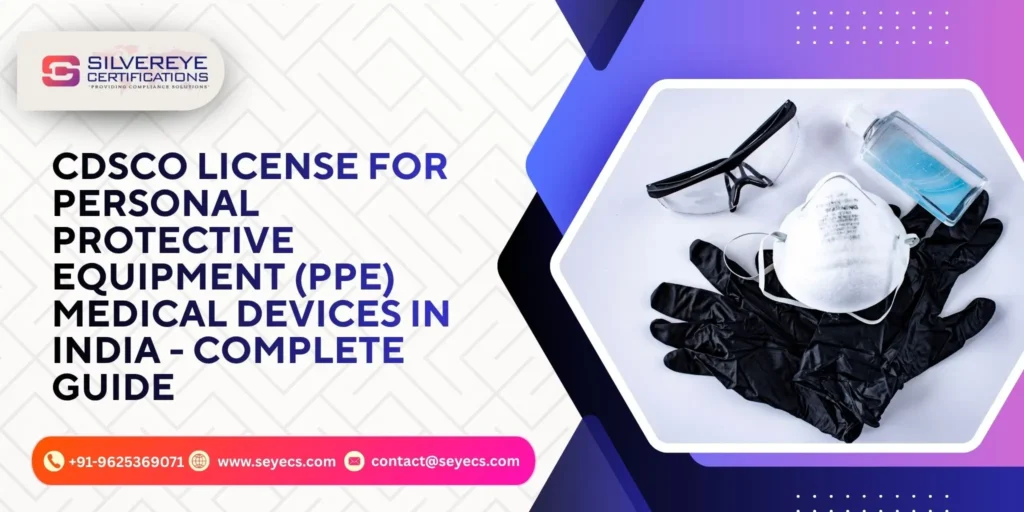
- Covers all CDSCO-notified PPE medical devices classified under Class A and Class B.
- Explains license application forms MD-14, MD-41, MD-3, and MD-7 — and their grant forms.
- Includes fees, documents, validity, renewal timeline, and step-by-step process.
What Is CDSCO License for Personal Protective Equipment Medical Dxevices?
CDSCO registration for Personal Protective Equipment (PPE) medical devices is a mandatory regulatory requirement in India under the Medical Devices Rules, 2017. All PPE products notified as medical devices — including surgical gloves, face shields, gowns, radiation protection gear, and body bags — must be licensed by the Central Drugs Standard Control Organization (CDSCO) before they can be legally manufactured, imported, or distributed in India. Class A devices require a low-risk license; Class B requires moderate-risk compliance. Importers apply via MD-14, Wholesalers via MD-41, and manufacturers via MD-3 (Class A/B) or MD-7 (Class C/D).
What Is CDSCO and Why Does PPE Registration Matter?
The Central Drugs Standard Control Organization (CDSCO) functions under the Ministry of Health and Family Welfare, Government of India. It is the apex regulatory body responsible for the approval, licensing, and post-market surveillance of medical devices in India.
Under the Medical Devices Rules, 2017 (MDR 2017), and its subsequent amendments, specific Personal Protective Equipment (PPE) products used in healthcare settings have been notified as medical devices. This means they are subject to the same regulatory controls as surgical instruments or diagnostic equipment.
If you are a manufacturer, importer, or wholesale distributor of any of the PPE products listed in the CDSCO Medical Devices Schedule, registration is not optional. Operating without a valid CDSCO license exposes your business to product seizure, criminal liability, and market bans.
Why PPE Is Regulated as a Medical Device in India
- PPE used in medical environments directly affects patient safety and infection control.
- CDSCO-notified PPE includes radiation protection devices, surgical gloves, examination gloves, gowns, and body bags.
- India aligns its regulatory framework with global standards including ISO 13485, CE marking, and US FDA protocols.
- Post-COVID regulatory tightening in 2020-2021 expanded the scope of PPE regulated as medical devices.
- Non-compliance can result in license suspension, product recall, and prosecution under the Drugs and Cosmetics Act, 1940.
CDSCO Medical Device Classification: Class A, B, C and D Explained
CDSCO classifies all medical devices into four risk-based categories. The classification determines the license type, application form, fee structure, and regulatory scrutiny.
| Class | Risk Level | Description | Who Regulates? |
| Class A | Low Risk | General purpose PPE, examination gloves, radiation protectors | State Licensing Authority (SLA) |
| Class B | Low to Moderate Risk | Surgical gloves, biosanitizers, chemotherapy kits, body bags | SLA with CDSCO oversight |
| Class C | Moderate to High Risk | Implantable devices, diagnostic reagents (not applicable to standard PPE) | CDSCO |
| Class D | Highest Risk | Active implantable devices, life-sustaining equipment (not applicable to standard PPE) | CDSCO |
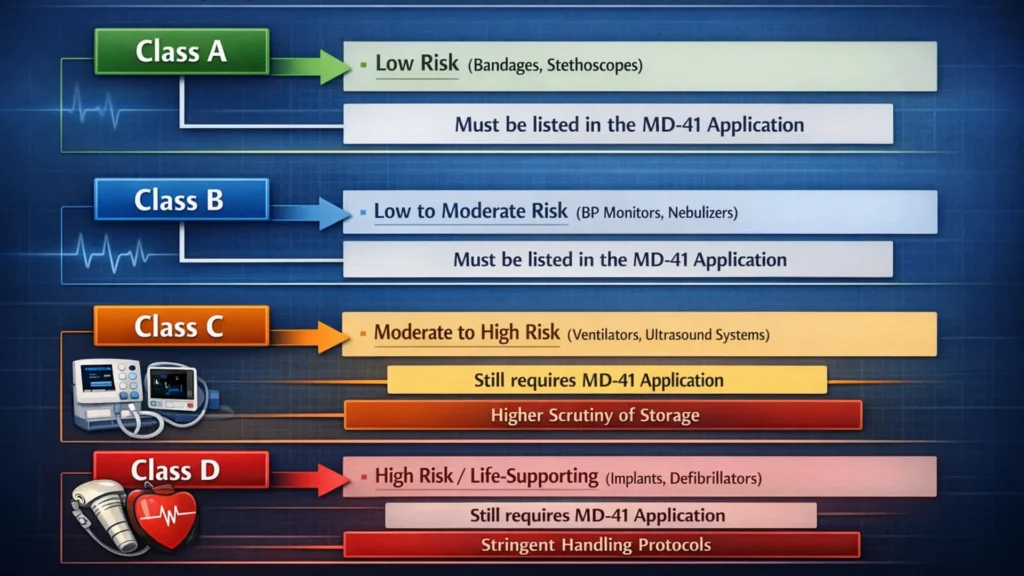
Note: All PPE medical devices listed in the CDSCO notified schedule fall under Class A or Class B. No standard PPE device is classified as Class C or Class D as of 2026.
Class A PPE Medical Devices — Complete List with Intended Use
Class A devices are low-risk medical devices regulated primarily by the State Licensing Authority (SLA). For importers, CDSCO at the central level issues the license. Below is the complete list of Class A PPE medical devices as notified by CDSCO.
| S.No | Device Name | Intended Use | Class |
| 1 | Garment, Protective, For Incontinence | Protects an incontinent patient's garments from excreta | A |
| 2 | Face Shield | Protects the wearer's face from chemical splashes and infectious materials in medical/lab environments | A |
| 3 | Particular Respirator (Disposable Medical Grade Mask) | Covers nose and mouth; protects wearer from hazardous or potentially infectious airborne materials | A |
| 4 | Radiation Protection Gloves | Fully protects operator hands from primary and scattered radiation during diagnosis and therapy | A |
| 5 | Partial Hand Radiation Protector | Flat pad or partial glove protecting part of hands/fingers from primary and scattered radiation | A |
| 6 | Radiation Protection Apron | Protects patient, operator, and personnel from radiation exposure during medical/dental procedures | A |
| 7 | Radiation Protection Mitten | Protects operator hands (thumb and fingers) from unnecessary primary and scattered radiation | A |
| 8 | Radiation Protection Goggles | Protects eyes of operator and personnel from radiation during medical/dental procedures | A |
| 9 | Radiation Face Protector | Transparent/opaque device protecting face and eyes from primary and scattered radiation | A |
| 10 | Operator Radiation Protection Spectacles | Eye protection from radiation; available in prescription and non-prescription variants | A |
| 11 | Gonadal Radiation Protector | Attenuates radiation exposure and shields gonads of patient and operator in diagnostic procedures | A |
| 12 | Radiation Protection Blanket | Protects specific body parts of patient/operator from unnecessary radiation exposure | A |
| 13 | Radiation Protection Collar | Protects neck/thyroid of patient, operator, and other personnel from radiation in medical/dental procedures | A |
| 14 | Radiation Protection Cap | Protects head of operator and other personnel from primary and scattered radiation | A |
| 15 | Mobile Radiation Protection Barrier | Stand-alone movable barrier protecting the operator from radiation during medical/dental procedures | A |
| 16 | Non-Latex Medical Examination Glove | Synthetic gloves protecting patient and user from cross-infection during examination, excluding surgery | A |
| 17 | Latex Medical Examination Glove | Natural rubber gloves protecting patient and user from cross-infection during examination, excluding surgery | A |
| 18 | Gown / Coverall | Full-body impermeable coverage protecting against biological and infectious agents | A |
Class B PPE Medical Devices — Complete List with Intended Use
Class B devices carry a low-to-moderate risk profile. These require more rigorous documentation including performance testing and quality certifications. Below is the complete list of Class B PPE medical devices notified by CDSCO.
| S.No | Device Name | Intended Use | Class |
| 1 | Biosanitizer for Medical Devices | Surface disinfection of medical devices, non-porous hard surfaces, medical equipment, and in-depth cleaning of small surfaces | B |
| 2 | Nitrile Gloves | Protects patient and wearer; resistant to chemicals and certain disinfectants; suitable for latex-allergic individuals | B |
| 3 | Latex Surgical Glove | Natural rubber glove for protecting patient and wearer from cross-infection during medical or dental surgery | B |
| 4 | Non-Latex Surgical Glove | Synthetic glove protecting patient and wearer from cross-infection during medical or dental surgery | B |
| 5 | Chemotherapy Spill Clean-Up Kit | Safely cleans and disposes of chemotherapy drug spills | B |
| 6 | Medical/Cadaver Body Bags | Transports human corpse safely without spreading biohazard or infectious agents | B |
CDSCO License Forms: MD-14, MD-15, MD-41, MD-42, MD-3, MD-5, MD-7, MD-9
Understanding which form to use is the foundation of a successful CDSCO registration. Each business activity — importing, wholesale distribution, and manufacturing — has a specific application form and a corresponding grant-of-license form. Here is a complete breakdown.
| Application Form | Grant Form | License Type | Description |
| MD-14 | MD-15 | Import License | Application (MD-14) and Grant of License (MD-15) for importing Class A, B, C & D medical devices into India. Filed with CDSCO Central Licensing Authority (CLA). |
| MD-41 | MD-42 | Wholesale License | Application (MD-41) and Grant of License (MD-42) for wholesale distribution of medical devices. Filed with State Licensing Authority (SLA). |
| MD-3 | MD-5 | Manufacture – Class A/B | Application (MD-3) and Grant of License (MD-5) for manufacturing Class A and Class B medical devices. Filed with SLA. Class A devices in some states may only require registration, not a formal license. |
| MD-7 | MD-9 | Manufacture – Class C/D | Application (MD-7) and Grant of License (MD-9) for manufacturing Class C and Class D medical devices. Filed with CDSCO through SLA. Requires technical dossier, clinical data, and regulatory approval. |
MD-14 Application for Import License
Form MD-14 is the application form for an import license for medical devices under the Medical Devices Rules, 2017. It must be submitted by an Authorized Indian Representative (AIR) on behalf of the overseas manufacturer. The AIR is responsible for all regulatory, safety, and post-market obligations of the imported device in India.
Key requirements for MD-14 application:
- Complete details of the overseas manufacturer including registration and regulatory approvals in the country of origin.
- Free Sale Certificate, CE Mark, US FDA 510(k), or equivalent market authorization from a recognized country.
- Device Master File including technical specifications, labelling, and intended use.
- Test reports from NABL-accredited or CDSCO-recognized laboratories.
- AIR agreement signed between the overseas manufacturer and the Indian representative.
- Declaration of Conformity and Post-Market Surveillance plan.
MD-15 Grant of Import License
Upon successful review and approval of the MD-14 application, CDSCO issues Form MD-15 as the official Import License. MD-15 is device-specific and company-specific. The license specifies the name of the device, the manufacturer, the Indian importer/AIR, and the validity period.
MD-41 Application for Wholesale License
Form MD-41 is used to apply for a wholesale medical device distribution license from the State Licensing Authority (SLA). Wholesale distributors — who procure from manufacturers or importers and sell to hospitals, retailers, or sub-distributors — must hold a valid MD-42 license before operating.
Key eligibility requirements for wholesale license:
- Dedicated, adequately sized storage premises meeting CDSCO infrastructure standards.
- Competent person or technical staff as required for the device class being distributed.
- Cold chain infrastructure if distributing temperature-sensitive devices.
- Valid GST registration and business registration documents.
MD-42 Grant of Wholesale License
After inspection of premises and verification of documents, the SLA issues Form MD-42 as the wholesale license. MD-42 is valid for 5 years and must be renewed at least 30 days before expiry to avoid lapses.
MD-3 and MD-5: Manufacturing License for Class A and Class B Devices
Manufacturers of Class A and Class B medical devices — including most PPE products listed in this guide — must apply using Form MD-3 to the State Licensing Authority. After inspection and review of manufacturing facilities, the SLA grants Form MD-5 as the manufacturing license.
Class A manufacturers in certain states may be eligible for a simplified registration (rather than a full license), but Class B manufacturers always require a formal license with inspection.
MD-7 and MD-9: Manufacturing License for Class C and Class D Devices
For higher-risk Class C and Class D devices, Form MD-7 is the application submitted to CDSCO (through the SLA). The process involves a clinical evaluation, detailed technical dossier review, and CDSCO Central Licensing Authority (CLA) approval. Form MD-9 is the grant of license for Class C and Class D manufacturers.
Note: No PPE devices notified under the current CDSCO schedule fall under Class C or D. MD-7 and MD-9 apply to devices such as in-vitro diagnostics, implantables, and life-sustaining equipment.
Who Is Eligible to Apply for CDSCO PPE Medical Device Registration?
Eligibility depends on the type of license being sought:
- Importer (MD-14/MD-15): Any Indian company or individual acting as an Authorized Indian Representative (AIR) for an overseas manufacturer. The company must be incorporated in India and registered with CDSCO's Sugam portal. The overseas manufacturer must have valid regulatory approvals in their home country.
- Wholesale Distributor (MD-41/MD-42): Any business entity — company, partnership, LLP, or proprietorship — registered in India and possessing adequate storage premises, competent staff, and valid business registrations. Wholesale license is issued state-wise.
- Manufacturer — Class A/B (MD-3/MD-5): Indian manufacturers with a dedicated manufacturing site, a functional Quality Management System (QMS) certified to ISO 13485, and technical competence appropriate to the device type. Premises must pass SLA inspection.
- Manufacturer — Class C/D (MD-7/MD-9): Indian manufacturers producing higher-risk devices must additionally submit clinical data, a detailed Device Master File, clinical investigation reports, and must clear CDSCO Central Licensing Authority review. (Not applicable to PPE devices in current schedule.)
Documents Required for CDSCO For Personal Protective Equipment (PPE) Medical Devices
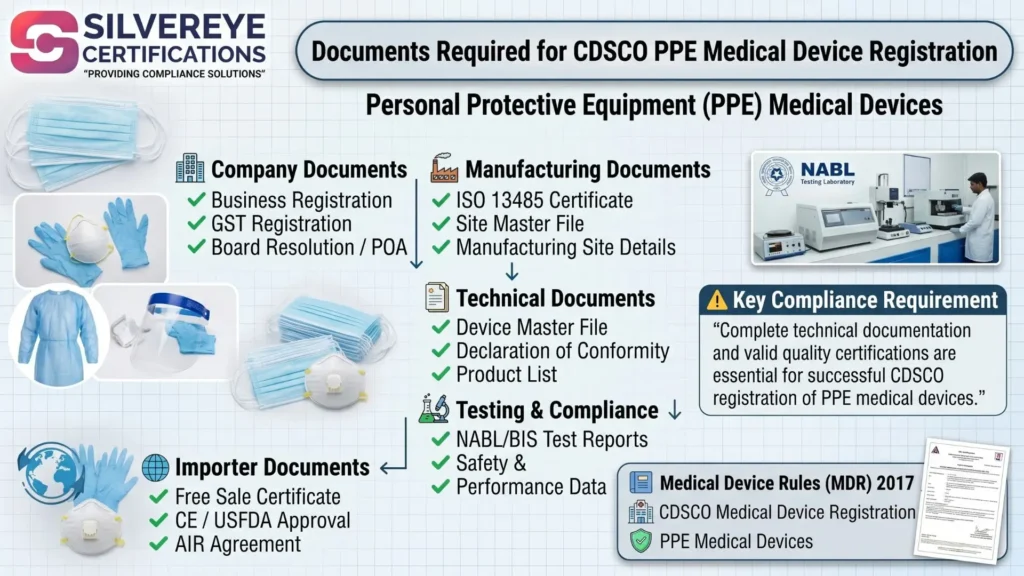
The exact document list varies by license type and device class. Below is a consolidated checklist covering all major document categories.
| S.No | Document | Applicability |
| 1 | Certificate of Incorporation / Business Registration | Mandatory for all applicants |
| 2 | GST Registration Certificate | Required for Indian entities |
| 3 | ISO 13485 Certificate (Quality Management System) | Mandatory for manufacturers |
| 4 | Free Sale Certificate / CE Mark / US FDA Approval | Required for importers |
| 5 | Test Reports from NABL / BIS Accredited Lab | Required for Class B, C, D devices |
| 6 | Declaration of Conformity | All applicants must submit |
| 7 | Site Master File / Manufacturing Site Details | For manufacturers only |
| 8 | Device Master File (Technical Dossier) | All applicants |
| 9 | Authorized Indian Representative (AIR) Agreement | Importers: overseas manufacturer agreement with AIR |
| 10 | Power of Attorney / Board Resolution | If filing through an agent or legal representative |
| 11 | Proof of Premises (Rent Agreement / Ownership Deed) | For manufacturers and wholesale licensees |
| 12 | List of Medical Devices (Form MD-1 / MD-2) | All device types being registered |
Step-by-Step CDSCO Registration Process for PPE Medical Devices
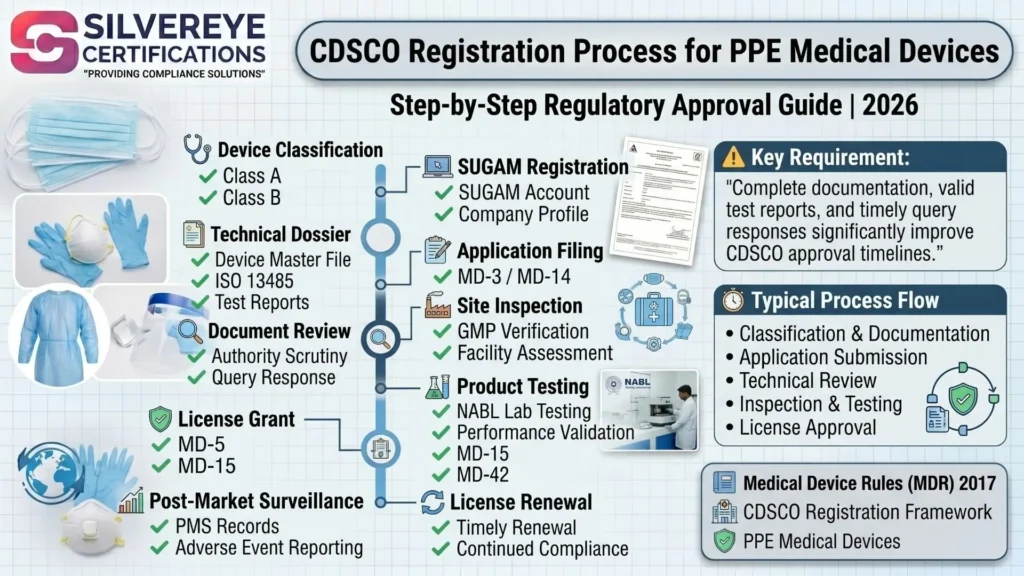
The registration process for PPE medical devices involves multiple steps across the CDSCO Sugam portal and the State Licensing Authority. Here is a clear, step-by-step overview for 2026.
- Classify Your Device: Determine whether your PPE device is Class A or Class B using the CDSCO Medical Devices Schedule. This determines which form and which authority you apply to.
- Create Account on CDSCO Sugam Portal: Register your business on the Sugam online portal. This is mandatory for all importer and manufacturer license applications.
- Compile Technical Dossier: Prepare all required documents including the Device Master File, test reports, ISO 13485 certificate, Free Sale Certificate (for importers), and Declaration of Conformity.
- Submit Application with Fees: Submit the appropriate form (MD-14 for importers, MD-41 for wholesalers, MD-3 for Class A/B manufacturers) along with the prescribed fee via the Sugam portal or physically to the SLA.
- Document Scrutiny by Authority: CDSCO or the SLA reviews the application for completeness and compliance. Deficiency letters may be issued if documents are incomplete. Respond within the stipulated period.
- Site Inspection (if applicable): For manufacturing and wholesale licenses, the licensing authority conducts a premises inspection to verify infrastructure, competent staff, and compliance with GMP (Good Manufacturing Practice) standards.
- Test Sample Submission (Class B and above): For Class B devices such as surgical gloves and biosanitizers, the authority may direct submission of product samples to a government or accredited test laboratory.
- Grant of License: Upon successful review and inspection, the authority issues the grant-of-license form — MD-15 (import), MD-42 (wholesale), MD-5 (Class A/B manufacture), or MD-9 (Class C/D manufacture).
- Post-Market Surveillance: After license grant, the licensee must maintain post-market surveillance records, adverse event reporting, and periodic audits to ensure ongoing compliance.
- Renewal: Track license validity. Apply for renewal at least 30 to 60 days before expiry to avoid lapse and business disruption.
CDSCO Registration Fees for PPE Medical Devices (2026)
The following fee schedule applies under the Medical Devices Rules, 2017. Fees are approximate government fees and do not include professional or consulting charges.
| License Type | Class A / B | Class C / D | Validity |
| Import License (MD-14/MD-15) | ₹3,000 per device | ₹5,000 per device | 5 Years |
| Wholesale License (MD-41/MD-42) | ₹2,000 | ₹3,000 | 5 Years |
| Manufacturing License (MD-3/MD-5 or MD-7/MD-9) | ₹3,000 – ₹5,000 | ₹5,000 – ₹10,000 | Perpetual / Subject to renewal |
| Renewal Fee | Same as original application fee | Same as original application fee | Renewed every 5 years |
Note: Fees are indicative and subject to revision by CDSCO. Additional state fees may apply for SLA-regulated licenses. Always verify current fees on the official CDSCO Sugam portal before filing.
Validity, Renewal, and Compliance Timeline
Keeping your CDSCO license valid is as important as obtaining it in the first place. Here is a clear breakdown of the validity and renewal requirements for each license type.
- Import License (MD-15): Valid for 5 years from the date of issue. Renewal application must be filed in Form MD-14 at least 30 days before expiry. Failure to renew on time means the import license lapses and the device cannot be legally imported until a fresh license is granted.
- Wholesale License (MD-42): Valid for 5 years. Renewal in Form MD-41 must be submitted to the SLA at least 30 days before expiry. A fresh site inspection may be conducted at the time of renewal.
- Manufacturing License — Class A/B (MD-5): Generally granted as a perpetual license without a fixed expiry, provided the manufacturer maintains ongoing GMP compliance. However, the SLA may conduct periodic inspections, and non-compliance can result in suspension or cancellation.
- Manufacturing License — Class C/D (MD-9): May carry a defined validity period with renewal requirements depending on the state and the specific device type. Always verify with CDSCO or the SLA at the time of grant.
Annual Compliance Requirements
- Submit Annual Performance Report (APR) through the Sugam portal.
- Maintain Adverse Event Reporting and Vigilance records.
- Update device-specific changes (formulation, label, manufacturer) via variation applications before implementation.
- Maintain GMP compliance and be ready for surprise inspections by the SLA or CDSCO.
- Ensure cold chain and storage conditions are continuously maintained for sensitive PPE devices.
Benefits of CDSCO Registration for PPE Medical Devices
Obtaining CDSCO registration for your PPE medical device is not just a regulatory obligation — it creates real commercial and reputational advantages for your business.
- Legal Market Access: Only CDSCO-registered devices can be legally sold, imported, or distributed in India. Registration opens access to hospitals, government tenders, and retail pharmacy channels.
- Government Tender Eligibility: CDSCO registration is a mandatory prerequisite for participation in government procurement tenders including GeM (Government e-Marketplace), hospital supply chains, and state health department purchases.
- Brand Trust and Credibility: Registration signals product quality and safety to healthcare professionals, hospital procurement committees, and patients.
- Global Recognition: Compliance with Indian MDR 2017 aligns your manufacturing or distribution process with ISO 13485 and international GMP standards, making it easier to export to other regulated markets.
- Protection Against Counterfeits: Registered devices benefit from CDSCO enforcement actions against counterfeit or substandard products in the same category.
Conclusion: Stay Compliant, Stay Competitive
CDSCO registration for Personal Protective Equipment (PPE) medical devices is a non-negotiable legal requirement for any business that manufactures, imports, or distributes these products in India. With 18 Class A devices and 6 Class B devices currently notified in the PPE category, the range of affected businesses is significant — from radiation protection equipment suppliers to surgical glove importers and chemotherapy kit distributors.
The Indian medical device market is growing rapidly in 2026. CDSCO is strengthening enforcement and expanding its list of notified medical devices. Getting registered early not only protects your business from regulatory risk but positions you to capture growing institutional and government procurement opportunities.
Whether you are applying for an import license (MD-14/MD-15), a wholesale license (MD-41/MD-42), or a manufacturing license (MD-3/MD-5 for Class A/B), the key to a fast and smooth approval is document completeness, quality system readiness, and compliance with the Medical Devices Rules, 2017.
For detailed compliance support, consult a CDSCO-experienced regulatory consultant or visit the official CDSCO Sugam portal.
Frequently Asked Questions
What is CDSCO medical device registration?
CDSCO (Central Drugs Standard Control Organization) is India's national regulatory authority under the Ministry of Health & Family Welfare. It regulates medical devices under the Medical Devices Rules, 2017. CDSCO registration is mandatory for all medical devices imported, manufactured, or sold in India.
Which class do Personal Protective Equipment (PPE) medical devices fall under?
Most PPE devices like face shields, radiation protection gear, examination gloves, and gowns are classified as Class A (low risk). Surgical gloves, biosanitizers, nitrile gloves, chemotherapy kits, and body bags are classified as Class B (low to moderate risk). No PPE device in the current CDSCO schedule falls under Class C or D.
What is the difference between MD-3 and MD-7 forms?
MD-3 is the application form for manufacturing license for Class A and Class B medical devices. MD-7 is the application form for Class C and Class D devices. The corresponding grant-of-license forms are MD-5 (for Class A/B) and MD-9 (for Class C/D).
What forms are required for importing medical devices into India?
Importers must submit Form MD-14 as the application for import license. Upon approval, CDSCO grants the license through Form MD-15. The import license is valid for 5 years and covers all device classes.
What is the wholesale license process under CDSCO?
Wholesale distributors must apply using Form MD-41. After review and inspection by the State Licensing Authority (SLA), Form MD-42 is issued as the grant of wholesale license. The license is valid for 5 years and must be renewed before expiry.
What documents are required for CDSCO medical device registration?
Key documents include: business registration proof, ISO 13485 certificate (for manufacturers), Free Sale Certificate or CE Mark (for importers), test reports from NABL-accredited labs, Declaration of Conformity, Device Master File, site master file, GST certificate, and Authorized Indian Representative (AIR) agreement for importers.
How long does CDSCO registration take for PPE medical devices?
For Class A devices, registration typically takes 30 to 60 working days. For Class B devices, it may take 60 to 90 working days. The timeline depends on document completeness, CDSCO workload, and whether a site inspection is triggered.
Is CDSCO registration mandatory for all PPE products used in hospitals?
Yes. Any product notified as a medical device under the Medical Devices Rules, 2017, including PPE like surgical gloves, gowns, face shields, radiation protection aprons, and body bags, requires CDSCO registration before it can be legally marketed, imported, or distributed in India.
What is the validity and renewal period for CDSCO licenses?
Import licenses (MD-15) and wholesale licenses (MD-42) are valid for 5 years and must be renewed before expiry using the same application forms. Manufacturing licenses for Class A and B (MD-5) are granted on a perpetual basis but must maintain ongoing compliance. Class C and D manufacturing licenses (MD-9) may carry specific renewal conditions.
Can a foreign manufacturer directly register a medical device in India?
No. A foreign manufacturer cannot apply directly. They must appoint an Authorized Indian Representative (AIR) who submits the import license application (MD-14) on their behalf. The AIR is legally responsible for regulatory compliance of the imported device in India.