
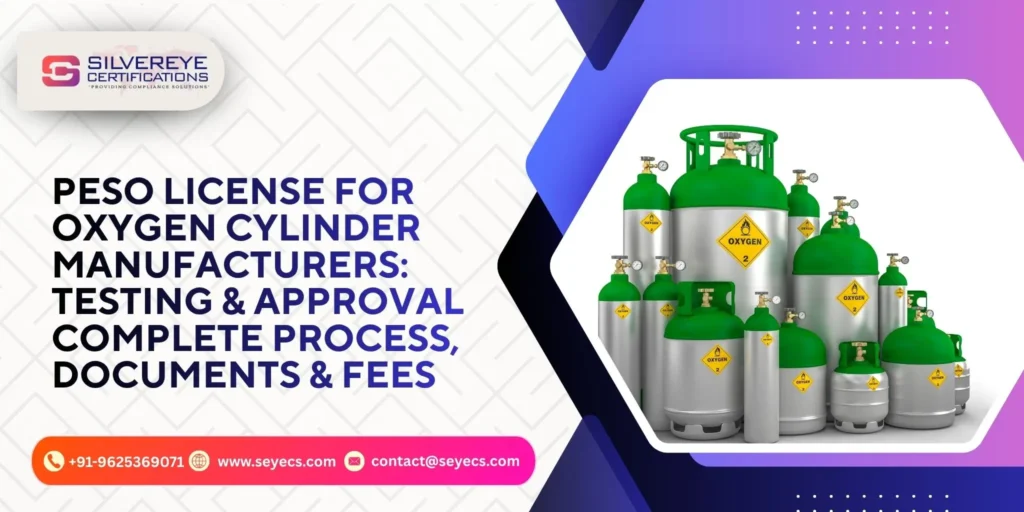
- Every manufacturer of oxygen cylinders in India must obtain PESO approval under the Gas Cylinders Rules, 2016 before any cylinder can be filled, sold, or supplied.
- The approval process includes design verification, material certification, batch prototype testing, and hydrostatic pressure testing at a PESO-recognized laboratory.
- PESO (Petroleum and Explosives Safety Organization), headquartered in Nagpur, is the sole Central Government authority that grants cylinder manufacturer approvals in India.
- Manufacturer approvals are valid for 5 years and require renewal along with periodic re-testing; non-compliance attracts penalties under the Explosives Act, 1884.
What is PESO License for Oxygen Cylinder Manufacturers?
A PESO license (manufacturer approval) for oxygen cylinders is the mandatory regulatory clearance granted by the Petroleum and Explosives Safety Organization (PESO), Nagpur, to any entity that manufactures seamless or welded oxygen cylinders in India. Governed by the Gas Cylinders Rules, 2016 under the Explosives Act, 1884, this approval certifies that the manufacturer's design, materials, and production processes meet Indian Standards (primarily IS 7285 for seamless cylinders). Without PESO approval, no oxygen cylinder can be legally manufactured, marked, filled, or sold in India.
What is PESO and Why Does It Regulate Oxygen Cylinders?
The Petroleum and Explosives Safety Organization (PESO) operates under the Department for Promotion of Industry and Internal Trade (DPIIT), Ministry of Commerce and Industry. It is India's apex technical authority for regulating the manufacture, storage, import, and transport of explosives, petroleum, and compressed gases — including oxygen cylinders.
Oxygen, though not flammable itself, is a powerful oxidizer. Oxygen cylinders are filled at high pressures — typically 150 bar or 200 bar — and a manufacturing defect can cause catastrophic failure. The medical oxygen supply crisis during the COVID-19 pandemic underscored the critical importance of quality-assured oxygen cylinder manufacturing in India. PESO approval exists to ensure every cylinder that reaches a hospital, industrial unit, or welding shop is structurally sound and safe.
Legal Framework
| Instrument | Relevance to Oxygen Cylinder Manufacturers |
| Explosives Act, 1884 | Overarching legislation under which PESO operates; penalties for violations |
| Gas Cylinders Rules, 2016 | Primary rules governing manufacture, testing, filling, import, and use of compressed gas cylinders in India |
| IS 7285 (Parts 1 & 2) | Indian Standard for seamless steel gas cylinders — design, material, testing (BIS standard referenced by PESO) |
| IS 3196 | Indian Standard for welded low-carbon steel cylinders for dissolved acetylene (reference for welded designs) |
| IS 8866 | Cylinders for liquefied petroleum gas — specification (for comparison context) |
| PESO Circulars / Orders | PESO issues periodic technical circulars updating testing protocols and approval conditions |
| Bureau of Indian Standards (BIS) | IS marks are mandatory on cylinders; BIS licence is often a parallel requirement for cylinder manufacturers |
Types of Oxygen Cylinders Covered Under PESO Approval
PESO approval for oxygen cylinder manufacturers covers cylinders based on design type, intended use, and pressure rating. Each type must be designed, tested, and approved separately. Manufacturers seeking to produce multiple types must obtain separate design approvals for each.
| Cylinder Type | Design Standard | Typical Working Pressure | Common Use |
| Seamless Steel Oxygen Cylinder | IS 7285 Part 1 (steel) / Part 2 (alloy steel) | 150 bar / 200 bar | Industrial welding, medical oxygen, chemical process |
| Seamless Aluminium Alloy Cylinder | IS 7285 Part 3 / ISO 7866 | 150 bar / 200 bar | Medical oxygen (portable), aviation, diving |
| Composite / CFRP Cylinder (Type IV) | ISO 11119 series | 200 bar – 300 bar | Portable medical oxygen, aerospace, emergency |
| Liquid Oxygen (LOX) Vessel / Cryogenic | IS 9483 / ISO 21010 | Low pressure, cryogenic | Hospitals, industrial gas plants, bulk supply |
| Oxygen Manifold Cylinder (Multiple Valve) | IS 7285 + PESO special approval | 150–200 bar | Hospital manifold systems, industrial banks |
| Note: This guide focuses on seamless steel and aluminium oxygen cylinders (IS 7285) as these are the most commonly manufactured and PESO-approved types in India. Composite and cryogenic vessel approvals follow different protocols and may involve additional technical review. |
Who Needs PESO Approval for Oxygen Cylinder Manufacturing?
Any person, firm, LLP, or company that manufactures oxygen cylinders in India for sale, supply, or own use is required to obtain PESO manufacturer approval before commencing production. This applies to:
- New greenfield oxygen cylinder manufacturing plants
- Existing manufacturers adding a new cylinder type, size, or design to their product range
- Manufacturers who have changed their manufacturing process, raw material source, or design since the last approval
- OEM manufacturers producing oxygen cylinders for gas companies, hospitals, or defense organizations
- Small and medium enterprises (SMEs) producing cylinders for industrial welding gas supply
- Manufacturers seeking to obtain BIS license for oxygen cylinders alongside PESO approval
Manufacturers importing cylinder shells from abroad and carrying out finishing, testing, and valve assembly in India also need PESO approval for the Indian manufacturing activity, in addition to applicable import permissions.
Eligibility Criteria for PESO Manufacturer Approval
| Criterion | Requirement |
| Legal Entity | Any registered legal entity — proprietorship, partnership, LLP, private or public limited company — incorporated in India |
| Manufacturing Premises | Dedicated manufacturing plant in India with adequate infrastructure for cylinder production (hot forming / seamless extrusion / deep drawing as applicable) |
| Technical Competence | Qualified metallurgist, mechanical engineer, or equivalent technical head responsible for quality control |
| Equipment & Testing Facility | Hydraulic press, mandrel extrusion equipment (for seamless), heat treatment furnace, NDT (ultrasonic / radiographic) equipment, hydrostatic testing machine, and burst testing facility — or access to PESO-recognised third-party testing lab |
| Design Documentation | Detailed engineering drawings with dimensional tolerances, material specifications, and design calculations conforming to IS 7285 (or applicable standard) |
| Quality Management | Documented quality control procedures; ISO 9001 certification is strongly preferred and often expected by PESO inspectors |
| Raw Material Sourcing | Steel billets / aluminium alloy meeting the chemical composition and mechanical properties specified in IS 7285 Part 1/2/3 from an approved mill |
Step-by-Step PESO Approval Process for Oxygen Cylinder Manufacturers
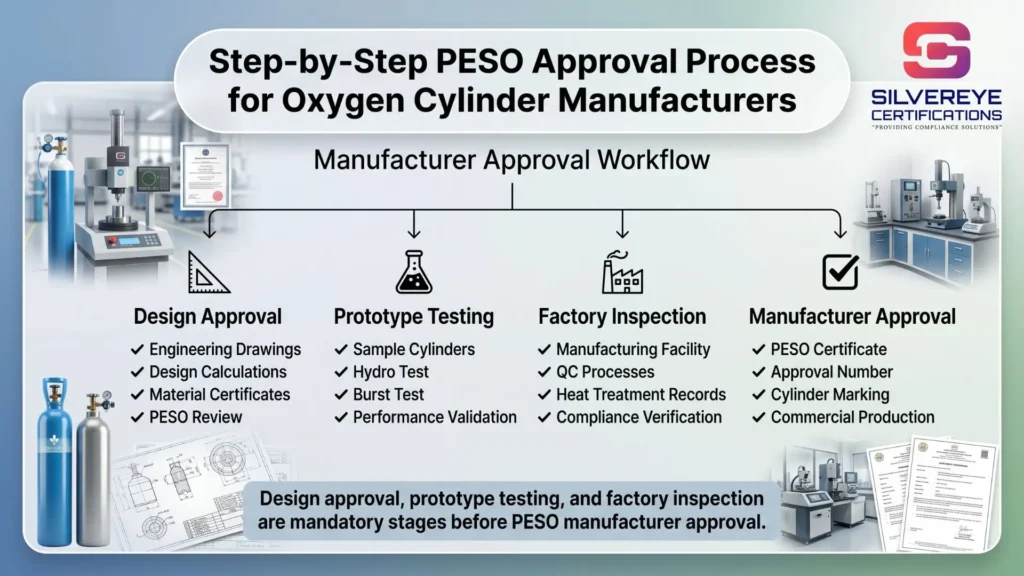
The PESO manufacturer approval process for oxygen cylinders involves design approval, prototype testing, inspection, and issuance of a certificate. The complete process typically takes 3 to 6 months for a well-prepared applicant.
Phase 1: Design Approval
- Prepare complete design dossier — engineering drawings, material test certificates (MTC), design calculations, and intended working pressure per IS 7285
- Submit design dossier to PESO, Nagpur (or regional office) along with the application form and prescribed fee
- PESO technical committee reviews the design; queries are raised if the design or documentation is deficient
- Applicant responds to queries and submits revised drawings or documents
- PESO grants Design Approval — a written acceptance of the submitted design
Phase 2: Prototype / First Article Testing
- Manufacture prototype cylinders from the approved design — typically a batch of 5 to 10 units for initial testing
- Submit prototype cylinders to a PESO-recognized testing laboratory (or PESO's own facility at Nagpur)
- Testing includes: visual examination, dimensional check, hydrostatic pressure test, burst test, tensile test of test pieces cut from cylinder, bend test, impact test (Charpy/Izod), and any special tests per IS 7285
- Testing laboratory issues a test report confirming pass/fail against IS 7285 requirements
- Submit test report to PESO along with production batch records
Phase 3: Factory Inspection
- PESO inspector visits the manufacturing premises to verify infrastructure, equipment, QC processes, and raw material records
- Inspector reviews heat treatment records, raw material mill test certificates (MTCs), and in-process QC documentation
- Any non-conformances are documented; applicant must rectify before approval is granted
- Inspector submits inspection report to PESO HQ, Nagpur for final review
Phase 4: Grant of Manufacturer Approval
- PESO HQ reviews design approval, test reports, and inspection report
- PESO issues the Manufacturer Approval Certificate specifying: manufacturer name, plant address, cylinder type and size, design standard, working pressure, and approval validity
- Approved manufacturer receives the PESO approval number, which must be stamped or engraved on every cylinder produced
| Important: Every individual cylinder produced under the PESO approval must undergo 100% hydrostatic pressure testing at the manufacturer's facility before despatch. PESO approval is for the manufacturing process and design — it does not replace per-cylinder testing requirements. |
Testing Requirements for Oxygen Cylinder PESO Approval
Testing is at the heart of the PESO approval process. Oxygen cylinders must pass a rigorous battery of tests both at the prototype approval stage and on every production batch. Below is a consolidated table of mandatory tests under IS 7285 and PESO requirements.
| Test | Standard Reference | Purpose | When Conducted |
| Hydrostatic Pressure Test | IS 7285 / Gas Cylinders Rules, Rule 9 | Confirms cylinder withstands 1.5x working pressure without leakage or permanent deformation | Every cylinder (100%) |
| Burst Test | IS 7285 Cl. 9.4 | Confirms cylinder rupture pressure exceeds 2.5x working pressure (minimum) | Prototype / type approval batch |
| Tensile Test | IS 7285 / IS 1608 | Verifies UTS, yield strength, elongation of cylinder material after heat treatment | Prototype + periodic production |
| Impact Test (Charpy/Izod) | IS 7285 Cl. 9.3 | Assesses toughness of cylinder material at specified temperature | Prototype + heat treatment batch |
| Bend Test | IS 7285 Cl. 9.2 | Confirms ductility of cylinder material (no cracking at 180° bend) | Prototype / type approval |
| Visual and Dimensional Inspection | IS 7285 / PESO checklist | Wall thickness, length, diameter, thread form, surface defects, markings | Every cylinder |
| Non-Destructive Testing (NDT) | IS 7285 + ASTM E213 / EN 10246 | Ultrasonic testing (UT) to detect internal seams, cracks, or laminations in wall | Per production batch or 100% (grade-dependent) |
| Hardness Test | IS 7285 / IS 1500 | Confirms hardness is within specified range after heat treatment | Per heat treatment batch |
| Thread Gauge Inspection | IS 3224 / ISO 11363 | Verifies valve thread form, pitch, and engagement length | Every cylinder |
| Leakage Test (pneumatic) | Gas Cylinders Rules, Rule 9 | Air or nitrogen pressure test to check valve and cylinder shell for leaks before final despatch | Every cylinder |
PESO-Recognized Testing Laboratories
Prototype and type approval testing must be conducted at a PESO-recognised testing facility. Key recognised laboratories for gas cylinder testing in India include:
- PESO's own testing facility, Nagpur
- Central Institute of Plastics Engineering and Technology (CIPET) — for composite cylinders
- National Test House (NTH), regional centres
- Bureau of Indian Standards (BIS) recognized labs
- NABL-accredited laboratories with cylinder testing capability approved by PESO
Always verify the current list of recognised laboratories with PESO before submitting samples, as the approved lab list is updated periodically.
Documents Required for PESO Oxygen Cylinder Manufacturer Approval
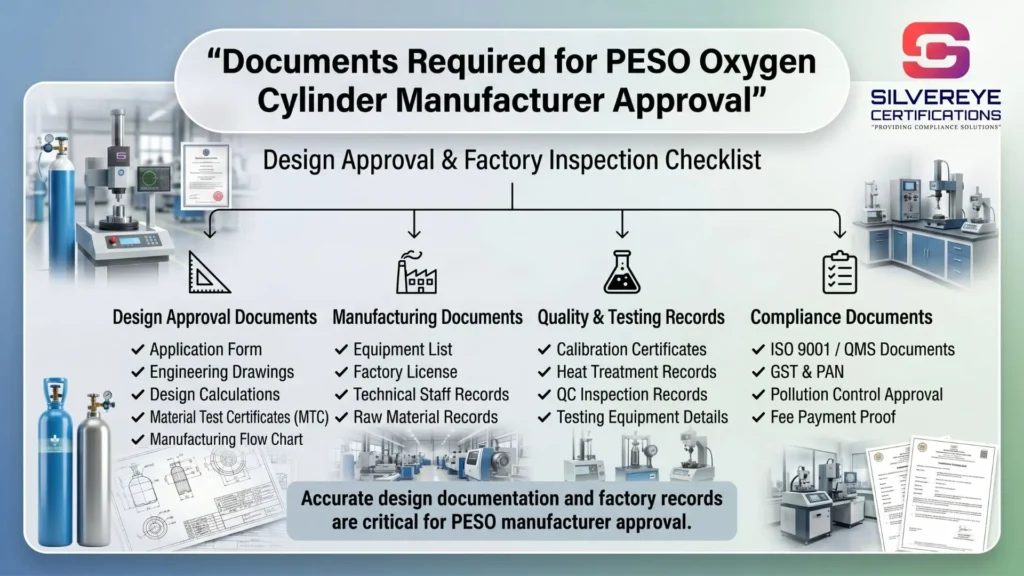
For Design Approval (Phase 1)
- Application form (as prescribed by PESO) with applicant and company details
- Engineering drawings of the cylinder — dimensional, assembly, and cross-section — signed by a qualified engineer
- Design calculations — wall thickness, working pressure, test pressure, burst pressure calculations as per IS 7285
- Material specification — grade of steel / aluminium alloy, chemical composition, and mechanical property requirements
- Mill test certificates (MTCs) of raw material (steel billets or aluminium alloy extrusions)
- Heat treatment cycle specification — temperature, soaking time, quenching/cooling medium
- Manufacturing process description / flow chart
- Proposed cylinder markings (PESO approval no., working pressure, tare weight, test date, manufacturer mark)
- Quality control plan for the proposed cylinder type
- Fee payment challan / DD
For Factory Inspection (Phase 3)
- List of all manufacturing equipment with specifications and calibration records
- List of testing equipment (hydrostatic test machine, UTM, NDT equipment) with calibration certificates
- Raw material procurement records and MTC register
- Heat treatment batch records
- In-process inspection records and QC formats
- ISO 9001 certificate (if available) or documented QMS manual
- Company registration certificate, GST certificate, PAN
- Factory license / consent from State Pollution Control Board (as applicable)
- Qualification and appointment records of technical staff
PESO Approval Fees for Oxygen Cylinder Manufacturers
PESO charges fees at multiple stages of the approval process. The following fee structure is indicative based on the Gas Cylinders Rules, 2016 and PESO fee schedules. Always verify the current fee with PESO, Nagpur before filing, as fees are periodically revised.
| Fee Head | Indicative Amount (INR) | Remarks |
| Design Approval Application Fee | Rs. 2,000 – Rs. 5,000 per design | Payable to Controller of Explosives, Nagpur by DD |
| Prototype Testing Fee (PESO lab) | Rs. 5,000 – Rs. 20,000 per batch | Varies with number of test pieces and test type; third-party labs charge separately |
| Factory Inspection Fee | Rs. 3,000 – Rs. 10,000 per inspection | Travel and TA/DA of inspector may be additional |
| Manufacturer Approval Certificate Fee | Rs. 2,000 – Rs. 5,000 | Payable at time of grant |
| Renewal Fee | Equivalent to fresh approval fee | Every 5 years |
| Amendment Fee (design change, new size) | Rs. 1,000 – Rs. 3,000 per amendment | For modifications post-approval |
| Duplicate Certificate Fee | Rs. 500 – Rs. 1,000 | For lost or damaged certificate replacement |
Note: All payments to PESO are made by Demand Draft (DD) in favour of 'Controller of Explosives, Nagpur' payable at Nagpur, or through DPIIT's approved online payment gateway as applicable. Confirm the payment mode with PESO before submission.
Validity and Renewal of PESO Manufacturer Approval
| Aspect | Details |
| Validity Period | 5 years from the date of grant of Manufacturer Approval Certificate |
| Renewal Application Timing | Apply at least 3 months before the expiry date to avoid lapse |
| Renewal Requirements | Renewal application + updated design drawings (if changed) + fresh periodic test reports + factory re-inspection (if PESO requires) + renewal fee |
| Post-Expiry Operation | Manufacturing or supplying cylinders after approval expiry is a violation of Gas Cylinders Rules, 2016 — attracts penalties and product confiscation |
| Periodic Re-testing | PESO may require periodic batch testing (typically every 1–2 years) even during the approval validity period — check your approval certificate conditions |
| Design Change During Validity | Any change in design, material, wall thickness, or manufacturing process requires fresh design approval — cannot be made without informing PESO |
| Change of Premises / Expansion | Change of manufacturing location or addition of a new plant requires amendment application to PESO before the change takes effect |
BIS License and Its Relationship With PESO Approval
Oxygen cylinder manufacturers in India often need both a PESO Manufacturer Approval and a Bureau of Indian Standards (BIS) licence under the BIS Certification Scheme for IS 7285. These are separate approvals granted by different authorities, but they complement each other.
| Aspect | PESO Manufacturer Approval | BIS Licence (IS 7285) |
| Governing Authority | PESO, DPIIT, Ministry of Commerce | Bureau of Indian Standards (BIS) |
| Legal Basis | Gas Cylinders Rules, 2016 / Explosives Act | BIS Act, 2016 / Quality Control Order (if applicable) |
| Primary Purpose | Safety approval — confirms design, material, and production process are safe | Conformity certification — allows use of ISI mark on cylinders |
| Mandatory? | Yes — no cylinder can be legally manufactured without PESO approval | Mandatory if oxygen cylinders are covered under a QCO; strongly advisable otherwise |
| Inspection Agency | PESO inspectors | BIS officers / BIS-empanelled testing labs |
| Testing Standard | IS 7285 + Gas Cylinders Rules | IS 7285 exclusively |
| Renewal Period | 5 years | Annual (BIS licence renewal) |
In practice, many PESO inspectors expect the cylinder design to comply with IS 7285 as part of the PESO design review. Getting both PESO approval and the BIS license simultaneously reduces duplication of testing and inspections — manufacturers are advised to coordinate both processes from the start.
Mandatory Markings on PESO-Approved Oxygen Cylinders
Every PESO-approved oxygen cylinder manufactured in India must carry specific markings stamped or engraved on the cylinder shoulder or top dome. These markings are required under the Gas Cylinders Rules, 2016 and IS 7285 and must be applied before the cylinder leaves the manufacturing premises.
| Marking | Details |
| Manufacturer's Mark / Name | Registered trade mark or abbreviated name of the manufacturer as approved by PESO |
| PESO Approval Number | Unique approval number assigned by PESO — e.g., 'PESO/CGS/MFR/XXXX/20XX' |
| Serial Number | Unique serial number for traceability of each cylinder |
| Standard Reference | IS 7285 Part 1 (or applicable part) |
| Working Pressure (WP) | In bar — e.g., 'WP 150 BAR' or 'WP 200 BAR' |
| Test Pressure (TP) | In bar — typically 1.5 x WP; e.g., 'TP 225 BAR' |
| Date of Manufacture | Month and year of manufacture — e.g., '06/26' |
| Date of Hydraulic Test | Month and year of hydrostatic pressure test |
| Tare Weight (TW) | Weight of empty cylinder in kg |
| Water Capacity | Internal volume in litres |
| ISI Mark (BIS) | If BIS licensed — CM/L number and BIS standard mark |
| Gas Service Marking | 'O2' or 'OXYGEN' to identify the intended gas service |
Post-Approval Compliance Obligations
Receiving PESO manufacturer approval is not a one-time activity. Manufacturers have ongoing obligations to maintain compliance throughout the approval validity period.
- Maintain batch-wise hydrostatic test records for every cylinder produced — minimum 5 years retention
- Maintain raw material MTC register — traceability from steel mill / aluminium supplier to finished cylinder
- Conduct periodic re-testing as specified in the PESO approval conditions or as directed by PESO
- Immediately inform PESO of any in-service failure, catastrophic event, or quality issue with supplied cylinders
- Do not change cylinder design, material, or manufacturing process without prior PESO approval
- Cooperate with surprise inspections or audits by PESO officers
- Ensure cylinders are filled only by PESO-licensed filling stations with the correct gas at the correct pressure
- Maintain a despatch register recording cylinder serial numbers, customer details, and dates of supply
- Display PESO approval certificate prominently at the manufacturing premises
Penalties for Non-Compliance
Violations of the Gas Cylinders Rules, 2016 and the Explosives Act, 1884 carry serious consequences. PESO and state authorities actively conduct market surveillance and can initiate action without prior notice.
| Violation | Penalty / Consequence |
| Manufacturing cylinders without PESO approval | Criminal prosecution under Explosives Act; imprisonment up to 3 years and/or fine; product confiscation |
| Using unapproved design or material | Cancellation of existing PESO approval; prosecution |
| Falsifying cylinder markings or test records | Criminal offence — fraud and falsification charges in addition to Explosives Act violations |
| Manufacturing after approval expiry | Same as manufacturing without approval; cylinders treated as contraband |
| Failure to cooperate with PESO inspection | Show cause notice; suspension or cancellation of approval |
| Supplying defective cylinders that cause injury or death | Civil and criminal liability; prosecution under IPC / BNSS in addition to Explosives Act |
Benefits of Obtaining PESO Manufacturer Approval
- Legal Authorization: The only pathway to legally manufacture and supply oxygen cylinders in India — protects your business from enforcement action.
- Market Access: Hospitals, industrial gas companies, defense, and government tenders all mandate PESO-approved cylinders — approval unlocks these high-value markets.
- Brand Credibility: PESO approval signals that your manufacturing processes meet national safety standards, strengthening buyer confidence.
- Export Readiness: Many international buyers and gas companies require proof of domestic regulatory approval as a prerequisite for acceptance or co-branding.
- Insurance Benefits: PESO-approved cylinders attract better product liability insurance terms compared to unapproved products.
- Government Tenders: Central and state government tenders for medical oxygen cylinders — including those for AIIMS, ESIC, and state health departments — require PESO approval as a qualification criterion.
- Safety Culture: The approval process enforces rigorous QC and documentation, reducing manufacturing defects and in-service failures.
Common Mistakes to Avoid in the PESO Approval Process
Submitting design drawings without complete design calculations — PESO will reject incomplete submissions, delaying the process.
- Using raw material that does not meet IS 7285 chemical composition requirements — always insist on mill test certificates (MTCs) from your steel / alloy supplier.
- Conducting prototype testing at a non-PESO-recognized laboratory — test reports from unrecognized labs will not be accepted.
- Changing the wall thickness or material grade after design approval without informing PESO — this renders the approval void.
- Not maintaining cylinder-wise hydrostatic test records — PESO inspectors routinely check these registers.
- Allowing PESO approval to expire before applying for renewal — manufacturing on an expired approval is a criminal offence.
- Overlooking periodic re-testing conditions specified in the approval certificate — each approval certificate may carry specific conditions that must be followed.
How Silvereye Certifications Can Help
Silvereye Certifications is a specialist regulatory compliance consultancy with hands-on experience in PESO approvals, BIS certifications, and industrial safety regulations. Our team has guided oxygen cylinder manufacturers, compressed gas companies, and MSME fabricators through the complete PESO approval process — from initial design review to certificate grant.
- PESO approval application preparation — forms, design dossier, and document compilation
- Design review and IS 7285 compliance gap assessment before submission
- Coordination with PESO-recognized testing laboratories for prototype testing
- Factory readiness assessment against PESO inspection criteria and Schedule M-II equivalent GMP
- BIS IS 7285 license application support — coordinated with PESO approval to minimize duplicate testing.
- Ongoing compliance management — record-keeping, periodic test scheduling, and renewal.
Frequently Asked Questions
Is PESO approval mandatory for all oxygen cylinder sizes?
Yes. PESO manufacturer approval is required for every cylinder type, size, and pressure rating that you manufacture. A single approval covers the specific design, size, and working pressure described in the application. If you manufacture the same cylinder in two different sizes — say 7-litre and 47-litre — you need separate design approvals and test evidence for each size, though a single factory inspection may cover all.
How long does the PESO oxygen cylinder manufacturer approval process take?
For a well-prepared applicant with all documents in order and a PESO-recognised lab available, the process typically takes 3 to 6 months. Delays commonly occur due to incomplete design documentation, laboratory capacity constraints, or PESO query responses. Manufacturers who appoint a regulatory consultant and prepare documentation meticulously can reduce timelines significantly.
Can a small MSME manufacturer get PESO approval for oxygen cylinders?
Yes. PESO approval is available to any legal entity regardless of size, provided it meets the technical and infrastructure eligibility criteria. MSMEs often face challenges in establishing in-house testing facilities — in such cases, a written arrangement with a PESO-recognised testing laboratory for prototype and batch testing is acceptable. ISO 9001 certification, while not always mandatory, significantly strengthens the application.
Do I need a separate PESO approval for medical oxygen cylinders vs. industrial oxygen cylinders?
Not necessarily, provided the cylinder design and construction are identical. The same PESO-approved seamless steel oxygen cylinder (IS 7285) can be used for both medical and industrial applications, as the cylinder standard does not differentiate between medical and industrial gas service at the manufacturing stage.
What is the PESO approval number and where must it appear on the cylinder?
The PESO approval number is a unique identifier assigned to your manufacturing approval — typically in the format PESO/CGS/MFR/XXXX/20XX. It must be stamped or engraved on every cylinder you produce, on the cylinder shoulder or top dome, as part of the mandatory markings under the Gas Cylinders Rules, 2016.
What happens to my existing PESO approval if I change my manufacturing premises?
A change of manufacturing premises — whether relocation or addition of a new plant — is a material change that requires you to notify PESO and apply for an amendment to your approval. The new or additional premises must be inspected by PESO before production can commence there. Operating from a premises not covered by your PESO approval is a violation equivalent to manufacturing without approval.
Is IS 7285 BIS certification separate from PESO approval?
Yes. IS 7285 BIS licence (allowing you to put the ISI mark on cylinders) is granted by the Bureau of Indian Standards and is separate from PESO manufacturer approval. Both are typically required for commercial oxygen cylinder manufacturers.
How often does PESO inspect a manufacturer after the initial approval?
PESO does not follow a fixed inspection frequency — approvals are valid for 5 years and PESO may conduct surprise or periodic inspections at any time. Some manufacturers report inspections annually; others report PESO visits only at renewal.
Can I sell PESO-approved oxygen cylinders directly to end consumers?
The PESO manufacturer approval permits you to manufacture and sell cylinders. However, cylinders must be tested (hydrostatic pressure tested and marked with the test date) and filled with gas only by a PESO-licensed cylinder filling station. Empty unfilled cylinders can be sold to licensed filling stations or gas companies.
What are the periodic re-testing intervals for oxygen cylinders after manufacturing?
Under the Gas Cylinders Rules, 2016, oxygen cylinders must undergo periodic re-testing (hydrostatic pressure test and visual inspection) every 5 years at a PESO-licensed testing station. This is a requirement on the cylinder owner/user and the filling station — not the manufacturer.