


- BEE Star Label certification must be renewed before expiry to continue legal product sales in India.
- The renewal window typically opens 90 days before the certificate expiry date.
- Key documents needed include test reports, manufacturer details, BOM, and original BEE license copy.
- Missing the renewal deadline can lead to product hold, market withdrawal, and regulatory penalties.
Introduction
If you manufacture or import electrical appliances in India, the BEE Star Label Renewal is not just a formality — it is a legal requirement. The Bureau of Energy Efficiency (BEE), under the Ministry of Power, mandates that all covered products carry a valid Star Label to be sold in the Indian market. Letting this certification lapse can cost your business dearly — from product recalls to market bans and reputational damage.
This complete guide covers everything you need to know about how to renew your BEE Star Label certification in 2026 — from understanding when to start the renewal process to the exact documents you need, the renewal fees, the online process, and what happens if you miss the deadline.
What Is BEE Star Label Certification and Why Does It Needs to be Renew?
The BEE Star Label is issued by the Bureau of Energy Efficiency under the Energy Conservation Act, 2001. It rates electrical appliances on an energy efficiency scale of 1 to 5 stars — with 5 stars being the most energy-efficient. The program is designed to help consumers make informed choices and push manufacturers toward greener product designs.
The certification is not a one-time affair. BEE regularly updates its energy performance standards to align with technology improvements and national energy conservation goals. This means the efficiency threshold for each star rating changes over time. A product that earned a 4-star rating two years ago may only qualify for 3 stars under the revised parameters — or it may require fresh testing altogether.
That is precisely why the BEE Star Label renewal process exists. It ensures that star ratings in the market reflect current energy performance standards, not outdated benchmarks.
Which Products Require BEE Star Label Renewal?
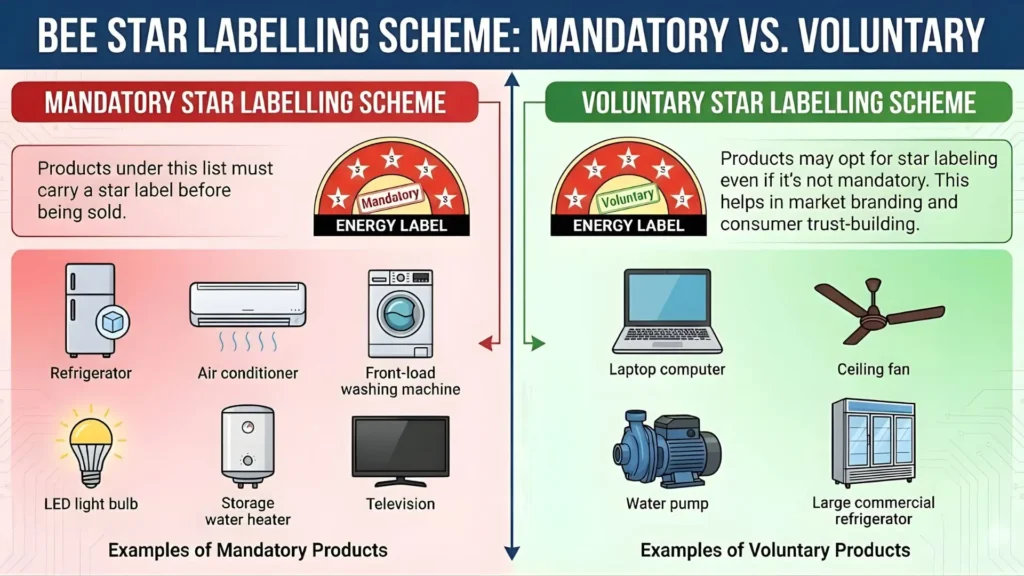
BEE covers two categories of products under its labelling programme:
1. Mandatory Labelling Products
These products are legally required to carry a BEE Star Label before they can be sold in India. Renewal of certification for these is compulsory.
| Product Category | Examples |
| Air Conditioners | Split ACs, Window ACs, Cassette ACs |
| Refrigerators | Single-door, double-door, side-by-side models |
| Ceiling Fans | Standard, BLDC, and decorative ceiling fans |
| Colour Televisions | LED, OLED, QLED TVs |
| Washing Machines | Semi-automatic, fully automatic (front & top load) |
| Direct Cool Refrigerators | Mini fridges, chest freezers |
| Geysers | Electric storage water heaters |
| Distribution Transformers | Used in industrial & residential setups |
| Pumps | Submersible, centrifugal, and monoblock pumps |
| LED Lamps & Luminaires | Bulbs, tube lights, street lights |
| Microwave Ovens | Solo, grill, and convection ovens |
| Laptops & Computers | Laptops, desktop PCs, workstations |
2. Voluntary Labelling Products
Manufacturers can voluntarily apply for BEE Star Labels for products not under the mandatory list. While renewal is not legally enforced for these, it is commercially important for brand credibility and export competitiveness.
BEE Star Label Validity: How Long Does the Certificate Last?
One of the most frequently asked questions businesses have is: how long is the BEE Star Label valid? Here is a clear breakdown:
| Certificate Type | Standard Validity Period | Renewal Required? |
| Mandatory BEE Star Label | 1 to 2 years (product-specific) | Yes — before expiry |
| Voluntary BEE Star Label | 1 to 2 years (product-specific) | Yes — if continuing use |
| Model-specific certification | Tied to the labelling period cycle | Yes — with fresh testing |
| Revised standards cycle | Aligned with BEE notification date | Yes — mandatory re-testing |
| Important Note for 2026: BEE periodically revises its Minimum Energy Performance Standards (MEPS). Products with certificates issued under older MEPS cycles must be re-tested and re-certified under the latest applicable schedule. Always verify the applicable MEPS version before initiating renewal. |
How to Renew Your BEE Star Label Certification Timeline: When Should You Start?
Timing your BEE Star Label renewal correctly is critical. Starting too late can result in your products losing certification before the new certificate is issued — causing a forced market withdrawal. Here is a recommended timeline to follow:
| Months Before Expiry | Action to Take |
| 3 Months (90 Days) | Review current certificate expiry date and check for any revised BEE standards applicable to your product |
| 2.5 Months (75 Days) | Arrange product samples and book testing slot at a BEE-approved laboratory (NABL-accredited) |
| 2 Months (60 Days) | Complete testing and collect test reports; begin compiling documentation |
| 6 Weeks (45 Days) | Submit renewal application on BEE's online portal with all documents and fees |
| 3-4 Weeks (21-28 Days) | Follow up on application status; respond to any BEE queries or additional document requests |
| 2 Weeks (14 Days) | Receive renewed certificate or collect physical license from BEE office if needed |
| Expiry Date | Old certificate expires — new certificate must be in hand by this date |
If you are applying for a BEE Star Label renewal after the certificate has already expired, the process becomes significantly more complex. Expired certificates require a fresh application rather than a renewal, which means higher fees, longer processing times, and a temporary suspension of lawful product sales.
Documents Required for BEE Star Label Renewal
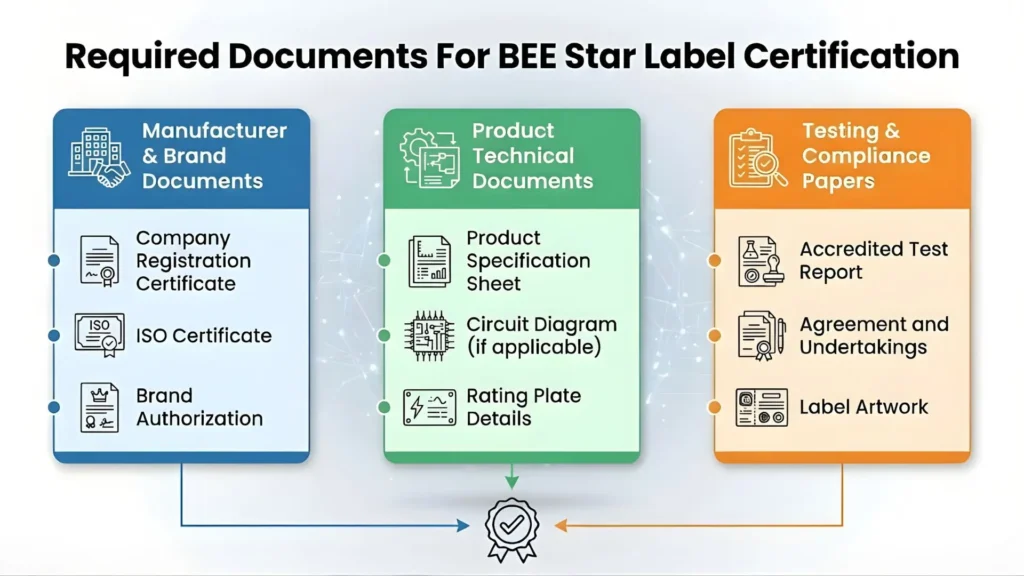
Getting your documentation right the first time is the single most important thing you can do to speed up your BEE Star Label renewal. Incomplete or incorrect documents are the primary reason for application delays. Here is a comprehensive list:
A. Mandatory Documents for All Products
- Copy of the existing/expiring BEE Star Label Certificate or License
- Valid BEE Registration Number
- Test Report from a BEE-recognized / NABL-accredited laboratory (not older than 3 months at the time of submission)
- Product technical datasheet including model name, model number, and energy consumption details
- Bill of Materials (BOM) — listing major components, especially those affecting energy performance
- Declaration of energy performance parameters as per applicable BEE schedule
- Authorization letter (if application is filed by a consultant or third party on behalf of the manufacturer)
- Company registration certificate (Certificate of Incorporation, MSME certificate, or equivalent)
- GST registration certificate
- PAN card of the company
- Duly filled BEE renewal application form
- Proof of fee payment (challan/bank transfer receipt)
B. For Imported Products — Additional Documents
- Import license / Import-Export Code (IEC) issued by DGFT
- Country of origin certificate
- Test report from an internationally recognized lab (IEC, CB Scheme, or equivalent) — may be accepted subject to BEE discretion
- Authorization from the foreign manufacturer appointing the Indian importer/representative as their agent for BEE certification
C. For Models with Design Changes Since Last Certification
- Detailed description of changes made to the model — materials, components, firmware, or design
- Revised BOM reflecting updated components
- Fresh test report for the modified model — even if the change appears minor
- Self-declaration that no changes affecting energy performance have been made (if applicable)
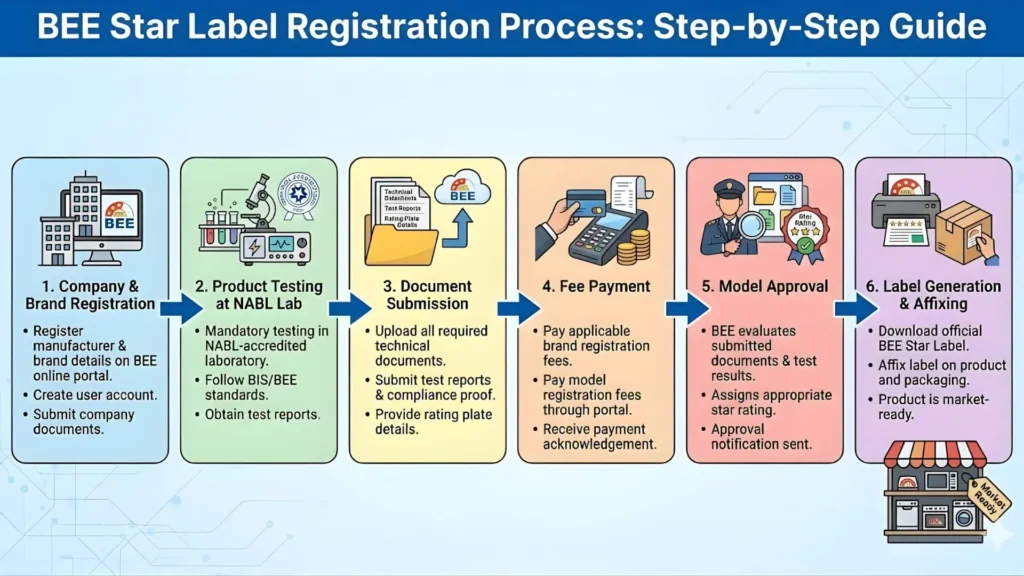
Step-by-Step BEE Star Label Renewal Process
Here is how the BEE Star Label renewal process actually works, from start to finish:
- Step 1: Check Certificate Expiry and Applicable BEE Schedule — Log in to the BEE portal and verify your current certificate status. Check if any new MEPS revision has been notified for your product category.
- Step 2: Product Testing at a BEE-Approved Lab — Submit product samples to a recognized laboratory for energy efficiency testing as per the applicable BEE test standard. Request the test report in the exact format required by BEE.
- Step 3: Document Compilation — Gather all mandatory documents as listed above. Ensure the test report is current and the lab's NABL accreditation is valid.
- Step 4: Online Application Submission — Log in to BEE's online portal. Fill in the renewal application form, upload all documents, and submit.
- Step 5: Fee Payment — Pay the prescribed renewal fee online. Keep the payment receipt safe as it is required for follow-up correspondence.
- Step 6: Application Processing by BEE — BEE reviews your application. If additional information or documents are required, they will send a query. Respond promptly to avoid delays.
- Step 7: Certificate Issuance — Upon successful verification, BEE issues the renewed Star Label certificate. Download the digital copy from the portal. Physical licenses are dispatched by post where applicable.
- Step 8: Update Packaging and Marketing Material — Ensure the new certificate number, star rating, and validity period are updated on product packaging, user manuals, and e-commerce listings.
BEE Star Label Renewal Fees: What Does It Cost?
The BEE Star Label renewal fee varies depending on the product category, type of applicant (manufacturer vs. importer), and whether the product is under mandatory or voluntary labelling. Below are the general fee ranges applicable for 2026:
| Applicant Type | Product Category | Approximate Fee Range (INR) |
| Indian Manufacturer | Mandatory labelling product (per model) | INR 5,000 – INR 25,000 |
| Indian Manufacturer | Voluntary labelling product (per model) | INR 3,000 – INR 15,000 |
| Importer / Brand Owner | Mandatory labelling product (per model) | INR 10,000 – INR 40,000 |
| Importer / Brand Owner | Voluntary labelling product (per model) | INR 5,000 – INR 20,000 |
| Disclaimer on Fees: BEE revises its fee schedule periodically. The figures above are indicative ranges based on historical data. Always check the current fee schedule on the official BEE portal or contact BEE's regional office for exact figures before making payment. |
What Happens If You Miss the BEE Star Label Renewal Deadline?
Missing the renewal deadline is not just an administrative headache — it has direct legal and commercial consequences. Here is what you face:
- Your product is no longer authorized for sale in India under the Energy Conservation Act.
- Retailers and e-commerce platforms are obligated to delist products with expired BEE certifications.
- BEE enforcement teams can inspect and seize products found in the market without valid labelling.
- Your business may be liable for penalties under the Energy Conservation Act, 2001.
- Fresh application (not renewal) is required — which takes longer and costs more.
- Brand reputation suffers, particularly with institutional buyers and government procurement agencies that verify BEE compliance.
The smartest move is to treat BEE Star Label renewal like a tax filing — calendar it well in advance and assign ownership internally. If your organization handles multiple product models and categories, consider working with a professional BEE consulting service that tracks renewal deadlines on your behalf.
Eligibility Criteria for BEE Star Label Renewal
Not every applicant qualifies for a straightforward renewal. Here are the eligibility conditions you must meet:
- Your existing BEE Star Label must be active (not yet expired) at the time of renewal application.
- The product model must remain substantially unchanged from the previously certified version. Any significant design or component change requires re-testing.
- The product must continue to meet the current MEPS (Minimum Energy Performance Standards) applicable at the time of renewal — not the standards at the time of original certification.
- Your laboratory test report must be from a BEE-approved and NABL-accredited facility.
- All previous BEE fee dues, if any, must be cleared before a renewal can be processed.
- The authorized signatory for the application must match the details on record with BEE.
BEE Star Label Renewal for Multiple Models: How to Manage It Efficiently
If your company manufactures or imports a range of products under BEE's mandatory labelling scheme, managing multiple renewals simultaneously is a real challenge. Different models may have different expiry dates, different applicable standards, and different testing requirements.
Here is a practical framework for managing multiple BEE renewals:
- Maintain a BEE Compliance Register — a central tracker listing every certified model, its certificate number, issue date, expiry date, and applicable BEE schedule.
- Set automated reminders 90, 60, and 30 days before each certificate's expiry.
- Batch testing — if multiple models are due for renewal around the same time, negotiate with your lab to schedule them together for faster turnaround and potential cost savings.
- Assign a dedicated compliance officer or engage a BEE consulting partner to own the renewal calendar.
- Monitor BEE notifications quarterly — new mandatory product categories and revised MEPS schedules are announced through the BEE website and official gazette.
BEE Labelling Programme: Recent Updates and Changes for 2026
Staying current with BEE's regulatory changes is as important as the renewal process itself. Here are key developments that affect BEE Star Label holders in 2026:
- Revised MEPS for Air Conditioners: BEE has progressively tightened efficiency norms for room air conditioners. Models certified under older schedules must meet new thresholds upon renewal.
- Expansion of Mandatory Labelling: BEE has been expanding its mandatory labelling programme to include additional product categories including certain industrial motors and commercial refrigeration equipment.
- Digital Certificate Integration: BEE has been strengthening its online portal infrastructure. Digital certificates are now the primary mode of issuance, reducing turnaround time for renewals.
- Stricter Enforcement: Market surveillance activities by BEE and state-level enforcement agencies have intensified. Products found without valid labelling face immediate action.
- Export Implications: BEE Star Label compliance is increasingly required as a prerequisite for government and institutional procurement tenders in India.
Benefits of Keeping Your BEE Star Label Certification Current
Beyond legal compliance, a current and valid BEE Star Label delivers measurable business advantages:
- Uninterrupted product sales — your products remain legally authorized for sale across all channels including e-commerce.
- Consumer trust — the star rating is one of the most recognized product quality signals among Indian consumers, particularly in the appliance segment.
- Access to government tenders — many government procurement contracts require verified BEE compliance.
- Export readiness — BEE certification adds credibility when entering international markets, especially those aligned with IEC energy efficiency standards.
- Avoidance of regulatory risk — a lapsed certificate exposes you to enforcement action, penalties, and product recalls.
- Brand differentiation — a higher star rating is a legitimate marketing advantage in a competitive appliance market.
Conclusion: Stay Ahead of Your BEE Star Label Renewal
The BEE Star Label renewal process is straightforward when you plan for it. The problems — market withdrawal, penalties, and business disruption — only arise when businesses treat it as an afterthought.
Build a renewal calendar, assign ownership, partner with an experienced BEE consultant if you manage multiple models, and treat compliance as a business function rather than a legal checkbox. In a market where energy efficiency is becoming a key buying factor and regulatory scrutiny is rising, a current BEE certification is both a legal requirement and a competitive asset.
Whether you are renewing a single product model or managing a portfolio of 50+ certified appliances, the fundamentals remain the same: start early, test properly, document meticulously, and submit on time.
Frequently Asked Questions
How long before expiry should I apply for BEE Star Label renewal?
You should ideally start the renewal process at least 90 days before your certificate's expiry date. This gives you time to arrange lab testing, compile documents, submit the application, and receive the new certificate without any gap in your product's legal authorization.
Can I sell my products while the BEE Star Label renewal is being processed?
Yes — as long as your existing certificate has not yet expired. You are authorized to continue selling under the current valid certificate while the renewal application is under review. If the renewal application is submitted before expiry but the new certificate arrives after the expiry date due to processing delays, it is advisable to maintain written correspondence with BEE documenting the timely submission.
What happens if BEE revises its energy standards between my certification cycles?
If BEE revises the MEPS for your product category between your old and new certification cycle, your product must meet the new standards at the time of renewal.
Is fresh product testing always required for BEE Star Label renewal?
In most cases, yes. BEE requires a fresh test report from an approved lab at the time of renewal. The test report must not be older than 3 months at the time of submission. If your product has not undergone any changes and the applicable BEE schedule remains unchanged, BEE may occasionally accept an existing test report — but this is an exception rather than the rule.
Can an importer apply for BEE Star Label renewal, or does it have to be the manufacturer?
Both manufacturers and authorized importers can apply for BEE Star Label certification and renewal. If the applicant is an importer or a brand's Indian representative, they must submit an authorization letter from the foreign manufacturer appointing them as the responsible party for BEE compliance in India.
What is the processing time for BEE Star Label renewal?
BEE's standard processing time for renewal applications is typically 15 to 30 working days from the date of successful submission of a complete application. However, this can vary based on BEE's workload, query responses required, and verification checks.
How many models can I apply for renewal in a single application?
BEE processes certifications on a per-model basis. Each distinct model (with a unique model number and technical configuration) requires a separate application and a separate fee. You can submit multiple applications simultaneously through the portal.
Can the star rating change during renewal?
Yes. If BEE has revised its energy efficiency schedules, your product may receive a different star rating upon renewal — even if the product itself has not changed. A product previously rated 4 stars may receive 3 stars under a revised schedule if it no longer meets the updated threshold for 4 stars. Fresh testing results determine the new rating.
Is there a late fee if I apply for renewal after the certificate has expired?
BEE does not typically impose a late fee for expired certificates. However, once a certificate expires, it cannot be renewed — you must apply as a fresh applicant, which involves a full fresh application process, higher complexity, longer timelines, and the inability to sell products during the gap period.
Do I need to update my product packaging after receiving the renewed certificate?
Yes. After receiving the renewed BEE Star Label certificate, you must update your product packaging, user manuals, and digital listings (including e-commerce platforms) to reflect the new certificate number, star rating, and validity period. Using old certificate details on products after receiving a renewal is a compliance risk.