

- BEE Star Label Certification is mandatory for 26+ product categories in India, including ACs, refrigerators, and LEDs — non-compliance attracts penalties under the Energy Conservation Act, 2001.
- The application is filed through the BEE Online Portal with supporting test reports from NABL-accredited or BEE-approved laboratories.
- Manufacturers and importers must both register independently — registration fees range from Rs. 5,000 to Rs. 2,00,000 depending on product category and company turnover.
- BEE certification validity is typically 1 to 2 years, after which renewal is required — early renewal avoids legal penalties and market disruption.
Introduction
If you manufacture or import electrical appliances or equipment in India, BEE Star Label Certification for manufacturers is not just a compliance checkbox — it is a competitive advantage. Consumers today actively compare energy star ratings before buying air conditioners, refrigerators, fans, or LED lights. Retailers give shelf priority to star-rated products. And the government is increasingly moving products from voluntary to mandatory labelling.
In this complete pillar guide, you will find every detail you need: what BEE Star Label is, which products need it, who is eligible, what documents are required, the exact step-by-step application process, applicable fees, validity periods, and how to renew. Whether you are a first-time applicant or looking to understand the renewal timeline, this guide covers it all.
What Is BEE Star Label Certification?
The Bureau of Energy Efficiency (BEE) is a statutory body established under the Ministry of Power, Government of India. It was set up under the Energy Conservation Act, 2001 with the mandate to develop programmes and policies that promote energy efficiency across India.
The Standards and Labelling (S&L) Programme is one of BEE's most impactful initiatives. Under this programme, electrical appliances and equipment are tested for energy performance. Based on the test results, products are assigned a star rating — from 1 star (least efficient) to 5 stars (most efficient). This is what consumers see as the BEE Star Label on a product.
The BEE energy efficiency label displays:
- Star rating (1 to 5 stars)
- Annual energy consumption in kWh
- BEE registration number
- Manufacturer or brand name
- Valid from and valid until dates
| Category | Description |
| Governing Body | Bureau of Energy Efficiency (BEE), Ministry of Power, Govt. of India |
| Legal Authority | Energy Conservation Act, 2001 |
| Programme Name | Standards & Labelling (S&L) Programme |
| Star Rating Scale | 1 Star (lowest) to 5 Stars (highest efficiency) |
| Label Types | Mandatory S&L and Voluntary S&L |
Mandatory vs. Voluntary BEE Star Labelling: What Is the Difference?
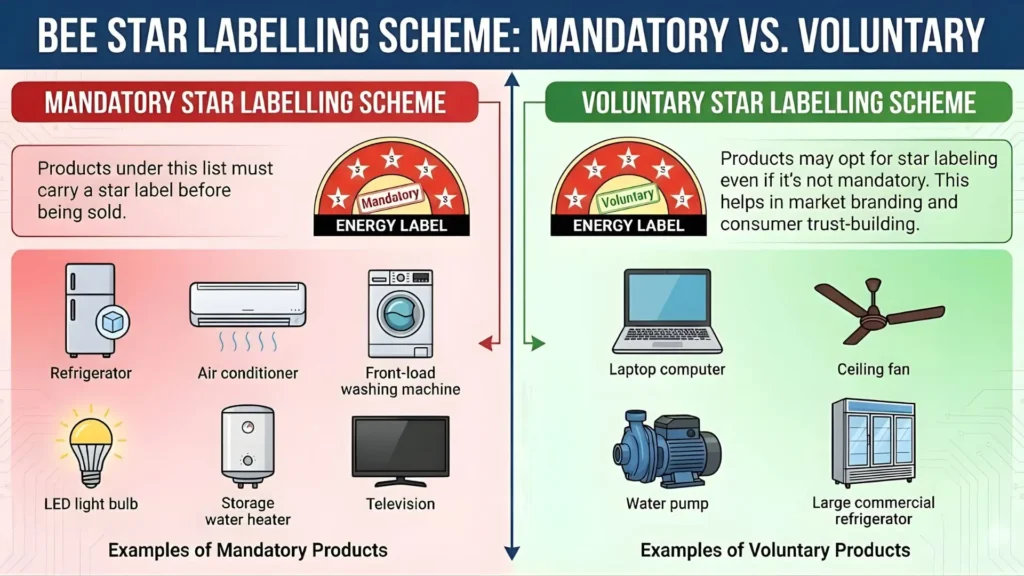
BEE Star Labelling operates in two modes. Understanding which mode applies to your product category is the first thing you must check before applying.
Mandatory S&L Programme
Under mandatory labelling, manufacturers and importers cannot sell the product in India without displaying a valid BEE Star Label. Non-compliance attracts penalties under the Energy Conservation Act, 2001, including fines and product recalls.
Products currently under mandatory BEE labelling (as of 2026) include:
- Room Air Conditioners (Split and Window)
- Refrigerators (Direct Cool and Frost Free)
- Distribution Transformers
- Tubular Fluorescent Lamps (TFL)
- Ceiling Fans
- LED Lamps and Luminaires
- Washing Machines (Semi-automatic and Fully Automatic)
- Direct Cool Refrigerators
- Color Television Sets
- Geysers (Electric Storage Water Heaters)
- Room Air Conditioners (Inverter type)
- Light Commercial Air Conditioners
- Motors (IE2, IE3 class)
Voluntary S&L Programme
Products under voluntary labelling are not legally required to carry a BEE Star Label. However, many manufacturers choose to get certified voluntarily to gain a competitive edge and build consumer trust. Products in this category include certain industrial equipment, agricultural pumpsets, and specialty appliances.
Who Is Eligible to Apply for BEE Star Label Certification?
Eligibility for BEE Star Label Certification is defined broadly, but there are key conditions every applicant must meet.
Eligible Applicants
- Indian manufacturers of electrical appliances or equipment covered under the S&L programme
- Importers of electrical appliances or equipment for sale in India
- Original Equipment Manufacturers (OEMs) who supply products under a different brand name
- Brand owners who outsource manufacturing but sell under their own label
Key Eligibility Conditions
- The product must fall under a product category covered by the BEE S&L Programme
- The applicant must be a registered legal entity in India — proprietorship, partnership, LLP, or private/public limited company
- The product must be tested at a NABL-accredited laboratory or a BEE-approved test laboratory
- The product must meet the minimum energy performance standards (MEPS) set by BEE for that category
- The applicant must have a valid GST registration and PAN
BEE Star Label Certification: Product Categories at a Glance
| Product Category | Label Type | Star Range | Review Frequency |
| Room Air Conditioner (Split) | Mandatory | 1 – 5 Stars | Every 2 Years |
| Refrigerator (Direct Cool) | Mandatory | 1 – 5 Stars | Every 2 Years |
| Refrigerator (Frost Free) | Mandatory | 1 – 5 Stars | Every 2 Years |
| LED Lamp | Mandatory | 1 – 5 Stars | Annual |
| Ceiling Fan | Mandatory | 1 – 5 Stars | Every 2 Years |
| Washing Machine (FA) | Mandatory | 1 – 5 Stars | Every 2 Years |
| Electric Geyser | Mandatory | 1 – 5 Stars | Every 2 Years |
| Distribution Transformer | Mandatory | Up to 5 Stars | Every 2 Years |
| Colour Television | Mandatory | 1 – 5 Stars | Every 2 Years |
| Inverter AC | Mandatory | 1 – 5 Stars | Annual |
| Agricultural Pumpset | Voluntary | 1 – 5 Stars | As Applicable |
| Motors (IE Class) | Mandatory | IE1 to IE4 | Every 2 Years |
Documents Required for BEE Star Label Certification
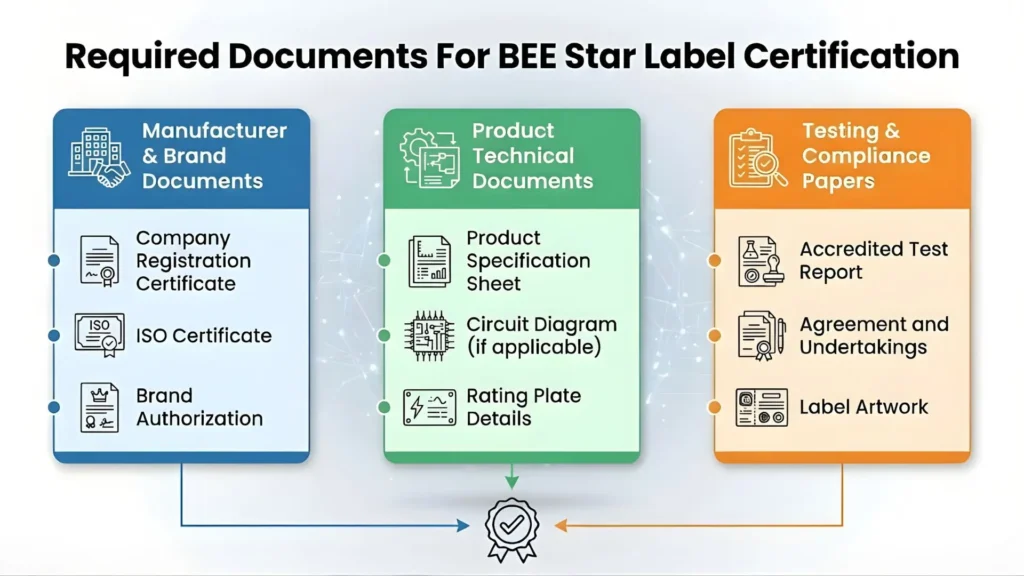
Before you begin the online application, gather all required documents. Incomplete applications are a common reason for delays in BEE Star Label registration. Here is the complete checklist:
Company and Identity Documents
- Certificate of Incorporation or Business Registration Certificate
- Permanent Account Number (PAN) Card of the company
- GST Registration Certificate
- Udyam Registration Certificate (for MSMEs, if applicable)
- Authorized Signatory Letter or Board Resolution
Product and Technical Documents
- Test Report from a NABL-accredited or BEE-approved laboratory (not older than 2 years)
- Product specification sheet and technical datasheet
- Sample BEE Star Label design (as per BEE template)
- Model number and brand details of the product
- Photographs of the product (front, back, label placement)
For Importers (Additional)
- Import-Export Code (IEC) issued by DGFT
- Authorization letter from the foreign manufacturer
- Copy of the original foreign test report with translation if not in English
Step-by-Step Process to Apply for BEE Star Label Certification in India
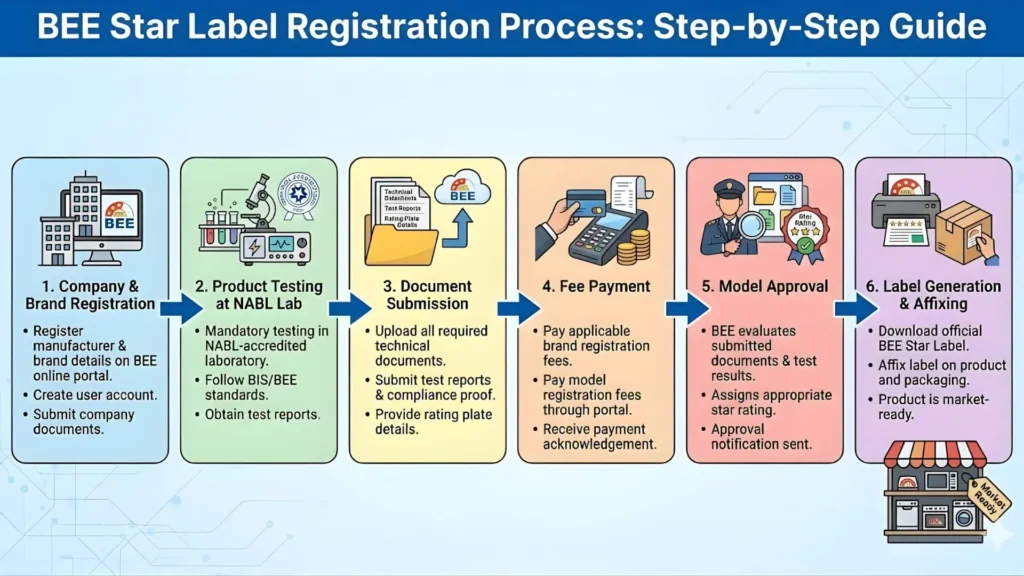
The BEE Star Label Certification application process in India is fully online through the BEE portal. Here is the complete step-by-step process updated for 2026.
Step 1: Check Your Product Category and Labelling Type
Visit beestarlabel.com and navigate to the Products section. Verify whether your product falls under Mandatory or Voluntary S&L. Download the relevant Product Schedule and Standards document. This document defines the Minimum Energy Performance Standards (MEPS) your product must meet.
Step 2: Get Your Product Tested at a BEE-Approved Laboratory
Your product must be tested at a laboratory that is either NABL-accredited for the specific product category or listed as a BEE-approved test lab. The test must be conducted as per the Indian Standard (IS) specified in the BEE Schedule for that product.
The test report is the most critical document in your application. Ensure that:
- The lab is currently on the BEE-approved list (check beestarlabel.com for the updated list)
- The test covers all parameters mentioned in the relevant IS Standard
- The report is not older than 2 years at the time of application
- The report explicitly states energy consumption figures and star rating eligibility
Step 3: Register on the BEE Online Portal
Go to beestarlabel and click on Manufacturer/Importer Login. If you are a first-time user, click on New Registration. Fill in your company details including legal name, address, PAN, GST number, and contact details. After submission, you will receive login credentials at your registered email ID.
Step 4: Login and Fill the Online Application Form
Log in with your credentials. Navigate to Apply for Registration and select the product category. Fill in all mandatory fields:
- Brand name and model number
- Product specifications as per BEE format
- Annual energy consumption figure from the test report
- Star rating applied for
- Manufacturing plant address
Step 5: Upload All Required Documents
Upload scanned copies of all documents mentioned in the checklist. Accepted formats are PDF and JPG. File size limit is typically 2 MB per document. Ensure all documents are legible and complete — partial documents are a leading cause of application rejection.
Step 6: Pay the Registration Fee
After filling the form and uploading documents, proceed to the fee payment section. BEE registration fees can be paid online through net banking, NEFT/RTGS, or demand draft. Keep the payment receipt as you will need to upload proof of payment.
Step 7: Submit the Application and Await Scrutiny
Once payment is complete, submit the application. You will receive an application reference number. BEE's technical team will scrutinise the application. If there are deficiencies, you will receive a deficiency letter asking for clarification or additional documents. Respond promptly to avoid delays.
Step 8: Receive BEE Registration Certificate
Upon successful scrutiny and approval, BEE will issue the Registration Certificate with the registration number. This number must be printed on every BEE Star Label affixed to your product. The certificate specifies the validity period (usually 1 to 2 years).
Step 9: Design and Print the BEE Star Label
Using the BEE-specified label template, design your product's Star Label. The label must include the star rating, annual energy consumption, BEE registration number, and validity dates. All label artwork must comply with BEE's colour, font, and size guidelines.
BEE Star Label Certification Fees in India
BEE registration fees are structured based on product category and, in some cases, the annual turnover of the manufacturer. Below is an indicative fee structure. Always verify the current fee schedule on beestarlabel.com before applying, as fees are revised periodically.
| Applicant Type | Product Category | Registration Fee (Approx.) |
| Micro Enterprise (Udyam) | Any Mandatory Category | Rs. 5,000 – Rs. 10,000 |
| Small Enterprise | Any Mandatory Category | Rs. 10,000 – Rs. 25,000 |
| Medium / Large Manufacturer | Air Conditioner | Rs. 50,000 – Rs. 1,00,000 |
| Medium / Large Manufacturer | Refrigerator | Rs. 50,000 – Rs. 1,00,000 |
| Medium / Large Manufacturer | LED Lamp | Rs. 25,000 – Rs. 50,000 |
| Medium / Large Manufacturer | Other Categories | Rs. 30,000 – Rs. 2,00,000 |
| Importer | Any Category | Same as Manufacturer Slab |
| Renewal (All Categories) | Any | Approx. 50% of Initial Fee |
BEE Star Label Certification Validity and Renewal
How Long Is BEE Star Label Certification Valid?
BEE Star Label Certification validity in India is typically 1 to 2 years depending on the product category. The exact validity period is mentioned in your Registration Certificate. Some categories have shorter validity due to frequent changes in MEPS or efficiency norms.
| Product Category | Typical Validity Period |
| Room Air Conditioner (Split) | 2 Years |
| Inverter AC | 1 Year |
| Refrigerator | 2 Years |
| LED Lamp | 1 Year |
| Ceiling Fan | 2 Years |
| Washing Machine | 2 Years |
| Electric Geyser | 2 Years |
| Distribution Transformer | 2 Years |
| Colour Television | 2 Years |
| Motors | 2 Years |
BEE Star Label Renewal Process
Renewal of BEE Star Label Certification should be initiated at least 3 months before the expiry date to avoid any lapse. Selling products with an expired BEE registration is a violation of the Energy Conservation Act.
Steps to renew BEE Star Label Certification:
- Log in to your account on beestarlabel
- Navigate to Renewal Application under your registered model
- Update any changed product specifications or model variants
- Upload fresh test reports (mandatory if the earlier test is more than 2 years old or if MEPS has changed)
- Pay the renewal fee (approximately 50% of the initial registration fee)
- Submit the renewal application and track the status online
If MEPS norms have been revised for your product category (which happens frequently for ACs, LEDs, and fans), your product must meet the new norms at the time of renewal. A fresh test report reflecting compliance with revised MEPS will be required.
BEE-Approved and NABL-Accredited Test Laboratories
Testing is the foundation of BEE Star Label Certification. The test report must come from a recognized laboratory. BEE maintains an updated list of approved test laboratories on its portal, categorized by product type.
How to Find a BEE-Approved Lab
- Visit beestarlabel and go to the Test Laboratories section
- Filter by product category to find labs accredited for your specific product
- Verify the NABL accreditation scope of the lab to confirm it covers the IS standard applicable to your product
- Contact the lab for testing timelines — lead times vary from 2 weeks to 6 weeks depending on the product and lab workload
Key Points About Testing
- The test must be done on a production sample, not a specially built prototype
- The lab must test as per the Indian Standard (IS) version specified in the BEE product schedule — using an older version of the IS standard will result in rejection
- For imported products, foreign test reports are sometimes accepted if the foreign lab has a mutual recognition agreement (MRA) with NABL — verify this before relying on a foreign report
Common Mistakes Manufacturers Make During BEE Star Label Application
These are the most frequent reasons for application rejection or delay. Avoiding them saves you time and money.
| Common Mistake | How to Avoid It |
| Test report from a non-approved lab | Always verify the lab is on the current BEE-approved list before testing |
| Test conducted as per outdated IS standard | Download the current BEE Product Schedule before testing |
| Incorrect star rating claimed | Cross-check the energy consumption figure against BEE's star rating table for the current revision period |
| Incomplete label design | Use BEE's label generation tool on the portal |
| Application filed after label printed | Always wait for Registration Certificate before printing labels |
| Missing or expired test report at renewal | Initiate renewal 3 months before expiry |
| Wrong fee category selected | Confirm your Udyam/turnover classification before paying |
| Not updating BEE after model modification | Any change in product design requires fresh testing and a model variant update or new registration |
Benefits of BEE Star Label Certification for Manufacturers
Getting BEE Star Label Certification is not just about regulatory compliance. For manufacturers and importers, it delivers measurable commercial and strategic benefits.
Legal and Regulatory Benefits
- Legally authorised to sell mandatory category products in the Indian market
- Avoids penalties, fines, and product seizure under the Energy Conservation Act, 2001
- Required for government procurement and tender participation
Commercial and Market Benefits
- Higher star ratings command a premium price — consumers pay more for 5-star rated appliances
- 5-star products receive priority placement at large format retail chains and e-commerce platforms
- Government schemes like EESL (Energy Efficiency Services Limited) bulk procurement favour higher-rated products
- BEE Star Label builds brand trust and signals quality to first-time buyers
Export and B2B Benefits
- BEE Certification is a credibility marker when approaching B2B buyers and institutional customers
- International buyers use BEE Star Rating as a proxy for quality compliance
- Facilitates participation in government-linked replacement schemes (e.g., LED bulb replacement programmes)
Sustainability and ESG Benefits
- Demonstrates commitment to energy conservation — increasingly important for ESG reporting
- Supports alignment with India's National Energy Efficiency targets under the Paris Agreement commitments
- Positions your brand favourably with sustainability-conscious consumers
Penalties for Non-Compliance with BEE Star Label Norms
Manufacturing or selling a product in a mandatory labelling category without a valid BEE Star Label is a violation of the Energy Conservation Act, 2001. The consequences can be severe:
- First offence: Fine of up to Rs. 10,000
- Subsequent offences: Fine of up to Rs. 10,000 plus an additional Rs. 1,000 per day for each day of continuing default
- Products may be seized and removed from shelves
- The company may face adverse publicity through public notices issued by BEE
- Import consignments of non-compliant products can be detained at the port of entry
Conclusion
BEE Star Label Certification for manufacturers in India has evolved from a regulatory box-tick into a genuine business driver. In 2026, as consumer awareness of energy costs grows and as the government tightens energy efficiency norms, star ratings directly influence purchase decisions across both consumer and institutional segments.
The certification process is fully digital, well-documented, and manageable — if approached systematically. The key steps are: confirm your product category, test at a BEE-approved lab, register on the portal, submit documents and fee, and then maintain compliance with timely renewals and production consistency.
Whether you are a first-time applicant or renewing a multi-model registration, this guide gives you everything you need to navigate the BEE Star Label Certification process confidently. If you need end-to-end support, connect with our regulatory consulting team.
Frequently Asked Questions
Is BEE Star Label Certification mandatory for all electrical appliances?
No. BEE Star Label is mandatory only for products covered under the Mandatory Standards and Labelling Programme. As of 2026, this covers around 26 product categories including ACs, refrigerators, LEDs, and fans.
Can an importer apply for BEE Star Label directly, or does the foreign manufacturer need to apply?
The importer must apply independently and obtain their own BEE registration. The importer is legally responsible for the product's compliance in India. Foreign manufacturers do not register with BEE directly.
How long does the BEE Star Label Certification process take?
The entire process, from product testing to certificate issuance, typically takes 8 to 16 weeks. Testing alone may take 3 to 6 weeks.
What happens if I change the product model after getting BEE registration?
Any design or component change that affects energy performance requires fresh testing and either a new registration or a registered model variant update on the BEE portal. Selling a modified product under the old registration number is a violation.
Can the same BEE registration cover multiple variants of a product?
Yes, but only if the variants are identical in terms of energy performance parameters. Different capacity models (for example, a 1 ton AC and a 1.5 ton AC) require separate registrations because they have different energy consumption figures and potentially different star ratings.
What is the minimum star rating required under BEE mandatory labelling?
There is no minimum star rating mandated for sale in most categories — a product can be sold with even 1 star. However, the product must meet the Minimum Energy Performance Standards (MEPS) for that category, failing which it cannot receive any star rating and cannot be sold in India in the mandatory category.
Is a NABL-accredited lab different from a BEE-approved lab?
Not exactly. Most BEE-approved labs are NABL-accredited for the specific product test standard. However, some labs may be approved by BEE even without NABL accreditation, particularly for newer product categories.
Can a BEE Star Label certificate be transferred to a new owner if the company is sold or merged?
BEE registrations are not automatically transferable. In the case of a company merger, acquisition, or name change, the new entity must inform BEE and apply for a change of registration details.
What is market surveillance by BEE and how does it affect manufacturers?
BEE periodically purchases samples of registered products from the open market and gets them independently tested. If the tested sample does not match the registered energy parameters, BEE may issue a show-cause notice, suspend the registration, require fresh testing, or cancel the registration entirely.
How do I renew my BEE Star Label Certification before expiry?
Log in to the BEE portal at beestarlabel.com, go to the renewal section, and submit a renewal application at least 3 months before expiry.