
- CDSCO pacemaker registration is mandatory under MDR 2017 for all manufacturers, importers, and distributors dealing in cardiac pacemakers in India.
- Cardiac pacemakers fall under Class C (high-risk) medical devices and require a permanent pacemaker CDSCO license before sale, import, or distribution.
- The registration process is handled through the SUGAM online portal and involves submission of technical dossiers, GMP certificates, and clinical evidence.
- Non-compliance with CDSCO cardiac device registration attracts penalties, product seizure, and cancellation of license under the Drugs and Cosmetics Act, 1940.
Introduction
If you are a manufacturer, importer, or distributor of cardiac pacemakers in India, one question comes up almost immediately: how do I legally sell or import pacemakers here?
The answer is straightforward — you need CDSCO pacemaker registration under the Medical Devices Rules, 2017 (MDR 2017). Without it, your product cannot legally enter or circulate in the Indian market.
India's Central Drugs Standard Control Organization (CDSCO), functioning under the Ministry of Health and Family Welfare, regulates all medical devices including cardiac pacemakers. Since pacemakers are implantable devices that directly sustain human life, they are treated as Class C high-risk devices and require the most stringent level of scrutiny before any license is granted.
This guide covers everything you need to know about CDSCO pacemaker registration in 2026 — from eligibility and documents to the step-by-step process, fees, timelines, validity, and renewal. Whether you are applying for a pacemaker import license in India or registering as a domestic manufacturer, this pillar page is your definitive reference.
What Is CDSCO and Why Does It Regulate Pacemakers?
CDSCO stands for Central Drugs Standard Control Organization. It is India's national regulatory body for pharmaceuticals and medical devices. It operates under the Drugs and Cosmetics Act, 1940, and the Medical Devices Rules, 2017 (MDR 2017).
Cardiac pacemakers are electronic implantable devices that generate electrical pulses to regulate abnormal heart rhythms. Given that a malfunction can be fatal, CDSCO places them in Class C — the second-highest risk category for medical devices in India.
This means any entity wishing to manufacture, import, sell, stock, exhibit, or distribute a cardiac pacemaker in India must obtain a valid CDSCO licence before commencing operations. This is not optional — it is a legal requirement enforced at the federal level.
Medical Device Risk Classification Under MDR 2017
| Class | Risk Level | Examples | Regulatory Requirement |
| Class A | Low Risk | Tongue depressors, bandages | State Licence only |
| Class B | Low-Moderate Risk | Hypodermic needles, thermometers | State Licence + CDSCO |
| Class C | Moderate-High Risk | Cardiac pacemakers, ventilators | CDSCO Licence (Central) |
| Class D | Highest Risk | Active implantable devices with highest criticality | CDSCO Licence (Strictest) |
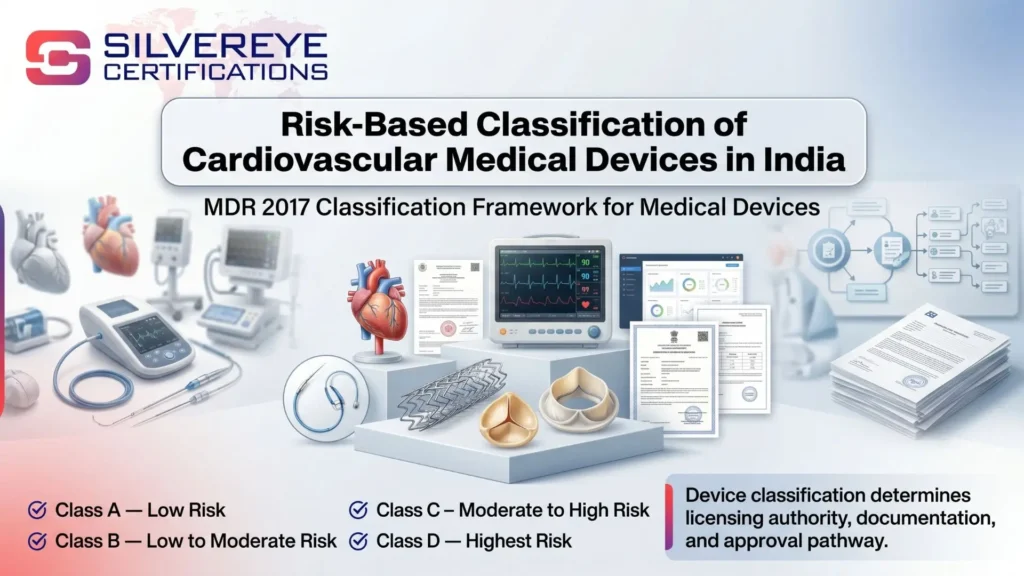
Cardiac pacemakers — both temporary and permanent — fall under Class C. Some advanced models with additional features may be reviewed for Class D applicability. When in doubt, always verify the classification of your specific device model with CDSCO directly.
Types of Pacemakers That Require CDSCO Registration
Not all cardiac rhythm management devices are the same. The following types of pacemakers require a valid CDSCO pacemaker registration before they can be legally marketed in India:
- Single-chamber pacemakers (one lead in ventricle or atrium)
- Dual-chamber pacemakers (leads in both atrium and ventricle)
- Biventricular pacemakers / Cardiac Resynchronization Therapy (CRT) devices
- Rate-responsive pacemakers
- Leadless pacemakers (intracardiac, catheter-delivered)
- Temporary external pacemakers
- Implantable cardioverter-defibrillators (ICDs) with pacing function
- MRI-compatible pacemakers
Each of these devices must be registered separately if they have different model numbers, intended uses, or design specifications. A single licence does not automatically cover all variants of a pacemaker family unless explicitly stated in the registration.
Legal Framework: MDR 2017 and Cardiac Pacemaker Regulations
The regulatory backbone for CDSCO pacemaker registration is the Medical Devices Rules, 2017, which came into effect on 1st January 2018 and replaced the earlier Schedule M-III provisions.
Key legal provisions relevant to cardiac pacemaker MDR 2017 compliance include:
| Legal Provision | Relevance to Pacemaker Registration |
| Rule 3 — Classification of Medical Devices | Places cardiac pacemakers in Class C |
| Rule 10 — Manufacture Licence for Class C Devices | Requires CDSCO central licence for domestic manufacturers |
| Rule 27 — Import Licence for Medical Devices | Mandatory for pacemaker import licence India applications |
| Rule 33 — Registration Certificate | Required for foreign manufacturers registering devices in India |
| Rule 50 — Labelling Requirements | Specifies what must appear on pacemaker packaging/IFU |
| Rule 56 — Post-Market Surveillance | Ongoing safety reporting obligations after registration |
| Schedule V — Technical Dossier Requirements | Details documents required for Class C device submission |
| Schedule VI — GMP Requirements | Good Manufacturing Practice standards for pacemaker manufacturers |
Violations of these provisions can attract criminal prosecution, product recall, and permanent disqualification from the Indian medical device market.
Who Needs CDSCO Pacemaker Registration?
There are three primary categories of applicants who need to obtain a CDSCO license for cardiac pacemakers:
1. Domestic Manufacturers
Any Indian entity that manufactures cardiac pacemakers within India must obtain a manufacturing licence under Rule 10 of MDR 2017. This applies whether the device is intended for sale within India or for export.
- Must comply with Schedule VI GMP requirements
- Facility must be inspected and approved by CDSCO before license is granted
- Technical dossier must include design verification and validation data
2. Importers (Foreign Manufacturers / Indian Authorized Agents)
Foreign manufacturers who wish to sell cardiac pacemakers in India must register their devices with CDSCO under Rule 27 (Import License). The foreign manufacturer must appoint an Indian Authorized Agent (IAA) who acts as the regulatory point of contact.
- Indian Authorized Agent must be registered with CDSCO
- Foreign manufacturer must hold a valid Free Sale Certificate (FSC) or CE Mark from a recognized regulatory body
- All technical documents from the foreign manufacturer must be apostilled or notarized
3. Loan License Holders / Contract Manufacturers
Entities that hold a loan license (manufacturing in another company's facility) or operate as contract manufacturers also need to comply with CDSCO registration requirements, with specific conditions around facility sharing and quality agreements.
| Criterion | Domestic Manufacturer | Importer / Foreign Manufacturer |
| Entity Type | Indian company/LLP/proprietorship | Foreign company with Indian IAA |
| GMP Compliance | Schedule VI (Indian GMP) | ISO 13485 or equivalent |
| Free Sale Certificate | Not required | Required from home country regulator |
| Technical Dossier | Full design and manufacturing data | Full technical file per Schedule V |
| Clinical Evidence | Required for Class C | Required — PMCF or clinical evaluation |
| QMS Certification | Required | ISO 13485 or equivalent required |
| Local Facility Inspection | Mandatory before licence | Indian agent premises inspected |
Documents Required for CDSCO Pacemaker Registration
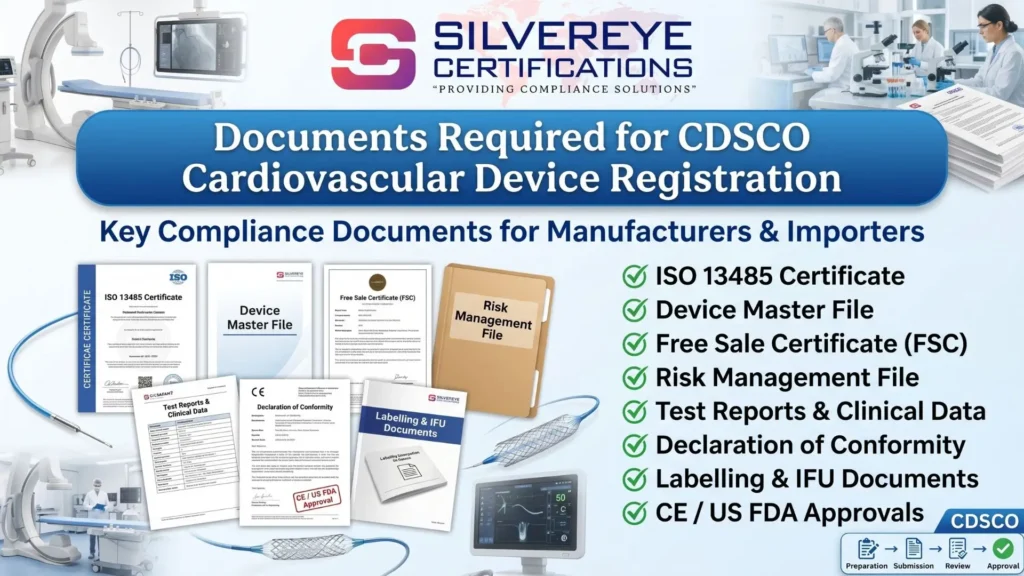
Getting your documents right is the single most important factor in avoiding delays. Incomplete or incorrect submissions are the leading cause of rejection or prolonged processing. Here is a comprehensive checklist:
A. Administrative Documents
- Duly filled Form MD-14 (application form for Class C device registration)
- Proof of business registration (Certificate of Incorporation / Partnership Deed)
- GST Registration Certificate
- Address proof of the registered office and manufacturing/warehouse premises
- Authorization letter from the applicant company (in case of authorized signatory)
- Indian Authorized Agent (IAA) agreement (for foreign manufacturers only)
- Power of Attorney from foreign manufacturer to IAA (notarized and apostilled)
B. Technical and Quality Documents
- Complete technical dossier as per Schedule V of MDR 2017
- Device description, intended use, and indications for use
- Design and development documentation (design history file)
- Risk management file as per ISO 14971
- Biocompatibility testing data (ISO 10993 series)
- Electrical safety and EMC testing data (IEC 60601-1 and IEC 60601-1-2)
- Software documentation (if device has embedded software) as per IEC 62304
- Sterilization validation report (if applicable)
- Shelf life / packaging validation data
- Clinical evaluation report (CER) or clinical investigation data
Post-Market Clinical Follow-up (PMCF) plan
C. Manufacturing and GMP Documents
- Valid Good Manufacturing Practice (GMP) certificate from a competent authority
- ISO 13485:2016 Quality Management System certificate
- Manufacturing process flow chart and site master file
- List of manufacturing equipment and calibration records
- Batch manufacturing records format
D. Regulatory Approvals from Reference Countries (For Imports)
- Free Sale Certificate (FSC) from the home country regulatory authority
- CE Marking certificate (if registered in EU) or FDA clearance/approval (if registered in USA)
- Certificate of Conformity from a Notified Body (for EU-registered devices)
- Declaration of Conformity
E. Labelling and Packaging Documents
- Specimen label / artwork compliant with Rule 50 of MDR 2017
- Instructions for Use (IFU) in English
- Outer carton label and primary label samples
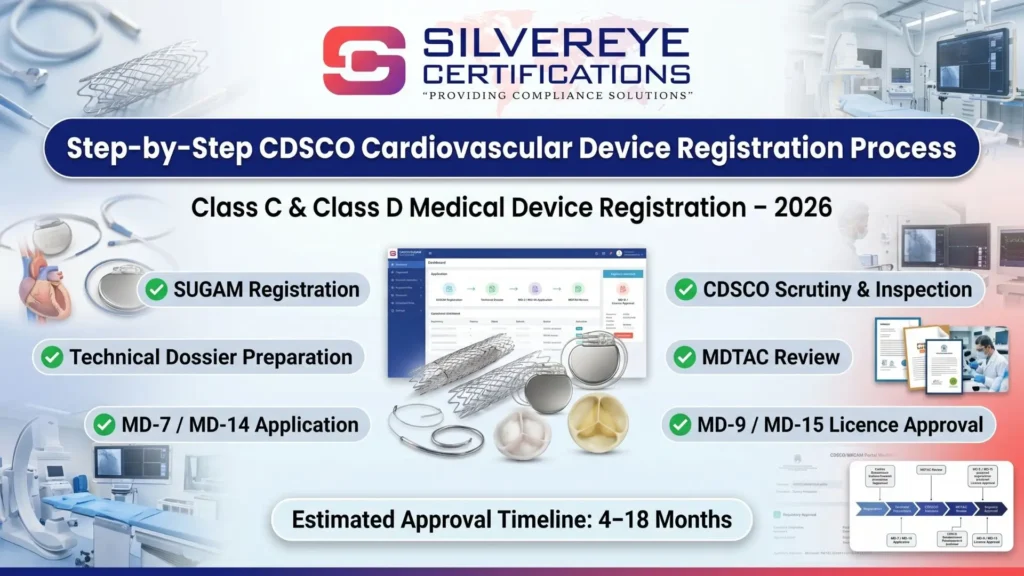
Step-by-Step Process: How to Apply for CDSCO Pacemaker Registration
Follow these steps carefully to ensure a smooth application process. Missing any step can result in query letters from CDSCO or rejection of the application.
Step 1: Confirm Device Classification
Before applying, confirm that your cardiac pacemaker is correctly classified as Class C under MDR 2017. Use the device classification guidelines available on the CDSCO website. Misclassification leads to application of the wrong form and fee schedule.
Step 2: Prepare the Technical Dossier
Compile all technical, clinical, and quality documents as per Schedule V requirements. For cardiac pacemakers, clinical evidence is non-negotiable — literature-based clinical evaluation reports are generally accepted, but CDSCO may request device-specific clinical investigation data for novel designs.
Step 3: Appoint an Indian Authorized Agent (for Foreign Manufacturers)
If you are a foreign manufacturer, appoint a registered Indian Authorised Agent (IAA). The IAA will represent you before CDSCO, receive all official correspondence, and is jointly responsible for regulatory compliance in India.
Step 4: Register on the SUGAM Portal
Create an account on the SUGAM Online Portal (sugamapplication.cdsco.gov.in). SUGAM is CDSCO's centralised e-governance platform for all medical device, drug, and cosmetic applications. All CDSCO pacemaker registration applications must be submitted through this portal — no physical submissions are accepted for initial applications.
Step 5: Fill Form MD-14 and Upload Documents
Log in to SUGAM, select the appropriate application type (Import Licence or Manufacturing Licence for Class C devices), fill Form MD-14 accurately, and upload all required documents in the specified formats (generally PDF, under specified file size limits).
Step 6: Pay the Application Fee Online
Application fees are paid online through the SUGAM portal using net banking, credit/debit card, or UPI. A fee receipt is generated automatically upon successful payment. Keep this receipt as proof.
Step 7: Technical Scrutiny by CDSCO
After submission, CDSCO's technical officers review the application. For Class C devices like cardiac pacemakers, this review involves evaluation of the technical dossier, clinical evidence, GMP compliance, and labelling. If any deficiencies are found, a query letter (Deficiency Letter) is sent to the applicant. Queries must be addressed within the stipulated timeline.
Step 8: Site Inspection (If Required)
For domestic manufacturers, a physical GMP inspection of the manufacturing facility by CDSCO inspectors is mandatory before the licence is granted. For importers, the inspection may be of the Indian authorised agent's premises or the foreign manufacturing site.
Step 9: Grant of License / Registration Certificate
Once all scrutiny is complete and queries resolved, CDSCO issues the licence — either an Import Licence under Rule 27 or a Manufacturing Licence under Rule 10. The licence is uploaded on the SUGAM portal and is downloadable in PDF format.
CDSCO Pacemaker Registration Fees
Application fees for CDSCO cardiac device registration are prescribed under the First Schedule of MDR 2017. Here are the applicable fees for Class C devices such as cardiac pacemakers:
| Application Type | Fee (INR) | Remarks |
| Import Licence — New Application (Class C) | Rs. 50,000 per device | Per model/variant |
| Manufacturing Licence — New Application (Class C) | Rs. 50,000 | Per product category |
| Renewal of Import Licence (Class C) | Rs. 25,000 per device | Per model/variant |
| Renewal of Manufacturing Licence (Class C) | Rs. 25,000 | Per product category |
| Addition of new device to existing licence | Rs. 25,000 | Per additional device |
| Amendment in existing licence | Rs. 5,000 – Rs. 15,000 | Depending on amendment type |
| GMP Inspection Charges (Foreign Site) | USD 2,000 + travel/lodging | Borne by the applicant |
| Late renewal surcharge | 25% of renewal fee | If renewal delayed beyond due date |
Note: Fees are subject to revision by CDSCO. Always verify the current fee schedule on the official CDSCO website or the SUGAM portal before making payments. Fees paid are non-refundable in most circumstances.
Processing Timeline for CDSCO Pacemaker Registration
How long does CDSCO pacemaker registration take? The official timeline under MDR 2017 for Class C devices is as follows:
| Stage | Standard Timeline | With Queries / Deficiencies |
| Application scrutiny (technical review) | 90 days from date of complete submission | Clock pauses on query issuance; restarts on reply |
| GMP/Site inspection scheduling | 30–45 days after technical clearance | May be delayed if facility requires remediation |
| Inspection report approval | 30 days after inspection | Additional 30 days if observations raised |
| Final licence grant | 30 days after all clearances | Total typical range: 6–12 months |
| Total (best case, no queries) | Approximately 4–6 months | Depends on document completeness |
| Total (with queries/inspection issues) | 9–18 months | Varies by complexity of queries |
Pro tip: Applications that arrive with a complete, well-organised technical dossier and no document deficiencies consistently get processed faster. Investing time in document preparation before submission saves months of back-and-forth with CDSCO.
Validity and Renewal of CDSCO Pacemaker License
Validity Period
Once granted, a CDSCO pacemaker registration — whether an import license or manufacturing license — is valid for the lifetime of the device as long as the conditions of the license are maintained and the license is renewed on time. Under MDR 2017, licenses are subject to renewal every 5 years.
When to Apply for Renewal
Renewal applications should be submitted at least 6 months before the expiry date of the existing licence. Submitting early ensures continuity of operations — a lapsed licence means you cannot legally import or sell the device until renewal is processed.
Renewal Process
- Log in to SUGAM and navigate to the renewal section
- Select the existing license and initiate renewal application
- Update any changed information (contact details, address, technical updates if any)
- Upload updated documents (ISO 13485 renewal certificate, updated FSC if expired, updated CER)
- Pay renewal fee online
- Submit and track the application
| Renewal Scenario | Action Required |
| No changes to device/manufacturer | Standard renewal with updated compliance documents |
| Change of Indian Authorised Agent | Amendment application + renewal |
| Significant design change to device | New registration may be required; consult CDSCO |
| Expiry of ISO 13485 or GMP Certificate | Renewal blocked until valid certificate submitted |
| Late renewal (within 1 year of expiry) | 25% surcharge on renewal fee |
| Lapsed licence (more than 1 year expired) | Fresh application required; cannot sell in interim |
Benefits of Obtaining CDSCO Pacemaker Registration
Beyond the obvious legal requirement, a valid CDSCO pacemaker license delivers several tangible business and regulatory benefits:
- Legal market access: Only registered pacemakers can be legally sold, imported, or distributed across India's entire healthcare network including hospitals, cath labs, and cardiac care centres.
- Tendering eligibility: Government hospital tenders, defense procurement, and CGHS/ESIC empanelment mandatorily require CDSCO registration. Without it, you are barred from the most lucrative procurement channels.
- Trust and credibility: Hospitals, cardiologists, and procurement committees verify CDSCO registration before stocking a device. A valid license builds institutional confidence.
- Protection against counterfeits: Registration gives you IP-level protection — any entity selling an unregistered similar product is in legal violation that you can report to CDSCO.
- Post-market surveillance framework: Registration formally establishes your post-market safety obligations, aligning you with global best practices and reducing liability risk.
- Foundation for business expansion: Once one pacemaker model is registered, adding new models or variants becomes a faster amendment process rather than a fresh application.
How to Use the SUGAM Portal for Pacemaker Registration
SUGAM (sugamapplication.cdsco.gov.in) is the single digital window for all CDSCO medical device applications. Here is a quick navigation guide for first-time applicants:
- Go to sugamapplication.cdsco.gov.in and click on 'New User Registration'
- Fill in company details, upload KYC documents, and create login credentials
- Log in and select 'Medical Device — Import License' or 'Manufacturing License' from the dashboard
- Choose 'Class C' device category and select 'Cardiac Pacemaker' as device type
- Fill Form MD-14 across all sections — device details, manufacturer details, technical summary
- Upload all required documents in PDF format (max file size as specified; typically 5–10 MB per document)
- Review application summary and make online fee payment
- Submit application — an Application Reference Number (ARN) is generated
- Track application status under 'My Applications' dashboard
- Respond to deficiency queries online within stipulated time; upload responses through the portal
India's Cardiac Pacemaker Market: Why Registration Is Worth the Effort
India's cardiac rhythm management market is growing rapidly. With rising prevalence of arrhythmias, bradycardia, and heart failure, demand for pacemakers is expanding beyond metro cities into Tier 2 and Tier 3 towns.
The Indian pacemaker market is projected to grow at a CAGR of approximately 7–9% through the late 2020s, driven by increased cardiac screening, growing health insurance penetration, and government schemes like Ayushman Bharat that are expanding surgical access.
Government-run facilities — AIIMS, PGIMER, SGPGI, and state-run cardiac centres — are significant procurers through GeM (Government e-Marketplace) tenders. CDSCO registration is a prerequisite for GeM listing and all institutional tenders.
For foreign manufacturers, India represents a high-priority emerging market. The relatively streamlined CDSCO Class C process — especially for devices already CE-marked or FDA-cleared — makes registration achievable within a realistic timeline when approached correctly.
Import License vs. Manufacturing License: Key Differences
| Parameter | Import Licence (Rule 27) | Manufacturing Licence (Rule 10) |
| Who applies | Importer / Indian Authorised Agent of foreign manufacturer | Indian manufacturer |
| Form used | Form MD-14 | Form MD-9 / MD-10 |
| Facility inspection | IAA premises + possibly foreign site | Domestic manufacturing site mandatory |
| GMP standard | Foreign GMP (ISO 13485 + home country) | Schedule VI (Indian GMP) |
| FSC requirement | Mandatory | Not applicable |
| Renewal frequency | Every 5 years | Every 5 years |
| Fee (Class C) | Rs. 50,000 per device | Rs. 50,000 per product category |
How a Regulatory Consultant Can Help You Register Faster
CDSCO pacemaker registration involves significant technical, legal, and procedural complexity. Working with an experienced regulatory affairs consultant or CRO (Contract Research Organization) specializing in medical devices can make a significant difference:
- Pre-submission gap analysis: Identifying document deficiencies before submission so the application arrives complete the first time.
- Technical dossier preparation: Structuring the technical file in the format CDSCO reviewers expect, aligned with MDR 2017 Schedule V requirements.
- IAA services: Acting as the Indian Authorized Agent for foreign manufacturers, handling all CDSCO correspondence and compliance obligations.
- Query management: Preparing detailed, technically sound responses to CDSCO deficiency letters to avoid multiple query rounds.
- Post-registration compliance management: Setting up PMS, vigilance reporting, and annual compliance systems so the license is not at risk.
Conclusion
CDSCO pacemaker registration is a non-negotiable legal requirement for anyone involved in manufacturing, importing, distributing, or selling cardiac pacemakers in India. While the process under MDR 2017 is structured and comprehensive, it is entirely manageable with the right preparation.
The key to a successful registration is treating the technical dossier as your most important asset — it is the foundation of your entire application. Submit complete, well-organised, standards-compliant documentation and you dramatically improve your chances of a timely, query-free approval.
India's cardiac device market is growing, and the opportunity for both domestic manufacturers and international brands is significant. Securing your CDSCO pacemaker registration in 2026 is your entry ticket to this market — and this guide has given you everything you need to navigate that process with confidence.
Need help with your CDSCO pacemaker registration application? Connect with a qualified medical device regulatory consultant who can guide you through the process from document preparation to licence grant.
Frequently Asked Questions
Is CDSCO registration mandatory for all types of cardiac pacemakers?
Yes. All cardiac pacemakers — permanent, temporary, single-chamber, dual-chamber, biventricular, or leadless — require CDSCO registration before they can be legally sold, imported, distributed, or even exhibited at trade events in India. There are no exemptions for pacemakers under MDR 2017.
Can I sell a pacemaker in India with only a CE mark or FDA approval?
No. A CE mark or FDA clearance is not a substitute for CDSCO pacemaker registration. However, having CE or FDA approval significantly speeds up the Indian registration process as it serves as evidence of regulatory acceptance in a reference country.
How long is a CDSCO pacemaker license valid?
A CDSCO pacemaker import or manufacturing license is valid as long as it is renewed every 5 years and all conditions of the license are met.
What is the role of an Indian Authorised Agent (IAA)?
The IAA is the local regulatory representative of a foreign pacemaker manufacturer. The IAA receives all CDSCO correspondence, is responsible for labelling compliance, maintains distribution records, and is the first point of contact for any regulatory action including recalls or vigilance reports.
What happens if I sell a pacemaker without CDSCO registration?
Selling, importing, or distributing an unregistered Class C medical device in India is a serious violation of the Drugs and Cosmetics Act, 1940. It can lead to criminal prosecution under Section 27 of the Act, seizure and destruction of the unregistered products, cancellation of any existing licences, and significant financial penalties. Repeat violations can result in imprisonment.
Does each pacemaker model need a separate registration?
Generally yes — each distinct device model or variant with a different intended use, design specification, or model number requires separate registration.
Are there any fast-track or expedited pathways for CDSCO pacemaker registration?
CDSCO has a fast-track review pathway for certain medical devices under exceptional circumstances — typically for devices intended to address public health emergencies or unmet medical needs.
What is the difference between device registration and market authorization for pacemakers?
In India's MDR 2017 framework, the Import License or Manufacturing License IS the market authorization — it permits the registered entity to sell the specific device in India. There is no separate marketing authorization step after the license is granted.
What documents need to be updated at the time of renewal?
At renewal, you typically need to provide an updated ISO 13485 certificate, updated Free Sale Certificate (if it has expired), an updated Clinical Evaluation Report reflecting the latest post-market data, updated labelling if any changes were made, and confirmation of no significant design changes.
Can a pacemaker manufacturer apply for CDSCO registration before completing all clinical trials?
For Class C devices like cardiac pacemakers, clinical evidence is required at the time of application. However, if the device has been in use internationally with an established clinical track record, a literature-based clinical evaluation report (CER) supported by published clinical data may be accepted by CDSCO in lieu of a new clinical investigation.