

- Renewal keeps your existing LMPC registration active — it is a continuation, not a fresh application, provided you file before or shortly after expiry.
- Common practice is to apply for renewal within three months of the certificate's expiry date, using updated business, product, and label details.
- A lapsed registration is treated as non-compliance even if your original certificate was valid, exposing you to the same penalties as never having registered.
- Renewal fees are generally similar to the original registration fee and vary by state and product category.
Introduction
LMPC Registration Renewal is the process of renewing your Legal Metrology Packaged Commodities certificate before it expires, so your business can continue manufacturing, importing, or packing pre-packaged goods legally in India. Registrations under Rule 27 of the Legal Metrology (Packaged Commodities) Rules, 2011 are generally valid for a period ranging from one to five years depending on the state and category, and common practice is to file the renewal application within three months of the expiry date.

Renewal involves submitting updated business and product details, current label samples, and the renewal fee to the same Director or Controller of Legal Metrology who issued the original certificate. Letting the registration lapse is treated as if you never registered at all, so building renewal into your compliance calendar well ahead of expiry is the safest approach.
What Is LMPC Registration Renewal?
LMPC Registration Renewal is the process of extending the validity of your existing Legal Metrology Packaged Commodities registration before it expires. Since an LMPC certificate is not issued for an indefinite period, and validity generally ranges from one to five years depending on the state and the category of registration, businesses that continue to manufacture, pack, or import pre-packaged commodities must renew before the certificate's expiry date to keep operating without interruption.
Renewal is different from applying for a brand-new registration. Because your business, premises, and core product categories are usually already on record with the Legal Metrology Department, renewal is generally a lighter-weight process focused on confirming that your details, labels, and product list are still accurate and compliant, rather than a full first-time review. That said, if your business has changed significantly since the original registration — new product categories, a different premises, or a change in constitution — the renewal application needs to reflect those changes accurately.
Legal Basis for LMPC Renewal
- Legal Basis: The requirement for registration and renewal arises from Rule 27 of the Legal Metrology (Packaged Commodities) Rules, 2011.
- Applicability: Rule 27 governs the registration of manufacturers, packers, and importers of pre-packaged commodities.
- Registration Framework: The Rules establish the overall framework and requirements for registration under Legal Metrology.
- Validity Period: The specific validity period of the registration certificate may be determined by the State Legal Metrology Department or the Central Directorate, depending on the authority that issued the original certificate.
- Renewal: Renewal should generally be initiated before the existing certificate expires to maintain continuous compliance.
- Common Renewal Practice: As an industry practice, renewal applications are generally filed within three months of the certificate's expiry date.
- Compliance: Timely renewal helps businesses avoid a compliance gap and ensures continued authorization for activities covered under the registration..
Who Needs to Renew Their LMPC Registration?
- Manufacturers: Factories and businesses manufacturing and packing pre-packaged commodities are required to maintain a valid registration.
- Packers: Businesses that pack goods for sale, including those using contract manufacturing arrangements, must renew their registration.
- Private-Label Brands: A private-label brand that sells pre-packaged products through a contract manufacturer may also fall within the registration and renewal requirements, depending on its role in the packaging and sale process.
- Importers: Businesses importing pre-packaged commodities into India must maintain valid LMPC registration.
- Applicable to All Businesses: The renewal requirement is linked to the LMPC registration, not to the size, turnover, or age of the business.
- No Automatic Renewal: Even an established company with a strong compliance history must actively apply for renewal; the registration should not be assumed to continue automatically after expiry.
Why Timely Renewal Matters
Renewing on time keeps your business continuously compliant, which matters most at the moments you can least afford a gap — a customs shipment about to clear, a large retailer or marketplace verifying your registration before an order, or a routine Legal Metrology inspection at your premises. A valid, current registration number is often checked directly against government records, so an expired certificate shows up immediately, regardless of how long you have been operating compliantly in the past.
Timely renewal is also simply cheaper and less stressful than the alternative. Because renewal is generally a lighter process than a fresh application, filing before expiry avoids the extra scrutiny, potential late fees, and business disruption that can follow if the registration is allowed to lapse and has to be revived or reapplied for later.
Eligibility Criteria for LMPC Registration Renewal
- Business Continuity: The business entity, legal constitution, and core registered activity should remain substantially the same as at the time of original registration.
- Change in Ownership: A significant change in ownership may affect renewal eligibility and could require a fresh registration.
- Change in Legal Structure: Changes such as conversion of the business into a different legal structure may require a new LMPC application instead of renewal.
- Material Changes: If there have been major changes in the business since the original registration, the concerned Legal Metrology Department may determine that fresh registration is necessary.
- Department Confirmation: Businesses that have undergone substantial changes should confirm the renewal requirements with the concerned Legal Metrology office before submitting the application.
Documents Required for LMPC Registration Renewal
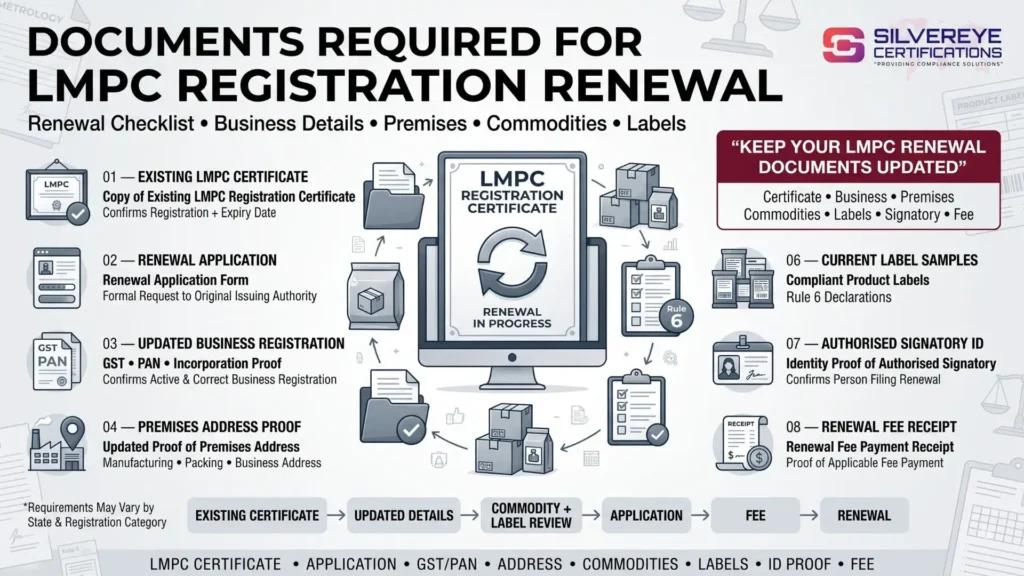
While requirements can vary slightly by state and registration category, most LMPC renewal applications ask for the following:
| Document | Purpose |
| Copy of the existing LMPC registration certificate | Confirms the registration being renewed and its expiry date |
| Renewal application form | Formal request for renewal, submitted to the original issuing authority |
| Updated business registration proof (GST, PAN, incorporation) | Confirms the business is still active and correctly registered |
| Updated proof of premises address | Confirms the manufacturing, packing, or business address is current |
| Current list of commodities manufactured, packed, or imported | Updates the department on any changes to product categories |
| Current label samples | Shows labels still carry compliant declarations under Rule 6 |
| Identity proof of the authorised signatory | Confirms the person filing the renewal on the business's behalf |
| Renewal fee payment receipt | Proof of payment of the applicable renewal fee |
Step-by-Step LMPC Registration Renewal Process
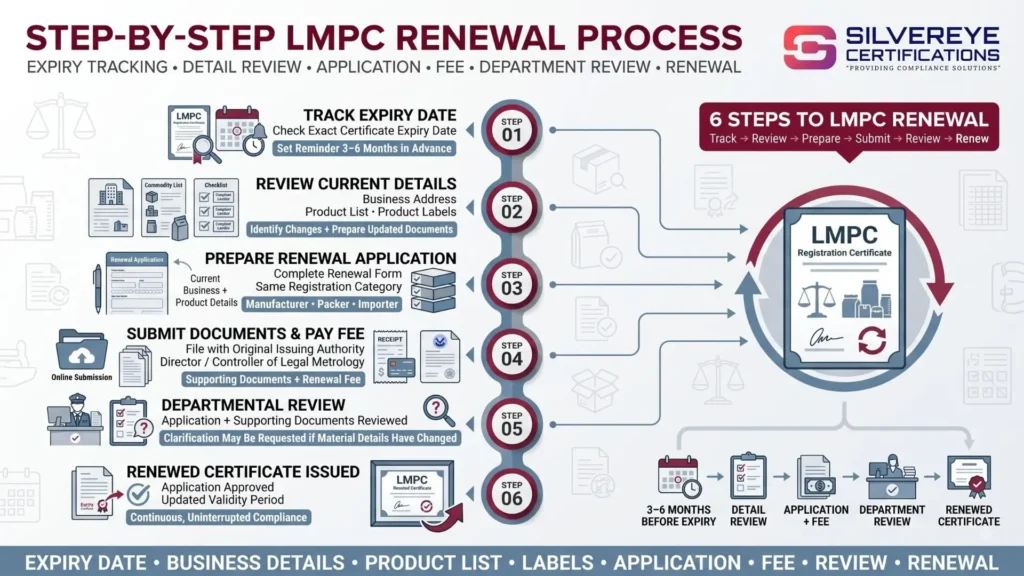
- Track your expiry date — note the exact expiry date on your existing certificate and set a reminder well ahead of it, ideally three to six months in advance.
- Review your current details — check whether your business address, product list, or labels have changed since the original registration, and prepare updated documentation accordingly.
- Prepare the renewal application — fill out the renewal form for the same registration category (manufacturer, packer, or importer) with your current business and product details.
- Submit documents and pay the fee — file the application with the Director or Controller of Legal Metrology who issued your original certificate, along with supporting documents and the renewal fee.
- Departmental review — the Legal Metrology office reviews the renewal application and supporting documents, and may seek clarification if anything has changed materially.
- Renewed certificate issued — once approved, you receive a renewed certificate with an updated validity period, allowing continuous, uninterrupted compliance.
Fees for LMPC Registration Renewal
| Particular | Details |
|---|---|
| Renewal Fee Structure | Generally similar to the fee structure applicable to the original LMPC registration. |
| Government Fee | Usually includes a modest base government fee. |
| State-Specific Fee | Additional supplementary fees may apply depending on the concerned State Legal Metrology Department. |
| Fee Range | Commonly ranges from a few hundred to a few thousand rupees, depending on the state and number of product categories. |
| Late Renewal Fee | Some state authorities may impose an additional late fee if the renewal application is submitted after the certificate has expired. |
| Fee Variation | The exact fee may vary based on the state, registration type, and product categories. |
| Before Filing | It is advisable to confirm the current renewal fee and applicable late charges with the concerned Legal Metrology office. |
When to Start the Renewal Process
Common practice under the Rules is to file the renewal application within three months of the certificate's expiry date, but starting earlier gives you a safety margin in case the department requests additional documents or clarification. Processing times for renewal applications vary by state and workload, but because renewal is generally lighter than a fresh registration review, many businesses see their renewed certificate issued within a few weeks of filing a complete application.
Waiting until the last few days before expiry to start the process leaves little room to correct any documentation issues, so starting the renewal conversation at least a month or two ahead of the deadline is a safer practice.
| Renewal Stage | Recommended Timing |
| Start reviewing your registration and documents | 3 to 6 months before expiry |
| File the renewal application | Within 3 months of the expiry date, per common practice |
| Follow up on departmental review | 2 to 4 weeks after filing, if no response received |
| Confirm renewed certificate before expiry | At least 1 to 2 weeks before the old certificate lapses |
What Happens If You Miss the LMPC Renewal Deadline?
- Expired Registration: Operating after LMPC expiry may be treated as operating without valid registration.
- Penalties: This can lead to fines, product seizure, and marketplace compliance issues.
- Late Fee: Some states may charge an additional late renewal fee.
- If Lapsed: Contact the concerned Legal Metrology office immediately.
- Renewal or Fresh Application: The authority may allow late renewal or require a fresh registration, depending on the state and duration of the lapse.
Penalties for Operating on a Lapsed Registration
Selling, manufacturing, packing, or importing pre-packaged commodities without a currently valid LMPC registration is a violation under the Legal Metrology Act, 2009, regardless of whether the lapse was intentional or simply missed. Penalties can include fines, seizure of non-compliant stock, and, for repeated or wilful violations, more serious consequences including potential imprisonment under the Act's enforcement provisions.
E-commerce sellers face an additional practical risk, since marketplaces increasingly verify LMPC registration status directly and can delist products or suspend seller accounts where the registration has expired, independent of any government enforcement action.
Renewal vs Fresh Registration: Which Applies to You?
Renewal is the right path when your business, premises, and core registered activity are substantially unchanged from your original registration, and you are simply extending the validity period.
A fresh registration is generally required instead if your business has undergone a change in legal structure or ownership, if you are registering an entirely new category of activity — for instance, adding importer registration to an existing manufacturer registration — or if your original registration has lapsed for an extended period, since some state authorities treat a long-lapsed registration as requiring a new application rather than a late renewal.
Confirming which category your situation falls into before filing saves time and avoids submitting the wrong type of application.
Why Work With a Legal Metrology Compliance Expert
Tracking renewal deadlines across multiple registrations, states, or product categories is one of the easier compliance tasks to lose track of, especially for growing businesses adding new product lines or expanding into new states.
A professional who handles Legal Metrology compliance regularly can maintain a renewal calendar for your registrations, confirm whether a renewal or fresh application applies to your situation, prepare updated documentation and labels for review, and file the renewal application well within the safe window — so your business never faces an unexpected compliance gap because of a missed date.
Frequently Asked Questions
What is LMPC Registration Renewal?
It is the process of extending the validity of your existing Legal Metrology Packaged Commodities registration before it expires, allowing your business to continue manufacturing, packing, or importing pre-packaged goods legally in India.
When should I apply for LMPC renewal?
Common practice is to file the renewal application within three months of the certificate's expiry date, though starting the review process three to six months ahead gives you a safer margin.
What documents are needed for LMPC renewal?
Typical documents include your existing certificate, the renewal application form, updated business and premises proof, a current product list, current compliant label samples, identity proof of the signatory, and the renewal fee receipt.
How much does LMPC renewal cost?
Renewal fees are generally similar to the original registration fee, commonly ranging from a few hundred to a few thousand rupees depending on the state and product categories, with a possible additional late fee if filed after expiry.
What happens if my LMPC registration expires before I renew it?
Operating with an expired registration is treated as non-compliance under the Legal Metrology Act, 2009, exposing your business to fines, stock seizure, and in some states an additional late renewal fee.
Is LMPC renewal the same process as applying for a fresh registration?
Not usually. Renewal is generally a lighter process for businesses whose details are substantially unchanged, while a fresh application is typically required if your business structure, ownership, or registered activity has changed significantly.
Can I still renew my LMPC registration after it has already expired?
In many states, a late renewal is possible, sometimes with an additional late fee, but the exact process can vary, so it's best to contact your issuing Legal Metrology office directly if your certificate has already lapsed.
Do I need to update my product list during renewal?
Yes. If you have added or discontinued any product categories since your original registration, your renewal application should reflect the current, accurate list of commodities you manufacture, pack, or import.
How long does the LMPC renewal process take?
Processing times vary by state and workload, but because renewal is generally lighter than a fresh registration review, many businesses receive their renewed certificate within a few weeks of filing a complete application.
Does my LMPC registration renew automatically?
No. LMPC registration does not renew automatically. You must proactively file a renewal application before or shortly after expiry to keep your registration continuously valid.
What happens to my e-commerce listings if my LMPC registration lapses?
Marketplaces that verify LMPC registration status can delist affected products or flag your seller account if your registration has expired, independent of any separate government enforcement action.