
- Mandatory by law: Every manufacturer, importer, dealer, and repairer of weighing scales in India must be certified under the Legal Metrology Act, 2009.
- Three linked approvals: Model Approval, a Manufacturer/Importer License, and Verification & Stamping – each is a separate step, not one single certificate.
- Fees are use-case specific: Model approval testing runs ₹10,000 (mechanical) to ₹25,000 (electronic), plus separate state license and verification fees.
- 2026 brought real change: New GATC rules, simplified verification for high-capacity scales, and a faster route for repeat model approvals now apply.
Introduction
Legal Metrology Certification for weighing scales is the government approval every manufacturer, importer, or dealer of weighing instruments in India must hold under the Legal Metrology Act, 2009, before making, selling, or using such devices in trade. It has three linked parts: a Model Approval Certificate for the instrument's design, a Manufacturer or Importer Licence for the business, and Verification & Stamping for every individual unit sold.
These are issued by the Department of Consumer Affairs and the respective State Legal Metrology Department. Without valid certification, weighing scales cannot legally be manufactured, imported, sold, or used commercially, and non-compliance can invite seizure, fines, or license cancellation.
If you manufacture, import, or repair weighing scales for the Indian market, this guide walks through everything Legal Metrology certification for weighing scales involves in 2026 – the legal basis, eligibility, documents, process, fees, validity, renewal, the newest rule changes, and answers to the questions manufacturers ask most.
What Is Legal Metrology Certification for Weighing Scales?
Legal Metrology is the branch of regulation that governs the accuracy, design, and use of weighing and measuring instruments in commercial transactions. In India, it is administered under the Legal Metrology Act, 2009, by the Department of Consumer Affairs, Ministry of Consumer Affairs, Food & Public Distribution, at the central level, and by the Controller of Legal Metrology in each state at the enforcement level.
For a weighing scale, Legal Metrology certification confirms that the instrument's design meets India's prescribed metrological standards (broadly aligned with OIML – International Organization of Legal Metrology – principles), that the business making or selling it is registered with the department, and that each physical unit has been individually checked, verified, and stamped before it is used to weigh goods for sale, billing, or trade. The objective is simple: no consumer or business should be shortchanged because a weighing scale reads inaccurately.
Why Legal Metrology Certification Is Mandatory for Weighing Scale Manufacturers
Section 22 of the Legal Metrology Act, 2009 requires every person to obtain approval of the model of a weight or measure before manufacturing or importing it. Section 24 and the Legal Metrology (General) Rules, 2011 further require verification and stamping of the individual instrument before it is used in any transaction, trade, protection, or industrial production activity. Together, these provisions mean that a weighing scale cannot legally be manufactured, imported, marketed, or put to commercial use in India unless it clears this compliance chain.
Skipping certification is not a minor paperwork gap – it is a direct violation of the Act, and enforcement officers routinely check for valid stamping and license documentation during inspections, especially at retail counters, fuel stations, mandis, and industrial weighbridges.
The Three-Part Compliance Chain Every Manufacturer Must Understand
A common misconception is that Legal Metrology certification is a single certificate. In practice, it is a chain of three distinct approvals, each covering a different layer of compliance:
1. Model Approval Certificate (Design-Level)
Covers the approved design, type, or model of the weighing instrument. It confirms the instrument's construction, materials, and metrological performance meet Indian standards before mass production begins.
2. Manufacturer / Importer / Dealer / Repairer License (Business-Level)
A separate registration issued by the State Legal Metrology Department that authorizes a specific company to manufacture, import, sell, or repair weighing and measuring instruments from a registered premises.
3. Verification & Stamping (Unit-Level)
Every individual weighing scale that leaves the factory must be tested and physically stamped or sealed by an authorised Legal Metrology Officer or a Government Approved Test Centre (GATC) before it is sold or used commercially, and again at periodic re-verification intervals thereafter.
The typical compliance flow looks like this: Manufacturer License → Model Approval → Manufacture/Supply → Verification & Stamping → Customer Use → Periodic Re-verification. A manufacturer needs all three layers working together – not just one – to be fully compliant.
Who Needs Legal Metrology Certification?
- Domestic manufacturers: Any company or individual manufacturing weighing scales, weighbridges, or weighing instruments in India.
- Importers: Any business importing weighing instruments for sale or commercial use in India, including finished scales and sub-assemblies sold as a working unit.
- Dealers and distributors: Businesses selling or supplying weighing scales to end users or retailers.
- Repairers: Service providers who repair, recalibrate, or re-stamp weighing instruments after servicing.
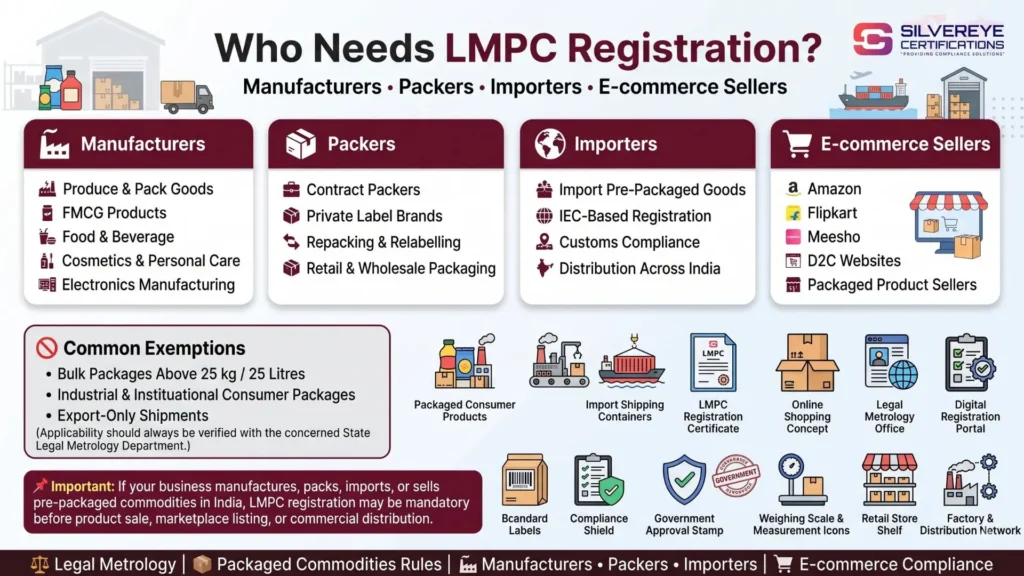
A limited set of items are exempt from model approval – for example, cast iron and brass weights, bullion and carat weights, ordinary beam scales, and length measures other than measuring tapes are generally excluded from the model approval requirement, though other Legal Metrology obligations may still apply. It is always worth confirming the exact classification of your product with the department, since exemptions are narrowly defined.
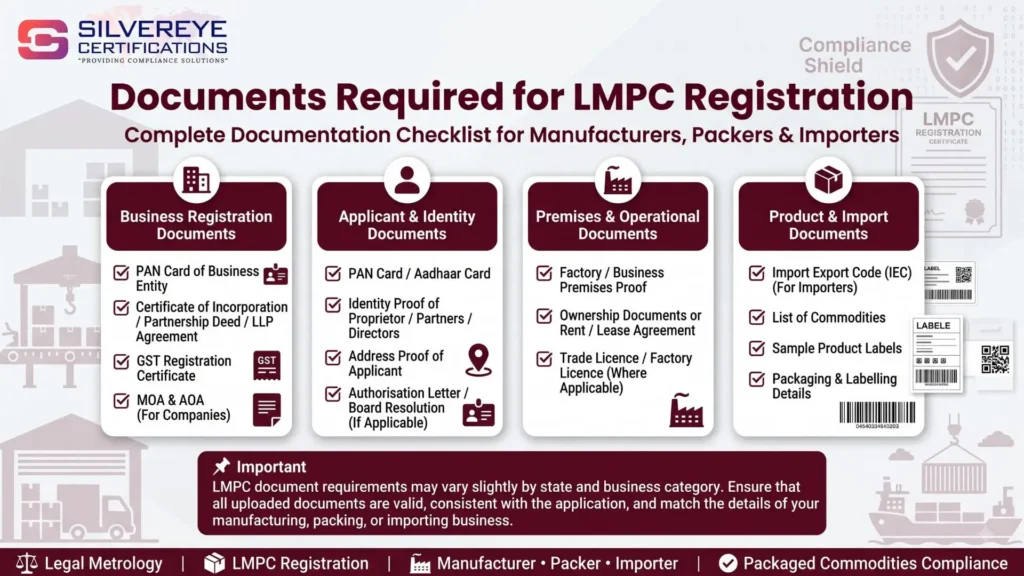
Documents Required for Legal Metrology Certification
While the exact checklist can vary slightly by state and licence type, manufacturers should generally keep the following ready:
- Business registration proof – incorporation certificate, GST registration, PAN, and MSME/Udyam registration, if applicable
- Identity and address proof of the applicant, proprietor, partners, or directors
- Technical drawing and specification sheet of the weighing instrument model
- Details of the manufacturing premises – layout, machinery, and quality-check facilities
- A physical sample of the instrument for testing (for Model Approval)
- Declaration that the model has not been rejected or modified without fresh approval
- Import documentation (IEC code, purchase invoice, bill of entry) for importers
- Duly filled application forms as prescribed by the Legal Metrology Department (e.g., Form LM series)
- Applicable fee payment receipt
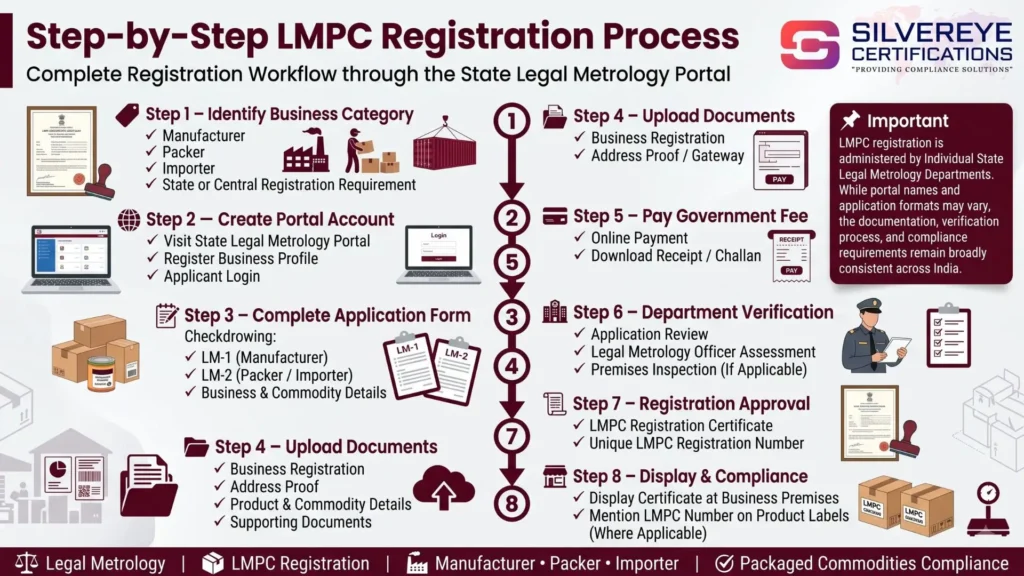
Step-by-Step Legal Metrology Certification Process for Weighing Scales
- Assess what you need: Confirm whether your product needs Model Approval, a Manufacturer/Importer License, Verification & Stamping, or all three, based on your role in the supply chain.
- File the Model Approval application: Submit the application, technical drawings, and fee to the Directorate of Legal Metrology (Department of Consumer Affairs), along with a physical sample of the instrument.
- Sample testing: The sample is tested at a recognized government laboratory or approved test centre to confirm it meets Indian metrological standards for accuracy, construction, and safety.
- Grant of Model Approval Certificate: Once the model clears testing, the Director of Legal Metrology issues the Model Approval Certificate for that specific design.
- Apply for a Manufacturer / Importer License: Submit a separate application to your State Legal Metrology Department, which typically includes a premises inspection before the license (commonly on Form LM-3 or the state-equivalent form) is granted.
- Manufacture strictly to the approved design: Production must match the approved model's specifications; any change in design, material, or metrological parameters generally requires a fresh or amended approval.
- Verification and stamping of every unit: Before sale or commercial use, each weighing scale is tested and physically stamped or sealed by an authorized Legal Metrology Officer or a Government Approved Test Centre (GATC).
- Periodic re-verification: Instruments already in use must be re-verified at the interval prescribed for that instrument category and capacity to remain legally usable.
Legal Metrology Certification Fees for Weighing Scales
Fees are charged separately at each stage of the compliance chain, and state-level licence fees can vary. The table below gives an indicative reference:
| Approval / Licence Stage | Indicative Fee | Issuing Authority |
| Model Approval – mechanical weighing instrument | ₹10,000 (testing fee) | Directorate of Legal Metrology, Dept. of Consumer Affairs |
| Model Approval – electronic weighing instrument | ₹25,000 (testing fee) | Directorate of Legal Metrology, Dept. of Consumer Affairs |
| Manufacturer / Dealer / Repairer Licence | ₹100 – ₹500 (state-dependent) | State Legal Metrology Department / Controller |
| Verification & Stamping (per instrument) | Category & state-wise, per prescribed schedule | State Legal Metrology Officer / GATC |
| Government Approved Test Centre (GATC) verification – fuel dispensers | ₹5,000/nozzle (petrol-diesel), ₹10,000+ (CNG/LPG/LNG) | Government Approved Test Centre |
Note: Fees are revised from time to time by the central and state governments. Always verify current fee schedules with the Directorate of Legal Metrology or your State Legal Metrology Department before applying.
Validity, Renewal Timeline, and Re-verification
Different parts of the certification chain carry different validity periods:
| Certification / Licence | Typical Validity | Renewal Window |
| Model Approval Certificate | Life of the approved model/design (fresh approval needed only if design or metrological specs change) | Not applicable unless design changes |
| Manufacturer / Importer Licence | 1 to 5 years, as fixed by the state authority | Apply well before expiry (many states require 30+ days’ notice) |
| Dealer / Repairer Licence | 1 to 5 years | Apply well before expiry |
| Verification & Stamping | Periodic – interval fixed by instrument category and capacity | Re-verification required at each prescribed cycle |
Because the manufacturer/dealer/repairer licence and periodic re-verification are time-bound, missing a renewal date can quietly turn a fully compliant business into a non-compliant one. Building a renewal calendar around each licence and each instrument's verification cycle is one of the simplest ways manufacturers avoid enforcement action.
Latest Legal Metrology Notifications Manufacturers Should Know (2026 Update)
Legal Metrology rules have seen active reform through 2026. The key changes relevant to weighing scale manufacturers include:
- Legal Metrology (Government Approved Test Centre) Amendment Rules, 2026 (notified 9 May 2026): Expanded the First Schedule of instruments that Government Approved Test Centres (GATCs) can verify, now covering weighing instruments alongside water meters, gas and energy meters, rail weighbridges, clinical thermometers, speed meters, flow meters, and petrol, diesel, CNG, LPG, LNG and hydrogen dispensers. States have also been empowered to notify additional instruments for GATC verification, and the Fifth Schedule now prescribes specific verification fees for fuel dispensing units.
- Legal Metrology (General) Fourth Amendment Rules, 2026: Eased the verification process for high-capacity, non-automatic weighing instruments (1 tonne capacity and above). Earlier rules required standard weights equal to at least 50% of the instrument's maximum capacity before constant loads could be substituted; after a successful repeatability test, this can now be reduced to as little as one-third or even one-fifth of maximum capacity – cutting verification time and operational downtime for manufacturers and users of large weighing systems.
- SOP for Recognition of Already-Approved Models: The Department of Consumer Affairs introduced a Standard Operating Procedure allowing importers to avoid filing repeat Model Approval applications for identical instruments from the same manufacturer, provided there is no change in design, metrological parameters, or technical specifications – reducing duplication and speeding up approvals for repeat imports.
- State-level simplification (e.g., Jammu & Kashmir Legal Metrology (Enforcement) Rules, 2026): Several states are moving from a licensing regime to a lighter registration-certificate system for manufacturers, dealers, and repairers, removing mandatory pre-registration inspections in some cases and extending re-verification periodicity for specified weights and measures – part of a broader Ease-of-Doing-Business push aligned with the Jan Vishwas (Amendment of Provisions) Act, 2026.
Because implementation timelines and specific provisions differ by state, manufacturers should track notifications from both the central Legal Metrology Division (Department of Consumer Affairs) and their own State Legal Metrology Department, rather than relying on a single source.
Penalties for Non-Compliance
Manufacturing, selling, or using a weighing scale without valid model approval, license, or verification/stamping is an offence under the Legal Metrology Act, 2009. Consequences can include seizure of non-compliant instruments, monetary fines, cancellation or suspension of the manufacturer/dealer license, and, in serious or repeat cases, prosecution.
Recent reforms under the Jan Vishwas Act, 2026 have introduced compounding fees for some categories of minor procedural lapses, but this does not remove the underlying requirement to be certified – it only changes how certain violations are penalized.
Benefits of Legal Metrology Certification for Manufacturers
- Legal right to manufacture, import, distribute, and sell weighing scales anywhere in India
- Smoother customs clearance for imported weighing instruments, since Model Approval is checked at the point of import
- Stronger buyer and consumer trust through demonstrated, verifiable accuracy
- Eligibility for government tenders and B2B contracts that require Legal Metrology compliance
- Reduced risk of costly seizures, penalties, and business disruption from enforcement action
Common Mistakes Manufacturers Make
- Confusing BIS certification with Legal Metrology certification: These are separate regimes – BIS focuses on product quality and safety standards, while Legal Metrology governs measurement accuracy and legal use in trade. Some weighing instruments may need both.
- Treating Model Approval as the finish line: A model approval alone does not permit sale – individual units still need verification and stamping.
- Changing the design after approval without informing the department: Any change in materials, construction, or metrological parameters can invalidate the existing Model Approval.
- Missing renewal windows: Letting a manufacturer, dealer, or repairer license lapse silently turns a compliant business into a non-compliant one.
- Assuming national fees apply everywhere: License fees and some procedural requirements are state-specific and should be confirmed locally.
Why Choose Silvereye Certifications
- Legal Metrology certification for weighing scales involves multiple authorities, overlapping paperwork, and rules that are actively evolving – as the 2026 amendments show. Silvereye Certifications works with manufacturers and importers to take that complexity off their plate, from the very first step to long-term compliance.
- End-to-end handling: Silvereye Certifications manages documentation, application filing, coordination for sample testing, and follow-up with the Directorate and State Legal Metrology Departments, so manufacturers can focus on production rather than paperwork.
- Familiarity with state-wise variations: Since license fees, forms, and inspection processes differ across states, Silvereye Certifications helps manufacturers navigate the correct process for the state where their unit is registered.
- Support across the full compliance chain: From Model Approval to Manufacturer Licensing and Verification & Stamping coordination, the team helps manufacturers understand which approvals apply to their specific product and business model.
- Renewal and re-verification tracking: Certifications and licenses are time-bound; Silvereye Certifications helps manufacturers plan ahead so renewal and re-verification deadlines are never missed.
- Guidance that keeps pace with regulatory change: With Legal Metrology rules being actively amended through 2026, Silvereye Certifications keeps clients informed of updates that are relevant to their product category and state.
For manufacturers who want a clear, guided path through Legal Metrology certification for weighing scales – without losing time to back-and-forth paperwork – Silvereye Certifications is built to be that partner.
Conclusion
Legal Metrology certification for weighing scales is not a single form to fill and forget – it is an ongoing compliance relationship built on three connected approvals: Model Approval, a Manufacturer/Importer License, and Verification & Stamping, each with its own documents, fees, and renewal timeline. With the 2026 amendments simplifying verification for high-capacity instruments, expanding Government Approved Test Centre coverage, and easing repeat model approvals for importers, the regulatory environment is genuinely shifting toward easier compliance – but only for manufacturers who stay informed and organized. Getting this right protects your business from penalties and seizures, and it protects the everyday trust that keeps weighing scales credible at every till, mandi, and weighbridge in the country.
Frequently Asked Questions
Is Legal Metrology certification mandatory for all weighing scale manufacturers in India?
Yes. Under Section 22 of the Legal Metrology Act, 2009, every manufacturer or importer must obtain Model Approval before manufacturing or importing a weighing instrument, and a Manufacturer/Importer License is required to run the business itself.
What is the difference between Model Approval and Verification & Stamping?
Model Approval certifies the design of the weighing instrument as a category, while Verification & Stamping is a separate, unit-level check where each individual instrument is physically tested and sealed before it can be sold or used commercially.
How long does it take to get Legal Metrology certification for a weighing scale?
Timelines vary by state and workload, but the process typically spans several weeks to a few months, covering application review, sample testing for Model Approval, and premises inspection for the Manufacturer License. Applying with complete documentation is the biggest factor in avoiding delays.
What is the fee for Model Approval of a weighing instrument?
Model Approval testing fees are commonly cited at around ₹10,000 for mechanical-type weighing instruments and ₹25,000 for electronic weighing instruments, in addition to separate state licence and verification fees. Always confirm current fees with the Directorate of Legal Metrology, as amounts can be revised.
Do importers of weighing scales also need Legal Metrology certification?
Yes. Importers must obtain Model Approval and an Importer License, and customs authorities can hold shipments of weighing instruments that arrive without valid Model Approval documentation.
Is BIS certification the same as Legal Metrology certification?
No. BIS (Bureau of Indian Standards) certification generally addresses product quality and safety standards, while Legal Metrology certification governs measurement accuracy and the legal right to use an instrument in trade. Depending on the product, a weighing instrument may need to comply with both regimes.
What happens if a weighing scale is sold without verification and stamping?
It is treated as a violation of the Legal Metrology Act, 2009. Enforcement action can include seizure of the instrument, monetary fines, and license action against the seller or manufacturer
How often must a weighing scale be re-verified?
Re-verification intervals depend on the instrument's category and capacity, as prescribed under the Legal Metrology (General) Rules, 2011. Recent state-level reforms have moved toward extending re-verification periodicity for specified instruments, so it is worth checking the current interval for your instrument category.
What changed in Legal Metrology rules in 2026?
Key 2026 changes include the Government Approved Test Centre (GATC) Amendment Rules expanding which instruments GATCs can verify, the Legal Metrology (General) Fourth Amendment Rules easing standard-weight requirements for verifying high-capacity weighing instruments, a new SOP that lets importers skip repeat Model Approval filings for identical models, and several states simplifying manufacturer/dealer/repairer licensing into lighter registration systems.
Can an approved weighing scale model be sold without a manufacturer license?
No. Model Approval only certifies the design; the entity manufacturing or importing that model must separately hold a valid Manufacturer or Importer Licence, and each unit must still be verified and stamped before sale.
Is Legal Metrology certification required for household or kitchen weighing scales?
If the scale is manufactured, imported, or sold for use in commercial or trade-related weighing, it generally falls under Legal Metrology requirements regardless of the household or small-capacity nature of the product. Certain narrowly defined categories of weights (like specific bullion or carat weights) are exempt from model approval – it is best to confirm your product's exact classification with the Legal Metrology Department.
How do I renew my Legal Metrology manufacturer license?
Renewal applications are typically filed online through the State Legal Metrology Department's portal, well ahead of the expiry date, along with updated documents and the prescribed renewal fee. Filing early avoids any compliance gap between the old and new license periods.