- X-ray machines are regulated as Class A/B/C/D medical devices under MDR 2017 — registration is mandatory before import or manufacture.
- Importers must file MD-14 on the SUGAM portal and receive MD-15 (import license) from CDSCO before commercial shipment.
- Indian manufacturers need MD-3/MD-5 (Class A/B) or MD-7/MD-9 (Class C/D) manufacturing licenses from the State Licensing Authority or CDSCO.
- Wholesalers distributing X-ray equipment must hold MD-41 (application) → MD-42 (wholesale license) under MDR 2017 Schedule M-II.
Introduction
CDSCO X-Ray Machine Registration in India is mandatory under the Medical Devices Rules (MDR) 2017. X-ray machines are classified as Class A, B, C, or D medical devices depending on risk level. Importers must obtain MD-14 (application) and MD-15 (import license).
Manufacturers need MD-3/MD-5 for Class A/B or MD-7/MD-9 for Class C/D. Wholesalers require MD-41/MD-42. All registrations are filed through the SUGAM portal. Compliance is mandatory from applicable MDR 2017 timelines. Silvereye Certifications guides you through every step.
What Is CDSCO X-Ray Machine Registration?
X-ray machines are classified as medical devices under the Medical Devices Rules (MDR) 2017, administered by the Central Drugs Standard Control Organization (CDSCO) under the Ministry of Health and Family Welfare. Any person or entity wishing to import, manufacture, or distribute X-ray equipment in India must obtain the appropriate CDSCO licence before commencing commercial activity.
The MDR 2017 replaced the earlier Drugs and Cosmetics Act provisions for medical devices, bringing a structured risk-based classification system aligned with global frameworks (GHTF/IMDRF). X-ray devices range from low-risk passive accessories (Class A) to high-risk CT and angiography systems (Class D). The licence form you file — and the regulatory scrutiny you face — depends entirely on the device class.
Key Regulatory Authority: CDSCO (Central Drugs Standard Control Organisation), operating under the Drugs and Cosmetics Act 1940 and Medical Devices Rules 2017.
Why Is CDSCO Registration Mandatory for X-Ray Machines?
X-ray equipment emits ionizing radiation. Unregulated import or manufacture poses direct patient safety, operator safety, and public health risks. CDSCO registration ensures that every device entering the Indian market meets:
- Applicable Indian or international safety standards (IEC 60601-1, AERB norms)
- Post-market surveillance and adverse event reporting obligations
- Adequate labelling and instructions for use (IFU) in Indian languages
- Traceability through Unique Device Identification (UDI) requirements
- Manufacturer or importer accountability through a valid licence
Operating without a valid CDSCO license is a cognizable offence under the MDR 2017 and can result in cancellation of import permissions, monetary penalties, and criminal prosecution.
X-Ray Machine Classification Under MDR 2017 (Class A, B, C & D)
CDSCO classifies medical devices into four risk-based categories. X-ray machines span all four classes depending on their radiation output, intended clinical application, invasiveness, and potential for patient harm. Understanding your device class is the single most important step before starting registration.
| Device Class | Risk Profile & Regulatory Implication |
| Class A | Low risk. Non-radiating accessories. Self-certification. Notified Body not required. |
| Class B | Low-to-moderate risk. Diagnostic X-ray with limited dose. Notified Body audit required for manufacturers. |
| Class C | Moderate-to-high risk. Interventional and advanced diagnostic systems. Strict conformity assessment. |
| Class D | Highest risk. CT, angiography, PET-CT. Full QMS audit, clinical evaluation, CDSCO central approval. |
Class A X-Ray Medical Devices (Low Risk — Passive/Non-Radiating Accessories)
Class A devices are low-risk, typically passive accessories that support X-ray workflows without themselves emitting ionising radiation. They require no Notified Body certification but must be registered on SUGAM.
| S. No. | Device Name / Product | Intended Use / Note | Risk Level |
| 1 | X-ray Film Viewer / Illuminator | Used for viewing developed X-ray films; no radiation emission | Class A |
| 2 | X-ray Film Processor (Manual) | Manual chemical processing of X-ray films; non-radiating | Class A |
| 3 | X-ray Cassette (Film/Screen Type) | Passive cassette holding X-ray film; no electronic components | Class A |
| 4 | X-ray Apron / Lead Shield (Accessory) | Radiation protective apron; passive protective accessory | Class A |
| 5 | X-ray Marker / Position Indicator (Non-Electrical) | Patient positioning accessory with no radiation source | Class A |
| 6 | X-ray Film Storage Cabinet | Storage unit for unexposed X-ray films; non-electronic | Class A |
Class B X-Ray Medical Devices (Low-to-Moderate Risk — Diagnostic Imaging)
Class B includes commonly used diagnostic X-ray devices with defined dose limits. These require conformity assessment by a CDSCO-recognised Notified Body before manufacturer registration. Importers must comply with MD-14/MD-15.
| S. No. | Device Name / Product | Intended Use / Note | Risk Level |
| 1 | Dental Intraoral X-ray Unit | Low-dose periapical/bitewing imaging for dental diagnosis | Class B |
| 2 | Portable X-ray Machine (Low Power) | Mobile, battery-operated, low-kV diagnostic X-ray for bedside | Class B |
| 3 | Fluoroscopy Unit (Low Power, Diagnostic) | Real-time continuous X-ray imaging; basic diagnostic use | Class B |
| 4 | Bone Densitometer (DEXA / DXA) | Dual-energy X-ray absorptiometry for bone mineral density | Class B |
| 5 | Panoramic Dental X-ray (OPG) Unit | Orthopantomogram; panoramic imaging of jaws and teeth | Class B |
| 6 | Cephalometric X-ray Unit | Lateral skull imaging for orthodontic/craniofacial analysis | Class B |
| 7 | X-ray Grid (Bucky) | Scatter radiation reduction grid for improved image quality | Class B |
| 8 | CR System – Computed Radiography Reader | Reads phosphor imaging plates to produce digital X-ray images | Class B |
| 9 | Mammography X-ray Unit (Analogue/Basic) | Low-dose dedicated breast X-ray imaging for screening | Class B |
| 10 | Veterinary X-ray Machine (Low Power) | Portable/fixed X-ray for animal diagnostic imaging | Class B |
| 11 | X-ray Image Intensifier (Accessory, Standalone) | Converts X-ray to visible light; used in fluoroscopy chains | Class B |
| 12 | Surgical Image Intensifier (Low Power) | Mobile C-arm with low-dose fluoroscopy for theatre guidance | Class B |
Class C X-Ray Medical Devices (Moderate-to-High Risk — Interventional & Advanced Diagnostic)
Class C covers high-power diagnostic and interventional systems where radiation dose is significant. Stricter documentation, clinical evaluation, and post-market surveillance are required.
| S. No. | Device Name / Product | Intended Use / Note | Risk Level |
| 1 | Fixed Diagnostic X-ray Machine (Radiography) | Ceiling/floor-mounted radiographic unit for general diagnosis | Class C |
| 2 | Mobile C-Arm Fluoroscopy System | Intraoperative C-arm for real-time surgical imaging guidance | Class C |
| 3 | Digital Radiography (DR) System | Flat-panel detector-based direct digital X-ray imaging system | Class C |
| 4 | Computed Radiography (CR) Full System | Complete CR system including generator, tube, and reader | Class C |
| 5 | Mammography Unit with Tomosynthesis (3D) | 3D breast imaging (DBT) with advanced dose management | Class C |
| 6 | Interventional Fluoroscopy X-ray System | High-power fluoroscopy for vascular/cardiac intervention | Class C |
| 7 | Dental Cone Beam CT (CBCT) Scanner | 3D volumetric X-ray imaging for dental/maxillofacial planning | Class C |
| 8 | Orthopedic Bone Densitometer (Advanced DXA) | High-precision DXA system with morphometry capability | Class C |
| 9 | Dual-Energy X-ray System | Dual-energy subtraction imaging for enhanced soft-tissue contrast | Class C |
| 10 | Tomosynthesis Unit (General) | Limited-angle 3D radiography for chest and musculoskeletal use | Class C |
| 11 | Chest X-ray Screening Unit (High Volume) | High-throughput chest radiography system for mass screening | Class C |
| 12 | Cath Lab X-ray System (Cardiac Catheterisation) | Dedicated cardiac cath lab fluoroscopy and angiography system | Class C |
| 13 | Urological Fluoroscopy System | Dedicated system for urological interventions and imaging | Class C |
| 14 | Pain Management Fluoroscopy Unit | C-arm fluoroscopy used in pain clinic and spine procedures | Class C |
| 15 | Endoscopy Fluoroscopy Combination Unit | Integrated fluoroscopy for gastrointestinal endoscopic procedures | Class C |
Class D X-Ray Medical Devices (Highest Risk — CT, Angiography & Hybrid Systems)
Class D represents the highest-risk X-ray devices in India. CDSCO's Central Licencing Authority (CLA) directly oversees all Class D approvals. Robust clinical evidence, ISO 13485-certified QMS, IEC 60601-series compliance, and AERB authorisation are typically required alongside CDSCO registration.
| S. No. | Device Name / Product | Intended Use / Note | Risk Level |
| 1 | CT Scanner (Computed Tomography) – All Types | Multi-slice/spiral CT for cross-sectional body imaging; highest dose | Class D |
| 2 | PET-CT Scanner | Hybrid PET and CT imaging for oncological and metabolic diagnosis | Class D |
| 3 | Interventional Angiography System (DSA) | Digital subtraction angiography for vascular interventions | Class D |
| 4 | Intraoperative CT (iCT) | CT integrated into operating theatre for neurosurgical guidance | Class D |
| 5 | Cardiac CT / Coronary CTA System | High-speed CT for non-invasive coronary artery imaging | Class D |
| 6 | CT Fluoroscopy System | Real-time CT-guided interventions; needle biopsies, ablation | Class D |
| 7 | Dual-Source CT Scanner | Two X-ray tubes for ultra-fast cardiac and spectral CT imaging | Class D |
| 8 | Radiation Therapy CT Simulator | CT simulator for radiation therapy treatment planning | Class D |
| 9 | CT-Guided Radiosurgery Planning System | CT imaging integrated with stereotactic radiosurgery planning | Class D |
| 10 | Intraoperative DSA (Digital Subtraction Angio) | DSA within hybrid OR for complex vascular surgery guidance | Class D |
| 11 | Cone Beam CT (CBCT) – Full Body (Interventional) | Interventional CBCT for liver, lung, and musculoskeletal biopsy | Class D |
CDSCO License Forms for X-Ray Machines: Complete Overview
MDR 2017 prescribes specific license forms for each stakeholder — importer, manufacturer, and wholesaler. Below is a structured breakdown of every applicable form for X-ray machine businesses in India.
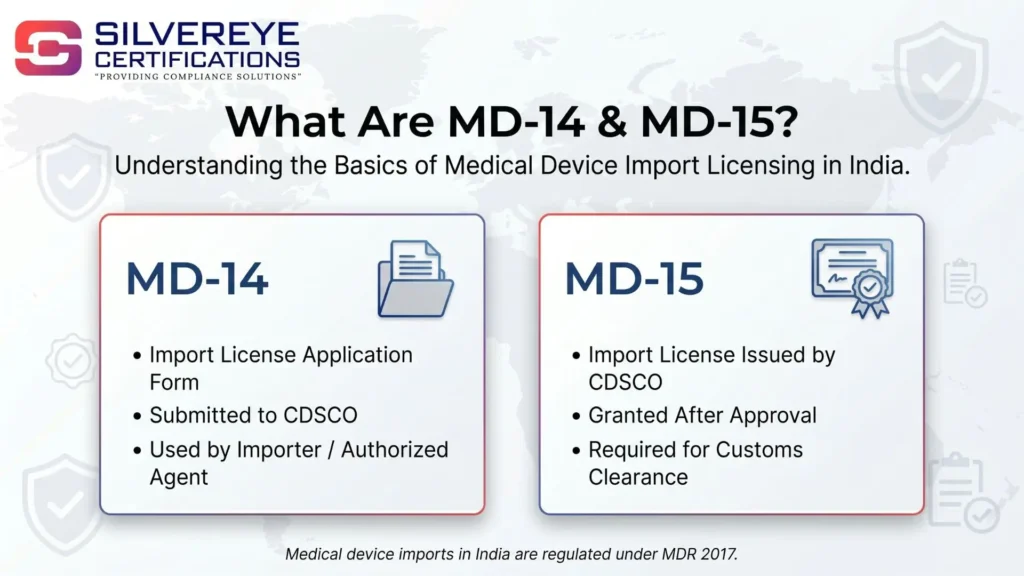
MD-14 and MD-15 — Import License for X-Ray Machines
Any entity wishing to import X-ray machines into India must obtain an import licence from CDSCO before the first commercial consignment. The process involves two key forms:
| Form | Purpose |
| MD-14 | Application form for grant or renewal of import licence for medical devices (including X-ray machines) — filed on SUGAM portal. |
| MD-15 | Licence document issued by CDSCO CLA granting the importer authority to import a specified X-ray device for a 5-year period. |
MD-14 Application — Step-by-Step Process for X-Ray Importers
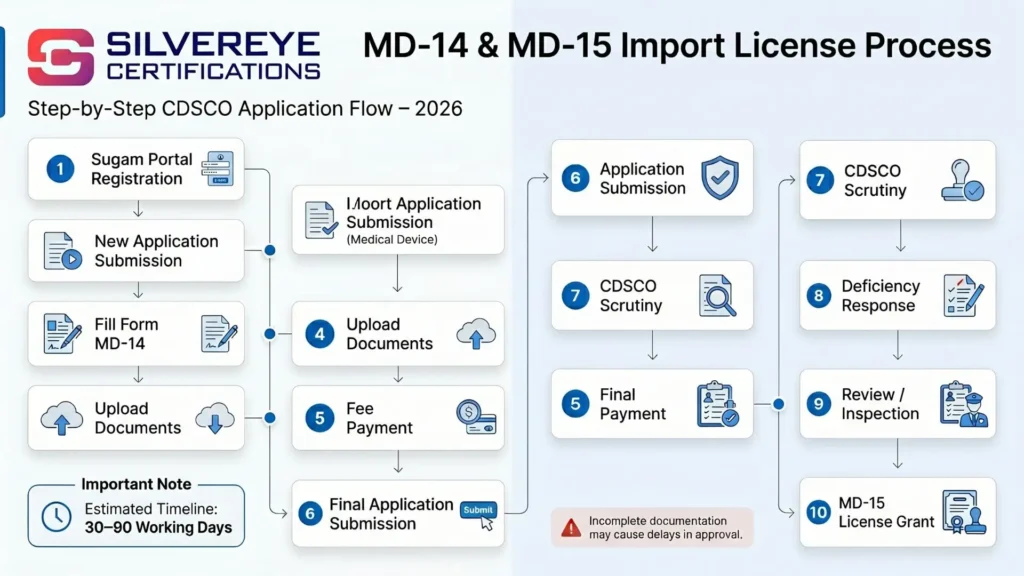
Create an entity account on the SUGAM portal.
- Select Form MD-14 under the 'Medical Devices — Import' module.
- Enter device details: generic name, model, intended use, classification class, HS code.
- Upload mandatory documents (see Document Checklist section below).
- Pay the prescribed government fee online.
- CDSCO scrutiny: technical review, query (if any), site inspection for Class C/D.
- CDSCO issues MD-15 import license (normally within 30–90 working days depending on class).
Important Note: For Class C and Class D X-ray machines, a Free Sale Certificate (FSC) from the country of origin and a Performance Test Report (PTR) from a NABL-accredited laboratory are mandatory.
MD-3 and MD-5 — Manufacturing License for Class A & B X-Ray Devices
Indian manufacturers of Class A or Class B X-ray devices apply to the State Licensing Authority (SLA) — typically the State Drug Controller — for a manufacturing licence.
| Form | Purpose |
| MD-3 | Application form for grant or renewal of State-issued manufacturing licence for Class A/B medical devices (X-ray accessories, dental X-ray, CR readers, etc.). |
| MD-5 | Manufacturing license issued by State Licensing Authority upon successful review of MD-3 application — valid for 5 years. |
- File MD-3 application with the State Drug Controller of the manufacturing state.
- Submit QMS documents, factory layout, equipment list, and technical documentation.
- State inspector visits manufacturing site for GMP verification (Schedule M-II compliance).
- MD-5 manufacturing license issued by SLA upon approval.
Class A devices may be self-certified. However, CDSCO registration on SUGAM is still required before market entry. Class B manufacturers also need Notified Body (NB) audit confirmation before the SLA issues MD-5.
MD-7 and MD-9 — Manufacturing License for Class C & D X-Ray Devices
Manufacturers of high-risk X-ray systems (Class C such as DR systems, C-arms, and Class D such as CT scanners and angiography systems) must obtain central CDSCO approval rather than state-level licensing.
| Form | Purpose |
| MD-7 | Application form for grant or renewal of manufacturing license for Class C/D medical devices — filed with CDSCO Central Licensing Authority. |
| MD-9 | Manufacturing licence issued by CDSCO CLA upon successful review of MD-7 — valid for 5 years. |
- File MD-7 on SUGAM portal under CDSCO Central Licensing Authority.
- Submit full Technical File: design documentation, risk management (ISO 14971), clinical evaluation, biocompatibility (ISO 10993), IEC 60601-1 test reports.
- ISO 13485 QMS certificate mandatory (from CDSCO-recognized Notified Body).
- CDSCO site audit of manufacturing facility.
- MD-9 manufacturing license issued by CDSCO CLA upon successful review — typically 90–120 working days for Class D.
For Class D X-ray devices (CT, DSA, PET-CT), additional requirements include clinical investigation data, radiation safety protocol, and AERB authorization. Silvereye Certifications prepares the complete dossier aligned with CDSCO's latest scrutiny checklist.
MD-41 and MD-42 — Wholesale Drug License for X-Ray Machine Distributors
Any business that stores and sells X-ray machines at wholesale to hospitals, diagnostic centres, or dealers — without holding an import or manufacturing license — must obtain a Wholesale Drug License under MDR 2017.
| Form | Purpose |
| MD-41 | Application form for grant or renewal of wholesale licence for medical devices (including X-ray machines) — filed with State Licensing Authority. |
| MD-42 | Wholesale drug licence issued by SLA authorising the holder to store and sell specified X-ray devices to licensed buyers — valid for 5 years. |
- File MD-41 with the State Drug Controller in the state of business.
- Provide storage premises details: area, temperature control, radiation safety compliance.
- Submit qualified person details (a Technical Person with relevant educational qualifications as per MDR 2017 Schedule M-II).
- SLA inspection of storage premises.
- MD-42 wholesale license granted upon compliance.
Wholesalers cannot stock Class D devices (CT scanners, angiography systems) without the approved importer's or manufacturer's original MD-15 or MD-9 license copy available in their records.
CDSCO X-Ray Machine License Forms — Summary Comparison Table
| Form | Type | Applicant | Licensing Authority | Applicable Device Class |
| MD-14 | Application | Importer | CDSCO CLA | Class A, B, C, D |
| MD-15 | Licence Issued | Importer | CDSCO CLA | Class A, B, C, D |
| MD-3 | Application | Manufacturer | State Licensing Authority | Class A, B |
| MD-5 | Licence Issued | Manufacturer | State Licensing Authority | Class A, B |
| MD-7 | Application | Manufacturer | CDSCO CLA | Class C, D |
| MD-9 | Licence Issued | Manufacturer | CDSCO CLA | Class C, D |
| MD-41 | Application | Wholesaler | State Licensing Authority | Class A, B, C, D |
| MD-42 | Licence Issued | Wholesaler | State Licensing Authority | Class A, B, C, D |
Documents Required for CDSCO X-Ray Machine Registration
Documents vary by stakeholder type and device class. Below is a consolidated checklist covering all scenarios. Silvereye Certifications reviews your specific profile and creates a gap-analysis before submission.
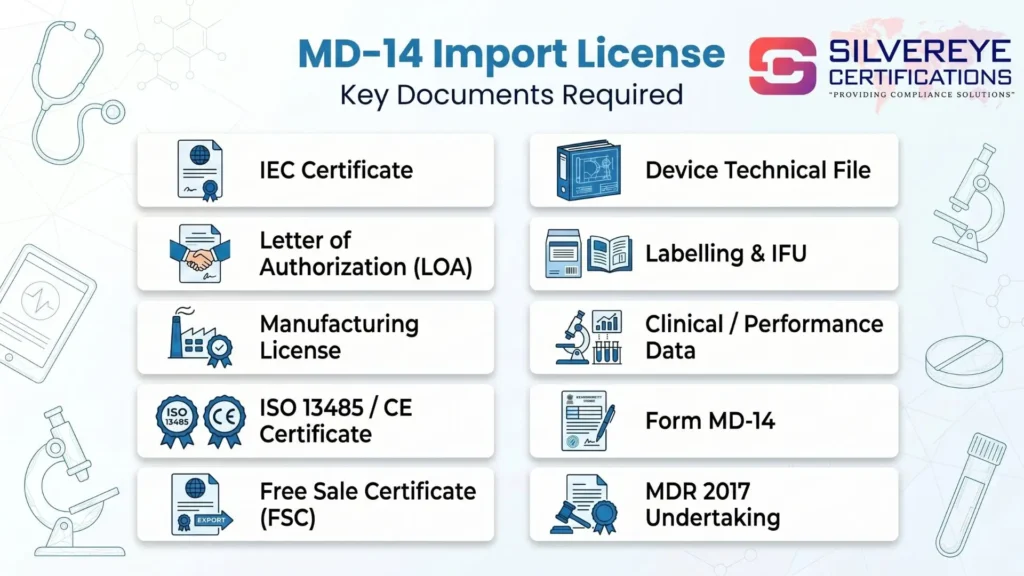
Documents for Importer (MD-14 Application)
- SUGAM portal registered entity account details
- Free Sale Certificate (FSC) or Certificate of Conformity from country of origin — notarized and apostilled
- CE Mark / FDA 510(k) / TGA TGO certificate (as applicable for Class C/D)
- ISO 13485 Quality Management System certificate of overseas manufacturer
- Declaration of Conformity signed by authorized representative
- IEC 60601-1 / IEC 60601-2 series test reports from accredited lab
- AERB Type Approval (for radiation-emitting devices — mandatory)
- Device description, intended use, specifications, models covered
- Labelling, Instructions for Use (IFU) — in English and Hindi where required
- Performance Test Report from NABL-accredited lab (Class C/D)
- Clinical Evaluation Report (CER) as per MDR 2017 Schedule III (Class C/D)
- Authorization letter from foreign manufacturer appointing Indian importer
- Business registration: GST certificate, Import Export Code (IEC — DGFT IEC Code)
Additional Documents for Manufacturer (MD-7 Application — Class C/D)
- Site Master File with facility layout and manufacturing flow
- ISO 13485 certificate from CDSCO-recognized Notified Body
- Design History File (DHF) / Device Master Record (DMR)
- Risk Management File as per ISO 14971:2019
- Biocompatibility reports as per ISO 10993 series
- Software documentation (IEC 62304) if device contains software
- Clinical Investigation summary (Phase III for novel Class D devices)
- Post-Market Surveillance (PMS) plan
- Qualified Person (QP) credentials as per MDR 2017 Schedule M-II
Documents for Wholesaler (MD-41 Application)
- Premises proof: ownership or rent agreement of storage facility
- Storage area details: floor area in sq. ft., temperature monitoring logs
- Qualified Technical Person certificate (degree in science/engineering)
- Business registration certificate, GST registration
- Copy of supplier's valid CDSCO import or manufacturing license (MD-15 or MD-9)
- Radiation safety compliance plan for storage of X-ray equipment
CDSCO X-Ray Machine Registration Fees (2026)
Government fees under MDR 2017 are paid online through the SUGAM portal at the time of application. Fees are non-refundable. Below are the applicable fees as per the current MDR 2017 fee schedule.
| Licence Type | Class A/B Fee (INR) | Class C/D Fee (INR) | Validity |
| Import Licence (MD-15) | ₹2,500 per device | ₹5,000 per device | 5 Years |
| Manufacturing Licence Class A/B (MD-5) | ₹3,500 (per category) | — | 5 Years |
| Manufacturing Licence Class C/D (MD-9) | — | ₹5,000 (per device) | 5 Years |
| Wholesale Licence (MD-42) | ₹2,000 (State) | ₹2,000 (State) | 5 Years |
| Renewal (all types) | Same as original fee | Same as original fee | +5 Years |
Note: Professional fees charged by regulatory consultants (such as Silvereye Certifications) are separate from government fees. Fees are subject to revision by the Ministry of Health. Verify current fees on the SUGAM portal before filing.
Validity and Renewal of CDSCO X-Ray Machine Licenses
All CDSCO medical device licences — import, manufacturing, and wholesale — are valid for 5 years from the date of issue. Renewal must be initiated at least 30 days before expiry to avoid lapse. A lapsed licence requires fresh registration, which significantly increases timelines and costs.
| Parameter | Detail |
| Licence Validity | 5 years from date of issue |
| Renewal Timeline | Apply 30 days before expiry (strongly recommended: 90 days in advance) |
| Renewal Form | Same form as original (MD-14, MD-3, MD-7, MD-41) |
| Renewal Fee | Same as original application fee |
| Grace Period After Expiry | No statutory grace period — immediate lapse |
| Post-Renewal Validity | 5 years from the date of renewal order |
Silvereye Certifications offers a Licence Renewal Monitoring service, sending automated reminders 120, 90, 60, and 30 days before expiry across your entire CDSCO portfolio.
AERB Authorization for X-Ray Machines in India
In addition to CDSCO registration, all radiation-emitting X-ray machines require type-approval from the Atomic Energy Regulatory Board (AERB) under the Atomic Energy (Radiation Protection) Rules 2004. CDSCO and AERB compliance are separate, parallel requirements.
- AERB Type Approval: mandatory for every model of X-ray machine before import — covers radiation output, shielding, and safety interlocks.
- AERB Registration of Users: hospitals and diagnostic centres using X-ray equipment must register with AERB.
- AERB License for Service Engineers: personnel servicing high-dose X-ray machines require AERB authorization.
- Annual Radiation Safety Audit: AERB-authorised medical physicists must audit high-dose facilities annually.
Silvereye Certifications coordinates CDSCO and AERB compliance simultaneously to avoid project delays.
SUGAM Portal: How to File CDSCO X-Ray Machine Registration Online
All CDSCO medical device applications — MD-14, MD-3, MD-7, MD-41 — are filed exclusively through the SUGAM portal. As of 2026, physical submissions are no longer accepted for most device categories.
- Register your entity on SUGAM with valid GST number, PAN, and authorized signatory Aadhaar.
- Select the correct module: 'Medical Devices — Import' (MD-14) or 'Medical Devices — Manufacture' (MD-3/MD-7) or 'Wholesale License' (MD-41).
- Complete the online form and upload all documents in the prescribed PDF/ZIP format (max file sizes apply per document type).
- Pay government fee through the SUGAM payment gateway (net banking, UPI, debit card).
- Track application status: SUGAM provides real-time status — Under Scrutiny, Query Raised, Under Inspection, Approved, Rejected.
- Respond to CDSCO queries within the stipulated timeframe (usually 15–30 days from query date).
- Download approved license (MD-15, MD-5, MD-9, MD-42) directly from SUGAM portal.
Timeline for CDSCO X-Ray Machine Registration (2026)
| Device Class | Licence Type | Estimated Timeline | Key Milestone |
| Class A | Import (MD-15) | 15–30 working days | Document review, no inspection |
| Class B | Import (MD-15) | 30–60 working days | Technical review, NB cert check |
| Class C | Import (MD-15) | 60–90 working days | PTR, CER review, possible audit |
| Class D | Import (MD-15) | 90–120+ working days | Full clinical/technical review + site audit |
| Class A/B | Manufacture (MD-5) | 45–75 working days | SLA inspection + NB audit (Class B) |
| Class C/D | Manufacture (MD-9) | 90–150 working days | CDSCO site audit + QMS verification |
| All Classes | Wholesale (MD-42) | 20–45 working days | SLA premises inspection |
Timelines are indicative and depend on query responses, completeness of documentation, and CDSCO workload. Silvereye Certifications' track record shows a 30–40% faster approval timeline compared to self-filing, owing to zero-deficiency dossier preparation.
Common Reasons for CDSCO X-Ray Registration Rejection
- FSC not apostilled or issued by wrong authority in origin country
- IEC 60601-1 test report not from an internationally accredited lab
- AERB Type Approval letter missing for radiation-emitting devices
- Mismatch between device model on FSC and model listed in MD-14 form
- ISO 13485 certificate issued by a Notified Body not recognized by CDSCO
- Clinical Evaluation Report (CER) missing for Class C/D devices
- Incorrect HS code or wrong device class declared on SUGAM
- Manufacturer authorization letter not on company letterhead or not notarized
- Incomplete QMS documentation during MD-9 site audit
- Software files (IEC 62304) missing for AI-powered or software-enabled X-ray devices
Eligibility: Who Can Apply for CDSCO X-Ray Machine Registration?
| Applicant Type | Eligibility Criteria |
| Importer (MD-14/MD-15) | Any registered Indian company or LLP with a valid DGFT IEC (Import Export Code), GSTIN, and a formal authorisation letter from the overseas manufacturer. |
| Indian Manufacturer (MD-3/MD-7) | Registered manufacturing entity with a physical facility meeting MDR 2017 Schedule M-II (GMP) requirements. Qualified Person (QP) mandatory on site. |
| Foreign Manufacturer (MD-7) | Foreign manufacturers with an Indian business entity or authorised Indian Representative (IR) can apply for MD-9 through CDSCO CLA. |
| Wholesaler (MD-41/MD-42) | Any registered trading company with compliant storage premises, qualified technical person, and valid supplier licence copies. |
Post-Registration Compliance for X-Ray Machine License Holders
Obtaining the CDSCO license is the beginning, not the end, of regulatory compliance. Licence holders must maintain ongoing obligations to stay compliant and avoid cancellation.
- Vigilance / Adverse Event Reporting: report serious adverse events and near-misses to CDSCO within 10 calendar days (Class C/D) or 30 days (Class A/B).
- Post-Market Surveillance (PMS): maintain PMS plan and annual reports covering field safety corrective actions (FSCAs) and customer feedback.
- Labelling Updates: update labels and IFU whenever device specs, indications, or contraindications change — file amendment application on SUGAM.
- Annual Returns: submit annual returns to CDSCO reporting sales volume, complaints, and FSCA data.
- AERB Renewal: AERB type approvals have separate renewal cycles — track independently.
- Change Notifications: notify CDSCO of changes in ownership, manufacturing site, authorized representative, or device model — requires fresh application or amendment.
How Silvereye Certifications Helps with CDSCO X-Ray Machine Registration
Silvereye Certifications is a specialist Indian regulatory compliance consultancy with deep expertise in CDSCO medical device registrations across all four device classes. Our end-to-end service for X-ray machine clients covers:
- Device classification advisory: confirm correct class (A/B/C/D) and applicable license forms
- Gap analysis: identify missing documents before filing to prevent CDSCO rejection
- Technical dossier preparation: CER, risk management file, technical file, IFU review
- AERB Type Approval coordination alongside CDSCO registration
- SUGAM portal filing and real-time application tracking
- CDSCO query management and rapid response drafting
- Notified Body (NB) identification and audit support for manufacturers
- Renewal tracking and amendment management for existing licenses
- Post-market surveillance framework setup and annual return filing
Frequently Asked Questions — CDSCO X-Ray Machine Registration
Is CDSCO registration mandatory for all types of X-ray machines in India?
Yes. Under the Medical Devices Rules 2017, all X-ray machines — from passive accessories (Class A) to CT scanners (Class D) — must be registered with CDSCO before they can be imported, manufactured, or sold commercially in India. Operating without a valid CDSCO licence attracts penalties and legal action.
What is the difference between MD-14 and MD-15 for X-ray machine importers?
MD-14 is the application form filed by the importer on the SUGAM portal to request an import license. MD-15 is the actual import license document issued by CDSCO CLA upon successful review of the MD-14 application. You cannot legally import X-ray machines without a valid MD-15.
Which form does an Indian manufacturer of CT scanners (Class D) need to file?
An Indian manufacturer of Class D X-ray devices such as CT scanners must file Form MD-7 with CDSCO's Central Licensing Authority. Upon successful scrutiny, site inspection, and QMS audit, CDSCO issues Form MD-9, the manufacturing license valid for 5 years.
Do X-ray machine distributors/dealers need a separate CDSCO license?
Yes. Any wholesaler storing and selling X-ray machines must obtain a wholesale drug license. The application is filed using Form MD-41 with the State Licensing Authority. Upon approval, Form MD-42 (the wholesale license) is issued. Retailers selling directly to end-users (hospitals) may require a retail license in some states.
Is AERB Type Approval separate from CDSCO registration for X-ray machines?
Yes. CDSCO registration and AERB Type Approval are two separate, mandatory requirements for radiation-emitting X-ray machines. AERB (Atomic Energy Regulatory Board) approves the radiation safety specifications of each X-ray model, while CDSCO approves it as a medical device for clinical use. Both must be obtained before import or sale.
How long does CDSCO X-ray machine registration take for Class D devices?
Class D devices such as CT scanners and angiography systems typically take 90–120+ working days from the date of filing a complete application on SUGAM. Timelines can extend if CDSCO raises technical queries or schedules a facility audit. Incomplete applications are the single biggest cause of delays.
Can a foreign manufacturer directly apply for CDSCO manufacturing license for X-ray machines?
Yes. Foreign manufacturers can apply for a manufacturing licence (MD-7/MD-9) through CDSCO's Central Licencing Authority by appointing a licensed Indian Representative (IR). The IR acts as the regulatory point of contact in India. The manufacturing site inspection may be conducted by CDSCO or a recognised Notified Body.
What standards must X-ray machines comply with for CDSCO registration in India?
Key standards include IEC 60601-1 (general electrical safety), IEC 60601-1-2 (EMC), IEC 60601-2-7/28/43/44/54 (specific to X-ray types), ISO 13485 (QMS), ISO 14971 (risk management), IEC 62304 (software), and ISO 10993 (biocompatibility). AERB also prescribes radiation output and shielding standards under its Safety Codes.
What happens if an X-ray machine import license (MD-15) expires?
An expired MD-15 means you can no longer legally import that device. There is no statutory grace period under MDR 2017. If you continue importing on an expired license, it is treated as importing without a license — attracting penalties. Renewal must be applied for using Form MD-14 at least 30 days before expiry; Silvereye recommends initiating 90 days in advance.
How much does CDSCO X-ray machine registration cost in India?
Government fees on the SUGAM portal range from approximately ₹2,500 to ₹5,000 per device depending on class and licence type. Professional/consultant fees vary based on device complexity and documentation status. Silvereye Certifications provides a detailed cost estimate after an initial document gap analysis at no charge.