- Surgical instruments in India are risk-classified as Class A, B, C or D under the Medical Devices Rules, 2017 — the class decides which CDSCO license applies.
- Manufacturers need MD-3/MD-5 (Class A/B) or MD-7/MD-9 (Class C/D); importers always need MD-14/MD-15, regardless of class.
- Wholesalers/distributors need an MD-41 application and MD-42 registration certificate to legally stock and sell surgical instruments.
- Class A non-sterile, non-measuring instruments only need CDSCO registration, not a full license — most general-use hand instruments fall here.
Introduction
CDSCO medical device registration for surgical instruments is the mandatory approval process under the Medical Devices Rules, 2017, that lets a business manufacture, import or sell surgical instruments in India. Instruments are classified as Class A (low risk), B (low-moderate), C (moderate-high) or D (high risk) based on intended use and risk.
Manufacturers apply for MD-3 (Class A/B) or MD-7 (Class C/D) and receive MD-5 or MD-9. Importers apply on MD-14 and receive MD-15. Wholesalers apply on MD-41 and receive MD-42. Most hand-held general surgical instruments (scissors, forceps, curettes) are Class A.
What Is CDSCO Registration for Surgical Instruments?
The Central Drugs Standard Control Organization (CDSCO), operating under the Directorate General of Health Services, Ministry of Health & Family Welfare, is India's national regulatory authority for medical devices. Every surgical instrument sold, manufactured, imported, or distributed in India — from a basic dissecting scissor to a pedicle screw spinal system — must be registered or licensed with CDSCO under the Medical Devices Rules, 2017 (MDR 2017) before it can legally enter the Indian healthcare market.
Surgical instruments are regulated because they come into direct contact with patient tissue during invasive procedures. CDSCO's approach is risk-proportionate: the regulatory burden — documentation, inspection, fees, and timeline — scales with the risk class of the instrument. This is why the very first step in any CDSCO registration journey for a surgical instrument is correctly identifying its risk class.
All applications, fee payments, and query responses are handled through CDSCO's online SUGAM portal, and the licensing authority differs by class: State Licensing Authorities handle Class A and B devices, while the Central Licensing Authority (CLA) handles Class C and D devices and all imports, regardless of class.
How CDSCO Classifies Surgical Instruments (Class A, B, C, D)
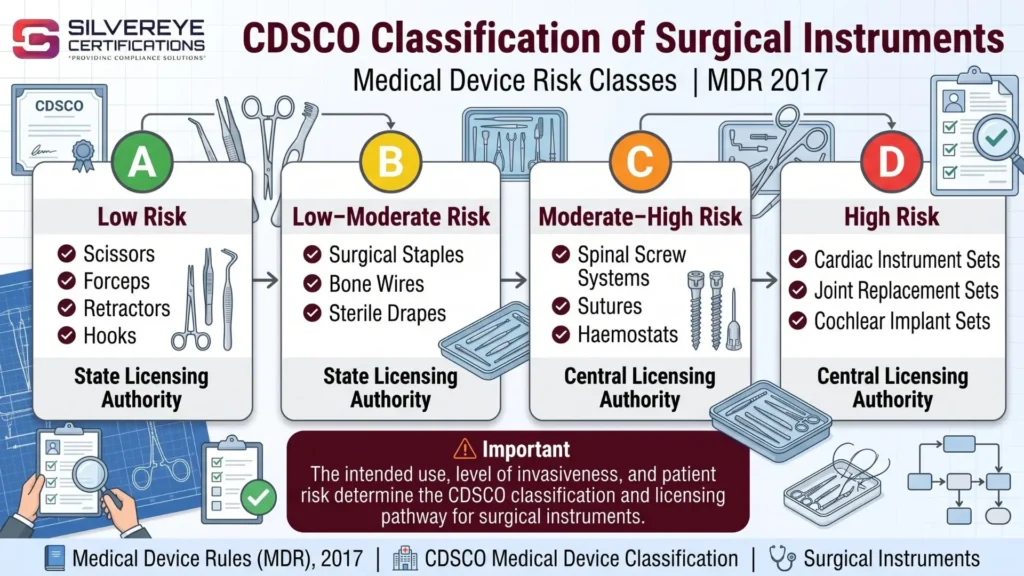
Under the First Schedule of MDR 2017, medical devices — including surgical instruments — are classified into four risk categories, broadly aligned with the Global Harmonization Task Force (GHTF) risk model:
| Class | Risk Level | Typical Surgical Instrument Examples | Licensing Authority |
| Class A | Low risk | Hand-held scissors, forceps, curettes, retractors, hooks | State Licensing Authority (registration for non-sterile/non-measuring) |
| Class B | Low–moderate risk | Surgical staples, bone wires, orthopaedic fixation kits, sterile drapes | State Licensing Authority |
| Class C | Moderate–high risk | Spinal pedicle screw systems, sutures, absorbable haemostats | Central Licensing Authority |
| Class D | High risk | Cardiac ablation instrument sets, joint replacement instrument sets, cochlear implant sets | Central Licensing Authority |
On 9 September 2022, CDSCO specifically notified the classification of non-sterile, non-powered, hand-held or hand-manipulated surgical instruments for general surgical use — the category most surgical instrument manufacturers fall under.
This notification confirmed that instruments used for cutting, dissecting, clamping, retracting, holding, and similar non-powered actions (without connection to an active/electrical device) are Class A medical devices. This classification list is dynamic and CDSCO revises it periodically, so businesses should always verify current classification on the CDSCO website or the SUGAM portal before filing.
Class A Surgical Instruments — Low Risk
Class A covers non-sterile, non-powered, hand-held or hand-manipulated general surgical instruments used for cutting, dissecting, scratching, scraping, clamping, retracting, holding, or similar procedures without connection to an active device. If the instrument is also non-sterile and non-measuring, it only requires CDSCO registration under Chapter III-B of MDR 2017 rather than a full manufacturing/import license.
| S. No. | Surgical Instrument / Device | Primary Surgical Use |
| 1 | Abdominal scissors, reusable | Cutting abdominal wall tissue during surgery |
| 2 | General-purpose curette, reusable | Scraping/excising tissue at various anatomical sites |
| 3 | Bone curette, reusable | Cutting and excising bone tissue in orthopaedic/plastic surgery |
| 4 | Bone cutting forceps, reusable | Cutting rib ends and bone tissue during surgery |
| 5 | Bone holding forceps, reusable | Grasping and holding bone during open surgery |
| 6 | Bone hook / bone retractor, reusable | Hooking, holding and applying traction to bone |
| 7 | Cranial trephine, reusable | Cutting/removing sections of the skull vault (neurosurgery) |
| 8 | Craniofacial rongeur, reusable | Cutting bone/cartilage in craniofacial surgery |
| 9 | Cartilage knife / chondrotome, reusable | Cutting, shaving or shaping cartilage |
| 10 | Cast cutting scissors, reusable | Cutting plaster casts and thick bandage material |
| 11 | Dermatome, manual, reusable | Cutting thin donor skin slices for grafting |
| 12 | Dressing / utility forceps, reusable | Non-dedicated grasping of dressings and sponges |
| 13 | Ear hook, reusable | Middle-ear surgery manipulation |
| 14 | Elevator, orthopaedic / periosteal, reusable | Lifting/separating periosteum during surgery |
| 15 | Elevator, ear/nose/throat, reusable | Lifting or positioning tissue during ENT surgery |
| 16 | Eyelid clamp, reusable | Atraumatic grasping and holding of the eyelid |
| 17 | Eyelid speculum, reusable | Retracting eyelids during ophthalmic procedures |
| 18 | Forceps, general-purpose, reusable | General grasping of instruments/objects |
| 19 | Forceps, dissecting (tweezers/scissors-like), reusable | Grasping/manipulating tissue during dissection |
| 20 | Forceps, haemostatic, reusable | Constricting blood vessels to control bleeding |
| 21 | Forceps, tooth extraction, reusable | Extraction of teeth in dental surgery |
| 22 | Forceps, bone, reusable | Grasping, cutting or crushing bone |
| 23 | Hand-held surgical retractor, reusable | Separating wound margins for access during open surgery |
| 24 | Hook, surgical, general-purpose, reusable | Hooking and applying traction to soft tissue |
| 25 | Hook, surgical, skin, reusable | Fixing or applying traction to skin |
| 26 | Adenotome, reusable | Excising tonsils/adenoids during adenoidectomy |
| 27 | Aneurysm clip applier, reusable | Applying/inserting aneurysm clips |
| 28 | Bone nail driver, reusable | Driving a fixation nail into the intramedullary canal |
| 29 | Bone tap, reusable | Cutting internal threads into bone for screw insertion |
| 30 | Bulldog clamp forceps, reusable | Grasping and applying small vascular clamps |
| 31 | Cilia forceps, reusable | Grasping and removal of eyelashes |
| 32 | Fluted surgical drill bit, reusable | Rotated to bore holes into bone |
| 33 | Fistula hook / fistula probe, reusable | Exploring or hooking a fistula during surgery |
| 34 | Cystoscopic rongeur, reusable | Removing hard tissue/calculi via cystoscope |
| 35 | Blepharoplasty scissors, reusable | Cutting eyelid tissue in plastic surgery |
| 36 | Cervical cytology scraper, reusable | Retrieving cytological samples from the cervix |
Class B Surgical Instruments — Low-to-Moderate Risk
Class B instruments carry a somewhat higher risk profile — typically because they are sterile, involve fixation/implant-adjacent use, or are part of a surgical kit used inside the body for a limited duration. These require a full manufacturing license (MD-5) or import license (MD-15); registration alone is not sufficient.
| S. No. | Surgical Instrument / Device | Primary Surgical Use |
| 1 | Grasping forceps, endoscopic | Grasping tissue/foreign bodies within the GI tract endoscopically |
| 2 | Bone wire (intra-osseous fixation wire) | Stabilising fractured bone segments by direct wire fixation |
| 3 | Bone cap | Implanted to cover the end of a bone |
| 4 | Surgical staples | Closing skin wounds and internal tissue during surgery |
| 5 | Sterile surgical drapes | Maintaining a sterile field during surgical procedures |
| 6 | Ligature wire | Auxiliary fixation in orthodontic/surgical procedures |
| 7 | Wound closure device | Soft-tissue approximation after surgery |
| 8 | Surgical sealant | Adjunctive haemostasis by sealing areas of leakage |
| 9 | Rigid limb brace / rib fracture / sacroiliac plates, clips, screws | External/internal fixation support for fractures |
| 10 | General internal orthopaedic fixation instrument kit, reusable | Non-implant instrument set (drills, guides, screwdrivers) for fixation surgery |
| 11 | General external orthopaedic fixation instrument kit, reusable | Instruments for placing external fixation frames |
| 12 | Vessel dilator for percutaneous catheterisation | Enlarging a vessel opening before catheter insertion |
Class C Surgical Instruments — Moderate-to-High Risk
Class C covers instruments and instrument-implant systems associated with longer-term tissue contact, structural load-bearing (e.g., spine), or systemic effect (e.g., haemostatic agents, sutures). These require Central Licensing Authority approval via MD-7/MD-9 for manufacturing, or MD-14/MD-15 for import.
| S. No. | Surgical Instrument / Device | Primary Surgical Use |
| 1 | Pedicle screw spinal system | Immobilisation and stabilisation of spinal segments |
| 2 | Orthopaedic implant & accessories (general) | Replacing a missing joint/bone or supporting a damaged bone |
| 3 | Gelatine sponge / absorbable haemostat | Controlling surface bleeding at vascular access or surgical sites |
| 4 | Non-absorbable synthetic suture | General soft-tissue approximation and ligation |
| 5 | Absorbable suture | General soft-tissue approximation and ligation |
| 6 | Custom cardiopulmonary bypass perfusion system | Extracorporeal circuit during cardiac bypass surgery |
| 7 | Tissue adhesive for topical use | Topical closure of surgical/laparoscopic incisions |
| 8 | Endovascular suturing system | Fixation/sealing between an endovascular graft and the native artery |
| 9 | Intervertebral body fusion device / cage | Intervertebral body fusion in degenerative disc disease |
| 10 | Anaesthetic conduction kit | Administering regional/local anaesthesia (syringes, needles, drugs) |
Class D Surgical Instruments — High Risk
Class D covers the highest-risk surgical instrument systems — generally those used with implants that support life, are permanently implanted, or involve the central circulatory/nervous system. These face the strictest scrutiny, mandatory site inspection, and Central Licensing Authority approval.
| S. No. | Surgical Instrument / Device | Primary Surgical Use |
| 1 | Absorbable haemostatic agent (advanced) | Accelerating blood clotting to control severe bleeding |
| 2 | Tissue adhesive for non-topical (internal) use | Adhesion of internal tissues/vessels, e.g. AVM embolisation |
| 3 | Intracardiac patch / pledget | Repairing septal defects and buttressing sutures in the heart |
| 4 | Radiofrequency cardiac ablation catheter system | Ablating dysfunctional cardiac conduction tissue |
| 5 | Vascular graft / occluder instrument set | Repairing, replacing or bypassing native/artificial vessels |
| 6 | Cochlear implant surgical instrument set | Placement of a cochlear implant for profound hearing loss |
| 7 | Total joint (hip/knee) replacement instrument set | Implanting constrained/semi-constrained joint prostheses |
| 8 | Intervertebral body fusion device (cervical/lumbar, complex) | Fusion of cervical or lumbosacral spinal segments |
Note: Classification lists are dynamic and subject to periodic CDSCO notification. Businesses should confirm the exact class of their specific product using the CDSCO risk-classification tool on the SUGAM portal, or by filing a classification query with CDSCO, before submitting a license application.
CDSCO Licenses You Need — Manufacturer, Importer & Wholesaler
The form you file depends on your role in the supply chain (manufacturer, importer, or wholesaler/distributor) and the risk class of the surgical instrument. Here is the complete picture:
MD-3 and MD-5: Manufacturing License for Class A & B Surgical Instruments
Manufacturers of Class A (sterile/measuring) and Class B surgical instruments apply to the State Licensing Authority using Form MD-3. Once the application, plant inspection (where applicable), and document review are complete, the manufacturing license is granted in Form MD-5. Class A non-sterile, non-measuring instruments are exempt from this license and only need CDSCO registration.
- Application form: MD-3 (filed on the SUGAM portal)
- Grant of license form: MD-5
- Licensing authority: State Licensing Authority
- Typical validity: Perpetual, subject to periodic retention/compliance review
MD-7 and MD-9: Manufacturing License for Class C & D Surgical Instruments
Manufacturers of Class C and D surgical instruments/instrument systems apply to the Central Licensing Authority (CDSCO headquarters) using Form MD-7. This process involves deeper technical scrutiny, mandatory manufacturing-site inspection, and review of clinical/performance evidence. Approval is granted in Form MD-9.
- Application form: MD-7 (filed on the SUGAM portal)
- Grant of license form: MD-9
- Licensing authority: Central Licensing Authority (CLA)
- Site inspection: Mandatory for most Class C/D applications
MD-14 and MD-15: Import License for Surgical Instruments (All Classes)
Any foreign manufacturer who wants to import surgical instruments of any class — A, B, C, or D — into India must route the application through an Indian Authorized Agent, who files Form MD-14 on the SUGAM portal. Once CDSCO reviews the Plant Master File, Device Master File, Free Sale Certificate, and other Fourth Schedule documents, the import license is granted in Form MD-15.
- Application form: MD-14 (filed by the Indian Authorized Agent)
- Grant of license form: MD-15
- Licensing authority: Central Licensing Authority (all classes, all imports)
- Validity: Indefinite, subject to a retention fee payable every 5 years
- Class A non-sterile, non-measuring exception: registration required instead of MD-15
MD-41 and MD-42: Wholesale License to Sell/Distribute Surgical Instruments
Any entity that wants to stock, sell, or distribute surgical instruments — as a wholesaler, dealer, stockist, or distributor — must apply on Form MD-41 for a Registration Certificate to Sell and Distribute Medical Devices. Once approved, the certificate is issued in Form MD-42. This MD-42 certificate is also a prerequisite: an Indian Authorised Agent representing a foreign manufacturer must hold a valid MD-42 (or a manufacturing license) before it can file an MD-14 import application.
- Application form: MD-41
- Grant of certificate form: MD-42
- Who needs it: Wholesalers, distributors, stockists, and Indian Authorized Agents
- Licensing authority: State Licensing Authority
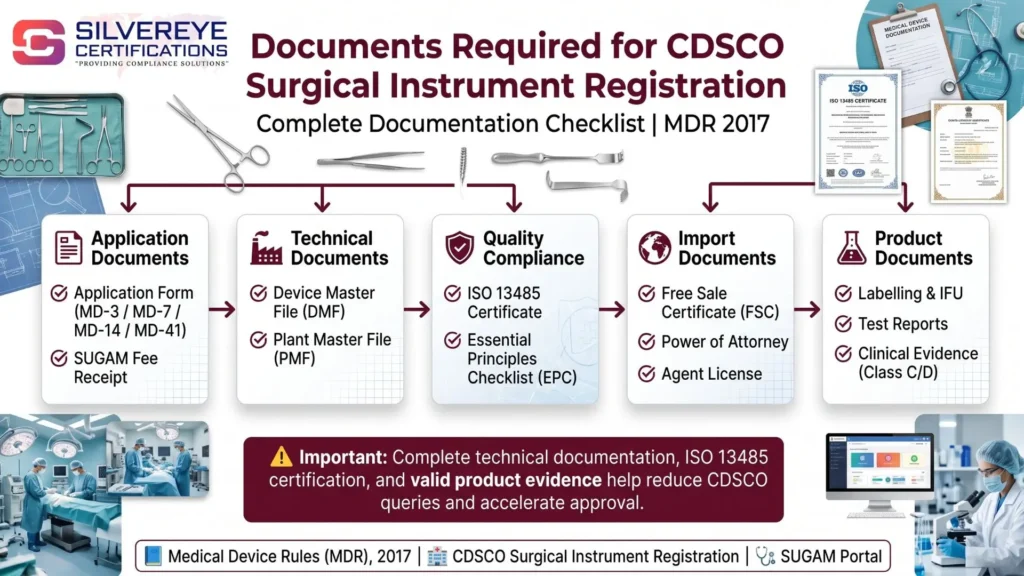
Documents Required for CDSCO Surgical Instrument Registration
Document depth scales with device class, but a typical application includes:
- Covering letter and duly filled application form (MD-3/MD-7/MD-14/MD-41 as applicable)
- Fee payment challan generated from the SUGAM portal
- Device Master File (DMF) — technical specifications, intended use, materials of construction
- Plant Master File (PMF) — for manufacturers/importers, covering facility and quality systems
- ISO 13485 Quality Management System certificate
- Free Sale Certificate (FSC) / Marketing Authorization from the country of origin (for imports)
- Essential Principles Checklist (EPC) compliance declaration
- Power of Attorney authorizing the Indian Authorized Agent (for foreign manufacturers)
- Copy of the agent's existing wholesale license (MD-42) or manufacturing license
- Labelling and Instructions for Use (IFU) samples
- Test reports / performance and biocompatibility data (higher for Class C/D)
- Clinical evidence or literature review (typically required for Class C/D only)
CDSCO Fees for Surgical Instrument Registration
CDSCO fees vary by class, role (manufacturer/importer), and number of products/sites, and are paid online through the SUGAM portal. Government import-license fees are commonly cited in the range of roughly USD 1,000 for Class A, USD 3,000 for Class B, and USD 5,000 for Class C/D, with additional per-product fees; manufacturing license fees are separately notified in the Second Schedule of MDR 2017 in Indian Rupees. Because fee notifications are revised periodically, always confirm the current fee schedule on the CDSCO/SUGAM portal or with a regulatory consultant before submitting payment.
CDSCO Registration Timeline for Surgical Instruments
| Class | Typical Processing Time* | Site Inspection |
| Class A (registration) | Near-immediate to a few weeks after document upload | Not required |
| Class A / B (MD-3 → MD-5) | Approx. 3–6 months | Usually not mandatory |
| Class C / D (MD-7 → MD-9) | Approx. 6–9 months | Mandatory |
| Import (MD-14 → MD-15) | Approx. 3–9 months depending on class | Mandatory for Class C/D |
| Wholesale (MD-41 → MD-42) | Approx. 30–90 days | Not typically required |
*Timelines are indicative and depend heavily on document completeness — incomplete or inconsistent submissions are the leading cause of delay, since CDSCO's review clock effectively pauses until every query is resolved.
Validity, Retention & Renewal
- Manufacturing licenses (MD-5/MD-9) and import licenses (MD-15) are generally valid indefinitely unless suspended or cancelled.
- A license retention fee must be paid every 5 years from the date of issuance to keep the license active.
- Missing the retention fee deadline can result in the license being deemed cancelled, with late fees applying for delayed payment.
- Wholesale registration certificates (MD-42) also require periodic compliance confirmation as prescribed by the State Licensing Authority.
- Any change in device design, manufacturing site, labelling, or intended use must be notified to CDSCO via an endorsement/variation application.
Benefits of CDSCO Registration for Surgical Instrument Businesses
- Legal authorization to manufacture, import, sell, or distribute surgical instruments anywhere in India
- Access to India's fast-growing hospital, surgical, and export markets under a single national framework
- Builds buyer and hospital-procurement trust, since CDSCO approval signals compliance with essential safety principles
- Enables participation in government tenders and institutional/hospital supply contracts
- Reduces regulatory and product-liability risk through documented quality systems and traceability
Eligibility Criteria For Surgical Instrument
- Manufacturers must have a valid manufacturing site with an appropriate Quality Management System (typically ISO 13485).
- Foreign manufacturers must appoint an Indian Authorised Agent holding a valid wholesale (MD-42) or manufacturing license.
- The applicant must correctly classify the surgical instrument (A/B/C/D) before filing, since the wrong form leads to rejection.
- A SUGAM portal account with verified login credentials and complete profile details is mandatory before any application can be submitted.
- Applicants must be able to certify compliance with the Essential Principles Checklist and applicable Indian/international standards.
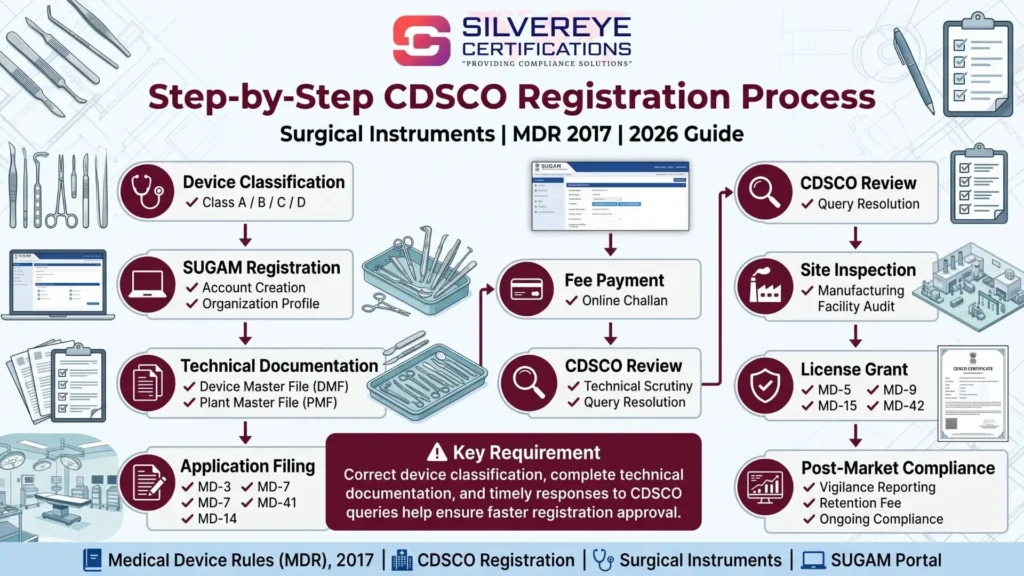
Step-by-Step CDSCO Registration Process For Surgical Instruments
- Identify the correct risk class (A, B, C, or D) of your surgical instrument using the First Schedule of MDR 2017.
- Create and verify a SUGAM portal account and complete your organisation profile.
- Compile the Device Master File, Plant Master File, and supporting technical/quality documentation.
- File the correct application form: MD-3 (manufacture, Class A/B), MD-7 (manufacture, Class C/D), MD-14 (import, any class), or MD-41 (wholesale).
- Pay the prescribed fee online through the SUGAM portal and generate the fee challan.
- Respond promptly and completely to any CDSCO deficiency queries or clarification requests.
- Undergo a manufacturing-site inspection where applicable (mandatory for most Class C/D applications).
- Receive the grant of license/registration (MD-5, MD-9, MD-15, or MD-42) and begin lawful manufacture, import, sale, or distribution.
- Maintain post-market surveillance, adverse-event reporting, and pay the 5-year retention fee to keep the license active.
Conclusion
This guide is based on the Medical Devices Rules, 2017, official CDSCO notifications (including the classification notice dated 9 September 2022 for hand-held surgical instruments and the CDSCO classification notice of 2017/2022 amendments), and publicly available CDSCO/SUGAM portal guidance current as of mid-2026. Device classification lists, fees, and timelines are revised periodically by CDSCO; always verify the current class, fee, and form for your specific surgical instrument on the official CDSCO website (cdsco.gov.in) or SUGAM portal, or consult a registered regulatory affairs professional, before filing any application.
Frequently Asked Questions
What class are most surgical instruments under CDSCO?
Most general-use hand-held surgical instruments — scissors, forceps, curettes, retractors, hooks — are classified as Class A under the CDSCO notification of 9 September 2022, provided they are non-sterile, non-powered, and hand-manipulated.
Do I need a license for Class A surgical instruments?
If the Class A instrument is non-sterile and non-measuring, you only need CDSCO registration, not a full manufacturing or import license. Sterile or measuring Class A instruments do require the applicable license (MD-5 for manufacture, MD-15 for import).
What is the difference between MD-3/MD-5 and MD-7/MD-9?
MD-3/MD-5 is the application-and-grant pair for manufacturing Class A and B devices, processed by the State Licensing Authority. MD-7/MD-9 is the equivalent pair for Class C and D devices, processed by the Central Licensing Authority with mandatory site inspection.
Is MD-14/MD-15 required for every imported surgical instrument?
Yes, for Class A (sterile or measuring), B, C, and D instruments. Only Class A non-sterile, non-measuring instruments are exempt from the import license and instead require CDSCO registration.
Who needs the MD-41/MD-42 wholesale license?
Any wholesaler, distributor, or stockist selling surgical instruments in India needs to apply on MD-41 and hold the registration certificate granted on MD-42. An Indian Authorised Agent representing a foreign manufacturer must also hold an MD-42 (or manufacturing license) before it can file an import application.
How long does CDSCO registration take for surgical instruments?
Class A registration can take a few weeks; Class A/B manufacturing licenses typically take about 3–6 months; Class C/D manufacturing and most import licenses can take 6–9 months, largely depending on document completeness and query turnaround.
What documents are essential for a surgical instrument manufacturing license?
Core documents include the Device Master File, Plant Master File, ISO 13485 certificate, Essential Principles Checklist declaration, labelling/IFU samples, and applicable test or biocompatibility reports.
Does a CDSCO license expire?
Manufacturing and import licenses are generally valid indefinitely, but a retention fee is payable every 5 years to keep the license active; missing this deadline can result in deemed cancellation.
Can a foreign manufacturer apply directly to CDSCO?
No. Foreign manufacturers must appoint an Indian Authorised Agent holding a valid wholesale or manufacturing license to file and manage the application on their behalf.
Where can I check the official CDSCO classification of my surgical instrument?
CDSCO's classification lists and notifications are published on the official CDSCO website and can also be verified through a risk-classification query on the SUGAM portal, since these lists are updated periodically.