
- All respiratory medical devices sold, imported, or manufactured in India must be registered or licensed under CDSCO as per the Medical Devices Rules (MDR), 2017.
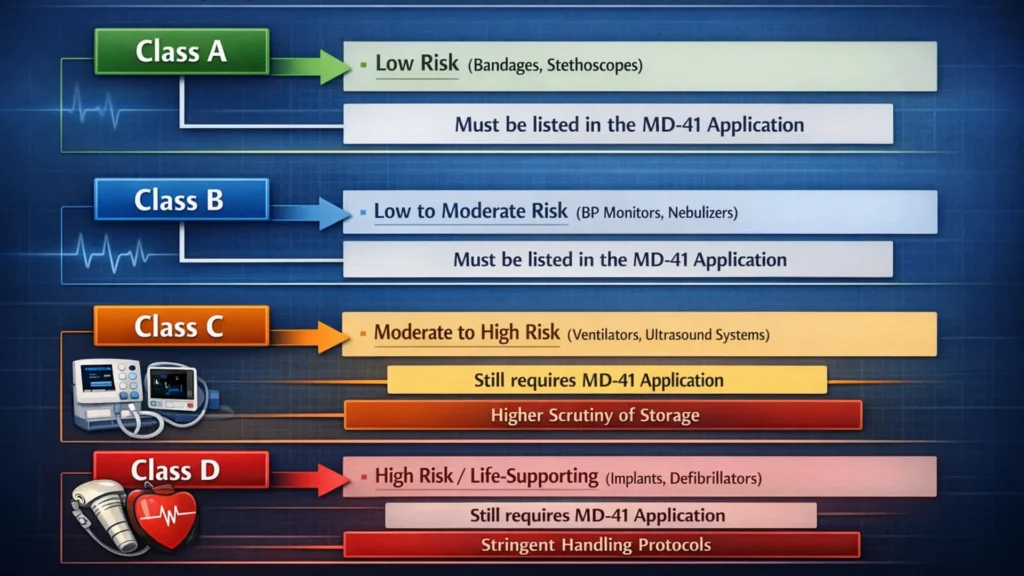
- Devices are classified into four risk-based classes — A, B, C, and D — each with a different registration pathway, fee structure, and documentation requirement.
- The entire application process is completed online on the SUGAM portal — no physical filing is accepted.
- This guide covers 71 notified respiratory medical devices classified by CDSCO, with the complete registration process, documents, fees, and renewal timelines for 2026.
What Are CDSCO Registration For Respiratory Medical Device?
Respiratory medical devices are instruments, equipment, assemblies, or accessories intended for the diagnosis, monitoring, treatment, or management of conditions related to the respiratory system — lungs, airways, trachea, bronchi, and blood oxygen levels.
Under the Medical Devices Rules, 2017 (MDR 2017), respiratory devices are categorized based on the risk they pose to the patient if they malfunction. The Central Drugs Standard Control Organization (CDSCO) is the regulatory body that governs the registration, licensing, import, and post-market surveillance of all notified medical devices including respiratory devices in India.
Why Is CDSCO Registration Mandatory for Respiratory Devices?
- Legal Compliance: Selling or importing an unregistered notified respiratory device is a punishable offence under the Drugs and Cosmetics Act, 1940.
- Patient Safety: CDSCO registration ensures devices meet safety, performance, and quality standards before reaching patients.
- Market Access: Hospitals, government procurement agencies, and distributors will not purchase devices without a valid CDSCO registration or license.
- Export Readiness: CDSCO registration supports Free Sale Certificate applications and international regulatory submissions.
Classification of Respiratory Medical Devices Under MDR 2017
MDR 2017 classifies all medical devices — including respiratory devices — into four risk-based classes. The class determines the applicable form, fee, and scrutiny level.
| Class | Risk Level | Regulatory Form | Authority |
| Class A | Low Risk | Form MD-3 (Manufacturer) / Form MD-15 (Importer) | State Licensing Authority (SLA) for manufacturers; CDSCO for importers |
| Class B | Low-Moderate Risk | Form MD-3 (Manufacturer) / Form MD-15 (Importer) | CDSCO |
| Class C | Moderate-High Risk | Form MD-5 (Manufacturer) / Form MD-15 (Importer) | CDSCO |
| Class D | High Risk | Form MD-5 (Manufacturer) / Form MD-15 (Importer) | CDSCO — with enhanced clinical/technical review |
Class A Respiratory Medical Devices — Full List
CLASS A — LOW RISK RESPIRATORY DEVICES
Class A respiratory devices carry the lowest patient risk. For domestic manufacturers, the manufacturing license is granted by the State Licensing Authority (SLA). Importers must still apply to CDSCO via Form MD-14/MD-15. These devices typically have a faster approval timeline.
| S.No. | Device Name | Intended Use / Function |
| 1 | Airway Device Cleaning Utensil | Hand-held device to clean in-situ and ex-situ airway devices |
| 2 | Airway Tube Forceps | Instrument for grasping tubes for insertion/extraction into/from airways |
| 3 | Breathing Circuit Bag | Device to store breathing gas during the respiratory cycle |
| 4 | Bulk Oxygen Concentration System | Assembly concentrating medical-grade O2 from ambient air for hospital supply |
| 5 | Cardiopulmonary Resuscitation Mask | Placed over patient's mouth for mouth-to-mask CPR delivery |
| 6 | Cough Long-Term Ambulatory Recording System | Assembly for long-term detection and recording of cough frequency |
| 7 | Dry Powder Inhaler | Hand-held device to administer powdered medicine into bronchial airways |
| 8 | Dry Salt Therapy Device | Hand-held inhaler prefilled with salt crystals for airway cleansing via inhalation |
| 9 | Endotracheal Tube Introducer | Assists insertion of endotracheal tube during intubation |
| 10 | Exhaled-Gas Oesophageal Intubation Detector | Detects CO2 levels to verify correct ET tube placement |
| 11 | Gas Pipeline/Supply System Air Compressor | Creates and supplies compressed medical-grade air to hospital pipeline |
| 12 | Steam Inhaler | Electrically-powered device for steam inhalation to relieve upper respiratory symptoms |
| 13 | Stress Test Treadmill | Component of stress test system evaluating patient's physiologic response to physical stress |
| 14 | Therapeutic Air Ionizer | Produces negatively-charged oxygen ions emitted into air for therapeutic effect |
| 15 | Tracheostoma Protective Filter | Filter protecting stomal opening in windpipe from harmful external influences |
| 16 | Tracheostomy Tube Lubricant | Oil-based substance applied to tracheostomy tube inner cannula for easy sliding |
| 17 | Ultrasonic Cough Stimulation System | Uses ultrasound to stimulate reflex cough in patients unable to cough on command |
| 18 | Valsalva Manoeuvre Mouthpiece | Inserted into patient's mouth to facilitate Valsalva manoeuvre performance |
| 19 | Video Intubation Laryngoscope Handle/Monitor | Component of video laryngoscope to enable clear tracheal view for ET tube insertion |
Total Class A Respiratory Devices: 19 devices
Class B Respiratory Medical Devices — Full List
CLASS B — LOW-MODERATE RISK RESPIRATORY DEVICES
Class B respiratory devices carry a moderate risk profile. These are the most common category for respiratory equipment — including diagnostic spirometers, oxygen concentrators, bronchoscopes, and pulse oximetry systems. Domestic manufacturers apply to CDSCO via Form MD-3; importers use Form MD-14/MD-15. ISO 13485 certification is effectively required for this class.
| S.No. | Device Name | Intended Use / Function |
| 1 | Activated-Oxygen Generator | Produces activated oxygen mixed with room air; generates activated water as by-product |
| 2 | Aerosol Inhalation Monitor | Enables objective assessment of how a test subject uses their inhaler |
| 3 | Argon Gas Analyser | Measures argon concentration in gas mixture to aid in determining ventilatory status |
| 4 | Artificial Airway Tube Cuff Pressure Monitor | Measures internal pressure in cuff of ET/endobronchial/tracheostomy tube |
| 5 | Bronchoscope | Endoscope for visual examination and treatment of trachea, bronchi, and upper lungs |
| 6 | Cerebral Oximeter | Adjunct monitor for regional haemoglobin oxygen saturation of blood in the brain |
| 7 | Chest-Oscillation Airway Secretion-Clearing System | Provides high-frequency chest wall oscillation (HFCWO) to loosen airway secretions |
| 8 | Chest-Percussion Airway Secretion-Clearing System | Applies mechanical percussion to chest wall to loosen airway secretions |
| 9 | Cold-Air Diagnostic Inhalation System | Used in assessment of patients suffering from asthma |
| 10 | Cricothyrotome | Manual surgical instrument for cricothyrotomy to provide emergency airway access |
| 11 | Diagnostic Spirometer | Measures respiratory-gas volume and flow to evaluate basic pulmonary function |
| 12 | Electroacoustical Airway Secretion-Clearing System | Applies externally vibrations via electroacoustical transducer to loosen airway secretions |
| 13 | Electronic Oesophageal Stethoscope | Inserted into oesophagus to listen to heart and breath sounds under anaesthesia |
| 14 | Foetal Pulse Oximeter | Monitors intrapartum foetal oxygen saturation during labour |
| 15 | Heated Respiratory Humidifier | Heats and humidifies inspired air/oxygen to maintain respiratory tract mucous membranes |
| 16 | Home-Use Sleep Apnoea Recording System | Continuously measures and records physiological parameters during sleep for apnoea diagnosis |
| 17 | Hypopnea Sensor/Alarm | Indicates patient hypopnea by monitoring thorax and abdomen movement with each breath |
| 18 | Impedance Pneumography Recording/Analysis System | Continuous recording of pulmonary function parameters using impedance pneumography |
| 19 | Infant Apnoea Monitor | Registers infant respiratory rate and alarms when breathing ceases (apnoea/SIDS risk) |
| 20 | Intracardiac Oximeter | Measures oxygen or dye concentration within the heart using transmitted radiation |
| 21 | Intravascular Oximeter | Continuous in-vivo measurement of venous blood oxygen saturation (SvO2) |
| 22 | Invasive Arterial Pressure Cardiac Output/Oximetry Monitor | Continuously measures and displays arterial pressure cardiac output and SpO2 |
| 23 | Manual Chest Percussor | Hand-held device for manual percussion to loosen airway secretions |
| 24 | Medical/Surgical String | Sterile cord to lift vessels, hold tracheostomy tubes, or stabilise organs/instruments |
| 25 | Monitoring Spirometer | Continuously measures tidal or minute volume to evaluate ventilatory status |
| 26 | Nitrogen Monoxide Analyser | Measures nitric oxide in exhaled air to aid asthma diagnosis and management |
| 27 | Nitrous Oxide Analyser | Measures N2O concentration in gas mixtures in healthcare or anaesthesia environments |
| 28 | Oxygen Concentrator | Concentrates O2 from ambient air and delivers it to patient |
| 29 | Pneumatic Chest Percussor | Pneumatic device providing external chest wall vibrations to loosen secretions |
| 30 | Public Respirator (2-ply, 3-ply Face Mask) | Filtering mask placed over nose/mouth to protect public from airborne pathogens |
| 31 | Pulmonary Function Analysis System | Measures respiratory system function in adults and compliant children |
| 32 | Pulse Oximetry Telemetric Monitoring System | Continuously measures and wirelessly transmits SpO2 signals to a receiving location |
| 33 | Respiration Monitor | Measures and displays respiratory functions of a non-ambulatory patient |
| 34 | Respiratory Apnoea Monitoring System | Detects cessation of breathing in patients at risk of respiratory failure |
| 35 | Thoracic Bioconductance Measurement System | Measures bioconductance to aid evaluation of lesions suspicious of lung cancer |
| 36 | Thoracic Electrical Impedance Segmentography System | Records distribution of air across 4 lung quadrants using bio-impedance measurements |
| 37 | Thoracic Suction Pump | Generates negative pressure for aspiration to allow normal lung/mediastinum expansion |
| 38 | Tongue-Adjustment Sleep Apnoea Treatment System | Manages OSA at home by monitoring breathing and reducing pharyngeal tongue obstruction |
| 39 | Tracheostoma Protector | Patient-worn patch/collar/cloth to protect tracheostoma orifice from external influences |
| 40 | Tracheotome | Surgical instrument to cut opening into trachea to create artificial airway |
| 41 | Transcutaneous Blood Gas Monitoring System | Continuous transcutaneous measurement of blood gas parameters via jugular vein |
| 42 | Ultrasonic Respiratory Humidifier | Agitates water into micro-particles with ultrasound to add moisture to administered air/gases |
| 43 | Vacuum-Assisted Airway Secretion-Clearing System | Removes excessive secretions from lungs and upper airway via vacuum technology |
| 44 | Whole-Body Plethysmograph | Records airway resistance and thoracic gas volume to assess pulmonary function |
Total Class B Respiratory Devices: 44 devices
Class C Respiratory Medical Devices — Full List
CLASS C — MODERATE-HIGH RISK RESPIRATORY DEVICES
Class C respiratory devices present a higher risk due to their direct interaction with critical physiological processes — breathing support, oxygen monitoring, and high-pressure oxygen delivery. Manufacturers require Form MD-5, issued by CDSCO after a detailed technical review and possibly a factory inspection. ISO 13485 certification and clinical performance data are required.
| S.No. | Device Name | Intended Use / Function |
| 1 | Artificial Airway Washing/Disinfection Jar | Container to hold artificial airway devices for washing/disinfection |
| 2 | Breathing Circuit Washer/Disinfector | Cleaning and high-level disinfection of breathing circuit components in respiratory therapy and anaesthesia |
| 3 | Hyperbaric Chamber | Administers 100% oxygen at pressure greater than ambient for therapeutic use |
| 4 | Negative-Pressure Ventilator | Automatic cycling machine assisting/controlling alveolar respiration via negative chest pressure |
| 5 | Pulse Oximeter | Transcutaneous measurement and display of haemoglobin oxygen saturation (SpO2) |
| 6 | Therapeutic Positive Pressure Breathing Ventilator | Rehabilitates chronic respiratory patients and distributes aerosolized drugs to airways |
| 7 | Thoracic Electrical Impedance Tomography System | Continuous bio-impedance measurements of thorax cross-section for real-time lung function feedback |
Total Class C Respiratory Devices: 7 devices
Class D Respiratory Medical Devices — Full List
CLASS D — HIGH RISK RESPIRATORY DEVICES
Class D respiratory devices carry the highest patient risk. Currently, one respiratory device falls in this category — the implantable sleep apnoea treatment system. These devices require the most rigorous regulatory review, including clinical data evaluation, mandatory factory inspection, and enhanced post-market surveillance requirements. Approval timelines can extend up to 12–18 months.
| S.No. | Device Name | Intended Use / Function |
| 1 | Implantable Sleep Apnoea Treatment System | Implanted stimulator for home management of OSA using electrical stimulation to the hypoglossal nerve |
Total Class D Respiratory Devices: 1 device
Who Can Apply for CDSCO Respiratory Device Registration?
Domestic Manufacturers
- Any company or individual manufacturing respiratory medical devices within India.
- Must hold or apply for a valid Manufacturing License from the State Licensing Authority (Class A/B) or CDSCO (Class C/D).
- Manufacturing premises must comply with Schedule M (Good Manufacturing Practices) of MDR 2017.
- ISO 13485:2016 QMS certification is required for Class B, C, and D devices.
Importers / Authorized Indian Representatives (AIR)
- Foreign manufacturers must appoint a resident Indian or registered Indian company as their Authorized Indian Representative (AIR).
- The AIR holds legal responsibility for post-market surveillance, adverse event reporting, and CDSCO correspondence.
- Importers apply through Form MD-14 (manufacturer's undertaking) and Form MD-15 (AIR application) on SUGAM.
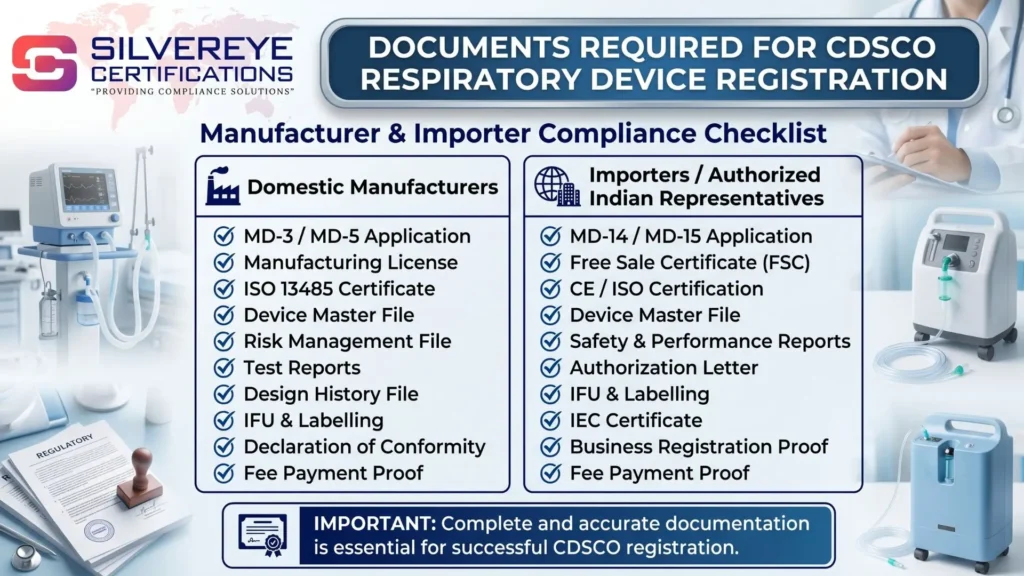
Documents Required for CDSCO Respiratory Device Registration
For Domestic Manufacturers (Form MD-3 / MD-5)
| Document | Purpose |
| Application Form MD-3 or MD-5 (via SUGAM portal) | Primary application form for domestic manufacturers |
| Manufacturing License from SLA (Class A/B) or CDSCO (Class C/D) | Proof of licensed manufacturing site |
| ISO 13485:2016 Certificate | QMS compliance evidence (required for Class B, C, D) |
| Technical Dossier / Device Master File | Complete technical documentation of the respiratory device |
| Risk Management File (ISO 14971) | Documented risk analysis and mitigation evidence |
| Performance & Safety Test Reports (NABL-accredited lab) | Validation of device safety and clinical performance |
| Design History File (DHF) | Records of design process, validation, and verification |
| Labelling & Instructions for Use (IFU) as per Schedule VI | Draft packaging labels and usage instructions in compliance with MDR 2017 |
| Declaration of Conformity (DoC) | Manufacturer's self-declaration of regulatory compliance |
| Business Registration Documents (MCA/GST) | Legal entity verification |
| Challan — Proof of Government Fee Payment | Payment receipt for application processing |
For Importers / Authorized Indian Representatives (Form MD-14 / MD-15)
| Document | Purpose |
| Form MD-14 (Manufacturer's Undertaking) | Commitment by foreign manufacturer to comply with Indian regulations |
| Form MD-15 (AIR Application) | Application filed by the Authorized Indian Representative |
| Free Sale Certificate (FSC) from country of origin | Confirms device is freely sold in the manufacturing country |
| CE Certificate / ISO Certification or equivalent | International safety and quality certification |
| Technical Dossier / Device Master File | Complete product technical documentation |
| Performance/Safety Test Reports | Evidence of safety and efficacy |
| Labelling and IFU in English (Schedule VI compliant) | Packaging and usage instructions for Indian market |
| Authorization Letter from foreign manufacturer to AIR | Official appointment document — notarized/apostilled as required |
| AIR's Business Registration Proof in India | CIN, GSTIN, or Partnership deed of the Indian entity |
| Import Export Code (IEC) Certificate | Customs clearance requirement |
| Challan — Proof of Government Fee Payment | Payment receipt for import license application |
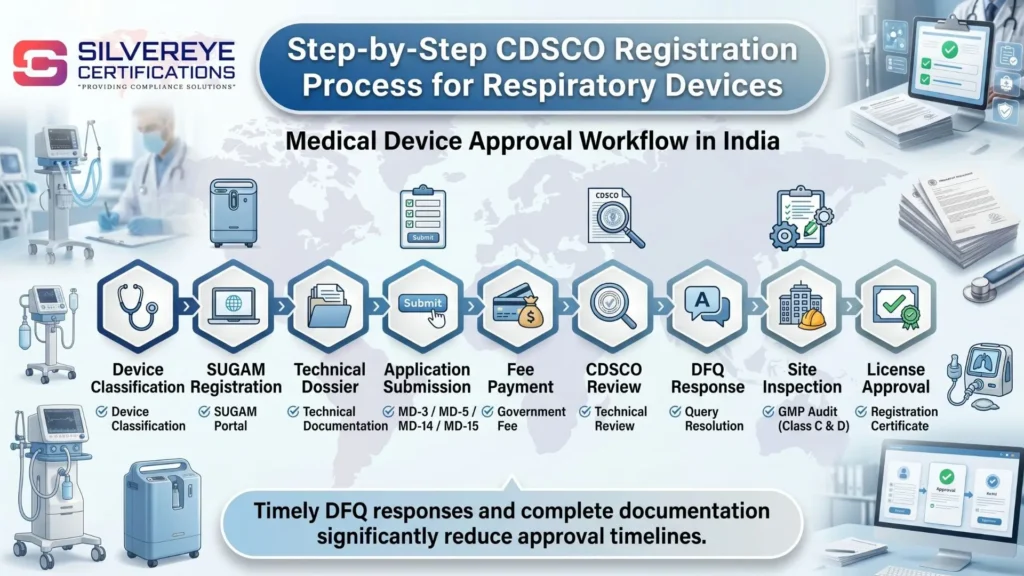
Step-by-Step CDSCO Registration Process for Respiratory Devices
Step 1 — Classify Your Respiratory Device
Use the CDSCO classification guidelines and MDR 2017 Schedule II to confirm whether your respiratory device is Class A, B, C, or D. This determines the form, fee, authority, and timelines. If you are unsure, consult the CDSCO notified device list or a regulatory affairs professional.
Step 2 — Register on the SUGAM Portal
Go to sugamapp.cdac.in. Create an entity account using your company's PAN/GSTIN/CIN, email ID, and mobile number. Select 'Medical Device Registration/Licensing' from the dashboard after login.
Step 3 — Prepare Your Technical Dossier
This is the most critical step. Compile your full technical dossier before starting the online form — incomplete documentation is the most common cause of rejection and delays for respiratory device applications. Ensure your NABL-accredited lab test reports are current, your ISO 13485 certificate is valid, and your labelling follows Schedule VI.
Step 4 — Fill and Submit the Online Application
Select the applicable form (MD-3, MD-5, MD-14, or MD-15), fill in device details, upload all documents in PDF format, and submit. For importers, both MD-14 and MD-15 must be submitted together.
Step 5 — Pay the Government Application Fee
After form submission, pay the applicable government fee online through the integrated SBI Collect gateway. Download and attach the payment challan to your application.
Step 6 — Respond to CDSCO Queries (DFQ)
CDSCO technical officers will review your application and may raise Deficiency Queries (DFQs) on the SUGAM portal. You have 30 days to respond to each DFQ. Check the portal regularly after submission. Prompt, accurate responses to DFQs significantly reduce overall registration time.
Step 7 — Inspection (Class C and D Only)
For Class C and D respiratory devices, CDSCO may conduct a manufacturing site inspection or request a third-party audit. Ensure your manufacturing facility, QMS records, and production processes are audit-ready before applying.
Step 8 — Receipt of Registration/License Certificate
Once all queries are resolved and the review is complete, CDSCO issues the Registration Certificate or Manufacturing/Import License digitally via the SUGAM portal. Download, store, and share this certificate with your distributors and customers as needed.
CDSCO Registration Fees for Respiratory Medical Devices
Government fees are set under Schedule II of MDR 2017. The following table gives an indicative fee range. Always verify current rates on cdsco.gov.in or the SUGAM portal before payment.
| Application Type | Device Class | Approx. Fee (INR) | Notes |
| Domestic Manufacturer Registration (MD-3) | Class A | ₹5,000 – ₹10,000 | Per device/category; SLA authority |
| Domestic Manufacturer Registration (MD-3) | Class B | ₹15,000 – ₹25,000 | Per device; CDSCO authority |
| Domestic Manufacturer License (MD-5) | Class C | ₹25,000 – ₹50,000 | Per device; factory inspection may apply |
| Domestic Manufacturer License (MD-5) | Class D | ₹50,000+ | Per device; enhanced review and inspection |
| Import License (MD-14/15) | Class A & B | ₹10,000 – ₹20,000 | Per device |
| Import License (MD-14/15) | Class C | ₹25,000 – ₹50,000 | Per device |
| Import License (MD-14/15) | Class D | ₹50,000 – ₹1,00,000+ | Per device; rigorous review |
| Amendment to Existing Registration | All Classes | ₹2,000 – ₹10,000 | Depends on type of change |
| Renewal Fee | All Classes | Similar to original fee | Applicable at renewal stage |
Note: Fees are indicative and subject to revision by the Government of India. Regulatory consultant fees, laboratory testing costs, and certification charges are separate and not included in the above.
Registration Validity and Renewal for Respiratory Medical Devices
| Registration/License Type | Validity | Renewal Timeline | Consequence of Non-Renewal |
| Class A Registration (Domestic) | Permanent (subject to compliance and amendments) | Amendment as needed | N/A unless SLA revokes |
| Class B, C, D Manufacturing License | 5 Years from issue date | Apply at least 6 months before expiry | Suspension; re-application required |
| Import License (All Classes) | 3 Years from issue date | Apply 3–6 months before expiry | License void; import becomes illegal |
| Class A Import Registration | Permanent (for notified devices) | Amendment when device changes | N/A unless CDSCO revokes |
Practical Advice: Import licenses for respiratory devices — especially Class C and D — should be flagged for renewal at least 6 months in advance. CDSCO processing timelines vary and business continuity depends on having a valid, active license at all times.
Registration Timelines — What to Expect for Respiratory Devices
| Device Class | Typical Processing Time | Key Factors That Affect Timeline |
| Class A | 30 – 60 days | Document completeness, SUGAM portal status |
| Class B | 60 – 120 days | Lab reports, CDSCO queries, ISO certificate validity |
| Class C | 3 – 6 months | Factory inspection scheduling, clinical data evaluation |
| Class D | 9 – 18 months | Clinical trials/evidence review, multi-round inspections, import scrutiny |
The single biggest factor in speeding up CDSCO respiratory device registration is document quality. Applicants who submit a complete, deficiency-free dossier on the first attempt consistently get faster approvals. Consider engaging a CDSCO-experienced regulatory affairs professional, especially for Class C and D respiratory devices.
Common Reasons for CDSCO Application Rejection or Delay
- Submitting incomplete technical dossier — missing risk management file, DHF, or performance test reports
- Using test reports from laboratories not recognized by CDSCO or not NABL-accredited
- Labelling that does not comply with Schedule VI of MDR 2017 — wrong font size, missing information
- Incorrect device classification leading to wrong form submission
- Expired or invalid Free Sale Certificate for imported respiratory devices
- AIR authorization letter not properly notarized or apostilled
- Payment of incorrect government fee for the device class
- Failure to respond to CDSCO Deficiency Queries (DFQs) within the 30-day window
- ISO 13485 certificate expired or not covering the specific respiratory device category
- Inconsistency between device description in the dossier and the labelling/IFU
Post-Registration Compliance for Respiratory Medical Devices
Receiving your CDSCO registration or license is the starting point, not the finish line. India's MDR 2017 mandates ongoing post-market obligations for all registered respiratory devices:
- Post-Market Surveillance (PMS): Systematic collection and analysis of data about your respiratory device once it is in use in the field.
- Adverse Event Reporting: Serious adverse events must be reported to CDSCO within 30 days; life-threatening events within 10 days.
- Periodic Safety Update Reports (PSUR): Required annually for Class C and D respiratory devices.
- Labelling Changes: Any modification to labelling, IFU, or clinical claims requires prior CDSCO approval via an amendment application.
- Amendments for Design Changes: Modifications to the device design, materials, manufacturing site, or software (for electronic respiratory devices) require CDSCO amendment approval.
- Recall Management: Maintain a documented recall procedure; notify CDSCO immediately if a field safety corrective action is initiated.
- Distribution Records: Maintain complete batch-wise distribution records for a minimum of 5 years.
Special Considerations for Importing Respiratory Medical Devices into India
Appointing an Authorized Indian Representative (AIR)
Every foreign respiratory device manufacturer must appoint an AIR — a resident Indian individual or a company registered in India. The AIR submits the import application, receives the license, and is legally accountable for compliance. The AIR's details appear on the import license and must be communicated to CDSCO if they change.
Free Sale Certificate (FSC) — What You Need to Know
The FSC must be issued by a competent government regulatory authority (not a private body) in the country of manufacture. It must confirm the device is freely available for sale in that country. For countries requiring apostille, ensure the FSC is properly apostilled. Expired FSCs are a common reason for import license rejection.
Cold Chain and Storage Compliance
Certain respiratory devices — such as diagnostic test kits or drug-device combination products — may require cold chain management. Importers must ensure their warehousing operations comply with Schedule M (storage conditions) of the Drugs and Cosmetics Rules.
2025–2026 Regulatory Updates Affecting Respiratory Device Registration
- Expanded Notified List: CDSCO has continued to expand the list of notified medical devices. All 71 respiratory devices listed in this guide are now notified and require mandatory registration.
- UDI (Unique Device Identification) Rollout: CDSCO has announced plans for phased UDI implementation. High-risk respiratory devices (Class C and D) are expected to be in the first phase. Manufacturers should prepare their labelling systems accordingly.
- Digital License Certificates: All CDSCO registrations and licenses are now issued digitally via SUGAM. Physical certificates are no longer issued.
- WHO GMP Alignment: Updated GMP guidelines now align more closely with WHO and ISO 13485 standards for Class C/D respiratory device manufacturers.
- MDR 2017 Amendment Watch: The Ministry of Health periodically amends MDR 2017. Manufacturers and importers should subscribe to CDSCO notifications to stay current.
Conclusion
Respiratory medical devices are among the most critical categories in India's healthcare ecosystem — from simple inhalers to life-sustaining ventilators and implantable apnoea treatment systems. Getting CDSCO registration right for these devices is not just a regulatory checkbox; it directly impacts patient safety, your brand's credibility, and your ability to access India's growing medical device market.
Whether you are a domestic manufacturer looking to scale production, a foreign OEM wanting to enter the Indian market, or a distributor trying to ensure your product portfolio is compliant, the pathway is clear: classify your respiratory device correctly, prepare a complete technical dossier, submit on the SUGAM portal, and stay compliant after registration.
The 2026 regulatory environment is stricter and more digitally driven than ever. CDSCO is actively enforcing mandatory registration, expanding the notified device list, and moving toward UDI compliance. Being proactive — not reactive — is the only sustainable approach to respiratory device compliance in India.
Frequently Asked Questions
Are all respiratory medical devices in India required to have CDSCO registration?
Yes. All 71 respiratory devices listed in this guide are notified under MDR 2017 and require mandatory CDSCO registration or licensing before they can be manufactured for sale, imported, or distributed in India. Selling unregistered notified respiratory devices is a punishable offence.
What is the difference between CDSCO registration and a manufacturing license for respiratory devices?
Registration typically applies to Class A devices, where the State Licensing Authority (SLA) grants the domestic manufacturer's authorization. A manufacturing license (Form MD-5) is required for Class C and D manufacturers and is granted by CDSCO directly after a technical review and possible inspection.
How do I classify my respiratory medical device under MDR 2017?
Refer to Schedule II of MDR 2017 and the CDSCO classification guidance document, or check the CDSCO notified device list on cdsco.gov.in. You can also cross-reference with GHTF/IMDRF classification principles. When in doubt, apply to CDSCO for a formal classification opinion.
Can a foreign manufacturer apply for CDSCO registration directly?
No. Foreign manufacturers must appoint an Authorized Indian Representative (AIR) — a resident Indian individual or registered Indian company — who files the application on their behalf. The AIR assumes legal responsibility for compliance in India.
How long does CDSCO registration take for a Class B respiratory device like an oxygen concentrator?
For a well-documented application, Class B respiratory devices like oxygen concentrators typically take 60 to 120 days. Delays are common when lab reports are from non-recognized labs, when DFQs are raised by CDSCO officers, or when the ISO 13485 certificate does not cover the specific product.
What is the government fee for importing a pulse oximeter (Class C) into India?
The government fee for a Class C import license is approximately ₹25,000 to ₹50,000 per device as per Schedule II of MDR 2017. Fees are subject to revision — always verify the current applicable fee on the SUGAM portal or cdsco.gov.in before making payment.
Is ISO 13485 certification mandatory for CDSCO respiratory device registration?
ISO 13485:2016 is not explicitly mandatory for Class A devices but is a prerequisite in practice for Class B, C, and D. CDSCO expects evidence of a Quality Management System, and ISO 13485 from an accredited certification body is the accepted standard.
What happens if I modify my registered respiratory device after getting CDSCO approval?
Any significant change — in design, materials, manufacturing site, software, labelling, or intended use — requires filing an amendment application with CDSCO before implementing the change. Unauthorized modifications can lead to license cancellation and product recall.
How do I renew an expiring import license for a Class B respiratory device?
Log in to the SUGAM portal and initiate a renewal application at least 3 to 6 months before the expiry date. Submit updated documents (renewed FSC, updated ISO certificate, etc.) and pay the renewal fee. CDSCO will review and issue a renewed license. Import activities must not continue on an expired license.
Where do I report an adverse event related to a registered respiratory device?
Adverse events must be reported to CDSCO through the SUGAM portal under the Post-Market Surveillance module. Serious adverse events must be reported within 30 days; life-threatening events within 10 days. Manufacturers and AIRs are both responsible for ensuring timely adverse event reporting under MDR 2017.