- CDSCO registration is mandatory for all neurology medical devices — from Class A instruments to Class D implantable neurostimulators — before they can be legally sold or imported in India.
- India's Medical Devices Rules, 2017 classifies 131 neurological devices across Class A, B, C & D based on risk level, invasiveness, and intended use.
- The CDSCO SUGAM portal is the official online gateway for filing all neurology medical device registration applications — correct classification is the most critical first step.
- Silvereye Certifications provides end-to-end CDSCO registration support specifically for neurology medical devices, covering documentation, dossier preparation, portal filing, and post-approval compliance.
Introduction
If you are a manufacturer, importer, or distributor of neurology medical devices looking to enter the Indian market, CDSCO registration is your first and most critical regulatory requirement. Without it, your device cannot legally be imported, manufactured, or sold in India — regardless of where it is approved in the world.
India's Central Drugs Standard Control Organization (CDSCO) regulates all medical devices under the Medical Devices Rules, 2017. Neurology medical devices — ranging from simple percussion hammers and EEG electrodes to high-risk implantable spinal cord stimulators and deep brain stimulation systems — each fall into one of four risk-based classes: Class A, Class B, Class C, or Class D.
This pillar page covers everything you need to know about CDSCO registration for neurology medical devices in India in 2026: the complete device classification list, eligibility criteria, required documents, step-by-step process, government fees, validity, renewal timeline, and answers to the most common questions companies ask before they begin.
What Is CDSCO Registration for Medical Devices?
CDSCO registration — also referred to as CDSCO import license, CDSCO approval, or CDSCO device registration — is the regulatory clearance granted by the Central Drugs Standard Control Organization (CDSCO) for medical devices sold in India.
All medical devices, including neurology devices, are regulated under the Medical Devices Rules, 2017 (MDR 2017), which came into force progressively and now covers a comprehensive list of notified device categories. Neurology medical devices were among the early categories brought under mandatory CDSCO oversight given their direct impact on patient safety.
Key Regulatory Framework: Drugs and Cosmetics Act, 1940 | Medical Devices Rules, 2017 | CDSCO Guidelines | Schedule M (GMP) | MDR Amendment 2020
CDSCO Medical Device Classification — Class A, B, C & D Explained
Under the Medical Devices Rules, 2017, all regulated medical devices are classified into four risk-based classes. For neurology medical devices, the classification determines the regulatory pathway, documentation requirements, and approval timelines.
| Class | Risk Level | Examples (Neurological) | Key Requirement |
| Class A | Low Risk | Percussion hammer, EEG tester, goniometer, skull anvil | Only manufacturing/import license; minimal technical documentation |
| Class B | Low–Moderate Risk | TENS system, EEG electrode cap, electromyograph, TES system | Technical dossier + performance data + labelling compliance |
| Class C | Moderate–High Risk | EEG, deep brain stimulation lead, nerve conduction velocity device, neurological endoscope | Clinical/performance evaluation, biocompatibility data, risk analysis |
| Class D | Highest Risk | Spinal cord stimulator, deep brain stimulator, intracranial stent, CSF catheter | Full clinical data, CE/equivalent approval, site GMP inspection may apply |
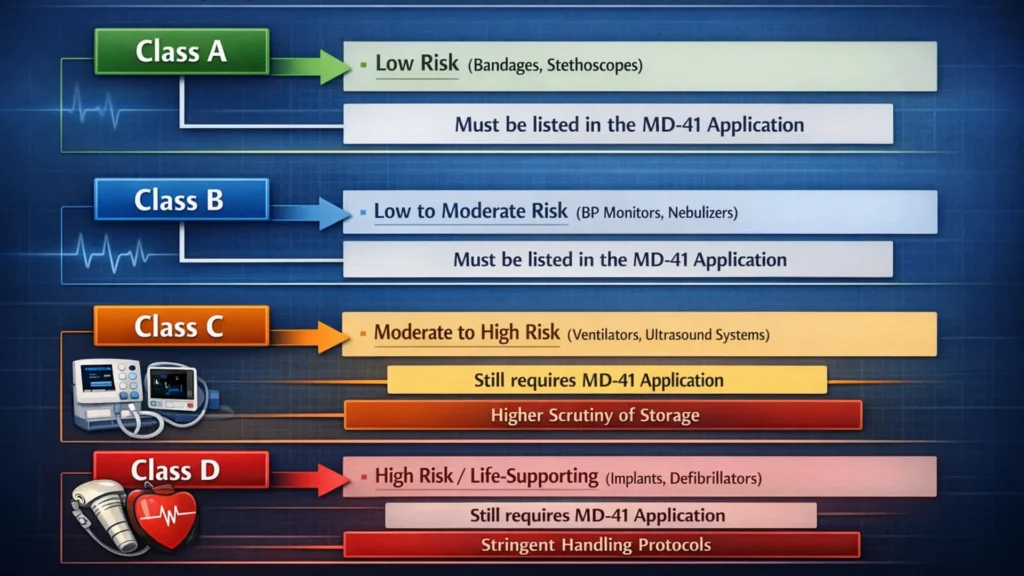
The higher the class, the more stringent the documentation and evidence requirements. Most implantable neurological devices fall in Class D and require the most comprehensive regulatory submission.
Class A Neurological Medical Devices — CDSCO Classification List
Class A devices are low-risk, non-invasive or minimally invasive instruments used for diagnostic assessment, surgical support, or neuromuscular evaluation. They have the simplest regulatory pathway under CDSCO.
| Sr. No. | Device Name | Intended Use |
| 1 | Analytical non-scalp cutaneous electrode | Electrical conductor attached to skin surface (non-scalp) to conduct electrical signals for electrophysiological recording/monitoring. |
| 2 | Analytical non-scalp cutaneous lead | Conducts electrical signals between skin/needle electrodes and electrophysiological recording device (EMG, EP, bioelectrical impedance). |
| 3 | Back/leg/chest dynamometer | Assesses neuromuscular function by measuring force/power exerted by back, chest, and/or leg muscles during flexion. |
| 4 | Cranial bur | Fits into powered handpiece to excavate soft or hard skull tissue. |
| 5 | Cranial trephine | Neurosurgical blade used to cut/remove circular sections of skull vault (calvarium) to provide access to interior. |
| 6 | Electroencephalograph tester | Performs quality control procedures on an EEG machine and/or a sleep recording machine. |
| 7 | Esthesiometer | Mechanical device (rod/fibre) used to determine whether a patient has tactile sensitivity. |
| 8 | Hand dynamometer/pinchmeter, electronic | Electronic instrument assessing neuromuscular function by measuring hand/forearm muscle force/power. |
| 9 | Hand dynamometer/pinchmeter, mechanical | Mechanical instrument assessing neuromuscular function by measuring hand/forearm muscle force/power. |
| 10 | Manual goniometer | Measures range of motion of a patient's limb by measuring the angle of movement at the joint. |
| 11 | Neurosurgical chair | Supports and positions a patient in sitting or reclined position during neurosurgery. |
| 12 | Neurosurgical headrests | Supports the patient's head during a surgical procedure. |
| 13 | Nonpowered neurosurgical instrument | Hand instrument/accessory used during neurosurgical procedures to cut, hold, or manipulate tissue (chisels, forceps, hooks, etc.). |
| 14 | Percussion hammer, manual | Used by physician to gently tap near patient's joints to test reflexes. |
| 15 | Percussor | Small hammerlike device for light blows to a body part as a diagnostic aid during physical examinations. |
| 16 | Pinwheel | Device with sharp points on a rotating wheel used for testing pain sensation. |
| 17 | Pressure algometer/aesthesiometer, electronic | Measures the sensitivity to pain. |
| 18 | Skull plate anvil | Used to form alterable skull plates in the proper shape to fit the skull curvature. |
| 19 | Skull punch | Punches holes through patient's skull to allow fixation of cranioplasty plates or bone flaps. |
| 20 | Skullplate screwdriver | Tool for fastening cranioplasty plates or skullplates to patient's skull by screws. |
| 21 | Tuning fork | Tests hearing acuity, diagnoses hearing disorders, and tests vibratory sense. |
| 22 | Ultrasonic scanner calibration test block | Block of material with known properties used to calibrate ultrasonic scanning devices (echoencephalograph). |
Total Class A Neurological Devices: 22 devices. These devices require a valid import license (Form MD-14) or manufacturing license and basic compliance documentation. No clinical performance evaluation is typically required at this class level.
Class B Neurological Medical Devices — CDSCO Classification List
Class B devices carry a low to moderate risk profile. They include therapeutic stimulation systems, diagnostic EEG equipment, neuromuscular monitoring devices, and non-implantable electrical stimulation systems. A technical dossier and performance data are required for CDSCO registration.
| Sr. No. | Device Name | Intended Use |
| 1 | Analgesic PENS system | Delivers controlled electrical impulses to subcutaneous tissue near a peripheral nerve for relief of chronic neuropathic pain. |
| 2 | Analgesic TENS system | Treats pain by transcutaneous electrical stimulation on peripheral nerves. |
| 3 | Analytical scalp electrode | Attached to scalp to transmit electrical potential changes for EEG/sleep/evoked potential recording. |
| 4 | Analytical scalp lead | Connects EEG electrodes to EEG system to transmit electrical signals during encephalography. |
| 5 | Arthritis TENS system | Reduces pain and stiffness of rheumatoid/osteoarthritis by electrically stimulating peripheral nerves transcutaneously. |
| 6 | Cranial perforator | Metallic rotary endpiece designed to cut holes in skull vault by attaching to powered drill/handpiece. |
| 7 | Diagnostic somatosensory tactile stimulation system | Applies tactile stimuli to the body (pneumatic activation) for evoked response procedures investigating brain function. |
| 8 | Electroencephalogram (EEG) signal spectrum analyzer | Displays frequency content or power spectral density of EEG signal. |
| 9 | Electroencephalograph electrode/lead tester | Tests impedance of electrode and lead system of EEG to assure adequate skin contact. |
| 10 | Electroencephalograph test signal generator | Tests or calibrates an electroencephalograph. |
| 11 | Electroencephalographic electrode cap | Preconfigured scalp electrodes in head-worn device for EEG use. |
| 12 | Electroencephalographic long-term ambulatory recorder | Continuously records EEG signals in ambulatory patients for 24–72 hours to assess neurological/psychiatric conditions. |
| 13 | Electroencephalographic simulator | Produces artificial physiological signals or replays recorded patient data to test EEG recorder/monitor. |
| 14 | Electromyograph | Evaluates muscle weakness in clinical diagnosis of muscular disorders. |
| 15 | Electronystagmograph | Detects electrical potential caused by eye movements. |
| 16 | Facial nerve locating system | Locates a facial nerve by applying an electrical stimulus. |
| 17 | Gait-enhancement electrical stimulation system, external | Improves gait in patients with partial paralysis of lower extremities via external electrical stimulation. |
| 18 | Gustometer | Measures threshold of a patient's taste by applying variable direct current to the tongue. |
| 19 | Interferential electrical stimulation system | Relieves/manages intractable pain; may include electrodes for other stimuli or suction for therapeutic massage. |
| 20 | Leukotome | Cuts brain tissue (white matter, leukotomy). |
| 21 | Magnetoencephalography system | Non-invasively detects, measures, and displays bio-magnetic signals from cortical brain tissue. |
| 22 | Manual surgical saw, flexible | Cuts bone through sawing action during neurological or orthopaedic surgery. |
| 23 | Neuromuscular transmission motion sensor | Placed on thumb/index finger to detect movements and convert to NMT signals during nerve stimulation. |
| 24 | Neurophysiologic monitoring system | Monitors and provides electrical stimuli to spinal nerves or neural pathways during intraoperative surgery or intensive care. |
| 25 | Neurosurgical head holder (skull clamp) | Clamps patient's skull to hold head and neck in position during surgical procedures. |
| 26 | Neurosurgical microscope | Magnifies minute neurological structures (brain/spine) for surgery under transmitted light. |
| 27 | Neurosurgical ultrasound navigation system | Intraoperative imaging of brain for precise navigation during brain surgery. |
| 28 | Otoacoustic emission system | Records and analyses faint sounds emitted by inner ear hair cells in response to stimulus for diagnostic evaluation. |
| 29 | Physical therapy ultrasound/neuromuscular stimulation system | Produces rhythmic contraction/release of injured muscles to promote removal of metabolic by-products while applying ultrasound. |
| 30 | Transcranial electrical stimulation system (continuous-current and pulsed-current) | Applies electrical stimuli for psychiatric/neurological therapy (tDCS, tACS, electroanaesthesia induction). |
Total Class B Neurological Devices: 30 devices. These require a complete technical file, safety and performance data, labelling review, and a valid ISO 13485 certificate from the manufacturer.
Class C Neurological Medical Devices — CDSCO Classification List
Class C devices are moderate to high risk. They include active monitoring systems, brain electrical stimulation components, programmers for implanted systems, diagnostic assessment aids, and invasive recording electrodes. Clinical evaluation, biocompatibility data, and detailed risk analysis are required.
| Sr. No. | Device Name | Intended Use |
| 1 | Autonomic neuropathy heart rate meter | Diagnoses autonomic nervous system dysfunction (autonomic neuropathy). |
| 2 | Behavioural therapy electrical stimulation system | Treats obsessive/compulsive behaviour and drug abuse via electrical impulse (aversion therapy). |
| 3 | Brain injury adjunctive interpretive EEG assessment aid | Prescription device using patient EEG to provide interpretation of structural brain condition in trauma setting (adjunct only). |
| 4 | Cerebrospinal fluid manometer | Measures CSF pressure/intracranial pressure via lumbar puncture. |
| 5 | Cerebrospinal fluid shunt valve programmer | Noninvasively modifies operating pressure of a programmable implanted CSF shunt valve. |
| 6 | Computerized cognitive assessment aid | Prescription device using cognitive task scores to interpret current level of cognitive function (assessment aid, not standalone diagnostic). |
| 7 | Craniotomy power tool system handpiece | Rotates cranial cutting tool (drill bit, bur, trephine, perforator) to produce holes in skull vault. |
| 8 | Cutaneous electrode | Applied to patient's skin to record physiological signals (EEG) or apply electrical stimulation. |
| 9 | Deep brain electrical stimulation system lead | Implanted in specific deep brain areas; used with deep brain electrical stimulation system. |
| 10 | Depth electrode | Temporary stimulation of, or recording from, subsurface levels of the brain. |
| 11 | Diagnostic peripheral nerve electrical stimulation system | Applies electrical stimuli to one peripheral region while response is monitored in another region. |
| 12 | Dura mater sealant | Applied to sutured dura mater to prevent CSF leakage during healing. |
| 13 | Echoencephalograph | Ultrasonic scanning device measuring intracranial interfaces and blood flow velocity to the head. |
| 15 | Ejaculation electrical stimulation system | Applies electrical stimuli to nerves controlling ejaculation. |
| 16 | Electroconvulsive therapy system | Applies strong electrical stimuli to patient's brain to induce convulsions, typically for major depression, schizophrenia, or mania. |
| 17 | Electroencephalograph | Measures and records electrical activity of patient's brain from electrodes placed on the head. |
| 18 | Electroencephalographic monitoring system | Continuously measures brain electrical signals and displays/records EEG along with other physiological parameters (EMG, respiration, SpO2, CO2). |
| 19 | Epicranial brain electrical stimulation system | Applies weak, pulsed electrical stimuli from beneath the scalp to specific brain areas for focal epilepsy treatment. |
| 20 | Home seizure monitoring system | Detects and records seizures in patients with epilepsy by measuring physical/physiological parameters (body motion, ECG, EMG). |
| 21 | Implantable lumbar neuromuscular electrical stimulation system programmer | Healthcare-professional tool to telemetrically program implantable lumbar neuromuscular electrical stimulation pulse generator. |
| 22 | Implantable sleep apnoea treatment system programmer/charger | Allows patient to telemetrically communicate with implanted pulse generator to control therapy and recharge battery. |
| 23 | Implantable spinal cord electrical stimulation system programmer | Telemetrically changes operating parameters of an implanted spinal cord stimulation pulse generator. |
| 24 | Intramuscular diaphragm/phrenic nerve electrical stimulation system programmer | Changes telemetrically one or more operating parameters of intramuscular diaphragm/phrenic nerve stimulation system EPG. |
| 25 | Intranasal cooling system | Rapidly cools patients where temperature reduction is clinically indicated (e.g., post-cerebral ischaemic event, cardiac arrest). |
| 26 | Intranasal lacrimal neurostimulator | Provides home electrical stimulation to sensory neurons of nasal cavities to increase tear production for aqueous deficient dry eye. |
| 27 | Invasive-detection physiological monitor | Continuous/intermittent measurement, display, and recording of invasively-detected physiological parameters (ICP, compartmental pressure). |
| 28 | Nasopharyngeal electrode | Temporarily placed in nasopharyngeal region for recording electrical activity. |
| 29 | Needle electrode | Placed subcutaneously to stimulate or record electrical signals. |
| 30 | Nerve conduction velocity measurement device | Measures nerve conduction time by applying stimulus to peripheral nerve. |
| 31 | Neurological endoscope | Instrument with light source to view inside the ventricles of the brain. |
| 32 | Neurological stereotactic surgery system | Stores diagnostic images for image-guided neurosurgery. |
| 33 | Neuromuscular transmission electrical skin sensor | Detects electrical NMT signals for assessing degree of neuromuscular block in a patient. |
| 34 | Neuropsychiatric interpretive EEG assessment aid | Prescription device using patient EEG to provide interpretation of neuropsychiatric condition (assessment aid only). |
| 35 | Non-EEG physiological signal based seizure monitoring system | Noninvasive prescription device collecting non-EEG physiological signals to identify signals possibly associated with a seizure. |
| 36 | Olfactometry system | Determines human response to odours delivered through the nose, including irritants. |
| 37 | Photodiode subretinal prosthesis system | Provides visual function to patients with vision loss due to retinal degeneration by detecting light and converting to electrical signals for neural stimulation. |
| 38 | Scalp clip | Plastic or metal clip used to stop bleeding during surgery on the scalp. |
| 39 | Spinal needle bioimpedance navigation unit | Transmits/receives electrical signals to/from a spinal needle (bipolar electrode), analyses bioimpedance data to predict needle tip location including CSF contact confirmation. |
| 40 | Stereotactic neuronavigation/planning system | Receives and analyses MRI images, registers them via 3D optical positioning to provide real-time positioning for treatment probes. |
Total Class C Neurological Devices: 40 devices. CDSCO registration for Class C neurological devices requires a full clinical/performance evaluation report, biocompatibility testing summary, and comprehensive risk management documentation per ISO 14971.
Class D Neurological Medical Devices — CDSCO Classification List
Class D devices are the highest-risk category and include all implantable neurostimulators, deep brain stimulation systems, intracranial vascular stents, nerve guides, CSF management devices, and life-sustaining systems. CDSCO requires the most extensive regulatory submission for Class D approvals, and a foreign site GMP inspection may apply for imported devices.
| Sr. No. | Device Name | Intended Use |
| 1 | Analgesic spinal cord electrical stimulation system | Implantable device treating acute/chronic intractable pain where drug therapy is undesirable or no longer effective. |
| 2 | Aneurysm clip | Used to occlude an intracranial aneurysm to prevent it from bleeding or bursting. |
| 3 | Antiseizure/psychiatric-therapy vagus nerve electrical stimulation system | Implantable device applying periodic electrical stimuli to vagus nerve to control seizures and/or treat psychiatric disorder symptoms (e.g., depression). |
| 4 | Atrial cerebrospinal fluid catheter | Implanted as distal component of a ventriculoatrial shunt to channel CSF to the right atrium. |
| 5 | Bare-metal intracranial vascular stent | Implanted into the base or parent artery of an intracranial aneurysm. |
| 6 | Bladder/bowel-evacuation implantable electrical stimulation system | Empties urinary bladder and/or bowels by applying electrical stimuli to the conus medullaris. |
| 7 | Brain-responsive electrical stimulation system | Continuously monitors brain activity and delivers electrical stimuli to seizure foci for neurological disorders (e.g., epilepsy). |
| 8 | Cardiac-therapy vagus nerve electrical stimulation system | Applies periodic stimuli to vagus nerve as treatment for cardiac failure. |
| 9 | Cerebral perfusion catheter | Intended for brain protection during profound hypothermic circulatory arrest during aortic surgery. |
| 10 | Coma-arousal vagus nerve electrical stimulation system | Applies periodic stimuli to vagus nerve to excite patient to arousal from vegetative state (deep coma). |
| 11 | Cortical electrode | Temporarily placed on brain surface for stimulating the brain or recording its electrical activity. |
| 12 | Cranial electrotherapy stimulator | Applies electrical current to patient's head to treat insomnia, depression, or anxiety. |
| 13 | Cryogenic surgical device | Destroys/produces lesions in nervous tissue by application of extreme cold. |
| 14 | Deep brain electrical stimulation system | Applies electrical stimuli to specific deep brain areas for treatment of movement/psychiatric disorders and chronic pain. |
| 15 | Diskectomy system, percutaneous, automatic | Percutaneous removal of nucleus pulposus from lumbar disc. |
| 16 | Extramuscular diaphragm/phrenic nerve electrical stimulation system | Provides ventilatory support via electrical stimulation of phrenic nerve using extramuscular electrodes. |
| 17 | Gait-enhancement electrical stimulation system, implantable | Improves gait in patients with partial paralysis of lower extremities via internal electrical stimulation. |
| 18 | Human dura mater | Human pachymeninx tissue intended to repair defects in human dura mater. |
| 19 | Implantable intrathecal infusion pump, programmable | Implanted for storing and intrathecal administration of narcotics/drugs to manage intractable pain and muscle spasms. |
| 20 | Implantable lumbar neuromuscular electrical stimulation system pulse generator | Delivers episodic electrical stimulation to lumbar nerves for treatment of chronic low back pain (CLBP). |
| 21 | Implantable pulse generator mesh bag, bioabsorbable | Envelops implantable pulse generator (IPG) to stabilize the implant in the subcutaneous pocket. |
| 22 | Implantable sleep apnoea treatment system | Delivers electrical stimulation to hypoglossal nerve (THN) for home management of obstructive sleep apnoea. |
| 23 | Implantable sleep apnoea treatment system, respiration-sensing | Delivers respiratory-synchronous electrical stimulation to hypoglossal nerve for home management of OSA. |
| 24 | Implanted cerebellar stimulator | Electrically stimulates cerebellar cortex for treatment of intractable epilepsy, spasticity, and movement disorders. |
| 25 | Implanted diaphragmatic/phrenic nerve stimulator | Provides electrical stimulation of phrenic nerve to rhythmically contract diaphragm for patients with hypoventilation. |
| 26 | Implanted intracerebral/subcortical stimulator for pain relief | Applies electrical current to subsurface brain areas to treat severe intractable pain. |
| 27 | Implanted neuromuscular stimulator | Provides electrical stimulation to peroneal/femoral nerve to contract leg muscles and improve gait in paralysed leg. |
| 28 | Implanted spinal cord stimulator for bladder evacuation | Electrical stimulator to empty bladder of paraplegic patients with complete spinal cord transection. |
| 29 | Intracranial pressure monitor device | Intermittent or continuous measurement and display of intracranial pressure (ICP) using invasive intracranial device. |
| 30 | Intramuscular diaphragm/phrenic nerve electrical stimulation system | Provides ventilatory support via electrical stimulation of phrenic nerve using intramuscular electrodes. |
| 31 | Meningeal prosthesis | Repairs the meningeal membrane (meninges). |
| 32 | Nerve guide, bioabsorbable, animal-derived | Collagen matrix tunnel for discontinuous peripheral nerve regeneration to bridge proximal and distal nerve stumps. |
| 33 | Nerve guide, bioabsorbable, synthetic | Synthetic material tunnel for discontinuous peripheral nerve regeneration. |
| 34 | Nerve guide, nonbioabsorbable | Non-bioabsorbable material tunnel for discontinuous peripheral nerve regeneration. |
| 35 | Rheoencephalograph | Estimates cerebral circulation (brain blood flow) by electrical impedance methods. |
| 36 | Scoliosis-treatment electrical stimulation system | Applies electrical stimuli to spinal musculature to stabilize or limit progression of lateral spinal curvature (scoliosis). |
| 37 | Stereotactic radiosurgical system | Delivers therapeutic radiation dose to anatomical region from multiple radionuclide sources (brain, neck, breast, spinal tumours). |
| 38 | Tibial nerve percutaneous incontinence-control electrical stimulation system | Treats urinary/faecal incontinence with electrical stimuli via percutaneous tibial nerve stimulation (PTNS). |
| 39 | Transvenous phrenic nerve electrical stimulation control unit | Configures/delivers stimulation of phrenic nerve via transvenous electrode to assist earlier ventilator weaning. |
Total Class D Neurological Devices: 39 devices. Class D neurological device registration with CDSCO demands full clinical trial or clinical evaluation data, regulatory approval from a reference country (CE marking or FDA clearance), GMP inspection of the manufacturing site, and complete post-market surveillance plans.
Who Is Eligible to Apply for CDSCO Registration of Neurological Medical Devices?
| Applicant Type | Eligibility Criteria |
| Indian Manufacturer | Valid manufacturing facility in India, GMP compliance under Schedule M or ISO 13485, State/Central Drug Authority license |
| Foreign Manufacturer | Must appoint an authorized Indian agent registered in India; foreign site may be subject to CDSCO GMP inspection for Class C/D devices |
| Importer / Authorized Indian Agent | Registered Indian company with Import Export Code (IEC), must hold Form 10 or Form 41 drug license |
| Distributor / Authorized Dealer | Cannot apply directly; must work through an authorized importer or manufacturer holding the relevant CDSCO license |
| Startup / MSME in Medtech | Same requirements apply; Silvereye Certifications can assist with regulatory pathway planning and eligibility assessment |
Documents Required for CDSCO Registration For Neurological Medical Devices
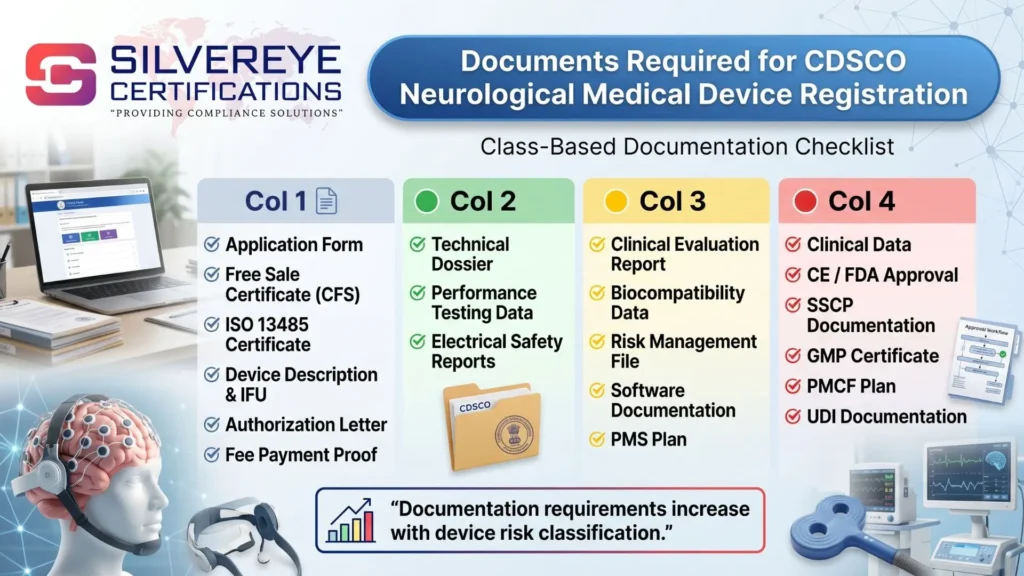
Document requirements vary by device class. Here is the comprehensive checklist used by CDSCO for neurological medical device applications:
For All Classes (Common Documents)
- Duly filled application form (Form MD-14 for import; Form MD-15 for Indian manufacturer)
- Certificate of Free Sale (CFS) or market approval from country of origin
- ISO 13485 certificate of the manufacturing site
- Device description, intended use, and indications for use
- Labelling and instructions for use (IFU) in English
- Authorization letter from foreign manufacturer to Indian agent
- Indian agent's import/drug license (Form 10 or Form 41)
- Fee payment proof (challan / SUGAM portal payment receipt)
Additional for Class B Devices
- Technical file / technical dossier (device design, materials, manufacturing summary)
- Performance evaluation / testing summary (safety and performance standards)
- Electrical safety data (IEC 60601 series compliance, where applicable)
Additional for Class C Devices
- Clinical evaluation report (CER) or performance evaluation report (PER) per MDR 2017 format
- Biocompatibility testing data (ISO 10993 series)
- Risk management file (ISO 14971)
- Software documentation (if device includes software — IEC 62304 compliance)
- Post-market surveillance (PMS) and vigilance plan
Additional for Class D Devices
- Complete clinical data (clinical trial results or equivalent reference country clinical evaluation)
- CE Certificate (EU MDR) or FDA 510(k)/PMA or equivalent approval from reference regulatory authority
- Summary of safety and clinical performance (SSCP) or equivalent
- GMP inspection report / certificate of the manufacturing facility
- Detailed post-market clinical follow-up (PMCF) plan
- Unique Device Identification (UDI) documentation where applicable
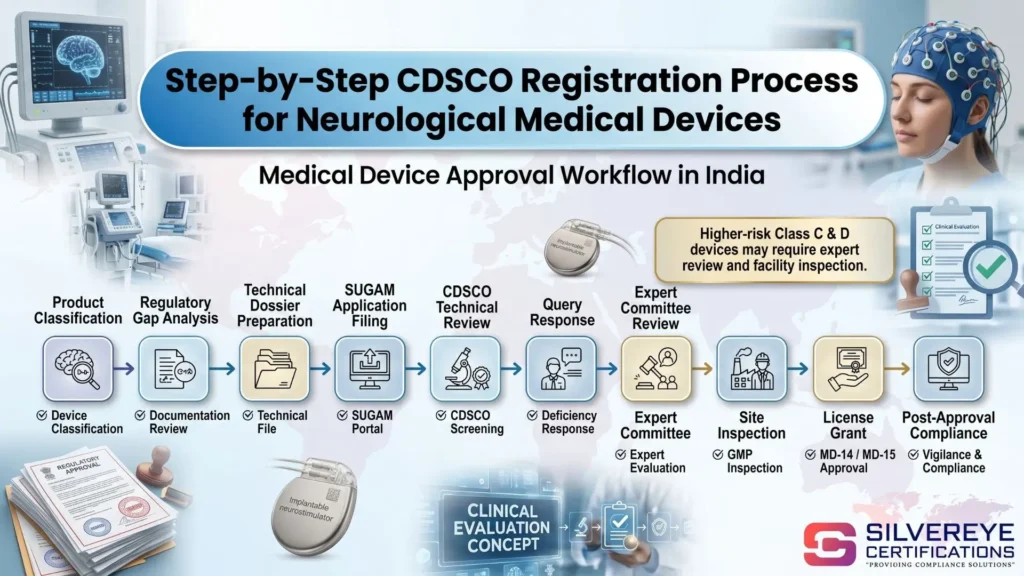
Step-by-Step CDSCO Registration Process for Neurological Medical Devices
- Step 1 — Product Classification: Determine the correct CDSCO class (A, B, C, or D) for your neurological device based on intended use, invasiveness, and risk. Misclassification is the most common reason for application rejection.
- Step 2 — Regulatory Gap Analysis: Assess all existing documentation — test reports, clinical data, ISO certificates, overseas approvals — against CDSCO requirements for your device class.
- Step 3 — Technical Dossier / Application File Preparation: Compile the complete application file in the CDSCO-specified format. For Class C and D devices, this includes clinical evaluation, biocompatibility, and risk documentation.
- Step 4 — SUGAM Portal Account Creation & Application Filing: Create/login to the CDSCO SUGAM portal, select the correct application type, upload all documents, and pay government fees online.
- Step 5 — CDSCO Screening & Technical Review: CDSCO reviews the application for completeness and technical merit. This may take weeks to months depending on device class and application load.
- Step 6 — Deficiency / Query Response: CDSCO may raise queries or request additional data. Responding accurately and within the stipulated time is critical to avoid re-screening delays.
- Step 7 — Expert Committee Review (for Class C & D): Higher-risk neurological devices are reviewed by CDSCO's subject matter expert committee before approval.
- Step 8 — Site Inspection (for Class D imported devices, if applicable): CDSCO may conduct a GMP inspection of the foreign manufacturing facility. Preparation is essential.
- Step 9 — Grant of License / Registration Certificate: Upon successful review, CDSCO issues the import license (Form MD-14) or manufacturing license (Form MD-15) for the device.
- Step 10 — Post-Approval Compliance: Maintain labelling compliance, file adverse event/vigilance reports as required, and plan for timely renewal before expiry.
CDSCO Registration Fees for Neurological Medical Devices
The following fee structure is indicative based on CDSCO's prescribed government fee schedule. Fees are subject to revision — always verify current fees on the official CDSCO/SUGAM portal before filing.
| Device Class | Application Type | Govt. Fee (Approx.) | Notes |
| Class A | Import License (Form MD-14) | INR 5,000 | Per device; payable online via SUGAM portal |
| Class B | Import License (Form MD-14) | INR 10,000 – 15,000 | Per device; technical documentation required |
| Class C | Import License (Form MD-14) | INR 25,000 – 35,000 | Per device; clinical evaluation mandatory |
| Class D | Import License (Form MD-14) | INR 50,000 – 75,000+ | Per device; GMP inspection fee may be additional |
| Indian Manufacturer (Any Class) | Manufacturing License (Form MD-15) | INR 5,000 – 50,000+ | Fee varies by class and production scale |
Note: Government fees are separate from consultancy service fees. Silvereye Certifications provides a transparent quotation for CDSCO registration services for neurological medical devices — contact them directly for a product-specific estimate.
CDSCO License Validity and Renewal for Neurological Medical Devices
| License Type | Validity | Renewal Timeline | Key Note |
| Import License — Class A (Form MD-14) | 5 years | Apply minimum 6 months before expiry | Renewal requires updated CFS and ISO certificate |
| Import License — Class B (Form MD-14) | 5 years | Apply minimum 6 months before expiry | Updated technical dossier may be required if product changed |
| Import License — Class C (Form MD-14) | 5 years | Apply minimum 6 months before expiry | PMS reports may need to be submitted at renewal |
| Import License — Class D (Form MD-14) | 5 years | Apply minimum 6 months before expiry | Updated clinical evidence and PMCF data required |
| Manufacturing License — All Classes | 5 years (renewable) | Apply before expiry | GMP inspection may be repeated at renewal |
A lapsed CDSCO license results in immediate prohibition of import/sale of the device and can attract penalties under the Drugs and Cosmetics Act. Never allow a CDSCO license to expire without renewal — Silvereye Certifications provides proactive renewal management for all neurological device clients.
Benefits of CDSCO Registration for Neurological Medical Devices
| Benefit | What It Means for Your Business |
| Legal Market Access | Authorized to import, distribute, and sell neurological devices across India |
| Hospital & Procurement Eligibility | Government hospitals and large private institutions require CDSCO-registered devices |
| Brand & Regulatory Credibility | CDSCO approval signals quality compliance to Indian healthcare providers |
| Insurance & Reimbursement Eligibility | Many insurance and government procurement schemes require CDSCO registration |
| Tender Participation | Government tenders (CGHS, AIIMS, state health departments) mandate CDSCO approval |
| Patent & IP Protection in India | Formally recognized regulatory entry supports IP and market exclusivity claims |
| Platform for PAN-India Distribution | Single CDSCO import license covers all-India distribution via authorized channels |
Conclusion — Navigate CDSCO Registration for Neurological Medical Devices with Confidence
CDSCO registration for neurological medical devices in India is a structured, multi-step regulatory process that requires precision, experience, and up-to-date knowledge of the Medical Devices Rules, 2017. With 131 device types spread across four risk classes — from simple Class A diagnostic instruments to life-sustaining Class D implantable neurostimulators — understanding your product's classification and regulatory pathway is the foundation of a successful application.
Whether you are an Indian manufacturer preparing a Form MD-15 application, a foreign neuro device company entering India through an authorized agent, or a startup in the medical technology space, the requirements are non-negotiable and the stakes are high.
Silvereye Certifications specializes in CDSCO registration for neurological medical devices. Their regulatory team handles everything — product classification, gap analysis, technical dossier preparation, SUGAM portal filing, CDSCO query responses, and renewal management — so you can focus on your business while they take care of your compliance.
Reach out to Silvereye Certifications today for a free initial consultation on your neurological medical device CDSCO registration.
Frequently Asked Questions
Is CDSCO registration mandatory for all neurological medical devices sold in India?
Yes. All medical devices falling under the notified device categories of the Medical Devices Rules, 2017 — including neurological devices — require valid CDSCO registration (import license or manufacturing license) before they can be legally imported, manufactured, or sold in India. The list of notified neurological devices has been progressively expanded and now covers all 131 device types listed in this guide.
How is a neurological medical device classified under CDSCO?
CDSCO classifies neurological medical devices into Class A, B, C, or D based on intended use, invasiveness, duration of contact, type of contact (skin, body cavity, implant), and whether the device supplies energy to the body or is life-sustaining. Class A is lowest risk; Class D is highest risk.
What is the difference between Form MD-14 and Form MD-15 for neurological devices?
Form MD-14 is the application form for obtaining a CDSCO import license for medical devices manufactured outside India. Form MD-15 is the application form for a manufacturing license for medical devices manufactured in India. For most foreign neurological device companies, Form MD-14 (via an authorized Indian agent) is the applicable route
How long does CDSCO registration take for neurological medical devices?
Timelines vary by device class. Class A and B devices typically take 3 to 6 months if documentation is complete. Class C devices may take 6 to 12 months. Class D devices — especially implantable neurostimulators and high-risk systems — can take 12 to 24 months, including potential expert committee review and site inspection.
Can a foreign company apply for CDSCO registration directly?
No. Foreign manufacturers cannot apply directly for CDSCO medical device registration. They must appoint an authorized Indian agent — a company registered in India with a valid drug license — who applies on their behalf. The Indian agent is jointly responsible for regulatory compliance. Silvereye Certifications can help coordinate with authorized Indian agents.
What is the CDSCO SUGAM portal and how is it used for neurological device registration?
SUGAM is CDSCO's official online portal for all medical device registration applications, renewals, license amendments, and fee payments. All applications, including for neurological medical devices, are filed and tracked exclusively through SUGAM.
Is CE marking accepted by CDSCO for neurological medical device registration?
Yes, CE marking (issued under EU MDR 2017/745 or previously MDD 93/42/EEC) is one of the reference regulatory approvals accepted by CDSCO to support applications for Class C and D neurological devices. CDSCO also accepts FDA 510(k), PMA, or equivalent approvals from Health Canada, TGA (Australia), PMDA (Japan), and other reference jurisdictions.
What is the CDSCO registration fee for a Class D deep brain stimulation system?
The indicative CDSCO government fee for a Class D import license (Form MD-14) for a neurological device such as a deep brain stimulation system is approximately INR 50,000 to INR 75,000 per device, excluding any applicable site inspection fees. Please verify the current fee schedule on the SUGAM portal or with CDSCO directly before filing, as fees are periodically revised.
How many years is a CDSCO medical device import license valid for?
A CDSCO medical device import license (Form MD-14) for neurological devices is valid for 5 years from the date of issue. Renewal must be applied for before expiry — CDSCO recommends initiating the renewal process at least 6 months before the expiry date to avoid any lapse in registration.
What happens if I sell a neurological medical device in India without CDSCO registration?
Selling, importing, or distributing a regulated neurological medical device in India without valid CDSCO registration is a violation of the Drugs and Cosmetics Act, 1940, and the Medical Devices Rules, 2017. Consequences include product seizure, import stoppage, financial penalties, and in serious cases, prosecution under the Act.