
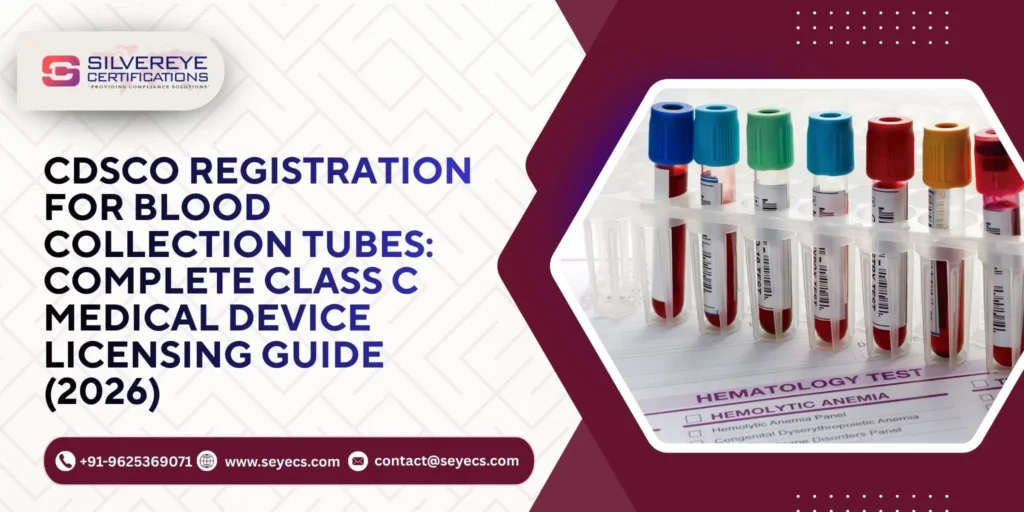
- Class C classification: Blood collection tubes used for critical diagnostic sample collection are treated as Class C IVD medical devices, placing them under CDSCO's Central Licensing Authority rather than State Licensing Authorities.
- Manufacturers need MD-7/MD-9: Indian manufacturers of blood collection tubes apply through Form MD-7 and receive the manufacturing license on Form MD-9 from CDSCO's Central Licensing Authority.
- Importers need MD-14/MD-15: Foreign brands must appoint an authorized Indian agent who files Form MD-14 and secures the import license on Form MD-15 from CDSCO.
- Wholesalers/distributors need MD-41/MD-42: Any business stocking, supplying, or distributing blood collection tubes commercially must hold the registration certificate granted on Form MD-42, applied for via Form MD-41.
What Is CDSCO Registration for Blood Collection Tubes?
CDSCO registration for blood collection tubes is the regulatory approval issued by the Central Drugs Standard Control Organization (CDSCO), under India's Ministry of Health and Family Welfare, that authorizes a business to manufacture, import, or distribute blood collection tubes as a notified in-vitro diagnostic (IVD) medical device. These products are regulated under the Medical Devices Rules, 2017 (MDR 2017), notified under the Drugs and Cosmetics Act, 1940.
Blood collection tubes — including vacuum-draw tubes with clot activators, EDTA, heparin, sodium citrate, or gel-separator additives — directly determine the accuracy of downstream laboratory testing, from routine blood counts to infectious-disease screening. Because a defective or contaminated tube can compromise a diagnostic result, CDSCO regulates these tubes as IVD devices, and their vacuum calibration, additive quality, and sterility all fall within the scope of CDSCO's technical review. Every entity in the supply chain — manufacturer, importer, and wholesaler/distributor — needs its own CDSCO authorization before the product can reach a laboratory or hospital.
Why Blood Collection Tubes Are Classified as Class C
CDSCO's risk-based classification system groups medical devices, including IVDs, into four categories — Class A, B, C, and D — as specified in the First Schedule of MDR 2017. Blood collection tubes intended for critical diagnostic use, such as infectious-disease screening, blood grouping, or other high-stakes laboratory tests, are treated as Class C (moderate-to-high risk) because an inaccurate or compromised result at this stage can materially affect a patient's diagnosis or treatment.
| IVD Category | Risk Level | Example Use | Licensing Authority |
| Class A IVD | Low individual/public health risk | General specimen collection accessories, culture media | State Licensing Authority (registration route) |
| Class B IVD | Moderate individual risk | Basic screening tests, urine test strips | State Licensing Authority (MD-3/MD-5) |
| Class C IVD | High individual, moderate public health risk | Blood collection tubes for diagnostic testing, glucose/PSA screening tests | Central Licensing Authority (MD-7/MD-9) |
| Class D IVD | High individual and public health risk | HIV/HBsAg screening, blood grouping reagents | Central Licensing Authority (MD-7/MD-9) |
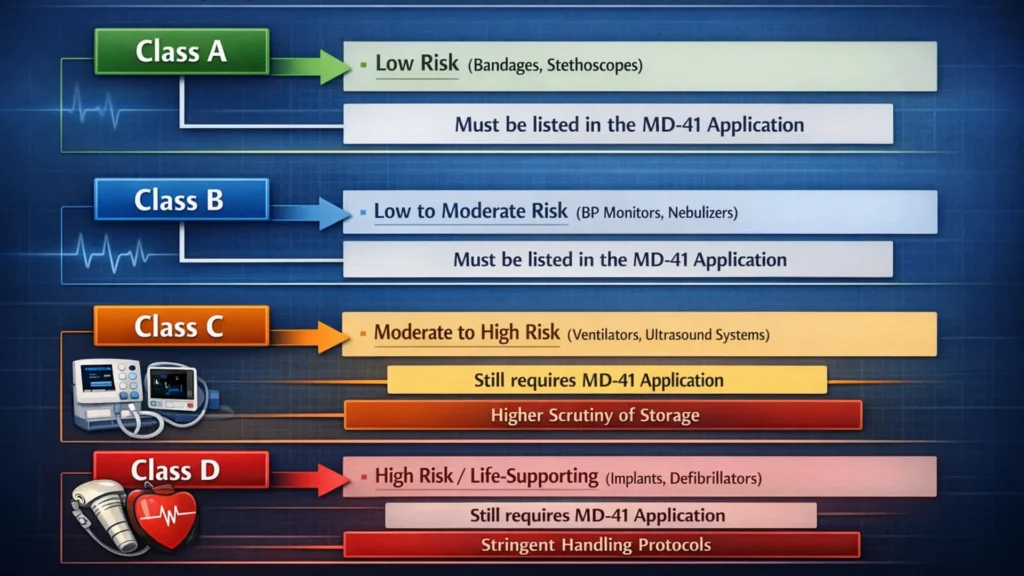
| Confirm your exact tube's classification before applying CDSCO's classification of an IVD product depends on its specific intended use, additive type, and the criticality of the test it supports — a basic specimen tube used for non-critical purposes may sit in a lower class than a tube specifically validated for high-stakes diagnostic testing. Because CDSCO's Central Licensing Authority periodically updates and reclassifies IVD device categories, always verify your product's current classification on the CDSCO website or SUGAM portal before filing Form MD-7, MD-14, or MD-41 — applying under the wrong class is one of the most common reasons IVD applications are delayed. |
Who Needs CDSCO Registration for Blood Collection Tubes?
CDSCO registration applies separately to each role in the blood collection tube supply chain:
| Entity | Application Form | Licence/Certificate | Issuing Authority |
| Manufacturer (Class C) | Form MD-7 | Form MD-9 (Manufacturing Licence) | CDSCO – Central Licensing Authority |
| Importer | Form MD-14 | Form MD-15 (Import Licence) | CDSCO – Central Licensing Authority |
| Wholesaler / Distributor | Form MD-41 | Form MD-42 (Registration Certificate) | State Licensing Authority |
Note that unlike Class A/B products, both the manufacturing license (MD-9) and the import license (MD-15) for a Class C blood collection tube are granted by CDSCO's Central Licensing Authority, not a State Licensing Authority — only the wholesale registration (MD-42) remains state-level.
CDSCO Manufacturing License for Blood Collection Tubes (MD-7 & MD-9)
Indian manufacturers producing blood collection tubes on their own premises must obtain a Class C manufacturing license. Unlike the state-level MD-3/MD-5 route used for Class A/B devices, this application is filed on Form MD-7 and reviewed directly by CDSCO's Central Licensing Authority, which grants the license on Form MD-9.
Eligibility for MD-7/MD-9
- The applicant must be a registered business entity (proprietorship, partnership, LLP, or company) with a defined manufacturing premise in India.
- The manufacturing site must maintain a Quality Management System aligned with ISO 13485:2016, with validated vacuum-fill calibration, additive-dosing accuracy, and sterility controls.
- A qualified technical person with relevant IVD or laboratory science background must be designated at the facility.
Documents Required for MD-7 Application
- Covering letter and duly filled Form MD-7.
- Proof of constitution of the firm (incorporation certificate, partnership deed, GST registration).
- Site Master File describing the manufacturing premises and layout.
- Device Master File covering tube material, additive composition, vacuum-draw volume specifications, intended use, and labelling.
- Performance evaluation data demonstrating accuracy of additive dosing and vacuum calibration.
- Sterilization and stability data supporting the tube's shelf life.
- Details of manufacturing plant, machinery, and quality-control equipment.
- Undertaking of compliance with Essential Principles of safety and performance under MDR 2017.
- Details of technical staff along with qualification proof.
MD-7/MD-9 Process — Step by Step
- Register the organization on the CDSCO SUGAM portal.
- Fill and submit Form MD-7 online along with the Site Master File, Device Master File, and performance evaluation data.
- Upload supporting documents and pay the applicable government fee.
- CDSCO's Central Licensing Authority scrutinizes the application for completeness and regulatory compliance.
- For Class C devices, CDSCO's Medical Device Officers typically carry out a facility inspection within 60 days of the application date, provided the submitted data is found satisfactory.
- On satisfactory review, CDSCO grants the manufacturing license on Form MD-9.
CDSCO Import License for Blood Collection Tubes (MD-14 & MD-15)
Foreign manufacturers cannot sell blood collection tubes directly in India. They must appoint an Authorized Indian Agent who holds a valid wholesale license (Form MD-42) or manufacturing license, and who then files the import application on Form MD-14. Because blood collection tubes are Class C, CDSCO's Central Licensing Authority reviews the application in greater depth than it would for a Class A/B product, and grants the import license on Form MD-15.
Eligibility for MD-14/MD-15
- The applicant must be an Indian-based Authorized Agent appointed by the foreign manufacturer through a notarized and apostilled Power of Attorney.
- The Authorized Agent must hold a valid wholesale license (MD-42) or manufacturing license to be eligible to import and further distribute the product.
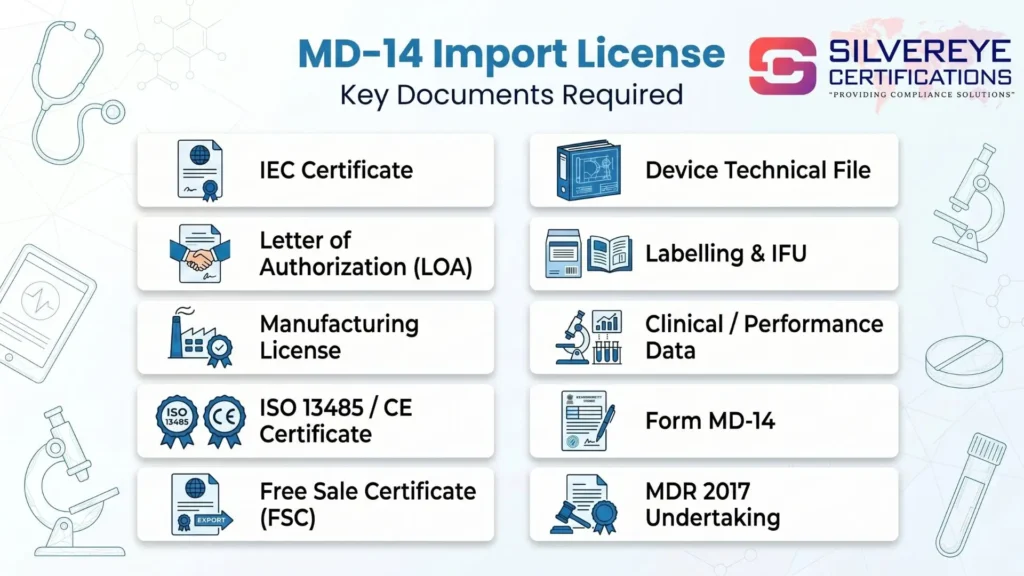
Documents Required for MD-14 Application
- Covering letter and duly filled Form MD-14.
- Government fee payment challan.
- Notarized and apostilled Power of Attorney from the foreign manufacturer authorizing the Indian agent.
- Copy of the agent's Wholesale License (MD-42) or Manufacturing License.
- Free Sale Certificate or Marketing Authorization from the regulatory authority of the country of origin.
- Device Master File and Plant Master File of the foreign manufacturing site, including additive composition and performance evaluation data.
- ISO 13485 certificate and any applicable CE marking or equivalent international approval.
MD-14/MD-15 Process — Step by Step
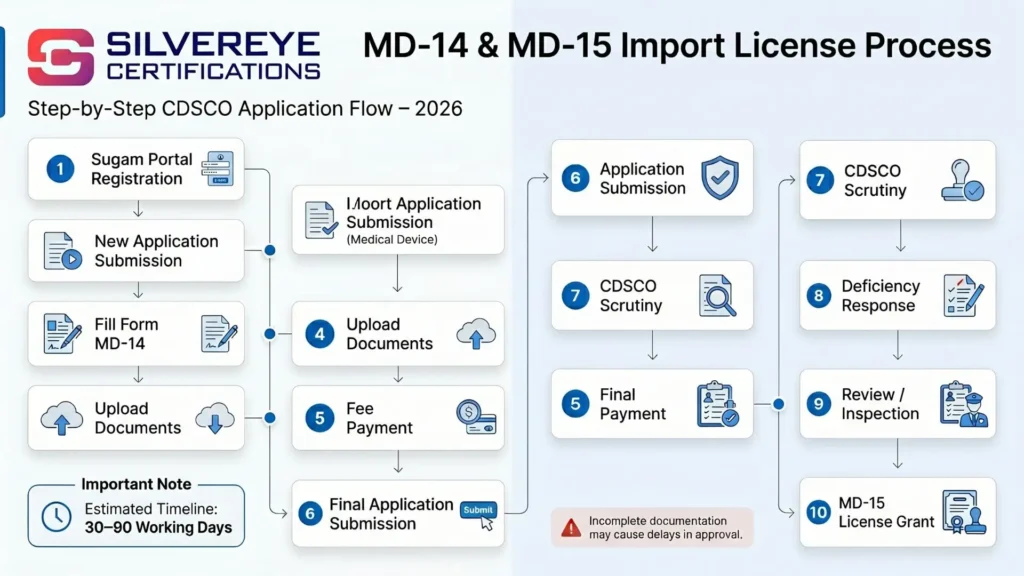
- The Authorized Agent registers on the CDSCO SUGAM portal.
- Form MD-14 is filled online with device, manufacturer, and agent details.
- Supporting documents are uploaded and the applicable government fee is paid.
- CDSCO reviews the application and may raise queries requiring clarification or additional performance and stability data.
- On satisfactory review, CDSCO grants the import license on Form MD-15, permitting legal import of the listed blood collection tube product(s).
| Class C import review takes longer than Class A/B Since blood collection tubes are Class C IVD devices, CDSCO's review typically covers additive-dosing accuracy, vacuum-draw performance, and stability data in more depth than it would for a Class A/B product. Building a complete performance evaluation dossier upfront is the single biggest factor in avoiding repeated query cycles. |
CDSCO Wholesale / Distributor License for Blood Collection Tubes (MD-41 & MD-42)
Any business that stocks, exhibits, sells, or distributes blood collection tubes in bulk — including distributors, stockists, C&F agents, and e-commerce sellers of regulated medical devices — needs a wholesale registration. The application is made on Form MD-41, and the State Licensing Authority grants the registration certificate on Form MD-42.
Eligibility for MD-41/MD-42
- A dedicated storage premise of adequate size with proper shelving, cleanliness, and record-keeping arrangements.
- Storage conditions that preserve the tube's vacuum integrity, additive stability, and sterility as specified by the manufacturer.
- A technically competent person overseeing storage and distribution — typically someone with a relevant science, laboratory, or pharmacy background, or equivalent experience in medical device or IVD distribution.
- A declaration to source blood collection tubes only from CDSCO-licensed manufacturers or importers.
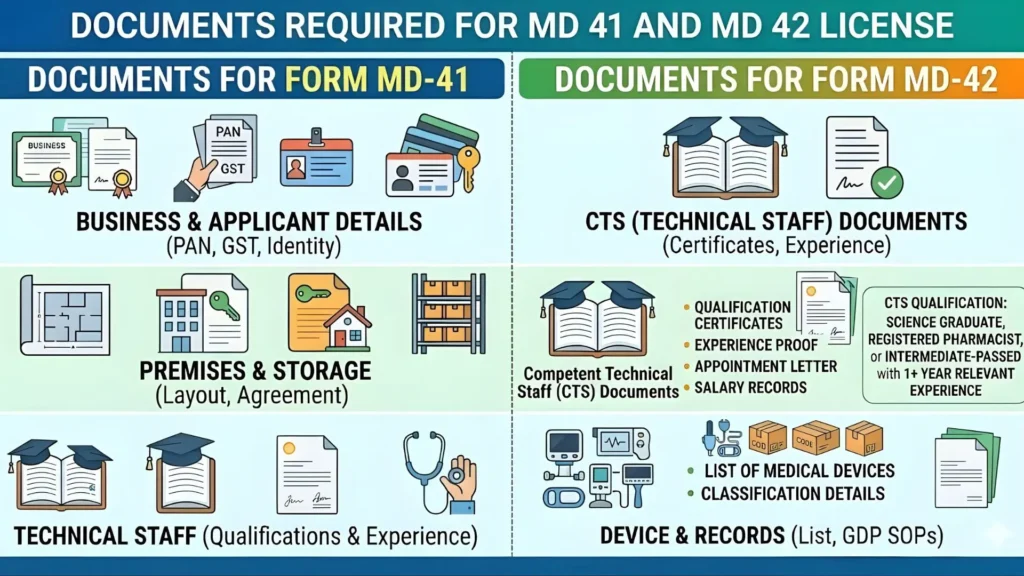
Documents Required for MD-41 Application
- Duly filled Form MD-41.
- Business constitution proof (Certificate of Incorporation, Partnership Deed, or GST registration).
- Address proof of the premises (rent agreement or ownership documents) and a site layout plan.
- Proof of technical competence of the qualified person.
- Manufacturer or importer authorization letter, where applicable.
- Fee payment receipt.
MD-41/MD-42 Process — Step by Step
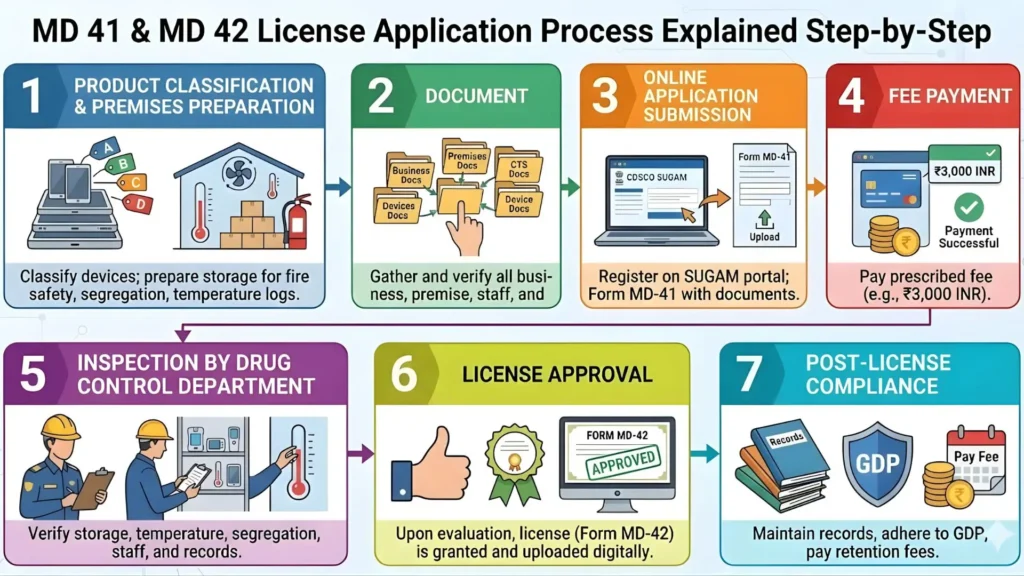
- Apply through the CDSCO SUGAM portal or the respective State Drug Control Department, as applicable in your state.
- Upload Form MD-41 along with premises, personnel, and business documents.
- Pay the prescribed government fee.
- A Drug Inspector conducts a physical inspection of the storage premises to verify compliance with CDSCO storage and record-keeping norms, including temperature-controlled storage where applicable.
- On successful verification, the State Licensing Authority issues the registration certificate on Form MD-42.
CDSCO Fees for Blood Collection Tube Registration
Government fees differ by license type and risk class, and are prescribed under the First Schedule of MDR 2017. Class C fees are meaningfully higher than the Class A/B rates, reflecting the deeper technical review involved. Fees are revised from time to time, so always verify the current amount on the SUGAM portal before submitting payment.
| Licence Type | Applicable Fee | Notes |
| Manufacturing Licence (MD-7/MD-9) | As per MDR 2017 Schedule I (Class C rate) | Higher than Class A/B fees; confirm current amount on SUGAM |
| Import Licence (MD-14/MD-15) | As per MDR 2017 Schedule I (device-count and site-based) | Applies per manufacturing site and per product/product group |
| Wholesale Licence (MD-41/MD-42) | ₹3,000 per premise (government fee) | Non-refundable; paid at the time of application submission |
Processing Timeline & Validity of CDSCO Blood Collection Tube Licenses
| Licence Type | Typical Processing Time | Validity | Renewal |
| MD-9 (Manufacturing) | Approx. 6–9 months, including a Central Licensing Authority facility inspection (typically within 60 days of a complete application) | 5 years from date of issue | Apply before expiry with retention/renewal fee |
| MD-15 (Import) | Approx. 6–9 months depending on document completeness and query rounds | Generally continues indefinitely subject to a 5-year retention fee cycle | Pay retention fee every 5 years to keep the licence active |
| MD-42 (Wholesale) | Approx. 30–60 days | 5 years from date of issue | Renew before expiry to avoid disruption in distribution |
As a best practice, begin your renewal filing at least 90 days before expiry for Class C licences, since the Central Licensing Authority's review depth is greater than a state-level Class A/B renewal, and any outstanding performance-data queries can extend the timeline further.
Benefits of CDSCO Registration for Blood Collection Tubes
- Legal market access: A valid CDSCO authorization is what allows a blood collection tube to be manufactured, imported, or sold in India in the first place.
- Laboratory and hospital trust: Diagnostic laboratories, pathology chains, and hospital procurement teams require CDSCO documentation before onboarding a blood collection tube supplier, since result accuracy is directly tied to tube quality.
- Protection from penalties: Registered businesses avoid the seizure, fines, and legal action that come with selling unregistered IVD devices.
- Export credibility: A CDSCO license strengthens your regulatory profile when blood collection tubes are later exported to markets that recognize Indian approvals.
Penalties for Selling Blood Collection Tubes Without CDSCO Registration
Manufacturing, importing, or distributing blood collection tubes without the applicable CDSCO authorization is a violation of the Medical Devices Rules, 2017 and the Drugs and Cosmetics Act, 1940. Consequences can include seizure of stock, suspension or cancellation of any related licences, financial penalties, and prosecution under the Act, which in serious or repeat cases can extend to imprisonment. Given that faulty blood collection tubes can compromise diagnostic accuracy and patient safety, CDSCO and laboratory accreditation bodies both treat non-compliance in this category seriously.
Common Mistakes to Avoid During CDSCO Blood Collection Tube Registration
- Assuming a Class C IVD device follows the same state-level MD-3/MD-5 pathway as Class A/B products — Class C requires Form MD-7/MD-9 through the Central Licensing Authority.
- Submitting an incomplete Device Master File without additive-dosing accuracy, vacuum-draw performance, or stability data.
- Underestimating the Central Licensing Authority's review timeline and filing renewals too close to expiry.
- Assuming a single license covers manufacturing, import, and wholesale activity — each role needs its own authorization.
- Not re-verifying the tube's exact IVD risk classification before filing, since classification can depend on intended diagnostic use.
- Overlooking cold-chain or vacuum-integrity storage requirements at the wholesale/distribution stage.
Conclusion
Whether you manufacture blood collection tubes in India, import them from an overseas supplier, or distribute them to laboratories and hospitals, CDSCO registration for blood collection tubes is the foundation of legal, credible operations in this Class C IVD medical device category. Correctly confirming the Class C classification, filing the right form — MD-7, MD-14, or MD-41 — and preparing complete performance and stability documentation are the biggest factors that determine how quickly your licence comes through.
The team at Silvereye Certifications specialises in end-to-end CDSCO medical device registration support — from device classification and technical dossier preparation to SUGAM portal submissions and post-approval compliance management for blood collection tube manufacturers, importers, and distributors across India.
Frequently Asked Questions
Is CDSCO registration mandatory for blood collection tubes in India?
Yes. Blood collection tubes are notified IVD medical devices under MDR 2017, so manufacturing, importing, or distributing them in India requires the applicable CDSCO license or registration.
What CDSCO class do blood collection tubes fall under?
Blood collection tubes used for critical diagnostic testing are generally classified as Class C (moderate-to-high risk), which places manufacturing and import approval under CDSCO's Central Licensing Authority rather than a State Licensing Authority.
What is the difference between Form MD-7, MD-14, and MD-41?
MD-7 is the Class C/D manufacturing license application (granted as MD-9), MD-14 is the import license application (granted as MD-15), and MD-41 is the wholesale/distribution registration application (granted as MD-42). Each serves a different role in the supply chain.
Who can apply for the CDSCO manufacturing license for blood collection tubes?
Any registered business entity manufacturing blood collection tubes on its own premises in India, with a designated technical person, validated vacuum-fill and additive-dosing processes, and a documented quality system, can apply on Form MD-7 to CDSCO's Central Licensing Authority.
Why is the manufacturing license for Class C different from Class A/B?
Class A and Class B manufacturing licenses (MD-3/MD-5) are granted by State Licensing Authorities, while Class C and Class D manufacturing licenses (MD-7/MD-9) are granted by CDSCO's Central Licensing Authority, reflecting the higher risk and deeper technical scrutiny these devices require.
How long does CDSCO registration for blood collection tubes take?
Manufacturing licenses (MD-9) and import licenses (MD-15) for Class C devices typically take about 6–9 months, including a facility inspection generally conducted within 60 days of a complete application. Wholesale registrations (MD-42) usually take 30–60 days.
What is the validity of a CDSCO blood collection tube license?
MD-9 and MD-42 are generally valid for 5 years from the date of issue. MD-15 import licenses generally continue indefinitely, subject to payment of a retention fee every 5 years.
What documents are required for CDSCO blood collection tube registration?
Core documents include the relevant application form (MD-7, MD-14, or MD-41), business constitution proof, site or premises details, a Device Master File with additive composition and performance evaluation data, technical staff qualifications, and the applicable fee payment receipt. Importers additionally need a Power of Attorney and a Free Sale Certificate from the country of origin.
Can one business hold manufacturing, import, and wholesale licenses together?
Yes, if the business genuinely performs all three activities. Each activity still requires its own separate CDSCO authorization — holding one license does not automatically cover the others.
How do I renew my CDSCO blood collection tube license?
Renewal applications should be filed at least 90 days before expiry, using the previous license details, updated documents where applicable — including current performance evaluation and stability data — and the prescribed renewal or retention fee, submitted through the SUGAM portal to CDSCO's Central Licensing Authority or your State Licensing Authority as applicable.