- CDSCO Manufacture Test License Registration statutory application form under the Medical Devices Rules, 2017 used to apply for a Manufacture Test License for medical devices in India.
- The CDSCO (Central Drugs Standard Control Organization) issues Form MD-13 as the Grant of Manufacture Test License upon approval.
- All Class A, B, C, and D medical devices notified under the Medical Devices Rules, 2017 require CDSCO registration before manufacture or import.
- With CDSCO expanding its notified device list and tightening compliance timelines, understanding this process is critical for manufacturers, importers, and regulatory affairs professionals.
Introduction
If you are a medical device manufacturer, importer, or regulatory affairs professional in India, CDSCO medical device registration is not optional — it is a legal requirement. Whether you manufacture surgical instruments, diagnostic kits, implantable devices, or in-vitro diagnostics, obtaining the correct CDSCO license is the gateway to legally placing your product in the Indian market.
The Central Drugs Standard Control Organization (CDSCO), operating under the Directorate General of Health Services (DGHS) and the Ministry of Health and Family Welfare (MoHFW), is the national regulatory authority for medical devices in India. Under the Medical Devices Rules, 2017 (MDR 2017), CDSCO has established a structured regulatory framework that classifies devices, mandates testing, and issues licenses through specific statutory forms.
Two of the most important forms in this framework are Form MD-12 (the application for a Manufacture Test License) and Form MD-13 (the Grant of Manufacture Test License). Together, these two forms govern the process by which a manufacturer receives legal authorization to manufacture medical devices in India for the purpose of testing, clinical investigation, or export.
What is CDSCO and Why Is Its Role Critical?
CDSCO stands for Central Drugs Standard Control Organization. It functions as India's apex regulatory body for medical devices, drugs, diagnostics, and cosmetics. For medical devices specifically, CDSCO's responsibilities include:
- Regulating the import, manufacture, sale, and distribution of medical devices
- Classifying medical devices into risk-based categories (Class A through D)
- Reviewing and granting market authorizations, import licenses, and manufacture licenses
- Conducting clinical evaluations and performance assessments
- Monitoring post-market surveillance and vigilance activities
- Maintaining the Indian Medical Device Registry (IMDR) on the Sugam portal
Since the Medical Devices Rules, 2017 came into full effect, CDSCO has progressively brought more device categories under its mandatory regulatory net. As of 2026, hundreds of device categories — from single-use syringes and blood glucose monitors to orthopedic implants and cardiac stents — are fully notified and require CDSCO registration.
| Important Note (2026 Update): CDSCO continues to notify additional medical device categories under Rule 5 of MDR 2017. Manufacturers should regularly check the official CDSCO portal and the Sugam portal for updated notified lists and compliance deadlines. |
Understanding Form MD-12: CDSCO Manufacture Test License Registration
What is Form MD-12?
Form MD-12 is the official statutory application form prescribed under Schedule II of the Medical Devices Rules, 2017. A manufacturer files this form to apply for a Manufacture Test License — a special category of license that authorizes the manufacture of a medical device specifically for the purpose of:
- Testing the device (including safety and performance testing)
- Clinical investigation or clinical trials
- Export of devices that have not yet received full market authorization in India
- Research and development (R&D) activities involving device manufacturing
The Manufacture Test License under MD-12 is distinct from the full-scale Manufacture License (Form MD-7/MD-9). It is designed for manufacturers who need to produce limited quantities of devices for testing, evaluation, or trial purposes before receiving commercial authorization.
Who Needs to File Form MD-12?
Form MD-12 is applicable to:
- Indian manufacturers seeking to manufacture medical devices for testing, clinical investigation, or export
- Start-ups and innovators developing new medical devices who need to produce prototypes or trial batches
- Manufacturers whose devices are newly notified under MDR 2017 and who are transitioning to full compliance
- Contract manufacturers producing devices on behalf of licensed brand owners for testing purposes
- Research institutions or hospitals involved in device development under certain conditions
Key Regulatory Provision
| Rule 19 of the Medical Devices Rules, 2017: A manufacturer intending to manufacture medical devices for the purpose of examination, test, or clinical investigation shall apply to the licensing authority in Form MD-12 for the grant of a Manufacture Test License in Form MD-13. |
Understanding Form MD-13: The Grant of Manufacture Test License
What is Form MD-13?
Form MD-13 is the official license document issued by the CDSCO licensing authority to a manufacturer upon approval of the MD-12 application. It is the Manufacture Test License — the formal grant of authorization that allows the manufacturer to legally manufacture medical devices for testing, clinical investigation, or export.
Once issued, Form MD-13 serves as documentary proof that the manufacturer has met all regulatory requirements and has been authorized by CDSCO to produce the specified device(s) under defined conditions.
What Does Form MD-13 License Authorize?
- Manufacture of the specified medical device(s) in limited quantities
- Use of the manufactured devices for examination, testing, or clinical investigation
- Export of devices as permitted under the license conditions
- Manufacturing at the specific premises and facility described in the application
- Use of the specific manufacturing processes and quality systems mentioned in the application
Validity Period of MD-13
| The Manufacture Test License (Form MD-13) is typically valid for 3 years from the date of issue, unless suspended, cancelled, or surrendered. Renewal must be applied for before the expiry date to ensure uninterrupted manufacturing authorization. The licensing authority may impose conditions on the license, including batch size limits, reporting requirements, and post-test submission of results. |
Medical Device Classification Under CDSCO: Class A, B, C, and D
Before applying for CDSCO medical device registration through Form MD-12, you must determine your device's risk classification. Under the Medical Devices Rules, 2017, all medical devices are classified into four risk-based categories using globally harmonized principles (aligned with IMDRF/GHTF guidelines):
| Class | Risk Level | Description | Regulatory Path |
| Class A | Low Risk | Non-invasive devices, general-use devices with minimal patient risk | State Licensing Authority (SLA); Self-certification for some |
| Class B | Low-Moderate Risk | Invasive devices of short-term use, active non-life-supporting devices | State Licensing Authority (SLA) with CDSCO oversight |
| Class C | Moderate-High Risk | Long-term invasive devices, active life-supporting devices | CDSCO Central Licensing Authority |
| Class D | High Risk | Implantable, life-sustaining, life-supporting, or diagnostic devices critical to patient safety | CDSCO Central Licensing Authority (strictest requirements) |
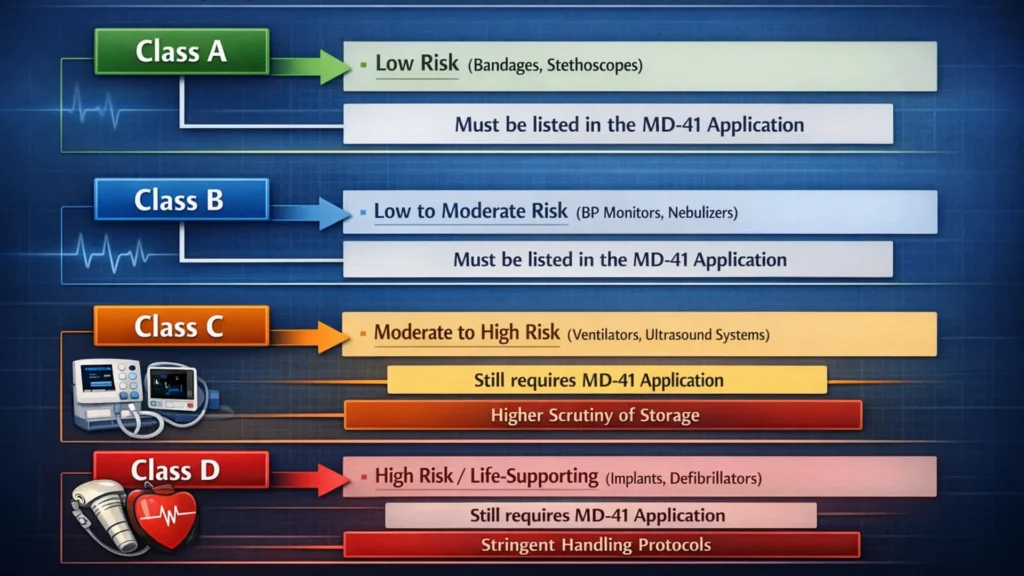
For the Manufacture Test License (MD-12/MD-13), all four classes of devices can apply, but the documentation rigor, fees, and review timelines vary by class.
CDSCO Medical Device Product List with Classification
Below is a representative list of medical devices notified under the Medical Devices Rules, 2017, along with their class classification. This list helps manufacturers identify where their product fits and what level of regulatory oversight applies.
| S.No. | Product Name | Class | Device Category |
| 1 | Examination Gloves (non-sterile) | Class A | General Surgical |
| 2 | Tongue Depressor (non-sterile) | Class A | Diagnostic Aid |
| 3 | Disposable Bedpan / Urinal | Class A | Patient Care |
| 4 | Non-powered Wheelchair | Class A | Mobility Aid |
| 5 | Walking Frame / Crutch | Class A | Mobility Aid |
| 6 | Adhesive Bandage / Wound Strip | Class A | Wound Care |
| 7 | Cervical Collar (non-inflatable) | Class A | Orthopaedic |
| 8 | Cold / Hot Pack (non-electrical) | Class A | Physiotherapy |
| 9 | Handheld Magnifier for Low Vision | Class A | Optical Aid |
| 10 | Dental Floss | Class A | Dental Hygiene |
| 11 | Hypodermic Needles (sterile, single-use) | Class B | Injection Devices |
| 12 | IV Cannula | Class B | Infusion Therapy |
| 13 | Urinary Catheter (short-term) | Class B | Urology |
| 14 | Surgical Drapes (sterile) | Class B | Surgical |
| 15 | Nasal Oxygen Cannula | Class B | Respiratory |
| 16 | Non-invasive Blood Pressure Monitor | Class B | Diagnostics |
| 17 | Hearing Aid (non-implantable) | Class B | Audiology |
| 18 | Surgical Sutures (absorbable) | Class B | Wound Closure |
| 19 | Contact Lenses (daily disposable) | Class B | Ophthalmic |
| 20 | Dental X-Ray Film | Class B | Dental Diagnostic |
| 21 | Thermometer (electronic, non-invasive) | Class B | Diagnostics |
| 22 | Laryngoscope | Class B | Anaesthesia |
| 23 | Blood Glucose Monitoring System | Class B | IVD Diagnostics |
| 24 | Pulse Oximeter | Class B | Patient Monitoring |
| 25 | Nebulizer | Class B | Respiratory |
| 26 | Long-term Urinary Catheter (>30 days) | Class C | Urology |
| 27 | Hemodialysis Machine | Class C | Renal Care |
| 28 | Infusion Pump | Class C | Drug Delivery |
| 29 | Ventilator (non-life-critical settings) | Class C | Respiratory |
| 30 | Orthopaedic Fixation Screws & Plates | Class C | Orthopaedic Implant |
| 31 | Drug-eluting Stent | Class C | Cardiovascular |
| 32 | Haemodialysis Filter (Dialyzer) | Class C | Renal Care |
| 33 | Implantable Contraceptive (non-hormonal) | Class C | Reproductive Health |
| 34 | Suction Apparatus (powered, surgical) | Class C | Surgical |
| 35 | Computed Radiography (CR) System | Class C | Diagnostic Imaging |
| 36 | Defibrillator (Semi-Automatic External) | Class C | Cardiac Emergency |
| 37 | HIV Rapid Test Kit | Class C | IVD — Infectious Disease |
| 38 | Cardiac Pacemaker | Class D | Cardiac Implant |
| 39 | Coronary Stent (bare metal) | Class D | Cardiovascular |
| 40 | Implantable Cardioverter Defibrillator (ICD) | Class D | Cardiac Implant |
| 41 | Cochlear Implant | Class D | ENT Implant |
| 42 | Total Hip / Knee Replacement Implant | Class D | Orthopaedic Implant |
| 43 | Spinal Disc Implant | Class D | Spinal Implant |
| 44 | Intraocular Lens (IOL) | Class D | Ophthalmic Implant |
| 45 | Vascular Graft | Class D | Vascular Implant |
| 46 | Mechanical Heart Valve | Class D | Cardiac Implant |
| 47 | Implantable Drug Delivery System | Class D | Drug Delivery Implant |
| 48 | Left Ventricular Assist Device (LVAD) | Class D | Life-Sustaining Cardiac |
| 49 | SARS-CoV-2 Diagnostic Test Kit (Molecular) | Class D | IVD — Critical Diagnostic |
| 50 | Hepatitis B Surface Antigen (HBsAg) Test Kit | Class D | IVD — Blood Safety |
Note: This table is illustrative and based on categories notified under MDR 2017. Final classification should be confirmed with CDSCO or a qualified regulatory consultant. Some devices may have subcategory-specific classifications.
Eligibility Criteria for MD-12 Manufacture Test License
Not every entity qualifies to apply for a Manufacture Test License under Form MD-12. Here are the key eligibility conditions:
- The applicant must be a legal entity — a company, partnership firm, LLP, or proprietorship — registered in India.
- The applicant must own or have lawful access to manufacturing premises in India that meet GMP (Good Manufacturing Practice) standards as prescribed under Schedule II of MDR 2017.
- The device proposed to be manufactured must be a notified medical device under MDR 2017 or a device that CDSCO has accepted for regulatory consideration.
- The applicant must have technically qualified personnel, including a designated Responsible Technician (RT) as defined under the rules.
- The manufacturing premises must have adequate infrastructure, equipment, and quality management systems to support the test manufacturing process.
- For Class C and D devices, the applicant must demonstrate additional technical capability, including prior clinical or product development experience.
- Any prior CDSCO license suspension or cancellation against the applicant or their premises may disqualify the application.
Documents Required for Form MD-12 Application
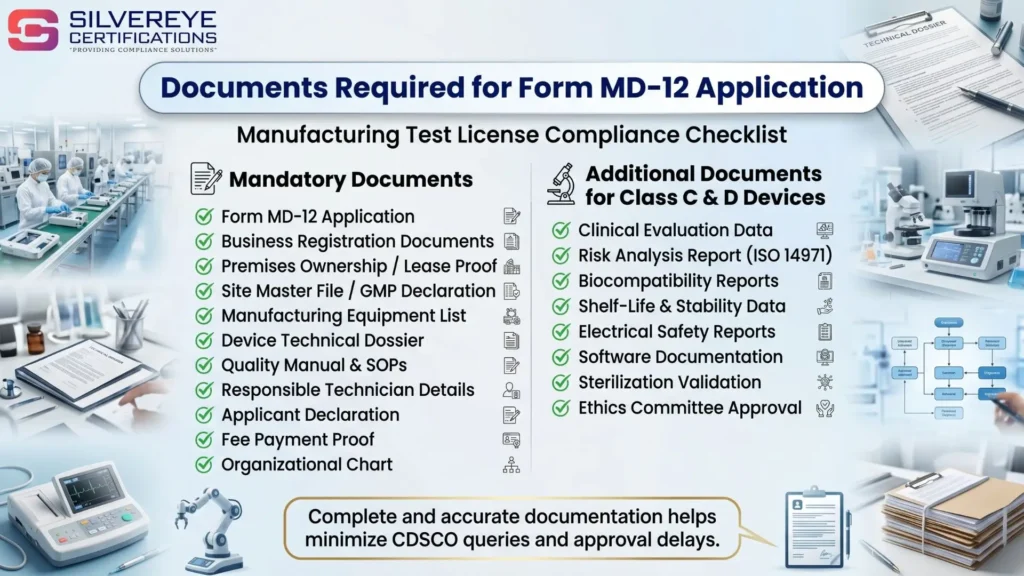
Documentation is the backbone of any successful CDSCO application. Submitting complete, accurate, and current documents significantly reduces the risk of rejection or queries. Below is a comprehensive list:
Mandatory Documents for All Classes
| S.No. | Document | Details / Remarks |
| 1 | Duly filled Form MD-12 | Must be completed in full; no blank fields |
| 2 | Proof of Business Constitution | Certificate of Incorporation / Partnership Deed / GST Certificate |
| 3 | Proof of Premises Ownership or Lease | Registered lease agreement or ownership documents for manufacturing site |
| 4 | Site Master File / GMP Declaration | Layout of premises, area details, HVAC, water system documentation |
| 5 | List of Manufacturing Equipment | Calibrated equipment list with make, model, and calibration certificates |
| 6 | Technical Documentation / Device Dossier | Device description, intended use, classification rationale, standards compliance |
| 7 | Quality Manual / SOPs | Quality management system documentation, SOPs for key manufacturing processes |
| 8 | Details of Responsible Technician (RT) | Qualifications, experience, appointment letter, and bio-data of RT |
| 9 | Declaration by Applicant | Signed declaration on company letterhead as per prescribed format |
| 10 | Proof of Payment of Fees | Challan or payment proof for prescribed government fee |
| 11 | Organizational Chart | Structure of quality, production, and regulatory teams |
Additional Documents for Class C and D Devices
- Clinical evaluation data or published literature supporting safety and performance
- Risk analysis report (ISO 14971 compliant)
- Biocompatibility testing reports (ISO 10993 series) if device contacts the body
- Shelf-life and stability test data
- Electrical safety test reports (IEC 60601 series, if active device)
- Software documentation (IEC 62304) if device contains software
- Sterilization validation reports (if sterile device)
- Prior approval from Ethics Committee (for clinical investigation devices)
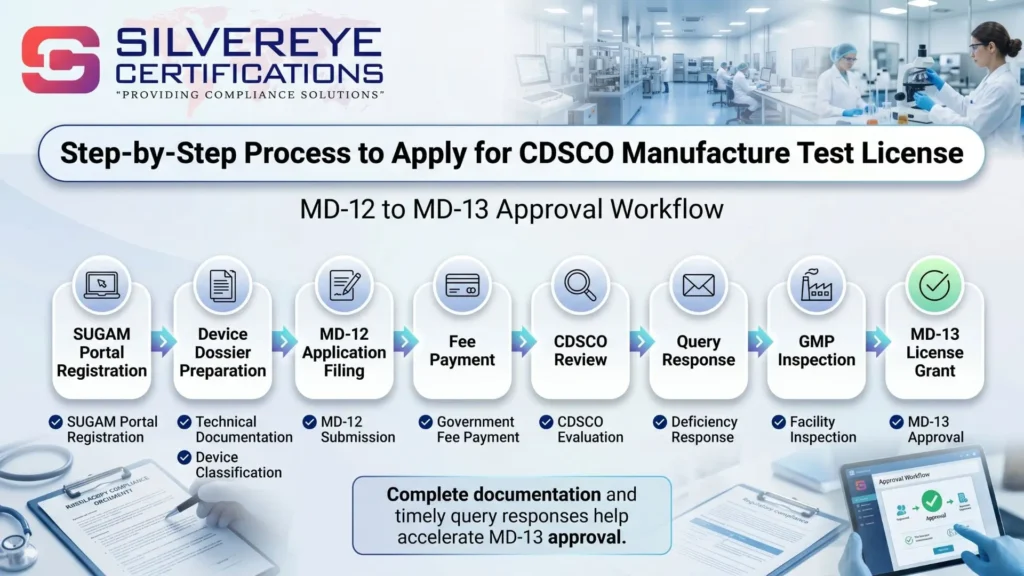
Step-by-Step Process to Apply for CDSCO Manufacture Test License (MD-12 to MD-13)
Here is the complete process to obtain Form MD-13 (Manufacture Test License) by filing Form MD-12 through the CDSCO Sugam portal:
Step 1: Register on the CDSCO Sugam Portal
Visit the official CDSCO Sugam portal. Create your business account using a valid email ID, mobile number, and GST/CIN number. Complete KYC verification.
Step 2: Prepare Your Device Dossier
Before starting the online application, compile all required documents (as listed above). Create a comprehensive device technical file covering device description, classification justification, standards compliance, testing data, and quality system details.
Step 3: Determine the Correct License Type
Confirm that the Manufacture Test License (MD-12) is the appropriate license for your intended activity. If you plan to commercially manufacture and sell in India, you will eventually need a full Manufacture License (MD-7 or MD-9).
Step 4: Fill and Submit Form MD-12 Online
- Log in to the Sugam portal and navigate to the Medical Devices license section
- Select 'Application for Manufacture Test License' and choose Form MD-12
- Fill in all required fields: company details, premises details, device details, RT details
- Upload all mandatory supporting documents in the specified format (PDF, size limits apply)
- Review all entries carefully before final submission
Step 5: Pay the Prescribed Government Fee
After form submission, the portal generates a fee demand. Pay online through the Sugam portal payment gateway. Save the payment receipt for records.
Step 6: Application Processing by CDSCO
- The application is assigned to the relevant CDSCO division (device category-specific)
- CDSCO may raise queries or deficiency notices if documents are incomplete or require clarification
- Respond to all queries within the stipulated time (usually 30 days per query cycle)
- For Class C and D devices, a technical committee or expert committee review may be required
- Premises inspection may be scheduled by CDSCO officers to verify GMP compliance on-site
Step 7: Grant of MD-13 License
Upon satisfactory review of the application, documents, and (where applicable) premise inspection, CDSCO issues the Manufacture Test License in Form MD-13. The license is digitally signed and available for download on the Sugam portal.
Government Fee Structure for MD-12 Application
The fee for the Manufacture Test License application under Form MD-12 is prescribed under Schedule III of the Medical Devices Rules, 2017. Fees are payable to the Central Government and are non-refundable.
| Fee Disclaimer: Fee structures are subject to revision by the Government of India. Always confirm current fees on the CDSCO Sugam portal or official CDSCO website before making payment. The figures below reflect the fee structure as prescribed under MDR 2017, and applicants should verify any 2026-specific revisions. |
| Device Class | License Type | Fee (INR) — Domestic | Fee (INR) — Export Only |
| Class A | Manufacture Test License (MD-12) | INR 1,000 – 2,500 | INR 1,000 – 2,500 |
| Class B | Manufacture Test License (MD-12) | INR 2,500 – 5,000 | INR 2,500 – 5,000 |
| Class C | Manufacture Test License (MD-12) | INR 5,000 – 10,000 | INR 5,000 – 10,000 |
| Class D | Manufacture Test License (MD-12) | INR 10,000 – 20,000 | INR 10,000 – 20,000 |
Note: The above fee ranges are indicative. Exact fees depend on the number of product categories and manufacturing sites. Fees for renewal, amendment, and duplicate license are separately prescribed.
Processing Timeline: How Long Does CDSCO Take?
One of the most common questions from applicants is: how long will it take to get the MD-13 license? Here is a realistic timeline guide:
| Device Class | Standard Processing Time | With Queries / Deficiencies | With Site Inspection |
| Class A | 30 – 45 Working Days | Add 30 days per query cycle | Not typically required |
| Class B | 45 – 60 Working Days | Add 30–45 days per query cycle | May be required |
| Class C | 60 – 90 Working Days | Add 45–60 days per query cycle | Usually required |
| Class D | 90 – 120+ Working Days | Add 60–90 days per query cycle | Always required |
| Pro Tip: The single biggest cause of delayed CDSCO approvals is incomplete or inconsistent documentation. A well-prepared, complete application can significantly reduce processing time. Consider engaging a qualified regulatory consultant with CDSCO experience for Class C and D device applications. |
Validity and Renewal of Form MD-13 Manufacture Test License
Validity Period
The Manufacture Test License granted under Form MD-13 is valid for 3 years from the date of issue. During this period, the licensee is authorized to manufacture the specified devices for the purposes stated in the license.
Conditions During Validity
- Manufacturing must be conducted only at the premises and for the device(s) specified in the license
- The licensee must maintain all GMP conditions and quality system requirements throughout the validity period
- Any changes to premises, devices, RT, or manufacturing process must be reported and amended on the license
- CDSCO may conduct unannounced inspections during the validity period
- Test results, clinical investigation reports, or export records may be required to be submitted to CDSCO periodically
Renewal Process
The licensee must apply for renewal of the MD-13 license before its expiry. The renewal application is filed using the prescribed renewal form on the Sugam portal. Key points:
- Apply for renewal at least 90 days before the license expiry date
- Submit updated documents, including any changes in premises, RT, or quality systems
- Pay the prescribed renewal fee (which may be different from the initial application fee)
- If renewal is filed before expiry, the license remains valid until a decision is made by CDSCO
- Late renewal or lapse of license may require a fresh application
Key Benefits of Obtaining a CDSCO Manufacture Test License
- Legal Authorization: Manufacture medical devices for testing, clinical investigation, or export without legal risk
- Market Readiness: A stepping stone toward full commercial manufacture license and India market entry
- Export Compliance: Enables export of devices to international markets where CDSCO authorization is recognized
- Clinical Trial Gateway: Required for manufacturing devices used in clinical investigations under Indian regulatory framework
- Investor Confidence: Demonstrates regulatory compliance to investors, partners, and institutional buyers
- IP Protection: Formalizes your device development process under a regulated environment
- Regulatory Track Record: Builds compliance history with CDSCO, which benefits future full-scale license applications
MD-12 vs Other CDSCO Medical Device License Forms: Key Differences
| Aspect | MD-12 / MD-13 (Test License) | MD-7 / MD-9 (Mfg. License) | MD-14 / MD-15 (Import License) |
| Purpose | Manufacture for testing/clinical investigation/export | Full-scale commercial manufacture in India | Import of medical devices into India |
| Authority | CDSCO Central or State (by class) | State Licensing Authority + CDSCO | CDSCO Central Licensing Authority |
| Quantity Allowed | Limited (test batches only) | Unrestricted (commercial scale) | As per import license conditions |
| Validity | 3 Years | 5 Years (typically) | 1–5 Years depending on device class |
| Clinical Data Reqd? | Not always (depends on class) | Yes, for Class C & D | Yes, for Class C & D |
How to Use the CDSCO Sugam Portal for MD-12 Application
The Sugam Portal is CDSCO's official digital platform for all medical device and drug regulatory applications. All MD-12 applications must be filed online through this portal. Here is a quick navigation guide:
- Access the Sugam Portal: Go to sugam.gov.in and log in with your registered credentials.
- Navigate to Medical Devices: Select 'Medical Devices & In-vitro Diagnostics' from the main menu.
- Choose Application Type: Select 'Manufacture Test License' under the license application section.
- Fill Form MD-12: Complete all sections of the digital form accurately.
- Upload Documents: Attach all required documents in PDF format. Each file has a defined size limit (usually 2–5 MB per document).
- Submit and Pay: Submit the form and proceed to the payment gateway for fee payment.
- Track Application Status: Use the application tracking feature on Sugam to monitor your application status in real time.
- Respond to Queries: Any deficiency notices or CDSCO queries appear in your Sugam dashboard; respond within the prescribed timeline.
- Download MD-13 License: Upon approval, download your digitally signed MD-13 license from the Sugam portal.
Do You Need a Regulatory Consultant for CDSCO MD-12 Application?
While it is legally possible to file the MD-12 application yourself, most manufacturers — especially those dealing with Class C and D devices — benefit significantly from engaging a qualified CDSCO regulatory consultant. Here is why:
- Consultants understand the exact document requirements and formats preferred by CDSCO reviewers
- They can accurately classify your device, reducing the risk of reclassification queries
- Experienced consultants know how to draft technical dossiers and risk analyses that align with CDSCO expectations
- They can respond to CDSCO queries promptly and appropriately, saving months of back-and-forth
- For Class D devices requiring expert committee reviews, consultant relationships with CDSCO can help navigate complex processes
- The cost of a consultant is almost always less than the cost of application delays and repeat submissions
| Regulatory Tip: Always verify that your consultant is experienced specifically in CDSCO medical device regulatory submissions ( Silvereye Certifications Trusted Medical Device Consultant) — not just drug regulatory work. The two domains have distinct requirements, timelines, and review processes. |
2026 Regulatory Updates: What's New in CDSCO Medical Device Registration?
Staying current with CDSCO regulatory updates is critical for compliance. Here are the key developments as of 2026 relevant to MD-12 and MD-13 applicants:
- Expanded Notified Device List: CDSCO continues to expand its list of notified medical devices under Rule 5, bringing more device categories under mandatory licensing requirements.
- Digital-First Submission: CDSCO has reinforced its Sugam portal infrastructure; all applications, renewals, amendments, and queries are now fully online. Physical submissions are no longer accepted for most categories.
- Strengthened GMP Inspections: CDSCO has increased the frequency and rigor of GMP inspections, especially for Class C and D device manufacturers applying for test licenses.
- Risk-Based Post-Market Surveillance (PMS): Licensees are now expected to maintain PMS records even during the test manufacturing phase for Class C and D devices.
- Standardized Review Timelines: CDSCO has been working toward more predictable review timelines under the improved Sugam 2.0 framework, with applicants able to track application stages more transparently.
- IVD-Specific Regulations: In-vitro diagnostic devices (IVDs) have seen additional regulatory guidance, including performance evaluation requirements and reference material specifications.
Conclusion: Getting Your CDSCO Medical Device Registration Right
CDSCO medical device registration is a legally binding, technically demanding, and strategically important process for any company operating in the Indian medical device sector. Form MD-12 and Form MD-13 are specifically designed to give manufacturers a regulated, compliant pathway to manufacture devices for testing, clinical use, and export — without the full commercial license burden.
Whether you are a start-up building your first prototype, a global manufacturer entering the Indian market, or an established Indian company expanding your product portfolio, understanding and correctly executing the MD-12 application process is fundamental to your regulatory success.
Know your device class, prepare your documents thoroughly, file on the Sugam portal, respond to queries promptly, and maintain your GMP standards throughout the license validity period. If your device falls in Class C or D, engage a qualified CDSCO regulatory consultant to navigate the additional complexity.
With CDSCO's expanding regulatory perimeter, improving digital infrastructure through the Sugam portal, and increasing inspection activity in 2026, staying ahead of compliance is not just good practice — it is a competitive advantage.
Frequently Asked Questions
What is the difference between Form MD-12 and Form MD-13?
Form MD-12 is the application form you submit to CDSCO to request a Manufacture Test License. Form MD-13 is the actual license document CDSCO issues to you upon approval. In short, MD-12 is the request; MD-13 is the grant.
Can I manufacture medical devices for commercial sale with an MD-13 license?
No. The Manufacture Test License (MD-13) only authorizes manufacturing for testing, clinical investigation, or export purposes. To sell devices commercially in the Indian market, you need a full Manufacture License (Form MD-9 for new devices, or Form MD-7 for devices already licensed).
How many devices can I include in a single MD-12 application?
You can include multiple medical devices in a single MD-12 application, provided they are manufactured at the same premises and under the same quality system. However, each device must be individually described and documented in the dossier. Additional fees may apply per device category.
Is a site inspection mandatory for all MD-12 applications?
Site inspections are generally mandatory for Class C and D device applications and may be required for Class B devices depending on the complexity of the manufacturing process. Class A device applications often proceed without a mandatory site inspection, though CDSCO retains the right to inspect at any time.
Can a start-up apply for Form MD-12 without prior manufacturing experience?
Yes, a start-up can apply. However, you must demonstrate that the manufacturing premises, equipment, and quality systems meet the GMP requirements specified under MDR 2017. You must also appoint a qualified Responsible Technician. CDSCO does not require prior manufacturing experience per se, but the facility must be operationally ready.
What happens if CDSCO raises a deficiency notice on my application?
A deficiency notice means CDSCO has identified missing or inadequate information in your application. You must respond within the stipulated time (usually 30 days). Failure to respond may result in rejection of the application. You can resubmit a corrected response with the required documents through the Sugam portal.
Can foreign manufacturers apply for Form MD-12?
No. Form MD-12 is specifically for manufacturers with facilities in India. Foreign manufacturers who wish to register their devices in India for import must apply under the Import License framework (Form MD-14/MD-15) through an authorized Indian agent or representative.
How do I renew my MD-13 Manufacture Test License?
Log in to the CDSCO Sugam portal, navigate to your existing license, and select the renewal option. Submit the renewal application along with updated documents and the prescribed renewal fee at least 90 days before your license expiry date. If filed before expiry, the license remains valid until CDSCO processes the renewal.
What is the role of the Responsible Technician (RT) in the MD-12 application?
The Responsible Technician is a qualified individual who takes personal responsibility for the manufacturing operations and quality compliance at the facility. Under MDR 2017, every licensed manufacturing facility must designate an RT with prescribed qualifications (typically a degree in science, pharmacy, or engineering with relevant experience). The RT's details and appointment letter are mandatory submission requirements for MD-12.
Can the MD-13 license be amended if I add a new product or change my premises?
Yes. Any change to the license particulars — including adding new device categories, changing the manufacturing premises, replacing the RT, or modifying manufacturing processes — requires a formal amendment application through the Sugam portal. Operating under unamended conditions is a compliance violation and can lead to license cancellation.