

- AEO registration documents depend on the tier: AEO-T1 applicants use the prescribed T1 annexures, while T2 and T3 applicants generally prepare Annexures A to E, with Annexure F applicable to T3 under the standard procedure. AEO-LO applicants follow the separate logistics-operator checklist.
- No government application fee: CBIC does not charge a government application fee for AEO certification. Preparation costs may include solvency documentation, SOPs, security plans and other supporting records.
- Certificate validity: AEO-T1 and T2 certificates are valid for 3 years, while AEO-T3 and AEO-LO certificates are valid for 5 years, subject to applicable conditions.
- Simplified MSME documentation: Eligible MSME applicants may use simplified annexures under the applicable CBIC provisions. Check the latest tier-specific checklist and keep valid MSME registration evidence ready where required.
Which AEO Registration Documents Do You Need?
The AEO registration documents required in India depend on your applicant category and the tier you are applying for. Standard AEO-T1 applicants complete the prescribed T1 annexures, while standard AEO-T2 and AEO-T3 applicants use Annexures A to E, with Annexure F for T3 business partner details. AEO-LO applicants follow a separate logistics-operator application process.
Eligible MSMEs applying for T1 use MSME Annexures 1 and 2, while eligible MSMEs applying for T2 use MSME Annexures 1, 2 and 3. Applicants should also prepare their business registration, IEC, PAN, GST, financial and other supporting records as required by the applicable checklist. There is no government application fee for AEO certification. Download the latest forms from the official AEO India Portal before filing.
What Counts as AEO Registration Documents?
AEO registration documents generally fall into three groups. Customs assesses the application and supporting evidence together to determine whether the applicant meets the requirements for the selected category.
- Identity and legal documents: Incorporation or business registration certificate, IEC, PAN and GST registration details, as applicable.
- Application annexures: The prescribed application forms and declarations for your AEO tier.
- Supporting evidence: Financial statements, a solvency certificate, commercial and transport records, SOPs, process maps, site plans and security documents, depending on the category.
This page focuses on the documents required for AEO registration. For an overview of the available tiers and benefits, read our AEO Certification Guide. For the filing sequence, refer to our AEO Registration Process Guide.
Legal basis: India’s AEO programme operates under CBIC Circular No. 33/2016-Customs, dated 22 July 2016, as amended by subsequent circulars, including Circular No. 54/2020-Customs, which introduced documentation and eligibility relaxations for qualifying MSMEs, and Circular No. 18/2021-Customs, which addressed AEO-T1 continuation and self-declaration requirements.
The programme is voluntary. However, once you apply, incomplete documents or inconsistencies in the information provided may lead to clarification requests and delays.
Eligibility Check Before You Collect AEO Documents
Before preparing your AEO registration documents, check whether your business meets the eligibility criteria for the intended category. The following table summarizes key requirements; the current CBIC circular and category-specific checklist should be used to confirm the criteria that apply to your business.
| Criteria | Standard applicant | Eligible MSME applicant |
|---|---|---|
| Customs documents in the preceding financial year | Generally at least 25 qualifying import/export documents, subject to the applicable criteria | Generally at least 10 qualifying documents, subject to the applicable MSME conditions |
| Business activity | Generally three preceding financial years | A reduced period of generally two financial years may apply |
| Financial solvency | Financial records and solvency evidence for the prescribed period, generally three financial years | Financial records and solvency evidence for the prescribed period, generally two financial years |
| Net worth and financial position | Information and evidence required under the relevant application annexures | Evidence required under the applicable MSME annexures |
| MSME status | Not applicable | Valid MSME documentation is required to claim applicable relaxations |
| Customs compliance | Must meet the programme’s prescribed compliance and eligibility requirements | Must meet the programme’s prescribed compliance and eligibility requirements |
Important: Do not treat these thresholds as a substitute for the official eligibility checklist. The relevant document-count rules, financial requirements and relaxations depend on the applicant category and the current CBIC provisions.
For AEO-T3, the applicant must meet the prescribed T3 conditions, which generally include holding AEO-T2 status for at least two years or satisfying the applicable alternative condition relating to qualifying business partners. T3 approval is not automatic.
Core AEO Registration Documents Every Applicant Should Keep Ready
The following documents form a useful starting checklist. The exact documents required depend on your legal structure, AEO category and whether you qualify for an MSME relaxation. Keep clear copies and ensure that the details are consistent across official records.
- Certificate of incorporation or business registration: For example, a company incorporation certificate, partnership deed or applicable proprietorship documents.
- Importer Exporter Code (IEC): Required for relevant importers and exporters applying under the programme.
- PAN of the entity: Ensure the details match the applicant’s legal identity.
- GST registration details: Keep the applicable GST registration certificates and relevant tax records ready.
- Audited financial statements: Prepare records for the financial period prescribed for your category.
- Solvency certificate: The official T1 applicant guide specifies a solvency certificate from a Chartered Accountant or statutory auditor for the last three financial years, reduced to two financial years for eligible MSMEs. Check the current category-specific instructions for the required format and alternatives. <
- Net worth and financial information: Prepare the financial details requested in the applicable annexures if these are not covered by the uploaded solvency certificate.
- Authorisation for the signatory: Keep the prescribed authorisation, board resolution or authority letter ready where required.
- MSME or Udyam certificate: Required where you are claiming an applicable MSME relaxation.
Additional Documents for AEO-T2, AEO-T3 and AEO-LO
Depending on your category, additional documents may include:
- Security plan: Describes the relevant safety and security arrangements.
- Process map: Shows the business and supply-chain processes relevant to the application.
- Site plan: Identifies the premises and relevant operational areas.
- Commercial and transport records: Supports the assessment of record management and customs-related activity.
- Business partner details: Required under Annexure F for standard AEO-T3 applications.
- Additional logistics and security records: AEO-LO applicants should follow the separate LO applicant guide and checklist.
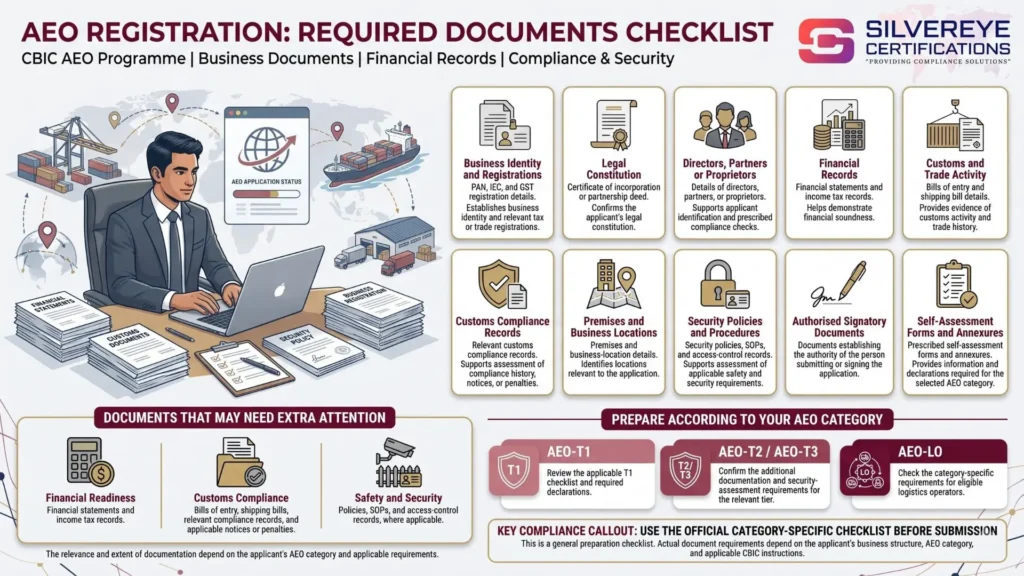
The standard T2/T3 applicant guide identifies Annexures A, B, C, D, E1, E2, E3, E4 and E5, with Annexure F for T3 business partner details. Eligible MSME T2 applicants use the simplified MSME annexures, including Annexure 3 for safety and security requirements.
Before submitting your application, download the latest forms and checklists from the AEO India Portal resources page. This helps ensure you use the correct documents for your tier and avoid preventable application delays.
AEO Documents Checklist by Tier: T1, T2, T3, LO and MSME
The AEO registration documents checklist depends on the applicant’s tier, business type and eligibility for MSME relaxations. Use the table below as a preparation guide, then confirm the exact requirements against the latest official applicant guide.
| Tier | Application forms or annexures | Supporting documents | Assessment approach |
|---|---|---|---|
| AEO-T1 | Annexure 1 and Annexure 2 | Core business documents, prescribed financial and solvency information, and compliance declarations | Primarily document-based |
| AEO-T2 | Annexures A, B, C, D and E.1–E.5 under the standard procedure | Business records, financial and solvency evidence, security plan, process map, site plan and relevant SOPs | Document review and premises verification |
| AEO-T3 | Standard T2 annexures plus Annexure F for business partner details | Supporting records required for T3, including evidence of eligibility and prescribed financial information | Detailed assessment and verification, as applicable |
| AEO-LO | Documents specified in the separate Logistics Operator applicant guide | Relevant business or operating licences, compliance records and applicable security documentation | Assessment under the LO procedure |
| MSME AEO-T1 | MSME Annexure 1 and MSME Annexure 2 | Valid MSME evidence and the prescribed business, compliance and financial documents | Simplified document-based process |
| MSME AEO-T2 | MSME Annexures 1, 2 and 3 | Valid MSME evidence, core business records and prescribed security information | Document review and security verification as applicable |
The standard T2/T3 applicant guide lists the relevant Annexures A–E, while Annexure F is used for T3 business partner details. The MSME route replaces the standard annexures with simplified forms for eligible applicants. AEO-LO applicants should use the separate LO guide rather than assume the standard T2/T3 annexure set applies.
Important: Annexure names, formats and portal instructions can change. Download the current versions from the official AEO India Portal resources page before filing.
AEO Registration Documents Explained: What Does Each Document Need to Show?
Annexure 1 and Annexure 2 (AEO-T1)
AEO-T1 applicants use Annexure 1 and Annexure 2 under the prescribed T1 application process. The portal’s applicant guide identifies these forms for collecting information about the applicant’s compliance history, legal compliance, commercial records and financial position.
The application may ask for information about customs and allied-law compliance, show-cause notices, contingent liabilities and relevant financial declarations. Applicants should ensure that every declaration is accurate and supported by records where required.
Annexures A to E (AEO-T2 and AEO-T3)
Under the standard application process, T2 and T3 applicants prepare a more detailed set of AEO application documents. The annexures cover the application itself, security arrangements, business processes, premises and compliance information.
| Annexure | Purpose |
|---|---|
| Annexure A | Application form |
| Annexure B | Security plan |
| Annexure C | Process map |
| Annexure D | Site plan |
| Annexure E.1 | General compliance |
| Annexure E.2 | Legal compliance |
| Annexure E.3 | Management of commercial and, where applicable, transport records |
| Annexure E.4 | Financial solvency |
| Annexure E.5 | Safety and security |
AEO-T3 applicants also provide Annexure F for business partner details under the standard procedure. Eligible MSME applicants should instead follow the simplified annexure requirements specified for their category.
Solvency Certificate: An Important AEO Registration Document
Financial solvency is an important part of the AEO assessment. Applicants must provide the financial information and declarations prescribed for their tier and application route.
Prepare the applicable financial statements, net-worth information and solvency certificate or other supporting evidence specified in the relevant checklist. The period covered and the required certifying professional may differ according to the applicant category and form.
Before filing, verify the required financial period, certificate format and authorised certifier in the current official guide. Avoid assuming that one solvency-certificate format is accepted for every AEO tier.
Import-Export Process Map
An import-export process map explains how your business manages a transaction, from receiving an order to customs clearance and record retention.
Depending on your business activities, it may show:
- Who receives and approves purchase or sales orders.
- Who prepares invoices and shipping documents.
- Who coordinates with the customs broker or other service providers.
- Who files customs documents and monitors cargo clearance.
- Who authorises cargo release and maintains the final records.
Keep the process map clear and consistent with your actual business operations and the relevant application declarations.
Site Plan
A site plan shows the layout of the relevant business premises, including operational areas that are important to the application.
Where required, identify the warehouse, cargo-handling area, access points, storage locations and other relevant facilities. The details should match the security plan and the premises being assessed.
Security Plan and SOPs (AEO-T2, AEO-T3 and AEO-LO, as applicable)
The security plan and supporting standard operating procedures explain how the business manages supply-chain risks and protects relevant operations. The exact requirements depend on the category and applicable checklist.
Areas to review may include:
- Premises security and access control: How entry to business and operational areas is managed.
- Cargo and container integrity: Procedures for handling, storing and protecting cargo.
- Personnel and visitor management: Relevant screening, identification and visitor records.
- IT and information security: Controls for protecting business and customs-related information.
- Written SOPs: Documented processes for cargo handling, customs compliance, record retention and responding to security incidents.
Document the controls your business actually follows. Where improvements are needed, address them before filing and ensure that the supporting documents reflect the implemented procedures.
Annexure F: Business Partner Details (AEO-T3)
Under the standard T3 application procedure, Annexure F covers relevant business partner information. Depending on your supply chain, this may include suppliers, transporters, customs brokers and other partners involved in international trade.
Prepare accurate details and supporting information requested by the current form. Ensure that the information is consistent with your business records and supply-chain arrangements.
AEO Registration Documents for MSMEs
CBIC introduced simplified AEO documentation and other relaxations for qualifying MSMEs through Circular No. 54/2020-Customs. The simplified annexures reduce the documentation burden for eligible applicants.
- MSME Annexure 1: General compliance.
- MSME Annexure 2: Legal compliance, management of commercial records and financial solvency.
- MSME Annexure 3: Safety and security requirements for eligible MSME AEO-T2 applicants.
Eligible MSME applicants may also benefit from relaxed customs-document thresholds and shorter processing targets under the applicable provisions. The published guidance specifies a minimum of 10 qualifying import/export documents, compared with the standard threshold of 25, subject to the prescribed conditions. Processing targets for complete MSME applications are 15 working days for T1 and three months for T2.
Keep your valid MSME or Udyam registration evidence ready when applying under the MSME route. Your business must continue meeting the applicable MSME conditions during the certification period to retain the relevant relaxations.
Final Document Check Before Filing
Before submitting your AEO application, confirm that:
- You have selected the correct AEO category.
- You are using the latest annexures for that category.
- Business names, PAN, IEC, GST and financial details are consistent.
- Financial and solvency documents cover the required period.
- Security and premises documents are complete where applicable.
- MSME documentation is valid if you are claiming the simplified route.
- Every required declaration is complete and signed by the authorised person.
For the latest application forms and instructions, refer to the official AEO India Portal. A complete, accurate application can help reduce avoidable clarification requests and processing delays.
Fees for AEO Registration Documents and Filing
The good news is that CBIC does not charge a government application fee for AEO registration. However, businesses may incur expenses while preparing the required documents, reviewing compliance procedures and implementing any necessary improvements.
| Cost item | Amount | What to know |
|---|---|---|
| CBIC application fee (T1, T2, T3 and LO) | Nil | No government application fee |
| Renewal fee | No government renewal fee specified in the AEO application guidance | Check the latest instructions for your category |
| CA or auditor services | Varies | Professional charges may apply for preparing financial or solvency documentation |
| Process map, site plan and SOP preparation | Varies | Can be prepared internally or with professional assistance |
| Security improvements (where applicable) | Depends on the premises | May be needed if existing controls do not meet the applicable requirements |
| Professional consultancy | Varies by scope | Compare the services included, not just the quoted price |
Before engaging a consultant, ask for a written scope covering document preparation, compliance review, application support and assistance with official queries. Separate professional charges from government fees.
AEO Certificate Validity
The validity period depends on the AEO category.
| AEO tier | Validity | Important note |
|---|---|---|
| AEO-T1 | 3 years | Subject to applicable annual self-declaration and continuation requirements |
| AEO-T2 | 3 years | Renewal requirements apply |
| AEO-T3 | 5 years | Renewal requirements apply |
| AEO-LO | 5 years | Renewal requirements apply |
Important: AEO-T1’s annual self-declaration should not be confused with a conventional renewal application. Under Circular No. 18/2021-Customs, T1 holders must follow the prescribed annual declaration process and applicable continuation requirements.
AEO Registration Renewal Documents: Timeline and Checklist
Businesses should monitor their certificate expiry dates and follow the renewal procedure applicable to their category. The commonly prescribed renewal windows are shown below; confirm the current requirements on the official portal before filing.
| AEO tier | Renewal route | When to apply |
|---|---|---|
| AEO-T1 | Annual self-declaration and applicable continuation or renewal procedure | Follow the annual declaration instructions; where a renewal application is required, check the prescribed deadline |
| AEO-T2 | Renewal application with updated supporting information | At least 60 days before expiry |
| AEO-T3 | Renewal application with updated supporting information | At least 90 days before expiry |
| AEO-LO | Renewal application with updated supporting information | At least 90 days before expiry |
Documents to Review Before Renewal
Prepare and update the documents required for your category:
- Latest annexures: Download the current forms from the AEO portal.
- Financial and solvency records: Update the financial statements and supporting evidence required under the applicable checklist.
- Process map and site plan: Reflect relevant changes to operations, premises or locations.
- SOPs and security plan: Update procedures if security arrangements, business processes or facilities have changed.
- Authorisation documents: Keep the details of the authorised signatory and AEO contact person current.
If your business changes its legal entity, ownership, address, premises or other relevant operational details, notify the appropriate AEO authority within the prescribed period. Do not wait until renewal to report a change that must be communicated earlier.
A Practical 4-Week Plan to Prepare Your AEO Registration Documents
This is a suggested internal schedule, not an official CBIC processing timeline. Adjust it to the size of your business and the complexity of your application.
| Week | Focus | Expected output |
|---|---|---|
| Week 1 | Legal and tax documents | Incorporation or registration proof, IEC, PAN, GST details, signatory authorisation and MSME evidence where applicable |
| Week 2 | Financial documents | Financial statements and the prescribed solvency evidence |
| Week 3 | Operational documentation | Process map, site plan, SOPs and applicable security documents |
| Week 4 | Final review and submission | Completed annexures, reconciled information and application submitted through the prescribed process |
Before submission, verify the document requirements for your selected tier and ensure that all information matches the relevant business and customs records.
Common Mistakes in AEO Registration Documents That Delay Applications
Incomplete or inconsistent records can lead to clarification requests and additional work during the assessment. Review these common issues before submitting your application.
- Outdated forms: Download the latest annexures and checklists from the official portal.
- Mismatched business details: Ensure the entity name, address and registration details are consistent across IEC, GST and incorporation records.
- Incomplete financial evidence: Check that the financial information covers the prescribed period and meets the applicable requirements.
- Security plans that do not reflect actual practice: Ensure documented procedures match the controls implemented at the premises.
- Unresolved compliance issues: Review relevant customs and other compliance matters and disclose information as required under the applicable criteria.
- Insufficient evidence for SOPs: Keep records, logs, approvals and other supporting evidence that demonstrate your procedures are followed.
A careful internal review before filing can help identify gaps early and reduce avoidable clarification requests.
Why Getting AEO Registration Documents Right Pays Off
Accurate, complete AEO registration documents help the customs team assess your application and may reduce delays caused by missing information. Once certified, eligible businesses can access facilitation benefits according to their category and the applicable conditions.
Potential benefits include:
- Faster customs clearance and reduced routine interventions, subject to risk-based controls.
- Reduced bank guarantee requirements for eligible activities, with benefits varying by tier and applicable exceptions.
- Deferred customs duty payment for eligible T2 importers under the notified facility.
- Improved supply-chain credibility with business partners that value documented customs compliance and security practices.
The benefits available depend on the AEO category, the transaction and current CBIC provisions. Confirm the applicable conditions before making business or financial decisions based on any individual benefit.
Get Your AEO Registration Documents Reviewed by Silvereye Certifications
Preparing accurate AEO registration documents can help reduce avoidable errors and clarification requests during the application process. Silvereye Certifications assists businesses with reviewing their documents against the applicable AEO annexures, identifying inconsistencies and organising the required paperwork for their selected tier.
From document checklist reviews and annexure preparation to compliance gap assessments and application support, our team can help you prepare your AEO documentation in line with the applicable requirements.
Contact Silvereye Certifications to discuss your AEO registration requirements and get your documents reviewed before submission.
Frequently Asked Questions
What documents are required for AEO registration in India?
AEO registration documents include incorporation proof, IEC, PAN, GST registration, audited financials and a solvency certificate. On top of that you file the annexures for your tier.
Which annexures does AEO-T1 need?
Annexure 1 and Annexure 2, as prescribed in Circular 26/2018-Customs.
Which documents are needed for AEO-T2, T3 and LO?
The AEO documents for higher tiers are Annexures A to E, a security plan, process map, site plan, SOPs and solvency proof. T3 adds Annexure F.
What is a solvency certificate for AEO?
A CFO declaration plus a Chartered Accountant certificate showing positive net worth for each year of the solvency period. T3 and LO need the statutory auditor.
Do MSMEs need fewer documents?
Yes. MSME AEO documents are lighter: MSME Annexures 1 and 2 for T1, and add Annexure 3 for T2, along with their MSME certificate.
Is there a government fee for AEO registration documents?
No. CBIC charges no filing or renewal fee. You pay only for your own preparation, CA certificates and any consultant.
Can I apply for AEO-T3 directly?
No. You need at least two years as an AEO-T2 holder first.
Where do I submit my AEO documents?
On the AEO portal, aeoindia.gov.in. Check the portal for any hard-copy instructions that apply to your tier.
How long is an AEO certificate valid?
Three years for T1 and T2, five years for T3 and LO.
How does AEO-T1 renewal work?
Eligible T1 holders can use auto-renewal by filing an annual self-declaration, under Circular 18/2021-Customs.
What happens if my solvency certificate shows negative net worth?
It is a serious problem. Resolve it with your CA and wait until your finances support a clean certificate before applying.
Can I use old AEO documents or annexure templates?
No. Use the current forms from the portal, because older formats can be sent back for re-upload.