
- Plastic feeding bottles must conform to IS 14625:2015 and use materials permitted by the standard, including PP, PES, and other approved polymers.
- Key tests include wall thickness, capacity, transparency, leakage, drop resistance, and compressive deformation resistance, along with other applicable safety and performance tests.
- Manufacturers must maintain suitable in-house testing facilities and provide the required test evidence. BIS-recognised laboratory reports may also be required as part of the certification process.
- BIS certification timelines vary depending on application completeness, inspection, testing, and verification. Domestic applications and foreign manufacturers applying under FMCS should confirm current processing estimates directly with BIS rather than relying on fixed 30- or 180-working-day promises.
Introduction
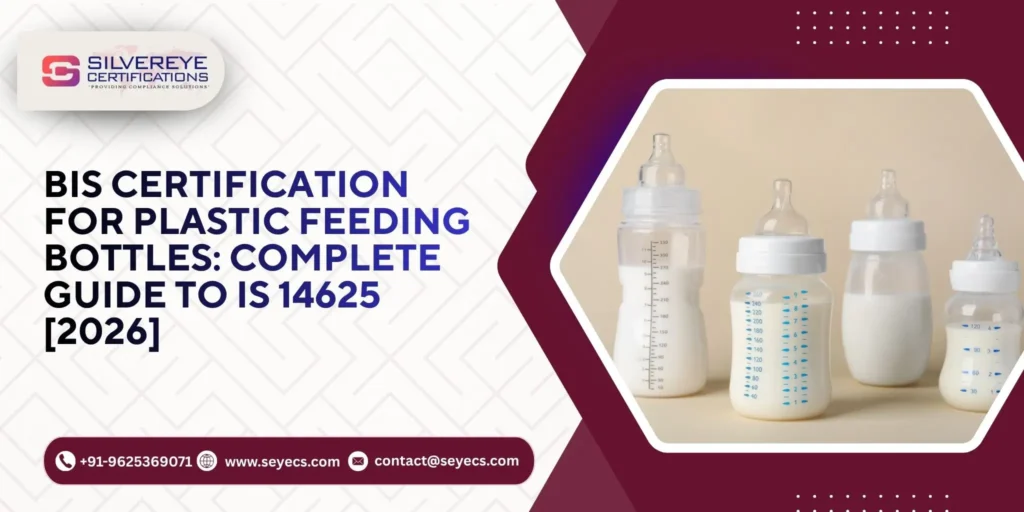
BIS certification for plastic feeding bottles is mandatory in India under IS 14625:2015. The standard covers bottles made from polypropylene (PP), polyethersulfone (PES), and other permitted olefin-based polymers. It specifies requirements for material safety, wall thickness, capacity, transparency, leakage, drop resistance, ageing resistance, and compressive deformation resistance.
Manufacturers must maintain the required manufacturing and testing facilities, submit representative samples for testing, and complete the applicable BIS Scheme-I (ISI Mark Scheme) certification process through the Manakonline portal. BIS evaluates the application, product test results, and manufacturing facilities before granting a license.

Certification timelines vary depending on the application, testing, inspection, and verification process. Domestic manufacturers and foreign manufacturers applying under the Foreign Manufacturers Certification Scheme (FMCS) should confirm current processing timelines directly with BIS rather than relying on fixed 30- or 180-working-day estimates.
What Is BIS Certification for Plastic Feeding Bottles?
BIS certification for plastic feeding bottles is the mandatory product certification required for applicable plastic feeding bottles in India. It is based on IS 14625:2015 — Plastics Feeding Bottles, which specifies requirements for materials, dimensions, physical properties, safety, testing, packaging, and marking.
The standard helps ensure that plastic feeding bottles meet prescribed quality and safety requirements for their intended use. Manufacturers must comply with the applicable standard and amendments before obtaining the necessary BIS licence under Scheme-I (ISI Mark Scheme).

After BIS grants the license, the manufacturer can use the ISI Standard Mark in accordance with the license conditions and applicable marking requirements. The mark and license details help buyers identify products covered by BIS certification.
Scope and Approved Materials Under IS 14625
IS 14625:2015 specifies the materials and product requirements applicable to plastic feeding bottles. Manufacturers should verify that their proposed material is listed in the standard's permitted materials and complies with the relevant specifications.
- Approved materials: Polypropylene (PP), polyethersulfone (PES), and other materials permitted under the applicable standard and its annexes.
- Body finish: Bottles must meet the prescribed requirements for manufacture, workmanship, finish, and appearance.
- Bottle capacity: Nominal capacity, brim capacity, and capacity markings must comply with the applicable standard.
- Accessories: Caps, stoppers, and other components must meet the requirements applicable to their use and scope. Feeding teats may be subject to separate applicable specifications.
- Printing and marking: Printed containers, labels, and product markings must meet the relevant requirements of the applicable standard and certification scheme.
Important: Do not assume that every plastic resin is permitted. Confirm the exact material specifications and any applicable amendments before finalising the product design or submitting samples.
Why Is BIS Certification Mandatory for Plastic Feeding Bottles?
Plastic feeding bottles come into contact with milk and are exposed to repeated cleaning and sterilisation. Compliance with the applicable Indian Standard helps assess whether these products meet prescribed material-safety and performance requirements.
Key Reasons for Certification
- Material safety: The bottle material must comply with the applicable material specifications and chemical-safety requirements.
- Ageing resistance: Testing evaluates the bottle's performance under the conditions prescribed by the standard.
- Leakage resistance: The leakage test checks the bottle's performance against the specified requirements.
- Impact resistance: The drop test assesses resistance to damage under the prescribed test conditions.
- Capacity accuracy: Capacity requirements help ensure that the bottle's declared and measured capacities comply with the standard.
- Structural strength: Compressive deformation testing evaluates the bottle's resistance to the specified compression forces.
IS 14625:2015 — Key Requirements and Tests
| Requirement or Test | Purpose |
|---|---|
| Material identification | Verifies that the material meets the applicable requirements |
| Wall thickness | Checks compliance with specified thickness requirements |
| Capacity | Verifies nominal and brim capacity |
| Transparency | Assesses visibility through the bottle as prescribed |
| Leakage test | Checks leakage performance |
| Drop test | Evaluates resistance to impact under specified conditions |
| Ageing resistance | Evaluates performance after the prescribed ageing procedure |
| Compressive deformation resistance | Assesses structural performance under compression |
| Migration and chemical-safety tests | Evaluate compliance with applicable chemical-safety limits |
| Permanency of pigment | Assesses the durability of applicable pigments and markings |
This table is a summary, not a substitute for the full standard. Exact test methods, acceptance limits, and testing frequencies must be checked against the latest applicable edition, amendments, and BIS Scheme of Inspection and Testing.
Manufacturers should also maintain the required in-house laboratory facilities, suitable testing equipment, calibration records, and quality-control documentation in accordance with the applicable BIS certification requirements.
Who Needs BIS Certification for Plastic Feeding Bottles?
BIS certification for plastic feeding bottles is relevant to manufacturers and businesses involved in producing or importing these products for the Indian market.
- Domestic manufacturers: Indian manufacturers producing plastic feeding bottles covered by IS 14625:2015 must obtain the applicable BIS licence before marketing products where certification is mandatory.
- Foreign manufacturers: Overseas manufacturers exporting plastic feeding bottles to India must apply under the Foreign Manufacturers Certification Scheme (FMCS) where applicable and nominate an Authorised Indian Representative (AIR).
- Private-label and D2C brands: Businesses selling bottles under their own brand should verify the manufacturer's BIS licence, product scope, and applicable brand-related documentation requirements.
- Importers and distributors: Importers must ensure that products subject to mandatory BIS certification are covered by a valid license. An importer cannot simply substitute its own application for the foreign manufacturer's FMCS application.
- E-commerce sellers: Sellers should verify that listed products comply with applicable mandatory certification and marketplace requirements, including valid licence details where required.
BIS certification is generally granted to the manufacturer for a specified product and manufacturing premises, rather than automatically to every importer, distributor, or retailer.
Eligibility Criteria for BIS Certification of Plastic Feeding Bottles
Manufacturers applying for a BIS license under IS 14625:2015 should assess the following requirements before applying.
- Eligible manufacturer: The application must relate to the actual manufacturing unit producing the plastic feeding bottles.
- Manufacturing facilities: The factory must have the required machinery, production infrastructure, and process controls.
- Approved materials: The product must use materials that comply with the applicable requirements of IS 14625:2015 and its amendments.
- In-house laboratory: The manufacturing unit must maintain suitable testing facilities, equipment, competent personnel, and calibration arrangements as prescribed by the applicable BIS product manual.
- Product testing: Samples must undergo the testing required by BIS for the relevant product and material types.
- Quality-control system: The manufacturer must maintain test records and follow the applicable Scheme of Inspection and Testing (SIT).
- Foreign manufacturers: Overseas applicants must meet FMCS requirements, including the appointment of an eligible Authorised Indian Representative (AIR).
Important: A GST registration or company incorporation certificate alone does not establish eligibility for a BIS license. BIS assesses the manufacturer's facilities, testing capabilities, and conformity with the applicable Indian Standard.
Documents Required for BIS Certification of Plastic Feeding Bottles
Preparing the relevant documents in advance can help reduce avoidable delays during the BIS application and inspection process.
| Document Category | Documents or Information to Prepare |
|---|---|
| Business details | Manufacturer's legal name, business address, and applicable registration documents |
| Authorised signatory | Identity and authorisation documents required for the application |
| Factory details | Manufacturing address, factory layout, machinery details, and production-process information |
| Raw materials | Material specifications, supplier details, and test certificates where applicable |
| Product technical file | Product specifications, capacities, design drawings, and material details |
| Testing facilities | Laboratory equipment list, calibration records, and testing personnel details |
| Test evidence | Samples and test reports required under the applicable BIS procedure |
| Product marking | Proposed product markings, packaging artwork, and required licence information |
| Accessories, where applicable | Relevant component specifications, supplier documentation, and certification evidence |
| FMCS application | Overseas factory details, AIR nomination documents, and other prescribed FMCS documents |
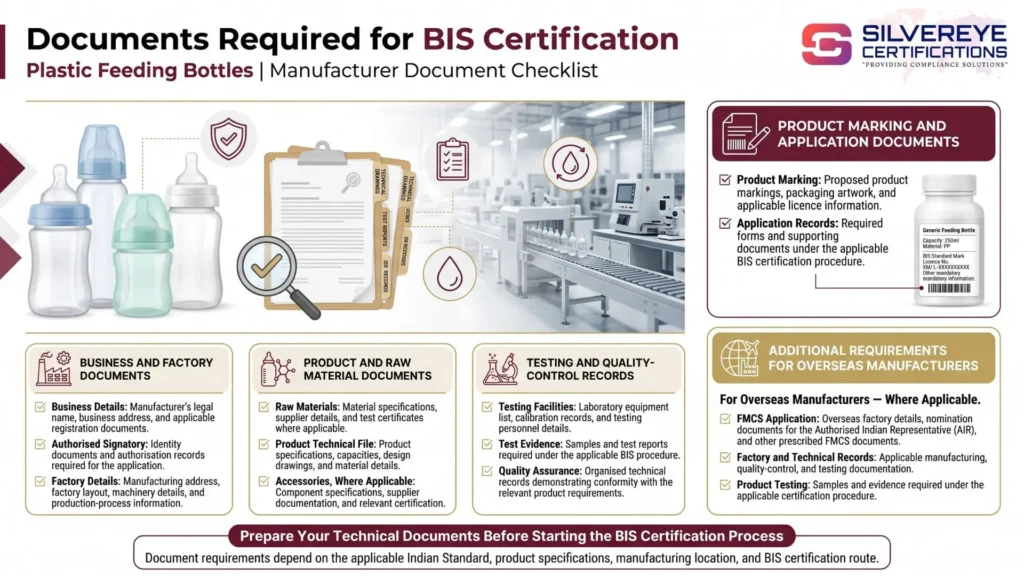
The final checklist depends on the applicable BIS procedure, the manufacturer's location, and the proposed product scope. Use the current product manual and application instructions rather than treating this table as an exhaustive statutory checklist.
Step-by-Step BIS Certification Process for Plastic Feeding Bottles
The following steps outline the general process for obtaining a BIS license for plastic feeding bottles.
- Confirm the applicable standard: Review IS 14625:2015, its current amendments, and the applicable certification requirements.
- Verify material compliance: Confirm that the proposed bottle material meets the relevant material specifications.
- Prepare the factory and laboratory: Ensure that manufacturing machinery, testing equipment, quality-control procedures, and calibration arrangements meet BIS requirements.
- Compile the technical documents: Prepare factory details, product specifications, material information, and the other prescribed documents.
- Arrange product testing: Identify the testing route and submit the required samples for testing in accordance with BIS instructions.
- Submit the application online: Apply through the BIS Manakonline portal under the applicable Scheme-I procedure. Foreign manufacturers must follow the FMCS application route.
- Complete factory assessment: BIS evaluates the manufacturing facilities, testing capabilities, quality controls, and conformity of the product with the relevant standard.
- Resolve observations: Respond to queries and address any deficiencies identified during the application review, testing, or inspection.
- Obtain the BIS licence: BIS may grant the licence once the applicable requirements are satisfied. The licence specifies the authorised product scope and conditions for using the ISI Standard Mark.
- Maintain ongoing compliance: Conduct prescribed inspections and tests, maintain quality-control records, and comply with applicable surveillance and licence-renewal requirements.
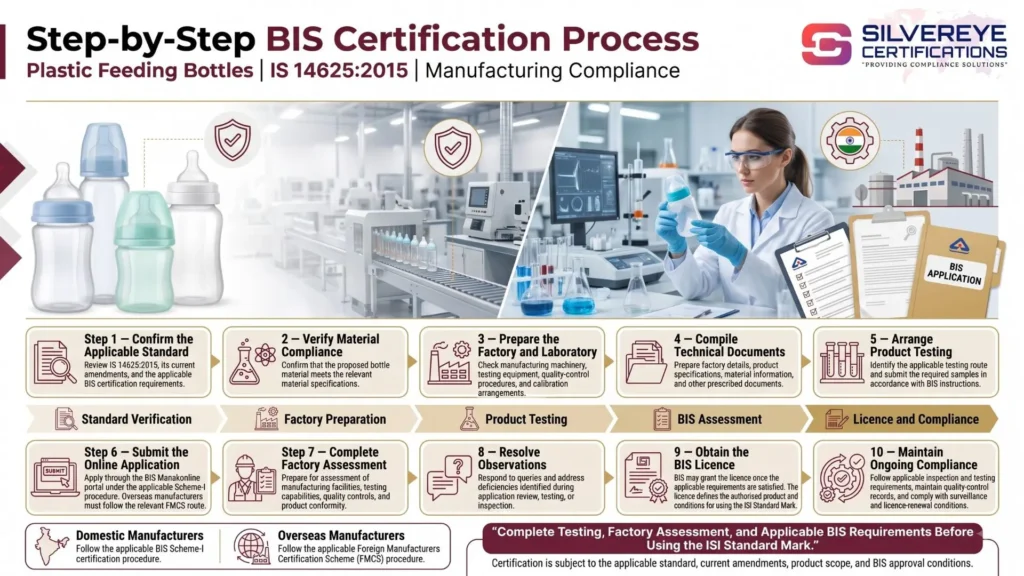
BIS states that certification depends on assessing manufacturing infrastructure, process controls, quality controls, testing capabilities, and product conformity. Applications and payments are accepted online for the domestic product-certification process.
For foreign manufacturers: BIS's published FMCS guidance states that applications must be submitted online from 1 June 2026. Check the current FMCS instructions for the applicable submission procedure.
BIS Certification Fees for Plastic Feeding Bottles: Approximate Cost Breakdown
The cost of BIS certification for plastic feeding bottles depends on the applicable certification requirements, laboratory testing, manufacturing facilities, and the number of product variants included in the application.
| Cost Component | What It Covers |
|---|---|
| BIS application fee | Government fee applicable to the certification application |
| Laboratory testing | Charges for testing samples against the applicable requirements of IS 14625 |
| In-house laboratory setup | Equipment, calibration, and testing facilities required under the applicable BIS product manual |
| Factory inspection | Applicable inspection charges, including overseas inspection costs under FMCS where relevant |
| Licence and marking fees | Applicable fees for grant, renewal, and use of the ISI Standard Mark |
| Consultancy charges | Optional professional assistance with documentation, testing coordination, and inspection preparation |
The total certification cost varies by manufacturer and application. Laboratory charges may differ by facility and test scope, while laboratory equipment can represent a separate investment.
Before budgeting, check the latest BIS fee schedule, the applicable marking-fee requirements, and the testing charges listed in the BIS Laboratory Information Management System (LIMS). Consultancy fees are separate from government charges.
Timeline: How Long Does BIS Certification for Plastic Feeding Bottles Take?
The time required to obtain BIS certification for plastic feeding bottles depends on application completeness, sample testing, factory inspection, and the resolution of any non-conformities.
Domestic manufacturers should prepare their manufacturing facilities, laboratory equipment, product documentation, and quality-control records before applying. Foreign manufacturers applying through the Foreign Manufacturers Certification Scheme (FMCS) should also allow time for overseas factory assessment and completion of the applicable AIR requirements.
The commonly quoted timelines of 30 working days for domestic applications and up to 180 working days for FMCS applications should be treated as estimates, not guaranteed approval periods. Confirm current processing guidance with BIS before committing to a launch date.
Common causes of delay include:
- Material non-compliance: The proposed polymer does not meet the applicable requirements of IS 14625.
- Incomplete laboratory facilities: Required testing equipment, calibration, or records are missing.
- Failed sample testing: The product does not meet one or more applicable requirements.
- Incomplete documentation: Factory, material, or product details require correction.
- Inspection observations: Manufacturing or quality-control deficiencies need to be addressed.
Validity and Renewal of BIS Certification for Plastic Feeding Bottles
A BIS license for plastic feeding bottles remains subject to the validity period and conditions specified by BIS. Manufacturers must renew the license as required to continue using the ISI Standard Mark legally.
To maintain certification:
- Monitor the licence expiry date and begin renewal preparations well in advance.
- Maintain updated production records, laboratory test results, and quality-control documentation.
- Keep manufacturing and testing facilities compliant with the applicable BIS requirements.
- Submit renewal documents and applicable fees within the prescribed period.
- Cooperate with applicable BIS surveillance, inspection, and market-sample testing.
Manufacturers must not use the ISI Standard Mark outside the scope or validity of their licence. Manufacturing, importing, or selling products in violation of applicable mandatory certification requirements can lead to regulatory action under the relevant law.
Benefits of BIS-Certified Plastic Feeding Bottles
- Product safety and conformity: Certification demonstrates conformity with the applicable requirements of IS 14625 within the scope of the licence.
- Legal market access: Helps manufacturers and businesses meet the mandatory certification requirements applicable to plastic feeding bottles in India.
- Retail and marketplace readiness: Supports compliance checks by distributors, retailers, and e-commerce platforms.
- Consumer confidence: The authorised ISI Standard Mark helps consumers identify products covered by BIS certification.
- Brand credibility: Demonstrates a manufacturer's commitment to product conformity and documented quality control.
Certification does not eliminate every product risk, but it provides an established conformity-assessment framework for products covered by the applicable Indian Standard.
How Plastic Feeding Bottle Certification Differs From Glass Feeding Bottle Certification
Manufacturers producing both plastic and glass feeding bottles must consider the separate standards applicable to each product type.
| Comparison | Plastic Feeding Bottles | Glass Feeding Bottles |
|---|---|---|
| Applicable Indian Standard | IS 14625:2015, subject to applicable amendments | IS 5168:2018 |
| Main material | Permitted plastics, including applicable PP and PES grades | Glass conforming to the applicable material requirements |
| Key testing areas | Material conformity, dimensions, leakage, impact, and other prescribed performance requirements | Material conformity, dimensions, capacity, thermal shock resistance, and other prescribed requirements |
| Certification route | Applicable BIS Scheme-I requirements | Applicable BIS Scheme-I requirements |
A manufacturer seeking certification for both product categories must meet the product-specific technical requirements applicable to each standard. The exact application scope and licence arrangements should be confirmed with BIS.
Consequences of Selling Non-Certified Plastic Feeding Bottles
Plastic feeding bottles covered by mandatory BIS certification requirements must comply with the applicable certification provisions before being manufactured, imported, or sold in India.
Failure to comply may lead to regulatory action, penalties, restrictions on sale, or other consequences under applicable law. The precise consequences depend on the nature of the violation and the relevant statutory provisions.
Businesses should verify the manufacturer's licence and ensure that the product falls within its authorised scope. Importers, distributors, and online sellers should also confirm that their products meet the applicable requirements before placing them on the market.
BIS compliance is an ongoing responsibility, not merely a one-time application. Manufacturers must continue to meet applicable product, testing, marking, and licence conditions.
Silvereye Certifications: BIS Certification Support for Feeding Bottles
Obtaining BIS certification for plastic feeding bottles requires careful preparation of product specifications, material documentation, laboratory facilities, and manufacturing quality-control records.
Silvereye Certifications can support manufacturers and businesses with:
- Material and standard guidance: Reviewing proposed materials against the applicable standard requirements.
- Documentation support: Organising product specifications, factory information, material declarations, and other required documents.
- Laboratory coordination: Helping prepare for applicable product testing and understand testing requirements.
- Inspection preparation: Reviewing manufacturing facilities, testing arrangements, and quality-control records before assessment.
- Renewal and compliance support: Helping businesses track licence validity and prepare for applicable renewal and surveillance requirements.
For businesses manufacturing both plastic and glass feeding bottles, support may also cover the separate requirements of IS 14625 and IS 5168, as applicable.
The final certification decision rests with BIS, based on the applicable requirements and assessment results.
Conclusion
BIS certification for plastic feeding bottles requires conformity with IS 14625, suitable manufacturing and testing facilities, product testing, and compliance with the applicable certification scheme.
Before applying, manufacturers should verify their raw materials, prepare the required laboratory facilities, organise their documentation, and confirm current fees and processing guidance with BIS.
With appropriate preparation and ongoing quality control, businesses can reduce avoidable application delays and maintain compliance throughout the licence period. Silvereye Certifications can assist with documentation, testing coordination, inspection preparation, and renewal planning.
Frequently Asked Questions
Is BIS certification mandatory for plastic feeding bottles in India?
Yes. Plastic feeding bottles must be certified under IS 14625:2015 through BIS's ISI Mark Scheme-I before they can be manufactured, imported, or sold in India.
What materials are approved under IS 14625 for feeding bottles?
Only food-grade virgin polypropylene (PP), polyethersulfone (PES), or another approved olefin-based polymer/co-polymer listed in Annex-A of IS 14625:2015 can be used for the bottle body.
What tests does a plastic feeding bottle undergo for BIS certification?
Key tests include wall thickness, capacity accuracy, transparency, leakage, drop test, compressive deformation, and permanency of pigment, along with material safety and ageing/heat resistance checks.
How long does BIS certification for plastic feeding bottles take?
Domestic manufacturers typically get certified in around 30 working days. Foreign manufacturers applying under FMCS should plan for up to 180 working days, since it includes an overseas factory audit.
Is an in-house testing lab compulsory for plastic feeding bottle certification?
Yes. Manufacturers are expected to maintain an in-house lab capable of running routine/daily tests such as wall thickness, capacity, transparency, leakage, drop, and compressive deformation testing.
What documents are required for BIS certification of plastic feeding bottles?
Business registration proof, authorized signatory ID, factory and in-house lab details, material declaration with raw-material certificates, a valid test report from a BIS-recognized lab, and label artwork.
Is a factory audit compulsory for plastic feeding bottle BIS certification?
Yes. BIS conducts a factory audit to check manufacturing capability, raw-material handling, in-house lab equipment, and quality control before granting the licence.
Can a foreign manufacturer get BIS certification for plastic feeding bottles?
Yes, through the Foreign Manufacturers Certification Scheme (FMCS), which requires an overseas factory audit and an Authorised Indian Representative (AIR) based in India.
Do I need a separate certification for glass feeding bottles?
Yes. Glass feeding bottles are certified separately under IS 5168:2018, which tests thermal shock resistance, breakage strength, and lead-free glass — different from the polymer-focused tests under IS 14625.
What happens if I sell plastic feeding bottles without BIS certification?
It is non-compliant with the BIS Act, 2016, and can lead to seizure of stock, penalties, delisting from e-commerce marketplaces, and reputational damage in a trust-sensitive category like infant products.
How much does BIS certification for plastic feeding bottles cost?
Costs include the application fee, external lab testing charges, in-house lab equipment investment, factory audit fee, and annual minimum licence/marking fee. Confirm current figures with BIS or a certification consultant, since they vary by variant and lab.
Can Silvereye Certifications help with plastic feeding bottle certification?
Yes, Silvereye Certifications supports manufacturers and importers with material guidance, documentation, in-house lab setup coordination, factory audit readiness, and renewal support for BIS certification under IS 14625 (and IS 5168 for glass bottles).