
- Start online: Begin your AEO registration through the official AEO India Portal. Keep your registered business details and contact information ready.
- Follow the correct filing process: The application procedure varies by AEO category. Follow the latest portal instructions for AEO-T1, AEO-T2 and AEO-T3, including any prescribed physical submission or verification requirements.
- No government application fee: CBIC does not charge a government application fee for AEO certification. Processing time depends on the tier, completeness of documents and applicable assessment procedure.
- Respond promptly to queries: Submit the requested documents and clarifications through the prescribed channel within the specified deadline to avoid unnecessary delays.
How Does the AEO Registration Process Work?
The AEO registration process in India begins with creating an applicant account on the official AEO India Portal. Applicants must provide the required business details, verify their contact information and submit the application for the appropriate AEO category. The portal provides a guided application process, document-upload facilities and application tracking.
The documents, compliance checks and verification requirements depend on whether you are applying for AEO-T1, AEO-T2, AEO-T3 or AEO-LO. There is no government application fee for AEO certification. The portal indicates that eligible T1 applications can be processed within 30 days after complete information and documents are submitted. T2 applications follow a staged review and verification process, while eligible T3 applications may qualify for a shorter timeline under the applicable conditions. If approved, the applicant receives the certificate and must comply with the applicable validity, renewal and post-certification requirements.
What Does AEO Registration?
The term AEO registration is commonly used in two ways. First, it refers to creating an account on the official AEO portal. Second, it refers to the complete process of applying for and obtaining Authorised Economic Operator (AEO) status.
This guide focuses on the full application journey, including portal registration, eligibility checks, document preparation, application submission and follow-up after filing.
If you want to understand AEO status, its benefits and the differences between the available tiers, read our AEO Certification Guide first. This page focuses on the practical steps involved in applying.
Before You Start AEO Registration: Readiness Checklist
Before beginning the application, review your customs activity, business history, financial records and applicable compliance requirements. The eligibility criteria differ by applicant category, and specific relaxations are available to qualifying MSMEs.
| Check | Standard applicant | Eligible MSME applicant |
|---|---|---|
| Customs documents during the preceding financial year | Generally at least 25 import/export documents, subject to the applicable criteria | At least 10 documents, including at least 5 in each half-year period, under the applicable MSME relaxation |
| Business history | Generally 3 preceding financial years, subject to the applicable category and rules | Generally 2 preceding financial years under the applicable MSME relaxation |
| Financial and legal compliance | Review the prescribed assessment period and supporting records | A reduced assessment period may apply under the MSME provisions |
| MSME status | Not applicable | Valid evidence of MSME status, where required for the relaxation |
| IEC and contact details | Required for relevant importers and exporters | Required for relevant importers and exporters |
The document thresholds and reduced assessment periods above reflect the published MSME relaxations. Eligibility must still be checked against the current CBIC circular and the requirements for the specific AEO tier.
Quick check: Make sure your IEC details and registered contact information are accurate and accessible. Keep the IEC certificate and other documents requested by the portal ready before creating your account.
Types of AEO Registration
The application requirements differ according to the applicant’s business activity and the AEO category. The current portal provides a guided application journey, while tier-specific guides and checklists explain the supporting documents and assessment requirements.
| Tier | Who can apply | Application and assessment |
|---|---|---|
| AEO-T1 | Eligible importers and exporters | Online application with the prescribed T1 information and supporting documents |
| AEO-T2 | Eligible importers and exporters meeting the higher-tier criteria | Application review, detailed compliance assessment and premises verification under the applicable procedure |
| AEO-T3 | Eligible existing AEO-T2 holders who meet the prescribed conditions | Application and assessment under the T3 requirements, including applicable conditions relating to continuous T2 status |
| AEO-LO | Eligible logistics service providers, custodians, terminal operators, customs brokers and warehouse operators | Separate logistics-operator application and verification process |
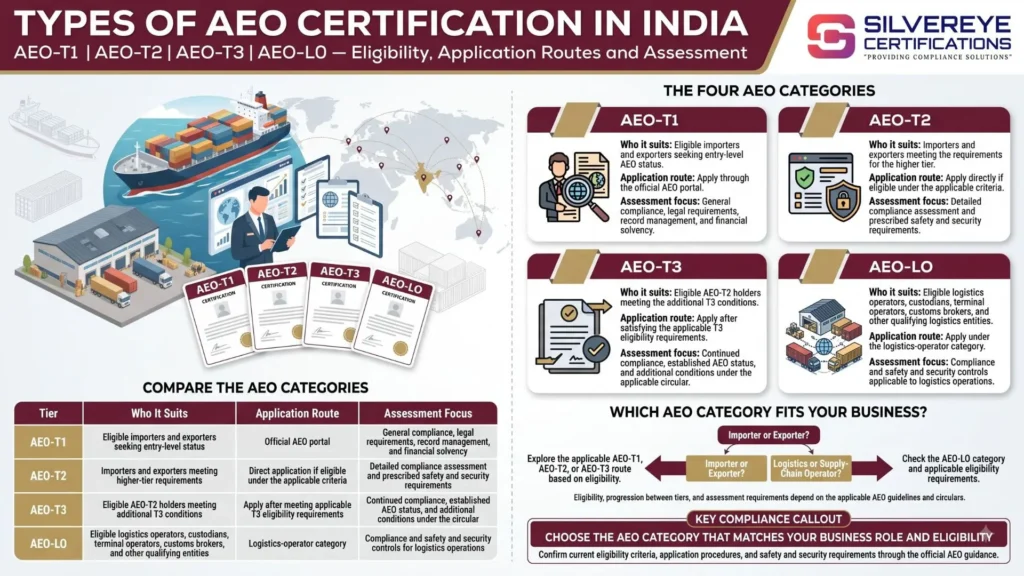
Important: Do not assume that all tiers follow the same registration or verification steps. Check the latest applicant guide for your category before filing, particularly if the portal specifies additional verification or submission requirements.
Step-by-Step AEO Registration Process on the AEO Portal
Follow these steps to prepare and submit your application. The exact screens and requirements may vary by category and portal updates.
- Open the official portal. Visit the AEO India Portal and select the applicant registration or application option.
- Complete applicant registration. Enter the requested business information, including the legal entity name, IEC details and other required fields. Ensure the information matches the relevant official records.
- Verify your contact details. Complete the prescribed OTP or other verification steps. Use an authorised email address and mobile number that your business can access.
- Wait for registration verification, where applicable. Follow the portal instructions and respond to any request for clarification. Some applicant categories require verification before the application can be filed. For AEO-LO, the official user guide specifically states that zonal officials verify the registration details before the applicant can submit the LO application.
- Select the appropriate AEO category. Choose AEO-T1, AEO-T2, AEO-T3 or AEO-LO, according to your eligibility and business activity.
- Prepare the required forms and annexures. Download the latest category-specific documents from the official AEO resources page. Check that your declarations, business details and supporting records are complete and consistent.
- Submit the application using the prescribed procedure. Complete the online fields and upload the required documents. If the current instructions for your category require an additional physical submission or another procedural step, follow those instructions.
- Track the application and answer queries. Use the portal’s application-management facilities to monitor progress and provide additional information or documents when requested. Respond within the deadline communicated by the AEO team.
- Receive the decision. The competent authority reviews the application and communicates its decision through the prescribed channel. If approved, retain your certificate and note the applicable validity, annual declaration and renewal obligations.
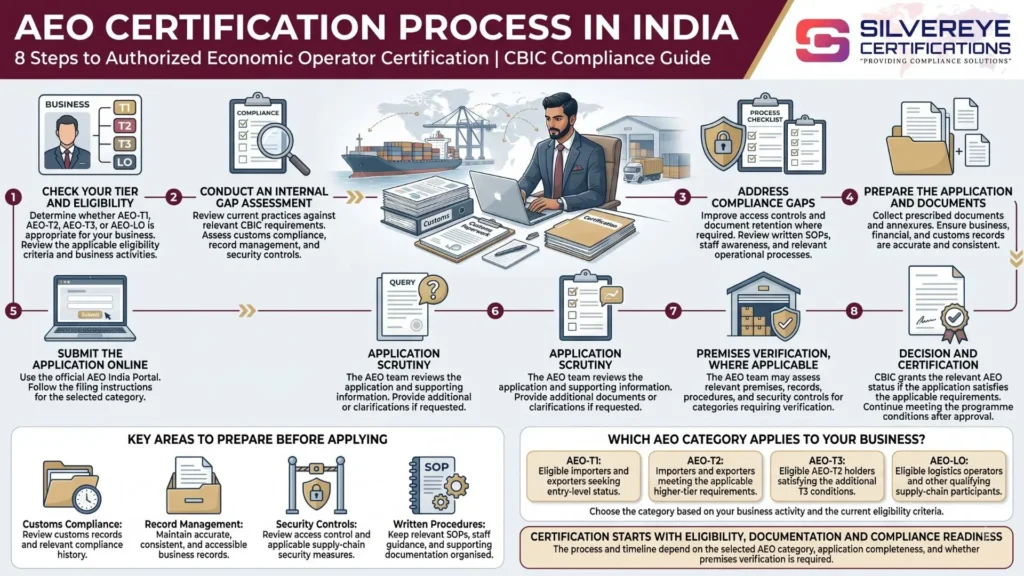
Final tip: Always use the latest instructions on the AEO India Portal rather than relying on older screenshots or guides. Application procedures can change, and completing each step according to the current instructions helps reduce avoidable delays.
How to File AEO-T1 Registration Online
AEO-T1 registration is completed online through the official AEO India Portal. Applicants must fill in the prescribed application details, provide supporting information and submit the required annexures.
For standard T1 applicants, the application uses Annexure 1 and Annexure 2. Eligible MSME applicants should use the simplified MSME annexures specified in the applicable CBIC instructions.
Keep the following information and documents ready, as applicable:
- IEC details and IEC certificate: Provide the Importer Exporter Code and the supporting document requested by the portal.
- GST registration details: Keep your GSTIN and relevant registration information available.
- Company registration and PAN: Provide the applicable incorporation or constitution documents and PAN details.
- Previous AEO application details: If an earlier application was rejected, review the rejection communication and disclose or attach it where required.
- Compliance declarations: Complete the prescribed declarations covering general compliance, legal compliance, commercial and transport records, and financial solvency.
Review the information carefully before submitting the application. Eligible MSME applicants should confirm their MSME status and use the correct simplified forms. Follow the latest instructions on the official AEO India Portal.
How to File AEO-T2 and AEO-T3 Registration
The official AEO-T2/T3 applicant guide describes a process in which applicants prepare their documents under Circular No. 33/2016-Customs, as amended, and submit the application documents to the jurisdictional AEO Cell. They then enter the required application and submission details on the portal for tracking.
Online Entries After Physical Submission
The portal guide lists the following details for tracking a T2/T3 application:
- Application date: The date of the application.
- Date and time of submission to the zone: When the physical application was submitted.
- Receiving officer’s details: Name and designation of the officer who received the application.
- Earlier AEO certificate number: Required for applicants applying for T3 who already hold AEO status.
- Additional information: Any other relevant details to communicate to the AEO Cell.
Follow the current portal guide and the instructions of your jurisdictional AEO Cell before submitting documents, as application procedures may be updated.
Annexures for AEO-T2 and AEO-T3
The standard T2/T3 applicant guide identifies the following annexures. Requirements may differ for eligible MSME applicants under the simplified procedure.
| Annexure | What it covers |
|---|---|
| Annexure A | Application form |
| Annexure B | Security plan |
| Annexure C | Process map |
| Annexure D | Site plan |
| Annexure E1 | General compliance |
| Annexure E2 | Legal compliance |
| Annexure E3 | Management of commercial and transport records |
| Annexure E4 | Financial solvency |
| Annexure E5 | Safety and security requirements |
| Annexure F | Business partner details; applicable to AEO-T3 under the standard procedure |
For the standard T2/T3 process, upload the required completed annexures and supporting documents as instructed by the portal after submitting the physical application. You can then monitor progress through the relevant application-view section.
AEO-LO Registration for Logistics Operators
AEO-LO registration is intended for eligible logistics operators and other qualifying participants in the international supply chain, including custodians, terminal operators, customs brokers and warehouse operators.
The official LO registration guide describes the following process:
- Register on the AEO portal and enter the required business and contact details.
- Verify your contact information using the prescribed OTP process.
- Wait for registration verification. The relevant zonal officials review the registration details.
- Access the LO application after registration verification is successful.
- Complete the LO application and provide the prescribed operational, compliance and security information.
- Complete the applicable assessment. Customs may verify the relevant premises and security arrangements as part of the assessment.
The portal does not allow an applicant to file the LO application until registration verification is complete. If registration is rejected, the applicant receives a notification and can correct the stated issues before registering again.
Before filing: Download the latest tier-specific checklist and applicant guide from the AEO India Portal resources page. This is particularly important for MSMEs, whose simplified annexures differ from the standard application documents.
What Happens After You File: Scrutiny, Deficiencies and Verification
Submitting your application is only one stage of the AEO registration process. After filing, the AEO team reviews your documents, checks eligibility and may request additional information before making a decision.
- Desk scrutiny: The AEO team checks whether your application is complete and whether the information is consistent with the applicable eligibility requirements.
- Deficiency notice: If information or documents are missing, you may receive a notification through your registered email address or another prescribed communication channel.
- Submit your reply: Use the portal’s Additional Documents option when it becomes available for your application. Provide the requested documents and clarifications within the specified period.
- Premises verification: Physical verification may be required for AEO-T2, AEO-T3 and AEO-LO applications, depending on the applicable procedure and category.
- Decision: Check the application dashboard for the current status. If approved, the certificate is issued through the prescribed process; if rejected, the applicant is informed accordingly.
Important: The official T2/T3 user guide specifically instructs applicants to upload deficiency documents through the portal, even if the same documents have already been sent by email or submitted physically. Without the required portal upload, the application may not return to the customs officer’s dashboard for further processing.
How Long Does AEO Registration Take?
The time required for AEO certification depends on the selected category, document completeness, responses to queries and verification scheduling. The current AEO India Portal publishes the following indicative processing stages and targets. These are not guarantees of approval by a fixed date.
| Application | Published target or process |
|---|---|
| AEO-T1 | Certificate within 30 days after complete information and documents are submitted |
| AEO-T2 | Staged process involving scrutiny, team assignment, premises verification, report preparation and decision |
| AEO-T3 | A 30-day timeline may apply to eligible applicants with continuous T2 status for at least two years, subject to significant changes and applicable conditions |
| AEO-LO | Staged process involving scrutiny, verification where applicable, recommendations and a decision |
Additional timelines for eligible MSMEs
The official portal specifies separate targets for qualifying MSME applicants:
- AEO-T1: 15 working days after submission of complete documents.
- AEO-T2: Three months after submission of complete documents.
These are priority-processing targets under the applicable MSME provisions. Applicants should confirm eligibility for the relaxation and check the latest portal guidance before relying on the timeline.
Documents Needed for AEO Registration
The required documents depend on the applicant’s AEO category and whether the standard or an eligible MSME application route applies. Use the current category-specific checklist rather than treating the following list as exhaustive.
- Business registration and PAN: Incorporation certificate or other proof of legal constitution, along with PAN details.
- IEC and GST information: Relevant IEC and GST registration records for importers and exporters.
- Customs activity records: Bills of entry, shipping bills or other evidence required to establish the applicable trade-document threshold.
- Financial and solvency records: Financial statements, tax records and the prescribed solvency evidence, as applicable to the category.
- Security documentation: Security plan, process map, site plan and other prescribed evidence where required for T2, T3 or LO.
- Business partner information: Relevant details and declarations required for the T3 application.
- MSME evidence: Valid documentation of MSME status when applying under an applicable MSME relaxation.
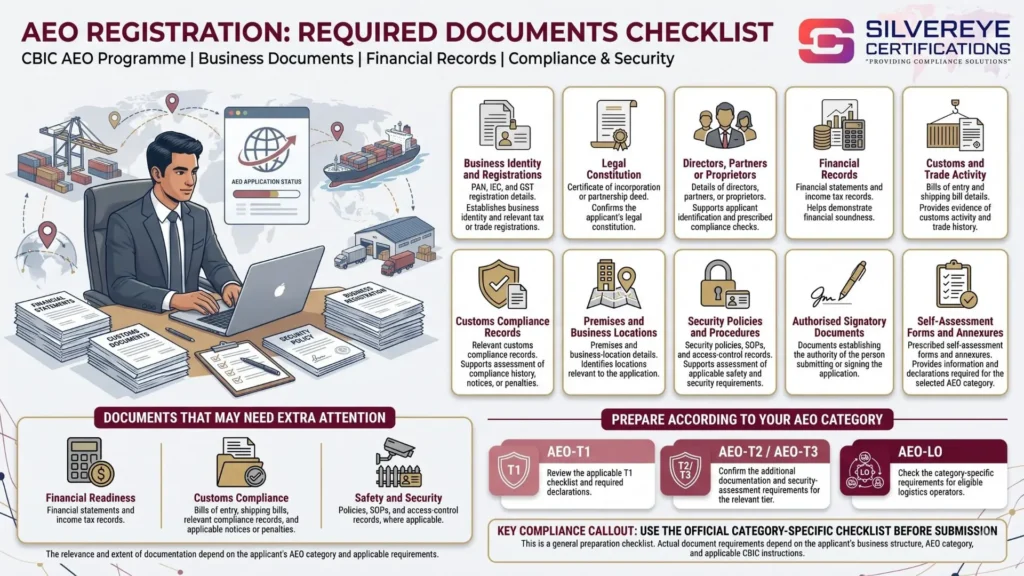
Download the latest forms and checklists from the official AEO India Portal resources page. The portal lists separate checklists for T2, T2-MSME and T3 applications.
AEO Registration Fees and Costs
CBIC does not charge a government application fee for AEO certification. However, a business may incur expenses for professional assistance, document preparation and any operational improvements needed to meet the applicable requirements.
| Cost item | Government fee or expense | What to know |
|---|---|---|
| Portal registration | No government fee | Creating an applicant account does not carry an AEO application fee |
| Application filing — T1, T2, T3 or LO | No government application fee | Follow the current portal instructions for the selected category |
| Renewal application | No government renewal fee specified in the AEO programme guidance | Confirm the current requirements before filing |
| Solvency documentation | Varies | Professional charges may apply for preparing required certificates or supporting records |
| Printing, binding and courier | Varies, if physical submission is required | Depends on the applicable filing procedure |
| Security and process improvements | Varies | Depends on existing facilities and the controls required |
| Consultant support | Varies | Depends on the provider, category and agreed scope of work |
How to Manage AEO Registration Costs
Before hiring a consultant, request a written proposal that specifies the scope of work, professional fees, document-preparation support, verification readiness and assistance with queries after submission.
Separate government charges from private professional expenses. Do not accept a consultancy fee described as a mandatory AEO government application fee.
AEO Certificate Validity After Registration
The standard validity periods under the AEO programme are as follows.
| Tier | Certificate validity | Who it applies to |
|---|---|---|
| AEO-T1 | 3 years | Eligible importers and exporters |
| AEO-T2 | 3 years | Eligible importers and exporters |
| AEO-T3 | 5 years | Eligible importers and exporters meeting T3 requirements |
| AEO-LO | 5 years | Eligible logistics operators and other qualifying entities |
Certificate validity should not be confused with ongoing compliance obligations. AEO holders must maintain the applicable standards and report significant business or operational changes as required. AEO-T1 holders must also follow the applicable annual self-declaration requirements.
AEO Registration Renewal and Timeline
Businesses that wish to continue their AEO status should track the certificate expiry date and submit the applicable renewal application within the prescribed window. When applying for renewal, they must clearly highlight changes since their previous application.
| Tier | Validity | Renewal application deadline | Important note |
|---|---|---|---|
| AEO-T1 | 3 years | At least 30 days before expiry, where renewal application is applicable | Follow the annual self-declaration and continuation requirements |
| AEO-T2 | 3 years | At least 60 days before expiry | Update supporting information and disclose relevant changes |
| AEO-T3 | 5 years | At least 90 days before expiry | Update the application and meet the applicable renewal requirements |
| AEO-LO | 5 years | At least 90 days before expiry | Update the application and meet the applicable renewal requirements |
Practical Renewal Planning
As a practical measure—not a separate CBIC deadline—start reviewing your documents four to six months before expiry. Update relevant annexures, review changes in ownership or premises, check your compliance records and prepare the renewal application well before the prescribed deadline.
For AEO-T1, do not assume that annual self-declaration removes every renewal or continuation obligation. Check the latest portal instructions and the conditions applicable to your certificate.
Common AEO Registration Problems and How to Avoid Them
The following issues can delay an application or create additional work during the review process.
| Problem | How to address it |
|---|---|
| Registration details do not match the IEC | Ensure the entity name and other details match official records. Correct outdated information through the relevant authority before applying, where necessary. |
| Portal says verification is pending | Follow the current verification instructions for your category and contact the relevant AEO Cell if the issue persists. |
| Deficiency reply sent only by email | Upload the requested documents through the portal’s Additional Documents option as instructed. |
| Outdated annexure format | Download the latest category-specific forms from the official portal before completing the application. |
| Inconsistent information across documents | Reconcile the application, financial records, customs documents and tax information before submission. |
| Missed renewal deadline | Set reminders well in advance and retain proof of submission. Follow the renewal window applicable to your tier. |
Final recommendation: Use the official AEO India Portal as your primary source for current application instructions, document checklists, processing targets and renewal requirements. This helps keep your AEO registration content accurate and gives applicants a reliable place to confirm the latest procedures.
AEO Registration, AEO Certification and ICEGATE: What Is the Difference?
Although these terms are related to customs operations, AEO registration, AEO certification and ICEGATE registration serve different purposes.
- AEO registration: The application process, from creating an account on the AEO portal to applying for and obtaining AEO status.
- AEO certification: The official recognition granted to an eligible business after approval. The applicable tier determines its benefits, compliance requirements and certificate validity.
- ICEGATE registration: Registration for accessing India’s electronic customs portal and the relevant online customs services. ICEGATE registration alone does not grant AEO status.
Businesses should check the separate requirements for each service before applying.
What Is New in 2026?
The AEO programme has seen important developments in 2026, including changes to the separate EMI Scheme and discussions about simplifying AEO application procedures.
- Ten years of India’s AEO programme: In September 2026, CBIC marked a decade of the programme and reported 5,967 AEO-certified entities across T1, T2, T3 and LO. The announced process-improvement roadmap included proposals for a unified SOP, clearer applicant checklists, a single-deficiency approach and time-bound processing. Confirm which measures have formally taken effect before relying on them.
- Circular No. 39/2026-Customs dated 3 September 2026: CBIC reduced the mandatory document uploads for the Eligible Manufacturer Importer (EMI) Scheme from 10 to 3, effective 15 September 2026. This change applies to EMI applications and should not be described as a reduction in the standard AEO registration documents.
Benefits of AEO Registration: Why Is It Worth the Effort?
AEO certification can help eligible businesses improve customs-clearance efficiency and reduce certain compliance burdens. The available benefits depend on the tier, the nature of the shipment and the applicable conditions. For a full comparison, read our AEO Certification guide.
- Reduced bank guarantee requirements: For eligible entities, the bank guarantee requirement is generally reduced to 50% of the applicable non-AEO amount for T1 and 25% for T2. Eligible MSMEs may receive further reductions under the applicable provisions. T3 generally receives a complete bank guarantee exemption, subject to prescribed exceptions.
- Faster customs clearance: Eligible AEO entities receive facilitation benefits, including priority processing and reduced routine examinations, subject to risk-based controls.
- Direct Port Delivery and Direct Port Entry: Eligible AEO entities may use these facilities when the relevant operational and trade-volume conditions are met.
- Deferred customs duty payment: Eligible T2 and T3 importers may access the notified deferred-duty facility, subject to the applicable rules.
- International recognition: Mutual Recognition Arrangements (MRAs) can provide reciprocal facilitation with participating customs administrations. Check the current partner list and the conditions applicable to your AEO category before assuming overseas benefits.
Should You Handle AEO Registration Yourself?
You can apply directly through the official AEO portal without hiring a consultant. Some businesses manage T1 applications internally, while others may need help preparing documentation, reviewing compliance gaps or getting ready for verification.
Professional assistance may be useful if your records are spread across departments, you are applying for T2 or T3, or your logistics operations require a detailed security review. Before choosing a consultant, ask for a written scope covering:
- Eligibility and gap assessment against the relevant CBIC requirements.
- Application and annexure preparation using the latest prescribed formats.
- Verification readiness, including review of relevant security procedures and records.
- Deficiency management and assistance with responses to official queries.
- Transparent professional fees, clearly separated from government charges.
Remember that CBIC does not charge a government application fee for AEO certification, and no consultant can guarantee approval. The final decision rests with the competent customs authority.
Conclusion
The AEO registration process in India requires accurate documentation, proper compliance records and timely responses to customs queries. Start by confirming your eligibility, selecting the appropriate AEO tier and using the latest application forms. Keep your business records updated, submit deficiency responses through the prescribed channel and plan renewal well before the certificate expires. With no government application fee and potential customs facilitation benefits for eligible businesses, AEO certification may be valuable for regular importers, exporters and logistics operators.
Get AEO Registration Support from Silvereye Certifications
Silvereye Certifications assists importers, exporters, manufacturers and logistics operators with the AEO registration process. Support may include tier selection, eligibility assessment, annexure preparation, documentation review, application assistance and renewal planning.
Contact Silvereye Certifications to discuss your business requirements, identify potential compliance gaps and understand the scope of support needed before submitting your AEO application. The final decision on certification rests with the competent customs authority.
Frequently Asked Questions
How do I register for AEO in India?
Open aeoindia.gov.in, click Registration, fill in your company details using the mobile number and email on your IEC, and collect your login from the email you receive.
Is AEO registration free?
Yes. CBIC charges no fee for registration, application or renewal. You only bear preparation costs such as the solvency certificate and security upgrades.
Can I complete AEO registration online?
T1 is filed online. For T2 and T3, the official applicant guide describes physical submission to the jurisdictional AEO Cell followed by online tracking entries. Confirm the current mode on the portal.
How long does AEO registration take?
CBIC targets one month for T1 and six months for T2 after a complete application. MSMEs get 15 working days for T1 and three months for T2.
Which documents are required for AEO registration?
IEC, GST, PAN, business registration proof, customs document list, audited financials, a solvency certificate and the tier annexures. T2, T3 and LO also need a security plan, process map and site plan.
Why does the portal say I can file only after verification?
Your sign-up is still being verified. For T2 and T3 it is deemed verified within one working day. T1 and LO sign-ups are verified by customs officials.
What is a deficiency in an AEO application?
It is a request from customs for missing or unclear information. Reply by uploading documents through the Additional Documents option on the portal.
Can an MSME use a simpler AEO registration process?
Yes. With a valid MSME certificate you need 10 customs documents, two years of activity and fewer annexures, with shorter processing targets for T1 and T2.
How will I receive the AEO certificate?
On approval, the certificate is digitally mailed to your registered email address.
What is the validity of the AEO certificate?
Three years for T1 and T2, and five years for T3 and LO.
When should I apply for AEO renewal?
Within 30 days before expiry for T1, 60 days for T2, and 90 days for T3 and LO. Highlight changes since your last application.
Can I apply for T3 straight away?
No. T3 needs at least two continuous years as AEO-T2, or T2 status with business partners who also hold AEO-T2, AEO-LO or an equivalent foreign status.
Does ICEGATE registration count as AEO registration?
No. ICEGATE is a separate account for filing customs documents. AEO is a trusted-trader status applied for on aeoindia.gov.in.