
- AEO Certification is a CBIC trusted-trader programme that offers eligible importers, exporters and logistics operators benefits such as faster customs clearance and reduced compliance checks.
- India’s AEO programme includes AEO-T1, AEO-T2, AEO-T3 and AEO-LO, with different eligibility criteria and benefits for each category.
- There is no government application fee for AEO certification. However, businesses may need to budget for compliance improvements, documentation and professional consultancy support.
- Certificate validity and renewal depend on the AEO category and the applicable CBIC guidelines. Verify the current validity period and renewal requirements before publishing specific timelines.
Introduction
AEO Certification is a trusted-trader status granted by the Central Board of Indirect Taxes and Customs (CBIC) to eligible businesses that meet prescribed customs compliance and supply-chain security requirements. Businesses can apply through the official AEO India Portal.
There is no government application fee for AEO certification. AEO-T1 and AEO-T2 certificates are valid for three years, while AEO-T3 and AEO-LO certificates are valid for five years. Renewal applications should be submitted before expiry—generally 30 days for T1, 60 days for T2, and 90 days for T3 and LO. Eligible AEO-T1 holders may follow the prescribed annual self-declaration process for continued certification.
What Is AEO Certification?
AEO (Authorized Economic Operator) Certification is a trusted-trader programme based on the World Customs Organization’s SAFE Framework of Standards. In India, the programme is administered by the Central Board of Indirect Taxes and Customs (CBIC) under Circular No. 33/2016-Customs, as amended from time to time.
The objective is to make international trade more secure and efficient. Businesses that demonstrate strong customs compliance, reliable record-keeping and supply-chain security may receive benefits such as reduced routine examinations, faster cargo clearance and simplified customs procedures, depending on their AEO category and the applicable rules.
If you are searching for AEO registration, you are generally referring to the application process for obtaining AEO status. Registration is the commonly used term, while AEO status or certification refers to the recognition granted after approval.
What Is an Authorised Economic Operator (AEO) in India?
An Authorized Economic Operator is a business that customs has checked and trusts. India runs the programme under the World Customs Organization’s SAFE Framework of Standards, and CBIC manages it through Circular 33/2016-Customs dated 22 July 2016, as amended by Circular 03/2018, Circular 26/2018, Circular 51/2018 and Circular 54/2020 (for MSMEs).
AEO certification as a “green channel” reputation. Customs spends less time checking your cargo because it already knows your records are clean and your premises are secure. That is why many exporters and importers treat AEO registration as a business tool, not only a compliance exercise.
In September 2026, CBIC marked ten years of the AEO programme. As per CBIC’s statement at that event, 5,967 entities across T1, T2, T3 and LO have been certified so far, including importers, exporters, manufacturers, customs brokers, logistics operators and warehouse operators.
Why Businesses Apply: AEO Certification Benefits
The benefits available to a business depend on its AEO category, eligibility and the applicable CBIC provisions. The official AEO India portal outlines facilitation measures for different categories. Confirm the latest conditions before relying on a specific benefit for business planning.
- Faster customs clearance: Eligible AEO businesses may receive priority facilitation and reduced routine examinations, helping improve cargo-release predictability.
- Reduced compliance costs: Eligible entities may receive reduced bank guarantee requirements and other procedural benefits, subject to prescribed conditions.
- Deferred customs duty payment: Eligible AEO-T2 and AEO-T3 entities may qualify for deferred duty payment under the applicable rules. Check the current notification for the relevant eligibility and payment deadlines.
- Direct Port Delivery and Direct Port Entry: Eligible AEO holders may access these facilities, subject to applicable conditions and operational requirements.
- Stronger business credibility: AEO status demonstrates that a business has met prescribed customs-compliance and supply-chain requirements.
- International recognition: India has Mutual Recognition Arrangements (MRAs) with selected customs administrations. Reciprocal benefits depend on the applicable arrangement, AEO category and eligibility conditions.
Is AEO Certification Worth It?
AEO certification may be useful for businesses that regularly import or export goods, depend on predictable delivery schedules or need to demonstrate supply-chain security to business partners.
Before applying, assess your annual customs activity, compliance systems, record-keeping practices and security arrangements. Compare the potential operational benefits with the effort required to maintain AEO compliance. Eligibility and the applicable benefits should be checked against the current CBIC requirements.
Types of AEO Certification in India (T1, T2, T3 and LO)
India’s AEO programme includes AEO-T1, AEO-T2, AEO-T3 and AEO-LO. T1, T2 and T3 are designed for eligible importers and exporters, while AEO-LO is intended for eligible logistics operators and other qualifying participants in the international supply chain.
| Tier | Who it suits | Application route | Assessment focus |
|---|---|---|---|
| AEO-T1 | Eligible importers and exporters seeking entry-level AEO status | Apply through the official AEO portal | General compliance, legal requirements, record management and financial solvency |
| AEO-T2 | Importers and exporters meeting the requirements for the higher tier | Apply directly if eligible under the applicable criteria | Detailed compliance assessment and prescribed safety and security requirements |
| AEO-T3 | Eligible AEO-T2 holders meeting the additional T3 conditions | Apply after satisfying the applicable T3 eligibility requirements | Continued compliance, established AEO status and additional conditions under the circular |
| AEO-LO | Eligible logistics operators, custodians, terminal operators, customs brokers and other qualifying logistics entities | Apply under the logistics-operator category | Compliance and the safety and security controls applicable to logistics operations |
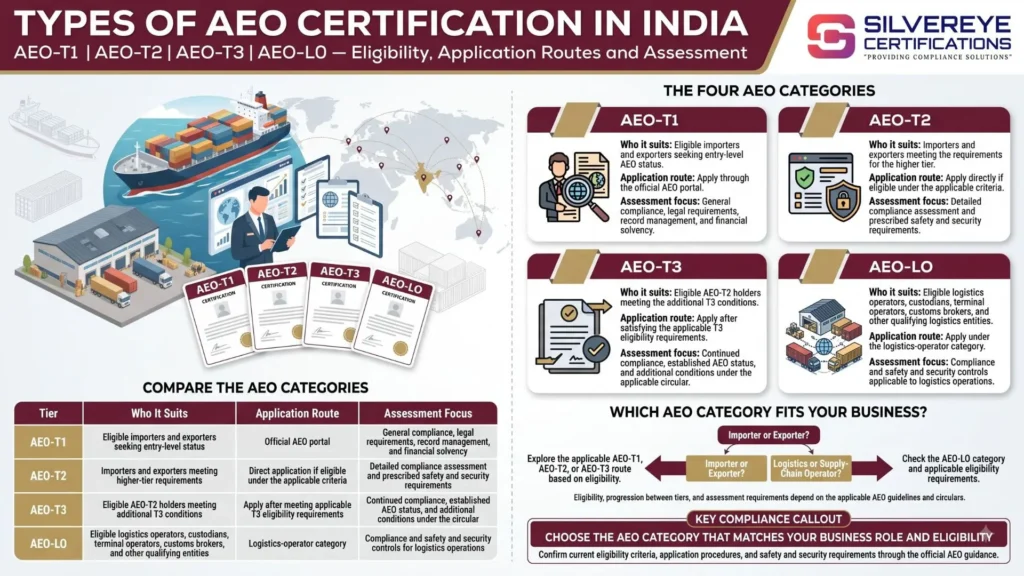
Important: AEO-T3 eligibility is linked to existing AEO-T2 status and the conditions prescribed by CBIC. Do not assume that a business can move directly from T1 to T3. Check the latest circular and tier-specific checklist before applying. Certificate validity and renewal requirements should also be verified against the current rules.
AEO Certification Eligibility Criteria
CBIC assesses an applicant’s customs compliance, financial soundness, business activity, record management and security controls, according to the AEO category.
Applicants should review the applicable criteria before submitting an application. Common areas to prepare include:
- Business identity and registrations: PAN, Importer Exporter Code (IEC) for relevant importers and exporters, GST details where applicable, and proof of the applicant’s legal status.
- Customs activity: Evidence of import/export or other qualifying customs-related activity, as required for the relevant category.
- Compliance history: Information about customs compliance, notices, penalties, offences or outstanding liabilities, where relevant under the prescribed criteria.
- Financial soundness: Financial statements, tax records or other evidence required to establish financial solvency.
- Record management: Documented procedures for maintaining, storing and retrieving business and customs records.
- Safety and security: Evidence of the prescribed access controls, premises security, personnel procedures and supply-chain safeguards for categories where these requirements apply.
- AEO-T3 conditions: Evidence that the applicant meets the additional requirements applicable to existing AEO-T2 holders.
Tip: Do not rely on a single document threshold or an old eligibility checklist. The current CBIC circular, relevant annexures and official AEO portal should be used to confirm the criteria for your business type and category.
AEO Registration Required Documents Checklist
The documents required for AEO registration depend on the applicant’s business structure, AEO category and applicable CBIC requirements. T1 applicants and applicants for T2, T3 or LO may have different documentation and security-assessment requirements.
The following is a general preparation checklist, not a substitute for the official category-specific checklist.
| Document | Why it may be needed |
|---|---|
| PAN, IEC and GST registration details | Establishes business identity and relevant tax or trade registrations |
| Certificate of incorporation or partnership deed | Confirms the applicant’s legal constitution |
| Details of directors, partners or proprietors | Supports applicant identification and prescribed compliance checks |
| Financial statements and income tax records | Helps demonstrate financial soundness |
| Bills of entry and shipping bill details | Provides evidence of customs activity and trade history |
| Customs compliance records | Supports the assessment of compliance history and relevant notices or penalties |
| Premises and business-location details | Identifies the locations relevant to the application |
| Security policies, SOPs and access-control records | Supports assessment of applicable safety and security requirements |
| Authorised signatory documents | Establishes the authority of the person submitting or signing the application |
| Prescribed self-assessment forms and annexures | Provides the information and declarations required for the selected AEO category |
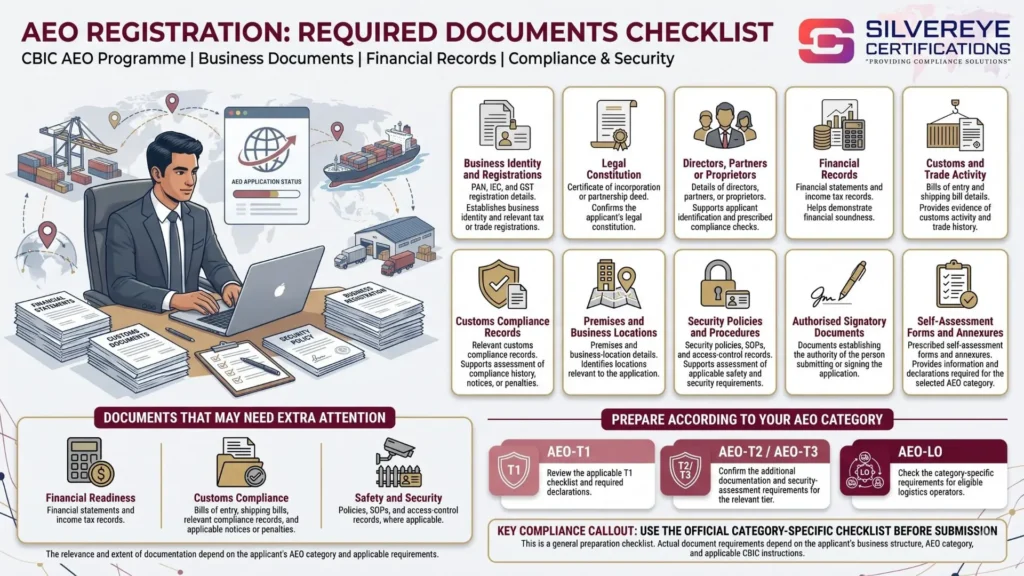
Before submitting the application, compare your documents with the latest AEO application guide, official checklist and relevant annexures. Ensure that business names, addresses and registration details are consistent across the documents. Incomplete records or missing evidence may lead to clarification requests and delays. The official portal provides category-specific application guidance and resources.
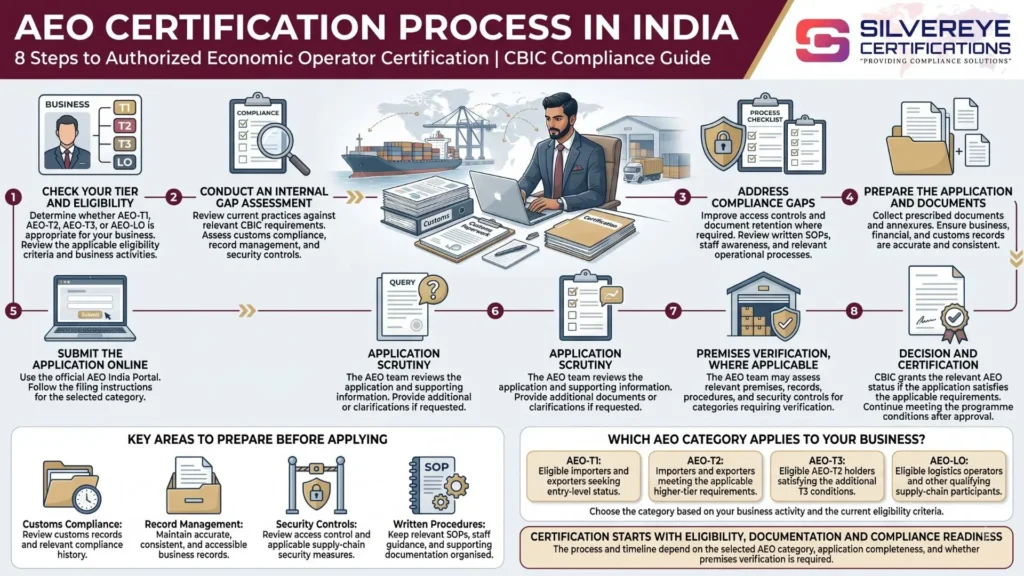
AEO Certification Process: Step by Step
The AEO certification process in India involves checking eligibility, preparing the required documents, submitting an application and completing the assessment applicable to the selected category. The exact process and timeline depend on the AEO tier, the completeness of the application and whether premises verification is required.
- Check your tier and eligibility. Determine whether your business should apply for AEO-T1, AEO-T2, AEO-T3 or AEO-LO based on its activities and the applicable eligibility criteria.
- Conduct an internal gap assessment. Review your existing practices against the relevant CBIC requirements, including customs compliance, record management and security controls.
- Address compliance gaps. Improve access controls, document retention, written standard operating procedures (SOPs), staff awareness and other processes where required.
- Prepare the application and supporting documents. Collect the prescribed documents and annexures. Ensure that your business, financial and customs records are accurate and consistent.
- Submit the application online. Use the official AEO India Portal and follow the filing instructions for your selected category.
- Application scrutiny. The AEO team reviews the application and supporting information. You may be asked to provide additional documents or clarifications.
- Premises verification, where applicable. For categories requiring verification, the AEO team assesses the relevant premises, records, procedures and security controls.
- Decision and certification. If the application meets the applicable requirements, CBIC grants the relevant AEO status. The business must continue meeting the programme’s conditions after approval.
How Long Does AEO Certification Take?
Processing time depends on the AEO category, the completeness of the application, responses to queries and verification scheduling. The current AEO India portal provides the following indicative timelines and processing stages. These are not guaranteed completion dates.
| Tier | Indicative processing timeline |
|---|---|
| AEO-T1 | Certificate within 30 days after complete information and documents are submitted, subject to eligibility and the applicable procedure |
| AEO-T2 | The portal outlines separate stages for scrutiny, team assignment, premises visit, report preparation and decision |
| AEO-T3 | Eligible applicants with continuous T2 status for at least two years may qualify for a shorter process, subject to the applicable conditions and changes in circumstances |
| AEO-LO | Processing includes scrutiny and premises verification, where required, followed by a recommendation and decision |
The official portal also states that eligible MSME applications are subject to targeted processing periods of 15 working days for AEO-T1 and three months for AEO-T2, after submission of complete documents. Confirm the applicable conditions before relying on these periods.
AEO Certification Fees
CBIC does not charge a government application fee for AEO certification. Businesses may still incur internal or professional expenses when preparing documents, improving procedures or arranging compliance support.
| Cost item | What to expect |
|---|---|
| Government application fee | Nil |
| Government renewal fee | Check the current AEO portal and applicable CBIC instructions for the relevant renewal process |
| Security and infrastructure improvements | Costs vary according to existing facilities and the controls required, such as CCTV, access control, lighting and visitor records |
| Systems and SOP development | Internal staff time or external assistance to document and implement procedures |
| Staff training | Training on customs compliance, record management and applicable supply-chain security requirements |
| Consultant or advisory fees | Vary by provider, AEO category and the scope of support |
How to Avoid Overpaying for AEO Consultancy
Before hiring a consultant, request a written scope of work covering the eligibility review, gap assessment, application preparation, supporting annexures, verification readiness and post-submission query support.
Ask for a clear breakdown of professional fees and any additional expenses. Be cautious of claims that a consultant’s fee is a mandatory government AEO application charge, because the official AEO portal states that no application fee is charged by Indian Customs.
AEO Certificate Validity
AEO certification validity depends on the tier, and it also sets how often customs reviews you.
| Tier | Validity | Periodic review frequency | Applies to |
| AEO-T1 | 3 years | Every 3 years | Importers and exporters |
| AEO-T2 | 3 years | Every 3 years | Importers and exporters |
| AEO-T3 | 5 years | Every 5 years | Importers and exporters |
| AEO-LO | 5 years | Every 5 years | Logistics operators and similar |
Validity was brought to three years for both T1 and T2 by Circular 03/2018-Customs and aligned further by Circular 51/2018-Customs. Some older articles still show two years for T1; that is outdated.
AEO Certificate Renewal: Timeline and Process
AEO certificate renewal is an important part of maintaining your trusted-trader status in India. Businesses should track their certificate expiry date, keep supporting documents updated and complete the applicable renewal or self-declaration requirements on time. Missing a deadline may put the continuity of AEO status and associated benefits at risk.
| Tier | Renewal route | When to act |
|---|---|---|
| AEO-T1 | Annual self-declaration and the applicable continuation or renewal procedure | The standard renewal window is at least 30 days before expiry. Follow the current annual declaration instructions. |
| AEO-T2 | Renewal application with updated supporting information | At least 60 days before expiry |
| AEO-T3 | Renewal application with updated supporting information | At least 90 days before expiry |
| AEO-LO | Renewal application with updated supporting information | At least 90 days before expiry |
These renewal windows are specified in the AEO programme guidance. Applicants should check the current circulars and portal instructions to confirm which procedure applies to their certificate.
How AEO-T1 Annual Self-Declaration Works
Under CBIC Circular No. 18/2021-Customs, AEO-T1 certification has an annual self-declaration process. Eligible T1 entities must provide the prescribed information about matters such as customs and GST compliance, financial position, business locations and record-management controls.
The current AEO portal specifies that the annual self-declaration for the preceding financial year is submitted between 1 October and 31 December. Its October 2026 update clarifies that the exemption from filing applies only to entities receiving fresh AEO-T1 certification during the relevant calendar year. Renewed and auto-renewed entities are not treated as freshly certified for this exemption and must submit the required declaration.
Do not assume that automatic continuation removes the annual declaration obligation. Check the portal for the relevant reporting year, submit the declaration within the prescribed period and respond to any queries from the jurisdictional AEO team.
Renewing AEO-T2, AEO-T3 and AEO-LO
Start preparing well before the minimum renewal deadline. The following steps can help make the process more organised:
- Review your certificate expiry date and work backwards from the prescribed filing deadline.
- Update the application and annexures to reflect relevant changes in ownership, premises, locations, security arrangements, business operations and customs activity.
- Review your compliance records, including any notices, penalties, corrective actions or changes that must be disclosed.
- Prepare for verification, if required under the applicable renewal procedure.
- Respond promptly to official queries and retain evidence of your submissions and corrective actions.
For planning purposes, beginning several months ahead can provide time to resolve documentation gaps. This is a practical recommendation, not an additional CBIC deadline.
Upgrading Your AEO Tier
Businesses may seek a higher AEO category when they meet the relevant eligibility conditions and can demonstrate the required level of compliance.
An AEO-T1 holder may apply for AEO-T2 if eligible under the applicable criteria. AEO-T3 is generally available to eligible AEO-T2 holders who satisfy the prescribed conditions, including the relevant continuous T2 holding period or other permitted criteria under CBIC guidance. An upgrade is subject to assessment; it is not automatic.
Before applying, review the latest eligibility requirements, documentation checklist and verification expectations on the official AEO India Portal.
What Is New in 2026
Trade rules move quickly, so these updates matter for anyone planning AEO certification this year.
- Ten-year milestone (September 2026): CBIC reviewed the programme and outlined a roadmap with a unified SOP, clear applicant checklists, a single-deficiency approach, time-bound processing and stronger Client Relationship Managers.
- Circular No. 39/2026-Customs (3 September 2026): documentation under the Eligible Manufacturer Importer (EMI) Scheme was cut from 10 documents to three, effective 15 September 2026.
- EMI Scheme and Budget 2026: as reported by trade advisers, the EMI scheme extends deferred duty payment to eligible manufacturer importers, and is open to AEO-T1 MSMEs without the T2 audit until March 2028. Confirm current conditions on the CBIC site before relying on this.
Several of these are proposals or recent circulars. Always check the latest CBIC notification before you file.
Common Reasons AEO Certification Applications Get Delayed or Rejected
An AEO application may be delayed or rejected if the applicant does not meet the prescribed eligibility requirements or fails to correct deficiencies identified during assessment. Common issues include:
- Inconsistent information across the application, customs records, GST returns or financial documents.
- Insufficient evidence of security controls or procedures where these are required for the selected category.
- Relevant customs compliance issues that affect eligibility under the applicable criteria.
- Incomplete annexures, missing documents or unsigned declarations.
- Delayed responses to requests for clarification or additional information.
- Failure to report significant business changes that may affect AEO status, such as changes to the legal entity, business address, relevant premises or key processes.
CBIC guidance identifies ineligibility and unremedied deficiencies as grounds for rejecting an application. Applicants should therefore review the applicable checklist carefully and resolve gaps before submitting their application.
AEO Certification vs AEO Registration: Is There a Difference?
In everyday business use, AEO registration and AEO certification are often used to describe the same application journey. However, they are not precisely interchangeable: registration commonly refers to applying or enrolling through the portal, while certification refers to the AEO status granted after the relevant assessment.
When comparing service providers, check that the scope clearly explains whether it includes eligibility assessment, application preparation, supporting documents, premises-verification readiness and assistance with official queries. The final decision to grant AEO status rests with the competent customs authority.
How to Choose an AEO Consultant in India
Businesses can apply directly through the official AEO portal. However, some choose professional assistance to organise their documentation, review compliance gaps and prepare for verification.
When evaluating an AEO consultant, consider the following:
- Relevant experience: Ask about experience with your specific AEO category and type of business.
- Transparent fees: Request a written proposal that separates professional charges from any other expenses.
- Practical gap assessment: Look for a provider that reviews your actual procedures and records rather than offering only a document checklist.
- Application and verification support: Confirm whether the service includes preparing annexures, organising supporting evidence and helping you prepare for a premises visit where applicable.
- Post-submission assistance: Check whether responses to clarification requests are included in the agreed scope.
- Verifiable references: Ask for references or evidence of relevant experience that can reasonably be checked.
Avoid providers that guarantee approval or describe professional consultancy charges as mandatory government application fees. Choose a service scope that matches your business needs and the requirements of your selected AEO category.
Conclusion
AEO certification rewards businesses that run clean, traceable, secure operations. Start with the tier that fits your record, build your documents around the current CBIC forms, and plan renewal early. With no government fee and real savings on guarantees and clearance time, it is worth a serious look for any regular importer, exporter or logistics operator.
Ready to move forward? Speak to an experienced customs compliance consultant for a gap assessment, document checklist and filing support for your AEO application.
Get AEO Certification Support From Silvereye Certifications
Silvereye Certifications helps importers, exporters, manufacturers and logistics operators with AEO certification, from checking which tier fits your business to preparing annexures, organizing documents and guiding you through customs queries and renewal. Contact Silvereye Certifications for a gap assessment and a clear scope of work before you file.
Frequently Asked Questions
What is AEO certification?
It is a trusted-trader status from CBIC that rewards compliant importers, exporters and logistics operators with faster and simpler customs processing.
Is there a government fee for AEO registration?
No. CBIC does not charge a filing or renewal fee. You may still spend on security upgrades, training and optional consultants.
How long is an AEO certificate valid?
Three years for T1 and T2, and five years for T3 and LO.
How do I renew my AEO certificate?
T1 holders certified on or after 1 April 2019 usually renew through an annual self-declaration. T2, T3 and LO holders apply for renewal 60, 90 and 90 days before expiry respectively.
Can I apply for AEO-T2 without AEO-T1?
Yes, if you meet the T2 criteria. T1 is not a mandatory first step.
Can I go directly to AEO-T3?
No. T3 is meant for operators who have held T2 and kept a strong compliance record over time.
How long does AEO certification take?
T1 often takes a few weeks after a complete filing. T2 and higher tiers take longer because of detailed review and site verification.
Where do I apply for AEO certification?
On the official AEO portal at aeoindia.gov.in. Check the portal for the current filing mode for your tier.
Do MSMEs get any relief?
Yes. MSMEs enjoy lower document-volume thresholds and some reduced documentation for T1 and T2.
What happens if my AEO certificate expires?
You lose AEO benefits from the expiry date. For T2, T3 and LO there is no formal grace period beyond the renewal window, so you may need to apply afresh.
Can an AEO certificate be suspended or revoked?
Yes. Serious non-compliance, misstatements or failure to maintain security standards can lead to suspension or revocation.
Is AEO certification mandatory for exporters and importers?
No. It is voluntary, but it can give a real operational edge for regular traders.