- How much does a PSARA license cost? The government license fee depends on the area of operation: ₹5,000 for one district, ₹10,000 for more than one and up to five districts, and ₹25,000 for the whole state. The overall cost can also include training, police verification and other compliance expenses.
- How long is a PSARA license valid? Under the central framework, a PSARA license is generally valid for 5 years. The applicable State/UT rules and licensing procedures should be checked for the specific agency.
- When should you apply for PSARA renewal? The renewal application should be submitted to the Controlling Authority at least 45 days before the existing license expires. Missing this deadline can create complications, so agencies should start preparing their renewal documents well in advance.
- What changed in 2026 regarding PSARA penalties? The PSARA framework has undergone regulatory changes in 2026, so agencies should check the latest MHA notifications and applicable State/UT rules rather than relying on older penalty figures. In particular, avoid assuming that every procedural lapse carries the same ₹25,000 penalty; specific penalties depend on the provision involved.
How Much Does a PSARA License Cost in India?
A PSARA license typically costs ₹5,000 to ₹25,000 in government fees, depending on whether you're applying for a single district, multiple districts, or an entire state. However, the total cost can also include guard training, police verification, notarized affidavits, documentation, and professional fees if you use a consultant.
Once issued, a PSARA license is generally valid for 5 years. The renewal application should be submitted at least 45 days before the license expires. Missing the renewal timeline can create complications, so agencies should track the license expiry date and renewal deadline well in advance.
Why Is the Actual Cost of a PSARA License Higher Than the Government Fee?
Ask different security agency owners what a PSARA license costs, and you may get different figures. That's because the government license fee is only one part of the overall cost. Agencies may also spend on training, police verification, notarization, documentation, professional assistance, and ongoing compliance.
For a security agency, understanding the complete cost structure, license validity and renewal timeline is important for planning the business budget and avoiding last-minute compliance problems. This guide breaks down the PSARA license cost, validity, renewal requirements, and relevant 2026 regulatory developments.
What Costs Are Included in a PSARA License?
The government licensing fee is only one part of the total PSARA licensing cost. A realistic budget can include four main cost components:
| Cost Component | What It Covers |
|---|---|
| Government Licensing Fee | Paid to the State/UT Controlling Authority based on the area of operation — district, multiple districts, or the whole state |
| Training & Verification Costs | Fees for recognized security guard training, along with applicable police verification charges |
| Documentation Costs | Notarised affidavits, stamp paper and certified copies of required documents |
| Professional / Consultant Fees | Optional fees charged by a compliance consultant for documentation, filing and follow-up |
How Much Is the PSARA Government License Fee?
Under the PSARA Act, the license fee depends on the area of operation:
| Area of Operation | Government Licence Fee |
|---|---|
| One district | ₹5,000 |
| Two to five districts | ₹10,000 |
| Whole state | ₹25,000 |
The Ministry of Home Affairs specifies these license-fee slabs in its PSARA FAQ. Since licensing is handled by the Controlling Authority of the relevant State/UT, applicants should confirm the current local procedure and any applicable charges before filing.
What Additional Costs Should a PSARA Applicant Budget For?
The government license fee does not cover every expense associated with setting up and operating a private security agency. Depending on the agency and applicable requirements, applicants may also need to budget for:
- Security guard training fees at a recognised training institute.
- Police verification or antecedent verification requirements applicable to the applicants.
- Notary and stamp-paper charges for affidavits and declarations.
- EPF and ESIC compliance costs once guards are employed, where applicable.
- GST compliance and professional accounting costs, depending on the agency's business structure and tax obligations.
- Consultant or professional fees if the application and compliance work are outsourced.
These should be treated as business and compliance expenses, rather than as additional PSARA government license fees.
How Long Is a PSARA License Valid?
Under the PSARA Act, a license is valid for 5 years, unless it is cancelled earlier under the Act. It may be renewed for another five-year period on payment of the prescribed fee and submission of the required documents.
This means agencies should not assume that a shorter validity period applies simply because they operate in a particular State or Union Territory. If a specific State/UT procedure or direction applies to your agency, confirm it with the relevant Controlling Authority.
When Should You Apply for PSARA License Renewal?
The renewal process should be planned well before the licence expires:
- Start preparing 60–90 days before expiry so there is enough time to collect documents and address any queries.
- Check that your training arrangements and required records are current.
- Gather updated business and compliance documents required by the relevant authority.
- Submit the renewal application at least 45 days before the existing licence expires. This is the statutory deadline under Section 8 of the PSARA Act.
- Respond promptly to queries raised by the Controlling Authority during processing.
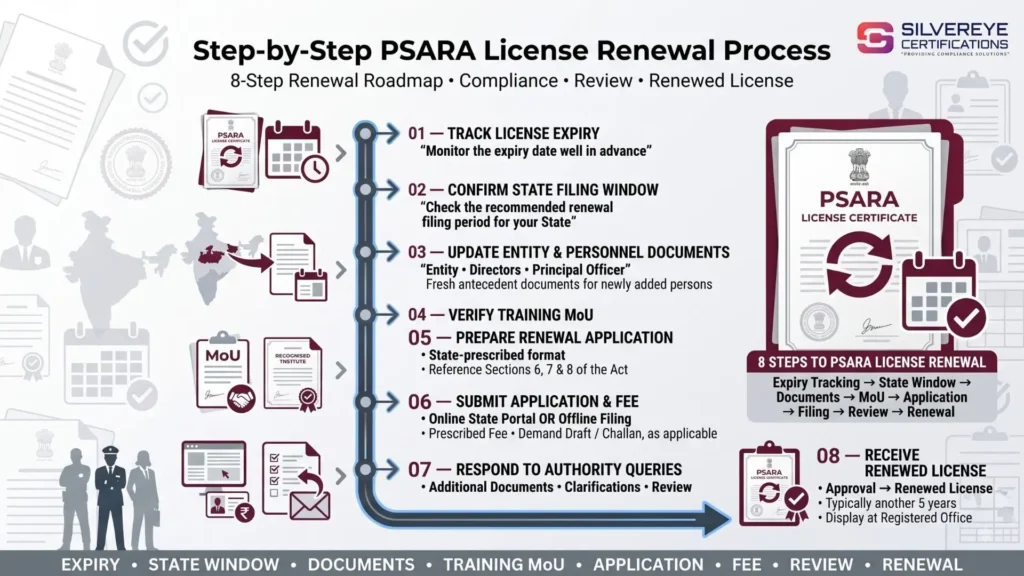
The PSARA Act states that the Controlling Authority should pass an order on a complete renewal application within 30 days of receiving it.
What Happens If You Miss the PSARA Renewal Deadline?
The safest approach is to avoid letting the license expire before the renewal process is properly handled. Section 8 specifically requires the renewal application to be made not less than 45 days before expiry.
Rather than stating that every late applicant must automatically submit a completely fresh application, check the current State/UT procedure and instructions from the Controlling Authority for the particular case.
Key Takeaway
For budgeting purposes, separate the official PSARA license fee from the wider costs of training, verification, documentation and ongoing compliance. Also track the five-year validity period and 45-day renewal deadline from the date of issue so the agency has enough time to complete its renewal formalities.
What Does It Really Cost to Let a PSARA License Lapse?
Beyond the obvious legal exposure, a lapsed PSARA license can create several additional business costs:
- Loss of active contracts: Many corporate and institutional clients require vendors to maintain a valid PSARA licence as part of their onboarding or contractual requirements. A lapse can therefore create problems with existing or new contracts.
- Fresh application costs and effort: Depending on the applicable procedure, the agency may need to go through new documentation, verification and other application formalities instead of relying on a timely renewal.
- Penalty exposure: Operating a private security agency without the required licence can attract penalties under Section 20(1) of the PSARA Act, including imprisonment of up to one year, a fine of up to ₹25,000, or both.
- Reputational impact: Clients may check licence validity and compliance documents during vendor onboarding, renewals and audits. A lapsed licence can therefore create additional questions during commercial due diligence.
What Changed in PSARA Compliance in 2026?
1. What Is the 2026 Change in PSARA Penalties?
The PSARA Act has undergone a 2026 regulatory change concerning specified provisions, so agencies should refer to the latest notification and current version of the Act when assessing penalty exposure.
Before making a blanket statement that all procedural lapses have been decriminalised, it is important to identify which specific sections were amended or omitted and from what effective date. The original PSARA framework provided a ₹25,000 fine under Section 20(2) for contraventions of Sections 9, 10 and 12, in addition to possible suspension or cancellation of the license.
For website content, the safer approach is to explain the specific 2026 amendment and its effective date rather than stating that all minor compliance failures are no longer criminal offences.
2. What Should Security Agencies Know About GST and RCM?
GST and the Reverse Charge Mechanism (RCM) can also affect the cash-flow and compliance planning of security agencies. However, GST treatment depends on the nature of the security service, supplier structure and applicable GST provisions.
Therefore, agencies should not treat any proposed industry relief or payment-timing recommendation as an already implemented change unless it has been formally notified by the competent authority.
For budgeting purposes, maintain the currently applicable GST and RCM requirements in your compliance plan and verify the latest GST notifications before preparing your final cost estimate.
PSARA Fresh License vs Renewal: What Is the Cost and Effort Difference?
| Factor | Fresh Application | Renewal Filed on Time |
|---|---|---|
| Government fee | Fee based on the area of operation | Prescribed renewal fee based on the applicable rules |
| Police verification | Verification may be required as part of the application process | Requirements depend on the current application and State/UT procedure |
| Training arrangements | Required training arrangements must be in place | Existing arrangements and compliance records should be kept current |
| Documentation | Full set of required application documents | Updated renewal documents and supporting records |
| Processing | The Act provides for a decision within 60 days on a complete fresh application | The Act provides for an order on a complete renewal application within 30 days |
| Risk if delayed | Application remains subject to the licensing process | Licence-expiry risk increases if the renewal application is not filed within the statutory timeline |
Under Section 7, the statutory licence fee is ₹5,000 for one district, ₹10,000 for more than one and up to five districts, and ₹25,000 for the whole State. A license is valid for five years, and Section 8 requires the renewal application to be submitted at least 45 days before expiry.
What Should You Remember?
The biggest cost of a PSARA lapse is not necessarily the government fee. It can also involve business disruption, additional documentation, verification, compliance work and potential contractual issues. Tracking the license expiry date and the 45-day renewal deadline should therefore be part of the agency's regular compliance calendar.
What Should You Keep in Mind When Planning PSARA License Cost?
The government fee is the easiest part of PSARA license cost to plan for — it is published, predictable, and linked to the area of operation. The harder part is everything around it: training costs that can increase with headcount, verification-related costs, and a validity and renewal timeline that should be tracked according to the applicable State or UT procedure.
Treat the 45-day renewal window as a fixed calendar commitment, not a flexible deadline. Also keep track of GST/RCM requirements and any regulatory changes during 2026, as these can affect the overall cost and cash flow of security agencies.
Need Help Planning Your PSARA License Cost or Renewal?
Silvereye Certifications helps security agencies plan for PSARA licensing and renewal costs, including government fees, training and verification-related expenses, and renewal timelines. The team can also support the renewal process from documentation to filing, helping agencies keep track of important deadlines and reduce the risk of an unnoticed license lapse.
If you'd prefer a clear cost estimate and a properly tracked renewal calendar instead of a last-minute scramble before expiry, Silvereye Certifications can help you plan and manage the process.
Frequently Asked Questions
How much does a PSARA license cost in total?
Government fees range from about ₹5,000 for a single district to ₹25,000 for state-wide operation, with additional costs for training, police verification, notarization, and any professional fees if you use a consultant.
Why do PSARA license costs vary so much between agencies?
The government fee depends on area of operation, but total cost also depends on how many guards need training, how many directors need police verification, and whether a consultant is engaged — no two agencies have an identical cost structure.
How long is a PSARA license valid?
Typically 5 years in most states and 1 year in most Union Territories. The exact validity period depends on your state's specific PSARA rules.
When should I start the PSARA license renewal process?
File the renewal application at least 45 days before expiry, but start preparing documents 60–90 days ahead to leave room for any updated verification or training-tie-up confirmation.
Is the renewal fee the same as the fresh application fee?
Renewal fees are generally comparable to, or somewhat lower than, the original fee for the same area of operation, though this varies by state — confirm the current renewal fee with your Controlling Authority.
What happens if I miss the 45-day renewal deadline?
If the license lapses without a renewal application on file, most states require a completely fresh application rather than a simple renewal, which can mean repeating police verification and risking a gap in legal operating status.
Does a lapsed PSARA license mean I have to stop operating immediately?
Yes, in effect — operating without a valid PSARA license is a criminal offence under the Act, regardless of how the license lapsed, so continuing to deploy guards on an expired license carries real legal risk.
What is the maximum penalty for operating without a valid PSARA license?
Up to 1 year of imprisonment, a fine of up to ₹25,000, or both, under the PSARA Act's penal provisions — this has not changed under the 2026 amendment.
What changed about PSARA penalties in 2026?
From 15 May 2026, certain procedural lapses — like failing to display the license or minor documentation delays — are no longer criminal offences, following an MHA notification that omitted Sections 12 and 20(2) of the Act. Operating without any valid license remains fully punishable.
Does GST affect the cost of running a PSARA-licensed agency?
Yes. Security services attract 18% GST, and under the Reverse Charge Mechanism, clients often pay this GST directly rather than the agency collecting it — a cost and cash-flow issue industry bodies have been actively raising with the government through 2026.
Can I renew a PSARA license in a different area of operation than my original license?
Generally, expanding the area of operation (say, from a single district to state-wide) is treated as a fresh scope change requiring the corresponding higher fee and updated documentation, rather than a simple like-for-like renewal.