- PSARA License annual filing is not one single form — it refers to a set of recurring compliance obligations that a private security agency needs to manage while holding a PSARA licence.
- Breaks down which obligations arise under the PSARA Act and applicable rules, and which come from other areas such as corporate, labour, tax, and employment laws that may also apply to a licensed security agency.
- Gives a practical annual compliance calendar to help agencies keep track of recurring requirements between one five-year PSARA licence renewal and the next. The PSARA Act provides for renewal of the licence, while agencies must also continue meeting the applicable licence conditions and record-keeping requirements during the licence period.
- Covers the 2026 legal update under which Section 12 of the PSARA Act was omitted with effect from 15 May 2026. The change removed the statutory requirement relating to displaying the license, but it does not remove the agency's other compliance obligations under the Act, rules, license conditions, or other applicable laws.
Introduction
PSARA licence annual filing refers to the recurring compliance obligations a licensed private security agency must keep up with during its five-year licence validity — it is not a single annual renewal form.
This ongoing compliance may include maintaining the required guard, training, deployment and other records under the applicable PSARA requirements and State rules, along with separate obligations under corporate, labour and tax laws where they apply to the agency. For example, a company or LLP may have its own annual MCA filings, while applicable employers may also need to maintain EPF, ESI, minimum-wage and other employment-law compliance.
None of this replaces the five-year PSARA license renewal itself. Instead, these are the ongoing compliance activities between renewals that help the agency maintain its regulatory and business records.
The 2026 legal update should also be stated carefully. The current official text of the PSARA Act shows that Section 12 was omitted with effect from 15 May 2026. Section 12 previously dealt with the requirement to exhibit the licence or a copy of it at the agency's business premises. The omission of Section 12 does not, by itself, remove the agency's other obligations under the PSARA Act, applicable rules, licence conditions, or other laws.
What is PSARA License Annual Filing?
It's worth being precise here, because the phrase can be misleading if taken literally. The Private Security Agencies (Regulation) Act, 2005 does not prescribe one single, universal "annual return" form for every licensed private security agency. Instead, a licensed agency has to maintain ongoing records and comply with applicable requirements under the PSARA framework, along with separate corporate, labour, tax, and other business laws that may apply to the agency. The Act specifically requires agencies to maintain prescribed registers and records, and the Controlling Authority can call for information and inspect records connected with the licence.
What the industry commonly calls "PSARA annual compliance" is therefore better understood as a cluster of recurring compliance obligations rather than one annual PSARA filing. Some requirements arise directly from the PSARA Act and applicable State rules, while others apply because the agency operates as a company, LLP, partnership, or other business entity.
Treating these as one combined compliance calendar — rather than assuming PSARA licensing alone covers everything — can help prevent gaps that may become relevant during an inspection, regulatory review, or licence renewal.
Who Needs to Track PSARA Annual Compliance
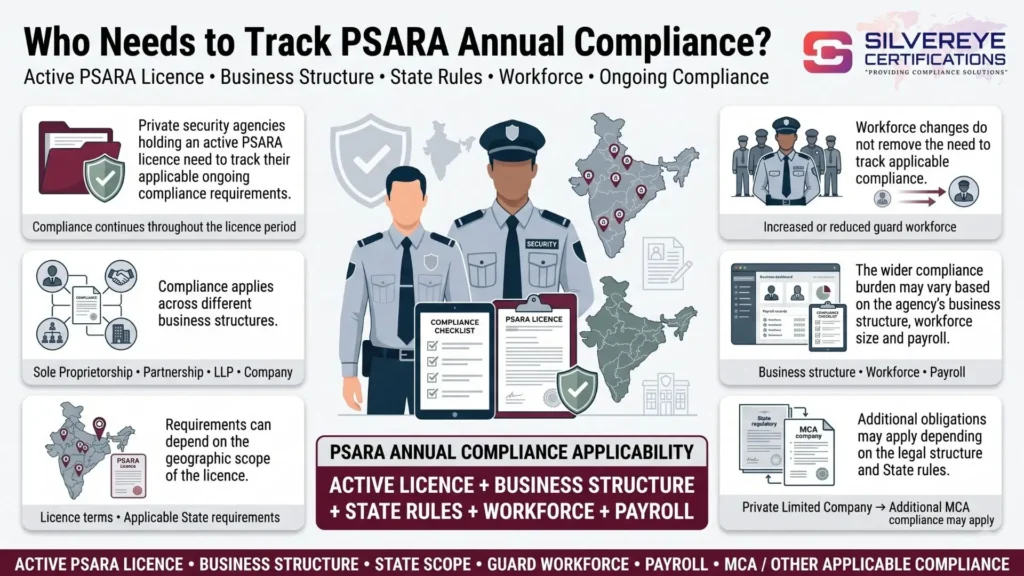
Any private security agency holding an active PSARA license needs to maintain its applicable compliance records and meet the requirements that continue throughout the license period.
This applies regardless of:
• Whether the agency is a sole proprietorship, partnership, LLP, or company
• The geographic scope of the licence, subject to the terms of the licence and applicable State requirements
• Whether the agency has increased or reduced its guard workforce since the licence was granted
The wider compliance burden can vary significantly depending on the business structure, workforce size, payroll, and applicable State rules. For example, a private limited company may have additional MCA compliance that does not apply to a sole proprietorship.
Benefits of Staying on Top of Annual Compliance
• Maintains a clear and organised compliance record for inspections and future licence-related procedures.
• Reduces the risk of gaps being identified by the Controlling Authority during an inspection or compliance review.
• Helps companies and LLPs keep their MCA filings and statutory records up to date.
• Keeps applicable EPF, ESI, minimum-wage and labour-law requirements properly tracked.
• Creates a well-documented compliance history that can be useful when corporate and institutional clients conduct vendor compliance checks.
The Two Categories of PSARA Annual Compliance
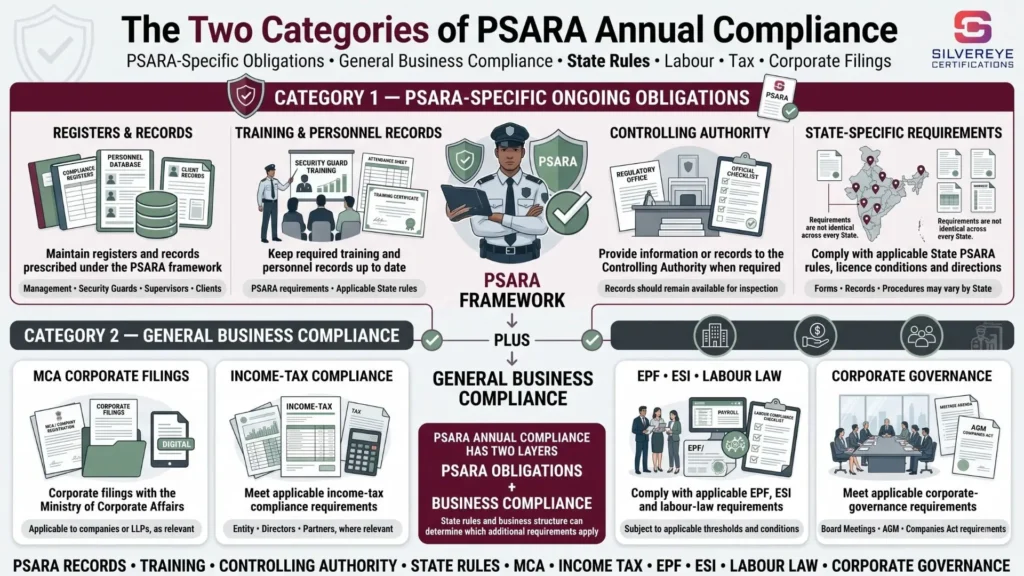
It helps to separate requirements that arise specifically from the PSARA framework from those that apply independently because of the agency's business structure.
Category 1: PSARA-Specific Ongoing Obligations
- Maintaining the registers and records prescribed under the PSARA framework, including information relating to persons managing the agency, security guards and supervisors, and clients to whom security services are provided.
- Keeping required training and personnel records up to date in accordance with the applicable PSARA requirements and State rules.
- Providing information or records to the Controlling Authority when required and keeping records available for inspection.
- Complying with applicable State-specific PSARA rules, licence conditions, and directions issued by the relevant Controlling Authority. State rules can prescribe additional forms, records, or procedures, so requirements are not identical across every State.
Category 2: General Business Compliance That Still Applies
- Corporate filings with the Ministry of Corporate Affairs, where the agency is incorporated as a company or LLP.
- Income-tax compliance applicable to the entity and, where relevant, its directors or partners.
- EPF, ESI and labour-law compliance where the relevant thresholds and applicability conditions are met.
- Board meetings, annual general meetings and other corporate-governance requirements applicable to companies under the Companies Act.
Annual and Periodic Compliance Checklist
| Requirement | Applies To | Typical Frequency |
|---|---|---|
| PSARA registers and records | Licensed private security agencies | Maintained continuously and produced when required |
| Information/reporting to Controlling Authority | Agencies where required under applicable State rules or directions | As prescribed by the relevant authority |
| AOC-4 and MGT-7/7A | Applicable companies | Annual, according to Companies Act timelines |
| DIR-3 KYC | Applicable directors | Annual, subject to current MCA requirements |
| LLP Form 11 and Form 8 | Applicable LLPs | Annual, according to LLP Act/Rules timelines |
| Income-tax return and related tax compliance | Applicable entities and persons | Annual/periodic, depending on the taxpayer and applicable law |
| EPF and ESI compliance | Employers meeting applicable conditions | Periodic/monthly, as prescribed |
| Board meetings / AGM | Applicable companies | As prescribed under corporate law |
The table is a general reference, not a universal PSARA annual filing calendar. The exact forms, deadlines, records, reporting requirements, and applicability depend on the agency's business structure, workforce, tax status, and the State in which the PSARA licence is issued.
For that reason, agencies should verify their checklist against the applicable State PSARA Rules, licence conditions, directions from the Controlling Authority, and the requirements of the other laws applicable to their business. The Ministry of Home Affairs currently lists the PSARA Act and Central Model Rules among its official Acts & Rules resources.
How Is Annual PSARA Compliance Different From PSARA Licence Renewal?
It's easy to conflate annual compliance with the licence renewal itself, but they're different things operating on different clocks. PSARA licence renewal happens once every five years (or according to the applicable State requirements) and is about extending the licence itself. Annual compliance is what happens throughout the period between renewals — the ongoing records, filings, and regulatory requirements that keep the agency's affairs in order.
A useful way to think about it: annual compliance supports a smoother renewal process, while neglected compliance can leave the agency with gaps to resolve when renewal time arrives. For the full renewal process and state-wise timing, see our companion guide on PSARA licence renewal.
What Can Happen If PSARA Annual Compliance Is Neglected?
- Corporate-law non-compliance: Missed AOC-4, MGT-7/7A, DIR-3 KYC, or other applicable MCA filings can result in late fees, additional penalties, and other consequences under the applicable corporate law, independently of PSARA.
- Incomplete guard and training records: Gaps in guard, training, and deployment records can become an issue if the Controlling Authority requests information or conducts an inspection.
- Labour-law non-compliance: Failures relating to EPF, ESI, minimum wages, or other applicable labour requirements can result in separate consequences under those laws.
- Accumulated compliance gaps: Unresolved issues can make the eventual PSARA license renewal or regulatory review more difficult because the agency may need to address outstanding records and compliance matters.
What Changed in PSARA Compliance in 2026?
A significant 2026 change to the PSARA Act concerns Section 12. The current official text records that Section 12 was omitted with effect from 15 May 2026. Section 12 previously dealt with the requirement to exhibit the licence or a copy of it at the agency's business premises.
For annual compliance, this means the specific statutory requirement under Section 12 to exhibit the licence is no longer present in the Act from 15 May 2026. However, this does not remove the agency's other obligations under the PSARA Act, applicable State rules, licence conditions, or other laws.
What remains important:
- Operating a private security agency without the required PSARA license continues to be subject to the Act's licensing and penalty provisions.
- Corporate, labour, tax, and other business compliance remains separate from PSARA and continues according to the applicable laws.
- Requirements relating to training, security guards, supervisors, records, and agency operations should continue to be followed where applicable under the PSARA framework and relevant State rules.
- The 2026 change to Section 12 should not be interpreted as removing the overall compliance responsibilities of a licensed private security agency.
How Can You Build a Simple PSARA Annual Compliance Routine?
- List every recurring obligation that applies to your specific business structure, using the checklist above as a starting point.
- Set recurring reminders well ahead of the actual deadlines, particularly for corporate, tax, labour, and other statutory filings.
- Keep guard, training, and deployment records updated continuously rather than trying to reconstruct them once a year.
- Review your training arrangements periodically and maintain the relevant records required under the applicable PSARA framework and State rules.
- Treat changes involving directors, the Principal Officer, registered office, or other license-related information as potential notification triggers and check the applicable State requirements promptly.
- Conduct a full compliance review before PSARA license renewal so that missing records or unresolved issues can be identified and addressed in advance.
How Can Silvereye Certifications Help With PSARA Annual Compliance?
Keeping track of PSARA-specific requirements alongside MCA, labour, tax, and other applicable compliance obligations can become difficult while running a security agency. Silvereye Certifications can help agencies organize their annual compliance calendar, track recurring requirements, maintain documentation, and prepare for PSARA-related regulatory requirements.
A structured compliance routine can help businesses avoid last-minute document collection and keep their PSARA compliance records organised throughout the licence period.
Frequently Asked Questions
Is there a single "PSARA annual return" form I need to file every year?
No. PSARA itself doesn't prescribe one universal annual return form. "Annual filing" refers to a bundle of recurring obligations — some PSARA-specific, others from separate corporate, labour, and tax law — that a licensed agency needs to keep current.
Does annual compliance replace the five-year PSARA license renewal?
No. Annual compliance is the ongoing work done every year between renewals; the five-year renewal is a separate process that extends the license itself.
What PSARA-specific reports do I need to maintain annually?
Guard-wise identity, training-certificate, and deployment registers, along with any operational compliance reporting your specific state's Controlling Authority requires.
Do sole proprietorships have the same annual compliance burden as companies?
No. Companies and LLPs have additional recurring MCA filings — like AOC-4, MGT-7, and DIR-3 KYC — that sole proprietorships and simple partnerships don't need to file.
What happens if I miss an MCA filing while holding a PSARA license?
You face the standard penalties under the Companies Act — late fees and, for persistent lapses, potential director disqualification — independent of anything PSARA-specific.
Do EPF and ESI compliance count as part of PSARA annual filing?
They're separate labour-law obligations, not part of the PSARA Act itself, but every licensed agency with guards on payroll still needs to stay current with them.
Can neglecting annual compliance affect my PSARA license renewal?
Yes. Renewal reviews the agency's overall compliance track record, so accumulated gaps can complicate what would otherwise be a straightforward renewal.
Does the Controlling Authority ask for these reports proactively, or only during inspection?
This varies by state — some Controlling Authorities expect periodic reporting, while others primarily review records during inspections or at renewal. Confirm your specific state's expectation directly.
What changed in PSARA compliance requirements in 2026?
Effective 15 May 2026, the MHA removed criminal liability for certain procedural lapses under Sections 12 and 20(2), such as not displaying the license. The substantive training, guard-eligibility, and corporate/labour/tax compliance obligations described in this guide are entirely unaffected.
Do I need to notify the Controlling Authority if a director changes mid-year?
Yes — this is generally expected to be reported promptly rather than held until the next renewal cycle.